ICT

Supreme Court affirms Indian Child Welfare Act

The U.S. Supreme Court heard oral arguments Wednesday, Nov. 9, 2022, in Brackeen v. Haaland, a case that will decide if the Indian Child Welfare Act is constitutional. Outside the Supreme Court Building, ICWA supporters were on site in numbers. (Photo by Jourdan Bennett-Begaye, ICT)

The Supreme Court handed down a major decision Thursday in the Haaland v. Brackeen case, affirming the constitutionality of the Indian Child Welfare Act by a 7-2 vote.

Justices Clarence Thomas and Samuel Alito were the lone justices to dissent.

The decision represents a major victory for federal Indian law and tribes across the nation.

In the opinion, authored by Justice Amy Coney Barrett, said the court “declines to disturb the Fifth Circuit’s conclusion that ICWA is consistent with” Congress’s authority under the Constitution in Article I.

“The United States, joined by several Indian Tribes, defends the law,” read the opinion. “But the bottom line is that we reject all of petitioners’ challenges to the statute, some on the merits and others for lack of standing.” Challengers cited that ICWA was against “federal authority, infringes state sovereignty, and discriminates on the basis of race.”

Justice Neal Gorsuch, the justice with extensive federal Indian law knowledge and experience of all the justices, wrote in support:

“Often, Native American Tribes have come to this Court seeking justice only to leave with bowed heads and empty hands. But that is not because this Court has no justice to offer them. Our Constitution reserves for the Tribes a place—an enduring place—in the structure of American life. It promises them sovereignty for as long as they wish to keep it. And it secures that promise by divesting States of authority over Indian affairs and by giving the federal government certain significant (but limited and enumerated) powers aimed at building a lasting peace.

“In adopting the Indian Child Welfare Act, Congress exercised that lawful authority to secure the right of Indian parents to raise their families as they please; the right of Indian children to grow in their culture; and the right of Indian communities to resist fading into the twilight of history. All of that is in keeping with the Constitution’s original design.”

Haaland v. Brackeen wasn’t the only Supreme Court case affecting Native people directly. The court also released a decision regarding Lac Du Flambeau Band of Lake Superior Chippewa Indians et. al. v. Coughlin. ICT will have more on this case soon.

The third federal Indian law case this term, Arizona v. Navajo Nation, has yet to be decided by the end of the month along with 22 other cases.

“For purposes of comparison, between June 13, 2022, and the last opinion day of the 2021-22 term (June 30, 2022), the court issued 29 decisions,” wrote former editor and reporter of SCOTUSblog Amy L. Howe.

President Joe Biden also weighed in shortly after the Haaland v. Brackeen ruling was released. He said ICWA is a vital law he is proud to support and stands with tribes.

The ruling keeps in place a vital law that protects tribal sovereignty and Native children, Biden said in a statement.

“Our Nation’s painful history looms large over today’s decision. In the not-so-distant past, Native children were stolen from the arms of the people who loved them. They were sent to boarding schools or to be raised by non-Indian families—all with the aim of erasing who they are as Native people and tribal citizens,” the statement reads. “These were acts of unspeakable cruelty that affected generations of Native children and threatened the very survival of Tribal Nations. The Indian Child Welfare Act was our Nation’s promise: never again.”

Interior Secretary Deb Haaland, Laguna Pueblo, called the decision “a welcome affirmation across Indian Country of what presidents and congressional majorities on both sides of the aisle have recognized for the past four decades.”

“For nearly two centuries, federal policies promoted the forced removal of Indian children from their families and communities through boarding schools, foster care, and adoption. Those policies were a targeted attack on the existence of Tribes, and they inflicted trauma on children, families and communities that people continue to feel today.”

Angelique EagleWoman, Sisseton Wahpeton Oyate (Dakota), described the decision as a “full circle moment” for Haaland. EagleWoman is a professor of law as well as the director of Native American Law & Sovereignty Institute at Mitchell Hamline School of Law.

“How wonderful it is to see Secretary of Interior Deb Haaland, Laguna Pueblo, have her name on a case, 7 to 2, that upholds the Indian Child Welfare Act,” she said. “I’m sure she breathed a huge sigh of relief to have her name in history in this manner.”

EagleWoman added that Gorsuch heavily relied on the investigation Haaland started through the Bureau of Indian Affairs into boarding schools to give historical context in his concurring opinion.

“We have a full circle moment here. We have cultural affirmation, we have true justice,” EagleWoman said. “So there’s a lot of good here.”

Tribes, Native organizations, advocates and allies cheered for the decision reposting sentiments like “tribal sovereignty wins” or “ICWA stands!”

Mary Kathryn Nagle, Cherokee, is a Native rights attorney and Counsel to the National Indigenous Women’s Resource Center for which she filed an amicus brief on behalf of in the case.

She emphasized what the day means to Indian Country, “we just could not have gotten better news. This is an incredible, incredible victory.”

“It’s definitely a day for Indian Country to celebrate,” Nagle told ICT.

Like many, she was still reading through the 133 page opinion as the news broke Thursday morning. She noted that there will be a number of Native attorneys and federal Indian law lawyers who will comb through the court’s opinion.

The first thing she said that jumped out at her was the overwhelming win for tribes.

“Just the fact that we won on every single issue and Gibson Dunn (the law firm representing the petitioners’) is not taking home anything,” Nagle said. “They’re not winning on a 10th amendment issue. They’re not winning on Indian as a race-based classification. They’re not winning on anything is huge.”

The Indian Child Welfare Act was enacted in 1978 and its purpose is “…to protect the best interest of Indian Children and to promote the stability and security of Indian tribes and families by the establishment of minimum Federal standards for the removal of Indian children and placement of such children in homes which will reflect the unique values of Indian culture…,” the Bureau of Indian Affairs website states.

For years, ICWA has been long seen as the “gold standard” for child welfare policy.

The Protect ICWA campaign, which includes the National Indian Child Welfare Association, the National Congress of American Indians, Native American Rights Fund and the Association of American Indian Affairs, said they are all “overcome with joy” that ICWA has been upheld.

“One thing is certain: ICWA is crucial for the safety and well-being of Native children and families and the future of Native peoples and Tribal Nations,” the campaign said in a statement. “The positive impact of today’s decision will be felt across generations.”

The campaign said they will give a deeper analysis Thursday afternoon after a legal review.

The ruling is an affirmation of rule of law and the constitutional principles of the relationship between Congress and tribes, Cherokee Nation Principal Chief Chuck Hoskin, Jr., Morongo Band of Mission Indians Chairman Charles Martin, Oneida Nation Chairman Tehassi Hill and Quinault Indian Nation President Guy Capoeman said in a statement.

They hope that this decision will slow the “political attacks” aimed at diminishing tribal sovereignty.

“By ruling on the side of children’s health and safety, the U.S. constitution, and centuries of precedent, the justices have landed on the right side of history. With these latest political attacks on ICWA now behind us, we hope we can move forward on focusing on what is best for our children,” the statement says.

Native members of Congress, Tom Cole, Chickasaw, and Sharice Davids, Ho-Chunk, shared a joint statement as co-chairs of the Congressional Native American Caucus. Echoing many, they said ICWA has protected vulnerable Native children since it was enacted and applauded the Supreme Court.

“This landmark decision rightly upholds protections for Native children and reaffirms the sovereign rights of tribal governments,” their statement reads. “We applaud the Supreme Court in rejecting these challenges and standing with Native American children and their right to remain in their own cultures.”

Indigenous peoples woke up to the news as early as 6:07 a.m. in Alaska. Social media reactions range from ICWA supporters saying they’re “really emotional” or “grateful for today.”

Charitie Ropati, Yup’ik and Samoan, wrote on Twitter, “Celebrate today, celebrate indigenous youth joy.”

Medical student and Forbes contributor Victor Lopez-Carmen, Hunkpati Dakota and Yaqui, gave kudos to the lawyers involved. “Just wanna throw a big party for all the Native lawyers who bodied this. Wow. Y’all really are incredible,” Lopez-Carmen wrote on social media.

In an April 2021 decision, the U.S. Court of Appeals for the Fifth Circuit upheld certain sections of ICWA and flagged constitutional concerns about others, prompting appeals on both sides. The U.S. Supreme Court granted petitions to review the Fifth Circuit’s decision and heard the case last November. Congressional members, 87 in total, filed a bipartisan, bicameral amicus brief defending ICWA’s constitutionality in Haaland v. Brackeen.

Oral arguments on the landmark case took place in November. Indigenous people from around the country traveled to Washington, D.C., for the hearing.

Kimberly Jump-CrazyBear, Osage and Oglala Lakota, was one of many who showed up to show support for the Indian Child Welfare Act.

“I’m just here on behalf of all of you who can’t be here today. To help lend my voice,” she told ICT before the oral arguments for Haaland v. Brackeen began. “Without our children, we don’t have a people anymore.”

While it is a day for celebration, Nagle said it is also important for tribes to stay vigilant and to support and heal one another after enduring the trauma of this long legal fight.

“They’re gonna probably try to find a different way to attack us. And so we have to celebrate, then we also have to kind of come back together and understand where the next attack is going to come from. And that’s unfortunate, but I think that’s just what it means to be Indigenous in the United States. So, but I think the first thing to do is to really celebrate because this is, I think, next to McGirt, the most incredible decision, victory we’ve gotten in the Supreme Court ever.”

This story originally appeared in Indian Country Today and is republished here with permission.

Can tribes win alone?

Audience watches a dance group perform at the Alaska Federation of Natives convention at the Dena’ina Convention Center in Anchorage, Alaska. Oct. 2018 (Photo from video by Joaqlin Estus, ICT)

“The foundation of the Alaska Federation of Natives is our people,” said the statewide organization’s President and CEO Julie Kitka, Chugach Eskimo, after a quarterly meeting of the organization’s board held on May 15. Her comment focused on the theme of this fall’s annual AFN convention: Our Ways of Life.

It’s also perhaps a response to the predicament the organization finds itself in: a diminishing membership. AFN represents and advocates to influence policy for 158 federally recognized tribes, 141 village corporations, nine regional corporations, and 10 regional nonprofit and tribal consortiums that contract and compact to run federal and state programs. .

The National Congress of American Indians, a national tribal policy organization based in the nation’s capital, is similar to AFN in terms of trying to represent hundreds of tribes with a wide range of interests and backgrounds while maintaining membership.

What drives members to resign? What keeps them united?
Julie Kitka, Chugach Eskimo, is president and CEO of the statewide Alaska Federation of Natives. (File: photo by Joaqlin Estus, Indian Country Today)

Two large regional tribal entities resigned from AFN earlier this month: southeast Alaska’s tribal consortium Central Council of Tlingit and Haida Indian Tribes of Alaska, and the Interior region’s nonprofit Tanana Chiefs Conference. That comes after three for-profit Alaska Native regional corporations dropped out in the past few years.

Tanana Chiefs stated, “Over the past few years, over 40 resolutions were passed by the full board at AFN that support a subsistence way of life, but no significant action has been taken on those directives.” Tlingit and Haida said it’s in its best interests to directly advocate for its people and communities, and it has strategically built capacity to do so.

The Arctic Slope Regional Corp. withdrew its membership after delegates of AFN member organizations at the 2019 AFN convention voted to declare a “climate emergency,” overriding the Arctic corporation’s opposition. Doyon, Limited, the regional corporation for Interior Alaska, had been urging improvements to AFN’s process for addressing conflict before it resigned in 2022. The Aleut Corp. resigned last year over fisheries.

The fisheries issue came up at AFN’s 2022 convention in October. Tanana Chiefs and delegates from the southwest Aleutian Islands region got into a battle over management of an area in North Pacific waters. Tanana Chiefs believes if fishing in Area M (a management designation) were cut back, more salmon would reach the Yukon and Kuskokwim rivers for subsistence users. The Aleutian delegates said closing Area M would only hurt them without benefiting other fisheries.

For both sides the argument was about putting food on the table.

When the convention voted in favor of AFN recommending to authorities that Area M fisheries be reduced, the Aleutian delegates stood up and turned their backs to the convention chair and audience.

Now two parties to that disagreement, The Aleut Corporation and Tanana Chiefs Conference, have resigned from AFN.

Emil Notti, at his 90th birthday party at the Alaska Native Heritage Center in Anchorage, AK on March 10, 2023 (Photo by Joaqlin Estus, ICT)

AFN’s first president, Emil Notti, who is Koyukon Athabascan, said AFN shouldn’t have been in that argument. The way to handle it, “would be to call the parties together, call a statewide meeting or a conference and talk about what can be done but arrive at a common solution.”

“Both sides are mad now. (Resigning) is just short sightedness on the side of these organizations,” he said.

Notti said the members who left AFN will feel, and regret, a loss of influence. He described a meeting organized by AFN and held in Washington, D.C., a few months ago. “They had five or six generals there. I think they had four Cabinet members there. They had John Podesta (White House deputy chief of staff), who has the ear of the president. They had the White House budget director. They had other influential people at this conference.”

“(The Alaska Federation of Natives) pulled it off,” Notti said, something he said smaller organizations couldn’t do. “Tlingit and Haida by itself couldn’t do it. Tanana Chiefs couldn’t do it. None of the regional corporations can get that kind of power to organize something like that. So I think that illustrates why they need to stay unified — in order to influence policy.”

“Our ancestors understood the need for a united front. AFN is a gift from your ancestors. Keep it strong,” Notti said in a statement. AFN was founded in 1966 to fight for land claims for tribes. The claims movement led to the enactment of the Alaska Native Claims Settlement Act of 1971, which transferred nearly $1 billion and title to 44 million acres of land to for-profit corporations created under the new law.

Tribal leader and long-time tribal advocate Mike Williams, who is Yup’ik, supports the tribal withdrawals. He said for decades AFN hasn’t given strong support to the priorities of tribes, especially tribal subsistence and sovereignty. Williams is chief of the Akiak Native Community and NCAI regional vice president for Alaska.

For instance, Williams has advocated that AFN support the transfer of Alaska Native corporate lands to trust status, which would provide protection from takings and strengthen self governance. “These are our lands, these are resources that we’re living with, and we’re suffering because of inaction,” Williams said.

Mike Williams, Yup’ik, Chief of Akiak Tribe, Alaska region representative to NCAI, speaking at the Alaska Federation of Natives 2022 convention, Oct. 22, 2022. (Photo by Joaqlin Estus, ICT)

Notti said AFN works to promote tribal interests on both subsistence and sovereignty but is limited in what it can get federal and state agencies, the state legislature, and Congress to do on those as well as many other issues.

The National Congress of American Indians was founded in 1944 to influence policy and otherwise advocate for its tribal members.

Like AFN, NCAI relies on membership dues for some of its operating costs. NCAI is the oldest, largest and most representative American Indian and Alaska Native organization in the country. Of the nation’s 574 federally recognized tribes, 40 percent are Alaska Native.

W. Ron Allen, S’Klallam Tribe, is chairman and CEO of the Jamestown S’Klallam Tribe located in western Washington state. He was NCAI president from 1995-1999. He also served on the board as first vice president, secretary, and treasurer, for 26 years in total. He said NCAI’s membership is down to about 150 from a norm of 200 to 300 but it fluctuates for a variety of reasons.

He said NCAI’s bylaws forbid the organization from taking sides in intertribal disputes. In the case of a tribe’s withdrawal over NCAI actions, the board would send a delegation to meet with the tribe, Allen said.

“We just encourage and we recognize and respect their position. If a tribe’s got one position, whatever it is, that is so important to them that they feel that they, in good conscience, can’t remain a member of an organization that is intended for unity, we’re disappointed, but we’re not discouraged,” Allen said.

He reminds tribes that “a singular voice is like the single twig that can break easily. But if we bond together, like a bunch of twigs together, then we can’t be broken.”

In his view, single tribes can’t win alone. “The political system that surrounds you, no matter where you are, whether you’re in Alaska or anywhere else in Indian country, the system is too big. It’s too overwhelming. It’s too complicated,” Allen said.

“It’s a multi-layered chess game, and it’s complicated because now the tribes, the tribal leadership is involved at the local level, at the state level, at the regional level, at the federal level, even at the international level. And so it’s hard for leaders now to grasp the magnitude of the game that they’re within and not realizing that they need to work together,” he said.

“No matter how good you are, no matter how much energy you have, there’s too many bases to cover and you need to cover them together.” Allen concluded, “you have to make a few mistakes before you realize this (going it alone) doesn’t work.”

For its part, AFN said it “will continue to advance and enhance the political, cultural, social, and economic voice of Alaska Natives. The board of directors remains hopeful for full membership again in the future.”

AFN said its annual convention will be held October 19-21, 2023 in Anchorage, Alaska. NCAI’s mid-year conference is June 4-8, 2023 in Prior Lake, Minnesota

The Alaska Federation of Natives did not respond to a request for comments to add to their prepared statement. The National Congress of American Indians had no comments for this story.

This story originally appeared in Indian Country Today and is republished here with permission.

USDA announces first-ever grants for Indigenous meat processing

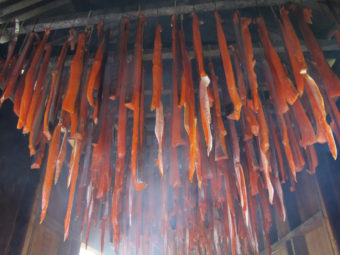
Strips of silver salmon hang in Valerie Davidson’s smokehouse on the Kuskokwim River in Bethel, Alaska. (Photo by Annie Feidt/APRN)

WASHINGTON, D.C. — The U.S. Department of Agriculture announced Wednesday it would – for the first time – offer grants for harvesting, processing and storing Indigenous meats such as bison, reindeer, moose, elk and salmon, offering a boost to tribes working to improve food sovereignty.

The change will expand USDA funding, which had been available only for meats the department regulates, such as beef, pork or chicken.

“We are thrilled that we’re going to invest in Indigenous animal processing,” said Heather Dawn Thompson, the USDA’s director of the Office of Tribal Relations. “We have heard loud and clear in our consultations with tribal governments that they want to make sure that they have proteins that are based on Indigenous animals for their communities. This is the first time that our funds are going to be available for those animals. We’re changing the course of history together.”

The department’s Indigenous Animals Harvesting and Meat Processing Grant Program will provide up to $50 million to improve tribal nations’ food and agricultural supply chain resiliency by developing and expanding infrastructure related to meat from Indigenous animals. The program will fund projects that focus on expanding local capacity for the harvesting, processing, manufacturing, storing, transporting, wholesaling, or distribution of indigenous meats.

“USDA is proud to offer this investment in tribal nations’ food chain resiliency as a part of USDA’s broader efforts to restore Indigenous food ways,” USDA Under Secretary for Rural Development Xochitl Torres Small said in a statement. “By expanding and enhancing local processing capacity, these projects will provide culturally appropriate food and community food security to tribal communities.”

Eligible applicants are tribes as well as wholly-owned arms and instrumentalities, and joint or multi-tribal government entities. There is no maximum dollar figure for a grant application nor a minimum. Additionally, there are no matching fund requirements. The deadline for applications is July 19.

The new grants announced Wednesday are part of USDA’s Indigenous Food Sovereignty Initiative, which promotes traditional food ways, Indian Country food and agriculture markets, and Indigenous health through foods tailored to American Indian/Alaska Native (AI/AN) dietary needs.

The USDA is partnering with tribal-serving organizations on the projects to reimagine federal food and agriculture programs from an Indigenous perspective and inform future USDA programs and policies, officials said. The USDA Food Sovereignty Initiative was announced in 2021.

“USDA is committed to empowering tribal self-determination and bringing Indigenous perspectives into agriculture, food, and nutrition,” said Agriculture Secretary Tom Vilsack.

This story originally appeared in Indian Country Today and is republished here with permission.

New sign tells real Alaska ‘discovery’ story

Aaron Leggett, Chief, Native Village of Eklutna, and Beth Nordland, Exec. Dir. Anchorage Parks Foundation, speaking at the unveiling of a Dena’ina place names sign at the Capt. Cook monument at Resolution Park, Anchorage, AK March 22, 2023 (Photo by Joaqlin Estus/ICT).

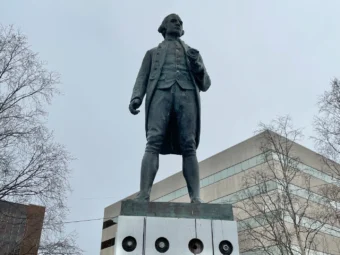
A monument to Captain James Cook in downtown Anchorage hails him as “greatest explorer-navigator the world has ever known.” The plaque under the life-size statue of him highlights Cook’s travels, including Cook Inlet, where Anchorage is located.

The inlet was no discovery, though. For at least a thousand years, the region has been home to the Dena’ina Athabascan people.

The Eklutna Tribe, Anchorage Park Foundation and Anchorage Museum last week unveiled a Dena’ina place names sign near the Cook monument.

The new sign is due in part to the Black Lives Matter movement. In 2020, activists pushed for the removal of symbols of the slave trade, colonization and other injustices. Similar calls were made in Anchorage to have the Cook monument taken down.

Plaque at Captain Cook monument in Resolution Park in downtown Anchorage, Alaska, March 22, 2023 (Photo by Joaqlin Estus/ICT)

Anchorage then-Mayor Ethan Berkowitz said he would defer to the Eklutna tribe.

“I’m not really in favor of tearing down monuments in this case, but I want to use it as an opportunity to tell the complete story,” said Native Village of Eklutna President Aaron Leggett, Dena’ina Athabascan, speaking at the March 23 unveiling. He’s also senior curator of Alaska history and Indigenous culture for the Anchorage Museum.

“One of the ways of doing that was (using) this great vista that you can see here to highlight the Dena’ina names,” Leggett said. “So, what are the names that existed here when Captain Cook arrived at the end of May in 1778?”

“This gives you a Dena’ina view and shows that Cook didn’t discover these places, he simply documented them,” Leggett said.

The new sign reads, in part, “Before Captain Cook sailed into the inlet, the Dena’ina Indigenous inhabitants named all the features of the land you see in front of you. These names and stories reveal relationships with lands, waters, animals, and plants of the environment. They also convey oral traditions.”

Anchorage Parks Foundation Executive Director Beth Nordland said the new sign is part of a larger project.

She said the foundation has been working with Leggett and the Native Village of Eklutna “for some years now on Indigenous place names and the conversation about being able to add historic and cultural value interpretation in our parks and on our trails.” The new sign is one of a handful of similar projects at Anchorage parks.

“Today is a small victory, but a beautiful victory,” Nordland said. “And we want to keep going, making these small and large changes in our public spaces for Anchorage and Anchorage visitors to enjoy.”

Life-size statue of Capt. James Cook at Resolution Park in downtown Anchorage. March 22, 2023 (Photo by Joaqlin Estus/ICT)
Dena’ina Athabascan place names sign at the Capt. Cook monument in Resolution Park, Anchorage, Alaska, unveiled March 22, 2023 (Photo by Joaqlin Estus/ICT).

After his speech at the unveiling, Leggett added, “I think for our tribal members in particular, it’s important that our future generations know who they are and can be proud of who they are and can see themselves as part of this place because we have been here for well over 1,000 years.”

This story originally appeared in Indian Country Today and is republished here with permission.

First Native woman in space is home

NASA astronaut Nicole Mann, Wailacki of Round Valley Tribes, taken out of the Dragon capsule on a stretcher as part of the recovery activities from space. SpaceX Crew-5 splashed down off the coast of Florida at 9:02 p.m. Eastern Time on March 11, 2023, after five months on the International Space Station. (NASA photo)

The first Native woman in space and Crew-5 returned to Earth Saturday evening after five months on the International Space Station. 

The SpaceX Dragon capsule splashed down off the coast of Florida near Tampa after nearly a 19-hour journey. 

“That was one heck of a ride,” Commander Nicole Mann, Wailacki of Round Valley Tribes, radioed after splashing into the Gulf of Mexico at 16mph. “Looking forward to next time.”

She logged 157 days in space, her first spaceflight. 

Mann and the crew — NASA astronaut John Cassada, astronaut Koichi Wakata of the Japan Aerospace Exploration Agency, and Roscosmos cosmonaut Anna Kikina — made the space station their home since October where they conducted scientific research for future space exploration and life on Earth. 

Besides dodging space junk, the astronauts had to deal with a pair of leaking Russian capsules docked to the orbiting outpost and the urgent delivery of a replacement craft for the station’s other crew members.

After splashing down in the ocean, Crew-5 was taken out of the capsule on a stretcher, one of the many recovery activities they will have to undergo, due to the change in gravity. 

Crew-5 was flown to Houston to reunite with their families after six months. 

Earlier in the week, high wind and waves in the splashdown zones kept them at the station a few extra days. Their replacements, Crew-6, arrived more than a week ago.

Remaining behind at the space station are three Americans, three Russians and one from the United Arab Emirates.

Wakata, Japan’s spaceflight champion, now has logged more than 500 days in space over five missions dating back to NASA’s shuttle era.

This story originally appeared in Indian Country today and is republished here with permission.

Indigenous people flocked to DC for ICWA hearing

A group gathered in front of the U.S. Supreme Court building. A pair of hands is holding up a sign that says "Uphold ICWA"
The U.S. Supreme Court heard oral arguments Wednesday, Nov. 9, 2022, in Haaland v. Brackeen, a case that will decide if the ICWA is constitutional. Kimberly Jump-CrazyBear, Osage and Oglala, from Virginia, hold a sign in support of ICWA. (Photo by Jourdan Bennett-Begaye/Indian Country Today)

Kimberly Jump-CrazyBear held up a self-made “Uphold ICWA” sign across the street from the U.S. Supreme Court in Washington, D.C., on the morning of Nov. 9.

“I’m just here on behalf of all of you who can’t be here today. To help lend my voice,” she said before the oral arguments for Haaland v. Brackeen began. “Without our children, we don’t have a people anymore.” Jump-CrazyBear is Osage and Oglala Lakota who grew up in Virginia.

While Jump-CrazyBear held up and alternated her sign, a woman across the street at the rally said over the speakers: “If you take our children, you take our identity.”

Jump-CrazyBear was one of the hundreds of Indigenous peoples and allies who showed up in front of the highest court in the land to show their support for the Indian Child Welfare Act.

Approximately 60 stood in line waiting to sit inside the court to witness the oral arguments. Many sat between the Capitol and court listening to three hours of oral arguments on their headphones, and others listened to the line of speakers and songs all morning and into midday.

Haaland v. Brackeen challenges the Indian Child Welfare Act, a law that has been referred to as the “gold standard” for child welfare by many child welfare organizations. It was enacted in 1978 to “halt the unnecessary forced removal of Native kids from their families,” said Sarah Kastelic, an enrolled citizen of the Native Village of Ouzinkie and executive director of the National Indian Child Welfare Association.

""
Sarah Kastelic, executive director of the National Indian Child Welfare Association and an enrolled citizen of the Native Village of Ouzinkie, stands outside the U.S. Supreme Court with a sign in her language in Washington, D.C., on November 9, 2022. (Photo by Jourdan Bennett-Begaye, Indian Country Today)

“So in our organization, one of the things that we talk about is the recipe for colonization,” Kastelic said. This recipe is “consistently followed by colonizers to colonize Indigenous people.”

She said there are five ingredients:

“Take the land;”
“Control the natural resources, especially the water;”
“Usurp, replace Indigenous governance to delegitimize Indigenous thought;”
“Undermine Native worldview, values, traditions, beliefs;” and
And number five, “the most important ingredient,” she says, is to “sever Native children from their sense of identity, from their culture, from their sense of belonging, from that sense of connectedness to something.”

This would meet the United Nations definition of genocide.

“So when we look at what the child welfare system has done, it followed right on the heels of the boarding school policy, as federal boarding schools waned in popularity, the child welfare system took over right where the education system left off,” Kastelic said. “This is no accident, this is by design.”

Among the dozens carrying ICWA signs was Bobbie Hamilton. She traveled 1,300 miles from El Reno, Oklahoma, with 150 citizens from Cheyenne and Arapaho Tribes to show support.

Hamilton is at the frontlines of Indian child welfare. She’s an Indian child welfare case worker with the Cheyenne and Arapaho Tribes and a foster care worker. She retired from the U.S. government as a registered nurse with veteran’s affairs and the Indian Health Service.

Hearing the oral arguments hit home with her, she said.

""
Bobbie Hamilton, Cheyenne and Arapaho Tribes, traveled 1,300 miles from Oklahoma to show support for the Indian Child Welfare Act in front of the U.S. Supreme Court in Washington, D.C., on November 9, 2022. (Photo by Jourdan Bennett-Begaye, Indian Country Today)

“So every day, we face the trials and tribulations that they’re (the children are) facing. There’s trauma. There’s a lot of feelings that the children have that they are trying to deal with, and on a daily basis, and I’m there with them. I feel those feelings. I feel their frustration, and even their happiness when their happiness comes through. I’m there with them,” Hamilton said standing in front of the Supreme Court. “And so our children are very important to us and we want what’s best for our children. It’s hard to see them in situations that they’re in sometimes. Hard decisions have to be made. And I’m right there with them feeling the same thing.”

Principal Chief Chuck Hoskin Jr. of the Cherokee Nation was one of several leaders in attendance at the three hour hearing. The Cherokee Nation is the largest Indigenous nation in the country with over 430,000 citizens.

“The dispossession of Native children, from their families from tribal lands, has done a measurable damage to Native peoples in this country over the centuries,” Hoskin said during a press conference after the hearing. “We were here today collectively, as Native peoples to make our case in court, that the Indian Child Welfare Act is constitutional, and to send a message to this country that we will not stand for the dispossession of our children, and the further erosion of our Native peoples.”

""
Cherokee Nation Principal Chief Chuck Hoskin Jr. speaks outside the U.S. Supreme Court after the court heard oral arguments Wednesday, Nov. 9, 2022, in Haaland v. Brackeen, a case that will decide if the ICWA is constitutional. (Photo by Pauly Denetclaw, Indian Country Today)
""
The U.S. Supreme Court heard oral arguments Wednesday, Nov. 9, 2022, in Haaland v. Brackeen, a case that will decide if the ICWA is constitutional. After, ICWA advocates spoke to the media. (Photo by Jourdan Bennett-Begaye, Indian Country Today)

Before the passing of ICWA up to 35 percent of Native American and Alaska Native children were removed from their homes and placed in non-Native homes. Generations of Indigenous families were disrupted, causing irreparable damage to Indigenous communities as a whole.

“Keeping our children at home is where they need to be,” Charles Martin, chairman of the Morongo Band of Mission Indians. “We will do as we always have as our ancestors did, we will move forward to protect future generations.”

Fawn Sharp, vice president of the Quinault Indian Nation, described the justices questioning as “agonizing.”

“In every single generation, we’ve had to fight this fight and I’m telling you spending three hours in this courtroom with the highest court of this land, the Supreme Court and sit here and still feel that they do not get us, three hours of agonizing argument, agonizing questions where they don’t understand the basic concept, that we have inherent sovereignty, and we have inherent rights to the future of every single Native child born into this generation,” Sharp said.

As with many issues in Indian Country, ICWA has bipartisan support. Leaders noted that it would be shocking if the Supreme Court did not uphold the act. During her speech, Sharp added that dark money and special interests groups looking to attack tribal sovereignty, that this case isn’t a normal Indian child welfare case.

“There’s dark money out there that is strategically targeting our children, our natural resources, our sacred sites. They want to continue to enrich profits at our expense,” Sharp said. “We know that no matter what they do, we occupy a certain place in this life as Native people. We occupy a position of inheriting all that our Creator gifted to us. There’s not a single thing that any one of them can do to take that away from us, no legislation, no court decision. They can’t buy their way into that and they can’t regulate us. We are sovereign tribal nations from the beginning of time until the end of time.”

The Supreme Court decision on this case will come in spring 2023.

This story originally appeared in Indian Country Today and is republished here with permission.

Site notifications
Update notification options
Subscribe to notifications