Subsistence

A millennia-old subsistence fishery replenishes the spirit and the freezer

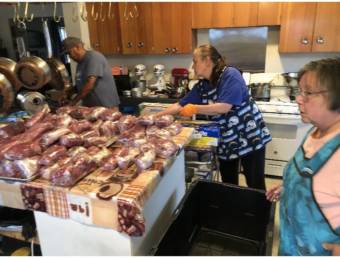
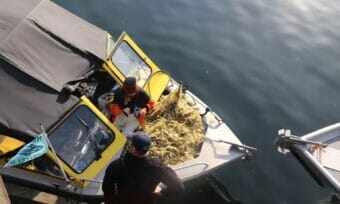
Tlk’ Un Yeik Paulette Moreno arrives to the Fishermen’s Quay with a boat overflowing with herring eggs on hemlock branches on April 3. (Katherine Rose/KCAW)

Herring season in Sitka is a study in contrasts. Each spring for the last 45 years, large seiners  land tons of herring, whose egg sacs are stripped and sold as a delicacy on the international market, often for millions. But the frenzy and money around the commercial sac roe fishery overshadows a far quieter Indigenous fishing tradition that’s taken place for millennia. KCAW recently accompanied a pair of subsistence harvesters in search of one of Sitka Sound’s most valued food resources – herring eggs on hemlock branches.

It’s a clear Sunday morning in March, and the herring are on the move. Tlk’ Un Yeik Paulette Moreno and Goos’ shu Andrew Roberts are slowly motoring north through Sitka Sound. Their 16-foot yellow boat, nicknamed Tweetybird, is loaded up with five hemlock branches to set today. The traditional Lingít herring egg harvest has begun.

Moreno has been harvesting roe on branches for around 15 years; Roberts has been doing it for most of his life.

“This is usually a pretty good spot, where that boat is, right in that little gut, there,” Roberts points to a rocky area on the western side of Middle Island that has been productive in the past.”

“Traditionally, when they start spawning in here, there’ll be 50 to 100 sets in there,” he adds. “This is real popular place.”

They’re cruising along when an announcement from the Alaska Department of Fish and Game comes over VHF radio. The big story of the morning? The first signs of spawn this spring, around two nautical miles, have been spotted near Shoals Point.

The sun is out, but the water is a bit choppy, so Moreno and Roberts may not make it out to Shoals Point, which is about nine miles of open water away from where we are now, on the southeastern tip of Kruzof Island. But they’re not worried, they’ve already set some trees in that area. Moreno says for the last three years she and the Herring Protectors, a local advocacy group, have been setting “protection trees” to call attention to traditional fishing grounds that should be avoided by commercial seining vessels.

“They’re complete sets, and we put them in strategic locations, and then we call Fish and Game and tell them where they’re at,” Moreno says. “We can set where and when we want, and these protection sets are to remind people who pass that area that there are sets out there. And sometimes those sets do really good, but the idea of a protection tree is to do that, to protect the herring and the area.”

Tlk’ Un Yeik Paulette Moreno and Goos’ shu Andrew Roberts smile as they realize their boat is passing over a school of herring, shown in their sounder radar (Katherine Rose/KCAW)

They slow their boat down in the lee of Middle Island to wait for the wind to die down. Roberts breaks out a rod and reel and begins to troll for salmon. It’s a delicate waiting game. The window to set branches at just the right time has shrunk in recent years.

“Instead of seeing the spawn for three or four days, we literally are seeing it pass through in four hours,” Moreno says. Unheard of. Unheard of.”

Roberts, who was born and raised in Sitka, says it didn’t used to be that way.

“I have witnessed when it spawned, it was on both South and North end, there was just nothing but solid herring, it was so thick,” Roberts says.

“I’ve seen, as a toddler, when the tide went out, herring would be stuck in the tide pools, because…the sound was so full, there was no place to fish to go,” he continues. “I’ve seen, just in my generation, how plentiful the herring were, and it’s not that way anymore.”

He believes that’s due to years of mismanagement of the commercial fishery. 2022 saw the biggest commercial harvest in Sitka’s history– 25,000 tons, which was  just over half of the 45,000 tons the Department of Fish & Game allowed that year. In 2019 and 2020 the market crashed, and there was no commercial fishing at all. Moreno remembers how good those years off were for traditional harvesters.

“It was a year that COVID had just started, and we came through Middle Island. And it was a very calm, beautiful day. It was Native heaven again,” Moreno says. “There were boats and skiffs, and it was calm, it was peaceful. There was spawn everywhere. There was no competition with the commercial fleet, whatsoever. Everybody’s waving and smiling, we’re all putting down our branches.”

Moreno yearns for that undisturbed time on the water. While she’s called for all-out moratoriums of the commercial fishery in the past, and would still like to see that, she suggests a year on and a year off could be a place where traditional harvesters and commercial fishermen could find compromise.

“It would give us as harvesters, a chance to go out undisturbed and be in that Native heaven, you know, that we experience when there are not obstacles and we are closest to our spirit and our way of life. And then it would give the herring a chance to replenish those different years,” Moreno says.

“So yes, every other year I think would be good,” she adds. “But we need help in pursuing it, because the organizations that we have to go to, to try to just bring these things forward, are not always receptive.”

These herring eggs, harvested by Moreno and Roberts on April 2, will be donated to the Yaaw Koo.éex’ Herring Ceremony on Saturday April 15 (Katherine Rose/KCAW)

That time out on the water is important to Moreno because traditional harvesting is much more, much deeper than the word “subsistence” suggests.

“And our core is something that we need as a people to survive in the best way possible, because this feeds our spirits. And not only our spirits…there are Alaska Native and Native Alaskans who share this with us, who are hungry for balance in this world, who are hungry for things that matter the most, and this is one of them,” Moreno says. “We need that to be uninhibited. The closer that we are to less barriers and challenges and obstacles just to get the food that we have always eaten…the closer we are to our core.”

“Every barrier that’s put up, that we need to deal with, brings us further from our very soul and our very way of life. And it’s a sacred, beautiful way of life,” she says. “And that’s all we’re asking is to be able to practice that.”

As Roberts and Moreno troll back towards town, over the VHF radio, commercial fishermen let each other know where they’re going next to look for schools of herring. Roberts and Moreno laugh. They can see a big school of herring on their depth sounder just below the boat. But they’ll keep it to themselves today.

“The herring were right there with us,” Moreno said later, as we got off the boat in Sealing Cove. “That’s communication.”

On appeal, state wins right to challenge subsistence hunting decision for Kake

Kake residents and Elders process moose meat to be distributed to the community
Kake residents and Elders process moose meat to be distributed to the community (Photo courtesy of the Organized Village of Kake)

The state of Alaska is claiming victory in a subsistence case argued before the 9th U.S. Circuit Court of Appeals.

The state challenged the authority of the Federal Subsistence Board to open an emergency hunt aimed at helping people in Kake get food in the first year of the COVID-19 pandemic. The board allowed a 60-day emergency hunt for moose and deer.
By the time the case was before a judge, the hunt was over. But the 9th Circuit ruled this week that the judge was wrong to dismiss the challenge as moot, or no longer applicable. The appeals court said the state should be able to make its case to a District Court judge because similar circumstances could arise again.

The appellate court also ruled on the state’s challenge to a Federal Subsistence Board decision to close moose and caribou hunting in in Game Unit 13 to all but rural subsistence users.  The area borders the Glenn and Richardson highways and is popular with urban hunters.

“This decision was made regardless of science or research from individuals on the ground and impacts how Alaskans plan their hunts and fill their freezers,” Attorney General Treg Taylor said in an emailed statement Wednesday. “Our assertion is that Alaskans know how to manage our resources.”

The District Court decided the subsistence board had the authority to issue the partial closure. But the appellate court said that challenge should have been dismissed as moot. The closure was over, and the appeals court said the regulatory circumstances were unlikely to occur again.

Ninth Circuit reaffirms Metlakatla’s off-reservation fishing rights but leaves extent up to lower court

""
The 32-foot gillnetter F/V Deja Vu sails on Aug. 3, 2020 near Metlakatla. (Courtesy of Johon Atkinson)

A federal appeals court has affirmed Metlakatla tribal members’ right to fish in their traditional waters without state permits. But a new opinion issued Tuesday by the Ninth Circuit Court of Appeals leaves open the question of where exactly those traditional fishing grounds are.
Metlakatla Mayor Albert Smith welcomed the news.

“This is something that we’ve been fighting for a long time, so we are extremely pleased to know that the Ninth Circuit so strongly supported our fishing rights,” Smith said in a phone interview from Juneau.

Metlakatla’s tribal government sued Gov. Mike Dunleavy and other state officials in 2020. The tribe asserted that the 1891 federal law that created the Annette Islands Reserve, the only reservation in Alaska, guaranteed the tribe fishing rights throughout much of the southern panhandle. Congress passed the 19th-century law after members of the tribe relocated from their previous home in Metlakatla, British Columbia at the invitation of President Grover Cleveland.

Senior U.S. District Court Judge John Sedwick rejected the tribe’s claim and dismissed the case the following year.

Metlakatla appealed to the Ninth Circuit Court of Appeals, which ruled in favor of the tribe last year. The court said Congress guaranteed Metlakatla’s tribal members the right to fish in their traditional waters despite the state’s limited entry program, which limits the number of vessels targeting particular species of fish.

“Alaska’s limited entry program, as currently administered, is incompatible with the Metlakatlans’ off-reservation fishing rights. Fishing had always been, and continues to be, the heartbeat of the Community. Congress’ intent in the 1891 Act was that the Metlakatlans would have off-reservation fishing rights that would ‘satisfy the future as well as the present needs’ of the Community,” wrote Senior Ninth Circuit Judge William Fletcher.

The Ninth Circuit’s three-judge panel initially ruled that Metlakatla tribal members had the right to fish in the state Department of Fish and Game’s Districts 1 and 2. Those encompass areas around Ketchikan’s Revillagigedo Island and the southeastern coast of Prince of Wales Island.

Smith says the tribe has records of its members bringing fish from as far as the Aleutian Chain. But he acknowledges that the tribe’s fishermen largely harvested from waters within a day’s travel of the reserve at the southeastern tip of the state.

“Since time immemorial, we’ve been fishing all of those districts — 1 and 2, all the way down to the border,” Smith said.

But the new opinion notes that the state of Alaska disputes the extent of the tribe’s historical fishing grounds. It’ll be up to the lower court to determine just how far the tribe’s fishermen should be allowed to go.

In its new order, the court also denied a request from the state of Alaska to reconsider its decision or put it before a larger Ninth Circuit panel.

Alaska Department of Law spokesperson Patty Sullivan said in a statement that the Ninth Circuit panel “continues to fundamentally misunderstand the history and legal framework in this case.”

“Even if the Ninth Circuit panel disagreed that the case should be dismissed, it should have merely remanded the case back down to the district court so it could properly vet the factual background,” Sullivan wrote. She said the state is reviewing the opinion and considering its next steps.

Smith says Metlakatla is eager to continue with the case.

“We are ready for the next phase in this case and look forward to finally and permanently restoring our community’s fishing rights. … Wayi Wah!” he said, using a Sm’álgyax phrase that translates to “Let’s go!”

The court’s decision would allow tribal members to fish “for personal consumption and ceremonial purposes, as well as for commercial purposes.” But details of how the decision might be implemented once the case concludes remain unclear.

Federal Subsistence Board to consider rural status for Ketchikan

""
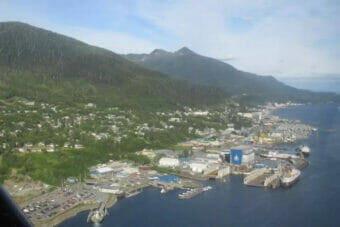
Aerial view of Ketchikan. (KRBD file photo)

The Federal Subsistence Board will take up a proposal this week to designate Ketchikan as a rural area under federal subsistence laws. The move would open up federal subsistence hunts and fisheries to Ketchikan residents.

Ketchikan and Juneau are the only two Southeast communities designated as urban.
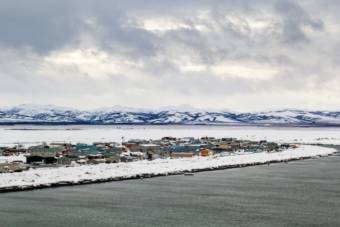
The Southeast Alaska Subsistence Regional Advisory Council voted to move forward with the proposal at its meeting in October. That was after hours of public testimony and a push by Ketchikan Indian Community, the local tribe.

The council found that Ketchikan met all the requirements to be considered for a rural designation. If the Federal Subsistence Board agrees, a vote this week would start a years-long dive into the prospect of changing Ketchikan’s status. Federal officials with the Office of Subsistence Management are recommending the board approve the proposal.

If Ketchikan were redesignated, both Native and non-Native hunters would become federally qualified subsistence users. Wildlife officials also would be required to prioritize their needs over commercial and sport users.

The board’s meeting is set to start on Tuesday at 1 p.m. in Anchorage, and run through Feb. 3.

This year’s Arctic Report Card highlights Indigenous perspectives, but is it enough?

An aerial view of Unalakleet in 2019, with open water along the coast. (Photo by Zachariah Hughes/Alaska Public Media)

NOAA’s annual Arctic Report Card, released on Tuesday, shows the changes brought by a rapidly warming Arctic — more rainfall, shorter periods of snow cover, shrinking sea ice and shifting seasons. 

But this year’s report card has something new: a chapter on the consequences of climate change for people who live in the Arctic. It’s a collaboration between scientists, Indigenous knowledge holders and decision makers across Arctic communities in Alaska.
Athena Copenhaver is the executive director of the Study of Environmental Arctic Change. (Photo courtesy of Athena Cophenhaver)

Athena Copenhaver, executive director of the Study for Environmental Arctic Change, said the chapter highlights highlights a different perspective for what is largely a scientific publication.

“It brings in Indigenous knowledge and features the impacts to Indigenous people first and foremost,” she said.

The chapter includes a video, an oral history by the Ahtna Dine’ storyteller Wilson Justin. He describes his experience living with climate change. In the video, he says climate change in the Arctic has already happened, and he reflects on the need for collaboration between scientists and Indigenous knowledge holders going forward.

“The trainwreck already happened. We’re just going to have to figure out how to speak to each other in terms of, not only how we are rebuilding, but what it is we are going to rebuild,” Justin says in the video.

‘We live on that thread of hope’

Indigenous food systems in the Arctic are intimately tied to a cold, icy environment, but the science in this year’s report card shows that those conditions are becoming harder to rely on. In a host of different ways, more rain and less ice are making food sources scarcer and harder to get to. 

The report warns that some climate models predict a shift from a snow-dominated to a rain-dominated Arctic, possible by the end of the century. This year was the third wettest year on record for the Arctic, and precipitation has been increasing across all seasons. Freezing rain is also getting more and more common, even in winter months.

Jackie Qatalina Schaeffer is Iñupiaq from Kotzebue and is the director of climate initiatives at the Alaska Native Tribal Health Consortium. (Photo courtesy of Jackie Qatalina Schaeffer)

Co-author Jackie Qatalina Schaeffer is Iñupiaq from Kotzebue and the director of climate initiatives at the Alaska Native Tribal Health Consortium. She said winter rain events will have a profound effect on Indigenous food security, in part because of their impact on animal foraging. 

“When you have freezing rain in the fall, or in the middle of winter, and it disrupts the food access for caribou, it’s a ripple effect,” Schaeffer said. “It impacts people, it impacts their traditional lifestyle. And then it impacts what’s coming next season.”

Schaeffer believes freezing rain could impact other food sources too.

“It could disrupt the berry season. Or it could disrupt the bird migration because they can’t access food,” she said. 

Five caribou seen up close, with snowy mountains behind them. Three of the caribou are looking straight at the camera.
A group of Western Arctic Herd caribou pause in front of mountains in Kobuk Valley National Park during fall migration in 2016. The Western Arctic herd, one of the largest in the world, has been in decline for the past two decades. The 2022 census shows that the decline is continuing. (Photo by Kyle Joly/National Park Service)

A report this fall cited winter rainfall as one of the causes of the Western Arctic Caribou Herd’s decline.

Sea ice is also changing rapidly, with less in the summer and later formation in the fall. Vera Kingeekuk Metcalf is Yup’ik, originally from St. Lawrence Island, and the executive director of the Eskimo Walrus Commission. She says sea ice — siku in Yup’ik — characterizes the seasons in the Arctic.

Vera Kingeekuk Metcalf, executive director of the Eskimo Walrus Commission, poses in front a map of St. Lawrence Island, where she was born and raised. Metcalf, who is an Yup’ik, now lives in Nome. (Photo courtesy of Vera Metcalf)

“It’s a very powerful presence in our relationship with our world. Here in the Arctic, it really defines our seasons and activities,” Metcalf said. “And right now, here in Nome, we don’t have sea ice yet. And it’s the middle of December.”

Metcalf is also a co-author on the new section. She says changes to the ice are already altering hunting and foraging practices. 

“We’re experiencing more and more sea ice that is weaker. It affects our traditional hunting seasons, which seem to be dissolving and blending together,” Metcalf said.

The report emphasizes an increase in fatal falls through sea, lake and river ice.

“Our hunters are traveling further with less sea ice and what seems more like disruptive stormy weather during some of our hunting trips, ” Metcalf said.

And in some instances, the absence of ice leaves communities more vulnerable to extreme weather events. Lack of sea ice contributed to greater damage across Western Alaska when the remnants of Typhoon Merbok, which was fueled by warmer ocean temperatures, lashed the coast with 50-foot waves and hurricane force winds this September.

Metcalf witnessed the damage to subsistence camps around Nome.

“That just made, you know, devastated coastal camping areas and just changed the environment in a way that we didn’t expect it to happen,” she said.

Two buildings at a fish camp, one badly damaged and the other knocked over
A fish camp in the Nome area, seen on Sept. 24, shows damages wreaked by the remnants of Typhoon Merbok. (Photo by Jeremy Edwards/FEMA)

The storm also caused severe flooding for communities on the coast of the Bering Sea. Power outages caused losses of meat already gathered, boats and equipment were wiped out, and fall hunts were delayed. 

The report also highlights changes that aren’t yet well understood, like the years-long seabird die-off in the Bering Strait region. Many species of ducks, puffins, shearwaters and auklets — important food sources and vital indicators of overall ocean health — have been hit hard by starvation despite their different diets.

Six dead seabirds on a beach. "Nome, 8/16/19" is written in the sand.
A few species of dead seabirds near Nome, Alaska, Aug. 2019. (Photo courtesy of Sara Germain, Alaska Department of Fish & Game)

Despite these profound changes in the Arctic, both Metcalf and Schaeffer said Indigenous values around food prevail despite unpredictable seasons and conditions.

“We don’t say — and we definitely don’t think it and put it out into the universe — that there’s not going to be any berries,” Schaeffer said.  “We hope. We live on that thread of hope that there’s going to be berries, whether they show up or not.” 

‘Living the environment’

For Schaeffer, the addition of this new chapter to the Arctic Report Card, and the work of the Study of Environmental Arctic Change in general, is a way to infuse more of that hope into conversations about climate change in the Arctic. 

“The narrative, if you just focus on the science and the monitoring, could be very scary,” she said. “And we don’t want people to be scared.”

This year’s report card is a step towards integrating Indigenous knowledge with science. But Metcalf says that doing so is challenging.

“How this actually happens can be complicated because Indigenous knowledge and science should not be used, for example, to verify each other,” she said.

But Metcalf says more on-the-ground observations from Indigenous knowledge holders will only strengthen the science. 

“Our own experts are living the environment, or they’re seeing the changes happening in our waters and our lands, often are the first to report these unusual changes to this environment,” Metcalf said. “The longtime people that have been there are experiencing these changes for many years.”

Metcalf sees the new chapter as an encouraging step towards exchanging more information across different knowledge systems.  

“The Arctic is our home. And it’s very eternal and very sacred to us, for those of us that live here,” she said. “Perhaps, collaborating on co-production of knowledge and research is simply another way that we are adapting.”

Alaska’s Arctic waterways are turning orange, threatening drinking water

A river running orange with orange brush on its bank and bare hills in the background.
Tributary of Kugururok River located in Noatak National Park and Preserve, Alaska with orange water. (Jon O’Donnell/National Park Service)

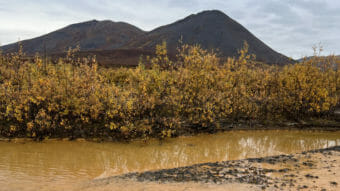
Dozens of once crystal-clear streams and rivers in Arctic Alaska are now running bright orange and cloudy, and, in some cases, they may be becoming more acidic. This otherwise undeveloped landscape now looks as if an industrial mine has been in operation for decades, and scientists want to know why.

Roman Dial, a professor of biology and mathematics at Alaska Pacific University, first noticed the starkest water-quality changes while doing field work in the Brooks Range in 2020. He spent a month with a team of six graduate students, and they could not find adequate drinking water. “There’s so many streams that are not just stained, they’re so acidic that they curdle your powdered milk,” he said. In others, the water was clear, “but you couldn’t drink it (because) it had a really weird mineral taste and tang.”

Dial, who has spent the last 40 years exploring the Arctic, was gathering data on climate-change-driven changes in Alaska’s tree line for a project that also includes work from ecologists Patrick Sullivan, director of the Environment and Natural Resources Institute at the University of Alaska Anchorage, and Becky Hewitt, an environmental studies professor at Amherst College. Now, the team is digging into the water-quality mystery. “I feel like I’m a grad student all over again in a lab that I don’t know anything about, and I’m fascinated by it,” Dial said.

Most of the rusting waterways are located within some of Alaska’s most remote protected lands: the Arctic National Wildlife Refuge, the Gates of the Arctic National Park and Preserve, the Kobuk Valley National Park and the Selawik Wildlife Refuge.

Orange water meets clear water at the confluence of two Arctic streams.
Mainstem of Kugururok River located in Noatak National Park and Preserve, Alaska. (Jon O’Donnell/National Park Service)

The phenomenon is visually striking. “It seems like something’s been broken open or something’s been exposed in a way that has never been exposed before,” Dial said. “All the hardrock geologists who look at these pictures, they’re like, ‘Oh, that looks like acid mine waste.’” But it’s not mine waste. According to the researchers, the rusty coating on rocks and streambanks is coming from the land itself.

The prevailing hypothesis is that climate warming is causing underlying permafrost to degrade. That releases sediments rich in iron, and when those sediments hit running water and open air, they oxidize and turn a deep rusty orange color. The oxidation of minerals in the soil may also be making the water more acidic. The research team is still early in the process of identifying the cause in order to better explain the consequences. “I think the pH issue” — the acidity of the water — “is truly alarming,” said Hewitt. While pH regulates many biotic and chemical processes in streams and rivers, the exact impacts on the intricate food webs that exist in these waterways are unknown. From fish to stream bed bugs and plant communities, the research team is unsure what changes may result.

The rusting of Alaska’s rivers will also likely have an impact on human communities. Rivers like the Kobuk and the Wulik, where rusting has been observed, also serve as drinking water sources for many predominantly Alaska Native communities in Northwest Alaska. One major concern, said Sullivan, is how the water quality, if it continues to deteriorate, may affect the species that serve as a main source of food for Alaska Native residents who live a subsistence lifestyle.

The Wulik River terminates at the village of Kivalina, a community of just over 400 people, 80 miles north of the Arctic Circle, that relies on the river. “We are always worried about drinking water,” said Tribal Administrator Millie Hawley, adding in a written message that her friends and neighbors fish for trout in the river year-round. The community has seen the river become increasingly turbid in recent years, she said, and some people blame the nearby Red Dog Mine. But Hawley said everyone is aware that the permafrost around them is melting, and that increased erosion is causing the level of dissolved minerals and salts in the Wulik to rise.

In addition to present-day impacts, the researchers are also considering the historical record. “I’m sure it has happened (previously),” said Dial, “because, in some sense, this is a natural phenomenon.” But Dial and Sullivan note that the rate of climate warming is greater than anything recorded in the past. “So, it’s very possible that something like this has happened before, but it happened really slowly. And maybe there wasn’t just this massive pulse of orange that wound up in these streams,” Sullivan said.

The team believes there could be more than one climate change-related factor at play. 2019 and 2020 — two of the warmest summers on record — were both followed by winters with unusually high snowpacks. “Snow is a great insulator of soils, and it can be a potentially potent driver of permafrost thaw,” said Sullivan. He likens it to adding an extra blanket to the ground before it freezes. For now, none of the researchers know for sure whether the orange streams and rivers are an anomalous occurrence, coinciding with a handful of unseasonably warm seasons followed by high snow pack. And only time will tell how long it might continue.

This story originally appeared in High Country News and is republished here with permission.

Emily Schwing is a reporter based in Alaska. Find her on Twitter @emilyschwing. Email High Country News at editor@hcn.org or submit a letter to the editor. See our letters to the editor policy.

Site notifications
Update notification options
Subscribe to notifications