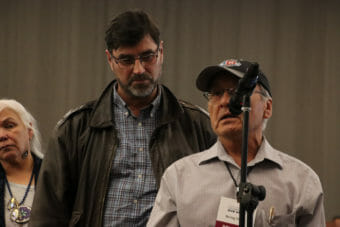
Roy Ashenfelter is an AFN delegate representing the Bering Straits region. He speaks during a debate over fish-related resolutions at the AFN conference on Saturday in Anchorage. (Photo by Elyssa Loughlin/Alaska Public Media)
Two resolutions brought before the Alaska Federation of Natives during this year’s annual convention called for efforts to reduce salmon bycatch for fish that return to the Yukon and Kuskokwim rivers. Debate over both resolutions was contentious and revealed a regional rift among tribes.
One resolution calls on Alaska’s Department of Fish and Game to support measures that decrease salmon bycatch by commercial trawlers in a region along the Aleutian Island chain known as Area M. A second resolution requests the North Pacific Fisheries Management Council address bycatch amounts in the same region.
“I really have to take a step back here and talk about how sad I am that we have to fight so hard here to be heard to try to protect our salmon,” said Brian Ridley. Ridley is the chairman of the Tanana Chiefs Conference, an Interior region tribal organization that brought both resolutions to the floor of this year’s annual Alaska Federation of Natives convention in Anchorage.
“I know this is a controversial issue,” Ridley told a crowd of hundreds, after the resolutions were introduced on the floor Saturday. “There’s a lot of people that didn’t want to have this discussion here, but if we don’t have it here and we don’t get the support of AFN, the problem is, we’re gonna be out of the fish on the Yukon and Kuskokwim and we’re gonna be talking endangered species.”
In Interior communities like Eagle, where Ridley grew up, people have not been able to fish for salmon for three years.
Resolutions are kind of like marching orders for AFN. Those that pass tell AFN leadership where to concentrate their efforts on behalf of the organization’s membership for the coming year. Member delegates from across the state debated on the two resolutions regarding salmon bycatch for over an hour.
“Historically, income we have received throughout the summer fishing season has lasted throughout the winter, and we also rely on it for subsistence fishing and we don’t have a store in our community,” said Bobbie Allen, who represents the Nelson Lagoon Corporation. “We have to have stuff flown in, barged in, or whatever other methods that we can to get food there that we can’t get through subsistence fishing or hunting,” she said.
Allen and other Aleutian and Pribilof islands representatives say they’ve seen salmon declines for two decades and that further limits on both their commercial and subsistence resources threatens the long-term sustainability of communities in that region.
“This resolution has singled out Area M without uniting and addressing the other affected areas,” Allen said. “We support the underlying initiative but we are unable to support the divisive nature of this resolution.”
Jodi Mitchell (far right) moderates the Consideration of 2022 AFN Convention Resolutions at the Dena’ina Center in Anchorage. (Photo by Elyssa Loughlin/Alaska Public Media)
Rob Sanderson is the second vice president of the Tlingit and Haida Central Council from Southeast Alaska.
“We’re fighting this fight in the wrong arena. I’ve been attending the North Pacific Fishery Management Council for over 22 years” he said. “And if you want action to get taken, start attending these meetings. Because ultimately, it’s gonna fall on the feds and the state government that makes these decisions.”
Fisheries are managed by the National Oceanic and Atmospheric Administration, which is within the Department of Commerce. During the debate, Karen Linell, who is the executive director for the Ahtna Intertribal Resource Commission, said she also sees federal managers as a more appropriate target for a fight about subsistence resources.
“The problem with this system is that the fisheries are under the Department of Commerce and not a natural resource agency who has the responsibility for sustainability,” said Linell.” It’s all about that dollar and not about the salmon.”
AFN Members who utilize Area M for subsistence fishing did try to both postpone the vote and move debate on the resolutions to executive session, but those motions failed. At one point, attendees from the Aleutian and Pribilof Islands region stood with their backs to AFN’s resolutions committee in protest of the process.
In the end, both resolutions passed. Some AFN members abstained from voting on the grounds that the issues were not unifying — and the theme of this year’s convention was unity.
This year’s AFN convention ended Saturday in Anchorage.
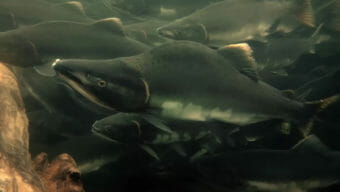
Pink salmon swim in the Tongass National Forest. (Photo by Joe Serio/U.S. Forest Service)
Access to traditional foods has long been a priority for Ketchikan’s federally recognized tribe. But for decades, Ketchikan residents have been barred from taking part in federal subsistence hunts and fisheries.
Now, Ketchikan Indian Community is pushing to change that. It hinges on one big question: is Ketchikan a rural community?
Trixie Bennett, the president of Ketchikan’s tribe, said the push to designate Ketchikan as a rural community is a major step toward the tribe’s goal of food sovereignty.
“Our food is our way of life,” Bennett said. “Our food is the medicine, our culture is the medicine.”
If Ketchikan were classified as rural, all residents — Native and non-Native — would be federally qualified subsistence hunters. That means they’d be able to hunt and fish on federal lands and harvest subsistence species, like ooligan from the Unuk River. And wildlife officials would be required to prioritize the needs of Ketchikan’s subsistence users over commercial and sport fishermen.
“We want this better access to our healthier foods around here and not just for us, but for everyone on the island,” Bennett said.
She said traditional foods like deer and fish are high in protein and that Indigenous people have been living off the land since time immemorial.
“There’s a reason that we’ve persevered,” Bennett said. “And we are so resilient, and I think a lot of that has to do with your food system.”
But what does it mean to be designated as a rural community?
Matthew Newman, from the Native American Rights Fund, said that’s decided by the Federal Subsistence Board.
“It is the definition by which subsistence rights are either offered or denied,” Newman explained. “But no one can come to a universal agreement as to what the term ‘rural community’ means.”
“In this instance, as a rural resident, you have the opportunity to hunt or fish under federal rules, federal hunting and fishing rules,” Newman said.
But Newman said there’s no precise definition of what the board sees as rural. As of now, Ketchikan is listed as non-rural, along with Juneau, Fairbanks, the Matanuska-Susitna Borough, Anchorage and the Kenai Peninsula.
Notably,the community of Saxman — which lies within Ketchikan’s borough and is connected to its road system — is considered rural by the board.
“It’s only by Alaska standards would anyone look at Ketchikan and say, “‘Well, that’s not that rural,’” Newman said.
In practice, re-designating Ketchikan as a rural community would allow residents to hunt and fish on more land and waters and increase bag limits.
But on Prince of Wales Island, where there’s widespread concern about deer populations, some aren’t so sure that opening the island to more hunting and fishing is a good idea. Earlier this month, wildlife and conservation agencies held a three-day summit to discuss the problems facing the island’s dwindling deer population.
Clinton Cook is the president of the Craig Tribal Association, but he spoke to KRBD in his personal capacity. Cook said he believes all small communities have a right to the designation, but he’s not sure now is the right time.
“I think adding 10 more thousands (of) people to the queue might not be what is best right now, especially with diminished salmon populations, diminished deer populations,” he said. “I don’t think now is quite the time that Ketchikan will be designated as rural.”
Cook doesn’t think Ketchikan’s tribe should stop pushing their request. But he said he wishes Prince of Wales Island tribes had been more involved.
“They should have been face-to-face with tribes on Prince of Wales and communities on Prince of Wales,” Cook said.
He said he’s having a meeting with Ketchikan’s tribe on the topic soon.
Bennett, the president of Ketchikan’s tribe, said Ketchikan hunters and anglers would still have to follow special guidelines depending on the status of the population at the time. And federal regulations mandate that if there aren’t enough deer on Prince of Wales Island to feed out-of-town hunters, local residents would get priority.
Ketchikan Indian Community’s request faces its first test in the coming days as the Southeast Regional Subsistence Advisory Council meets in Ketchikan.
But it’ll be a while before any changes take effect. Bennett said it could take as long as three years to complete the process.
The Southeast Regional Subsistence Advisory Council is meeting Tuesday through Thursday at Cape Fox Lodge. People who want to comment on the proposal can contact Ketchikan Indian Community for updates. More information is available at www.kictribe.info/ruralsupport.
Spawning salmon swim on Sept. 7, 2005, in the Grand Central River on western Alaska’s Seward Peninsula. Salmon-dependent villagers in western Alaska believe trawlers harvesting pollock and other groundfish in the Bering Sea are intercepting too many salmon that would otherwise return to rivers and lakes to spawn. (Photo by Christian Zimmerman/USGS Alaska Science Center)
In the search for a solution to the problem of bycatch, the unintended at-sea harvest of non-target species, the stakes in Alaska are high.
Now a special task force is nearing the end of a year-long process to find solutions that satisfy competing interests to the problem of bycatch, which refers to fish that are caught incidentally by commercial fishers who are targeting other fish.
Many of the mostly Indigenous residents of western Alaska who depend on now-faltering salmon runs in the Yukon and Kuskokwim rivers have said strict rules to reduce at-sea bycatch are needed to help alleviate a crisis. Disasters have been declared for these fisheries.
Serena Fitka, the executive director of the Yukon River Drainage Fisheries Association who grew up in the Yup’ik village of St. Mary’s near the Bering Sea coast, said she has not been able to harvest river salmon for three years.
It’s not only about lost food, she told the task force at a meeting in Anchorage on Wednesday. “It’s also very important for rural communities because it’s our culture, which includes mental, social consequences,” she told the task force at a meeting on Wednesday. “Every single person in our communities relies on that salmon.”
Stakes are also high for the commercial industry and for communities that depend on trawling, representatives said. Trawling is a term for fishing with a large, wide net that a ship drags, often to harvest groundfish near the sea bottom.
“I’m very sympathetic to what’s happening in the Bering Sea with salmon and subsistence. But in the same token, I’m concerned for my own community that I live in,” Julie Bonney, executive director of the Kodiak-based Alaska Groundfish Data Bank, a group advocating for groundfish harvesters, told the task force. About 60% of the fish that crosses the docks at Kodiak, a major fishing port, is trawl-caught, she said.
“I want to see Kodiak prosper into the future. So trawling is an important component of the economics of the town that I live in,” she said.
The Alaska Bycatch Review Task Force meets on Oct. 12 at the William A. Egan Civic and Convention Center. Jon Warrenchuk, senior scientist with Oceana, is at far left, testifying about research needs; Doug Vincent-Lang, commissioner of the Alaska Department of Fish and Game, is at far right. The task force is due to present its final report to Gov. Mike Dunleavy by the end of November. (Photo by Yereth Rosen/Alaska Beacon)
The Alaska Bycatch Review Task Force, created by Gov. Mike Dunleavy last November, is due to release its final report by the end of next month. At least two additional meetings are to be held between now and then.
At Wednesday’s meeting, task force members reviewed and took public testimony on all the consensus recommendations made by the group’s various committees, with a goal of agreeing on a final set of recommendations to Dunleavy.
Possibly most striking is a draft recommendation for a firm numerical cap on chum salmon taken as bycatch in the Bering Sea’s industrial-scale pollock trawl fishery, a measure that managers have been reluctant to take in the past.
In 2021, the Bering Sea pollock fishery – one of the world’s largest seafood harvests – netted about 540,000 chum salmon as bycatch, along with halibut, crab and other species. At the same time, western Alaska subsistence fishers have been struggling with such poor returns that, at times, they have not been able to catch any fish. The runs of chum salmon, a species that is particularly important as food for Yukon and Kuskokwim villages, have been some of the lowest on record.
There are caveats on the chum-cap recommendation. Any cap must be “scientific-based,” and the recommendation suggests a phased-in approach.
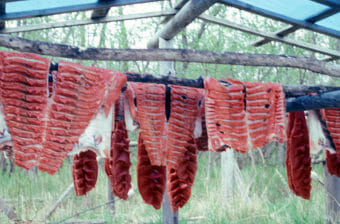
Kuskokwim River Chinook salmon, harvested for traditional subsistence use, dries on a rack near Bethel in 2001. Salmon runs on the river have crashed to record or near-record lows since then, and at times even subsistence fishing was prohibited. (Photo provided by the U.S. Fish and Wildlife Service)
Related recommendations are for enhanced science on myriad potential threats to fisheries happening from the open ocean, where prolonged heat waves have ravaged various marine populations, to the spawning grounds far inland in the upper Yukon and Kuskokwim rivers, where rising temperatures have been linked to increases in parasitic infections of salmon and to die-offs from heat stress. Much of that research is underway, but some projects have limited funding or funding that is set to expire.
Scientists have pointed to climate change as a likely cause of the fish problems, but the task force is focusing on issues the state can more directly control.
A special focus of research is the role that Asian-origin hatchery fish play in bycatch and the overall health of Alaska salmon stocks.
Of the more than 540,000 chum salmon netted in 2021 by the pollock fishery as bycatch – a total that was twice the 10-year average – the vast majority were from Asian hatcheries, and less than 10% were of western Alaska origin, according to a genetic analysis by the National Marine Fisheries Service.
Any effective chum bycatch cap should be focused on preserving Alaska-origin fish – and therefore depends on better information about fish genetics, said task force member Doug Vincent-Lang, commissioner of the Alaska Department of Fish and Game.
“I don’t really care that much if we’re catching a whole bunch of Asiatic chums,” Vincent-Lang said of bycatch at Wednesday’s task force meeting. Lack of information was one of the reasons that the North Pacific Fishery Management Council declined in the past to establish a chum bycatch cap, said the commissioner, who is one of Alaska’s six members on that 11-member federal council. “If we’d instituted one, we may just be saving a bunch of Asian hatchery chum salmon,” he said.
Around 3 billion hatchery chum are now released annually into the North Pacific Ocean, and they may be overtaxing the resources and depleting food sources needed by Alaska-based salmon, according to some theories.
“They’re using the eastern Bering Sea as a pastureland to fatten up and go back to Asia and to get caught,” Brent Paine, executive director of United Catcher Boats, a trade group of more than 60 trawlers, told the task force on Wednesday.
The fishing vessel Gold Rush, which harvests pollock and other groundfish, is docked on Oct. 3 at Trident Seafood’s Kodiak plant. Trawling is an important part of Kodiak’s fisheries-based economy, and one industry representive expressed concerns about new restrictions aimed at reducing bycatch. (Photo by Yereth Rosen/Alaska Beacon)
Though the science on the subject is preliminary, there is some evidence to back up the hypothesis. A 2012 study by the U.S. Geological Survey used modeling to find that a big increase in the population of adult hatchery chum was linked to a 72% decline of wild Norton Sound chum. A later study, published in 2018, considered all hatchery salmon in the North Pacific Ocean and found that about 60% of the chum salmon in the North Pacific between 1990 and 2015 was of hatchery origin, with Japanese hatcheries dominant.
To others, the Asian hatchery fish are proverbial red herrings.
Focusing on hatchery fish does not address the disproportionate nature of the suffering endured by western Alaska subsistence fishers, said Lindsey Bloom of SalmonState, another environmental group. “The solutions that are being presented by the bycatch commission are not addressing the problem, which is equity,” she said.
“We see it as something that’s an injustice, something that’s unfair,” Martin Nicolai, a subsistence fisherman from the Kuskokwim River village of Kwethluk, said in online testimony Wednesday. “It’s hitting our hearts. It’s hurting our hearts.”
As long as subsistence fishers are denied access to salmon in their rivers, trawlers should face the same fate, he said. He called for a five-year moratorium on Bering Sea trawling. “As we are talking, the destruction is continuing,” he said. “You don’t need more studies and studies for decades and years.”
Western Alaska salmon runs are not the only concern of the task force. It is examining bycatch issues for all commercially important fish, including crab and halibut, in both the Bering Sea and the Gulf of Alaska.
Fishing boats line the dock in Kodiak’s St. Paul Harbor on Oct. 3. One recommendation being considered by the Alaska Bycatch Review Task Force is a conversion to a quota-share “rationalization” system for Gulf of Alaska trawlers to encourage more careful harvesting. But the idea has been controversial in Kodiak and other Gulf of Alaska towns. (Photo by Yereth Rosen/Alaska Beacon)
Bycatch of crab in particular is gaining more attention because Bering Sea crab stocks have crashed. On Monday, the Alaska Department of Fish and Game announced that there will be no fishing allowed in the 2022-23 seasons for Bering Sea snow crab or Bristol Bay red king crab, two of the major Alaska crab harvests.
Among the recommendations for the Gulf of Alaska is that trawl fisheries there be reformulated into a quota-share system, which the industry refers to as “rationalization,” to encourage more careful harvest practices. Such quota systems are widely used for other Alaska fisheries, with shareholders assigned predetermined amounts of fish they are allowed to harvest over specific seasons. But the trawl fisheries in the Gulf of Alaska, which mostly target pollock, remain on a system that allows all permitted participants to catch whatever amounts they can up to a total fleet cap, leading to what critics say is a dangerous rush to harvest. Defenders of the current system, however, argue that a switch to quota systems would erect more barriers to participation by less-wealthy fishers.
Another Gulf of Alaska recommendation is for full observer coverage on trawlers. That is a mandate in the larger Bering sea fisheries, where NMFS-credentialed observers are on board large vessels to monitor bycatch and other fishery practices. Opponents of a Gulf of Alaska observer mandate argue that it would be too expensive for that fleet.
Whatever the task force winds up recommending, there are worries that any resulting actions on bycatch will be too slow.
“The changes we’re experiencing in the ecosystem are occurring faster than our ability to respond,” said Lauren Mitchell, a Sitka fisher who is a member of the North Pacific Fishery Management Council’s advisory panel.
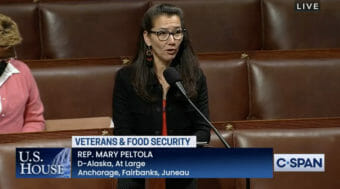
Rep. Mary Peltola on the House floor advocating for her first bill on Sept. 28, 2022. (Screenshot from CSPAN)
U.S. Rep. Mary Peltola’s first bill, which would establish an Office of Food Security in the Department of Veterans Affairs, has passed the House.
Peltola’s bill advanced Thursday afternoon on a 376-49 vote, with significant GOP support. Many far-right Republicans from the Freedom Caucus voted against it.
The vote came just a day after Peltola spoke on the House floor to advocate her proposal.
“I rise today to speak on a topic of vital importance to my state, where veterans comprise about 10% of the population, and I know many veterans who face food insecurity,” she said Wednesday.
The office would coordinate with the Department of Defense and the Department of Agriculture, which is in charge of the food-stamp Supplemental Nutrition Assistance Program.
According to researchers from the Rand Corporation, veterans who are disabled, unemployed and who served in the years since 9/11 are at higher risk of food insecurity than other veterans. The scope of the problem is not clear, but Rand researcher Tamara Dubowitz said one argument in favor of getting more needy veterans on SNAP benefits is that improved nutrition would save on health-care costs.
“I think others would say, ‘Look, these are people who have given to our country and we owe it to them to make sure that they have the basics,'” Dubowitz said. “And, you know, SNAP is something that allows them to not be living in on shaky ground.”
Peltola cited a Center for Strategic and International Studies study that said food insecurity among veterans and service members is a national security concern, in part because it adds stress to military families and may harm recruitment.
“I know this bill will not solve the problem entirely, but I believe it can help Alaska and throughout the country,” Peltola said.
Josh Wilson, a spokesman for Peltola’s congressional office, said her staff – hired just days ago – drafted the bill with the staff from the House Veterans Affairs Committee.
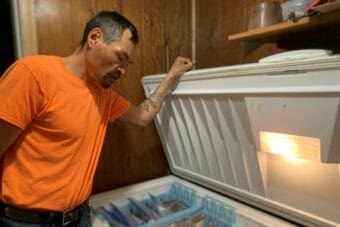
Chevak resident Ryan Bukowski says three freezers at his home filled with subsistence and store-bought foods completely thawed out during a three-day power outage after Western Alaska’s September 2022 storm. (Emily Schwing for Alaska Public Media & KYUK)
The historic storm that slammed into Alaska’s west coast last weekend was a dramatic blow to food security in Chevak, where people are reeling after the storm destroyed boats, gear and many of the tools they use to hunt and fish for their main sources of food.
“I was hoping to go moose hunting, but unfortunately this storm hit us here, so I can’t use my boat and motor,” said Derek Knight. He was at the Chevak community building this week to report his losses to the local tribe, which plans to seek disaster relief funds from the state and federal government.
The storm hit at the tail end of the fishing season and just as the berry-picking season was ending. It’s also the middle of the moose-hunting season.
“It’s just devastating,” said an emotional Knight. “It’s hard, but we have to deal with it. But there’s a lot of heartbreak.”
Losing this summer’s fish is already painful, but with their boats lost locals are unable to replace that with moose or seals they would hunt in the fall. Knight and others say nearly 90 percent of the 100 or so boats people use to gather food were damaged or completely destroyed by the storm.
It’s not just boats and motors that are now gone. Video on social media during the storm shows small, square plywood shacks floating away. Those sheds held all kinds of equipment: life jackets, gas cans, fishing nets, camping gear — all the tools required for subsistence. The community stands on a tall bluff along the Chevak River, 17 miles from the Bering Sea coast. The storm surge brought so much water inland that for a few hours, it was as if Chevak were right at the coast.
Nearly 90 of the 100 boats people use for hunting and fishing out of Chevak were damaged or destroyed after a powerful storm hit Alaska’s west coast in September 2022. Nearly all of the sheds that store the tools for subsistence harvest in the community were also destroyed. (Emily Schwing for Alaska Public Media & KYUK)
Many of the damaged boats lying along the riverbank now look like dented soda cans. They’re tangled up in fishing nets. There are pieces of lumber and broken sheets of plywood all over the place. There are bottles, soda cans, round orange fishing floats and overturned gas cans everywhere, and there’s a strong smell of gasoline and oil.
On Wednesday, Leemon Joe had the cowling off his boat motor. As a light evening rain fall, he wiped mud and debris from inside the boat motor motor with an old towel.
“Yeah, I’m trying to clean everything, trying to see if everything is good,” Joe said.
Joe said the motor was completely submerged in the river for three days.
“My friend’s coming down to help me out, see if I can get it running again,” he added.
The boat was still parked at the riverbank on Friday.
The storm surge also knocked out power to part of the village as well. Ryan Bukowski lives on the west side of town and has three giant freezers at his home, which was without power for three days.
“Yeah, everything thawed out and refroze here,” Bukowski said.
Bukowski’s freezers are filled with fish, moose and seal meat, all of the berries his family gathered this summer and a lot of store-bought supplementary food — much of it now spoiled. He’s responsible for feeding at least nine family members, but now he’s not sure if any of this food is safe to eat.
Just under 1,000 people live in Chevak, roughly 136 miles west of Bethel. The food security threat is both short and long-term. People have lost not only the food they’ve already gathered, but also their means to replace it.
Bukowksi said losing the contents of a freezer is like finally showing up at a store, only to find the shelves are empty.
“We’re gonna have to start over,” Bukowski said. “I don’t know how we’re gonna do it, but we’re gonna have to figure out something fast.”
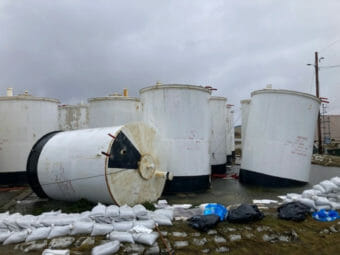
An empty bulk fuel tank toppled in Hooper Bay during the storm. (Photo by Will McCarthy/KYUK)
Signs of the flood are everywhere. Seaweed and debris hang shoulder high off fences in the middle of town. A steel culvert rests on top of a building got pushed off its frame. Fishing boats lie stranded on the tundra.
Parts of Hooper Bay were without power for about 36 hours over the weekend as a storm surge flooded the coastal community of about 1,300 people. But the situation could have been far worse — and threatened the town’s winter subsistence stock — if not for the work of two local power plant operators.
On Sept. 20, at the airstrip, cousins Leemon Andrew and Leemon Bunyan were working to restore power to the airstrip’s lights.
Andrew, the older of the two cousins, said things are still in a much better shape than just a few days ago.
“Everybody’s happy that they have power,” Andrew said.
Andrew, born and raised in Hooper Bay, said he had never seen anything like the flooding that rocked the village over the weekend. He only just started his job as an Alaska Village Electric Co-op power plant operator in April. His cousin, Bunyan, has only been working as a plant operator for three weeks. Both are in their early 30’s.
The past few days have been about as intense of an initiation into the job as anyone could imagine.
When the water started to rise up to the bulk fuel tanks and the power plant on Friday night, Leemon Andrew and Leemon Bunyan were there with an AVEC contractor.
Soon, some of the empty bulk fuel tanks started to lift and tilt. One toppled over completely. The falling tank caused the gaskets of the fuel lines to rupture. Those lines bring fuel from the bulk tanks to a smaller tank that powers the generator, which in turn powers the whole town. Now that power was close to shutting off completely.
They needed to figure out a solution.
“We had a bucket brigade going to fill up the day tank so the generator wouldn’t run out of fuel,” Andrew said. “After the flood in the morning, the day tank was getting low.”
Without a functioning fuel line, Andrew, Bunyan and the AVEC contractor became a human fuel line instead. As the water rose up toward their waists, debris floating around them, they started carrying bucket after bucket of fuel to the day tank.
If the generator shut down, the whole town would lose power. Everyone’s freezers are filled with moose meat and fish for the winter. Without power, Leemon Andrew said the freezers risked thawing and spoiling all the food inside. It was more than electricity — it was a matter of food security.
As the team worked, Robert Lohman, the AVEC contractor, kept an eye on the rising waters pummeling the bulk fuel tanks. With the water around his waist, he started unlocking the gates further up the hill, creating an escape route for the crew in case they needed to abandon the plant.
I asked Lohman if he was worried for his life.
“No,” Lohman said. “I’m old.”
Eventually the group came up with a workaround for the bucket brigade. They ran a garden hose from the valve at the bottom of the tank to a pump, then ran another garden hose from that pump to the tank feeding the town’s generator. That MacGyvered solution is still powering the village.
AVEC leadership visited the power plant on Wednesday to look for a more permanent solution.
Close
Update notification options
Subscribe to notifications
Subscribe
Get notifications about news related to the topics you care about. You can unsubscribe anytime.