Subsistence

‘Some of them just disappeared’: Essential pieces of life in Nome were lost in the storm

Plywood, lumber, and other debris strewn along a treeless coast, with a single small house in the background
The storm left trash and debris along the coast in places where the ocean surged and rivers topped banks. Some people were looking for possessions that washed away, including cabins and outbuildings that were moved or shifted. This debris is by the mouth of the Nome River along the Nome-Council Road. (Photo by Zachariah Hughes/ADN)

NOME — The storm that slammed Western Alaska over the weekend has reorganized the land.

There was no loss of life, but the landscape of Nome is physically altered for the foreseeable future, with raw material scattered wildly, the coastline reconfigured, the camps and shore-side compounds anchoring generations of subsistence either flattened or gone.

All up and down the Nome-Council Road heading east out of town, cabins used for fishing, foraging and seasonal family life are in ruin.

“Some of them just disappeared,” said Bryant Hammond, the incident commander for Nome’s emergency operation center.

Nome, a city of about 3,700 people that functions as the commercial and logistical hub for 15 smaller communities in the Bering Strait region, weathered the worst storm in decades relatively well. By Monday, business owners were unboarding windows along Front Street and shoveling muck out of gutters as heavy equipment rumbled around side streets and the seawall. Utilities are fine. Many car and truck owners are gradually discovering their vehicles were effectively totaled by partial submersion in the salty, silty floodwaters.

But the worst damage is out of town, with an as-yet-uncounted number of subsistence cabins in shambles.

To those unfamiliar with Western Alaska, the word “cabin” might conjure a hut of neatly notched logs nestled in the woods, or a euphemism for a lavish weekend home overlooking Nancy Lake. These are not those. The fish camps peppering the river mouths and shores of the southern Seward Peninsula are more like cozy shacks, neither electrified nor plumbed, buttressed by meat racks, smokehouses, saunas, cutting tables, woodpiles and utilitarian bric-a-brac for making use of the land and sea’s seasonal offerings.

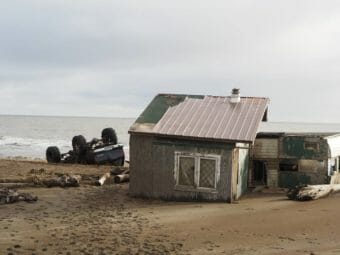
A tilted, badly damaged camp with an upside-down truck lying next to it
Family camps and subsistence cabins lie in ruins, shifted off their pads, floated away, and buried in sand along the Nome-Council Road. (Photo by Zachariah Hughes/ADN)

They are essential to the region’s economy: family-scale food production and processing plants, summertime child care and education centers, a release valve for overcrowded homes and apartments in a region with an endemic housing shortage.

“My daughter’s smokehouse is gone. The outhouses, gone,” said Sterling Gologergen, standing at her second-story living room window, from where she watched the storm drown Nome’s small-boat harbor Saturday.

Even though the main cabin at her daughter’s camp remained intact, bedding and other material inside was soaked, ruined, costly to eventually replace, Gologergen said. Though she’s lived in Nome for a decade, the 67-year-old spent most of her life on St. Lawrence Island, where the communities of Gambell and her hometown of Savoonga were largely spared substantial destruction, but caches of fish and meat stored or hung from racks by the shore were trashed or gone.

“Already a lot of people are out beachcombing for edible stuff,” Gologergen said. “And to see what’s left of everyone’s camps.”

“They work faster than internet,” she said with a laugh about damage assessment and repair work. “The network of people out in the villages. And they already had it done yesterday.”

Camps are less built than accumulated over years and generations, rarely insured or registered in the formal banking system, which makes financing reconstruction or repair all the more difficult.

A woman sits at a table by a window overlooking Nome
Sterling Gologergen watched the storm pummel Nome’s small boat harbor and Front Street from the second floor of her home. “This was my third storm,” said the 67-year-old, who spent most of her life in Savoonga. “It ages you.” She worries about camps and caches of food that were lost in the storm, and what the salty ocean spray along the coastal tundra means for the berries. (Photo by Zachariah Hughes/ADN)

Gologergen said she worries about the storm’s lasting impact on vegetation. Tufts of sea foam “the size of baseballs” blanketed the street below her window. She fears the ocean salt could wither next summer’s berry crop along the miles and miles of shore.

Ruined, too, is the Nome-Council Road itself. For the first two dozen miles or so, it’s passable, especially since the state Department of Transportation has had graders and heavy equipment removing stones plucked loose from the seawall, fixing washouts, pushing driftwood to the sides and leveling drifted sand.

But then around Mile 24, there’s a massive new hole where the creek-fed Safety Sound punctured the barrier islands that supported the road.

“That lagoon became one with the ocean, where our camps are,” Gologergen said.

Camps on the far side of the new quarter-mile-wide gash are now cut off, except by plane.

“I don’t think if you had a canoe you could get across it,” Hammond said.

Tire tracks through a field of loose, recently deposited mud with small buildings in the background
The long road east out of Nome remains in states of disarray, including sections totally washed out or buried in sand. Farther down, a bridge by Safety Sound was almost impassable just two miles before a new channel broke through the barrier island, obliterating the roadway. (Photo by Zachariah Hughes/ADN)

Families with seasonal camps past Safety Sound, along with a few dozen old-timers who live most of the year out around Council, will have to find new ways of getting into town.

“We’re gonna have to build a new bridge, looks like,” Hammond said.

The storm was major: high seas, ferocious wind, powerful waves, all of it lasting for well over a day. The massive seawall that helped blunt the damage to town was reordered elsewhere along the coastline. Boulders and rocks are scattered everywhere. Swaths of beach are gone, eroded, as if erased or dropped 6 feet lower than they should be, the sand swept away and sprinkled all over the tundra on the lee side of the road.

A cluster of camps, one badly damaged, and debris all around
Family camps and subsistence cabins lie in ruins, shifted off their pads, floated away and buried in sand along the Nome-Council Road. (Photo by Zachariah Hughes/ADN)

There will be major repairs and challenges ahead, not just for Nome but across the region, all the way to the mouth of the Kuskokwim River hundreds of miles south. Even communities that fared relatively well — that didn’t lose whole houses or see major infrastructure fail — will be grappling with considerable costs that are not easily or quickly tallied in the accounting of a cataclysm: family camps, familiar harvesting grounds, small boats and subsistence equipment, rebuilding pummeled weather mitigation infrastructure.

“The system reorganized. It does it normally in nature. But we humans, it kinda screws us,” Hammond said.

A pickup truck backed up to the water with a piece of mining equipment next to it
The storm churned up so much sand and beach material that shortly after the storm subsided, gold miners were dredging and panning for gold along the Nome-Council Road. (Photo by Zachariah Hughes/ADN)

In a reordering of the land, for some, there is opportunity. Along the scoured beaches heading east out of Nome, there are newly churned up plumes of red-tinged dirt, the kind known to be fertile hunting grounds for gold. As public employees smoothed the road, volunteers picked up driftwood or detritus, distant figures surveyed cockeyed cabins and a few gold miners with small dredging rigs attached to their pickup trucks panned the freshly pulped beach for treasure.

This story was originally published by the Anchorage Daily News and is republished here with permission.

Disaster response presents an early test for Alaska’s Rep. Peltola

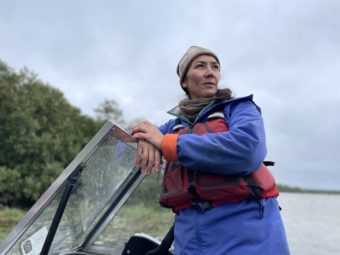
Mary Peltola stands at the wheel of a small boat
Mary Peltola has been fishing on the Kuskokwim since she was a child. “Small boats with outboard motors, four-wheelers, snow machines — my concern is that we make sure that government agencies know that these are not recreational vehicles, that these are critical vehicles for everyday living,” she said. (Photo by Liz Ruskin/Alaska Public Media)

As she starts her second week on the job, Congresswoman Mary Peltola is preparing to prod the U.S. House for supplemental disaster spending to help Western Alaska recover from the storm.

Peltola was one of the last representatives to leave the House chamber after a series of votes Monday night.

“I’ve been having conversations with members of the Transportation Committee, members of various subcommittees, members with more seniority than I have who have been through natural disasters, giving me advice on different approaches I can take,” she said.

It hasn’t happened yet, but President Biden is likely to sign a disaster declaration, as he did for a different storm over the weekend that devastated Puerto Rico. Gov. Mike Dunleavy said Monday night he’d send a request soon.

That would release a lot of federal money to storm victims. Congress often has to pass supplemental funds to pay for responses to major disasters.

One of her challenges will be to make other House members recognize the gravity of the Alaska disaster, especially because fewer people are hurt there compared to the three million Puerto Ricans who lost power and other infrastructure.

Peltola talks about the toll on Alaskans who hunt, fish and gather to feed their families.

“These communities, all up and down the coast, have been spending all summer long, gathering food and putting it in their freezer for the winter,” she said Monday night. “Now all of these freezers are going to have electrical damage, water damage. It remains to be seen how much of that food can be salvaged.”

Peltola says disaster relief funding for both Alaska and Puerto Rico might be needed in the continuing resolution — the legislation Congress has to pass before the end of the month to keep the government operating.

She has been elected to serve until January. She’s also running for the next full term. Politicians are often judged by how well they handle a disaster, and this is her first.

She wants people in the nation’s capital to know of all the vehicles damaged in the storm and how important they are to a family’s food security.
“Small boats with outboard motors, four-wheelers, snow machines — my concern is that we make sure that government agencies know that these are not recreational vehicles, that these are critical vehicles for everyday living,” she said.

Her Republican rivals, Sarah Palin and Nick Begich, also issued statements about the storm.

Palin said in a news release that she’s heartbroken by the devastation.

“We are seeing the real spirit of Alaska right now, with people all over the state reaching out to help their fellow Alaskans in this time of need,” her release said.

Begich, in an emailed statement, said his prayers go out to the people affected by the tragedy. As did Palin, he spoke of appreciation for first responders and the Red Cross.

To center Yup’ik culture, a Southwest Alaska school district has adopted a subsistence calendar

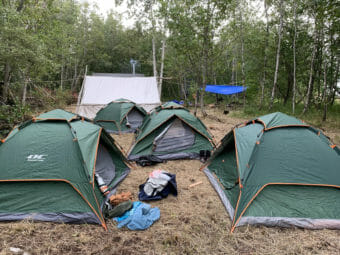
Tents set up in a clearing
A jumbled drift net, like one the district may have used at their summer fish camp. (Photo by Woody Woodgate/
Yupiit School District)

For years, students in the Yupiit School District were already following an unofficial subsistence calendar. That meant that they just wouldn’t show up to classes during bird hunting season in the spring and moose hunting season in the fall. Now, thanks to a shift to a subsistence calendar, students at the small district — made up of Tuluksak, Akiak, and Akiachak — will no longer have to miss school to go hunting.

To Scott Ballard, the superintendent, it always made sense to change the school year so that it wouldn’t interfere with those activities. When Ballard first began the process of changing the schedule, he thought it would be pretty straightforward.

“It’ll be a slam dunk. We’ll petition the commissioner of education, he’ll give us the waiver, and we’ll be done with it,” Ballard said. “It was not simple at all.”

Instead, Ballard said that it took months of phone calls. Ballard morphed from superintendent to activist as he worked to earn support from state senators and representatives. He negotiated with the Alaska Department of Education and its commissioner.

Finally, in April, the department approved the waiver for a subsistence calendar. To Ballard, all the effort was worth it.

“We think it’s going to really benefit our students and get our communities connected to the school,” Ballard said. “Instead of seeing the school as this alien institution that occupies their village that promotes Western values and Western instruction.”

The change is simple. Instead of August through May, school will only be in session from September to the end of April. To make up the time lost, 30 minutes of instruction are added to each day. There is also an optional, two-week summer school in August, which incorporates subsistence activities.

According to Moses Peter, a Yupiit School Board member, the change is all part of a decades-long initiative to center Yup’ik culture in the district’s educational goals and curriculum.

“We don’t want our future generations to forget who we are,” Peter said. “We want to educate them about our ancestors and how they survived in this harsh environment.”
That effort goes beyond changing the rhythm of the school year. It means incorporating Yup’ik culture into everything the district does.

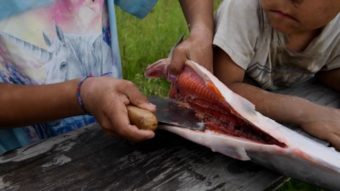
Woody Woodgate, the federal programs director for the Yupiit School District, said the district tries to match traditional cultural activities with state educational standards. The summer school this year was a fish camp organized by the district. Woodgate said the kids loved it.

“They were just coming out, having a blast. They had a chance to do all kinds of activities,” Woodgate said. “They sat around and drank ayuk tea, tundra tea, and they heard stories from elders and community members.”

The district is already incorporating activities like fishing, hunting and gathering into their curriculum for the rest of the year. They’re also studying other issues important to the community, like science labs on river erosion.

Peter believes that this is the best way for kids to learn. It’s how he learned. When he was growing up, his parents would pull him out of the Bureau of Indian Affairs school he attended to bring him to spring camp.

“The actual environment was our education,” Peter said. “How to survive, how to get along as a village, as a whole village.”

Ballard and the board believe that centering Yup’ik culture should permeate every aspect of the school, from the topics students study to the meals that they eat. If students are excited about what they’re learning and eating salmon they caught instead of chicken nuggets for lunch, Ballard believes that they’ll be happier and more engaged in education. If students are happier, then teachers are happier, which makes it easier to keep teachers around.

“We’re striving for every child, when they get up in the morning, as much as possible is going to look forward to coming to school,” Ballard said.

This is the district’s first year operating under a subsistence calendar. Ballard said that they’ll be able to assess if the change increased attendance and student engagement by the end of the school year.

Watch: With the salmon collapse on the Yukon River, families are losing a vital food source and way of life

For the second year in a row, a severe and sudden salmon collapse has affected Indigenous residents on the Yukon River. Subsistence fishing for the two main salmon species, king and chum, has been closed for two summers due to record low runs. Residents of traditional villages are now facing food insecurity because of the collapse. Now, the Indigenous communities on the river whose ways of life have revolved around the fish for thousands of years are also facing a devastating loss of culture. Olivia Ebertz reports from the Lower Yukon.
Aniak Traditional Council rescinds its support for the Donlin Gold mine

A foggy treeless hill
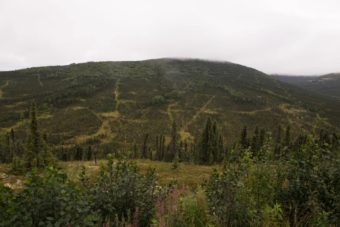
The Donlin Gold mine site is located about 70 miles up the Kuskokwim River from Aniak. (Photo by Katie Basile/KYUK)

The Aniak Traditional Council unanimously voted to rescind its support for the proposed Donlin Gold mine over concerns about increased barge traffic on the Kuskokwim River. The tribe’s withdrawal removes a longtime pillar of support for the project. The mine’s landowners say they see the repeal as an opportunity to better understand and address community concerns.
The council’s repeal vote on Aug. 30 revokes its 2016 resolution to support the mine. But council Chief Wayne Morgan said that the body had unofficially supported the project for over a decade before that, since 1995. It wanted the potential jobs and economic benefits that the mine could bring. Now, Morgan says, that desire is overridden by concerns over the mine’s barge traffic.

“I really believe our river, Kuskokwim River, it’s a scenic river. It’s a wild river. And with the increased traffic on the river, I’d call it industrializing the river, it’s going to take away the wild and scenic part of that,” Morgan said.

Aniak is the largest community in the middle Kuskokwim. The town of about 500 people sits about 70 miles downstream from the proposed mine. To operate, Donlin would need a steady stream of materials, equipment, supplies, and diesel fuel.

From early June to early October, when the river is ice-free, much of those resources would arrive by barge, traveling 190 miles of river. Donlin plans to send one to two barges per day along the Kuskokwim River between Bethel and the mine, increasing summer barge trips by almost 200%. The traffic would last the length of the mine’s lifespan, projected at about 30 years, but it could run longer if more gold is found and as mining technology advances.

For Morgan, age 57, that’s longer than he expects to be alive.

“That’s too much to give and sacrifice on our end,” Morgan said.

Morgan predicts that the barge traffic will disrupt subsistence activities, jeopardizing people’s abilities to feed their families. For example, it’s currently moose hunting season, and Morgan said that the barge traffic could spook off moose before hunters can see them. Fishing is also a concern. The river narrows upstream, and to catch salmon, most people use gillnets stretched across the water.

“We’d have to wait until a barge passes and then try and fish. It’s going to put a burden on fishermen trying to get their subsistence foods in a limited amount of time,” Morgan said.

Also, he said, the wake caused by barges makes the river more difficult and more dangerous to navigate in small skiffs. Another concern for Morgan is any contamination the barges could cause if an accident, like a fuel spill, occurs. If the mine begins operations, he expects the barges to become many people’s main experience of it.

“Some people will never get to see the mine, but they’ll see it every day for 30 plus years on the river with the barges,” Morgan said.

The mine would be built on Native corporation land. The Kuskokwim Corporation owns the surface rights. Aniak is one of 10 middle and upper Kuskokwim River village corporations that compose The Kuskokwim Corporation and the first to take this type of action. The Kuskokwim Corporation President and CEO Andrea Gusty is an Aniak tribal member and said that she welcomes her tribal council’s concerns.

“It’s concerns that make the project better. It’s being skeptical, and diving into the details, and doing due diligence, and doing research,” Gusty said. “I mean, there’s a reason that development like this takes years and years and decades and decades.”

Calista Corporation is the other land owner. It owns the sub-surface rights. Vice President of Corporate Affairs Thom Leonard also framed Aniak’s concerns as a positive.

“If everyone was in support of the project, then I would be more worried, because then we wouldn’t be getting the feedback we need to make improvements and support our people,” he said.

Donlin External Affairs Manager Kristina Woolston pointed out how Donlin has adapted to address concerns about barge traffic in the past.

When an Aniak resident shared concerns over the traffic impacting smelt, Donlin began researching the fish and its habitat. When residents shared concerns over the number of daily barges transporting diesel fuel, Donlin proposed a plan to reduce the number by constructing an over 300-mile natural gas pipeline from Cook Inlet to the mine. Also, Donlin formed a Subsistence Community Advisory Committee and is accepting applications for the group.

Woolston sees Aniak’s repeal as another way the mining project can adapt while continuing to move forward.

“We appreciate the feedback, and we feel this is an ongoing opportunity to continue our robust discussion with the community of Aniak and its leaders, and throughout the region,” she said.

Though the Aniak Traditional Council rescinded its support for the Donlin Gold mine, it did not vote to oppose it. Fourteen tribes in the Yukon-Kuskokwim Delta have issued resolutions of opposition, along with tribal organizations that include the Yukon-Kuskokwim Health Corporation, the Association of Village Council Presidents, and the National Congress of American Indians.

Mother Kuskokwim Tribal Coalition is a new organization that formed this summer to advance tribal opposition to Donlin. When Director Sophie Swope heard that the project landowners were characterizing Aniak’s repeal as an opportunity to address concerns, she pushed back on that framing.

“Them talking about how it’s going to bring more robust and clear conversations, I don’t believe that is what it will bring. I just think it makes it more clear that they do not have the social license,” Swope said.

Morgan said that he could not predict if the Aniak Traditional Council would again support the mining project if it reduced its projected barge traffic.

Court rules with Metlakatla in case challenging Alaska state fishing regulations

""
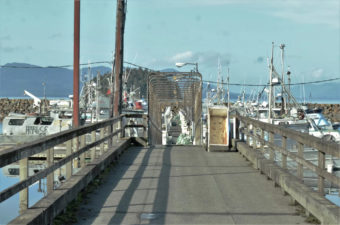
A view down a pier to a Metlakatla harbor in October 2020. (Photo by Eric Stone/KRBD)

A federal appeals court has ruled that Metlakatla tribal members shouldn’t need state permits to fish in waters they’ve traditionally relied on — even outside their reservation’s boundaries. The decision is a major victory in the tribe’s decades-long fight for fishing rights.

The Ninth Circuit’s 28-page opinion is broad and unambiguous: the 1891 law that created Metlakatla’s reservation gives tribal members the right to fish in areas near Ketchikan and Prince of Wales Island, outside the boundaries of the Annette Islands Reserve.

“We hold that the 1891 Act reserves for the Metlakatlan Indian Community an implied right to non-exclusive off-reservation fishing in the areas where they have fished since time immemorial and where they continued to fish in 1891 when their reservation was established,” writes Senior U.S. Circuit Judge William Fletcher.

Metlakatla Mayor Albert Smith called the decision “a very well-reasoned and strongly worded opinion.”

“Today is an important day for the Community,” Smith said in a statement. “It is the right we all knew existed but a right that we unfortunately have had to fight to protect. With this opinion, we are an important step closer to preserving this right for our future generations. It has been a long, long road, and we need to acknowledge the contributions of many past Council members, mayors, community elders and historians. Thank you to all.”

The ancestors of Metlakatla’s Tsimshian people relocated from their former home in British Columbia in the late 19th century at the invitation of the U.S. government. In 1891, Congress passed a 101-word statute creating the Annette Islands Reserve “for the use of the Metlakahtla Indians.”

That law doesn’t specifically mention fishing rights. But the tribe argued in its 2020 lawsuit that Congress intended the Annette Islands to be a permanent, self-sustaining home for the tribe — and that that wasn’t possible without the ability to fish outside the reservation’s marine boundaries. They pointed to past court precedents and 19th-century historical records of Metlakatla residents fishing in places like Naha Bay near Ketchikan and Karta Bay on Prince of Wales Island.

U.S. District Court Judge John Sedwick sided with the state of Alaska and dismissed the case in February of last year, saying the 1891 law and the historical context didn’t imply that Congress granted the tribe off-reservation fishing rights.

But the Ninth Circuit disagreed.

“The key question that the Ninth Circuit resolved in Metlakatla’s favor was whether Congress in 1891 granted, when they established the reservation, also granted the community the right to fish on a non-exclusive basis in waters outside the reservation,” attorney Christopher Lundberg, who’s part of the team representing Metlakatla Indian Community, said in a phone interview.

The appeals court sent the case back to the district court for further consideration, but Lundberg says the major legal question has been resolved.

Alaska Department of Law Communications Director Patty Sullivan called the decision “perplexing and disappointing” in a written statement.

“The panel went out of its way to decide legal issues that were not before it, misconstrued facts, and misapplied the law. We expect more from our courts, especially when dealing with important decisions that affect the livelihoods of many Alaskans. Allocating our fishing resources to ensure we are meeting our constitutional obligations under Article 8 is a delicate balance. This decision upends that balance without giving the State a chance to present its case. We cannot let this decision stand and we hope the court will see the errors in its decision,” Sullivan said by email.

She said the state is evaluating whether to appeal the case.

Site notifications
Update notification options
Subscribe to notifications