Subsistence

‘People are running out of food’: Subsistence closures leave Yukon River residents with few options

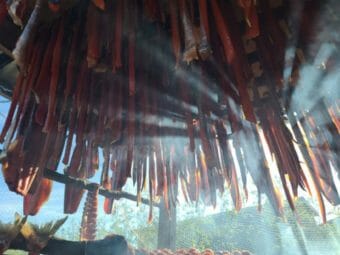
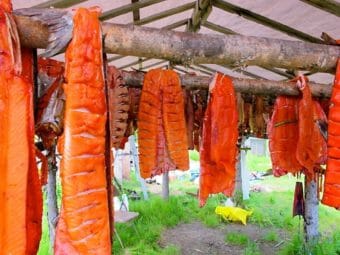
Salmon filets hanging from a drying rack
Yukon river residents are not able to make dry fish from chum and chinook for the second year in a row. (Photo by Shane Iverson/KYUK)

Each week during the summer, subsistence users and managers up and down the Yukon meet on a teleconference to share fish news and reports. On last week’s call, Anvik First Chief Robert Walker said that people are hanging on by a thread.

“These people are running out of food, basically,” Walker said.

That’s because there’s not much food swimming up the river. As the summer salmon runs finish up, counts are once again at record lows. Chinook runs had been dwindling for years, but last year the region suffered an unexpected chum salmon crash, too. Now, no one has been able to subsistence fish for either species in two years.

When the chum ran abundantly, they provided subsistence users with a buffer zone against the low chinook counts. With that buffer gone, salmon conservation scientist Peter Westley said that the record low chinook run has become glaringly obvious.

“There are no chinook in the Yukon. They’re at 40,000. Remember how last year was like this terrible year, there was 150,000. This year, there’s 40,000. That’s my point. I’m not trying to be dramatic, but there are no chinook,” Westley said.

He said that last year, he was optimistic chinook could bounce back. This year, he’s not so sure.

“I thought all these things, like, if we did X, Y, and Z, they’ll come back. I think I might be wrong. It’s a collapse. I mean, it’s heartbreaking,” said Westley.

The Yukon River is not the only river system with low chinook runs. Other parts of the state are suffering low runs, too. The state says that Bristol Bay is likely having some of its lowest chinook runs yet, and the Kenai River is also set to miss its escapement goal. Most scientists point to something in the ocean causing the low chinook runs.

Subsistence users on the Yukon River say they’re going broke trying to replace the salmon.

“We’re spending more money on food than we ever did before because we don’t have that bump of salmon to ease the price,” said Anvik’s First Chief Robert Walker.

Walker said that they’re having to rely on government subsidies.

“We don’t want more food stamps, we just want our way of life, good lord,” Walker said.

Walker said that people are not the only species being impacted by the low runs.

“Since there’s no fish coming up the Anvik River, we had grizzly bears coming through our dump. This is really early. It doesn’t usually happen until October,” Walker said.

Normally this time of year, bears would be filling their bellies with river fish, and people would be preparing for the fall chum run. But that won’t be an option this year either.

“We’re looking at a critically low fall chum run again this year,” said Christie Gleason, the fall manager from the Alaska Department of Fish and Game, who said she expects subsistence fishing for fall chum will remain closed on the whole Yukon for the second season in a row.

Gleason said that fall chum have begun to enter the river, and they expect to start seeing coho salmon in a few weeks. Last year was the worst year on record for coho salmon on the Yukon too, so this year the department has implemented a new project to try to understand that crash. They’ll begin radio tagging coho salmon in August to track their movements up the river.

In a bit of good news, Basil Larson from Russian Mission reported that the pink salmon run is strong this year.

“The humpies are running pretty thick. I get probably 50 of them in no time,” Larson said.

Plus, he said, there’s an odor that makes him think the chum may, at least, be reproducing well.

“The mud is pretty stink, which kind of indicates that there’s some local spawners in the creeks,” Larson said.

Fish for Families aims to bring Bristol Bay sockeye to Alaska communities facing low salmon runs

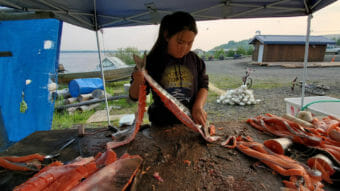
A young girl processing salmon on a wooden table outside
Serena Fitka’s daughter, Hali, cutting chum in St. Mary’s. June 10, 2020. (Photo courtesy of Serena Fitka)

Bristol Bay’s sockeye run is the largest on record this season. It has been an astounding summer: More than 70 million sockeye have returned, and fleets have pulled in record harvests of more than 53 million fish.

Fish for Families is a new program that aims to share that catch. The program is an extension of the Alaska Longline Fishermen’s Association and the Alaska Sustainable Fisheries Trust. Since 2020, these groups have helped coordinate sockeye salmon donations from Bristol Bay to Alaska Native communities in southwest Alaska.

At the end of June, it sent out its first shipment of the season — 1,000 pounds of salmon to Chignik communities on the Alaska Peninsula. The program plans to send a total of 8,000 pounds of salmon there this month.
But the fish donations come at a cost. Those 8,000 pounds run about $64,000 to purchase, process and ship. They’ve gotten some donations and grants, but they’re also fundraising with a GoFundMe account to cover the other costs.

The group also wants to send salmon to communities on the Yukon and Kuskokwim Rivers that are facing record low chum salmon returns. That will require more funds. They’re asking the Alaska Department of Fish and Game for help shipping the salmon there.

Deenaalee Hodgdon fishes commercially and is helping to coordinate the salmon donations. Hodgdon, who is Deg Xit’an Athabaskan and Supiaq, said it’s important to look at the state as a community.

“How do we collaborate across our different regions, as Yup’ik and Sugpiaq people, reaching across to Dine and Tanana and Koyukon, all the way up into the border?” they said.

Part of doing so is trying to help people in other places who need salmon. It’s a central food source for people who live along the Yukon River. But in the past two years, multiple species have crashed to record lows, and people have struggled to catch enough fish to feed their families.

Serena Fitka, the executive director for the nonprofit Yukon River Drainage Fisheries Association, grew up subsistence hunting and fishing in St. Mary’s, along the lower Yukon River. She said the decline of the salmon runs has changed ways of life in her home village.

“The river was barren,” she said. “And it was sad, not seeing people gathered at their fish camps, not seeing the smoke come out of smokehouses.”

Fitka said the low numbers have been incredibly difficult to contend with. Last year’s chum run was a record low at under 200,000 fish. But these donations do help to feed people and further Southwest Alaska’s culture of sharing.

“With the efforts that are underway with sharing of the fish, our Native instincts, it’s ingrained in us to share our foods,” she said. “We’ve always shared our catch with people. And with another fishing region sharing their fish with us — it’s a great, great honor.”

The donations build off other efforts to bring salmon to communities in need in the past. In 2020, the fishermen’s association helped coordinate tribes, fishermen, local governments and Native organizations and nonprofits to donate fish from areas around the state, including from Bristol Bay and southeast Alaska. To date, the association said it has deployed $2.5 million to buy salmon and donate more than half a million meals.

Other organizations stepped in, too. Tanana Chiefs Conference helped organize fish donations, and fishermen gave thousands of pounds of chinook and chum salmon. Operation Fish Drop distributed more than 12,000 pounds of Bristol Bay sockeye to hundreds of families.

Maio Nischkian, who fishes in Bristol Bay and owns a direct marketing company, works with the fishermen’s association. She said it’s important that people who make their living fishing in Alaska give back some of that wealth.

“We have a really big responsibility to share, not only with our local communities, but throughout the state,” she said. “Especially to Alaska Native communities that are struggling right now when, you know, they are the reason that we’re allowed to be here. And they’re the reason this fish has kept running.”

You can find out more about the seafood donations program at alfafish.org/seafood-donation-program

Correction: The first shipment of salmon donations was sent out at the end of June, not in early July as originally reported.

Bristol Bay’s sockeye run is already the biggest on record

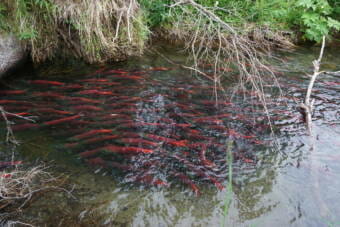
Sockeye in a creek in the Wood River watershed. July 28, 2021. (Photo by Stephanie Maltarich/KDLG)

Bristol Bay’s 2022 sockeye run is now the biggest on record: 69.7 million fish have returned this summer. That surpasses the previous record of 67.7 million fish, which was set last year.

More than 3 million sockeye have swum up the Wood River to spawn in the tributaries around Lake Aleknagik, about 20 miles from Dillingham, according to the state’s counting tower on the river.

Sherol Mershon lives along the lake near the head of the river. She owns a bed and breakfast there and has hung commercial fishing nets for 45 years. She said this year’s runs are remarkable.

“They just pour by. Sometimes there’s 500 in the air, breaking the water. When it’s dead calm you can see really well,” she said. “I lay in my bed at night with the window open and I can hear them jumping, and it’s just amazing. It’s absolutely beautiful.”

The east side of Bristol Bay has seen robust sockeye returns as well. Shaelene Holstrom grew up in Naknek and returns each summer to subsistence fish.

“I have been enjoying hearing how everybody is catching and how it’s just been crazy processing and running all over the place, trying to figure out what to do with fish,” she said. “I think that’s a great feeling, cause then we know we’re getting our numbers up at the river, and that warms my heart.”

Huge commercial harvests

Bristol Bay’s commercial fleet hauled in the most fish on record this year. Fishermen in the Nushagak, one of the bay’s five commercial districts, harvested more than 2 million sockeye in one day this season.

William P. Johnson just finished his sixty-second year as a boat captain. He grew up set net fishing near Igushik in the 1940s with his family. After more than six decades of fishing, he wasn’t phased by the large returns this season.

“Our goal was to get at least 100,000 [pounds]. We exceeded that, and so we came home after our last delivery on [July] 12th,” he said.

For thousands of years, Yup’ik, Alutiiq and Dena’ina peoples have presided over Bristol Bay. The commercial fishery began in 1884, as outsiders came to the region and built canneries. The federal government managed the fishery until the state took over in 1960.

Johnson believes that change was an improvement.

“I think the local control by our local Fish and Game department has a lot to do with the improvement of the resource that we participate in,” he said.

Johnson, who also fishes for subsistence, said the large sockeye runs haven’t changed how much food he and his family put away for winter.

“There has never been any problem for us in getting our fish,” he said. “But one thing that has been impacted is that king salmon seem to have declined.”

As sockeye abound, chinook and chum runs decline 

While sockeye have returned in droves, chinook and chum salmon runs have dropped. Scientists don’t know why that is, either.

Dan Schindler is a professor of aquatic and fisheries sciences at the University of Washington. He’s studied sockeye on the west side of Bristol Bay for decades and says the exact reasons for why the bay’s sockeye runs are so huge will probably always remain a mystery.

“In terms of what the mechanism is, it’s really hard to really pinpoint that,” he said. “What we have is correlations. And the correlations are that when we’ve had really warm — to hot, even — eastern Bering Sea sea surface temperatures, Bristol Bay sockeye have done really well. And other species in the region haven’t,” he said.

There are slight differences in how these fish behave.

“We know they eat slightly different things in the ocean. They migrate to the ocean at slightly different times during the season. They probably have slightly different behaviors in the ocean,” Schindler said. “All of those things are making chinook and chums vulnerable to something that sockeye aren’t – at least sockeye that are returning to Bristol Bay.”

Of course, this isn’t the case for sockeye returning to rivers in other parts of the state. Runs to tributaries along the Gulf of Alaska have performed poorly over the past decade.

“I suspect it’s something to do with ocean temperatures causing some change in the food web — that smolts leaving the west side of Bristol Bay are hitting really excellent conditions for survival, whereas smolts leaving places like Chignik and the Copper River are hitting ocean conditions that have been really poor for smolt survival,” he said.

Warming oceans and lakes coincide with big Bristol Bay returns

River systems on the west side of Bristol Bay have seen an especially large sockeye boom over the past few years.

“All the way up along the western north side of Bristol Bay all the way to the Kuskokwim. So something anomalous has happened here. And it has coincided with some of the warmest ocean temperatures ever observed in the eastern Bering Sea and in the Gulf of Alaska,” Schindler said.

Warming waters at the spawning grounds likely also affect their growth, Schindler said.

“As the lakes have warmed up, we see more plankton in the lakes, and of course the plankton are the food for juvenile sockeye,” he said. “So over the last 60 years, we actually see that juvenile sockeye are growing much faster now than they were 30 or 40 years ago, which means they’re leaving for the ocean as bigger smolts. And presumably, that has something to do with their higher survival rates in the ocean.”

The sockeye runs now returning to Bristol Bay may be the largest of the past several hundreds of years. Schindler and other scientists have attempted to reconstruct how big the bay’s runs were hundreds of years ago.

“Salmon coming back from the ocean bring back a distinctive marine nitrogen signature, which we’ve used to reconstruct how many sockeye were spawning in places like the Word River and the Kvichak and throughout the Togiak refuge over the last thousand years or so,” he said.

This is called paleolimnology, where researchers take the mud out of the bottom of lakes and scan that sediment for an isotope, Nitrogen-15. Schindler said even with commercial exploitation of the sockeye populations, the recent runs have returned at historically high rates.

“If you add up the catch and escapement that we’ve observed in the last 25 or 30 years, the sum of those two numbers appears to be higher than the number of fish that ever returned to these lakes in the last 500 to 1,000 years,” he said. “And while that might seem surprising, it really does support what we’ve seen with our real time data over the last 50 or 60 years that climate warming has actually made these lakes more productive than they were 100, 200, and 300 and longer — 400 years in the past.”

The total run is now 69.7 million sockeye, but the season isn’t over yet. Fish and Game forecast a run of 75 million fish, but it could go as high as 90 million this summer.

Mackenzie Mancuso conducted an interview with Shaelene Holstrom which was used in this story.

Chum fishing will remain closed on the Yukon amid projections for another low fall run

""
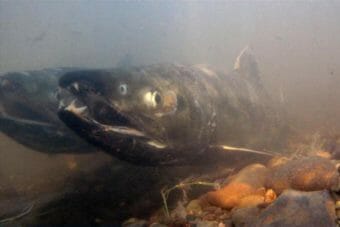
Chum salmon (NOAA photo)

Fall chum are expected to begin entering the Yukon River soon, and the Alaska Department of Fish and Game is projecting another low run for the species after 2021’s record low return. To conserve the salmon, government fishery managers will keep fishing for fall chum closed unless an unexpected surge of the species arrive.

Fish and Game is projecting that less than 300,000 fall chum will return to the Yukon River. That’s fewer than the state’s drainage-wide escapement goal of 300,000 to 600,000 fall chum reaching the spawning grounds. On average, 1 million of these fish return to the Yukon River each year.

To help the fraction of fall chum expected to arrive have a chance to spawn, managers are keeping chum fishing closed.

“I just want to let fishermen know that we’re really sorry that we don’t have better news,” Fish and Game fisheries manager Christy Gleeson said during a weekly teleconference about Yukon salmon hosted by the Yukon River Drainage Fisheries Association. ”These fish counts are devastating for people trying to live along the Yukon River. We know that it’s been a really difficult fishing season so far with these salmon closures. But we really appreciate everyone coming together and doing continued cooperation during these times of salmon conservation.”

That conservation has led to no salmon fishing for chinook or chum along the river for the second year in a row.
2021 saw the lowest fall chum run on record. This year’s chinook and summer chum runs have continued the same trend from last year. Neither are expected to meet escapement goals set by state and federal fishery managers. The continued closures are economically and culturally straining Yukon River residents.

“We long to taste our fish that we smoked and dried. This is our food, our livelihood,” Russian Mission resident Sandra Kozevnikoff said during the Yukon River salmon teleconference.

Fishing will remain open for other species on the river, including red, pink and coho salmon, along with non-salmon fish.

Another Russian Mission resident, Basil Larson, said during the teleconference that pink salmon are passing by in “full force.” In a six-hour stretch, he and his brother caught enough pinks to feed their dogs for three to four days.

“There’s some pretty good, healthy looking ones that we’re taking and eating, along with the whitefish,” Larson said.

Upriver in Huslia, Lisa Bifelt said that local fishermen were making a 75-mile round-trip to a slough to target sheefish.

“People were having some luck down there, not much though. I think seven was the most caught,” Bifelt said.

But when she boated there with her mother, she said that they didn’t catch anything.

Meanwhile, other callers said that berry picking season had begun, a hopeful abundance of local food amid the historic declines of salmon.

As Kuskokwim fishing lawsuit grows, lawyers say subsistence could be affected across Alaska

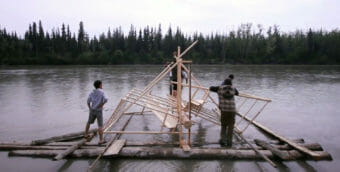
People building a fish wheel on a river
Residents of Nikolai, Alaska are seen building a fish wheel on the Kuskokwim River in June 2013 in this image from a National Park Service documentary. (Image by National Park Service/Charlotte Bodak)

A legal dispute between the U.S. government and the state of Alaska about subsistence fishing on the Kuskokwim River is growing, and a leading Native corporation says it could endanger subsistence hunting and fishing rights across Alaska.

In a filing this month, attorneys representing Ahtna Inc. said the state is arguing a position that — if upheld by a federal judge — could overturn the famed Katie John decisions that confirmed preferential subsistence hunting and fishing rights for rural Alaskans on federal lands and waters here.

“It’s a really big deal, and they’re kind of being sneaky about it,” said Anna Crary, an attorney representing Ahtna.

For years, state and federal officials have issued conflicting orders opening and closing salmon fishing on the Kuskokwim River in the Yukon Delta National Wildlife Refuge. These conflicts confused fishermen.

The state’s openings allowed all Alaskans to fish; the federal openings only allowed qualified subsistence users to fish.

In May, the federal government sued the state, seeking an injunction to block the state’s actions.

One month later, a federal judge ruled in favor of the federal government, issuing an order that temporarily prevents the Alaska Department of Fish and Game from opening gillnet fishing.

Meanwhile, the case is continuing toward a final, permanent result.

Consequences beyond the Kuskokwim

In a filing Thursday and in prior court documents, attorneys representing the state said Fish and Game should be in charge of deciding openings, among other reasons, because the Kuskokwim River “is not ‘public land’ under ANILCA.”

The Alaska National Interest Lands Conservation Act, a federal law, mandates preferential treatment for rural fishermen and hunters.

Because the Alaska Constitution mandates equal treatment for all fishermen and hunters, it’s illegal for the state to run a rural-preference program.

If the Kuskokwim is public land, the state — not the federal government — is in charge, and there’s no rural preference.

The definition of “public land” determines where preferential treatment applies, and a series of cases known as the Katie John decisions interpret how the federal programs run.

If the Kuskokwim is not public land, many other rivers may not be public either, overturning much of the legal ground beneath the Katie John decisions.

“If successful, the state’s attack upon the application of the rural priority to navigable waters will have far-reaching consequences extending well beyond the Kuskokwim River,” Ahtna’s attorneys said.

Arsenal of arguments

The state’s argument that the Kuskokwim River is not “public land” is one of seven affirmative defenses raised by the state in the lawsuit.

That makes the argument just one of multiple weapons in the state’s legal arsenal, and it may not be used, Crary said.

“I think that the state is using or raising a number of other arguments that it appears to be prioritizing,” she said. “But in the event that those arguments are not successful, what the state is doing is preserving for itself the opportunity to litigate that issue.”

Asked whether it is attempting to overturn Katie John, the Alaska Department of Law did not answer directly.

“We are in the very early stages of litigation,” said Patty Sullivan, communications director for the Alaska Department of Law, which is representing the state in the lawsuit. “The purpose of the (filing) is to preserve any potential defenses or claims, which will be fully evaluated and developed as the case proceeds. We are continually in the process of determining when and how to raise the appropriate claims and defenses in order to best represent Alaska on this matter of utmost importance.”

“Alaska’s right to manage its fish and game resources is critically important to our social, cultural and economic well-being,” Sullivan said. “The right to manage our resources was a primary driver for our statehood and was granted to our state under its statehood compact. The state primacy to manage its resources was not changed with the passage of ANILCA.”

“We believe that what the government is seeking would expand federal authority beyond any statutory justification and would undermine the careful balance between state and federal authority reached in ANILCA,” Sullivan said.

In 2018, when the U.S. Supreme Court considered the boundaries of state and federal control in a case known as Sturgeon, the state urged the court to leave Katie John precedent in place.

Since then, the state has pushed back against actions by the Federal Subsistence Board, which operates under that precedent.

In addition to the Kuskokwim lawsuit, the state has challenged the board’s ability to open special hunting seasons and regulate hunting in other ways. After losing in Alaska District Court, the state has appealed its loss to the 9th Circuit Court of Appeals.

The Department of Law appears to be readying itself for the possibility of a lengthy legal battle over the Kuskokwim River as well.

In a public notice published Friday, the Department of Law said it plans to hire a private firm to represent the state in the Kuskokwim case. It estimates that fighting the case in federal district court will cost $250,000.

That estimate was accompanied by a cautionary note: “It is not possible to accurately estimate the total amount of this contract, as it may be settled, or appealed and continued to be litigated, even as far as the Supreme Court.”

Area M: Where Alaska commercial and subsistence fishing interests collide

Two people in a skiff picking salmon out of a net
Fritz Charles’ family picks a chinook salmon from the net. (Photo courtesy of Sharon F. Charles)

There have been clashes over regulating Area M for decades, but the battle heated up after the Yukon-Kuskokwim chum crashes began. This is the first in a three-part series.

Kuskokwim fisherman Fritz Charles grew up in Tuntutuliak, on the lower river. There were so many fish then that his parents would put away literal barrels of them. His job as a child was to pack the dry fish tight in the barrels using a special method.

“Somebody would put me in the drum and start stomping on the fish so they can pack more in there. They put away two drums of salmon. One drum would mainly be king slabs, and the other one would be chums and reds. And that was our main diet for the winter back then,” Charles said.

Nowadays, there’s no more stomping on dry fish. There aren’t enough to put away a whole barrel.

“There’s hardly any fish, and we can’t fish anymore to support our subsistence lifestyle,” Charles said.

Chinook runs have been low in the Yukon-Kuskokwim Delta region for a long time. And chum runs have been faltering as well, though they stayed dependable until 2021.

In 2021, chum runs took a sharp downward turn. It was the worst year on record for them on the Yukon River, and it’s the same story on the Kuskokwim. This year, the runs on both rivers are at their second lowest.

strips of salmon drying on a drying rak
Fritz Charles’ fish rack is filled only with reds and kings. This year he didn’t even catch one chum. (Photo courtesy of Sharon F. Charles)

There are many theories behind the salmon crash. Most scientists have attributed it to issues out at sea. Many have theorized that climate change is negatively impacting the salmon’s ocean environment.

Subsistence fishermen say that salmon fishing in the ocean is hurting their chum run

Charles and many other local fishermen have another theory as to why the chum are crashing.

“They’re being slaughtered out at sea,” Charles said.

They’re concerned about one part of Alaska waters in particular, called Area M. Area M is a state-managed section of water along the western Alaska Peninsula and eastern Aleutians. It’s called an intercept fishery because most fish caught there originated elsewhere. They must pass through Area M on the way back to their spawning grounds.

In June, oceangoing vessels there scoop up fish bound for coastal western Alaska. The fishermen primarily target sockeye, but they also catch and sell chum and chinook salmon. Area M fishing is different from bycatch, where commercial fishermen targeting non-salmon species discard incidental salmon catches.

There have been clashes over regulating Area M for decades, but the battle heated up after the chum crashes started.

A map of the Alaska Peninsula showing area m labeled on either side
Map of Area M. (Alaska Department of Fish and Game)

In 2021, 153,497 summer chum salmon swam up the Yukon River. That’s compared to an average of about 1.7 million summer chum. The river was missing about 1.5 million fish.

At the same time, Area M commercial fishermen caught 1,168,601 chum at sea while subsistence fishing on the rivers was closed. In the midst of the smallest chum run western Alaska subsistence users had ever seen, Area M fishermen were catching more than ever before.

Even the Alaska Commissioner of Fish and Game, Doug Vincent-Lang, who has been hesitant to over-restrict the Area M commercial fishery, acknowledged last year’s record high numbers.

“We got surprised, as it got added up at the end of the season, just how large that harvest was,” Vincent-Lang said.

Charles and other subsistence users say that Area M commercial fishermen are stealing their livelihoods, taking food that they believe belongs in their rivers and their freezers. The Bethel and Kusilvak Census Areas, where the Yukon and Kuskokwim Rivers flow, are some of the poorest regions in the United States, and people depend on fish to feed their families.

But the Area M fishermen believe they have a claim to the fish, too.

This brings us to the crux of this decades-long dispute: to whom do these fish belong?

Charles said that the fish belong to the Yup’ik people. The Yupiit have been stewards of the fish for thousands of years. Plus, he said, he only takes what his family needs to survive on the land.

“We need our fish, and we’re the end-users. They’re there just for the money,” Charles said.

He said that fishing for salmon is his culture. And with the low runs, it’s been harder and harder to pass his traditions on to his children.

Commercial fisherman say that without Area M’s June fishery, they’d have little income

Over in Area M, Safron Kusnetsov surveys the scene from his 50-foot Polar Marine.

“I’m fishing in the Ilnik section, near Stroganoff Point. Today looks like the sun’s out,” Kusnetsov said.

Kusnetsov is a fisherman from Voznesenka, a town near Homer. He said that like Charles, his culture depends on fishing too. Like Charles, he grew up fishing.

Two people celebrating on the deck of a boat filled with salmon
Crew from Kusnetsov’s boat survey their catch. (Courtesy of Safron Kusnetsov)

“I am an Old Believer. Culturally, gillnetting is a way of life for Old Believers,” Kusnetsov said.

Old Believers are from a branch of Russian Orthodoxy that fled persecution in Russia long ago and eventually ended up in Alaska.

“They came to Alaska mostly because it was a lot like Russia. A lot of culture and heritage is still very Russian here. They felt connected to that. And they were looking for a similar climate to grow traditional foods and someplace with the ability to live off the land,” Kusnetsov said.

Kusnetsov said that if the June fishery were to be shut down or more tightly regulated, it would be a devastating blow to his community and to his livelihood.

“There’s a saying here that 90% of our annual income is earned in two weeks when the hot run hits,” said Kusnetsov.

Kusnetsov mainly targets sockeyes, but he sometimes catches chums and chinook, too.

Do the subsistence fishermen in the Y-K Delta or the commercial fishermen in Area M have a greater claim to the chum? About a decade ago, a comprehensive salmon genetics study of the Area M fishery confirmed that most of the chum caught in the region, around 60%, are bound for coastal Western Alaska. But when you start to break that number down further, that’s where things get complicated.

In part two of the series, we’ll look at what science can tell us about whether commercial fishing in Area M is truly taking a toll on Western Alaska salmon populations. 

Site notifications
Update notification options
Subscribe to notifications