Subsistence

More shrubs means way more moose in western Alaska

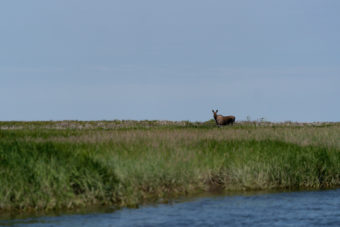
A moose, seen from across a stream, stands in tall grass
A moose near Newtok, Alaska, in the Yukon-Kuskokwim Delta. (Katie Basile)

Fall moose hunts are beginning across Alaska. In western parts of the state, biologists hope that hunting pressure will help protect the health of booming populations. They also want to know why there are so many moose in the first place.

It may have a lot to do with shrubs — particularly scrubby willows shooting up at the edges of open tundra. Moose feast on their leaves during the spring and summer. These short woody plants are spreading west, aided by climate change, and moose populations are expanding along with them. Researchers say it highlights the way that ecological changes cascade. Meanwhile, it’s prompting changes in hunting management, as people in rural areas depend increasingly on moose for subsistence.

The shrub spread appears to be caused by warming temperatures and the loss of snowpack in the Subarctic. Rick Thoman, a climate specialist with the International Arctic Research Center at the University of Alaska Fairbanks, said that spring in southwest Alaska has changed substantially, with snow melting earlier as temperatures rise. In the Yukon-Kuskokwim Delta, for example, the average springtime temperature has increased by more than 4 degrees Fahrenheit between 1972 and 2021. “That’s of course critically important for vegetation, because the earlier you can start to grow, the more you’re going to grow, in a Subarctic environment,” said Thoman.

Shrub expansion across the tundra, sometimes called “shrubification,” is visible from space: In satellite images, areas dominated by shrubs are greener than open tundra during the summer. Researchers track shrubification by comparing the greenness of images across the years. Shrubs have been proliferating in the rapidly warming global Arctic since at least the 1980s, and recent research shows that they are expanding in tundra below the Arctic Circle as well.

For moose in western Alaska, it’s been a boon. Their populations have swelled to record numbers in parts of the Yukon-Kuskokwim Delta and in the nearby Togiak National Wildlife Refuge. “From the early ’90s to now, we’ve seen at least a 400-fold increase in the moose population (in the refuge), which has tremendous effect on the environment,” said Sebastian Zavoico, a master’s student at the University of Alaska Fairbanks. A rise in moose predators, including bears, could be among the possible consequences. There might also be physiological changes to the shrubs moose eat. Willows can produce chemicals that make them less nutritious for moose as a defense.

A woman watches as children butcher a moose on a wooden table
Students learn subsistence skills while butchering a moose at Ayaprun Elitnaurvik, a Yup’ik immersion charter school in Bethel, Alaska. Subsistence hunting is vital both culturally and economically in rural areas. (Katie Basile)

Zavoico is studying changing moose demographics in the refuge. He’s found that when summer vegetation does well, so do moose: They give birth to more twins, and more calves survive. Satellite data shows that the refuge has grown significantly greener in the last two decades. That confirms what people who live in the refuge have told Zavoico: “Shrubs, which are the main moose food, have just exploded.”

But Zavoico is careful not to equate correlation with causation. For years, hunting and habitat management have aimed to boost moose populations in the refuge. Still, he said, the fact that moose are expanding in other western areas of the state suggests that climate change is also propelling the population boom. “It’s important to understand why (moose have) been expanding in the past so that we can better manage for the future,” Zavoico said.

The moose boom has huge implications for communities in the region that rely on the animals for subsistence. One moose can supply more than 500 pounds of meat, which is usually divvied up between several freezers as hunters share the bounty with family, friends and elders. It’s vital both culturally and economically, because it can help offset the high cost of groceries in rural areas. And moose hunting is increasingly important as numbers of caribou, another important subsistence animal, have declined steeply in this area in recent years.

The Mulchatna caribou herd in southwest Alaska is a traditional food source for villages from the Yukon-Kuskokwim Delta to Bristol Bay. For several years, however, the herd’s numbers have fallen below half the minimum population objective of 30,000 individuals.The Togiak National Wildlife Refuge and the Alaska Department of Fish and Game canceled last year’s fall caribou hunt. There won’t be one this year, either.

Biologists suspect that the decline is caused by a combination of factors, including disease, overhunting and increased predation by wolves and bears, according to public radio station KYUK.

Whatever the cause of the caribou decline, more people are relying on moose to stock their freezers. “In procuring lots of meat efficiently, moose are kind of your best bang for the buck, but also because the caribou population does not have any harvest available at this time, there’s a lot more people putting a lot more importance on the fall (moose) hunt,” said John Landsiedel, an Alaska Department of Fish and Game wildlife biologist for the west side of Bristol Bay.

A herd of caribou stands skylined on top of a snowy rise
Caribou from the Mulchatna herd graze near Eek Lake in the Yukon-Kuskokwim Delta. With a decline in some caribou populations, more people are relying on moose to stock their freezers. (Katie Basile)

This fall and winter, bag limits for local hunters are more liberal than usual in parts of Bristol Bay and the Yukon-Kuskokwim Delta: These hunts will allow people to harvest two moose each, and some of the harvested animals can be “antlerless,” or female. This could help moose as well as people: Managers don’t want the moose populations to outstrip the capacity of their winter food sources. “Antlerless harvest only occurs where … you’re trying to bring that population back down to a level that biologists have determined is more sustainable on the landscape,” said Landsiedel.

Last winter in the lower Yukon, the Federal Subsistence Board increased the limit for local hunters to three moose each at the request of the Yukon Kuskokwim Delta Subsistence Regional Advisory Council, which was concerned about a potential moose population crash. The council also said that low salmon runs in the region and the decline of the Mulchatna caribou herd underscore the urgency of the local moose hunt.

However, moose population trends are not uniform across Alaska’s southwest. Just east of the Togiak National Wildlife Refuge, moose numbers are dropping, mostly because bears are preying on calves. In that area, Choggiung Limited, an Alaska Native Corporation, has restricted hunting on land it owns near Dillingham, Alaska, to improve subsistence opportunities for its shareholders. For the second year in a row, it is reserving hunting big game animals — including moose — on portions of its property for its shareholders, with exceptions for other Alaska Native people, family members and proxy hunters.

“The bigger game is their primary meat for winter, so we’re trying to give the shareholders of our organization a little bit better opportunity to find big game,” said Mark Bielefeld, Choggiung Limited’s land manager. “We are stewards of this land. … It’s our future generations’, and we’re trying to uphold it for the future.”

More shrubs means way more moose in western Alaska was originally published Aug. 29, 2022 at High Country News.

Yukon River chum and coho runs remain too low to open subsistence harvest

""
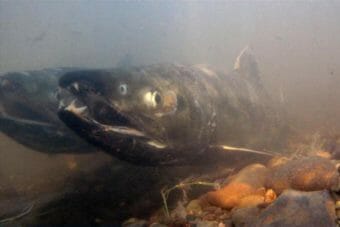
Chum salmon (NOAA photo)

Both the fall chum salmon and the coho salmon runs on the Yukon River remain too low to open subsistence harvest. Alaska Department of Fish and Game biologists do not expect either to reach their goals for fish reaching their spawning grounds.
An estimated three quarters of the fall chum salmon run is past the lower river. As of Aug. 21, the state-run sonar at Pilot Station counted 194,000 fall chum. That’s compared to a historical medium of 486,000 fall chum by that date.

The fall chum that have returned are slightly older than the historical average and with slightly fewer females than the historical average. The fish are also smaller, measuring 26 millimeters less than their historical average length.

The Yukon River coho salmon run is also far below its average run size but coming in higher numbers than last year’s record low. The Pilot Station sonar has counted 43,000 coho, compared to a historical average of 73,000 by this time.

Like the fall chum, the coho are also returning smaller. The coho are averaging 31 millimeters less than their historical average length. The sampled coho length averaged 544 millimeters, compared to a historical average of 575 millimeters.

At Russian Mission, state biologists have attached radio tags to over 118 coho as of Aug. 19. ADF&G asks anyone catching a coho carrying a tag to call the department at 907-459-7274.

Fishing for fall chum and coho salmon remains closed on the Yukon River. Selective gear types remain allowed, and fall chum must be returned to the water alive. Four-inch mesh gillnets are also allowed.

Yukon River state fishery manager Christy Gleason says mesh size restrictions are unlikely to lift until early October.

Correction: This story originally said that both fall chum and coho caught in selective gear must be returned to the water alive. That is incorrect. Coho can be retained along with non-salmon. Only fall chum must be returned to the water alive. Also this story originally said that four-inch mesh set nets are allowed on the Yukon River. That has been corrected to say that four-inch mesh gillnets are allowed.

For the first time ever, state to close Kuskokwim and most tributaries to coho fishing

""
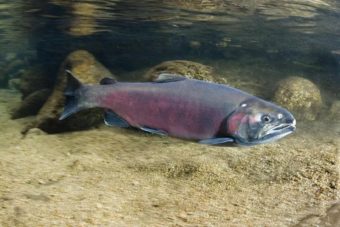
Coho salmon (NOAA)

For the first time ever, state fishery managers are closing the Kuskokwim River and nearly all its tributaries to coho fishing to conserve the species’ low returns. Anticipated federal action could still allow for some subsistence openings in the lower river.

For now, the month-long closure takes effect at 12:01 a.m. on Wednesday, Aug. 17. At that time, subsistence fishermen will no longer be allowed to fish with gillnets, fish wheels, beach seines, or dipnets on the Kuskokwim River, from the mouth upstream to the headwaters.

Nearly all Kuskokwim River tributaries will also close to this gear, except for the Gweek, Johnson, Kialiq, Tagayarak, and Eenayarak Rivers, which will remain open 100 yards upstream from their confluence with the Kuskokwim.

Subsistence fishing with this gear will continue to be allowed in non-flowing waters, including lakes, ponds, backwaters, and oxbow lakes of the Kuskokwim River drainage, according to the Alaska Department of Fish and Game.

Hook and line fishing will continue to be allowed throughout the drainage, but fishermen are not allowed to target coho and must return any coho back to the water alive.

The closures would mark the first time managers have closed the river to conserve coho salmon returns. State data indicates that the run is the second-lowest in the past decade and that the species is not expected to meet the state’s escapement goals for coho reaching the spawning grounds.

“As of Aug. 14, the Bethel test fishery cumulative CPUE for coho salmon was 746 (2008–2021 average is 2,112), and the total estimated passage past the sonar was 104,346 coho salmon,” Fish and Game wrote in its announcement.

However, federal managers could override the state’s actions in the lower river, from the mouth upstream to Aniak. These waters flow through federal land. Last week, Yukon Delta National Wildlife Refuge Manager Boyd Blihovde said that he planned to declare federal management of the coho run in these waters if returns remained low. Blihovde said that he would seek to allow some fishing opportunities for coho. The announcement is expected later this week.

The federal government has a restraining order against the state that prevents the state from issuing conflicting management orders.

News of the low coho run comes as a worrisome blow to people along the river. While other runs have been tightly restricted in recent years, fishermen could rely on an open river to catch coho at the end of the summer. Last month, many fishermen had said that they were planning to target coho after a summer of limited fishing openings.

How people on the Lower Yukon River are faring 2 years into the chum crash

A woman stands inside an empty smokehouse
St. Mary’s Elder Sophie Beans stands inside her empty smokehouse. (Photo by Olivia Ebertz/KYUK)

At the AC store in Emmonak, near the mouth of the Yukon River, Maggie Westlock was picking up a few things for dinner. In her cart she had grapes, coleslaw, sandwiches and some canned ham.

These are not the foods she and her family of 8 prefer to eat. During a normal summer, Westlock would be filling her family’s dinner plates and chest freezers with lots of wild chum and chinook salmon they catch themselves. But fishing for those two species on the Yukon has been closed for two summers because of a sudden and severe collapse.

That means Westlock’s diet is changing. Her family is relying more on store bought food. Her grocery bill has gone way up, and inflation is making things far worse.

Westlock rolled her cart over to the freezer section.

“I’ll show you something,” she said.

Westlock picked up a small pack of ribs, less than 2 pounds worth.

“This one is $37.10,” Westlock said.

On the other side of the store, things were even more dire.

“The detergent is very expensive! $62.99, that’s Tide and that Kirkland is $55.99. Expensive I tell you. And look at these pampers, huggies: $84.99. One box,” Westlock said.

The final damage was $81.81 for five items.

Residents are feeling the loss 100 miles upriver in St. Mary’s too. Elder Sophie Beans lives on the banks of the Andreafsky River, one of the Yukon’s salmon-spawning tributaries. She says when there was fishing, her whole block would be orange and smoke-filled.

“Full of kings and fish,” Beans said.

And now?

“Nothing! Nobody’s cutting,” Beans said.

Beans stood inside her empty smokehouse. The leftover smell lingered in the wooden walls, but it’s been two years since her smokehouse held fish. Both of those years, managers closed subsistence fishing for both chum and chinook to try to protect their dwindling numbers.

gyDow-yukon-river-summer-chum-run.png

Last summer, the Yukon’s summer chum run sank to just a tenth of its average size. This year numbers ticked up slightly for chum but collapsed even more for chinook, the Yukon’s most prized species. Normally, families would put away hundreds of both species to get through the winter.

“My son when he went drifting one time he caught 700 chums and it took us three days. Seven totes!” Beans said.

And that wasn’t even including the kings.

Beans uses every part of the fish from the head to the tail. She makes culunaq and egamaarrluk.

Beans usually keeps three chest freezers full of salmon, but now only one has salmon. It’s about a third full. That fish is from two years ago, when fishing was still allowed. She and her husband are now rationing, taking fish out for special occasions only.

Scientists point to warming seas

Scientists have been scrambling to figure out why western Alaska chum and chinook stocks are crashing. They’re starting to hone in on one primary cause for the chum collapse: recent marine heatwaves in the Bering Sea and Gulf of Alaska. Dr. Katie Howard from the Alaska Department of Fish and Game says that’s linked to climate change. There have always been marine heatwaves, but the recent ones are different.

“They were just bigger, they were geographically larger, they were more intense. And they lasted over a much, much longer period of time than is typical. And so that is what has been tied to a changing climate — that it’s more extreme when it happens. And the other expectation is that they may occur more often,” Howard said.

But Howard says they’re not exactly sure what’s impacting wild chinook, and that species has been on the decline in many Alaska rivers for a decade now.

Many residents also point to another driver behind the low returns of both species: commercial fisheries in the Bering Sea. State and federal managers have allowed these commercial fisheries to continue to operate, even as they have placed more stringent measures on Yukon River subsistence users.

The bow of a boat filled with white cardboard boxes
Frozen donated salmon coordinated through the state is some of the only fish people on the lower Yukon river will eat all year. (Photo by Katie Basile/KYUK)

The state says it wants to keep studying the fish before it takes action against commercial fisheries, but most subsistence users say they don’t have time for years-long scientific studies. Many want the state and the feds to more strictly manage the commercial fisheries now.

Some scientists argue that the numbers are now so low that getting each and every spawner back to the Yukon River matters. Dr. Howard says she is getting concerned, and this issue will only get more urgent as time goes on.

“If, over the course of more than five years, you’re not getting enough fish to the spawning grounds to replenish the population, you really start to become very concerned,” Howard said.

The low chinook runs are well past that five year mark.

Higher grocery bills, less protein

Across town in St. Mary’s, in a small house with a view of the Andreafsky and Yukon rivers, Jolene Long and Troy Thompson live with their six young children.

Thompson used to work as a commercial fisherman and has now been out of work for two years. He says they’re relying much more on the store and are spending two or three times as much on groceries compared to when the salmon ran abundantly.

To feed their family of 8, they spend $400 to $600 per week. They don’t eat much protein these days.

“When they do get a little bit of fish, they just gobble it up,” said Long.

Children cutting salmon
11-year-old Nicole Long practices cutting fish for the first time in two years with her mother, Jolene Long. (Photo by Katie Basile/KYUK)

The salmon crash means it’s become more difficult for parents to pass on their Yup’ik culture to their kids. Long used to cut fish with her oldest daughter every summer. Now her daughter barely remembers how to cut.

She did get a little practice after most tribal members in St. Mary’s received a couple of donated salmon each from the state.

For many in St. Mary’s, that small amount of donated salmon is the only taste they’ll get all year.

For the first time, live invasive green crabs have been found in Alaska

A hand holding a small, green crab
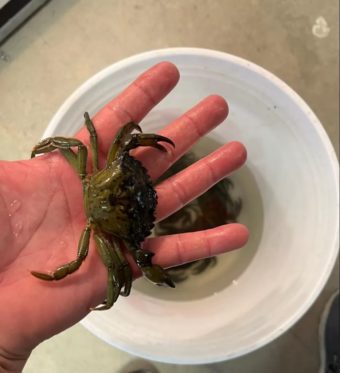
An invasive green crab that was collected in Metlakatla. Officials with Metlakatla’s Division of Fish and Wildlife are keeping the crabs alive in a refrigerator while more information is gathered. (Photo courtesy of Albert Smith).

When Metlakatla residents spotted invasive green crabs in their waters on July 22, the critters were dead. This time, they were alive.

Wildlife monitors in Metlakatla say they’ve found 13 invasive European green crabs in the waters around Annette Island — the first time they’ve been documented alive in Alaska.

Staff from the community’s Division of Fish and Wildlife have been combing the beaches and waters around Metlakatla for the five-spined crabs, which federal officials have called one of the most invasive marine species around. 

On Wednesday, Metlakatla Indian Community announced they had found 10 live crabs — four late last week and six on Tuesday. Then Albert Smith, Metlakatla’s mayor, said three more crabs were caught on Thursday for a total of 13.

A man sits on a floor and works on a rectangular cage
Spencer Guthrie, with Metlakatla Indian Community’s Division of Fish and Wildlife, works on an oyster bucket. The container will be used to catch invasive green crabs. (Photo courtesy of Albert Smith).

The crabs are largely falling into salmon traps around Tamgas Harbor.

“There’s a salmon trap that has been there for hundreds of years,” Smith explained. “And that’s kind of where they’re kind of congregating a little bit. Because it’s like a tide pool. So that’s where they’ve been catching them.”

Shrimp pots are also being set to catch the crabs, which is how staff from the Division of Fish and Wildlife caught one crab on Thursday. Another was found in an area with lots of eelgrass.

Of the 13 trapped live crabs, three are female and 10 are male. Smith said the Tribe’s scientists are preserving them alive for now for research.

“The people that are catching them are our Fish and Wildlife staff,” Smith said. “So they’re bringing them right to the office. And then we put them in a bucket of water, and then put them in the refrigerator until they can get all the data they need from them.”

In a statement, the Tribe announced that officials are working with federal and state partners to conduct genetic analysis and outreach efforts.

“It is essential that we address this matter urgently as GC (green crab) target juvenile Dungeness crab, juvenile salmon, shellfish and mollusks,” the statement read. “This species poses a real and present threat to our most critical subsistence and commercial resources.”

Smith said he’s concerned about what it means for the community’s traditional food sources.

“They go after salmon habitat and salmon fry,” he said. “Also, they go after most of all of our subsistence lifestyle.”

But at the same time, the discoveries haven’t been a total surprise.

“We’ve been watching them work their way up the coast, in the Haida Gwaii,” Smith said. “And then also over by Prince Rupert last year, which isn’t far from here.”

A bucket of small, green crabs
Invasive green crabs in a bucket of sea water. To keep the crabs alive while more information is collected, Metlakatla’s Division of Fish and Wildlife are keeping them in a bucket of cool in a refrigerator. (Photo courtesy of Albert Smith).

Smith said he’d like to avoid a situation like Washington’s experience dealing with the invasive crabs. The appearance of the species prompted Gov. Jay Inslee to issue an emergency proclamation.

For now, Metlakatla’s scientists are keeping an eye on the area and trapping the crabs. The goal of that work is to learn more about just how many might be in the area.

As for what to do with the crabs, NOAA strongly advises against releasing the invasive crabs back into the water. Smith said the community is still discussing options, but he noted that adding the crabs to the community’s garden compost pile might be a good idea.

Sightings of European green crabs can be reported to the Alaska Invasive Species Hotline at 1-877-INVASIV.

Sitka Tribe researchers are studying how far herring eggs travel when they get shared

A spoon in a bowl of herring egg salad
Herring egg salad served at the Yaaw Koo.éex’ in Sitka this year (Photo by Katherine Rose/KCAW)

Researchers in the Sitka Tribe of Alaska are trying to figure out how far subsistence herring eggs travel across the state — and beyond — each spring.

The distribution network for herring eggs is complex and far reaching. It’s estimated that around 87% of eggs harvested out of Sitka are given away, and eggs are often shared several times before they reach their final user.

Kyle Rosendale is a fish biologist for the Tribe. He says they’ve been surveying harvesters in the post-season since 2002. This year they’re expanding their survey efforts to include folks on the receiving end of the eggs, which are traditionally gathered on hemlock branches in Sitka Sound each spring.

“We received some feedback from people, and realized there’s a lot of information we’re not capturing about the distribution network for herring eggs,” Rosendale said. “We ask harvesters about meeting their needs and how they share herring eggs in our post-season harvest surveys. And this survey looks from the other end of the distribution network. How are final consumers meeting their needs? How do they receive eggs?”

Rosendale says they’ve received around 200 responses, so far. The survey takes about five minutes, and they’re looking for anyone who likes to eat subsistence herring eggs to respond, whether they live in Sitka, Southeast Alaska or farther away.

“We know they go to Juneau. We know they go to Bethel. We know they go to Hawaii and Ohio,” Rosendale says. “We’re just hoping to hear from some of those people about how they get eggs, and if they’re able to meet needs both for themselves and to share with all the people they would like to share with.”

Rosendale says the Tribe hopes the data will paint a picture of the overall reach of local herring eggs and will inform future research. Participants who fill out the survey will be entered in a drawing to win cash prizes.

Site notifications
Update notification options
Subscribe to notifications