Subsistence

Amid lowest chinook run ever, no end in sight for Yukon River subsistence closures

""
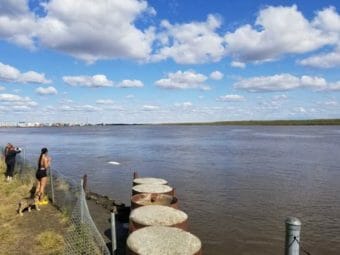
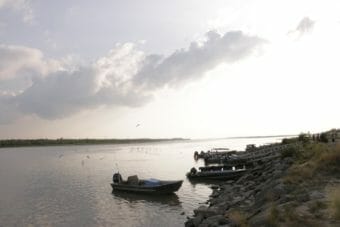
Skiffs line the Yukon River bank near the Kwik’Pak fish plant in Emmonak, Alaska on June 15, 2019. (Photo by Anna Rose MacArthur/KYUK)

Subsistence fishing for Yukon River chinook and summer chum salmon will likely remain closed through the end of the season.

It’s a possibility that fishery managers had warned could happen since before the salmon arrived.

Now, with both runs past their midpoints, fisheries officials say there’s no indication that there will be enough fish to meet the goals managers set for fish to escape to their spawning grounds.

“So unless these runs are abnormally, exceptionally, extremely late, it’s unlikely that we’ll get enough fish coming in the last part of this season,” said Alaska Department of Fish and Game Yukon River Fishery Manager Deena Jallen. Jallen gave the update during a weekly salmon teleconference hosted by the Yukon River Drainage Fisheries Association.

Only about 20% of the average amount of chinook and summer chum have returned to the lower river, according to data from the Pilot Station sonar. It’s the lowest chinook run ever, and the second lowest summer chum run, just barely more than what returned last year.

“So we know that it’s incredibly disappointing,” said Jallen. “It’s extremely hard to see these runs come back so low. It’s hard to have fishing be closed, but that’s unfortunately what we have to do when the runs are this small.”

A caller who identified herself as Ruby in Eagle said that she couldn’t provide a subsistence report during the teleconference since no one had been fishing.

“It’s very, very quiet at the public boat landing in town,” she said. “Almost eerily quiet.”

The community is facing other challenges as wildfires burn across the Alaska Interior.

“Very dry, very hot, lots of smoke. We haven’t had any measurable rain for a very long time, probably a month,” Ruby said.

Downriver, in Russian Mission, a caller who identified herself as Olga said that an elder has been asking her for a taste of fish.

“Then I told her that it’s not us that’s saying that they can’t fish; it’s just a regulation from way up high. And then she was practically crying and said, ‘Well, tell those people not to go shop for four weeks in their store. They have it easy to go to the store to get what they want to eat,’” Olga said.

Pink salmon counts are picking up in the lower river. Subsistence users can target pink and red salmon with 4-inch mesh set nets, 60 or fewer meshes in length, along with other gear types.

U.S. Fish and Wildlife Service Fishery Manager Holly Carroll asked fishermen to move their nets if they’re catching a lot of summer chum or chinook. She said that it’s important that each of those fish makes it to the spawning grounds.

“We have had years like this before, certainly for chum in 2000 and 2001, and we recovered. And I have faith that we can recover again and we’ll be fishing that species again, but just not this year,” Carroll said.

She also referenced the moratorium in 2013 and 2014, prohibiting all chinook harvest, and the rebound that followed. She acknowledged that prohibiting fishing for both summer chum and chinook is a compounded hardship.

“So while it may be hard right now, I’m just trying to put out a message for hope that if we let these fish go by now, we will be fishing on them again in five years time, four years time for the chum. That’s my hope. Maybe even less for the chum; maybe two or three years we could see these runs rebound,” Carroll said.

In the meantime, fishing for summer chum and chinook remains closed on the Yukon River for the second consecutive year.

At a Soldotna gun shop, national news drives local sales

Two men on either side of a glass display case that has several pistols laid out on top of it
Shoppers like Steve Milliron (right), say they want to keep their ammo supplies up in case of shortages. (Photo by Sabine Poux/KDLL)

When there’s a big national news cycle, Michael Modrell knows.

Not just from the Google Alerts he gets in his email or the news he sees on his phone, but also from the business in his store.

“Any time anything happens with Congress or the Supreme Court or gun control is brought up, people always come in and talk about it,” he said.

Modrell manages Soldotna Ammunition on Kalifornsky Beach Road.

He said whenever there’s unrest or something big in the news in the Lower 48 — even if it has little or no connection to Alaska — people come in and start stockpiling.
That’s especially true when there’s any news related to gun control. Last week, Congress passed a gun law, the Bipartisan Safer Communities Act, which enhances background checks for young people and funds risk prevention programs, among some other measures.

“The gun control one always makes people feel like now is the time to hurry up and buy these things that they worry they won’t be able to get later in the year,” Modrell said.

But he said spikes in business are not exclusive to gun control conversations.

When the Supreme Court overturned Roe v. Wade last week, customers from all sides of the political spectrum came in to buy supplies and talk politics. That was also true in 2020 and 2021, during the election and Black Lives Matter protests.

“It doesn’t matter if it’s even happening in our community,” Modrell said. “It’s just, people fear that it’s happening at all, in our nation. They feel this is the time to get stocked up on whatever.”

Modrell said some customers are concerned about personal safety when riots are happening in the Lower 48. But he said in large part, buyers stock up because they’re worried about the ongoing ammunition shortage that has hit gun supply stores around the country. They think that any sort of unrest or chaos in the Lower 48 could make that shortage worse.

Shelves in a gun shop, with many empty spaces
Industry watchers say the ammunition is still impacting supply, though less so than in 2020. (Photo by Sabine Poux/KDLL)

That shortage started in 2020 came from a combination of national turmoil and production setbacks.

Modrell said the shortage has improved, as vendors and buyers have caught up with the pent up demand. Still, it isn’t entirely resolved. At his store Wednesday, there were rows of empty shelves where there would normally be stacks and stacks of boxes.

And, not unlike the toilet paper crisis early in the pandemic, panic buying has just been making the problem worse.

“It always causes that little bit of panic,” Modrell said. “And we financially benefit from it. But we try not to encourage it, because a panicked customer base doesn’t really help anything.”

Customer Steve Milliron comes into the store two or three times a week to check out new inventory. It’s not far from his house, and he knows the guys in the store.

He’s noticed the ammunition shortage. He said he was shooting less to spare his ammo when it was at its peak.

“What I think it’s causing me to do is just try to probably keep more of a supply of ammo than I did before,” Milliron said. “And I always try to replace what I shoot.”

When something does pop up, he said, he might be more likely to come in, since things aren’t always available. And he thinks his friends are doing much of the same.

“Not so much hoarding, but just because you don’t know when you can find it,” he said. “And sometimes a couple boxes of things will show up, just randomly, and you go, ‘Oh, I could use that.’ and you get it and you don’t see it again for months. So it was a good thing that you did.”

It’s not just recreational gun owners like Milliron that are driving sales.

Soldotna Ammo sells supply to subsistence hunters in rural Alaska. And Modrell said those hunters, too, are stocking up — buying more supply at one time in case ammo hits another supply chain hitch.

“I’ve been planning to try to go to Bethel and Mountain Village and a few of those ones around there to see what it’s been like there,” Modrell said. “I know the prices they’re charging for now are much higher because a lot of them, just like a lot of businesses, do a percentage over what they pay. And the cost for the ammo costs more now, the shipping it out there cost more now. There are hazmat fees that we didn’t use to have.”

But not everyone’s buying. Some people just want to see what other gun owners are thinking.

Modrell pointed to one customer on the security camera, who was browsing at a glass case. He said he comes in almost everyday, though he rarely buys anything.

“People spend more time in the shop, even if they’re shopping less,” Modrell said. “Because they want to talk about whatever big thing happened.”

As long as people feel like there are big things happening nationally, he’s not sure that traffic will let up any time soon.

EPA extends comment period on watershed protections that would block Pebble Mine

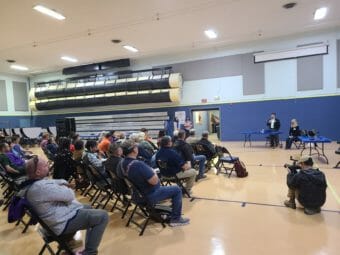
A public meeting in a gymnasium
Residents flew in from around the Bristol Bay region to give public comment on the EPA’s proposed determination. (Photo by Corinne Smith/KDLG)

The Environmental Protection Agency announced last week that it is extending its comment period for proposed restrictions on mining of the Pebble deposit. The comment period was originally set to end in July. Now it will continue for two more months, to Sept. 6.
Representatives with the EPA visited Dillingham and Newhalen earlier this month to hear public testimony on the agency’s proposal to protect waters around the Pebble deposit. It was the first in-person public hearings since the start of the COVID-19 pandemic.

Dozens of residents from around the Bristol Bay region traveled to Dillingham to weigh in.

Robin Samuelsen is a board member of the Bristol Bay Native Corporation. He has fished in the bay for 57 years and now fishes with four grandsons on his boat.

Samuelsen urged the EPA to take action to protect salmon runs that support Alaska Native ways of life.

“My family has subsisted in Bristol Bay for thousands of years. Subsistence is the most important fish you can put in front of an individual in Bristol Bay,” he said. “We live and die by our fish.”

If finalized, the EPA’s determination would implement federal watershed protections for South Fork Koktuli River, North Fork Koktuli River, and Upper Talarik Creek watersheds. It would also pose restrictions on mining waste discharges around the proposed mine site.

Bertha Pavian-Lockuk flew in to testify from Togiak, a community about 67 miles southwest of Dillingham.

“This two minutes, you will not fully get all the detailed information that each person that flew in from each village has. It’s not enough time for me, or any of us,” she said.

She thanked the EPA representatives for visiting in-person and stressed the importance of healthy salmon runs in her community.

“Our subsistence lifestyle, each and every one in here is carrying on. My children and my grandchildren are still subsisting today. And we are teaching our children of what we have learned from our parents and grandparents,” she said. “And we’ve gone through this COVID, we just we are still going over (it), and subsistence was our only way, only source of food that we were able to survive by.”

In 2014, when the Obama administration released a proposed determination for protections, more than a million people — including tens of thousands of Alaskans — commented in support of the federal protections for Bristol Bay. In 2019, the Trump administration revoked the proposal.

In May, the EPA used its authority under the Clean Water Act to issue a revised proposal that included analysis from multi-year environmental reviews and Pebble’s mining proposal.

EPA spokesperson Suzanne Skadowski says the agency found that the mine would negatively affect salmon habitat in the area.

“Basically, within the mine footprint, the fisheries are too sensitive and too important to be doing any any discharges in related to the mine, in that footprint,” she said.

But Skadowski says the EPA’s plan would only limit mining of the deposit as proposed by the Pebble Limited Partnership.

“It’s very specific to the Pebble deposit and the Pebble Mine to that area, and not to any other development or mining that might be happening in Alaska, it’s very specific to their plan,” she said.

Many Bristol Bay tribes, fishermen and environmental advocates want to see comprehensive protections and bans on any mining activity near the bay.

Skadowski says the EPA can only restrict digging and dumping that would impact waterways around the Pebble Mine site, but federal authorities could further restrict mining. For example, Congress could create a protected area in Bristol Bay.

During a virtual hearing, interim CEO of Pebble Limited Partnership John Shively opposed EPA restrictions on the mine, citing demand for copper resources.

“Copper is essential to the green economy,” Shively said. “This federal administration is attacking not only Pebble but, for other mines, how it thinks you’re gonna get all the minerals you need in order to do the green economy?”

Shively has served as interim CEO since 2020, when former CEO Tom Collier resigned after secretly recorded comments about close relationships with elected officials and federal regulators were released, known as the Pebble Tapes.

Dillingham Mayor Alice Ruby says that since the EPA started to deliberate about protections for Bristol Bay, the economic value of the commercial fishing industry has only increased. She says the city opposes any mining activity that puts it at risk.

“We’re even more committed now to protecting that industry from the huge risk presented by large scale mining in the very waters that assure our industry, our economy and our future,” Ruby said.

Bristol Bay is forecasted to see a record-breaking harvest of 75 million sockeye salmon this summer. The commercial fishing industry is estimated at roughly $2 billion in 2019 and 15,000 jobs.

The EPA announced last week that it would extend the comment period on its proposal by another two months. At another public hearing, the state Department of Environmental Conservation spoke in favor of an extension. But mining opponents have said they want this process to wrap up as quickly as possible.

The EPA will accept written comments on the proposed restrictions on mining of the Pebble deposit until Sept. 6. A final determination is expected to be issued before the end of the year.

Pollutants from far distances found in Bering Sea animals hunted by Indigenous people

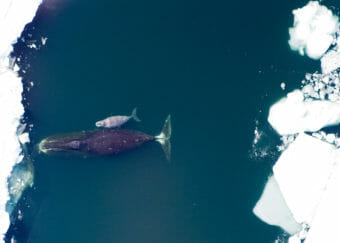
An adult whale and calf swimming among ice floes
A bowhead whale and calf are seen swimming in an open-water lead the Arctic Ocean in this undated photo. A new study appears to be the first to document the presence of PFAS compounds, known as “forever chemicals,” in body tissues of bowhead whales. (Photo provided by the National Oceanic and Atmospheric Administration)

Chemicals from fire retardants and other materials have accumulated in the bodies of seals, whales and other animals of the northern Bering Sea, showing that pollutants emitted thousands of miles away continue to contaminate animals on which Indigenous people depend for food, according to a newly published study.

The study, published in the journal Environmental Science and Pollution Research, focuses on marine mammals and reindeer harvested by the Yup’ik residents of St. Lawrence Island, at the southern end of the Bering Strait.

Through samples donated by hunters, researchers – who included island residents themselves – found varying levels of polybrominated diphenyl ethers (PBDEs) and per- and polyfuoroalkyl substances (PFAS) in marine mammals and reindeer on or around the island.

PBDEs are a class of compounds used as flame retardants. PFAS compounds are also used for that purpose but are found in a wide variety of consumer products such as cosmetics, clothing and cookware; they are known as “forever chemicals” because they do not break down in the environment. PBDEs have been phased out in the United States since 2004, but there is no national PFAS ban.

The study of subsistence foods at St. Lawrence Island shows how contaminants carried to the far north by atmospheric and ocean currents persist for years and sometimes decades, burdening the region’s Indigenous people.
Two women, standing outside, hold a large photo of another woman
Pam Miller, executive director of Alaska Community Action on Toxics, and Vi Waghiyi, the organization’s environmental health and justice program director, hold up a photo of the late Annie Alowi, a health aide from the St. Lawrence Island community of Savoonga who spurred studies of contaminants from local and long-range pollutants. Miller and Waghiyi are co-authors of a study that examined contaminants found in marine mammals and reindeer that the Yup’ik people of St. Lawrence Island hunt for traditional foods. Waghiyi is also from Savoonga. (Photo by Yereth Rosen/Alaska Beacon)

“We are being contaminated against our will,” said study co-author Vi Waghiyi, who is from Savoonga, one of the two villages on the island.

Still, the findings should not deter people from conducting their harvests of negepik, or traditional foods, said Waghiyi, the environmental health and justice program director at Alaska Community Action on Toxics, a nonprofit environmental health organization based in Anchorage.

“Our people still feel the benefits outweigh the risks. It is our identity,” she said. “We’re intricately tied to our lands and waters and wildlife that have sustained our people since time immemorial.”

The St. Lawrence Island findings are, in some ways, similar to those of other studies of contaminants in animals around the Arctic.

There were some new discoveries, however. The study appears to be the first to document PFAS compounds in bowhead whales, with traces showing up in mangtak – the name for skin-attached blubber – and blubber alone and muscle.

It also found that of all tested species, seals generally had the highest levels of PBDEs. That shows how persistent those chemicals are in the environment, said Pam Miller, ACAT’s executive director.

“Even though they’ve been subject to some global regulation and regulation in the U.S., they’re still very ubiquitous in the Arctic and still prevalent in people and wildlife that people depend on for traditional foods,” said Miller, another co-author.

The study, which used tissue samples provided by local hunters, is the latest in a series in a research program conducted by ACAT and its partners. The program traces back to the advocacy of Annie Alowa, a former health aide in Savoonga, who pushed for cleanup of military pollution on the island after watching so many villagers get cancer and other health problems. Much of the inspiration for ACAT’s founding and its continued work; she died of cancer herself in 1999.

Strips of meat drying on horizontal poles
Walrus meat dries on a rack in Gambell, one of the two communities on St. Lawrence Island, in 2005. Walruses were among the animals tested in a study that traced persistent pollutants in the Bering Sea environment. (Photo provided by the Alaska Division of Community and Regional Affairs)

The research program is notable for its community focus and reliance on local leadership and knowledge, said Waghiyi, who was named last year to a White House advisory council on environmental justice. “It’s one of the few where we’re not just research subjects,” she said.

While this newly published study focuses on pollutants that are carried long distances in the air and in the ocean, other work in the program is continuing to examine the effects of pollution from Northeast Cape, a military site closed in the 1970s, and other on-island sites.

St. Lawrence Island gets pollution from both faraway and local sources, and it is possible to distinguish between the two, said study lead author Sam Byrne, an assistant professor of biological and global health at Middlebury College.

Proximity to military sites and places like landfills is one distinguishing factor, he said. The types of chemicals discovered is another factor, as lighter compounds are more volatile and can be more easily carried by the winds, while heavier compounds such as some of the PCBs found near Northeast Cape, tend to not travel far.

The face of a white seal, in profile
A Bering Sea bearded seal displays its distinctive whiskers. A study of animals hunted by St. Lawrence Island’s Indigenous people found that the highest levels of flame-retardant chemicals were generally in seals. (Photo provided by NOAA)

The problems go beyond emissions of dangerous chemicals, Waghiyi and Miller said. Melt of sea ice and glacier ice, thaw of permafrost and the proliferation of microplastics in the ocean is also spreading contamination, some of what had previously been sequestered in frozen states, they said.

“The convergence of climate, chemicals and plastics has not been fully appreciated by the scientific community or climate-justice activists,” Miller said.

The eight-nation Arctic Council is one organization that has made the connection between climate change and persistent organic pollutants, known as POPs.

report issued at a meeting last year of high-level officials from council nations showed how climate change has eroded some of the progress made since the mid-1990s by international bans and phaseouts of dangerous chemicals. In some places of the Arctic, the report said, POPs are even increasing in concentration after earlier declines.

Moose population boom, linked to climate change, inspires some hunting changes

A large bull moose stands in a stream
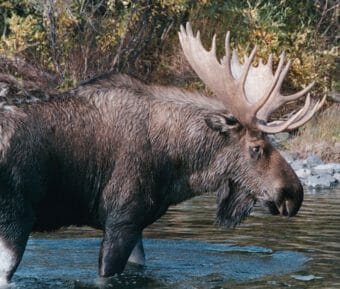
A bull moose stands in Nunavaugaluk Lake, October of 1997. The moose population in the nearby Togiak National Wildlife Refuge has boomed over the past three decades. (Photo by Andy Aderman/U.S. Fish and Wildlife Service)

In southwestern Alaska, where there is a mix of tundra, mountains, forests and river-crossed terrain, there has been a rapid transformation in the wildlife.

In the Togiak National Wildlife Refuge specifically, the moose population has increased a whopping 400-fold since the early 1990s, from just a handful a few decades ago to about 2,000 animals now.

The reason appears clear: climate change. Milder winters and the proliferation of vegetation correlate directly with the moose population boom, according to ongoing research by Sebastian Zavoico, a graduate student at the University of Alaska Fairbanks.

The strongest part of the trend seems to be in river-crossed areas on the western side of the refuge, where woody shrubs have spread into areas that used to be more tundra-dominated, said Zavoico, who has used mathematical analysis to compare climate and vegetation changes with moose population changes.

The Togiak moose changes are part of a global pattern, Zavoico said. “We know that species are shifting their distribution all over the world,” he said. “It definitely fits the mold, that’s for sure.”

‘Tundra Be Dammed’

In Alaska, the shifting populations include moose and snowshoe hares moving farther north onto territory that used to be strictly tundra but now has woody plants, such as the North Slope. It also includes beavers, which have become fixtures in some Arctic areas where they were rare only a few decades ago. Beavers not only take advantage of the new shrubby conditions but, through engineering their dams and lodges, are hastening permafrost thaw and other ecological changes, as described in a UAF-led study appropriately titled: “Tundra Be Dammed: Beaver Colonization of the Arctic.”

While the changes have been good for some species, including moose in the Togiak refuge, they mean trouble for others. Among the highest-profile losers in the transformation are caribou, which depend on tundra vegetation like lichen and moss.

Scientists working in western Greenland, for example, found a “trophic mismatch” that is bad for caribou calf survival. The plants are emerging earlier, thanks to warming temperatures, but the daylight-regulated calving season has not changed accordingly, meaning the animals are missing out on the most nutritious greenery when they need it most, the scientists found.

As in some other regions, the caribou and moose trends have gone in opposite directions around the Togiak National Wildlife Refuge. The region’s Mulchatna Caribou Herd, which numbered about 200,000 animals in the late 1990s, is now down to about 12,850, said Andy Aderman, a U.S. Fish and Wildlife Service biologist working at the Togiak National Wildlife Refuge. The low population count triggered an emergency hunting closure last year.

Hunting changes

For people who have traditionally relied on caribou meat, a shift to moose hunting is logical, Aderman said. “The need doesn’t go away,” he said.

In sharp contrast to the situation with caribou, moose-hunting seasons in the area are liberal, appropriate to the science about moose populations. There is even a concern about the moose population getting too big too quickly, devouring the plants and overwhelming the region’s carrying capacity. “Something we’d like to not see is starving moose,” Aderman said.

Around Alaska and the wider Arctic, the rapidly changing climate has sometimes created mismatches with hunting and fishing seasons. Sometimes the regulatory calendar, which can be difficult to adjust, misses the altered arrival of the fish and game the hunting and fishing rules target. Sometimes the designated seasons no longer match conditions for safe travel over the tundra, snow or ice.  Sometimes, hunting practices adjust.

In Kotzebue, for example, subsistence hunters are coping with a compressed season for their spring hunts of bearded seals. The ice floes that the seals rest on melt away earlier, so hunters make more frequent boat trips over a shorter time period, a change detailed in recently published research.

Six moose, seen from above, browsing in low willows
Six moose feed on willows in March of 2007 along Land Otter Creek in the Togiak National Wildlife Refuge, March 2007.
The refuge’s moose population has boomed over the past three decades. (Photo by Andy Aderman/U.S. Fish and Wildlife Service)

While seal-hunting success rates have been maintained, local people are having less success with the beavers that have proliferated in the Kotzebue region, said Alex Whiting, environmental specialist for the Native Village of Kotzebue.

Overall, beaver trapping is a lot of work for little reward, as “the fleshing and putting up of beaver is the most labor intensive of all the fur, especially for novices,” Whiting said by email, referring to the region’s fur-bearing animals.

Fur prices are low in the commercial markets, and fur from animals like sea otters is generally preferred, Whiting said by email. Harvesting beavers “is more complicated trapping than most, because most of the sign is underwater and the trap sites are covered in ice and snow,” he said, and working on the ice can be unsafe.

Around the Togiak refuge, the switch from caribou to moose hunting hasn’t always been easy, either. “I think some people prefer caribou over moose for flavor,” Aderman said. A single moose generally weighs about 120 pounds more than a single caribou, meaning some logistical challenges for hunters, he added. “One person can usually handle a caribou by themself,” he said.

Both people and bears adjust

While people are adjusting, so apparently are bears. They are famously reliant on the region’s rich salmon runs, but they are also learning to prey on the young moose calves available each spring.

Aderman said he has even seen bears lying in wait nearby when pregnant cow moose are bedded down and preparing to give birth.

In recent years, Zavoico said, the region’s staggeringly high rate of calf survival has dipped, potentially a sign of bear predation. “It seems like the story that I’ve heard is the bears are starting to take advantage of this new resource that they’ve never had before,” he said.

Scientists want samples from the beluga whales that swam up the Kuskokwim River to Bethel

People onshore watch a beluga whale swimming in a large river
Onlookers gather to watch a beluga whale swimming in the Kuskokwim River near Bethel, Alaska on May 26, 2022. (Photo courtesy of Anne Kosacheff)

In an unusual event, a pair of beluga whales swam about 60 miles up the Kuskokwim River to Bethel. After word got out, boaters pursued the belugas and took at least one of them. Now, an official is working to collect samples of the animal to better understand where it came from.

Anne Kosacheff lives along the Kuskokwim River in Bethel. Last Thursday, around 6 p.m., she and a friend were sitting outside when they saw something white in the river below.

“Initially I thought they were swan, because what else is bright white and big across the river?” Kosacheff said.

But no, she realized, they weren’t birds. Still, they were too far away to see. Kosacheff went inside for a bit, and then shortly after stepped back out.

“And there was this beluga whale turning around literally at my feet. I mean, 30 feet away, but at my feet,” Kosacheff said. “And I was stunned.”

She ran to get her camera and then ran down the hill to the seawall to get closer.

“It came up for air literally 10 feet in front of me. There were two of them,” Kosacheff said.

More people began gathering to watch the whales.

“They swam around in front of Bethel maybe 30 minutes, and there was a crowd of us just oohing and ahhing and taking pictures. And it was really quite an amazing thing,” Kosacheff said.

Jennifer Hooper also lives along the Kuskokwim River in Bethel. Her friend told her about the beluga, and she walked to the seawall to watch them.

“After a good half hour or so, maybe even an hour, it was obvious that some boats were heading out and were actively going to be looking for them and pursuing them,” Hooper said.

At least six boats began hunting the whales. Hooper watched them take at least one of the belugas near the island across from the Bethel riverfront.

Alaska Native people can legally take beluga whales under the Marine Mammal Protection Act.

Hooper works as the Natural Resource Director for the regional Tribal nonprofit, the Association of Village Council Presidents. The association is part of the Alaska Beluga Whale Committee, which co-manages beluga stocks in Western and Northern Alaska. The committee encourages hunters and scientists to work together to collect samples of harvested beluga to better understand and manage them.

Hooper is trying to track down the hunters so she can collect samples. There’s not much data on where the beluga are migrating from that swim along the region’s coast.

“We’re trying to get more samples from whales that are harvested from our region to know more succinctly whether they’re whales that are migrating north or back south,” Hooper said.

This work includes collecting a skin sample to gather genetic data, salvaging its lower jaw bone to look at its teeth for signs of aging, and observing health indicators like its stomach contents to see what it was eating.

Hooper noted that pursuing food could be the reason why the beluga swam about 60 miles up the river to Bethel. The first king salmon have begun running up the river, and more are expected to follow.

Site notifications
Update notification options
Subscribe to notifications