Subsistence

Subsistence harvesters, seiners react to fuel spill north of Sitka

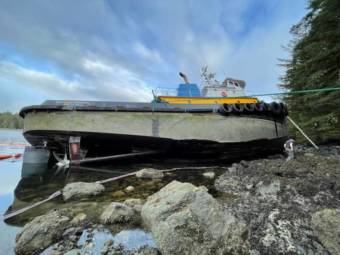
A tugboat stranded on a rocky beach
View of the Western Mariner and primary boom configuration as of March 25. (ADEC Photo)

Herring seiners and subsistence harvesters are grappling with a large diesel spill near Sitka that happened last Monday.

On Thursday, state managers shifted the focus of the commercial fishery away from the areas where an oily sheen has been reported and were conducting test fishing instead on eastern shore of Kruzof Island.

KCAW spoke with commercial fisherman Matt Kinney on Friday, who said the weather forecast was one sign that fishing could happen soon — which it did, with an opening this weekend.

“I think this nice stretch of weather that we have coming into the weekend is going to cause the picture to change quite a bit, and you’ll see a lot of fish separate out,” Kinney said. “And we’re actually seeing a tremendous amount of biomass out there.”

Kinney has been on the Kruzof shoreline and north into Promisla Bay. No sign of the diesel sheen had been reported in those areas. Over the week, diesel sheen was reported from as far north as St. John Baptist Bay and, as of Thursday, as far south as Krestof Sound, near the Magoun Islands.

Kinney says wind had pushed the sheen north, and the schools of herring commercial fishermen are tracking hadn’t moved into Krestof Sound yet.

“There really hasn’t been any fish mixed with the diesel that I’ve seen, but you know, I know there’s a lot of concern about that,” Kinney said. “And so we’re trying to be really careful. You know, they won’t let us fish anywhere where there’s even a hint of sheen. And that’s really responsible by the department.”

Subsistence harvesters begin to assess fuel spill impact on fishing grounds

While commercial fishermen were preparing for a fishery, subsistence harvesters were trying to figure out how the diesel spill could affect their harvest season, which typically happens a little later in the spring. Krestof Sound — one of the areas where diesel sheen was spotted on Thursday — is an important spawning area for herring.

Andrew Roberts has been harvesting herring eggs since the early 1980s. He was heading out Friday afternoon to scout locations for setting branches.

“I am very concerned. Very concerned,” Roberts said. “And it’s almost like it’s kind of a worst-case scenario of the catastrophic spill like this … during a time when the precious herring are expected to spawn.”

He says in all the years he’s harvested, he’s never seen a fuel spill this big or this close to spawning grounds. He typically sets branches in the Hayward Strait area but said he would be documenting any diesel sheen he spots along the way and looking for safer locations to harvest eggs.

Roberts’ partner, Paulette Moreno, who has been harvesting eggs for the last decade, says the stakes are high for the herring right now, and called on Sitkans to respond.

“I believe this is an emergency. We need more resources sent to the Sound as soon as possible,” Moreno said. “We went through an area close to [the spill site]  just a couple of days ago. And it was such an eerie silence. I didn’t see any wildlife or marine life in sight. And it was a strong feeling of mourning. So I would humbly call on all of us as a community, and supporters of our community, to gather and use their voices, that absolutely every tool and every resource is brought here to Sitka and is put on this area.”

After nearly a month, Hooper Bay has plugged the 40-foot hole in its sewage lagoon

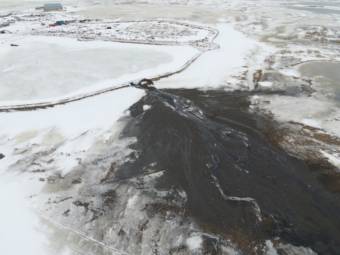
An aerial photo of a brown area downhill of a breach in the wall of an ice-covered lagoon
Hooper Bay’s sewage lagoon was leaking onto the surrounding tundra. (Photo courtesy of Paul Galvez/Lower Yukon School District)

After nearly a month, Hooper Bay’s sewage lagoon has finally stopped leaking out onto the tundra. Hooper Bay City Administrator Sandra Tall-Lake said that by March 21, city workers had put enough sand into the hole in the sewage lagoon to stop the flow of sewage leaking out.

It’s taken so long because the hole is large — 40 feet wide by 15 feet tall — requiring a lot of sand to fill it. Plus, city employees had trouble plowing a path through heavy snow to the beach to get enough sand.

An excavator on top of newly moved dirt
Hooper Bay workers have stopped the flow of sewage onto the surrounding tundra. (Courtesy of Sandra Tall-Lake/City of Hooper Bay)

Hooper Bay residents have also continued to run water and flush their toilets in the last month because, as Tall-Lake pointed out, the community’s pipes would freeze if residents stopped using them.

The sewage has been flowing into a slough, an important subsistence location for the coastal community. But because of that, the city administrator said that the spill on the tundra hasn’t gotten bigger. Tall-Lake said that city workers will continue placing sandbags in the hole this week. It won’t completely fill the hole because the community doesn’t have enough sand.
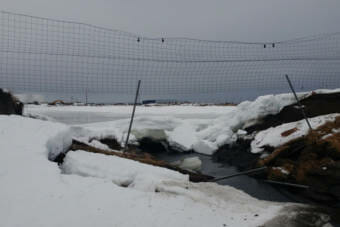
Hooper Bay’s long-term solution will be to build a new sewage lagoon, which is expected to be completed in around three years. Tall-Lake said that the city did not yet have a plan for what to do with the existing lagoon in the meantime.

Hooper Bay’s sewage lagoon has failed, spilling onto an area vital to local subsistence

Water flowing from a breach in an ice-covered sewage lagoon
A leak in the Hooper Bay sewer lagoon caused it to spill out onto the surrounding land on Feb. 25, 2022. (Photo courtesy of Sandra Tall-Lake/City of Hooper Bay)

The sewage lagoon in Hooper Bay began leaking early on the morning of Feb. 25. By the afternoon, the entirety of the community’s sewage had poured onto the surrounding tundra, threatening an important subsistence location for the coastal village. Community leaders are worried it could spread further and are calling upon the state for help.

The spill followed a sudden rise in warm temperatures in recent days. Hooper Bay Mayor Sandra Hill said the thaw and rain had melted the previously frozen land surrounding the sewage lagoon, causing a wall of the lagoon to cave.

Hill said that the sewage spill is around 500 feet north of the nearest resident’s home, in an area that is a vital source of subsistence foods for Hooper Bay’s approximately 1,100 residents.

“North of the village sits a slough where we usually fish. We go and gather greens from north of the village back there,” Hill said. “I’m worried about food security for our village.”

City employees were busy on Feb. 26 plowing the roads leading to the sewage lagoon to allow heavy machinery to reach the spill. But Hill said the city is unsure how it will fix the lagoon or clean up the spill once the machinery gets there.

“We are not engineers. We need engineers to help us,” Hill said.

The day of the spill, the City of Hooper Bay declared a state of emergency and reached out to the Alaska State Emergency Operations Center for assistance.

The following day, Gov. Mike Dunleavy issued a state disaster declaration for the village of Hooper Bay, which Alaska Division of Homeland Security and Emergency Management spokesperson Jeremy Zidek said would allow Hooper Bay to get reimbursed for their response efforts.

Zidek said that the Yukon-Kuskokwim Health Corporation would be working with the community to fix the broken walls of the lagoon. He said cleaning up the spill could take months, and that Hooper Bay will have to try to deal with the situation locally before the community can turn to the state for help.

But Hill said it was already clear that Hooper Bay would not be able to clean up the spill on its own. And she was worried it could spread quickly with temperatures above freezing this week.

In addition to cleaning up the spill, Hooper Bay will also need to stop it from getting bigger. As of Feb. 26, Hill said that the breach in the sewage lagoon had not been fixed, and any resident that flushed their toilet or ran their faucet would likely add to the spill on the tundra.

Hill said half of Hooper Bay is connected to piped water and sewer, and she said that city officials are considering asking those residents to stop running their water and switch to using honey buckets until the breach in the lagoon is contained.

This is the second disaster declaration the governor has issued this month to aid a Yukon-Kuskokwim Delta community. In mid-February, the governor issued a disaster declaration to make state funding available to help the coastal community of Tununak after its washateria burned down.

Biden administration deals setback to Ambler road

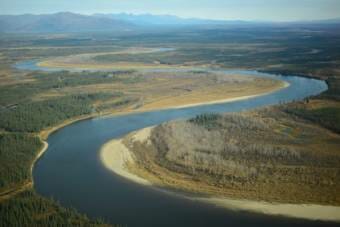
Aerial view of Ambler and the Kobuk River in the summer. (Photo courtesy of the National Park Service via UAF Gates of the Arctic Research Portal)

The Biden administration is reeling back federal permission for the proposed Ambler road, a project that would support large-scale mining in Northwest Alaska.

In a court filing Tuesday, the administration agreed with road opponents that the environmental analysis of the project is flawed. The Interior Department wants to reconsider the federal right-of-way permits that the Trump administration granted.
Alaska’s congressional delegation blasted the decision. Sen. Lisa Murkowski called the move a setback for the project but said the fight is not over.

“This project is too important to us in the state, to the people in the region, and really to the country for the resource,” said Murkowski.

The Ambler mining district is believed to contain large amounts of good-quality copper and other minerals that proponents say will be important to an economy based on renewable resources. The proposed access road would stretch 211 miles in the Brooks Range, with 26 of those miles in the Gates of the Arctic National Park.

State Sen. Donny Olson, a Democrat who represents the region, said his constituents need the road and the mining it will support.

The project, though, is controversial. Tanana Chiefs Conference President Brian Ridley calls it a threat to cultural resources and the subsistence way of life.

Bycatch task force works to refine mission ahead of November deadline

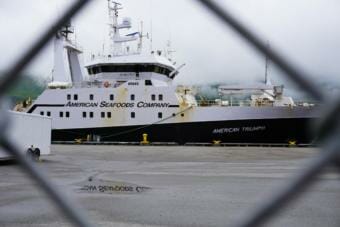
The American Triumph — a 285-foot factory trawler, with an onboard processing plant — sits in the Port of Dutch Harbor on Friday, waiting for clinic staff to test the remaining members of its 119-person crew. (Photo by Hope McKenney/KUCB)
The American Triumph — a 285-foot factory trawler with an onboard processing plant — sits in the Port of Dutch Harbor on Friday. (Photo by Hope McKenney/KUCB)

The governor’s task force to review the effects of bycatch in Alaska fisheries is working to organize against its tight timeline for submitting recommendations to state and federal policymakers. It also has to balance commercial and subsistence interests.

Bycatch is when fishing vessels catch something they’re not targeting. It could be tanner crab caught in a black cod pot or halibut scooped up in a pollock trawl net. It’s been a contentious issue in Alaska’s fisheries for decades. Now, as stocks of crab, salmon and halibut decline, trawl fisheries have come under fire for their role, which represents the vast majority of incidental catch in and around Alaska.

The governor’s office took notice. Gov. Mike Dunleavy established a task force to review bycatch late last year, with a deadline of November to submit its recommendations.

But during that time, the Alaska Bycatch Review Task Force also has to establish its own priorities, break into subcommittees, and decide what it’s going to focus on before its mandate expires in just nine months. And there’s a lot of information to sort through already as it plays catch-up.

At an almost six-hour meeting on Feb. 11, the task force heard presentations from the state Department of Fish & Game, North Pacific Fishery Management Council staff, and the National Oceanic and Atmospheric Administration with data and information about bycatch of many species, including salmon, crab and halibut. Task force members questioned the experts about existing bycatch data.

Kevin Delaney holds the seat on the task force designated for sport and personal use fishermen. He told his fellow task force members they need a clear focus to be effective.

“If we just start throwing data at the wall hoping something sticks, we’re just going to spend the next nine meetings doing the same darn thing that the North [Pacific Fishery Management] Council has already done and the Board of Fish has already done,” Delaney said. “We’re here because a problem has risen to the top loud enough that the governor called us together.”

Over the last year, some of the loudest voices advocating for action to reduce bycatch have come from tribal organizations in Western Alaska, in communities that have seen subsistence salmon harvests dramatically reduced, or stopped entirely.

Early in the task force’s process, frustrations are already simmering about who’s in the loop. Kuskokwim Inter-Tribal Fish Commission executive director Mary Peltola said she wasn’t notified of the meeting in advance. Public outreach fell short, she added, saying online portals and state public notices don’t reach the people most affected by declining fish populations.
“If there were real interest in hearing from the public, there would be a real effort put to letting the public know when and where the meeting is happening and how to provide their opinions or their feedback,” Peltola said. “The composition of the task force, the timing of the task force, one hundred percent, the task force is a campaign charade.”

The Kuskokwim Inter-Tribal Fish Commission is one of several Western Alaska tribal consortiums requesting state and federal support during salmon disasters. And that’s not new: salmon runs in Western Alaska have been declining for more than a decade, and affected communities have been requesting action for just as long.

Peltola also questioned the need for a task force at all. She says the Dunleavy administration already has tools to manage fisheries to give relief to struggling subsistence stocks through the Alaska Department of Fish & Game.

“After decades of prioritizing ex-vessel value and commodifying our resources over Alaskan citizens’ own freezers, and own larders, now he’s doing a Food Security Task Force, and not including any subsistence users. That’s a total punch to the gut. It’s adding insult to injury. The bycatch issue is a food security issue,” she said, referring to the Alaska Food Security Task Force, which is separate from the Bycatch Review Task Force. Gov. Dunleavy announced the task force on food security at his State of the State speech earlier this year.

But others expressed optimism about the bycatch task force. At its Friday meeting, the task force heard from a variety of fisheries stakeholders, including a few trawl fishery representatives, who say they’re ready for conversations.

United Catcher Boats, which represents pollock and cod trawlers, says its members are collecting data and are willing to share findings with the task force about what it’s found keeps salmon, halibut and crab out of nets.

But UCB Executive Director Brent Paine also told the task force he doesn’t see much room for improvement. UCB boats are already using best practices to avoid bycatch, he told the task force.

“I’ve got to be honest with you, I don’t know if we can do a better job than what we’re doing right now,” Paine said.

He said the bycatch limits and system in the Bering Sea pollock fishery are very motivating to boat captains already.

“We’re averaging about 13-15,000 chinook [bycatch] to catch 1.4 million tons of pollock a year. You know, if we get one or two chinook per 100 metric tons of salmon, that triggers an alarm that tells the rest of the fleet that it’s a high bycatch area. Every single toe that goes in the water in the pollock fishery right now in the Bering Sea, those captains — the first thing they’re thinking about is what the bycatch rate is.”

While it’s required to be reported, there isn’t a federal cap for chum salmon bycatch.

Last year, federal data show trawlers in the Bering Sea scooped up more than half a million chum, pink and silver salmon, and almost 14,000 king salmon. In the Gulf of Alaska, groundfish harvesters took even more king salmon as bycatch, which does fall within federal limits for bycatch.

Even so, critics say it represents tens of thousands of fish that aren’t in smokehouses feeding predominantly Native communities in western Alaska or filling directed state or federal commercial fishery quotas.

Karen Pletnikoff called in to request concrete action from the task force to reduce incidental catch. She’s an Anchorage-based program manager for the Aleutian Pribilof Islands Association, which represents 13 of Alaska’s most remote coastal Native communities. She asked the task force to keep the focus on the effects of bycatch on directed fisheries and subsistence harvesters.

“Data and information are how we get to the truth, but we’re not going to be able to inform the people who are being impacted by this bycatch, that, you know, these other factors are at play, and that’s why this is happening. It’s really about the only thing that we do control, and that is the bycatch,” Pletnikoff said.

When discussing how to divide subcommittees, the task force discussed dividing by fishing sector or species. Pletnikoff questioned why the force would give outsized influence to the trawl industry.

“If the subcommittees are going to be offering opportunity for direct input from the those who have well-funded and industry spokesgroups, they have businesses that are built around supporting them, then at least that much consideration should be given to the directed fisheries, the subsistence fisheries, the personal use and the sport fisheries all separately,” she said. “The industry has had the chance to mull it over themselves amongst themselves before and will continue to, but this opportunity to hear from the public is unique.”

Across gear groups, both Alaskans and representatives of the Seattle-based trawl fleet called for a clear problem statement for the bycatch task force to address before it goes any further.

The task force assigned half of its members to get started on that. That subcommittee will include task force chair John Jensen, and the members representing the Department of Fish & Game, the general public, the trawl industry, Alaska Native organizations and the state Senate president.

The ADF&G commissioner’s office said Monday that the department is also looking into setting up a website for the Bycatch Review Task Force to improve access to documents and other task force publications.

The next meeting of the task force is scheduled to take place over teleconference on March 9. By then, there may be a clearer idea of what the governor’s bycatch task force will attempt to accomplish before its deadline to report back in November.

Federal government denies tribal groups’ petition to limit salmon bycatch

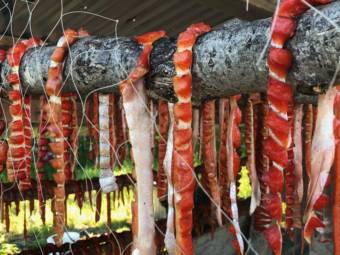
strips of salmon drying
Photo by Petra Harpak/KYUK

The federal government has denied a petition to eliminate chinook salmon bycatch and cap chum salmon bycatch in the Bering Sea pollock fishery. Tribal groups in Western Alaska submitted the petition following dismal chinook and chum salmon runs this summer.

In a letter denying the tribal groups’ petition request, the National Marine Fisheries Service wrote that the requested limits on bycatch would likely not make a big difference for Western Alaska salmon runs. The fisheries service estimates that less than 3% of chinook salmon bycatch and less than 1% of chum salmon bycatch in the Bering Sea Pollock Fishery are from Western Alaska rivers.

“I question that number. I think there needs to be more research on that,” said Mike Williams Sr., chair of the Kuskokwim River Inter-Tribal Fish Commission, one of the tribal groups that petitioned the federal government to add new salmon bycatch limits. Williams Sr.’s group has also asked the federal government to conduct up-to-date analysis to find what percentage of chinook and chum salmon bycatch is from Western Alaska.

In October 2021, the federal body that regulates the Bering Sea pollock fishery, the North Pacific Fisheries Management Council, asked the National Marine Fisheries Service to fulfill that request.

Williams Sr. said that he knew the petition was a long shot, but he’s still disappointed it got denied.

“Our relatives up in the Yukon are really suffering right now because of the zero fishing this summer. The pollock fishery, even they say 3%, they should knock it off for a while,” Williams Sr. said.

Williams Sr. said that he and the Kuskokwim River Inter-Tribal Fish Commission will continue to fight for lowered chinook and chum salmon bycatch limits in the Bering Sea.

Site notifications
Update notification options
Subscribe to notifications