Some retailers say they are still having trouble stocking ammunition. (Zachariah Hughes)
Alaskans own a lot of guns, per capita. But finding some types of ammunition has been tough recently, amid supply shortages and rumors of hoarding.
And in a state where hunting is a way of life — not to mention a way to put food on the table — that’s a problem. Just ask Anchorage Daily News reporter Zachariah Hughes, who wrote about the ammo shortage.
Hughes says the problem is putting a pinch on the ammunition that big game and subsistence hunters use the most.
Listen here:
The following transcript has been lightly edited for clarity.
Zachariah Hughes: There’s boxes on the shelves, but it’s this weird mishmash of, you know, sort of like the leftover Halloween candy of ammunition. Like big cartridges that really aren’t very popular, and then some smaller cartridges that aren’t that popular and some shotgun shells. And if you’re in Anchorage at least, and I think this is probably true throughout the Railbelt, there’s just not a lot on the shelves in stores. And that situation isn’t very different off of the road system, as far as I was able to learn.
Casey Grove: Why is this a problem for folks in Alaska, maybe a little bit more than elsewhere?
Zachariah Hughes: Well, I think in general, we, just as a state, have a much more intimate relationship with firearms than a lot of other places. Some of that is just how much hunting happens here and how large a share of the population, in one way shape or form, harvests wild food through the use of guns. For some people, maybe that means going out once a year for caribou, and for others that means putting down a lot of caribou and filling your freezer or getting multiple moose in the Interior, you know, all the way to bird hunting out in the Yukon and Kuskokwim regions in the springtime. There’s just a lot of different ways that people are using guns to feed themselves. There’s also a general culture in the state of preparedness and readiness. There are people who think you need to have several thousand rounds in case the supply line breaks down as it’s doing now, or to prevent the zombie apocalypse or government takeover. I mean, there’s just a lot more reasons that people have guns here. It’s part of the reason I think some people live in Alaska, and there’s a lot of enthusiasm for shooting sports.
Casey Grove: So why is this happening? Why are we seeing an ammunition shortage? And are some of the national trends around ammunition — are they happening here in Alaska?
Zachariah Hughes: It’s a good question. And the short answer is, it’s not any one reason. It’s several different reasons that are all converging. Turns out that ammunition, like a lot of consumer goods, is a system that’s been under stress for a long time now. And the combination of the pandemic, along with just national instability that’s happened the last two years — it’s been a really wild two years — just a lot more reasons that have sent people seeking out guns or expecting the worst and stockpiling. The FBI tracks background checks for gun purchases, and there’s something like a 40% increase in the number of background checks the FBI saw in 2020, over 2019. That’s a huge increase that the industry says is coming a lot of the time from first-time buyers. So you have more people that are seeking out ammunition. At the same time, one of the biggest manufacturers of ammunition in the country, Remington, had filed for bankruptcy proceedings for a long time, and in recent years, went under — plants had to close. They were later bought up by, you know, sold off in bankruptcy and started to come back online. So at the same time, as you had more people rushing to stores to stock up on ammo, you had less production capacity across the country. So there’s just not anything like the inventory that has existed in previous times.
Casey Grove: I know there’s probably some overlap in different user groups, whether somebody is a hunter, or they’re shooting targets, or they’re keeping ammunition and guns for personal protection. But is there any, I guess, animosity between those user groups about who is responsible for taking up more ammunition or hoarding it?
Zachariah Hughes: I think there is. I mean, that was an area of the story that I wish I could get into a little bit more, is the ways that Alaska’s shooting culture has really changed. One of the people mentioned in my story said it’s changing from a shooting culture to an owning culture, by which he meant a gun-owning culture — that instead of people buying guns and ammunition to shoot and practice and as, you know, train as functional tools, there’s almost this fetishization and individualistic mentality of: “I want these guns and I want this ammunition even if I’m not going to shoot it, because either I love these guns, I love these machines, or I just, you know, I’m going to get as much ammo as I can. I’m going to cache it. I’m going to keep it and if the world falls apart, it’ll be better than money.” And I think there’s a lot of esteem in Alaska for, you know, hunting and subsistence and being able to provide for yourself, and I think people see it as unfortunate when that is undermined by some of the other shooting cultures.
The 32-foot gillnetter F/V Deja Vu sails on Aug. 3, 2020 near Metlakatla. (Courtesy of Johon Atkinson)
Alaska’s sole Native reservation has taken a fishing dispute with state authorities to a federal appeals court. Metlakatla Indian Community is asking the U.S. Circuit Court of Appeals for the 9th Circuit to rule that Metlakatla’s tribal members don’t need state permits to fish in their traditional waters.
Congress created the Annette Islands Reserve in the late 19th century as a self-sustaining home for the people of Metlakatla.
Now, the Metlakatla Indian Community tribal government argues the 1891 law also gives its modern-day members unfettered rights to commercially fish around Ketchikan and Prince of Wales Island.
The problem for Metlakatla’s case is that the 1891 law doesn’t explicitly mention fishing. The 101-word statute says only that the reservation was set aside “for the use of the Metlakahtla Indians.”
But Weis cited a 1996 9th Circuit opinion that found that when reservations are created by fiat — as opposed to by a negotiated treaty — important rights and privileges are often left out of the text.
“The court indicated that we should look at the circumstances of the reservation’s creation and the history of the people for whom the reservation was created,” Weis said.
And she said Metlakatla’s fishermen had long harvested in waters within a day’s travel from their home. She said that was proof enough that they did not believe they were bound by the reserve’s waters extending out 3,000-feet.
“The facts alleged in the community’s complaint and the inferences drawn therefrom demonstrated that an Indian in Southeast Alaska more than a century ago could not have conceived of an invisible line around the reserve beyond which it could not fish,” Weis said.
Weis argued that the U.S. Supreme Court had recognized the importance of fishing to Metlakatla’s citizens more than a century ago.
“The court stated, Congress must be held to have known that without the food yield of the sea, these Indians could not survive there being a little or no agricultural land on the islands, or for that matter, in all southeastern Alaska,” she said.
That 1918 Alaska Pacific Fisheries case upheld Metlakatla members’ exclusive right to fish in waters near Annette Island. But Weis said the tribe was not a party to the case back then, so they weren’t able to argue for the wider interpretation they’re seeking in 2021.
Weis asked the three-judge panel to reverse a lower court judge’s dismissal and instruct the District Court to define Metlakatla’s fishing rights off the reservation.
But the state’s attorney fired back that Metlakatla’s demands would give their tribal citizens an unfair advantage over other Alaskans. Alaska Assistant Attorney General Laura Wolff said Alaskans have to follow uniform fishing rules and regulations.
“They’re not asking just to share fishing,” she said. “They’re asking for a priority.”
She emphasized that the 1891 law doesn’t say anything about fishing, and the Congressional Record doesn’t indicate that was ever a consideration.
“And these facts don’t add up to the legal conclusion that the act created an off-reservation right when the act is completely silent,” she said.
Wolff argued that the state’s fishing permit system, which in most cases only allows a limited number of vessels to commercially fish in state waters, was the state’s primary method to prevent overfishing. Wolff argued that allowing otherwise would undermine that.
“Opening up the limited entry program would derail the conservation purposes,” she said.
Judge William Fletcher, part of the three-judge panel, seemed to question that last point.
“It may derail this particular program, but I don’t think it would disable the state from regulating for purposes of conservation,” the judge said.
He said prior cases had held that tribal fishing rights are subject to state regulations aimed at conserving fisheries. Metlakatla’s attorney agreed.
Sitka Tribe of Alaska fisheries biologist Jen Hamblen empties blue mussel meat into a blender in 2016. (Emily Russell/KCAW)
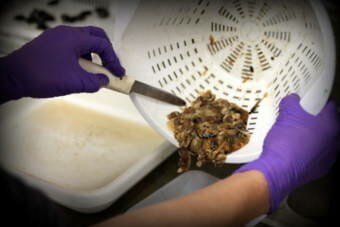
For millennia, people in Southeast Alaska have relied on the sea for sustenance. But what happens when traditional foods could be deadly? That question was behind the founding of Sitka Tribe of Alaska’s Environmental Research Lab in 2016. The lab tests shellfish from 17 Southeast communities as well as tribes on Kodiak Island.
The state tests commercial shellfish for toxins. But Sitka Tribe Resource Protection Director Jeff Feldpausch says subsistence harvesters are left to fend for themselves.
“They don’t do any public testing or certifying any beaches in Alaska, like you see in Washington and other Lower 48 states,” he said.
Feldpausch says the state’s official message is simply not to eat the clams and mussels on the beach because of the risk of toxins.
“We just figured, you know, that’s not that’s not acceptable response,” Feldpausch said. “We started down this road with, I think, 15 other tribes in Southeast as far as looking at ways to address safe access to shellfish resources.”
Paralytic shellfish poisoning, or PSP, is caused by toxic algae blooms. Filter feeding shellfish like clams and mussels store the algae’s biotoxin in their tissues, which can prove fatal when ingested.
PSP has always existed in Southeast. Harvesters could once rely on ancestral knowledge alone to be safe, but climate change has made PSP more frequent and harder to predict without testing.
“You know, a lot of the old harvesters used to say you only harvests shellfish in a month with ‘r’ in it, and we’re starting to find out that that’s not necessarily the case right now, ” Feldpausch said. “It’s just, with climate change, we’re seeing a higher frequency of PSP or biotoxin levels that can cause death.”
It was spring of 2016 when Sitka Tribe of Alaska took a risk and opened its research lab, the first of its kind in Southeast Alaska. In November, the lab was recognized by Harvard’s Honoring Nations program in the 2021 American Indian Governance awards. Out of the 70 different programs that applied, Sitka Tribe was one of the top six.
Feldpausch says that tribal sovereignty is at the heart of the lab’s mission.
“Unfortunately, statehood and the Alaska Native Claims Settlement Act separated tribes and tribal citizens from the land and the resources to where the point that tribes really don’t have much more input, or much more leverage on how those resources are managed than any other entity or individual within the state,” he says. “So basically, it’s given the tribes the ability to act to exert sovereignty over some of the resources.”
For those who use the lab’s services, it’s about more than just subsistence. Yakutat Tlingit Tribe’s environmental director Jennifer Hanlon says the initiative is part of a greater struggle for cultural preservation.
“This data — it’s really important to inform harvesters of the current levels, if there’s any concern related to when and where to harvest shellfish,” Hanlon said. “Because that is such an important subsistence food for us that nourishes our people and our communities, on so many levels. Not just nutritional, but also fostering that relationship to our ancestral lands and waters.”
Feldspauch says the tribe’s shellfish testing program is still expanding and now includes training for tribal citizens.
“We’re actually testing for two other biotoxins that are produced by harmful algal blooms. So we’re expanding our testing range,” he said. “We’re also testing subsistence resources for total mercury. And beyond that, we’ve, outside of the lab, we’ve actually grown to training tribal citizens or other tribes to do shellfish biomass surveys.”
Sitka Tribe offers free shellfish testing for Sitka residents and is continually monitoring Starrigavan Beach, with new data out every two weeks, year-round. For more information on the lab and their services, you can visit their website.
Kake residents and elders process moose meat to be distributed to the community (Courtesy of the Organized Village of Kake)
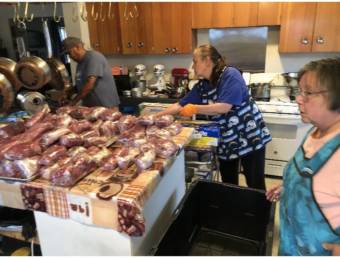
A federal judge has rejected the Dunleavy administration’s legal challenge to a special rural subsistence hunt that was authorized by federal authorities during the early months of the COVID-19 pandemic. The Southeast tribal government in Kake had organized the deer and moose harvest out of concerns about food security during the early months of the pandemic.
About a year and a half ago, fresh groceries in the community of Kake were in short supply. It was the early weeks of the COVID-19 pandemic, and meat, dairy and other perishables weren’t showing up on the barge as nationwide hoarding caused shortages of basics like toilet paper, flour and other staples.
“Our meat supply kind of got pretty low because of the virus hitting the meatpacking plants in the Lower 48,” Organized Village of Kake’s tribal president, Joel Jackson, told CoastAlaska.
The normal hunting season doesn’t begin till the fall, and it was too early for the salmon run in the Kupreanof Island community of a few hundred people.
But then Republican Gov. Mike Dunleavy’s administration filed a lawsuit claiming there was no food security risk. It raised a number of procedural objections to allowing the special hunt.
There’s long been tension between state and federal authorities over subsistence rights. And the state’s position was that the special hunt was exclusionary and an example of federal overreach.
But federal Judge Sharon Gleason rejected the state’s request for a restraining order against the Federal Subsistence Board. She also rejected the state’s objections over the board’s excluding urban hunters harvesting moose in an area of the Interior, which the subsistence board had ruled was needed for public safety. That had been a second part to the state lawsuit.
In a 49-page order issued Dec. 3, she rejected all the state’s legal arguments.
Indigenous legal firm celebrates sovereignty win
The Native American Rights Fund, which offered legal aid to Kake’s tribe, welcomed the ruling.
“The Organized Village of Kake, like many Alaska Native communities, relies on subsistence hunting to ensure food security for its tribal citizens,” NARF staff attorney Matthew Newman wrote in a statement, saying the federal authorities did well to work with a Native community like Kake anxious about its food security.
“It was ridiculous of the state to suggest anything otherwise, and the court made the right decision when it held that the board acted within its authority,” the attorney’s statement added.
And Jackson, the tribe’s president, says it was a victory for tribal sovereignty in a crisis situation.
“I hate the word ‘subsistence’ because that’s Western world,” Jackson said. “But we practice our way of life here in the villages … If worse comes to worst, and somebody tries to limit us when we’re in dire need of something, I’m not going to sit back and wait for their decision — that’s not going to happen.”
Alaska Attorney General’s office considers appeal
A spokesman for the Department of Law released a short statement accusing the judge of ignoring the Alaska National Interest Lands Conservation Act — known as ANICLA — which proscribes subsistence rights on federal lands in Alaska.
“This ruling today is entirely contradictory to ANILCA, which was intended to protect the rights of all hunters on federal lands in Alaska and retain the state’s management authority with a subsistence preference only when necessary to restrict harvest,” wrote agency spokesperson Aaron Sadler.
“The state maintains the Federal Subsistence Board overstepped its authority — in part in illegal, secret meetings at that — including by restricting hunting in Units 13A and B and by authorizing an emergency hunt in Kake last year in spite of no food shortages,” the communications director added.
At first glance, Metlakatla looks similar to many of the other villages in Southeast Alaska: glacier-cut coastlines, dense temperate rainforests, dramatic mountains in the backdrop. But locals know better — there is something distinctly different about the place. Spend enough time there, and you’ll notice it too. Metlakatla Indian Community is the only federal reserve in Alaska, and is not a part of the Alaska Native Claims Settlement Act.
“It’s not just a feeling or perception. ANCSA is a fundamentally different system than a reservation system,” said Gavin Hudson, Tsimshian, who is the Metlakatla Field Representative to the Bureau of Indian Affairs and was previously on the Metlakatla Tribal Council. “And those differences are reflected in how a community views itself.”
Fifty years ago, the community of 1,400 was caught in the crosshairs of a monumental decision: should they keep their reserve status, or should they join other Indigenous Alaskans as part of the Alaska Native Claims Settlement Act?
If they had chosen to participate in the ANCSA system, they would have received a sizable payment and the means to create a village corporation and regional corporation. They also would have been granted a significant portion of the surrounding acreage. However, the way they could have interacted with this land would’ve changed — their reserve status would have been revoked, and they would have to go through the corporations to manage the land, not their own tribal government.
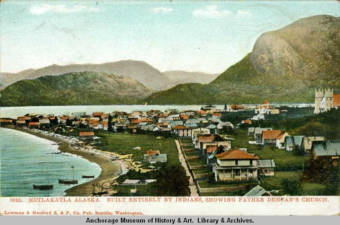
In some ways, the island town was already different from many other Indigenous Alaskan communities, making their land claim options unique as well. Metlakatla originated in 1887, when Anglican Missionary William Duncan led a group of 826 Tsimshian people from British Columbia to start a new settlement in Alaska. Congress officially established it as the Metlakatla Indian Community, Annette Islands Reserve in 1891.
There were only a handful of other federal reserves in the state prior to ANCSA. As the Alaska Federation of Natives described, there was an eclectic mix of Indigenous groupings at the time, including tribal organizations, regional non-profits, individual village tribes, urban Native groups and tribes that had federal reservations, like Metlakatla. More than 200 village tribes did not have federally recognized reserves and therefore did not have a back-up option beyond ANCSA. If Indigenous claims were not addressed, they would have likely lost all of their land. In contrast, tribes with federal reserves still would have been able to hold on to their reserve land allotments if they did not join ANCSA. Ultimately, every other community with a reservation, apart from Metlakatla, chose the ANCSA terms.
Metlakatla, Alaska in 2019. (Joey Mendolia/Alaska Public Media)
It wasn’t an easy decision for the tribe to make, said Hudson. His dad recalled a time of intense debate, which even divided some families who couldn’t agree. In the end, it came down to a community-wide vote, resulting in today’s dynamic: Alaska’s lone reservation.
“Our council at the time refused to take part in [ANCSA] because they wanted to keep their sovereignty, and make their own decisions on what to do with the lands and waters within the reservation — and there was no price for that,” he said.
The pressure to choose ANCSA would’ve been intense, according to Charles Wilkinson, professor of law emeritus at the University of Colorado. Wilkinson specializes in public land law and federal Indian policy, and has done extensive research on history in the Western U.S. From his historian’s perspective, Metlakatla’s decision stands out.
“The truth is, there was huge pressure to terminate. It was a huge decision, and it was hard. You had to have to really want it,” said Wilkinson.
Metlakatla wasn’t the only tribe that faced these options.
Around 20 years earlier, the Klamath tribe in Oregon had the choice to terminate their reserve status as well. The termination would remove their federal services and land ownership, in exchange for a monetary payment. Like in Metlakatla, the debate in the Klamath community was highly controversial. Some wanted to accept the deal, others felt they should keep their tribal sovereignty. Outside forces only made the pressure worse — both the federal government and the logging industry heavily lobbied Klamath to accept the terms.
The motivations behind the lobbying were clear. At the time, Klamath managed one of the largest ponderosa pine forests in Oregon and was one of the wealthiest tribes in the nation. The logging industry wanted access to this land, but couldn’t do so as long as Klamath’s sovereign status remained.
“It was resource land that characterized most of the terminated tribes,” Wilkinson said. In Metlakatla’s case, it was the oil industry that sought a speedy settlement. For Klamath, it was loggers pushing the deal forward. Different resources, but the same idea.
(Courtesy of Visit Metlakatla)
In 1954, the Klamath Termination Act officially ended the tribe’s oversight of the area after a majority of the community accepted the new arrangement. Years later, the tribe’s sovereign status was restored, but their original land base was never returned.
Both Metlakatla and Klamath were part of a larger tribal termination trend common during that era, although in some cases it was only years later that the termination aspect of a policy became clear.
“I don’t think Metlakatla thought it was termination at the time, but I do think they recognized they had special hunting and fishing rights, and thought that it was really important to get that aspect of it right,” Wilkinson said.
Even with this recognition, there still would have been some aspects of the outcome left to chance. Tribal sovereignty, in a legal sense, was different 50 years ago. The Bureau of Indian Affairs was oftentimes the primary governing power, rather than a tribe’s own government. There were also fewer legal protections for hunting and fishing rights.
“There wasn’t anything to make you think sovereignty was a really good option either,” Wilkinson said.
This dynamic caused many Alaska Natives to be wary of an unproductive trustee relationship with the federal government. In this lens, ANCSA represented an opportunity for self-determination and further autonomy over their homelands. Ideally, this definition of land would include fishing and hunting rights.
“When they said land, they meant more than what American law means when it says land. In American law, if you’ve got land you got some things, but there are a lot of other rights you don’t have,” he said.
The ambiguous legal future of land, sovereignty, and subsistence rights would have made any termination decision at the time more unclear. Sovereignty and tribal land rights have evolved since the 1970s, and the number of lawyers that specialize in this area have significantly increased. But back then, there would have had to have been some betting that their idea of the future would turn out correctly.
According to Hudson, the risk payed off.
“I would be confident saying that most of us in Metlakatla still think that it was the right decision to keep the reservation,” he said.
Google Earth image showing location of Metlakatla, Alaska. (Screengrab)
Today, the island reserve has a thriving fishing and tourism industry, with several Tsimshian cultural programs and museums open to visitors and locals alike.
Like other villages in the state, they still face a set of unique rural Alaskan obstacles. Climate change has strained the local economy, salmon runs have been weaker, and high costs of food, energy, and internet can burden households.
Where they differ from other Alaska Native villages is in management. The Metlakatla Indian Community has authority over its fisheries, forests and legal system, while most other Alaskan communities also have to coordinate with the state government.
The setup makes Metlakatla similar to neighboring tribes in the Lower 48. In fact, their community is part of the Bureau of Indian Affairs’ northwest department rather than the Alaskan department, like the rest of the state’s Indigenous communities.
“In general, I think that we have more in common with the tribes of the Northwest region in terms of governance, governing, managing minerals and forests, fisheries and hatcheries,” Hudson said.
It has also created a slight disconnect between Metlakatla and other Alaska Native communities. While many Alaskan villages encounter the same challenges in relation to climate change and rural development, the mechanisms they are able to use and institutions they must go through are different. These contrasts are reflected in policy considerations. When Hudson spends time with Indigenous Alaskans from other regions at the Alaska Federation of Natives each year, he is regularly surprised at how little he relates to conversations about community plans and present day dynamics.
Despite the contrasts, Hudson is always happy to hear about the successes of the regional corporations. He also acknowledges that there are some beneficial aspects of ANCSA, such as additional economic development opportunities or extra funds for heritage centers and cultural initiatives. However, it’s like comparing apples to oranges — the two systems are so unrelated in his mind, that it’s difficult for him to even imagine what life would be like in Metlakatla had they chosen ANCSA instead.
“Having a reservation … it goes to the very core of who we are,” he said.
Travel elsewhere in Alaska, and one might hear the inverse of this statement, with reservations seeming like a foreign concept for those who grew up part of ANCSA.
Governance distinctions aside, Hudson believes there are more parallels across Alaskan Indigenous communities than there are differences. He hopes in coming years, the southeastern region and statewide Alaska Native population will find ways to cooperate more outside of their existing institutions.
“Even though there are differences that are undeniable. We still have friends and relatives all across Alaska,” he said. “We’re still Alaska Native. And we still stand in solidarity with our Indigenous brothers and sisters across the state.”
This story is part of a reporting collaboration between Alaska Public Media, Indian Country Today and the Anchorage Daily News on the 50th anniversary of the Alaska Native Claims Settlement Act. Funding for the ANCSA project was provided by the Alaska Center for Excellence in Journalism. Read more stories from the series.
Seth Kantner sees his life today as a continuation of the subsistence life he grew up with in northwest Alaska, with some new additions: commercial fishing in the summer, writing in the winter and photography in the spring and fall.
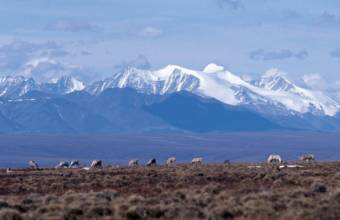
In the last several years, he’s gathered images and stories from the caribou herds that live near his home on the south side of the Brooks Range. His latest book, “A Thousand Trails Home,” recounts those tales, his own story and how they all intersect in a part of the country that’s experiencing climate change at a staggeringly rapid pace.
Kantner capped off a three-week tour through Alaska, Washington and Montana with a visit to Homer this week.
Listen here:
The following transcript was lightly edited for length and clarity.
Sabine Poux: Seth, thanks for being here. Your new book, “A Thousand Trails Home,” came out last month. Can you talk about how long this book has been in the works? When did you start writing?
Seth Kantner: Probably about nine years ago. And the photographs, probably 30 years ago, without the idea of a caribou book. More just wanting to get photos of the land, and the caribou were hard to resist — big herds of caribou — when you got a camera. The book was supposed to be out Sept. 1, after all these years, and then was held up for a couple extra months in a shipping container on the barges. And so it was a little bit of a rocky start.
Sabine Poux: Affected by the supply chain problems that we’re hearing a lot about.
Seth Kantner: Yep. Yeah.
Sabine Poux: I know that you’re a big photographer. And you have managed to capture these really vivid descriptions of the things you’re doing and seeing while also taking photos and writing. How do you balance all of that at once? Do you have a process when you’re out and how you think about writing?
Seth Kantner:I don’t have a process at all. I don’t think I was born with organizational skills. But they’re along the south side of the Brooks Range, where I was born and raised. Our life was so focused on the land, I think I carried on with that, a searching-for-food type of life. But then I just added searching for stories and searching for photographs to that. So, in my mind, it feels like a subsistence way of life with some new additions. And then the seasons kind of decide — maybe winter would be more writing, and fall and spring would be more photographing and then summer would be trying to make a living.
Sabine Poux: Do you see the photos and writing as complementing each other? Do you think that when a reader takes it in, they have to take in all of that to get the full picture of what you’re trying to communicate?
Seth Kantner: I think it helps with this book. Obviously, if I wrote a novel, I would feel like photographs would take away from that experience you have, or you fall into another world and you’re surrounded by that world. And so my first book was “Ordinary Wolves” in 2004 and, similarly, there were things I really wanted to say. I just chose fiction as the way to say it. And so with this, yeah, I feel like kind of to say enough about caribou, I really wanted photographs mixed with words. Which definitely makes a much more complicated project.
Sabine Poux: Your first book is a novel, and this book of course is more autobiographical. Do you feel like there are things that you were able to freely write about and say in a novel that maybe you aren’t when you’re writing in such a first-hand way? The things that character deals with in “Ordinary Wolves,” I imagine, are paralleling your experience. But of course, you’re writing through another character.
Seth Kantner:Yeah, you hit it dead on there. That book is autobiographical, and I was urged to write it as nonfiction. Apparently it would have sold better, et cetera. But I was adamant that if I wanted to describe a situation that may or may not be admirable for the for the person portrayed by my words, then writing a fictional person, I could say “so-and-so did this.” And if you had a real person’s name tied to that, well, good luck with feeling free with what you say.
Sabine Poux: A lot of the people reading your work will have never been to this part of the state. And, at the same time, you’re writing about issues of identity and issues about race that are very real to the people who live there. How do you balance explaining a place to people who have no frame of reference, and doing a place justice for the people who are actually from this part of the country?
Seth Kantner: That, I would find, wasn’t a balance. It’s more like all at one end of the teeter-totter. I just spend endless amounts of time weeding through my words and being suspect of each one. Does this do its job, is this fair? But also, is it as descriptive as possible? And so this book, I joke — but it’s not too much of a joke — that it took an extra five years because of the politics of talking about some issues that a lot of people disagree on, like the difference between sport hunting and subsistence and user rights, and then ways of hunting caribou now versus 50 years ago. So each one of those felt like a dangerous swamp I was heading into as far as trying to say the truth and and be fair at the same time. And then not always good things to be said.
Sabine Poux: Right. And your educational background is in journalism. So I imagine fairness and considering things from a lot of sides is very front of mind for you.
Seth Kantner: Yeah. I think my upbringing is stronger than my journalism training. But the journalism training in Missoula, Mont., they were adamant about if you’re using a quote, it has to be the real thing, you can’t just sort of make one up. And adamant about, you know, if something’s 95% true, it’s fiction still. It’s not nonfiction. So yeah, I hadn’t thought of it until you said it, but I think that those journalism ethics from that school have kept me on the desire to stay as true as possible.
Sabine Poux: Then, of course, you mentioned controversial topics. A big part of life in northern Alaska is dealing with the effects of climate change. Do you see communicating messages about how climate change is impacting that part of the state as a major reason that you’re writing these stories? Is that something you think about a lot in your writing?
Seth Kantner: Absolutely. Yeah. I think it would be different if I made a living off of writing, that I might be writing for money. In this case I’m not, so I write about what I care about. And that’s the land and the caribou and being able to hunt in the future and have wild lands. And I don’t mean wild lands to look at, I mean wild lands to live on.
But yeah, climate change has really affected that part of Alaska. I guess it’s sort of the ground zero for the most warming and the most effects of climate change on the planet. And so the permafrost is melting and the ice is not freezing as consistently as it did, and then we’re getting rain in the winter which would coat the land with ice and make so animals perish and or have a hard time getting their food.
And so all those effects are sort of exaggerated in my mind because of the fact that I’m so tied to the land and I expect the caribou at this time of year, as do other people there.
Twenty five years ago, I was sort of nervous about talking about climate change, which I did, but people were very quick to call you a “greenie” or a “bunny hugger” or something. And that’s interesting because the amount of change up in northwest Alaska is so intense that now, 25 years later, I’m not a bunny hugger and everybody’s a believer. You can’t help up there being that, because of the change.
One simple thing is we travel on ice, we don’t have roads. So those are our roads, and if it doesn’t get cold like it used to and we don’t have those trails and traveling routes, then you can’t kind of pretend that there’s no climate change. So, anyway, the long and the short of that is that it’s kind of a relief not to be accused of being some animal lover, making up this weird stuff — that climate change is finally not such a big discussion.
Sabine Poux: Well, it sounds like you recognize, too, that you’re in this position where you see these effects so prominently in a way that most people — even in this part of Alaska — just wouldn’t really see.
Seth Kantner: Yeah. I think that getting your food from the land makes you notice. And if I shop totally at Costco — which, I love Costco — and traveled in cars on roads, I think it would be so much harder to see, even if it was around you. And so traveling on ice and eating from the land just makes those changes obvious.
Sabine Poux: You also have written a children’s book. What was it like writing for a younger audience?
Seth Kantner:The children’s book — I guess that the whole publishing effort was so dismaying that I’ve kind of lost memory of what it was like before that, just the actual writing of the story. At that point, my daughter was pretty young when I was writing that. So I considered her and I more like siblings because we played together a lot, and mentally I’m sort of on that level. So yeah, I was always making up stories every day and night for her and it was fun to write one down. It was surprising to me how complicated the next steps were with publishing and illustration and stuff. And otherwise, I think I would love to write children’s stories. Just because I like that age. I like kids and I like that age.
Sabine Poux: Speaking of kids, do you have a first memory of caribou? Is there a memory you can think back to?
Seth Kantner:Yeah. The funny thing is that the caribou were so ubiquitous in my life that they just sort of flowed through everything, in spring and fall. We didn’t see them in the middle of summer. But yeah, I do have that first memory of waking up in the old igloo and scared because there was nobody there and stumbling outside, probably no shirt, and who knows what else, probably four years old. And calling for my parents, and they were just sort of around the front of the hill there, gutting a caribou.
So in that time of year, the caribou swim across the Kobuk toward our place. Caribou are constantly flowing by the house and constantly — not constantly, but every day — so some would come ashore. And apparently they needed a caribou, needed meat, and they were working on it. So I remember the caribou in the melting-out grass and my parents bending over it and me sort of really grateful to see them. I don’t know about the caribou. I was just a little kid looking for parents.
Close
Update notification options
Subscribe to notifications
Subscribe
Get notifications about news related to the topics you care about. You can unsubscribe anytime.