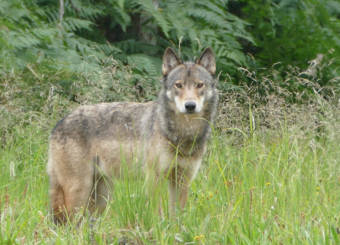
An Alaska Department of Fish and Game wildlife biologist came upon this Alexander Archipelago wolf on Prince of Wales Island in the summer of 2018. It had been sleeping. It woke up and moved away. (Photo by Kris Larson/ ADF&G)
State and federal wildlife authorities are proposing a 31-day wolf harvest on and around Prince of Wales Island.
Conservationists have signaled they could file a lawsuit, saying the Alexander Archipelago wolf population is threatened. That conflicts with resident hunters, who say the population is rising and preying on island deer, an important subsistence food source.
Alaska Department of Fish & Game’s most recent fall population estimate is 386 wolves — much higher than previous counts.
The Alaska Board of Game had set a population target of 150-200 wolves years ago, when the agency thought wolf numbers were much lower. ADF&G regional wildlife supervisor Tom Schumacher says a month-long trapping harvest likely won’t reduce the population that far.
“But given the uncertainty about whether that’s an appropriate population objective, we feel that’s a conservative and responsible way to go,” he told CoastAlaska.
Potential ESA lawsuit hangs over wildlife managers
Environmental groups have warned they could sue the federal government to force Alexander Archipelago wolves to be listed under the Endangered Species Act following last year’s petition. They’ve long argued that decades of clear-cut logging, not predators, are to blame for the island’s dwindling deer herds.
Shaye Wolf, an Oakland, California-based conservation scientist with the Center for Biological Diversity, says her organization doubts the reliability of the population estimates, which are largely based on DNA sampling of wolf hair gathered in the field or turned over from previous harvests.
“The agencies shouldn’t open the trapping and hunting season on these vulnerable wolves,” she said Monday. “They’re not generating reliable population estimates and ensuring that they’re doing sustainable management.”
But Schumacher, the state game official, says says the shorter season should ensure there aren’t too many taken this season. Two years ago, he says there was a two-month season that resulted in a record 165 wolves reported taken.
“There was a lot of effort that year,” Schumacher said. “We think that a one-month season will leave us with a lower level of harvest. And given the high population estimate the last two years, we’re pretty convinced that that’ll result in a sustainable harvest.”
Game managers are holding a public meeting and taking public testimony from 6 p.m. Tuesday, Nov. 9 to hear from members of the public over the proposed trapping season. An announcement on the trapping season is expected later this week with trapping on and around Prince of Wales to run from Nov. 15 through Dec. 15.
Federal wildlife officials working on Alaska wolf study
In a related development, the U.S. Fish and Wildlife Service penned a letter this month to conservationists that recently threatened a lawsuit saying a status review on Southeast Alaska’s wolf population is in the works.
“We will begin working on the status review soon and plan to incorporate information from studies that are planned or currently underway that will help inform the review and subsequent 12-month finding,” wrote Gina Schultz, a deputy assistant director for the U.S. Fish and Wildlife Service based in Falls Church, Virginia.
The federal agency is exploring new population estimate methods, including cameras and an updated genetic study to get a better understanding of wolf numbers in the region, she wrote in the two-page letter.
Staff attorney Camila Cossio with the Center for Biological Diversity says her advocacy group is weighing its next move.
“Litigation is still an option because the agency has already blown the deadline for acting to protect these rare wolves,” she wrote in an email.
Alaska officials have pushed back on a possible listing, saying federal protections which would affect permitting for development and resource extraction across Southeast Alaska.
The public meeting to discuss the proposed 31-day harvest will be held telephonically from 6 to 7 p.m. Tuesday, November 9 with a one-hour public hearing at 7 p.m. The number is 888-809-8973 Passcode: 2074362
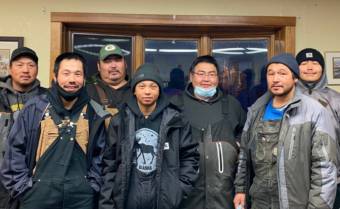
The seven Pilot Station hunters wait for a charter plane at the Bering Air terminal in Nome on Nov. 6, 2021. The group removed their masks for the photo. From left to right: Andrew Makaily III, Neil Makaily, Robert Myers, Andrew Makaily IV, Ronnie Paul, Rex Nick, Dimitri Nick. (Anna Rose MacArthur/KYUK)
Seven subsistence hunters from Pilot Station in Southwest Alaska spent seven nights stranded at a fish camp after the lower Yukon River unexpectedly froze, blocking their way home.
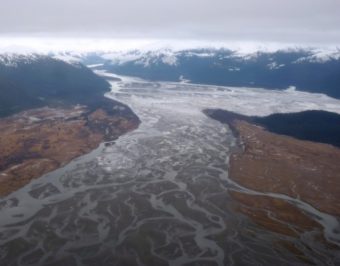
On the eighth night, Thursday, the U.S. Coast Guard airlifted them out and flew them north to Nome.
The next morning, at the hotel where the group had stayed the night, two of the hunters walked to the lobby. Signs said masks were required, and a hotel worker asked them to put theirs on.
The men said they’d been stranded on the Yukon for a week and didn’t have any masks. They’d left the fish camp with the clothes on their backs and what they could fit in their pockets, which meant their phones and GPS.
They were wearing the same clothes they’d worn for a week and a half.
“Same socks, same shorts,” said Rex Nick, one of the hunters laughing and stretching out his legs, which were covered in torn, black Carhartt bibs.
“It was really good to take a shower,” said Robert Myers, another hunter. “I feel clean, but my clothes are dirty.”
The men had left Pilot Station 12 days earlier to boat down to the coast to hunt seal and beluga whale. Nick originally wanted the hunting trip to be over a weekend for students in the village.
“Some of the kids don’t get a chance to go out hunting, or some of their parents might not have a boat or a father-figure type,” Nick said.
The group delayed the trip for weeks waiting for a break in the weather. Finally, it cleared on Oct. 25. Because it was a Monday, they didn’t take students out of school, but one hunter brought his 14-year-old son. There were two brothers and two father-son pairs in the group. The rest are friends.
“Nobody is starving,” Nick said. “But it’s good to have that extra food for the winter ahead.”
Nick is 43 years old. Myers is 38. They’ve made this trip many times in their lives, often multiple times a year. The seven hunters loaded into two boats and made the three-hour trip to the coast. The plan was to go down Monday, hunt Tuesday and return Wednesday.
And, at first, the plan worked out. They went down and took three seal and two beluga.
The hunters pulled their boats onto the shore at the fish camp where they stayed for seven nights. (Rex Nick)
But on Wednesday, Oct. 27, when they were set to return home, they awoke to a frozen river.
“The ice was so thick flowing down the river. It was forming so fast. It was freezing so fast. Just amazing. I’d never seen anything like that,” Nick said.
From all their years on the river, they never expected it to freeze so early or so quickly. There had been no ice when they left home. Using an axe, oars and their body weight, they hacked the boats free and used the weight of the skiffs to push open a path upriver to Alakanuk. A trip that would’ve taken an hour and a half in open water took five hours.
They stayed the night in Alakanuk.
The next morning, Oct. 28, ice was flowing downriver, but other boats were moving between the sheets. The hunters decided to head home. Everything was fine until they reached a narrow part of the river near Emmonak.
The ice jammed, turned jagged and began crashing into the boats.
“That’s the first time I really got scared,” Nick said, “when I thought the ice was going to either damage my boat and sink my boat or flip my boat over. I’ve never been scared like that by ice before.”
The hunters stayed at a fish camp about 20 miles east of Emmonak for seven nights after the Yukon River unexpectedly froze. (Rex Nick)
Nick is second-in-command of Pilot Station Search and Rescue. He said he knew that it was too dangerous to keep going. The group decided to stop and found a friend’s nearby fish camp, about 20 miles east of Emmonak. The hunting group would remain there for the next seven nights.
“God bless the family that had that fish camp,” Nick said.
The camp had containers of frozen rain water, a wood stove, firewood and food.
“Oatmeal, coffee, some noodles, dry eggs, things like that,” Nick said.
The group also had their seal and beluga meat and food from their camping trip. Another friend had a fish camp just a five-minute walk away. It had a cell phone booster and a generator. They used it to contact their families.
The group also had a VHF radio and a Garmin inReach satellite device. The first day at the camp, they texted nearby friends about their situation, but no one could come overland or by river to help. The trails were not yet fully frozen. Their friends contacted Alaska State Troopers.
On day three at camp, Oct. 31, 2021, Alaska State Troopers flew over and dropped food, supplies medicine and Halloween candy for the hunters. (Rex Nick)
On day three at the camp, Oct. 31, the troopers flew over and dropped food, supplies and medication needed by one of the hunters.
And to Nick’s relief: Copenhagen Fine Cut Snuff. With tobacco, he said, he eats less. There was another treat too.
“We got some Halloween candy. They left a note on there [saying], ‘Happy Halloween,’” Nick said.
The group stayed together in one of the fish camps in a single room about 12 feet by 20 feet, sleeping in sleeping bags from their camping trip. Staying together conserved firewood and concentrated heat. Also, Nick said, “There’s safety in numbers.”
Each day they rationed their food, water and firewood, only burning wood before going to sleep and a bit when waking up. During the day, they created their own entertainment.
“We took out our .22s and started killing mice. We probably killed about 50 mice,” Nick said.
One day a hunter killed a beaver, which they boiled into soup. Another day they found a fox in a snare that had been set by the owner of the fish camp and killed it. Once they set a net in the river but didn’t catch anything. Time moved slowly.
On the fifth day at the camp, Nov. 2, a pilot twice tried to land. In a video Nick took on his phone, the small red and white plane swoops close to the beach. Nick urges it on.
“Come on. You can do it. Land. Come on,” he said in the recording.
When the wheels look a few feet above the snowy riverbank, it veers back up and flies away. A trooper spokesperson said that 20-knot crosswinds prevented a landing.
Emmonak Search and Rescue coordinated another food drop for that day. This one contained ground beef and other hearty food.
The hunters set a net near the camp but did not catch any fish. (Rex Nick)
By now, the hunters had become frustrated with the rescue response. State troopers were coordinating the effort, but Nick said that they would not hear from them for entire days at a time.
Trooper spokesperson Austin McDaniel said troopers “maintained consistent and frequent contact with the group directly via a satellite communications device and through their communication with third parties that the group was communicating directly with.”
McDaniel also said, “We had our search and rescue coordinator, who was a lieutenant here in Anchorage, working on this day in and day out. We had a trooper out in Emmonak working on trying to find solutions to get these folks out of there every single day.”
The hunters said they had heard planes flying every day they were at the camp. Flight logs show planes landing each day in nearby Emmonak, except for one day that the hunters were stranded.
Nick said he expected a quicker rescue. The longer someone is stranded, he said, the more likely that person will be in danger. He’s helped look for many people with his village’s search and rescue group.
“The very first day we find out somebody is missing, we’re working on trying to get him home. We’re out there looking day or night, storm or clear skies,” he said.
He questioned whether the response was slowed because the group had supplies to survive the elements. McDaniel, the troopers spokesman, said no.
“The amount or quantity of supplies played no role in the efforts made by troopers to respond to extract the group,” McDaniel said.
Nick also questioned if because the group was all Alaska Native that slowed the response.
“Well, that’s absolutely not the case,” McDaniel said. “We perform search and rescue missions across the state, and there’s never any consideration given to the race, gender, any of those. None of those questions ever come up when we’re planning a response to a search and rescue operation.”
Regardless, Nick said, being stranded for a week took a toll on the hunters, as well as their wives, children, friends and community.
“All these years you help people so much, and when it comes down to needing help, it’s like it’s not there. Just beat you up inside. It just hurts,” Nick said, his voice cracking.
One of the hunters missed his cousin’s funeral. Nick missed his daughter’s 12th birthday. He said that the worst part of the ordeal was the worry it placed on his wife.
On the eighth day at the camp, Nov. 4, the hunters were about to burn the last of the firewood when they saw a U.S. Coast Guard plane overhead. It dropped food and a handwritten note that said to bring the radio with them when the H60 picked them up and to enjoy the pizza. The bag contained seven slices. The note ended with a big smiley face.
They turned on the VHF. The pilot told them to stay on channel 16. A helicopter was coming. Hours later, past 8 p.m. on the eighth night at the camp, they heard the chopper.
“It was getting louder and louder, and we’re like, ‘Where is it? Where is it?’ Then all of a sudden, we see lights,” Myers said.
The U.S. Coast Guard landed in Nome with the seven hunters on Nov. 4, 2021. (Rex Nick)
The helicopter circled and landed. The hunters climbed aboard. They left behind their boats, supplies and seal and beluga meat. They said that everything is well stored, and they’ll return in spring to gather their belongings. The Coast Guard flew them north to Nome.
The hunters said that everyone in the group was healthy, but the Coast Guard told them they’d be taken to the hospital to be checked out. A Coast Guard spokesperson said that it’s not required for paramedics to accompany rescue missions.
When they landed in Nome, Nick said that a trooper picked them up and then asked them where they wanted to go. They never went to the hospital.
“We were freaked out when they asked us where we wanted to go. We thought they had a place for us. We didn’t know what to say. They asked if we had family or friends. We don’t know nobody here,” Nick said.
A trooper spokesperson didn’t respond to a question by publication of this story about why the officer didn’t have a plan to house the men.
The trooper took them to a hotel, where the hunters paid $450 plus tax for two rooms for the night. The next day, a trooper spokesperson told KYUK that the troopers would cover the hunters’ lodging and airfare home.
Troopers and the Coast Guard said that they rescued the hunters as soon as their resources and the weather allowed. The helicopter had to fly from the Coast Guard base in Kodiak.
On Nov. 6, after spending two nights in Nome, a plane flew the group to Pilot Station. They landed around 1:15 p.m. It had been 13 days since they left home.
The hunters thank everyone who helped them, especially the owners of the fish camps where they stayed.
KYUK reporter Olivia Ebertz contributed reporting to this story.
The Stikine River empties into the ocean near Wrangell. Mines and energy projects proposed for upstream sites in Canada are worrying some municipal and tribal governments. (File/CoastAlaska News)
Wrangell has joined with a dozen other Southeast municipal and tribal governments in calling for stronger protections from mines in Canada that straddle transboundary watersheds.
Wrangell’s assembly and residents say the issue is especially pressing to the community, which sits in the mouth of the British Columbia-originating Stikine River.
That’s because there aren’t financial or legal protections in place for Southeast Alaska tribes and communities that depend on transboundary salmon watersheds. If a mine dam failed in Canada, it argues the downstream waste could devastate the environment and economy of communities like Wrangell.
Wrangell Mayor Steve Prysunka says he’s seen firsthand how mines have been abandoned in Canada, “And I’m here to tell you it was insane,” Prysunka told the assembly at a meeting on October 26.
In a previous job, he ran canoe trips on the Iskut River — the largest tributary of the Stikine — near the old Johnny Mountain mine site. “This was shortly after the shutdown and they literally walked away. We’d go into a building and there would still be the beakers inside the lab with Bunsen burners and rain gear still suspended. It was like they just disappeared. And over the course of three years or four years, I watched that tailings pond drain down the side of the mountain … It was this unreal turquoise color that was just unnatural. It reminded me of Lake Louise in Alberta. And it was just filled with all these minerals and was all draining down into the Iskut and into the Stikine.”
But Prysunka’s larger point was that it’s important to protect Wrangell from legacy pollution. The borough’s resolution points out how the Stikine River is integral to Wrangell’s fishing economy, the work of the community’s Marine Service Center, and the traditional lifestyle of the indigenous population.
Wrangell resident and artist Brenda Schwartz-Yeager spoke in favor of the action at the assembly’s Tuesday meeting.
“I believe that for all of us here, whether you’re a fisherman, a health care worker, a teacher or a boat repair person, a little bit of Stikine River water runs through just about everything we do here in Wrangell,” Schwartz-Yeager told the assembly. “I don’t think this community would exist at all if it wasn’t for the remarkable richness and bounty of the Stikine. It’s a fragile ecosystem.”
Schwartz-Yeager told the assembly she finds it “incredible and scary” the size of the tailings upriver from Wrangell.
The largest mine operating in the Stikine River watershed is the Red Chris Mine, operated by Imperial Metals since 2015. That’s the same company that operated the Mt. Polley Mine that had a tailings dam failure in 2014. The tailings dam which holds mine waste from the Red Chris Mine is more than twice as tall.
“These mining companies have a pretty deplorable track record for taking responsibility for previous messes that they’ve made,” Schwartz-Yeager said. “We have a lot to lose, and they kind of have a lot to gain and really not a lot to lose. I feel like we need a place at the table, and I feel like this resolution will help bring us closer to using the treaty to put some teeth in the agreements that might help us downstream stakeholders. We just need a voice.”
The Southeast Alaska Indigenous Transboundary Commission is a coalition of 15 tribes that banded together in the wake of the 2014 dam failure. Wrangell tribal citizen Tis Peterman is a former executive director of the commission, and said in an interview that they’re still working to gain representation as stakeholders in transboundary watersheds.
“We feel as tribal members in Southeast Alaska, that we should have a voice,” Peterman said, “Because anything that’s being done on the B.C. side on transboundary mining is going to affect downstream communities.”
Peterman says the Canadian government needs to recognize the rights of all indigenous peoples affected by its actions, not just those within a relatively recent border: “Tribes have pretty well taken care of the land for thousands of years. And to have a say in how the waters are being affected in Southeast Alaska is one of our rights.”
“It’s literally out our back door. Look across the backchannel. There’s Canada,” Peterman added.
Wrangell’s local tribe, the Wrangell Cooperative Association, is a member of SEITC, and had already passed a resolution asking for more engagement and protections from the effects of transboundary mines.
But Alaska critics say that call for IJC oversight of transboundary mines hasn’t borne fruit.
“Until we have binding protections in place, we are just sitting ducks below what everybody calls these ticking time bombs,” says Jill Weitz, the Juneau-based campaign director for Salmon Beyond Borders, one of the organizations that requested a resolution on transboundary mining protections from Wrangell’s government.
Like Peterman, Weitz notes that the community of Wrangell is mere miles from the mouth of the Stikine River.
“Nearly the entire riparian corridor of the Stikine watershed is staked with mineral claims –54% of the river’s lower watershed is covered by mineral claims that overlap with salmon spawning habitat,” Weitz explains. “We’re not under the illusion that mining is going to stop or that any of us are going to stop mining in British Columbia. We need some of these resources towards the energy transition that is underway in face of a changing climate. But mining can be done better, it has to be done better.”
Alaska and B.C. regulators have been meeting regularly to discuss transboundary mining issues since 2016 under a bilateral agreement signed during Gov. Walker’s administration. And state officials say their B.C. counterparts do consult with them when permits are being reviewed for mines in transboundary watersheds.
This isn’t the first time Wrangell has called on the Canadian government to create a table for discussion with indigenous and municipal governments from Alaska — the assembly passed resolutions in 2017, 2019 and 2020. But it’s a stronger request than before, with a call for an immediate pause on permitting new mines and a full ban for earthen tailings dams.
A bloom of algae discolors a swath of Gastineau Channel just north of the Douglas Bridge in Juneau on Monday, July 30, 2018. Scientists have documented an increase in harmful algal blooms in the northern Bering and Chukchi Seas. (Jeremy Hsieh/KTOO)
Scientists have documented an increase in harmful algal blooms in the northern Bering and Chukchi Seas. The blooms carry toxins, but scientists aren’t sure what effect they will have on marine mammals.
“We don’t know yet if toxin levels in Arctic food webs are reaching high enough concentrations to cause health impacts in marine mammals in that (the Arctic) region,” Don Anderson said.
Anderson, a senior scientist with Woods Hole Oceanographic Institute, or WHOI, has been studying algal cysts in the Bering and Chukchi Seas for several years. He presented his data and the work of other researchers in the region during a Strait Science virtual event hosted by the University of Alaska Fairbanks Northwest Campus on Oct. 14.
Map of harmful algal blooms in the Northern Bering and Chukchi Seas. (courtesy of Don Anderson/WHOI)
Not all types of algal blooms are harmful, Anderson pointed out. In fact, there are thousands of them spread across the world’s oceans. But in the Northern Bering and Chukchi Seas, there is a growing presence of Alexandrium cysts, an algal bloom that creates harmful saxitoxin.
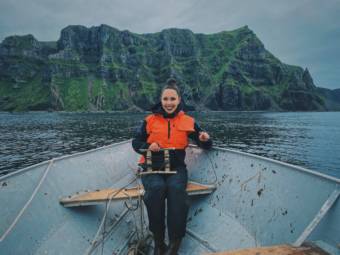
The previously accepted explanation for how they got this far north is called the “trail of death” hypothesis, Anderson said.
“That (says) it’s being carried from the south in these relatively warm surface waters, and that it would form cysts in the Chukchi region that fall to bottom sediments where the temperatures would be too cold to support significant germination,” Anderson said. “I call that cyst seed bed a sleeping giant.”
Since bottom water temperatures have been warming drastically across the Northern Bering and Chukchi Seas over the last few years, cysts are now growing locally in Arctic waters. In other words, the sleeping giant has awoken.
“So what you’ve got then is a dramatic increase in the potential for what we would say is local initiation of blooms. In other words, not just transport, but blooms that are starting, inoculated from that region, from those two Ledyard Bay and Barrow cysts’ seed beds,” Anderson stated.
Ocean currents shown on a map in the Northern Bering and Chukchi Seas. (courtesy of Don Anderson/WHOI)
Since 2016, low levels of biotoxins have been documented in all different types of marine mammals, seabirds and various fish species in the Bering Sea, Anderson pointed out.
Even so, Anderson said eating various forage fish or salmon in the region still poses low risk to human health.
“Based on current understanding of these toxins in many other parts of the world, we think that muscle and blubber are not likely to accumulate saxitoxin in levels that pose a human health hazard. These tissues haven’t been fully tested, but there are reasons to believe they’re not going to accumulate toxin,” Anderson said.
This baseline is based on the only metric that exists from the FDA regarding safe food consumption of shellfish. It determines the level at which clams or other shellfish become too toxic to eat and then could cause paralytic shellfish poisoning. However it is not the best way to gauge how high algal toxins can be in marine mammals before causing harm to humans who eat them, Anderson said.
Alaska Marine mammals map showing toxin levels found in various species, from Kathi Lefebvre’s 2016 report on algal toxins in Alaskan waters, used with permission. (courtesy of Kathi Lefebvre)
While Anderson believes the health risk for Bering Strait subsistence users is quite low, he still emphasized using caution and safe practices as usual when eating shellfish or marine mammals. He also highlighted the fact that other parts of the world are living with the same conditions.
“Many regions of the world face similar risks and yet are able to maintain healthy communities and ecosystems. But it’s done through good management, good communication, and through understanding what the threats are,” Anderson said.
Overall, as cysts spread and cause more harmful algal blooms, there is an increasing potential for them to impact human health and ecosystem health in Northern Alaskan waters.
One observation from Edgar Ningeulook cited in 2013 pointed to an algal bloom near a historical place called Ipnauraq.
“This was the location of a red tide that at one time caused many deaths. And it doesn’t say how, what were they eating? I note that this is a place where there is a lot of fishing going on, especially for herring, one of those forage fish that I was talking about. So was it herring that was eaten, was it clams, who knows. But notice its location, it’s in that pathway of the transported blooms from the south. So long ago there was that threat and it got to the point where many people died,” Anderson said.
Research in the Chukchi Sea is ongoing. Anderson’s team will be partnering with scientists on the Russian side of the Strait in 2022 to get the full scope of what other changes are happening in the Bering Sea ecosystem.
Rosita Worl unexpectedly grew teary eyed as she looked at the coho salmon a younger family member had brought her.
The silver fish was a sight she was used to, but one she had learned wasn’t always guaranteed.
“I just cried that our traditions were still viable, and that he was able to still bring food to me as an elder,” she said.
Worl, Tlingit, was born in Petersburg, Alaska, during the 1930s. She was brought up in a subsistence lifestyle, living off the land in Southeast Alaska as her ancestors had. As she grew older, the ceremonies, traditions, and community need for subsistence stayed constant, but the laws surrounding it changed.
She recalled the first time she realized this, as if it were yesterday. She was fishing with other kids from her village as they always did, when state officials suddenly told them that the familiar process was illegal.
“We didn’t know that it was against the law. They confiscated the fish and we couldn’t believe it. We kept saying, ‘what value is it to you to take that fish away and not return it?’ Whereas to us it meant winter food,’” she said.
Decades after this incident, similar legal disputes over subsistence are still occurring. The Alaska Native Claims Settlement Act was intended to protect this Indigenous community right, but the matter did not end up being resolved. As the 50th anniversary of the landmark legislation approaches, the question still remains: what can be done to protect subsistence rights today?
‘An unsettled and unsettling landscape’
(Illustration by Holly Mititquq Nordlum of Naniq Design)
While Indigenous land claims were being settled during ANCSA, many Alaska Natives fought to include subsistence rights in the final bill. The pairing appeared natural. After all, the legislation addressed traditional lands, which seemed inseparable from the hunting and fishing that accompanied them.
However, outright subsistence protections were left out of the final legislation, due to disagreements and a pressured timeline to develop oil. Instead, ANCSA ended up extinguishing all aboriginal hunting and fishing rights as part of the settlement. Congressional intent was for the Secretary of Interior and state of Alaska to “take any action necessary to protect the subsistence needs of the Natives.” Many believed this would be sufficient, but it soon became apparent that more concrete protections were needed.
The omission is viewed as one of the largest unintended consequences and unresolved portions of ANCSA.
“I think the ongoing, unsettled nature of subsistence has caused people to take pause; to see and ask themselves whether that part of ANCSA was a shortcoming,” said Margie Brown, Yup’ik, in an interview with University of Alaska Anchorage.
Subsistence fishing in the past. (Photo courtesy of University of Alaska, Fairbanks).
Around 10 years later, there was a second chance to protect subsistence with the passage of the Alaska National Interest Lands Conservation Act (ANILCA). While ANCSA determined the future of Native lands, ANILCA designated what would happen to the rest of state. Through the act, approximately 222 million acres of Alaskan land were put into conservation units such as parks, preserves, wildlife refuges, and national monuments. The decision meant that around 60% of the state was under federal control, making it the highest acreage of federal land ownership in the country by a long shot. Even states known for their national parks hardly compare — Alaska’s federal land is more than that of California, Oregon, Washington, Montana, Wyoming, and Idaho combined.
This time, subsistence was explicitly addressed. ANILCA protected the customary and traditional uses of fish and wildlife for food and other noncommercial use, and made subsistence the priority use on federal lands, above sport or commercial fishing and hunting.
But there was a catch. ANILCA designated subsistence to be a priority for rural residents, not Alaska Natives. Under this law, urban residents could still practice subsistence, they just wouldn’t receive priority status during times of shortage. The rural distinction was a compromise meant to protect Native subsistence, while not discriminating on the basis of ethnicity —something that several influential non-Native groups in the state opposed.
The state of Alaska set out to replicate this policy on non-federal lands, but urban hunters and fishers who considered it unfair were determined to fight it. After a few years of legal disputes, the Alaska Supreme Court ruled in their favor, deeming the rural distinction unconstitutional. The decision meant that any Alaskan resident could practice subsistence on state lands, if the state approved subsistence use in the area for that season.
An elder hangs salmon during the 1950s. (Photo courtesy of University of Alaska, Fairbanks).
Today, this dynamic has resulted in a vague and often-clashing dual system. The federal government regulates subsistence on the 60% of Alaskan land under federal control, while the state regulates subsistence on the 30%of Alaska which is under state management, the 10% which is privately owned, and navigable waters.
“You’ve got three different land jurisdictions in Alaska: you’ve got the state lands, you’ve got the federal lands, and then there’s this 40 million acres of Native lands,” said John Sky Starkey, Cheyenne River Lakota Tribe, a lawyer who has spent decades representing Alaska Native organizations in subsistence cases.
Since ANILCA passed, there have been several lawsuits between the state and federal government that have put this system to the test.
“Although the laws can potentially provide protection, the implementation of the laws is greatly lacking. And the legal meaning of the laws is also still in flux,” he explained. “In both the federal and the state regulatory regimes, Alaskan Natives have really very little say in what the regulations are going to dictate and the restrictions that they’re going to cause.”
Subsistence, a practice which past generations participated in without question, had now become a complex legal puzzle.
“It’s a very unsettled and unsettling [legal landscape] for Alaska Native people,” Starkey said.
‘An embodied way of life’
“We don’t think about subsistence as merely a quantifiable event. Subsistence is a whole structure, it’s a way of life,” explained Haliehana Alaĝum Ayagaa Stepetin, Unangax̂. Stepetin grew up subsistence fishing and hunting in her homelands on the Aleutian Islands. Today, subsistence is part of everything she does: her PhD research in Native American studies at the University of California Davis, her teachings at the Alaska Native Studies program at the University of Alaska Anchorage, and her performance and choreography of traditional Unangax̂ dance.
“It’s an embodied knowledge, an embodied way of life. And when we dance about these activities, we’re extending that process of subsistence,” she said.
From the Athabascans in the interior to the Inupiaq in the Arctic, this sentiment is consistently echoed. The practice itself looks different across the varying Alaska Native regions. Some communities hunt seals and whales along icy coasts, others fish for salmon during the long days of the midnight sun. The ceremonies might vary, and the passed down stories might differ. But despite these contrasts, all tribes have one aspect in common: subsistence means more than just food security, it also has greater cultural significance.
“Subsistence is absolutely critical to our survival. Without it, we don’t exist out here,” said Steve Ivanoff, Inupiaq, a subsistence hunter and fisherman from Unalakleet, a village of about 600 people in Western Alaska. For him, subsistence meant the community gathering and sharing of food from nature.
It can be difficult for those who aren’t familiar with subsistence to fully understand this concept.
“A major issue is that the general public, overall, does not understand the full significance of subsistence hunting as one, our basic food security, and then also the cultural dimensions of it,” explained Worl, who has a PhD in Anthropology and a renowned career in subsistence research and advocacy. She currently works as the president of Sealaska Heritage Institute and spent years on the Alaska Federation of Natives’ subsistence committee.
Worl believes some of the disconnect stems from antiquated views of Indigenous people, in which others expect them to be solely traditional, rather than the reality of modern people living in current times, who also practice their traditions.
“These spiritual things, they’re important to our cultural survival. And I don’t know that people realize that, because they see us driving cars and dressed up in modern clothes,” she said.
Stepetin also encountered misunderstandings surrounding subsistence, both as a teacher and a student.
In her PhD program, she found that the term “subsistence” was often corrected to “sustenance,” and that people viewed it in the same light as agriculture.
Past walrus hunting practices. (Photo courtesy of University of Alaska, Fairbanks).
“It’s always surprising to me that people don’t know what subsistence is, which is really just living a balanced and sustainable lifestyle with your local ecosystem, and stewarding that ecosystem for returns to come for generations in the future,” she said.
As a teacher of Alaska Native studies, she tries to emphasize this point for students who might be unfamiliar with the tradition.
“All of our our pedagogy revolves around transfers of subsistence, which includes sharing, storytelling, dance, song, and eating together,” she said. “It permeates into every single part of an Alaskan Native existence. So I try to make it clear in my curriculum.”
She starts by encouraging her students to think beyond what’s represented in mainstream culture, which can be a challenging exercise for anyone.
“It takes a lot of introspection to even be able to understand that there’s a whole other way of living and thinking and being in the world that exists,” she said. “So really, it’s a philosophical question of, “Can I get these students to think in a different way?’ And to think critically and to think deeper about the ways that people have adapted to living in place over time.”
For many Alaska Natives, the highlight of subsistence is the generational bonding formed over passed down knowledge and shared experiences.
“It’s an important part of our wellness, our health, and our healing culture. It’s the very center of who I am as an Alaska Native person,” said Jody Potts, Han Gwitch’in Athabascan. “And it’s important for me to be raising my kids this way.”
Jody Potts on the Yukon River.(Photo courtesy of Jody Potts, 2021)
But in recent years, the legal landscape has made the crucial generational component more difficult to fulfill. Subsistence life is usually tied to the village one is from. In the summers, people travel to their fish camps — settlements near one’s village where people fish, oftentimes in the same location their ancestors had practiced subsistence. In the winter, they trap or hunt in areas located near their village as well.
Today, an increased number of Alaska Natives have moved away from their family’s village to urban areas, such as Anchorage, for employment or educational opportunities. However, many still have ties to their home village, and return for key community events, such as subsistence practices and celebrations.
Ice fishing subsistence practices of the past. (Photo courtesy of University of Alaska, Fairbanks).
“They want to continue to engage with their village and their kin and everybody around subsistence activities. They want to bring the kids up with that culture. And because of this rural priority, if they live somewhere other than in the village, then they’re cut out, which causes a great amount of consternation to people,” Starkey said.
If the federal government exercises its authority to close a river to subsistence fishing to anyone who’s not a qualified rural resident, that means their own family can’t come out to fish camp anymore, says Starkey. Because federal subsistence protections extend to rural residents, urban Alaska Natives aren’t included.
“It’s just becoming a real tool for assimilation,” he explained.
Even those who do qualify for the rural precedent can have their access removed. For example, in 2006, the Federal Subsistence Board terminated the Southeastern village Saxman’s rural status and grouped it in with the larger town Ketchikan. For 10 years, the small community of 400 worked to restore their subsistence access before it was finally granted.
It’s situations like this that reveal how the rural precedent can be unpredictable, and demonstrate why some Alaska Natives would favor a law that more directly protects their subsistence practices.
“This does not mean that non-Natives from Anchorage and Fairbanks can’t go out and take a moose or go fishing,” wrote Thomas Berger in his 1985 Report of the Alaska Native Review Commission. “What it does mean is that I believe Congress should entrench Native subsistence rights, so they cannot be placed in jeopardy by any future state action.”
The argument that Berger made almost 40 years in his report to the Inuit Circumpolar Conference is still being debated today.
Basic rights, different wavelengths
In theory, the current legal setup is designed to provide equal hunting and fishing opportunities for all Alaskans. But some argue this approach doesn’t account for pre-existing societal inequities.
Most Alaska Native villages are located in highly remote areas, disconnected from roads and far from other communities. Food must be shipped in by plane or boat, and the unconventional transportation route can cause prices to skyrocket. Expensive airfare and unpredictable weather conditions can make grocery deliveries unreliable.
“There is currently this notion that all Alaskans, regardless of whether or not they’re living a subsistence way of life, are subsistence users. And if everyone is, then it dilutes the so called priority for real subsistence users. If everybody is a subsistence user then what does priority mean?” Starkey said, referring to the state’s subsistence laws.
Worl sees cases of these inequities all the time. For example, during the pandemic, transportation to the village of Kake was interrupted, meaning the coastal town was unable to get a steady supply of commercial goods during the health crisis. In light of the urgent situation, the village applied for an emergency subsistence use permit. The request was initially denied, briefly approved, then stalled by a lawsuit from the state government.
“It just seemed like it should be a basic right. But we must be on different wavelengths than other people,” she said.
Cutting the salmon at fish camp on the Yukon River in Alaska.(Photo by Meghan Sullivan, Indian Country Today)
To make matters worse, it occurred at a time when the health qualities of subsistence food were especially sought after.
“There was this great concern for elders who were more susceptible to getting COVID,” she said. “And the community really wanted them to be able to have this healing food.”
The case demonstrated how Alaska Native subsistence rights can often become tangled in legal conflicts focused on state vs federal power. Matthew Newman, an attorney for the Native American Rights Fund, says they should be two separate issues.
“Unfortunately, the board’s effort here has been attacked as part of a much different battle between the federal government and the state of Alaska about who gets to control fish and game management,” said Newman said in an interview with High Country News.
For those worried that an increase in subsistence practices could lead to a strain on natural resources, data says otherwise. Subsistence users take just 1% of the fish and game harvested in Alaska, according to the Department of Fish and Game, with the vast majority going to commercial fishers and hunters instead.
A worsening situation
The Alaska Native subsistence debate has been occurring for years. But the stakes are even higher in recent times, when a changing climate has altered everything from salmon runs and hunting seasons, to migration patterns and berry growth.
“There are so many threats to our subsistence and our traditional ways of life, be it climate change, be it laws, [other] hunters, and the stress on the resource,” explained Potts.
Many subsistence based communities have been impacted by this first hand. For example, the Yukon River has seen two consecutive years of record breaking low salmon runs, consistent with a decade of downward trends. Around 40 communities in the area rely on subsistence fishing. The situation was so dire that emergency shipments of salmon and other food had to be flown out to particularly afflicted regions.
This dismal data isn’t surprising news to subsistence users. Many have been seeing warning signs for years. Stepetin described how her dad taught her to observe the signs in the land, and note the interconnected nature of the wildlife that surrounded them. This knowledge was based on thousands of years of passed down insights. For instance, when there wasn’t enough snowfall, there would likely be a shortage of berries.
“We’re already Indigenous scientists and already know this. We don’t need outside sources to tell us what’s going on. We can tell them that we’re witnessing and experiencing a changing climate and returns of salmon and the different fish,” she said.
The value of traditional knowledge was apparent to outside perspectives as well. Through his legal work on subsistence, Starkey has witnessed countless times where Indigenous customs predicted food shortages, or traditional management prevented overfishing.
A fish camp in the past. (Photo courtesy of University of Alaska, Fairbanks)A fish camp today (Photo by Meghan Sullivan, Indian Country Today)
He views this as another reason Alaska Natives should have an increased role in subsistence management.
“It’s not just for the sake of Alaska Native people, that Alaska Natives need to be much more meaningfully engaged in land management. It would benefit everyone,” he said.
50 years later, an ANCSA amendment?
From the very start of the legislative process, it was evident that many expected ANCSA lands to be tied to Indigenous subsistence. When ANCSA first passed and the various Alaska Native corporations began choosing the lands they would own, some corporations, such as Ahtna, specifically selected areas that were best for subsistence, says Starkey. Thousands of years of knowledge went into the decision. Decades later, Ahtna has had to consistently fight for hunting and fishing rights on their own lands.
“In one lifetime, we went from being the only inhabitants of our region to co-managing the resources of our homeland alongside state and federal actors,” said Ahtna chairman Ken Johns, Udzisyu Caribou clan, in an essay for the Anchorage Daily News.
It’s another example of the unsettled dynamic between subsistence and ANCSA. But there are still possibilities for change down the line.
“I think that there needs to be amendments made to the Alaska Native Claims Settlement Act that reinstates our Aboriginal hunting and fishing rights,” Potts said.
There are a few potential solutions. One change would be to enable Alaska Natives to manage and harvest ANCSA lands, as they initially believed they would be able to.
This could be accomplished through an amendment to ANCSA legislation. Many in the community, like Potts, believe this is a good compromise: if Alaska Natives aren’t legally given priority to subsistence hunt and fish on all Alaskan land, then they should at least be able to receive priority on their own lands.
Unfortunately, the amendment process would likely be extremely expensive. Already, Alaska Native subsistence advocacy has cost millions of dollars, says Worl. Furthermore, many of the Alaska Native organizations that could lead the process already are inundated with other pressing legal matters.
“There is an estimate that we’ve spent around $20 million trying to protect subsistence, because it seems that every time we try to do something, we end up with a lawsuit. And it’s still ongoing,” Worl said.
This is where the Alaska Native corporations have been able to help: funding. Any legal battle would most likely be a sort of David and Goliath dynamic, where subsistence users would have to go against resource-heavy opponents such as the state and federal government, or special interest groups like sports hunters that receive outside funding from national sporting organizations. Many villages simply don’t have the resources to counter these larger groups. But the Alaska Native corporations, which have more assets and organizing capacity, might be able to provide more assistance.
Subsistence hunting in the early 1900s. (Photo courtesy of University of Alaska, Fairbanks)
Another option would be to amend ANILCA, so that Alaska Natives have priority to subsistence hunt and fish on federal lands in addition to rural residents. This would also likely be a lengthy and expensive process.
The third option is to implement a co-management solution, which would enable Alaska Natives to have greater influence over state and federal subsistence laws.
“In both the federal and the state regulatory regimes, Alaskan Natives have very little say in what the regulations are going to dictate and the restrictions that they’re going to cause,” Starkey said. “They’re left out of control of one of the most important aspects of their way of being. And that’s just wrong. It’s been a huge problem from the beginning.”
As it currently stands, there are three Alaska Native representatives on the federal subsistence advisory board, and one representative from the BIA. However, these voices are often outvoted by the 5 other representatives that don’t have ties to Alaska Native communities. The setup can cause critical subsistence decisions to depend solely on the current administration.
“If your way of life depends on who’s in office every four years, either as a governor or president, what kind of security do you feel about that?” asked Starkey.
Worl also saw a need for a more concrete co-management policy.
“We’ve been pushing and pushing for increased co-management. I know some regions have more success with co-management, but it should be addressed on a statewide level,”’ she said.
Tribes fishing in the Pacific Northwest, where some states have adopted co-management approaches.(Photo courtesy of Linda Tanner, 2018)
This strategy has worked in other locations. In Washington, salmon and steelhead fisheries are managed cooperatively by Western Washington tribes and the Washington state government. The arrangement involves an annual agreement on salmon fishing seasons and on hatchery production objectives in Puget Sound and the Washington coast.
While the region still experiences the type of salmon population challenges that are becoming increasingly common today, the co-management approach has seen positive results overall.
“I don’t know of a better working relationship between a tribe and a state agency,” Scott Chitwood, Jamestown S’Klallam Tribe’s natural resources director, told the Northwest Indian Fisheries Commission in 2007. “By working well together, we’ve been able to make real progress toward recovering Dungeness chinook.”
Even sports fishers who had initially been against a co-management relationship eventually saw the value of Indigenous-led fishing policies.
“I had a lot of sports fishermen come directly up to me. And they put out their hand and they said, ‘Would you please tell the Yakama Nation thank you? Because we know if it wasn’t for their tribe, there’d still be no fish in that river,’” recalled Carol Craig, Yakama, in a 2016 NMAI interview.
As the Alaska Federation of Natives rolls around this year, Worl and others will be including a resolution to amend ANCSA to protect subsistence rights. Considering the cost it would take to change the law, coupled with the many other advocacy campaigns Alaska Native organizations are already handling, she isn’t optimistic that it will pass. But giving up doesn’t seem like an option, either. She’s hoping that increased emphasis on social and environmental justice might just make a difference this year.
“I was thinking this would be the perfect time to try to pursue it when people are looking at social justice and social equity. But again, it takes money to be able to push these things through Congress. So I just don’t know what it’ll take to move it past a stalemate,” she said.
Until then, Indigenous Alaskan communities will continue passing on their traditions despite legal barriers, just as they have done for centuries.
“It’s a sustainable way of life,” Stepetin said. “And we will keep it alive as long as communities with this knowledge continue to transmit it to the next generation, and keep these stories and lessons of subsistence alive within us.”
This story is part of a joint project between Indian Country Today, Alaska Public Media, and Anchorage Daily News on the 50th anniversary of the landmark Alaska Native Claims Settlement Act. Funding for ICT’s ANCSA project is provided in part by the Alaska Center for Excellence in Journalism and the Solutions Journalism Network. Stay updated on ICT’s ANCSA project using #ANCSA50 at https://indiancountrytoday.com/tag/ancsa-50.
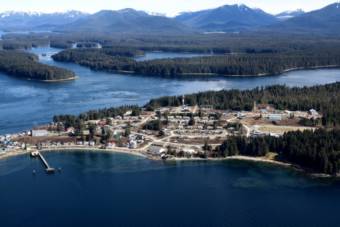
Aerial view of Angoon in 2017. The Southeast Alaska Subsistence Regional Advisory Council is recommending making lower Admiralty Island off-limits to sport hunters during deer season. (Emily Russell/KCAW)
Hunters in Juneau are pushing back on proposals that could restrict their deer hunting rights in parts of Southeast Alaska. The Southeast Alaska Subsistence Regional Advisory Council says its proposals are responding to food security concerns from villages.
Pelican deer hunter Terry Wirta testified this month to the regional subsistence council from the tiny hamlet on Chichagof Island. He says it’s been difficult for guys like him to fill his freezer.
“I don’t know, things seem to have slowed down around here, and all I hear nowadays is a lot a lot of hunters want to be coming here.” he told the council on Oct. 6. “I think the residents in Pelican should have the priority on hunting around here, I’ll tell you that much.”
He was supporting a proposal to restrict hunters coming from urban areas to hunt along Lisianski Inlet. It was one of a handful of proposals that would restrict deer hunting in areas popular with state-licensed hunters from bigger towns.
The strongest measure would be an outright closure of the southern portion of Admiralty Island to urban hunters, to give more opportunity to subsistence hunters living in nearby Angoon.
That’s where council member Albert Howard lives. He says hunters coming from Juneau have access to cheaper fuel to run their skiffs. And if they need affordable meat, there are supermarkets like Fred Meyer and Costco.
“If an Angoon resident fails at hunting, heh, I don’t know how else to say it. But they’re S-O-L,” he said last week. “And we’re people that don’t like to depend on anybody, and I don’t want to go ask anybody for help.”
These rules would apply to federal lands. Much of Southeast Alaska is in Tongass National Forest. And federal law gives priority to subsistence hunting for those living outside of the urban areas of Juneau and Ketchikan. Everywhere else in Southeast, from tiny Pelican to larger Sitka and Petersburg, is considered rural.
State and federal wildlife agencies opposed added restrictions on non-rural hunters. That’s because data shows the deer population appears healthy.
The federal Office of Subsistence Management also argued that many hunters originally from Southeast villages move to larger towns like Juneau or Anchorage. They’d be restricted when they come home to hunt with friends and family.
Juneau-based hunting group organizes opposition
More than 50 letters came in against the measures.
Territorial Sportsmen, a Juneau-based hunting and fishing organization, has lobbied hard against the proposals and encouraged its membership to chime in.
Ryan Beason is an accountant and commercial fisherman living in Juneau and the group’s president.
“We want to promote the rights to all hunters and Southeast and not limit each other,” he told CoastAlaska in an interview. “I think what these proposals are doing is creating conflict between user groups.”
The proposed restrictions on non-rural deer hunters were recommended by the council in amended form. They included urban hunters being allowed to hunt for bucks only with a reduced bag limit on areas of Chichagof Island near Hoonah and Pelican.
State tidelands would be exempt, meaning state-licensed hunters could still cruise the shorelines in their skiffs.
“The mean high-tide line is all state land,” Beason said. “So beach hunting would still be allowed.”
Regional Advisory Council Chair Don Hernandez, who lives on the northern tip of Prince of Wales Island, told CoastAlaska the council has been hearing from villagers concerned about rising costs of fuel and aging rural populations.
“There’s worry about the ability of people in these villages to get the food that they require add at a cost that they can afford,” he said.
He says he understands the wildlife agencies’ opposition. After all, on paper the deer herds are relatively healthy. But he says the regional advisory councils were set up to consider more than population surveys and the number of animals taken.
Final details of the recommendations approved earlier this month remain unclear but will be published in coming weeks after the minutes of the multi-day meeting are finalized.
That’s because the federal Office of Subsistence Management says the precise language won’t be available until a court reporter prepares a transcript of the meeting and minutes.
But those recommendations are not final. They’ll be forwarded to the Federal Subsistence Board, which in mid-April will consider whether to incorporate these in the federal hunting regulations as early as next year.
If they are adopted, it could limit deer hunting opportunities over large swathes of Southeast Alaska that had long been popular with sport hunters from larger towns.
Close
Update notification options
Subscribe to notifications
Subscribe
Get notifications about news related to the topics you care about. You can unsubscribe anytime.