Subsistence

Dead seabirds are washing ashore in Western Alaska for the fifth straight summer

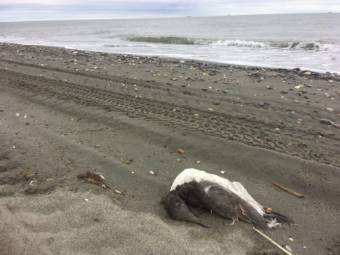
A dead seabird on a Nome beach. (Photo courtesy Gay Sheffield, UAF & Alaska Sea Grant)

Communities all over Western Alaska are finding dead seabirds on their shores for the fifth consecutive summer.

Researchers and federal scientists still have no definitive explanation for the cause.

Gay Sheffield, a wildlife biologist with the University of Alaska Fairbanks and Alaska Sea Grant, collects dead seabird samples each year from communities across the Bering Strait region.

“I would say the scope of this bird die-off is regionwide, and reports have come from Gambell, Savoonga, Koyuk, Shaktoolik, Golovin, the Solomon area, East Beach, West Beach (near Nome), even around Diomede and actually at Shishmaref as well,” said Sheffield.

The numbers total in the hundreds, and that’s only what’s been reported so far.

The National Park Service recently conducted a survey in the Bering Land Bridge Preserve and reported to Sheffield that they found upwards of 100 dead birds every two-and-a-half miles on some stretches of the beach.

According to Kathy Kuletz, seabird section lead for the U.S. Fish & Wildlife Service, the die-off is significant but not as large as the thousands found in Bristol Bay in 2019. Her team is responsible for managing seabirds across Alaska and sending any carcasses onto the appropriate testing labs like the National Wildlife Health Center in Madison, Wisconsin.

And so far in this die-off, Kuletz told KNOM, no infectious diseases or toxins related to harmful algal blooms have been identified in the seabirds’ tissues.

“The last I’ve heard, in most cases, the birds are emaciated, so they’re starved. And so far there’s been no evidence of disease or toxins from harmful algal blooms or anything like saxitoxin,” said Kuletz.

“So if you cross off toxins and you cross off disease, what’s left? And I am left thinking the birds actually cannot find the proper foods,” said Sheffield.

After five years of consistently documenting dead, adult seabirds of multiple species in the Bering Strait region, more and more evidence supports Sheffield’s claim: Seabirds are not eating.

UAF researcher Alexis Will recently released a study that ruled out food shortages as a cause for the 2018 seabird die-off documented on St. Lawrence Island. Since their usual food source — various benthic prey — was available for the birds at the time, Will cited the potential for another unknown factor that was preventing murres, specifically, from catching their prey.

Savoonga residents like Punguk Shoogukwruk have also seen distressed and dying chicks once again this summer. Shoogukwruk has been collecting seabird samples for Will’s research and continues to observe low numbers of nesting birds, similar to what he saw last year.

Meanwhile further south, Will said a major kittiwake die-off is occurring in the Gulf of Alaska but is unrelated to what’s happening in the Bering Strait region this summer.

The unanswered question remains, however: What is causing these seabirds to starve to death?

“The Bering Sea’s ecosystem is in serious, serious trouble, and my fear is that it’s on the verge of collapsing,” said Iyaanga Delbert Pungowiyi.

Pungowiyi, a tribal member of the Native Village of Savoonga, is urging leaders to take action to reduce the effects of climate change in the Arctic. What’s happening to the seabirds cannot be reversed he said, and he wants these die-offs to be taken seriously.

For the U.S. Fish & Wildlife Service’s part, biologist Robb Kaler said its options beyond testing more birds and monitoring the die-offs are limited.

“In terms of what the agency can do about it, is well… remain vigilant, continue asking for community members to share reports and observations and then continue to work with our other colleagues to try to figure out if it’s a food issue?” said Klaer. “Is it food as well as exposure to saxitoxin or a harmful algal bloom event?”

Fish and Wildlife said it does not have plans to conduct a research cruise or do in-person seabird surveys in the Bering Strait region this year.

While more dead birds are studied, and unanswered questions remain, subsistence users across the region are feeling the impacts of the die-off.

In Savoonga, Pungowiyi said, fewer seabirds are nesting, fewer eggs are available and fewer healthy birds are around to eat, which has significant food security implications.

“Since time immemorial,” he said, “over 90% of our food security has been from the Bering Sea itself with the bowhead whales, walrus, seals, seabirds and ducks.”

One Savoonga elder even sent his dinner of seven auklet chicks to Sheffield, wondering if it was safe for him to eat as he normally would. He also reported observing seabirds eating the wrong type of krill based on his own traditional knowledge of seabirds’ diets and behaviors.

Pungowiyi, Sheffield and many others believe the five straight years of seabird die-offs are connected to an ecosystem-wide shift that’s been occurring in the Bering Sea since the cold pool barrier was removed in 2018.

Bottom temperatures in the Bering Sea (NOAA Fisheries)

Keeping with this trend, scientists with NOAA Fisheries documented extremely warm temperatures in the Northern Bering Sea on Aug. 21. According to data from this summer’s bottom trawl survey, sea bottom temperatures in the Eastern Norton Sound and other waters around Nome reached 8 degrees Celsius, or just over 46 degrees Fahrenheit.

According to climatologist Rick Thoman, these significant temperature changes are a sign of what’s yet to come.

“That is undoubtedly going to be important for commercial fisheries,” he said. “And in the long run, that is going to, I’m sure, impact the kinds of fish species that show up and wind up taking residence in the Northern Bering Sea as well.”

But in terms of what caused these significantly warm sea bottom temperatures, Thoman said, he doesn’t have enough information yet to explain that.

Subsistence users, scientists seek answers for chum salmon declines

“It’s hard to comprehend that this is happening in my lifetime. It makes me sad just thinking about it,” said Bill Alstrom of St. Mary’s. (Olivia Ebertz/KYUK)

In Western Alaska, chum salmon stocks have sharply declined over the last two years. That’s a problem, because people in the region depend heavily on the fish for food and for work. Scientists are in the early stages of trying to understand the crash.

Bill Alstrom lives in St. Mary’s on the lower Yukon River. It used to be that if he wanted fresh salmon for dinner, he’d throw a net in the river to catch a couple. But with fishing closures this season, he can’t do that anymore.

“It’s hard to comprehend that this is happening in my lifetime. It makes me sad just thinking about it,” Alstrom said.

The State of Alaska has closed fishing for chum to protect the runs. For Yukon River families, chum is particularly important. Chinook salmon have been low for decades, but chum were the fish families could depend on until last year, when the summer chum run dropped below half of its usual numbers. This year the run dropped even further, to record lows.

Biologist Katie Howard with the Alaska Department of Fish and Game said that the chum declines are not just occurring in the Yukon River.

“When we talk to colleagues in the lower 48 and Canada, Japan, Russia, they are all reporting really poor chum runs. So it’s not just a Yukon phenomenon. It’s not just an Alaska phenomenon, but pretty much everywhere,” said Howard.

So why are the chum numbers so low? The short answer is that no one really knows for sure. But there are a lot of theories.

Every week during the summer, subsistence users, biologists and fishery managers gather on a weekly teleconference hosted by the Yukon River Drainage Fisheries Association. They share information and ask each other questions, and the subsistence users bring up one theory for the decline again and again: bycatch.

Bycatch is when ocean fishing vessels targeting one species also incidentally kill other fish. Some see it as a necessary evil, while others are opposed to it completely. The National Oceanic and Atmospheric Association tracks bycatch. Non-chinook chum salmon bycatch is already bigger than normal this year, and bycatch has been trending upwards since 2012.

NOAA distinguishes between non-chinook and chinook bycatch because chinook bycatch is heavily regulated. If trawlers catch more chinook than allowed, they have to cut short their fishing season. It incentivizes trawlers to avoid chinook feeding grounds. Trawlers must also report their non-chinook salmon bycatch, but there are no limitations on these amounts. NOAA estimates that 99.6% of its non-chinook salmon bycatch is chum.

So if chum bycatch is greater than normal this year and trending upwards, would bycatch be a major factor in Western Alaska’s chum decline? Not necessarily, said a NOAA spokesperson, because the fish that are dying on the trawlers are largely not bound for Western Alaska. About 16% are from coastal Western Alaska, and less than 1% are from the upper and middle Yukon.

The rest of the bycatch is mostly hatchery fish: fish that have been hatched in a controlled environment. They’re largely from Japan.

Hatchery fish are also cited by some as a possible cause of chum decline. Jack Schultheis is the manager of the only wild salmon processor on the Yukon: Kwik’pak Fisheries Emmonak.

“I think it’s disrupted something in the foodchain,” Schultheis said.

Kwik’pak manager Jack Schultheis says this year’s chum run is the worst he’s ever seen. (Olivia Ebertz/KYUK)

Kwik’pak is Native-owned, by a community development quota (CDQ) group called Yukon Delta Fisheries Development Association, which also owns trawlers. NOAA data shows that CDQ trawlers are responsible for less than 10% of chum by-catch, and Yukon Delta Fisheries Development Association-owned trawlers are responsible for less than 1% of chum bycatch on American vessels.

State biologist Howard doesn’t think hatchery fish are the issue. That’s because hatchery fish populations haven’t changed much in the past 30 years. But Peter Westley, an associate professor of fisheries at the University of Alaska Fairbanks, thinks hatchery fish could be at least part of the problem.

“These declines in salmon that we’re seeing in our local rivers is possibly linked to actually, ironically, too many fish in the ocean,” Westley said.

Westley said that’s because since the 1970s, the North Pacific Ocean and the Bering Sea have been full of food for both wild and hatchery chum, and both populations have grown over the decades. But now he suspects that increasing competition for food has led to the massive decline.

“The reality is, you don’t know that you were at a tipping point until it’s in the rearview mirror,” Westley said.

Westley said that climate change could be the culprit behind the lack of food in the ocean. He said that crashes in salmon stock will be more likely as the ocean continues to warm. Westley said that this competition affects hatchery and wild fish alike, leading to dwindling numbers for all salmon.

On the Yukon River, subsistence fisherman Alstrom also thinks warming temperatures could be a factor in the crash. In his 70 years in St. Mary’s, he’s seen the changes in the environment firsthand.

“And all these trees out there looks like a jungle. There used to be scrubs out there when I was growing up,” Alstrom said.

Alstrom said that the animals in the region are changing too. He never saw moose as a kid, but over his lifetime they started to move in.

Researchers are trying to understand the chum crash. For decades, biologists have mainly been focusing on chinook salmon, which have a longer history of decline and are more valued by commercial and subsistence fishermen.

NOAA and the Alaska Department of Fish and Game are leading two surveys on the Bering Sea this year to study salmon marine life. State biologist Howard is out on one of those surveys right now. She’d like to see more funding to study chum overwintering habitat in the North Pacific but said that it’s expensive and dangerous to conduct that research because of turbulent winter seas.

Westley said that the number one question that needs to be answered now is where the chum are dying in their lifecycle. That will help scientists determine what’s killing the fish.

Alstrom said that it will be hard for his community if the salmon don’t return.

“It’s just not right when you live in your region that’s supposed to be teeming with salmon, and to go without it. It’s just devastating,” Alstrom said.

Despite the decline, biologists say that chum are not endangered, and the subsistence fishing closures are helping the salmon get to their spawning grounds.

Declining sea ice in Kotzebue Sound is shortening subsistence hunt for seals, study finds

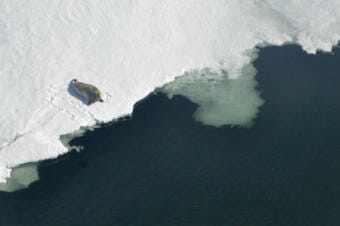
A bearded seal sits on the ice edge in Kotzebue Sound. (Photo by Jessie Lindsay, NMFS MMPA Permit No. 19309.)

Seal meat makes up a good portion of what’s in subsistence hunters’ freezers in Kotzebue. However, the sea ice the seals haul out on is diminishing, and new research has shown the window to hunt seals is getting shorter as a result.

Iñupiaq hunter Cyrus Harris has harvested ugruk, or bearded seal, his whole life. For many people in Kotzebue and the surrounding region, the rotund mammal is a dietary staple.

“Ugruk, once we process it into a seal oil form and using it as a preservative for the meats, the product itself is very nutritious,” Harris said. “We may be processing this stuff in the month of June, but we’re thinking ahead to fill our Siglauq, or storage, with product that’s going to run us through the winter.”

Harris says the hunting season starts in the spring, as the sea ice breaks up in the Kotzebue Sound. But he’s noticed a change in the season length.

“Once the ice flows break loose and are drifting north, we’d have about a two-week timeframe to do that on a regular hunting season,” Harris said. “But the shortest I’d seen it happen was about three days.”

The sharp decline in the season length can be directly linked to the decline in sea ice due to a warming climate. That’s the finding of a new collaborative study conducted by the Native Village of Kotzebue and the International Arctic Research Center at the University of Alaska Fairbanks.

Alex Whiting is the environmental program director for the Native Village of Kotzebue. He’s a co-lead author on the study and has been documenting the change in the ugruk hunting season for almost 20 years. He says it’s become more relevant as the tribe has studied the change in sea ice extent.

“Notes that I had been taking since 2002 did show a pattern of shorter ugruk hunting seasons because the ice would disappear a little bit earlier and earlier over time,” Whiting said.

That change has translated to an average loss of a day per year for the hunting season since 2002. The study found that the season is ending an average of 26 days earlier than normal. Whiting says the sea ice extent fluctuates.

“Some years it resembles a little bit like it used to in the 20th century,” Whiting said. “But other years, like 2018 and 2019 in particular, by the time the ugruk hunting season began, the ice in the Kotzebue Sound, which was 70 to 80 percent gone already, looked like it would at the end of June or the beginning of July.”

Roswell Schaffer, an Iñupiaq elder and hunter from Kotzebue, Alaska, who helped co-author the study. (Photo from Sarah Betcher, Farthest North Films)

With these changes, Whiting says hunters are having to plan their hunts earlier in the year.

“If they wait, all you need is a week of strong west winds, and you could lose out on your opportunity for that year,” Whiting said. “Because the ugruk hunting season only occurs during that short window of May, June.”

To date, researchers haven’t seen any drastic decline in hunters’ ability to land ugruk, but it’s largely due to hunters adapting to the shifting ice.

Donna Hauser is a marine ecology researcher with the International Arctic Research Center and the other co-lead author on the study. She says normally hunters would have a lot more sea ice to travel out on to harvest ugruk, often meaning packing more gear and gas for their boats. That is changing as the sea ice extent becomes smaller.

“Some sea ice had grounded close to Kotzebue, within 10 miles,” Hauser said. “And so people could make more frequent, shorter trips, use more gear, less gas, and actually be really successful still. So hunters have had to adapt to these changing conditions. That has allowed them to still be successful, despite the sea ice loss.”

In researching the impacts of sea ice extent on ugruk hunting, Hauser says the process was collaborative from the start. That meant input from more Western academics at the university level, but also the inclusion of village officials as well as an Indigenous Elder Advisory Council, something Whiting from the tribal office says is a first. Hunters like Harris were added as co-authors of the study.

Hauser says the co-production of knowledge was valuable, and the research wouldn’t have been as robust without the inclusion of Indigenous knowledge from the study’s inception.

“This is really responding to Indigenous sovereignty over the entire research process,” Hauser said. “It creates a more inclusive and sustainable research process, which hopefully will lead to more equitable outcomes in terms of incorporating those Indigenous perspectives in climate change planning and adaption.”

As Hauser and others look forward to further collaboration, hunters like Harris say they’re looking ahead to this upcoming winter, to see what sea ice it’ll bring for spring.

How low chum runs changed the lives of these Western Alaska fisheries workers

Commercial fisherman Paul Andrews makes $9 a day measuring the water level in Emmonak. (Olivia Ebertz/KYUK)

For decades, Kwik’Pak Fisheries in the Western Alaska village of Emmonak has provided reliable summer employment in one of the state’s most unemployed regions. The company is the only fish processor on the Yukon River.

But with salmon runs low and commercial fishing closed, it’s offering few jobs this summer. Commercial fishermen and women are feeling the economic stress, and those who are still working at the plant have had to transition to new roles.

Every day at half past noon, Paul Andrews walks to the river bank in Emmonak, stopping at a small metal marker nestled on a dune. He takes out a surveyor’s measuring tape, hooks it on to the marker and walks it to the water line. Then he phones the National Weather Service.

“Make that 79 feet at 12:30,” Andrews said.

Paul Andrews marks the rain gauge and the level in his notebook. (Olivia Ebertz/KYUK)

Andrews is measuring the water level of a slough off the Yukon River, not far from the mouth. He marks the rain gauge and the level in his yellow notebook. He usually takes his youngest child with him for the task.

In Andrews’ notebook, the water levels date back to early July. That’s when he started this job. He gets paid $9 per day. It’s a massive pay cut from his previous work.

In prior summers, Andrews worked as a commercial fisherman for Kwik’pak. It was his only employment during the year, and he said that he usually made $10,000.

“My wife works. But you know, that’s not enough. But we get by,” said Andrews.

He took the water reporting job this summer because he knew there wouldn’t be any commercial fishing openings. The chum salmon numbers on the Yukon tanked last year, and sunk to record lows this year. All commercial and most subsistence fishing for salmon on the river is closed.

Usually Kwik’Pak pays out $7 million to $10 million to local workers. This year it’ll be paying out $700,000 to $800,000 to plant workers, and nothing to commercial salmon fishermen and women.

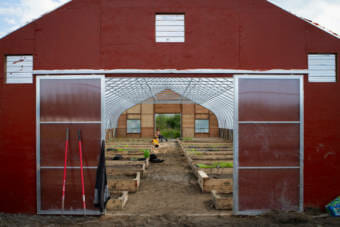
Kwik’pak is able to hire plant workers at all because it is experimenting with new endeavors. The company built three greenhouses to grow vegetables, and it’s trying its hand at very limited commercial cod processing. This summer the company is buying a few fish from commercial cod fishermen to see how it goes, though they’re not selling it quite yet.

Most of the people working at Kwik’pak this summer are its long-term, most loyal employees. And they’re all having to get used to new roles. Like Lisa Andrews. Usually she does fish accounting, but now she supervises teen workers in the greenhouse.

“I wasn’t certain, but now I like it. These kids actually grown on me,” said Lisa Andrews, who is not related to Paul Andrews.

For now, Richard Akaran’s job as a welder hasn’t changed, though he knows it could. (Olivia Ebertz/KYUK)

When she started hearing about the low chum runs, she said she thought she might not have a job at all this summer.

“I called many times, because I was worried that I wasn’t going to work,” she said.

She said that she’s lucky she got a job. She had worked at a gardening store in Anchorage, so she felt prepared for the new role.

There’s also some folks who haven’t quite felt the impacts of the low chum numbers on their job descriptions yet. Like welder Richard Akaran from Kotlik. He’s wearing overalls and a thick leather welding jacket. He builds boats for the Yukon Marine Manufacturing company, which sits on the Kwik’pak campus.

“We build boats for the fisherman. The fishermen that fish for Kwik’pak,” Akaran said.

For now, he said, his job hasn’t changed. But he knows it could. It’s been two years of low chum runs now. Already other welders have been impacted. Half of them have not been hired back. Akaran said that he hopes next year’s runs are better.

Meanwhile, Kwik’Pak and its workers are trying to keep up with chum runs that are declining faster than the industry can adjust.

With chum runs crashing, Yukon River fish processor pivots to greenhouses

This summer at Kwik’pak, youth workers are planting tomatoes instead of breaking down fish. (Olivia Ebertz/KYUK – Bethel)

Usually Kwik’pak Fisheries, the only commercial fish processor on the Yukon River, sells salmon around the world. After the Yukon’s main salmon species started dwindling to record lows last year, Kwik’pak had to pivot to stay afloat.

Kilee Fratis and Josine Wasky are standing with a group of teenagers in one of the only greenhouses along the lower Yukon River. It’s a rare sunny day for this summer, and the two girls are feeling it.

This summer, Josine Wasky and Kilee Fratis are learning how to garden instead of breaking down fish. (Olivia Ebertz/KYUK)

“It’s really hot,” said Fratis.

They’re sticking thermometers in the soil and making notes.

“We’re watering the plants and taking the temperature,” Wasky said.

“And checking the moisture on the soil,” Fratis added.

The greenhouses are filled up with peppers, peas, chard and turnips. Right now they’re watering the tomatoes. They just got to taste one.

“It was really sweet, and so it was good,” Fratis said.

It’s their third summer working at Kwik’pak Fisheries in Emmonak, but this work looks very different from past years.

Fratis and Wasky say that normally they would be deboning fish and boxing them up. But with fish returning in record low records, fish plant employees are planting tomatoes instead.

The Kwik’pak greenhouses are filled up with peppers, peas, chard, tomatoes, and more. (Olivia Ebertz/KYUK)

“This is the worst I’ve ever seen ever to where somebody who lives here can’t go out and catch a fish to eat,” said Kwik’pak general manager Jack Schultheis.

He said these are the worst chum salmon runs he’s ever seen in the nearly 50 years he’s been in Emmonak.

When chinook runs began declining decades ago, Kwik’pak opened to keep employment and profits up in the region. It focused on chum salmon, and for 20 years it profited off the abundant chum by canning it, packing it and selling it around the world. Kwik’pak grew to one of the largest employers in one of the country’s poorest regions.

Last year, the summer chum run fell to below half its usual size: from 1.7 million fish to 700,000. This year it dropped even more: to 153,497 salmon, less than a tenth of its usual size.

“You know, do I wonder if this is going bad? You know, as much as I hate to admit it, this is going really bad,” Schultheis said.

Kwik’pak manager Jack Schultheis says this year’s chum run is the worst he’s ever seen. (Olivia Ebertz/KYUK)

Fall chum are still running, but the numbers have also dropped dramatically. Commercial and subsistence fishing is closed on the river, and Kwik’Pak Fisheries can’t process the fish it was created for or fulfill its main purpose of infusing cash into the local economy. It usually pays out $7 million to $10 million to local workers, but this year it’ll be much lower.

“I’m guessing less than a million. Seven-hundred thousand to 800,000 [dollars],” Schultheis said.

So to keep up local employment, Schultheis quickly pivoted last summer when the chum runs started dropping. If workers couldn’t catch food, they could grow it. He applied for a grant to build greenhouses. That allowed Kwik’pak to hire back loyal employees and retain its summer teen workers, who we heard from earlier.
The Kwik’pak logo is a man holding a salmon, but crashing salmon runs mean the company might start buying and selling cod. (Olivia Ebertz/KYUK)

Schultheis hopes the greenhouses will eventually contribute to local food security. And to diversify even more, Kwik’Pak is also experimenting with buying an entirely new species of fish: cod. There are a handful of commercially licensed cod fishermen in Emmonak, and they’ve been taking their river-going skiffs onto the Bering Sea to try their luck.

After 20 years of relying on chum, the company could change its logo from a man in a qaspeq holding a salmon to holding a cod instead.

Why is Bristol Bay’s sockeye run breaking records while other areas struggle?

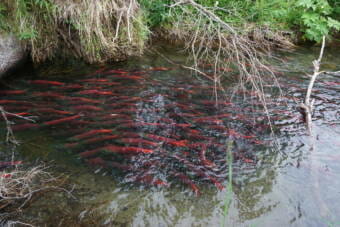
Sockeye in a creek in the Wood River watershed. July 28, 2021. (Stephanie Maltarich/KDLG)

This summer, Bristol Bay set a record for the largest sockeye run: 65.86 million salmon returned. That’s much higher than the pre-season forecast of 50 million salmon, and the run hasn’t finished yet.

But why Bristol Bay is such a sockeye hotspot poses a puzzle for scientists.

“The question of why so many sockeye have returned to Bristol Bay the last seven or eight years is a bit of a mystery to I think most people, if not everyone,” said Daniel Schindler, a professor and ecologist in the school of Aquatic and Fishery Sciences at the University of Washington.

Schindler is also the principal investigator at the Alaska Salmon Program — a research project that has documented the watersheds surrounding parts of Bristol Bay since the late 1940s.

This was Schindler’s 25th year exploring and researching the Wood River system, one of the nine rivers feeding into Bristol Bay.

As part of the job, he spends most of his days from mid-June through mid-September walking a couple miles up and down obscure creeks and rivers, counting salmon as they return to their spawning grounds.

This was Dan Schindler’s 25th year researching the Wood River system. July 28, 2021. (Stephanie Maltarich/KDLG)

By the end of July, only a fraction of sockeye have returned to spawn.

“I mean, this looks like a lot of fish, but the peak is still about 10 days away,” Schindler said while tallying sockeye on a July afternoon.

But not every area of Alaska is seeing a lot of fish.

This summer, communities along the Yukon River saw some of the lowest chinook and chum runs on record. Several communities have even appealed for federal aid through fishery disaster declarations.

With access to decades of data, Schindler and his colleagues are trying to make sense of what sets Bristol Bay apart.

One factor, he said, might be water temperature.

Western Alaska is one of the fastest warming places on earth, and scientists have had to re-scale their charts over the last decade to adapt.

“Climate warming seems to have actually benefited Bristol Bay sockeye — warmer temperatures, more food, more growth opportunities, and they are still in the sweet spot of water temperatures that are still profitable,” Schindler said.

Other parts of the state aren’t as lucky. Ocean waters are a few degrees warmer in the Gulf of Alaska, and that slight difference has challenged fish populations south of Bristol Bay.

Schindler said another possibility for Bristol Bay’s success is the area’s large and intact habitat. The surrounding watersheds are uninterrupted by roads, dams and other development.

“That’s one of the reasons Bristol Bay is so unique, is that all of that habitat diversity is still here, and all of that genetic diversity in the salmon and life history diversity is still here,” he said. “And it’s interesting scientifically, but it’s also important for the fishery, because all of that diversity stabilizes how many fish come back from year to year.”

Sockeye carcasses. June 28, 2021. (Stephanie Maltarich/KDLG)

It’s normal for fish populations to fluctuate. And while at some point Bristol Bay will likely see a smaller run, Schindler said he remains optimistic.

“It’s hard to believe the 50 to 60 million fish per year that we’ve been seeing — never mind the 64 million fish that we’ve seen this year — is going to continue at that level forever,” he said. “But if we look into a crystal ball for the next century and look at the fact that the world is warming, there is no reason to believe that Bristol Bay salmon populations won’t continue to flourish even under substantially warmer temperatures.”

But Schindler admits the ocean is a complex place full of many unknowns that scientists still don’t fully understand.

“Really the question is how much more warming these systems can withstand before they get too warm, like California and other places in the Pacific Northwest,” he said.

Schindler plans to return to Bristol Bay each summer to count the salmon and better understand how the warming climate is impacting the world’s largest sockeye salmon fishery.

Site notifications
Update notification options
Subscribe to notifications