Subsistence

Tribal and commercial fishing groups call for drastic reductions to trawl salmon bycatch

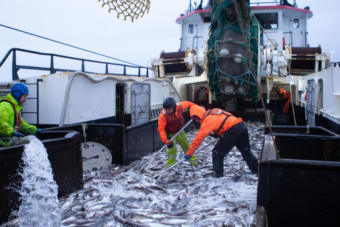
Crew members shovel pollock off the deck of a Bering Sea fishing boat earlier this year.
Crew members Joe Johnson, left, and Derrick Justice shovel pollock on the deck of the Commodore as another crew member, Brian Hagen, holds the hose. (Nat Herz/Alaska’s Energy Desk)

Fisheries managers allow whitefish trawlers to inadvertently scoop up halibut, crab and salmon in their nets. The bycatch rate is relatively low. But because the trawlers catch so much of their target species, the unintended harvest adds up.

That’s raising alarms in Western Alaska, where chum and king salmon runs have been performing poorly.

While the bycaught salmon is often donated to food banks, that’s of little assurance to those living along the Yukon and Kuskokwim rivers, where subsistence is a way of life.

“We eat dry fish like people from the Midwest eat bread, with every meal,” Mary Peltola told the North Pacific Fishery Management Council this month. She’s the executive director of the Kuskokwim River Inter-Tribal Fish Commission and lives in the largely Yup’ik community of Bethel. “Our babies teethe on dry fish. It’s the first food most Yup’iks eat, and it’s something that we crave year-round.”

Peltola said fishing on the Kuskokwim has been severely restricted to preserve wild salmon stocks. Meanwhile, trawlers haven’t faced new restrictions of their own as they scoop up lucrative whitefish like pollock, cod and halibut. She asked the council to put an end to bycatch in the industrial commercial trawl fleet.

“We’re not policy experts,” Peltola said, “We’re not scientists. We’re not career people. This isn’t part of our career ladder. We’re very desperate to pass on the knowledge that we’ve received over 12,000 years on how to live in harmony with salmon and utilize salmon as our foundational diet.”

The At-Sea Processors Association — a large industrial trawl organization — said in an emailed statement that no fishery is without bycatch, and there’s always other species in the nets or caught on a line. The group argued that a moratorium on salmon bycatch in the Bering Sea would mean a total shutdown of the pollock fishery.

North Pacific Fishery Management Council member Andy Mezirow said he’s heard the call for “zero bycatch” before. He asked: Why not request less bycatch?

“I can see how it would be galling to have no chinook salmon returning to your river and have thousands of them being caught in the ocean out in front of the river, so I understand your frustration,” Mezirow told Peltola during public testimony. “But what I don’t understand is what the strategy of asking for zero bycatch is. That’s a huge change from where we’re at now.”

Peltola responded that the goal should be zero.

“For people who rely on salmon for food security, if they cannot harvest one (salmon), then the commercial industry should not be able to harvest any accidentally when it is not even what you’re targeting,” Peltola said. “There are strong feelings also that even the term bycatch is an affront to foundational principles of not wasting and making sure that all life is sustainable and able to regenerate itself.”

In 2020, Bering Sea trawlers reported bycatch of tens of thousands of chinook salmon and hundreds of thousands of chum.

This year’s abysmal salmon runs to the Kuskokwim, Unalakleet and Upper Yukon rivers have already triggered one of the council’s bycatch reduction measures. But even under these rules, the trawl fleet is allowed to catch up to 45,000 kings.

And the Bering Sea isn’t the only place where bycatch is a problem.

In the Gulf of Alaska, some salmon fishermen complain about rules that allow bycatch allocations to be moved around. If pollock trawlers in one area catch 1,300 fewer king salmon, for example, that 1,300 salmon allowance can be transferred to another fishery.

Kodiak-based commercial salmon fisherman Alexus Kwachka is a former member of the NPFMC’s advisory panel and was among the dozens who recently called on Gov. Mike Dunleavy and the NPFMC to tighten the rules.

“The trawl fleet has done a mighty job of trying to mitigate their interaction with king salmon,” Kwachka said in a phone interview. “But the bottom line is, they still use a bunch of them. And, you know, as these programs have developed, we’ve allowed for one fishery to roll fish into the next fishery. And I think that it’s time to revisit that, and see if that’s really, you know, if we’re talking about saving king salmon, then the net result should be savings.”

Kwachka said he believes that weighing commercial interests like the billion-dollar pollock industry against rural subsistence traditions is a false equivalence.

“The tax that the state receives is minor compared to the cost that’s being incurred by the residents of the state, as far as way of life, whether you’re talking about halibut or crab or salmon,” he said.

Kwachka said he knows that climate change issues play a factor in the ongoing declines of wild salmon stocks in much of the state.

“It’s not all put on the pollock fishery,” he said. “Obviously, there’s something going on in the ecosystem. But until we have a better understanding of what’s going on, I think that savings should be savings.”

The Alaska Whitefish Trawlers Association, an industry group representing independent catcher vessels in the Gulf of Alaska, said its business model depends on its ability to shift bycatch limits around.

“If trawling shuts down, then life as I know it is over,” says Kodiak-based trawler Paddy O’Donnell. “I can’t pay my mortgage, I can’t keep my boat running. And so that’s the impact it’s gonna have on me and a lot of other families that are in the same situation. I don’t have other fisheries to go to. I trawl, I don’t salmon fish, I don’t do any other fisheries.”

O’Donnell said the fleet has spent years working to improve technology and methods to reduce salmon bycatch.

“The trawl sector has gone a long way in gear development … gear modifications, electronics, and what have you over the years to try and decrease the amount of incidental take we have when it comes to salmon,” he said. “We’re continuing to work on that. We’ll continue to work on that.”

Bycatch isn’t limited to salmon. Crab fishermen are also calling for serious reductions in bycatch of juvenile crab in trawl nets.

The North Pacific Fishery Management Council’s ongoing meeting runs through Friday.

While the advisory panel rejected a zero salmon bycatch proposal, the council will still consider a broader plan that supports consulting with tribes and encourages further research about chinook and chum salmon bycatch.

Haines gillnetting season bounces back with late surge of sockeye

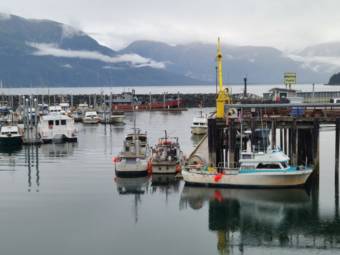
Fishing vessels fuel up for the crab and shrimp openers at the Haines harbor (Corinne Smith/KHNS)

Haines commercial fishermen saw a much better salmon season this year than last, with a surprise late summer surge of sockeye up the Chilkat Inlet.

Marty Smith mans the harbor crane, maneuvering gear onto the back of his pickup as he wraps up a summer season of gillnet salmon fishing.

“It was a little better than last year,” Smith said. “But the bar was so low last year that I hope we never see that again. Thankfully, we had some decent prices, so a guy could make a living.”

Last year, Haines gillnetters struggled with weak returns and low prices along with pandemic-related supply chain issues.

Smith says the restrictions are difficult, but the prices and harvest have bounced back.

“Mostly I was fishing dogs and chum and then sockeye. I didn’t get into the fall fisheries too much. And the late shot of sockeye really helped,” Smith said.

Alaska Department of Fish and Game area management biologist Nicole Zeiser manages the region’s commercial gillnet and shrimp fisheries. She says improvements were seen over last year, especially a late summer run of Chilkoot River sockeye salmon.

“The return was well above average this year,” Zeiser said. “Out of the blue, it was almost like a second run showed up. But you know, we can’t really verify that. It’s basically just a whole new surge of fish came through the Chilkoot River weir.”

She says sockeye escapement estimates exceeded sustainable escapement goals at 98,672, but she said that shouldn’t have any detrimental impacts to long term salmon returns.

Zeiser also noted that for the second year, Chilkat River sockeye returns were below escapement goals.

“There really wasn’t a reason to believe that, you know, it would have been a really well below average return. So that’s kind of an unknown thing. We just we don’t really know what what’s happening to Chilkat sockeye salmon stocks,” she said.

The District 15 gillnet fishery is open for one more week, until Oct. 6. And Zeiser says that because the commercial fishery is open, the subsistence fisheries at the Chilkat River and Chilkat Inlet have also been extended through that same period.

Tribal and environmental advocates celebrate the first water flow down the Eklutna River in decades

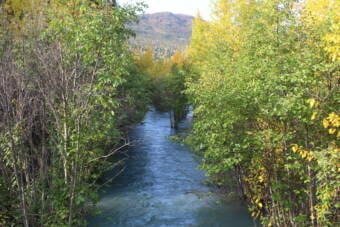
Water flows down the Eklutna River on Sep. 18, 2021. (Wesley Early/Alaska Public Media)

For more than 60 years, the Eklutna River north of Anchorage had been dammed up, stifling the salmon runs that fed generations of Dena’ina people in the area.
Before the damming, for hundreds of years, the area surrounding Eklutna Lake was populated by the Dena’ina people. Curtis McQueen says the inhabitants were originally more nomadic.

“They settled these lands here and never left because of the rich abundance of habitat in this area,” he said.

McQueen is the former CEO of Eklutna Inc., the tribe’s for-profit corporation.

“And the Eklutna River, which was a raging, massive river at the time, has – still has — all five species of salmon,” he said. “A lot of rivers don’t have all five species.”

McQueen is Tlingit but was formally adopted by the Eklutna people. In his time working with the tribe, he says he’d heard stories about how bountiful the river used to be.

“We lost an elder recently named Alberta Stephan,” McQueen said. “Alberta was our historian, and she would talk about when she was a little girl, down there at the mouth, where literally, they could walk across the back of salmon. And it was a massive stream, and there was no such things as mortgages and houses and cars. Everything they needed was right here.”

The fish were their main source of food. That was, until the construction of the lower river hydroelectric dam in the 1920s, which provided Anchorage with its first major source of power.

McQueen says it didn’t operate for long.

“The challenge was, when they built it in the canyon, it would fill up with silt really quick,” McQueen said. “And so they were constantly dredging it. And as Anchorage was growing, they needed more power, that became an issue.”

The lower dam became defunct in the 1950s when the federal government opted to build a larger dam project further up the river. But the lower dam continued to fill with sediment for decades, blocking off the river run.

Supporters of the Eklutna River restoration efforts gather for a group photo at the river campgrounds. (Wesley Early/Alaska Public Media)

That was until 2018 when, with the support of the Native Village of Eklutna and Eklutna Inc., the environmental non-profit Conservation Fund raised $7.5 million to demolish the lower dam. The entire process took about five years.

Earlier this month, tribal and environmental advocates witnessed the first water to flow down the river in decades.

“For the first time in 66 years, the thirsty Eklutna River is finally getting a drink of water,” Trout Unlimited project manager Eric Booton said as the crowd applauded.

Native Village of Eklutna Tribal President Aaron Leggett was part of the celebration. He says he’s grateful for the work that has been done so far to get the river flowing.

“Our ultimate goal is to restore the salmon runs that sustained us for many hundreds of years,” Leggett said.

There’s still more work to be done to make sure the river can support a salmon run. Eklutna Lake supplies 90% of Anchorage’s drinking water, so the water release needs to strike a balance.

(left to right) Eric Booton and Austin Williams (both with Trout Unlimited) and Curtis McQueen, former CEO of Eklutna Inc. (Wesley Early/Alaska Public Media)

Austin Williams is a legal and policy director with Trout Unlimited.

“The question here is how much water and what needs to be done to ensure that salmon returning to the Eklutna River can successfully spawn, rear and support a healthy fishery,” Williams said.

In the early 90s, the electric utilities agreed to help with studies to look at the impacts from the dams and how to protect and bolster the salmon runs in the Eklutna River. Booton with Trout Unlimited says those studies are ongoing.

“The study plans that they will do for two years in order to get the data necessary to come up with the mitigation outcomes,” Booton said. “At this point, they’re nearly wrapped up with the first year of collecting that data and there will be a second year in 2022 to also collect that information.”

While different groups continue to work on what’s next, McQueen with Eklutna Inc. says there’s still cause for celebration, and a flowing river to enjoy.

“I want to camp out here tonight. I’d sleep rock hard listening to this,” McQueen said. “Whether you’re on a beach or on a river, there’s nothing that relaxes a human mind more than hearing water moving. It’s amazing.”

Correction: An earlier version of this story misspelled Aaron Leggett’s last name.

Pollock fishery may be cause of decline in Bering Sea fur seals, study says

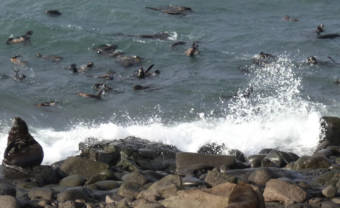
The number of northern fur seals in the Bering Sea has dropped by around 70% since the 1970s.
Fur seals are an essential subsistence food for the Unangax̂ communities in the Bering Sea’s Pribilof Islands. But for years, scientists have been unable to explain why the seals’ populations have been falling.

Now, a new study points its finger at an industry that’s long been suspected, but never definitively linked with the population declines: Alaska’s huge commercial pollock fishery, which harvests the same species that nursing female seals rely on to feed their pups.

Jeffrey Short is the lead author of a study published in the Journal of Marine Science and Engineering on Sept. 9, which he says presents for the first time clear evidence linking the pollock fishery with fur seal reductions.

Some scientists have suspected the pollock fishery, but evidence-based research linking the two has been scarce. According to Short, that’s because much of the existing literature has focused on the overall abundance of pollock, which is quite high.

By contrast, this new study focuses on the pollock catch — that is, the amount of fish being pulled out of the water.

“I was just astonished at how well it worked,” Short said. “Just that single number of pollock catch can explain nearly all of the [fur seal] population trajectory since about the mid-1970s.”

The team found evidence to suggest that the pollock industry, by breaking up the dense schools of fish the mothers rely on while fattening their pups, has made it harder for lactating fur seals to feed their young.

“What a female lactating fur seal wants to do is find a dense aggregation of food right next to where her pups are,” Short said. “So she can spend the minimum amount of energy to go find it, sit on top of it and eat to her heart’s content, and then swim right back and nurse her pups and repeat that all summer long.”

But commercial fishing boats also seek dense schools of fish. By fishing those schools, the fleets break them up, and the fish disperse. Which means the mother seal can’t fatten up her pups as quickly as she once could.

That’s a problem because the pups swim south in the fall. If they haven’t built up enough reserves, those seal pups likely won’t survive their first year.

And that, according to this study, is why fur seal populations are declining so steeply.

The number of northern fur seals in the Bering Sea has dropped by around 70% since the 1970s.

“I think it’s possible for the fur seal herd to eventually go extinct or become extirpated off the Pribilof Islands,” Short said.

The fur seal rookeries in the Bering Sea hold special importance to the Unangax̂ communities in the Pribilof and Aleutian Islands which rely on fur seals for subsistence.

Martin Stepetin grew up on St. Paul Island — the most populated of the Pribilof Islands — but now lives in Juneau where he advocates for Alaska Native rights.

“We eat those seals, so it gets scary,” Stepetin said. “If you’re trying to support your family, and you’re trying to put food in the refrigerator, you worry about the future. What about your kids? How much food is there going to be whenever your kids come of age? Are they going to be able to support their families?”

The study suggests that to make any real changes, the fishery — which is one of the most lucrative in the United States — would likely need to limit pollock catch to around a million tons in the areas surrounding the Pribilof Islands. That’s nearly a quarter of the total 1.375 million tons currently allowed.

One pollock industry booster, Stephanie Madsen, said she’s worried about a one-size-fits-all solution.

“It would be devastating to just have a blunt tool. And that’s what I think this is. It’s a blunt tool,” said Madsen, executive director of an industry group that represents large factory trawlers, the At-sea Processors Association.

Madsen said she welcomes the paper into the growing body of research on the subject, but she said there needs to be more precise measures than simply limiting the total allowable catch. She also expressed skepticism that limiting catch would improve the seals’ fate.

“When you’re talking about drawing circles around rookeries, and preventing fishing from occurring in there, you’re making quite a few assumptions about the pollock staying inside that circle, that the fur seals aren’t going to go outside the circle,” Madsen said.

The pollock industry employs around 30,000 people nationwide. In the eastern Bering Sea and Gulf of Alaska, the fishery brought in around $420 million in 2020, according to the National Oceanic and Atmospheric Administration.

“Thousands of jobs and tens of thousands of families depend on that income,” Madsen said. “I think depending on the size of those circles, for the most part, it could be quite damaging to the pollock fishery’s ability to harvest our quota.”

Madsen said that while she is moderately concerned about the authors’ findings, she doesn’t anticipate they will lead to immediate changes in the industry.

The North Pacific Fishery Management Council, which manages fisheries in the region, receives updates on marine mammals at the beginning of each year.

“We have great science, we have rational thinking heads,” Madsen said. “And I think the North Pacific council will take this information [when] they get their annual marine mammal updates at their February council meeting.”

As low Chignik salmon runs continue, people worry their communities will disappear

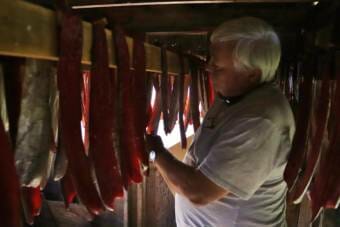
Gene Carlson checks red salmon strips in his smokehouse on July 16, 2021. Carlson was born in Chignik Bay but lives in Washington state now, usually returning in the summer to fish. He says this may be his last season. (Izzy Ross/KDLG)

Gene Carlson drove the streets of Chignik Bay one afternoon in July, between quiet wooden houses and old cannery buildings.

“That used to be a restaurant there,” he said. “That’s a web loft over there, which is shut down now. Here’s another one of my cousin’s houses. He’s not living there anymore.”

The Chignik River’s salmon runs have sustained generations in the century-old small fishing communities along the Alaska Peninsula.

But, for the fourth year in a row, the runs came in severely low. For years, residents have struggled to earn a living fishing and to put up enough fish for the winter, and some worry their villages will disappear, taking with them a fishing tradition that connects their families to the region.

Carlson was born in Chignik Bay, which is now home to around 90 people. He has fished commercially since he was a kid in 1961. Now he lives in Washington state and usually returns for the summer. Driving through the quiet village, he says this may be his last season.

“If we have another prediction like this year, I don’t think I can come back,” he said. “It’s expensive. ‘Cause you know, we come back, we bring food for the whole summer, ‘cause we’ve got to feed our crews, which you can’t find anymore.”

Gene Carlson with his nephew. July 16, 2021. (Izzy Ross/KDLG)

The area comprises Chignik Bay, Chignik Lagoon, Chignik Lake, Perryville and Ivanof Bay, and it’s been home to Native people for millennia. The village of Kalwak was previously located there, but it was destroyed when Russians came to the area during the fur boom in the late 1700s, according to the Lake and Peninsula Borough. Chignik Bay and Lagoon were established as fishing communities in the late 1800s, and more people of Alutiiq, Aleut, Russian and Scandinavian descent moved to the area.

The salmon runs are central to people’s lives in many ways. The economy has developed around the commercial fishery, and fish also provide food for the winter.
Some people think climate change is causing the runs’ decline. Others point to fishermen in other places catching Chignik-bound fish. Regardless of the cause, people are anxious that without the runs, the communities will die.

Chignik Bay. July 16, 2021. (Izzy Ross/KDLG)

The village of Chignik Lagoon, home to about 70 year-round residents, is an hour’s boat ride along the bay’s shoreline.

“It’s protected by that sand spit, which is a natural breakwater,” George Anderson said as he navigated his boat through the lagoon.

Anderson fishes commercially and for subsistence. He’s also the president of the Chignik Intertribal Coalition, which was formed after the run collapsed in 2018.

Earlier this summer, the run was so low that some people chose not to put out nets for subsistence fish. They were worried about harming the fragile run.

“We had something that we took for granted in the past — that the fish were just always going to be there for, you know, smoking, salting, freezer, whatever,” he said. “And to have that not be there for you is just something we were never prepared for. Never imagined even not subsisting.”

The low runs prompted federal managers to restrict subsistence fishing for sockeye to all but rural residents. King salmon fishing was closed completely in state and federal waters.

George Anderson on his seiner. July 16, 2021. (Izzy Ross/KDLG)

Since the Chignik run collapsed, much of the debate has centered on another state-run fishery to the south, called Area M. Critics see it as an intercept fishery, where sockeye traveling through are harvested before they can reach fisheries closer to spawning grounds, like Chignik.

This year’s early sockeye run didn’t meet its escapement goals — the minimum number of fish that managers want to see make it up the river. The late run did, and some people were able to fish. But the commercial fleet was just a fraction of its normal size. The area biologist said 15-20 boats fished, instead of around 60.

Some scientists have connected fishery failures in the Gulf of Alaska to marine heat waves in the past decade. But state research biologists also say it could be because of habitat changes in the salmons’ spawning grounds.

Salmon are notoriously difficult to research because part of their lives are spent in the ocean — a vast expanse that is mostly inaccessible to biologists. Along with warmer waters, a loss of spawning habitat might increase competition for habitat between Chignik’s two sockeye runs.

Anderson said the Chignik villages are shouldering the burden of conservation. He pointed to Area M, where South Peninsula fishermen landed more than 3.8 million sockeye this summer, and said the state wasn’t considering studies that showed Chignik fish caught further south in its management decisions.

Kevin Shaberg, a finfish research coordinator for the Alaska Department of Fish and Game based in Kodiak, said the situation is tough.

“It’s hard to understand that, you know, everybody else gets to go fishing, but you got to sit home next to the river and watch no fish go by. And that’s tough. And it’s something that we’ve, we’ve tried to handle in the past,” he said.

In previous years, he said, the department has limited fishing in nearby areas when Chignik was low. But Shaberg said the burden of conserving a run usually falls on the areas closest to where those fish should be returning to spawn.

“[Area M is] a traditional fishery that’s mandated and directed by the Board of Fish for us to prosecute, and we follow the management plans that are put in front of us,” he said.

The village of Chignik Lagoon. July 17, 2021. (Izzy Ross/KDLG)

Many people have asked for genetic sampling of harvests further south, in Area M, to figure out where Chignik fish are being caught. The state conducted tagging studies in the 1960s, and as late as the 1980s. In the 2000s, it conducted genetic studies in Area M in a project known as the Western Alaska Salmon Stock Identification Program, which showed fish from several stocks moving through — some of the sampled salmon were headed to the Chigniks, while in certain places, most of the fish were going to Bristol Bay or areas to the east. The state continued sampling in the early 2010s in parts of the area; the majority of fish caught during those studies were bound for the Chigniks, though percentages varied between areas and sampling groups

Still, Shaberg said, distribution of those catches change from year to year, so managers don’t know whether that applies to a given season. And the department hasn’t done additional testing in the area in years, he said, mostly because the state doesn’t have the budget for it.

Another question is what a study would seek to accomplish. Shaberg said a snapshot of genetics from one year, in one area, doesn’t help understanding of what’s happening or how to address it.

“One of the big issues for myself is that, you know, how long are we going to do this?” he said. “What’s the design for this? What are we really trying to answer?”

Shaberg said the department does plan to research the watershed, to try to figure out if something in the freshwater environment is affecting fish.

The Chignik Intertribal Coalition, along with state and federal agencies, has plans to research the river’s dwindling king salmon. That depends on funding approval, which they’ll find out about next year.

One of the coalition’s members, the Ivanof Bay Tribe, also received a $65,000 Tribal Resiliency Grant from the Bureau of Indian Affairs; it will partner with the coalition to gather environmental observations from Tribal members in the area.

But Chignik residents have had to contend with other forces, too. Anderson said they haven’t yet received the federal disaster relief money they were promised after the 2018 run failure. And due to the COVID-19 pandemic, the next Board of Fish meeting, which was supposed to take place this year, has been delayed until 2022.

Some industry organizations have tried to help as well. Last summer, Northline Seafoods, a commercial processor, donated thousands of Bristol Bay sockeye to the Chigniks. Lots of people said receiving that fish was helpful, but subsistence isn’t just about food; it is also a connection to place and family, as people work together to harvest.

A Chignik Lagoon beach. July 15, 2021. (Izzy Ross/KDLG)

On a warm evening in Chignik Lagoon, Al Anderson shucked clams with his wife, the shades of their house drawn to keep the heat at bay.

“It’s our lifeblood. Chignik’s going to go away — all the Chigniks are going to go away if we can’t get this run back up to where it used to be,” Anderson said. “You know, the young people are moving away. There’s not much for them here.”

Many of those who have moved away return in the summers to fish, including one of Anderson’s daughters.

“It’s so important that she comes back every year to do it. Typically it doesn’t take her three weeks to get her subsistence fish, you know,” he said, laughing. “Of course she comes back to visit, too, so that’s good.”

Elder Vivian Brandal, 80, and has lived in the Chignik area all her life. Now, she goes to Kodiak in the winter.

She said it’s difficult to comprehend what is happening.

“Subsistence fishing is a lifeline. I mean, we depend on that. That’s something we’ve done all our life,” she said. “It’s something we really depend on actually, not only fishing, but we used to be able to get caribou. We’d get caribou every year. You can’t even do that anymore.”

Brandal said the lower sockeye runs have changed the future of the Chignik communities.

“That’s five villages that depend on this fishery, and you look at it, you think, how can the state let this happen? How can they just let this happen without doing anything about it. I have grandchildren that thought this was their legacy,” she said.

Vivian Brandal in her backyard. July 16, 2021. (Izzy Ross/KDLG)

Brandal doesn’t think the state has managed the fishery correctly. She, along with many others, wants the state to be more responsive to the drop in the run and thinks it should conduct studies on why the fish aren’t coming back.

Still, Brandal is hopeful; she’s inspired by Katie John, an advocate and defender of Alaska Native subsistence rights who petitioned the state and federal government to allow for traditional fishing in her home.

“She fought for what she believed in, and that’s what I think we should do,” Brandal said. “We believe in this and we should fight for it. I won’t be able to anymore, but I just think the young people really ought to. It’s just, it’s very emotional for people. I’m sorry, I shouldn’t be crying, this is crazy. But it’s very hard.”

Brandal thinks they should work together to find a way forward, too.

This article has been updated to include additional context on the state’s genetic testing in Area M.

Budget bill in Congress could derail ANWR drilling

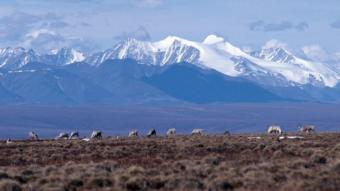
Caribou graze on the coastal plain of the Arctic National Wildlife Refuge, with the Brooks Range as a backdrop in October 2010. (Public domain photo by U.S. Fish and Wildlife Service)
Caribou graze on the coastal plain of the Arctic National Wildlife Refuge, with the Brooks Range as a backdrop in October 2010. (U.S. Fish and Wildlife Service photo)

Democrats in the U.S. House want to use the budget process to reverse the 2017 law requiring oil lease sales in the Arctic National Wildlife Refuge.

The ANWR reversal is part of the budget reconciliation bill debated in the House Resources Committee Thursday.

Budget reconciliation is a type of bill that can’t be filibustered in the Senate, so in theory it could pass there without any Republican votes. Rep. Jared Huffman, D-Calif., said it’s a fitting way to repeal the refuge leasing mandate.

“This is something congressional Republicans enacted as part of their 2017 tax cut legislation,” Huffman said. “It happened through budget reconciliation.”

Alaska Congressman Don Young sponsored an amendment to strike the anti-drilling section. He didn’t participate in the committee’s video proceeding. His spokesman said Young is in Alaska and had a prior commitment.

The House Resources Committee is scheduled to vote on the amendment next week. Meanwhile, Senate committees will work on their own versions of the budget bill, and it’s not clear Democrats there will go along with their House counterparts.

Sen. Joe Manchin, D-W.Va., chairs the Senate Energy Committee. He has previously voted in favor of drilling in the Arctic Refuge. He recently called on fellow Democrats to hit “pause” on reconciliation, which includes $3.5 trillion in spending.

Site notifications
Update notification options
Subscribe to notifications