Subsistence

Yukon subsistence users go to new lengths for food after massive salmon decline

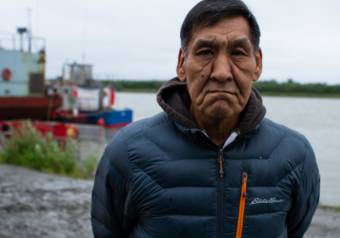
“I had to go 100 miles north up just to get my subsistence needs,” Herman Hootch said. (Olivia Ebertz/KYUK)

This has been the worst salmon fishing season on record for the Yukon River. King salmon, a regional favorite, have returned in low numbers for years, but now a typically stable species, chum salmon, has also collapsed. Subsistence fishing on the lower Yukon River for both species is closed, and residents who usually depend heavily on the fish are pivoting toward other ways to get meat.

“I started fishing on the Yukon when I was six years old. There was one point, me and my grandpa were coming down here for supplies and we had a summer chum jump into the boat. But those days are gone,” Jason Lamont said.

Lamont is from Emmonak and lives off of subsistence food, which in past summers has meant salmon. His family doesn’t buy meat from the store; the salmon caught during the summer will help carry his family through the winter.

“We used to target 300 fish to put away. We’d get that in about two to three hours. Nowadays in our freezer we have only one fish so far, and we’re lucky to have it,” Lamont said.

Elder Herman Hootch also relies on subsistence food. Like Lamont, Hootch is from Emmonak near the Yukon River mouth.

“We learned from our parents that food from the store is not healthy,” Hootch said.

Neither Hootch nor Lamont have been able to subsistence fish for chums or kings on the Yukon this year. Subsistence fishing for the species has been closed all season.

A lone skiff motors up the river past a fish camp. (Olivia Ebertz/KYUK)

In order for the Alaska Department of Fish and Game to open subsistence fishing, over 500,000 summer chum salmon first need to be counted in the river. Five hundred thousand fish is the lower end of the escapement goal.

Normally that number is met without a problem. On average, the run size is 1.7 million summer chum, as counted by a sonar in Pilot Station. But last year the run suddenly dropped to just 700,000 fish. The number dropped to a fraction of the average run size this year: just 153,497 fish.

Hootch and Lamont are missing a big part of their diet. And to make up for the lost protein, they’ve gone to some pretty extreme lengths.

“I had to go 100 miles north up just to get my subsistence needs,” Hootch said.

He traveled to the Norton Sound area to harvest chum this summer, but the numbers weren’t great there either. According to state fisheries biologist Kathrine Howard, chum numbers have been dismal all over the Bering Sea area since last year. Howard theorizes that climate change is responsible for the decline.

But because subsistence fishing was at least open in Norton Sound, Hootch made the journey.

“But that first trip I didn’t have any luck,” Hootch said.

The second time Hootch did have some luck and caught about 100 chums. He estimates that each round trip cost $500. That means with all the expenses added up, each chum cost him about $10. It was expensive, but cheaper than groceries in Emmonak. And he wasn’t the only one trying his luck there.

“What surprised me this year was the whole delta of the Yukon was up in Norton Sound. We saw hundreds of nets up there. And I said, ‘holy cow, that’s the first time that this ever happened,’” Hootch said.

Jason Lamont has been traveling 50 miles out into the Bering Sea on a small skiff to try his hand at ocean fishing. (Olivia Ebertz/KYUK)

Lamont has also ventured into new waters. He’s been taking his river-going skiff out into the testy waves of the Bering Sea.

“There’s a small group of us who are crazy enough to go out there and start harvesting food,” Lamont said.

But they’re not targeting salmon, they’re going for cod and other ocean species and learning in real-time what ocean fishing entails. Lamont said that he takes his boat sometimes as far as 50 miles off the coast. Most boats that go out that far are several times larger than his small skiff.

“And we go out there to the same size ocean, but the storms are the same too,” Lamont said.

But Lamont is determined to not give up on his Yup’ik culture’s subsistence traditions.

“You either gotta adapt, or lose it,” he said.

Three hours upriver by skiff, in the community of St. Mary’s, folks don’t have the same option to travel all the way out to Norton Sound. Instead, they’re supplementing their diet with extra groceries, more whitefish, and they’ll try to bag extra game meat.

Empty skiffs line the shore in St. Mary’s. (Olivia Ebertz/KYUK)

At the St. Mary’s boat harbor, Bay and Walky Johnson are on their way out to pick berries. Theirs is one of the only skiffs leaving the harbor that day. The rest of the boats bob along the shore, empty of fishing gear. I ask the couple how they will fill their pantry this winter.

“We’ll go after other species of fish,” Walky said.

“Definitely more moose,” Bay said. “We hope to get fall chum, but I doubt it. Fall chum are good for canning. Also when making more dry fish. But we didn’t see any last summer, so I doubt we will see any this summer either,” she added.

The state has no plans to open subsistence fishing for fall chum. That’s because an international treaty governs salmon fishing on the river, and not enough fish will pass through to meet treaty numbers.

Bay and Walky Johnson plan to target more moose to supplement their diet for the winter. (Olivia Ebertz/KYUK)

Correction: An earlier version of this story said that the Pacific Salmon Treaty between the U.S. and Canada dictates summer chum subsistence fishing, and that 300,000 summer chum salmon must be counted to open fishing. That is incorrect. It dictates fall chum subsistence fishing. To open summer fishing, 500,000 summer chum salmon must be counted. To open fall fishing, 300,000 fall chum must be counted.

When Yukon River chum stocks collapsed, donated fish came in from Bristol Bay

Daren Jennings loads up his skiff to deliver Bristol Bay salmon to Lower Yukon River communities. (Olivia Ebertz/KYUK)

For eight years, Tanya Ives has been traveling up from Washington each summer to work at the Yukon River’s only fish processing plant: Kwik’Pak Fisheries. The plant sits outside of Emmonak, at the river’s mouth. Normally at this time of year, Ives would be packing up chum salmon harvested by commercial fishermen along the Yukon River to sell around the world. But this summer, she’s doing the opposite.

Ives is packing up salmon, caught hundreds of miles away, to send to Yukon River villages. She wears a red sweatshirt and gloves to keep warm while working with the frozen fish.

The Yukon River has seen its worst summer chum salmon run on record, and its third-worst chinook run. The commercial fishery is closed, and Kwik’Pak can’t sell salmon. Subsistence fishing for chum and chinook is also closed, and many people along the river have not had a taste of the fish this season.
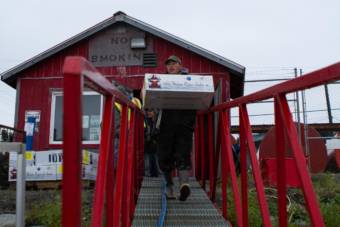
Normally at this time of year, Ives would be packing up chum salmon to sell around the world. (Olivia Ebertz/KYUK)

Meanwhile, on the southern end of the peninsula, Bristol Bay has been enjoying its best salmon run on record. To share the bounty, processors there donated 22,000 pounds of chinook and chum salmon to Yukon River villages. The Bristol Bay processors sent some of that salmon to Kwik’Pak to distribute to lower river communities.

Inside the Kwik’Pak plant, workers divide about 12,000 pounds of salmon into boxes. Ives gives instructions for how to label them.

“You’re going to write the number of fish and the pounds on this label, and then you’re going to put this donation label on the right top corner,” Ives says.

The fish are whole and frozen, so villagers can use them how they wish. Kwik’Pak is splitting the fish between 10 Lower Yukon River villages: Emmonak, Alakanuk, Nunam Iqua, Kotlik, Pilot Station, St. Mary’s, Marshall, Russian Mission and Pitkas Point.

Kwik’Pak is splitting the fish between 10 Lower Yukon River villages: Emmonak, Alakanuk, Nunam Iqua, Kotlik, Pilot Station, St. Mary’s, Marshall, Russian Mission, and Pitkas Point. (Olivia Ebertz/KYUK)

Dividing the salmon by village population, regional tribal nonprofits determined how many fish would go to each village. Tanana Chiefs Conference directed distributions upriver, and the Association of Village Council Presidents directed distributions along the lower river.

Kwik’Pak boated the salmon from community to community. Weighed down by thousands of pounds of frozen fish, a tender boat slowly motored up the cold, rainy Yukon. At the helm stood captain Daren Jennings, bundled up in a Rick and Morty sweatshirt with thick layers of raingear on top. As the skiff wound further upriver, willows more densely crowded the banks. Then spruce forests appeared.

According to local Elders, the area used to be pure tundra. The flora is changing, and sandbars claim more territory each year. They’re getting harder to avoid, even for someone who knows the river as well as Jennings.

Delivering salmon to the villages is new to him. In previous years he’d be doing the opposite: picking up commercial fishermen’s fresh catches and taking them back to Kwik’Pak to be processed. With the commercial fishery closed, he’s one of the few dozen employees that Kwik’pak has been able to hire back this year.

“Usually we’d be running way more and had way more people here, but since there’s no fishing you can only have so many workers that are doing so many things,” Jennings said.

A Kwik’pak worker unloads salmon in St. Mary’s. (Olivia Ebertz/KYUK)

The boat makes a gentle left turn onto the Andreafsky River. The river, fed by the Kusilvak Mountains, runs cold and black, a stark contrast to the muddy lower Yukon. The tender docks in St. Mary’s. Workers from the Algaaciq and Andreafsky tribes meet the tender at the bank.

“I’m droppin’ off big boxes of fish,” Jennings says, while calling the tribes to announce his arrival.

The tribal workers meet him at the shore. They load the fish into their pickups and drive them to households, until late evening. Bay Johnson from St. Mary’s is grateful to have at least a bit of fish.

The tribal workers from the Algaaciq and Andreafsky tribes load the fish into their pickups, and then drive them to households until late evening. (Olivia Ebertz/KYUK)

“We got two, and we were so happy for them,” she said. “Right now I have them thawing out so I can can them. They can last longer throughout the winter for us.”

But she said that the fish isn’t enough food for her family for the months ahead. With little opportunity for subsistence salmon fishing, her grocery bill has gone up. Her husband, Walky, said that they’ll have to try for other species of fish to get them through the winter.

A spokesperson for Gov. Dunleavy’s office also said that the Alaska Department of Fish and Game has purchased an additional 25,000 pounds of fish. Half of that arrived in Emmonak on Aug. 10 for distribution to Yukon-Kuskokwim Delta communities.

Bethel records wettest July in more than 90 years

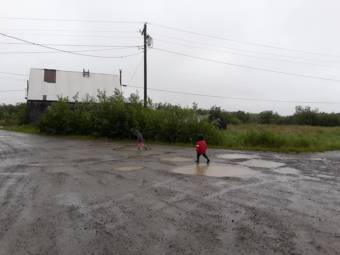
Children walk through puddles in Napakiak, Alaska on August 4, 2019 as rain drenched Western Alaska. (courtesy of Andrew West)

Some people in Bethel have called this the dreariest, wettest summer of their lives. And they’re probably right.

Last month was the wettest July in Bethel in more than 90 years, with 4.22 inches of rainfall.
When it hasn’t been raining this summer, the sky has still often been gray. Bethel also experienced the cloudiest June and July in 60 years.

Many subsistence fishermen have called into salmon management meetings reporting difficulty drying salmon in this year’s conditions.

The wet, cloudy weather has spanned most of Western and Northern Alaska. Kotzebue broke a record in July for the most precipitation ever in a single month.

Most of the time, summer weather in Western Alaska is a mix of sunny and stormy, said Rick Thoman, an Alaska climate specialist with the International Arctic Research Center at the University of Alaska Fairbanks.

“A storm comes through and then high pressure builds in, and it clears out and it gets nice. There’s been much less of that this summer than we might expect. Rather, we’ve been in this very stagnant pattern,” he said. “Sometimes the atmosphere gets into these patterns where the jet stream flow is relatively stable for long periods of time and doesn’t change much. Other times, it’s much more changeable. That one, probably, we just chalk up to random variability.”

But some scientists don’t believe stagnant weather patterns are completely random.

Research suggests that these stalled weather systems with long-lasting periods of rain or heat are happening more often lately, and some scientists say that it’s due to climate change. They say that climate change is slowing down the jet stream, which keeps the same weather system in place for longer. But Thoman said the research is just emerging, and climate scientists have not yet come to a consensus on the issue.

While rainfall in Bethel has neared record highs, Thoman said that temperatures this summer have been moderate, despite some locals’ perceptions that it’s a cold summer.

“It’s been cool by recent standards, but by historical standards it’s not,” said Thoman. “It’s a very average summer, if you will.”

This summer’s temperatures have been a shift from the last six years, when the community recorded a string of above-average temperatures. Two years ago, Bethel had its second hottest summer on record.

According to the most recent Climate Prediction Center outlook, the weather around Bethel will stay wet and cool throughout August, said Thoman.

LISTEN: A lifetime of subsistence fishing tells story of Yup’ik traditions

Debbie Coolidge processes sockeye at her home in Aleknagik. (Stephanie Maltarich/KDLG)

Each summer, Alaskans take to the rivers, bays and oceans to subsistence fish. Some head out to set nets, others may use dip nets, but the end goal is the same: to stock up on enough fresh fish to last the winter.

Debbie Coolidge spends at least one week each summer catching and processing salmon that will last her the entire year, continuing the traditions she learned from her grandmother.
Coolidge grew up fishing with women in her family on the Wood River near her home on Lake Aleknagik, in Bristol Bay.

“I started fishing when I was 8 years old, it was just my grandma and my Aunt Virgin,” said Coolidge.

Today, in her mid-50s, she’s still at it, and she’s still independent. In early July, she heads downriver in her skiff to set nets.

Debbie Coolidge sets out for a day of fishing. (Stephanie Maltarich/KDLG)

Her favorite fish are kings.

“One year we went and sat down there and we didn’t expect to get a whole bunch of kings, our net was just smoking and we were trying to get the net in and trying to get the fish in, you know they are big fish,” Coolidge said.

By early July, she usually has about 10-12 kings in her freezer, but this time she only caught four.

Coolidge’s experience isn’t unique. The Nushagak River’s Chinook run started slow this summer. Additionally, the huge number of sockeye returning to the bay have filled subsistence nets, taking up room that kings may have occupied during a slower sockeye run.

Like many who fished this season, Coolidge caught hundreds of reds.

After a long day on the river, Coolidge sets up shop under a pop-up tent in her front yard. She processes fish while they are fresh.

First, she washes them. Then, she lines them up on a chest-high table.

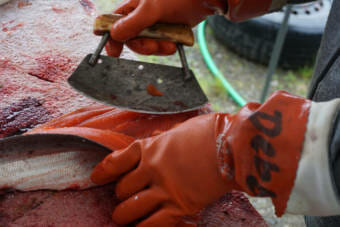
Next, she cuts them with an ulu.

“It’s considered a women’s knife. We use it for everything — cutting fish, cutting meat, cutting seal and beluga,” she said.

Often, she hangs them to dry.  But the rainy summer made drying difficult this summer.

“There has been so much rain, trying to get them to dry; they are looking sad though,” said Coolidge.

And sometimes, they end up in the smokehouse she built with her brother many years ago.

Once the processing is done?

Coolidge smiled, laughed and said, “We eat it!”

Early this summer, Coolidge and her son enjoyed watching a show that explored Japanese food and culture. The series inspired them to share food stories as they relate to Yup’ik culture and way of life.

So one day, her son took out the camera and started filming.

“We thought about doing that with king salmon and how we do strips, how we catch, process and then eating them,” Coolidge said. “We thought about doing that with greens we pick, incorporating that into the video. Berries, eating and enjoying it just showing the world what our life is like.”

For Coolidge, the project is not just about the food she eats. It’s also about culture, community and taking care of one another.

She’s not sure what they’ll do with the videos, but she hopes they can help preserve and teach others about Yupik cultural traditions.

“There are disabled people and people don’t have resources to come and get fish, so everyone shares,” she said. “Even in the wintertime when people get moose or caribou, people share with the elders and widows and people who can’t do it themselves. ”

A day of fishing and processing isn’t complete until Coolidge throws some fresh filets on the grill with her favorite marinade.

“I get a nice char on it, then I flip it over and let it cook for a while, then I put the glaze on it,” Coolidge said.

With jars of canned salmon stacked in the corner, more in the freezer and plenty hanging outside, Coolidge is stocked for winter.

How could British Columbia commercial fishery closures affect Southeast Alaska?

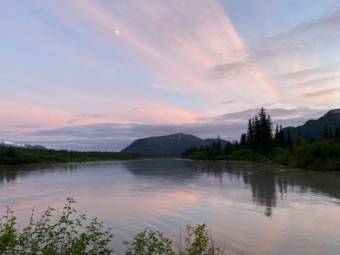
Sunset on the Stikine River. Canada’s government closed transboundary fisheries on the Canadian side of the Stikine in late June.
(Sage Smiley/KSTK)

This summer, Canada closed most of British Columbia’s commercial salmon fisheries. Declining stocks were to blame for the drastic conservation measures. Southeast Alaska shares coastline and transboundary rivers with B.C. — so what could this mean for the region?

The Department of Fisheries and Oceans Canada — the federal agency that manages Canada’s fisheries — effectively ended the 2021 commercial salmon season on the West Coast in late June.

Seafood Alliance Executive Director Christina Burridge says Canada’s fishing industry was stunned.

“First Nations have harvested salmon forever. And post-contact, salmon canneries are what in the sense built this province. To be now in this situation seems really tragic to me,” she said.

The closure came just weeks after Canada announced a $535 million plan to revitalize its flagging Pacific salmon stocks in B.C. and Yukon Territory.

But Burridge says the closure erased most of the Canadian fleet’s entire year.

“The minister’s announcement and most subsequent media coverage has said that it’s 60% [of B.C.’s commercial fisheries closed],” she explains. “In terms of the number of actual fisheries, that is correct. In terms of landed volume, it is 80%. And for gillnet fisheries, it’s about 95%.”

Canadian government officials say this has been a long time coming.

“I know it was a bit of a surprise to some — to many — but those that have been close to the industry and close to Pacific salmon fisheries here, at least and [along] the B.C. coast recognize that the overall level of catch has been dropping significantly for some time,” Sarah Murdoch said. She’s the senior director of Canada’s Pacific Salmon Strategy Initiative, which aims to shape Canadian fisheries policy moving forward.

So what does Canada’s salmon shutdown mean for its Alaska neighbors?

From a market standpoint, not much, says McKinley Research analyst Dan Lesh in Juneau.

“Alaska dwarfs B.C.,” Lesh explains, “And so anything that happens in those markets is not going to be a big impact on our fisheries. For instance, Canada produces only about .017%, so less than .1%, of sockeye globally — that’s as of 2019.”

B.C.’s largest wild salmon market is chinook: about 14% of the global market in recent years. But its shares of the other four salmon species represent less than 2% of worldwide production.

So, while the closures are devastating for B.C., they shouldn’t move world markets.
Still, Lesh says the shutdown isn’t good for the perception of wild salmon as a sustainable product. Concerns about declining food sources for killer whales have prompted some in the Pacific Northwest to avoid chinook salmon.

“Of course, that doesn’t make sense for protecting the orcas,” Lesh said. “The salmon are coming from a different area and a different stock. But so that’s my broader concern with some of these declining stocks on Alaska’s market.”

State fisheries managers say B.C.’s experience isn’t likely to be repeated in Alaska. Southeast management biologist Troy Thynes says Alaska has safeguards in place to keep salmon runs from dropping too far, allowing spawning fish to keep moving up rivers and streams. Drastic measures like widespread closures aren’t in the nature of Alaska’s dynamic management, where biologists can time openings at will.

“When Fish & Game is concerned about stocks — if a stock is not making escapement after a number of years, those types can be listed or recommended to the Board of Fisheries as a stock of concern. And we do have several stocks of concern that are in Southeast Alaska right now,” Thynes said.

The chinook on the transboundary rivers Unuk and Chilkat are among the current Southeast stocks of concern. Stikine and Taku kings — both also transboundary rivers — are proposed to be added to the list.

Burridge, with the B.C. Seafood Alliance, says she admires Alaska’s proactive strategies, which involve long-range management plans and a lot of public input.

“Basic things like stock assessments in Canada have been starved for at least two decades,” Burridge said. “And I think that’s one of the reasons why we’re looking at these closures is that the work simply hasn’t been done. I suspect most Alaskans would agree with me that the foundation of good fisheries management is good stock assessment.”

Burridge says the sacrifice being made by B.C. fishermen will only be worthwhile if there’s more investment in research and restoration of fish habitat.

“Salmon, as you know, are doubly vulnerable because they depend both on the marine environment and the freshwater environment,” she said. “And we have certainly compromised the freshwater environment here and particularly in southern B.C.”

But about a third of Canada’s $500 million salmon rescue plan will likely be spent buying out permit holders.

“I’m not for a moment saying that we should go fishing because people need to go fishing,” Burridge said. “We have to be extremely careful and cautious, but this is very, very devastating. And I think while some of the closures were probably necessary, many it seems to me are just putting the burden on the commercial sector rather than putting it on other sectors.”

U.S. states and Canadian provinces work cooperatively to co-manage transboundary salmon runs through the Pacific Salmon Treaty. But the Canadian government says the shutdown on their end likely won’t affect current allocations, as the treaty won’t be renegotiated until 2028.

State to help bring salmon to Yukon River communities hit hard by low runs

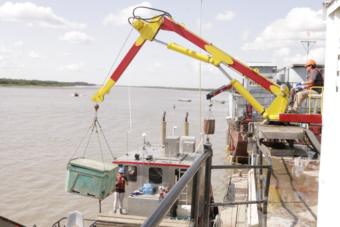
A crane unloads totes of salmon from a tender at Kwik'Pak Fisheries in Emmonak, Alaska on July 15, 2019. (Photo by Anna Rose MacArthur/KYUK)
A crane unloads totes of salmon from a tender at Kwik’Pak Fisheries in Emmonak, Alaska on July 15, 2019. (Anna Rose MacArthur/KYUK)

The Dunleavy administration has directed the Alaska Department of Fish and Game to coordinate salmon deliveries to Yukon River communities.

Kwik’Pak Fisheries General Manager Jack Schultheis said 8,000 pounds of salmon arrived at the Emmonak processing plant last week, and the company is preparing to distribute the fish to lower Yukon River communities.

The delivery is the first in what is expected to be a string of salmon shipments along the river after low runs have meant no subsistence fishing for king or chum salmon on the Yukon River this summer.

On July 22, the state did finally open subsistence fishing for other salmon species, including pink, red and coho, for the first time this season.

To help get food in fish racks and freezers, the Dunleavy administration is helping to coordinate deliveries of salmon donations from Alaska-based processors to Yukon River communities. It is working with nonprofits, including SeaShare, and shippers to make it happen.

Dunleavy spokesman Jeff Turner said the administration has allocated $75,000 to purchase king and chum salmon from Alaska processors to add to what’s being donated to communities and is asking the Tanana Chiefs Conference to match those funds.

The Tanana Chiefs Conference is helping distribute the fish to communities along the middle Yukon River near Fairbanks. On the lower Yukon River, the Association of Village Council Presidents and Kwik’Pak are helping share fish into the community.

The exact amount of salmon that will be sent to Yukon River communities has not been confirmed.

“We are still collecting quotes from seafood processors,” Turner said. “The governor’s goal is to maximize the amount of fish that can be donated.”

Site notifications
Update notification options
Subscribe to notifications