Subsistence

Alaska Supreme Court upholds $20K fine for Metlakatla fisherman in tribal fishing rights case

The Alaska Supreme Court has upheld the conviction of a Metlakatla fisherman who was fined for fishing without the proper permits. The case is part of a long-running dispute over tribal sovereignty.

In 2014, U.S. Coast Guard officers reported a Metlakatla tribal member fishing in a closed area without a state commercial fishing permit. When they boarded the boat they found a few dozen coho salmon, which the skipper reportedly said he intended to sell. Metlakatla resident John Scudero Jr. was cited for three commercial fishing violations and fined $20,000 after a one-day trial the following year.

He appealed the case. Metlakatla’s elected tribal government has long objected to state fishing regulations, arguing that its status as the state’s only Indian reservation gives it federally guaranteed rights. The tribe filed a brief in support, arguing enrolled tribal citizens fishing outside the reservation’s boundaries  were not under the state’s jurisdiction

The argument goes like this: Attorneys argue the 1891 law creating the reserve intended to create a self-sustaining community. And an essential part of the community’s ability to sustain itself is through fishing — both within a 3,000-foot exclusive zone around the reserve and outside of that boundary. And since federal law trumps state law, Scudero’s attorneys argued Alaska’s fishing regulations infringed upon the tribe’s sovereign rights set out by Congress.

But the Alaska Supreme Court disagreed in a 4-0 decision. Writing for the court, Justice Peter Maassen declined to rule on whether Metlakatla tribal members held a federally guaranteed right to fish outside the 3,000-foot boundary. But Maasen cited a raft of U.S. Supreme Court cases that held tribes’ off-reservation hunting and fishing rights were subject to state regulations aimed at conserving fish and wildlife populations. Three other Supreme Court justices joined Maasen’s opinion. The remaining justice, Dario Borghesan, did not participate in the case.

It’s not the first time Metlakatla Indian Community has asked a judge to rule on the question of off-reservation fishing rights. The tribe sued Gov. Mike Dunleavy’s administration in federal court last year on similar grounds. A federal district judge dismissed the case; it’s now pending in the Ninth Circuit Court of Appeals.

US House bill would add tribal seats to North Pacific Fisheries Management Council

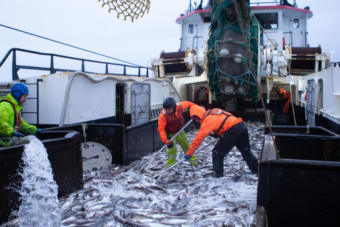
Crew members shovel pollock on the deck of a Bering Sea trawler last year. (Nathaniel Herz/Alaska’s Energy Desk)

A key Democrat in the U.S. House introduced a bill Monday to renew the Magnuson Stevens Act. Magnuson Stevens is the primary law that covers fishing in federal waters. Past bills have languished in Congress in part because many in the industry were generally happy with the law as it is.

But Jared Huffman, D-Calif., included a few provisions in his bill that certain Alaska groups have been requesting for a long time. Huffman chairs the oceans subcommittee of the House Resources Committee.

The bill emphasizes the need to consider the impacts of climate change on marine resources. It would, for the first time, recognize the importance of subsistence fishing. It would also put two tribal representatives on the North Pacific Fisheries Management Council — the committee responsible for fisheries in the Bering Sea and Gulf of Alaska.
The bill won praise from environmental advocates and groups representing Alaska’s small-boat fishermen, as well as several tribal organizations.

Seafood Harvesters of America said it has a few issues it hopes to work out with the bill’s sponsors.

Alaska Republican Congressman Don Young also said he has concerns and recommendations to discuss.

Read the summary of the bill here and the full text of the bill here.

‘It’s the fabric of our culture coming apart’: Yukon River communities face chinook and chum closure

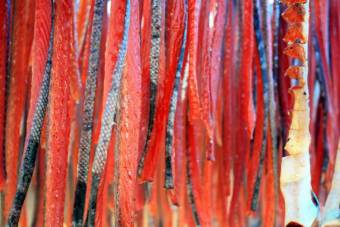
Yukon River salmon strips. (ADF&G photo)

In late June, summer chum salmon numbers in the Yukon River were the lowest on record. The chinook run is also extremely low, resulting in ongoing closures of salmon fishing on much of the Yukon River.

The loss is causing anxiety for more than 30 riverside communities that depend on chinook and chum as a main source of protein for the winter.
Ben Stevens is the Tanana Chiefs Conference tribal resources manager. Stevens is from Stevens Village on the upper Yukon and said he has never before seen such a total shutdown.

Below is a transcript of an interview with Lori Townsend on Alaska News Nightly, with minor edits for clarity

Ben Stevens: We’ve seen chinook crashes before in recent history. We were still okay with the idea because we had something else to fall back on. And that was the fall chum.

This year, it’s unprecedented because we don’t have the chinook or the fall chum, and that has disturbed our folks to a level I haven’t seen before.

Lori Townsend: Are there other river or tributary opportunities close enough that could help people get fish in other places? Or is it just not possible?

Ben Stevens: My family, when we go to fish camp, instead of setting the salmon net out there in the main stream, we’re starting to go into the back sloughs for whitefish and pike. That is another source of protein. I guess pound for pound, it’s a tremendous exertion of energy. But that’s what it is. And that’s what we’re going to do.

A lot of folks up and down the Yukon are doing similarly. If folks don’t get a moose — which, you know, is very difficult — they’re going to be staring into October with nothing in their freezers. I think that scares a lot of people.

Lori Townsend: As you’re talking to Yukon River community residents, what are you hearing about their concerns for winter protein and how they plan to try to help their families have enough to eat this winter?

Ben Stevens: Well, what we’re hearing is a lot of fear. And as an Alaska Native man, my job is to help feed the people, and that’s what I have grown up doing. But I think that there’s fear way down deeper inside folks than I have ever sensed in my life. I’ve been around, I’ve experienced some things, I’ve experienced fear before in our people. But nothing is so deep as this fear. I think that as we cannot harvest food from the land and the waters, it’s the fabric of our culture coming apart. That’s essentially what it is.

Lori Townsend: Meanwhile, as you’re probably aware, Bristol Bay is seeing the largest sockeye run in history right now. Is Tanana Chiefs Conference working to get fish from Bristol Bay or other areas for residents along the Yukon? Could that be part of at least the short-term solution for this winter?

Ben Stevens: Absolutely. We’re looking at all options in front of us. But you’re right: It is only a short-term solution. And it is not a solution that can be carried into the future. Because we should not be giving up our fish in Stevens Village to buy fish from the system out there in the marine environment. Does that make any sense? We should be able to take our families to the fish camps, have our kids pull that fishnet, have them process and that fillet goes straight on to the fire.

There’s something strong, there’s something very, very spiritual about that thing that our people survive on. It’s not just sustenance for your tummy, it’s sustenance for your soul. It’s family ties that are being strengthened.

When schools shut down in Alaska, these students went moose hunting

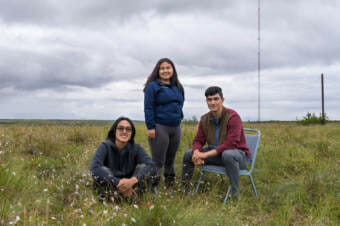
High schoolers Ethan Lincoln, Kaylee King and Jamin Crow’s podcast about their experiences subsistence hunting is a finalist in the NPR Student Podcast Challenge. The students are pictured here at the KYUK radio transmitter site in Bethel, Alaska. (Katie Basile/KYUK)

Jamin Crow waited silently for the bull moose to turn and face him. In the cold, the teen stood in an open meadow, his gun resting on a branch. He waited and waited and waited.

Then the moose turned, and his brother started to yell, “Shoot!” If Crow didn’t shoot, his brother would. So Crow took a deep breath and pulled the trigger.

“Your ears are ringing after the gunshot. And I look at my brother and he’s giving me the happiest look I’ve ever seen,” he says. “Everything is perfect at that moment …You know you succeeded in what your goal is.”

Crow lives in Bethel, in the remote Yukon Delta region of Alaska. For generations, his family has practiced subsistence hunting to get food on the table. The process hasn’t changed much, except that these days, the Crows use motor boats and snowmobiles to get to their moose camp, which serves as a home base while they’re on hunting trips.

“Food is very expensive here. You have to ship everything up,” Crow says. “We don’t go out just for the antlers. We’re not looking for trophies; we’re not hunting for something big. We’re looking for meat to feed our families.”

Crow is one of three Alaska Native students — along with Kaylee King and Ethan Lincoln — who made a podcast about their hunting tradition. The students are from different towns, but met as interns at NPR’s member station KYUK in their senior year of high school. Right before they graduated last spring, their podcast was chosen as a finalist in this year’s NPR Student Podcast Challenge.

Ethan Lincoln, Kaylee King and Jamin Crow. The three students say hunting helped them get through the isolation of the pandemic, when their schools and many other activities, like sports, were shut down because of COVID-19. (Katie Basile/KYUK)

The three students say hunting helped them get through the isolation of the pandemic, when their schools and many other activities, like sports, were shut down because of COVID-19.
In the podcast, Crow went hunting with his 17-year-old brother, Peter, but sometimes the whole family goes, including his father and grandmother. King and Lincoln — who are cousins — also go hunting with their families.

“Nowadays, you see everybody go out and hunt. Dads will take their daughters,” says Crow. “It doesn’t really matter what your gender is.”

COVID-19 did not hit Bethel until August of 2020 — when people started to travel to and from other cities. The virus quickly spread, closing schools through March of this year. Meanwhile, King’s village of about 250 people managed to make it through with very few cases, and she was allowed to finish out high school in person; she was the only graduating senior in her town this year.

The students explain that, as time goes by, fewer and fewer people are practicing subsistence hunting. King, especially, feels a pressure to keep the traditions alive.

“It makes me really sad because the way we used to do things is so different from how we do them now,” King says. “Even our language [Cup’ig] is slowly fading away.”

For the students, the practice of hunting allows them to connect with older generations.

“Whenever I go out hunting with my granny, I’m always hearing past stories about when my dad was a kid and he went hunting or my late grandpa [and] how he would just take the family up,” Crow says.

He sees peers like King practicing cultural dances, speaking the language and hunting, and he’s hopeful the traditions he grew up with will last. He already knows he wants to share the hunting experience with his own children some day.

“If we keep at this pace, I think our younger generation can pick it back up again because we have pride in our culture and we love where we are from and we don’t want to see it fade away.”

Sneha Dey is an intern on NPR’s Education Desk.

Copyright 2021 NPR. To see more, visit https://www.npr.org.

With fisherman caught in middle, state and feds promise more cooperation on fishing regulations

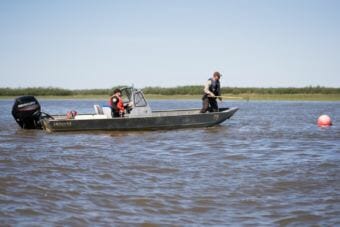
A fisherman driftnets for salmon in the Kuskokwim River near Napaskiak on June 12, 2018. (Katie Basile/KYUK)

Confusing. That word came up a lot in a meeting with state and federal managers to describe the state’s June 28 Kuskokwim River fishing opening. Both the state and the feds say that they need to work together to prevent more confusion in the future.

Six local fishermen called in to the state’s Kuskokwim River Salmon Management Working Group meeting on June 30 to express frustration with the state opener.

“The announcement was confusing,” said elder James Charles of Tuntutuliak.

“It was real disappointing to see how they were contradicting each other and making it so confusing for everyone,” said Clarence Daniel of Bethel.

They were confused because the state announced a drift net opening on June 28, but federal managers said it was illegal because the state did not have jurisdiction.

Federal managers, along with organizations like the Association of Village Council Presidents and the Kuskokwim River Inter-Tribal Fish Commission, were asking people not to participate in the state opening. Meanwhile, state wildlife troopers were visiting communities along the river, encouraging them to go fishing, Sgt. Walter Blajeski told the working group on June 30.

The contradicting information led to fewer fishermen participating in the state opener than in previous openers this season.

Federal manager Boyd Blihovde said in the June 30 working group meeting that the state and feds should work harder to come to an agreement on management actions.

“So that we’re not bringing the public into that disagreement and having to sort of have the public decipher what is legal or not legal,” Blihovde said.

Alaska Department of Fish and Game Deputy Commissioner Ben Mulligan was also at the working group meeting. He said that the state announced the June 28 opener because it has a constitutional obligation to offer subsistence fishing opportunities when there are enough salmon to meet escapement goals. Mulligan said that outside of that hard requirement, the state is willing to work with the feds to reduce confusion for local fishermen.

“I think a cooperative and collaborative relationship is what is going to be called for, because at this point in time, there’s obviously some differing opinions of legal authority. Now, this is not the place to hash that out. What is important, I believe to everyone, is that we take care of the resource while helping to provide that opportunity for the local folks,” Mulligan said.

Federal and state managers discussed having additional meetings with each other in the hopes of coming to a consensus.

Orutsararmiut Native Council to challenge Donlin Mine water quality certificate in court

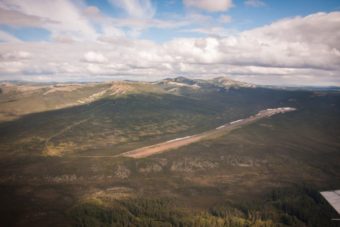
Donlin runway and camp site in summer 2014.
The proposed Donlin Gold mine would be one of the biggest gold mines in the world if completed. (Dean Swope/KYUK)

On June 28, the Orutsararmiut Native Council appealed the Alaska Department of Environmental Conservation’s decision to uphold a water quality certificate for the proposed Donlin Gold mine.

The council has contested the water quality certificate before. The most recent appeal comes a month after DEC Commissioner Jason Brune upheld the certificate.

Donlin was first issued its state water quality certificate back in the summer of 2018. The certificate is a big one for the company. It says that mine runoff won’t negatively impact the water quality in the area of the proposed site, which sits about 10 miles north of Crooked Creek. The certificate is critical for Donlin because it’s attached to another permit from the U.S. Army Corps of Engineers, which the mine needs to start construction and actually begin mining. Now the matter is going to court.

The council first filed an informal review in August 2018, just days after the Army Corps issued its permit. Lawyer Tom Waldo, who works for Earthjustice, the law firm representing ONC, said that they take issue with the certificate on three main points.

“The mine, as proposed, would not comply with water quality standards for protection of salmon habitat, for temperature, and for mercury,” Waldo said.

After the state informally reviewed and then reissued the water quality permit twice, Earthjustice called for a formal review process about a year ago. In April 2021, Administrative Law Judge Z. Kent Sullivan recommended rescinding the water quality permit.

In his decision, he wrote that “salmon and salmon habitat in a large segment of Crooked Creek will be significantly and detrimentally impacted by the project.”

But Brune upheld the state water quality certificate in May 2021. Donlin applauded the decision at the time and reaffirmed their support in a press release following the appeal.

ONC Executive Director Mark Springer said that the certificate would have far-reaching, negative impacts on the region.

“The upper Kuskokwim environment, and the entire Kuskokwim reach, and the fish in the Kuskokwim, and all of the people who live here and who have depended on salmon and smelt for thousands of years,” said Springer.

Waldo says the appellate court’s decision could be released in around a year, and the decision would likely be appealed once more after that. If the state water quality certificate is permanently rescinded, the permit from the U.S. Army Corps of Engineers will be as well.

“I think it is very likely that whoever loses in the superior court, it’s very likely that party would appeal to the Alaska Supreme Court,” said Waldo, who added that because this involves a state permit, the case can only reach the level of the Alaska Supreme Court.

Site notifications
Update notification options
Subscribe to notifications