Subsistence

Yukon River on track for dismal king and chum runs

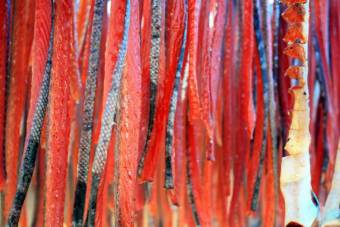
Yukon River salmon strips. (Courtesy of ADF&G)

The Yukon River Fisheries Drainage Association hosts weekly teleconferences where river residents, fishery organization leaders and government resource managers talk about what’s happening with salmon on the river.

There wasn’t much positive news during this week’s teleconference.

Yukon River Inter-Tribal Fish Commission chair Brook Woods has a dismal king salmon count from the Pilot Station sonar near the river’s mouth.

“As of Monday, June 28, just over 60,000 king have been counted at the Pilot (Station) sonar station, and that is only half the average count for this date,” she said.

Wood said the run is estimated to be about midway through, and if things don’t change, a border passage agreement with Canada and drainage-wide escapement goals won’t be met.

“If we’re not able to meet escaping goals, this will be the third year in a row,” she said.

The situation is even worse for summer chum salmon. State research biologist Fred West said just 31,000 are estimated to have passed the Pilot Station sonar as of Monday, well below the historic median of 500,000.

“That’s the lowest on record for this day. So yeah, so this is lower than the runs we saw in 2000 and 2001,” he said.

Deena Jallen, the state summer season management biologist, said managers had no choice but to close the fishery.

“I really feel that everyone is really struggling this year. We know it’s really hard. If there were a fish to be harvested I would you be wanting to let people harvest but there’s just no fish to be harvested so it has to be closed,” she said.

The Chinook and summer chum salmon fishing closure extends from the Yukon Rivers headwaters to its mouth as well as area coastal communities. Hooper Bay resident John Rivers lamented the situation.

“I’ve never seen Hooper they closed ever since I was a little boy to this day. It’s so sad to see it’s closed,” he said.

Martin Kelly of Pilot Station said communities need help filling the food void.

“Fish and Game and everybody else better be prepared to go out and get some crab or pollock or halibut and bring it to each household on the Yukon River,” he said.

Application for a federal disaster declaration is already in the works, according to Yukon River Inter-Tribal Fish Commission director for the Tanana Chiefs Conference, Stephanie Quinn Davidson.

“Just so folks know, that disaster declaration process takes a long time. We don’t anticipate that funding would be available to fishermen for at least a year, maybe possibly two years,” she said.

Quinn-Davidson said that a request submitted for a disaster declaration for last summer’s poor Yukon River salmon runs was just recently forwarded by the state to the federal government.

New smartphone app helps fishermen track ocean conditions in real time

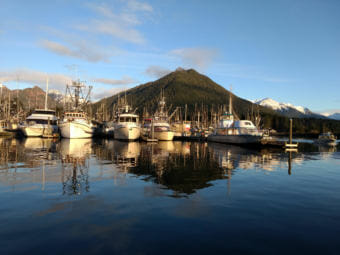
Sitka fishing vessels in harbor on Jan. 18, 2018. (Photo by Jacob Resneck/KTOO)
Sitka fishing boats in harbor on Jan. 18, 2018. (Jacob Resneck/KTOO)

A new smartphone app hit the market last week, with the potential to transform the debate over Alaska’s ocean resources.

The Skipper Science app will allow users along Alaska’s entire coastline to contribute observations about changes in fish and animal populations, which can then be collected and quantified as data for Alaska’s science-based resource management.

Anywhere the Alaska Board of Fisheries meets, there is always a certain amount of frustration among some who testify because their years of experience — sometimes over many generations — don’t seem to carry much weight in data-driven management decisions.

In Sitka this is particularly acute around herring season, where subsistence harvesters have noted drastic declines in the abundance of the species over many decades, while 40-odd years of data collection by the Alaska Department of Fish & Game suggests everything is okay.

“I wonder if all the scientists that are here can figure out what’s going to happen when the herring’s gone,” said Coho clan leader and elder Herman Davis when he testified before the Board of Fisheries in Sitka in 2015.

Skipper Science was created for exactly this purpose. Developed by the Aleut Community of St. Paul Island, it’s a way for Alaska’s harvesters and managers to at least speak the same language.

“How do we take what has historically been called anecdotal and create some structure around it that is rigorous, has scientific repeatability?” asks Lauren Divine, Director of Ecosystem Conservation for the tribal government of St. Paul Island in the Bering Sea.

Divine and a team of collaborators have built the Skipper Science app in an attempt to convert the thousands of informal-yet-meaningful environmental observations by fishermen and others into hard numbers that can be brought to the Board of Fish, the North Pacific Fisheries Management Council or any other agency that makes decisions that impact fisheries.

The idea is that, scaled up over many harvesters, the observations of someone like Herman Davis can carry the weight of scientific data.

“This is the way that, you know, an Indigenous person takes on life and living and engaging in traditional harvests and relationships with the ecosystem. It is very non-quantitative,” she says. “And so we’re very far behind the times really, but yet there’s no weight that’s historically been given and the respect given to the more social science on, and you know, non-western scientific side of things. And so we were really working to, to shift that paradigm.”

Divine and the Aleut Community of St. Paul are not new to this. About 15 years ago the tribal government established the Indigenous Sentinels Network to monitor changes in animal populations and the environment in the Bering Sea. They’ve since developed a half-dozen apps and utilities, one of which is called Citizen Science.

Skipper Science is built on the Citizen Science platform, but the goal is to make it coastwide, “From the Beaufort to Baja,” as Divine says.

To extend their reach, the Aleut Community of St. Paul needed a partner. Enter Lindsey Bloom, who works with the Juneau non-profit, SalmonState.

Bloom works within SalmonState’s Salmon Habitat Information Program — or SHIP. A coastwide advocacy organization, SalmonState and the Aleut Community of St. Paul have similar goals: quantifying informal observations.

“We’ve been working through the SHIP program for many years now to help bring fishermen’s voices and perspective and knowledge and information to the table when it comes to decision making around not only policy and habitat related policy, but we think the information from fishermen can be really helpful in a number of ways to fisheries managers, whether they’re at the state or federal level,” she says.

Bloom and her husband are drift gillnetters. She’s been using the beta version of Skipper Science. The way she explains it, the app takes something that in the past might just have been a few minutes of dock talk after a fishing trip and compiles it into a database.

“It could be a marine mammal sighting, it could be a change in water temperature, that’s unusual. It could be algae blooms. You know, there’s many, many sorts of categories of data that could be observed or reported,” she said. “You’ll just pull up your app, you’ll hit a button that says ‘record an observation.’ In my phone, in my case, it actually just loads in my GPS coordinates right then and there. And I can describe what I’m seeing and how it’s different from what I’ve seen in the past, and perhaps take a picture and upload that as well and send it in.”

The Skipper Science app works anywhere, whether or not it’s connected to the internet. Observations will be cached until users are back in range. Individual observations are also private and password protected, so users can go back in and review past observations. The overall dataset, however, is the property of what Lauren Divine is calling the Skipper Science community. Divine and other researchers will compile it and prepare reports as needed based on the information.

The app is free. Divine has considered the possibility that it will gain traction and explode into an enormous amount of work. She says she’d welcome that event.

“That would be such a dream of mine,” she said. “This is honestly such an untapped area of really rich information that could totally change the way you know that we approach fisheries management from subsistence to personal use to recreational to commercial and it has such amazing potential.”

The Skipper Science app is available for download for both iPhone and Android.

State announces Kuskokwim fishing opening, but feds say it’s illegitimate

The Alaska Department of Fish and Game has announced a fishing opening on June 28. The Yukon Delta National Wildlife Refuge manager says the opening is illegitimate. (Katie Basile/KYUK)

Kuskokwim River fishermen have been cast into confusion. Federal and state agencies both manage the lower Kuskokwim River, and they are currently at odds. The state is saying that the lower river is open to driftnets on June 28; the feds are saying it’s closed.

The Alaska Department of Fish and Game declared a driftnet opening in the lower Kuskokwim River for this coming Monday, June 28, from 10 a.m. to 10 p.m., but federal managers say that they’re not sure how that opener will be enforced.

Before the summer fishing season began, the Yukon-Delta National Wildlife Refuge declared federal management of the lower Kuskokwim River salmon fishery. They did so under the Alaska National Interest Lands Conservation Act to help conserve king salmon.

The feds have not issued an opening for June 28, and federal manager Boyd Blihovde said that they do not plan to. Blihovde said that the state’s announcement for the opening is illegal and illegitimate.

“My interpretation is that folks should not be fishing under a state announcement at all. That wouldn’t be right or legitimate,” Blihovde said.

ADF&G Kuskokwim manager Nick Smith did not respond to KYUK’s request for comment before this story was published to reply to Blihovde’s claims.

The state released their announcement via email on June 24 during FishTalk, a KYUK call-in show about summer fishing. Tribal and federal managers were guests on the show. Local fishermen asked how federal law enforcement officers would handle the state-announced opener on June 28.

“I don’t know the exact direction that the law enforcement officers will go,” Blihovde said. “Law enforcement has their own discretion. They don’t work for the refuge directly, so they have their supervisors that they’ll have to answer to.”

Blihovde said that he is working to get more information for fishermen before the opening.

“It’s just crazy,” said Kuskokwim fisherman Tim Andrew, who called into the FishTalk program, saying that the state is trying to exert its sovereignty over the federally managed waters. “The only people that are going to get hurt are the subsistence fishers, because they’re the ones that are going to get cited. They’re the ones that are going to be confused. And, above all, it may hurt our resources.”

The state and the federal managers not only disagree on who has jurisdiction to manage the lower Kuskokwim salmon fishery, they also disagree on the strength of the king salmon run.

ADF&G biologist Nick Smith was the one who issued the state opener. In a meeting on June 23 with federal managers and local advisors, Smith said that the king run looks large enough for another opening. State biologists estimate that slightly more king salmon are arriving in the Kuskokwim this year than last year, but slightly fewer than in 2018. In both 2018 and 2020, there were four drift net openings. There have been three so far this year.

Blihovde, the federal manager, expressed skepticism during the meeting that the state’s evaluation of where the king run stands is completely accurate.

“Maybe our run’s early. We may have seen the strongest part of the run,” Blihovde said.

Fishermen caught fewer king salmon per drift in the most recent opener than in the opener before that. That drop could support Blihovde’s theory that the midpoint of the king salmon run has already passed and that the king run is actually smaller than the state’s estimate.

But the kings are not the only concern this season. This year’s chum run is the lowest on record since record-keeping began nearly 40 years ago, according to the Bethel test fishery. Federal biologist Spencer Rearden said that he expects those numbers to stay low.

“Right now, we have concern,” Rearden said.

The state’s decision to announce an opener on June 28 goes against recommendations by the state’s own advisory group, the Kuskokwim River Salmon Management Working Group. On June 23, the state working group voted to oppose any openings announced by the state until the feds and the Kuskokwim River Inter-Tribal Fish Commission review the king and chum salmon run on June 25.

The state’s own advisory working group has opposed state management of the Kuskokwim River all season. At the beginning of the season, the working group voted for the state to take no management action in the lower river while the feds were managing it. The group has opposed state management actions in three votes since then.

Kuskokwim River Inter-tribal Fish Commission Executive Director Mary Peltola said that the state’s power struggle with federal and tribal managers only hurts local fishermen.

“I don’t think any fisherman on the river cares what jurisdiction they’re in. They just want to know what’s legal and when they can fish. And this is just going to cause a lot of confusion, and a lot of chaos, and a lot of hard feelings,” Peltola said.

Blihovde called the state’s decision to open on June 28 reckless and disappointing. He said that he hopes that the state rescinds its announcement.

Low salmon run forecast for Yukon River

Yukon River salmon strips. (Courtesy of ADF&G)

The 2021 Yukon River chinook salmon run is expected to be poor.

A forecast based on past years’ run sizes and age classes, as well as on sea salmon surveys, points to a run of between 102,000 and 189,000 chinook. That may put it in line with some of the weakest runs in the past 20 years, said Deena Jallen, Yukon River summer season manager with the Alaska Department of Fish and Game.

“We have concerns that we’re not going to meet escapement goals, primarily in Canada, but we’re also concerned about meeting escapement goals in the Alaska drainages as well,” Jallen said.

Yukon River subsistence fishing will be closed until the return size is clearer.
“One of the strategies in our management plans is to close fishing on the first pulse, which allows chinook salmon to get upriver,” Jallen said. “We’re also going to be closed on that trickle of fish before the first pulse is detected, so this could translate to a closure that’s two to three weeks long in the the lower Yukon.”

The first chinook are expected to enter the river in early June. The prospect for this season’s summer chum run is below average, but Jallen said that there should be enough to allow decent fishing opportunities.

“We’re looking at a run size of about 1.2 million. It should be enough to meet escapement and subsistence and provide for some commercial fishing,” Jallen said.

The generally smaller fall chum run is also forecast to be below average.

Alaska, B.C. regulators discuss concerns over transboundary mining

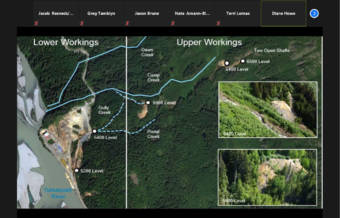
British Columbia regulators offered an update on May 19, 2021 on the progress towards cleaning up the Tulsequah Chief legacy mine about 10 miles upstream from Alaska’s boundary with B.C. (Screenshot by Jacob Resneck/CoastAlaska)

Alaska’s top environmental regulators held a cross-border Zoom session May 19 with British Columbia officials in charge of permitting mines in the shared transboundary watershed that flows into Southeast Alaska.

“This area is called the Golden Triangle for a reason,” said Peter Robb, a deputy minister with B.C.’s mining ministry, pointing out a sparsely populated area in the province’s northwest that faces the Alaska’s panhandle.

“There is lots of exploration and lots of potential in these rocks,” he added. “And we will continue to see that exploration and development, and we want to work with our Indigenous partners to build what that future looks like.”

More than a dozen working and legacy mine sites are located in watersheds shared between British Columbia and Southeast Alaska. (Image courtesy of B.C. Ministry of Energy, Mines and Petroleum Resources).

Beyond holding promising mining prospects, the Golden Triangle is also on the headwaters of major salmon-producing rivers in Southeast Alaska, like the Stikine, Unuk and Taku.

Officials from both sides presented findings from a joint water monitoring study on three transboundary rivers. The study grew out of the landmark 2015 agreement inked by Gov. Bill Walker and his B.C. counterpart.

Tribes and others have criticized the joint-decision to wrap up their work after just two years.

But Alaska Department of Environmental Conservation’s Terri Lomax says the water quality standards on Alaska’s side of the boundary were within regulatory limits. And there’s already monitoring being done by Alaska tribes, Canadian First Nations, the U.S. government and mining companies themselves.

There was no need for additional monitoring from the state of Alaska and British Columbia,” she said.

Canadians give report on Tulsequah Chief Mine cleanup

Efforts are continuing to finally clean up the long shuttered Tulsequah Chief Mine. B.C.’s deputy chief of abandoned mines Diane Howe described a year-old remediation plan.

She spoke of eventually using water to fill the mine’s underground complex.

By flooding this area, we are going to cut off the oxygen to this area which is the main culprit for causing the (acid rock drainage),” she said.

A Tulsequah Chief Mine settling pond overflows at the site about 40 miles northeast of Juneau Sept. 26, 2016. (Photo Courtesy of British Columbia Ministry of Energy and Mines)
A Tulsequah Chief Mine settling pond overflows at the site about 40 miles northeast of Juneau Sept. 26, 2016. (Courtesy of British Columbia Ministry of Energy and Mines)

For decades, acid rock drainage has been visible as a red and orange acidic sludge leaching into a tributary of the Taku River about 10 miles upstream from the border.

Provincial officials have been prepping a $37 million plan for the former mine, which the owners have not cleaned up.

Alaska officials applauded the preparatory work so far.

I know this has been a sore spot between the US and Canada for years,” Alaska Department of Fish and Game Commissioner Doug Vincent-Lang said. “But we’re very pleased with the effort that you have been making towards towards identifying the issues at the site, identifying a path forward to clean up and this presentation highlights that you have a pathway identified moving forward.”

The Tulsequah Chief Mine hasn’t been active since 1957. But there have been attempts by various firms to restart mining. Its current owner is a capital investment firm that’s been trying to find a new buyer. A Canadian bankruptcy court last year ruled it has until August 2022 to find a new buyer.

That was echoed by DEC Commissioner Jason Brune, who told his provincial counterparts that responsible mining is important to his boss.

I know on behalf of Gov. Dunleavy, this is a very large priority for us,” Brune said. “And it’s one that we take very seriously and have a number of meetings with with our colleagues from B.C. and we appreciate that relationship.”

Absent from the call were any representatives from Southeast Alaska’s tribes or Canada’s First Nations. Both have been critical of the pace of cleaning up abandoned mines and ongoing permitting of new ones they say could foul salmon habitat that’s both a critical source of food and income.

Tribes, conservationists underwhelmed by summit

Conservationists and tribes released a joint statement less than an hour after the meeting, criticizing the lack of commitments offered by either side.

“Why is this the first public meeting by Alaska/British Columbia since the Walker-Mallott Administration?” Southeast Alaska Indigenous Transboundary Commission Chair Rob Sanderson, Jr. wrote in a statement.

Others said they they failed to see the point of the publicity surrounding the meeting as officials routinely discuss these issues as part of the transboundary bilateral working group between the state and province.

“We didn’t learn anything new whatsoever,” said Chris Zimmer of Rivers Without Borders, an advocacy group in Juneau. He told CoastAlaska there was a lot of technical discussion from reports that had been released months ago.

“That’s all we heard,” he added. “We wanted to hear about next steps and commitments and not essentially a rehash of what we already know.”

The meeting comes just weeks after the Inter-American Commission on Human Rights agreed to hear a petition from Southeast Alaska tribes asking it to investigate Canadian mines in transboundary watersheds. But that won’t be a swift process — the Canadian government isn’t expected to reply to the petition until later this summer.

Lawyer who won landmark Alaska subsistence case in line to be Interior’s top attorney

Robert T. Anderson is the acting Interior Department solicitor. (Photo: University of Washington)

A pioneering advocate of Alaska tribal sovereignty will have an important job at the U.S. Interior Department, assuming the Senate confirms him.

Robert T. Anderson, who represented Athabaskan elder Katie John in a landmark subsistence fishing case, is President Biden’s pick to be the solicitor of Interior.

Anderson, a member of the Bois Forte Band of Ojibwe, began his legal career at the Native American Rights Fund.

“In 1984, I moved to Anchorage, Alaska as one of two attorney who opened an office for that law firm (NARF) to work on matters related to tribal status, tribal jurisdiction, hunting and fishing rights and amendments to the Alaska Native Claims Settlement Act that were important to protection of the Native corporation land base in Alaska,” Anderson said Tuesday at his Senate confirmation hearing.

When Anderson opened the NARF office in Anchorage, the federal government had not yet recognized more than 200 Alaska Native villages as self-governing tribes. It was a controversial idea. Many Alaskans thought ANCSA precluded tribal sovereignty. Anderson advocated for that recognition and was a key player in getting the Clinton administration in 1993 to issue a list and a statement that says Alaska tribes have the same status as those in the Lower 48.

Anderson faced largely friendly questioning at the hearing. He taught at the University of Washington law school for 20 years and has been the acting solicitor for four months.

The Interior solicitor’s job is to interpret federal law for the department. Solicitor opinions sometimes stand as legal pillars for years. But Anderson has already withdrawn six opinions written by President Trump’s Interior solicitor. Anderson told senators it had to be done.

“When there is a solicitor’s opinion, written by a predecessor, whether he or she is a Democrat or a Republican, they need to be reversed when they’re plainly inconsistent with existing law,” he said.

Other opinions need to be tossed, he said, when they are intended to facilitate a policy that’s been rescinded.

Among the opinions Anderson has thrown out was one signed on the last day of the Trump presidency. It said the Interior secretary could not hold Alaska tribal land in trust. Some Alaska tribes want that legal status for parcels they own. It would make the land “Indian country” and immune from state and local taxation.

Anderson’s opinion calls for the Interior Department to resume processing land-in-trust applications from Alaska tribes, after a consultation period.

Site notifications
Update notification options
Subscribe to notifications