The Sitka Sound sac roe herring fishery closed last week after 14 consecutive days of openers.
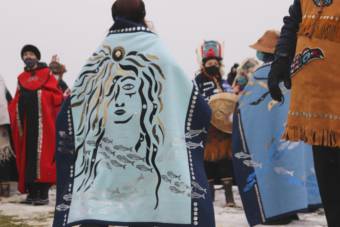
During the event, five ceremonial Kiks.ádi robes were unveiled along with a new song honoring the herring. The song was written by Louise Brady and is owned by the Kiks.ádi. The robes were designed by local Tlingit artist Jennifer Younger along with Carol Hughey, with formline design by Charlie Skultka. Together, they tell the story of the Herring Rock Woman, Kaxátjaashaa.
Thirteen volunteers put in over 300 hours into the creation of the traditional robes.
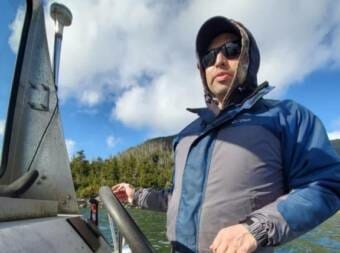
Theodosius “Dosy” Merculief. (Kootznoowoo, Inc. image)
One Sitka man has died and another sustained injuries after being thrown from their skiff while subsistence fishing for herring eggs on April 9.
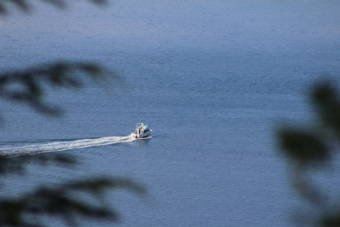
Good Samaritans played a critical role in the rescue, which took place less than a quarter mile from shore.
41-year old Theodosius Merculief — known to family and friends as “Dosy” — was pronounced dead at the Mt. Edgecumber Medical Center shortly after he and his companion, 43-year old James Jensen, were pulled from the water near the Starrigavan boat ramp.
Tom Climo, who works in Sitka’s harbor department, and was traveling with friends to a cabin for the weekend. It was 12:30 in the afternoon, and they had run about a quarter-mile from the Starrigavan ramp when one of the women in his party, Camila Gomez Duclos, spotted the empty skiff, which was turning tight circles at high power.
Climo at first thought she was talking about an actual whale circling, making a bubble net, which is a common sight in Sitka Sound this time of year.
“Actually she had said, ‘Look! There’s a whaler doing circles.” Climo said. “Like brodies. With no one in it. We went over to it and realized someone’s got to be in the water somewhere. And we’re looking around, and Emmett looked way out — maybe a hundred yards — and all of the sudden there’s this arm coming out of the water and it’s waving, and we jetted over there.”
Emmitt Andersen spotted the victims. The man waving his arm was James “Jimmi” Jensen, who was holding onto Merculief. Climo says that Merculief was already unresponsive, and that he was wearing a float coat and hip waders. Climo held Merculief’s head above water while Jensen was brought aboard. Then the boat’s skipper, Terry Perensovich, maneuvered to retrieve Merculief.
“Terry’s got a drop bow, so he put the drop bow down, but we had to slice his hip waders, because there was so much water in them, they were really heavy,” said Climo. “And we brought him around to the front of the boat, and were able to get him up on the deck.”
Climo and Perensovich’s brother, Gary Perensovich, along with Andersen, performed CPR on Merculief, for the 8-minute boat ride back to the Starrigavan boat launch. Camila Gomez Duclos tended to Jensen, assisting him into dry clothes. Another member of the party, Nicole Duclos, had summoned help, and the boat was met first by Sitka police officers, who assisted with CPR until the arrival of EMS personnel.
After the victims were transported, Climo says his party resumed their camping plans. On the way out, they saw that the Boston Whaler skiff had apparently run out of gas, and they were going to tow it back, but an Alaska State Trooper vessel instead arrived to retrieve it.
In an email to KCAW, troopers said they are investigating the possible cause of the mishap.
Jensen and Merculief were believed to have been harvesting herring eggs on branches — a traditional subsistence food — at the time of the accident. Climo says that there were signs in the skiff of egg harvest, but no branches.
Dosy Merculief leaves behind his partner, Natalie, and three children ages 13, 5, and 16 months. A GoFundMe campaign was started on Saturday for the family. It has raised just about $27,000 so far.
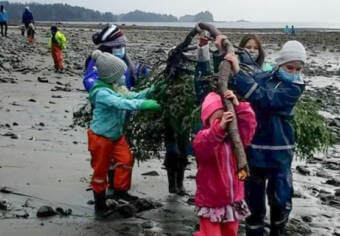
Students at Herring camp carefully carry a Hemlock branch across the beach. Gamble said he told students to treat the branch like they would their food, taking care to not let it drag in the sand. (Courtesy of Tom Gamble)
The beginning of the herring spawn in Sitka Sound signals the wind-down of commercial fishing and the start of the subsistence harvest: the millennia-old tradition of submerging hemlock branches along the shoreline, and waiting for herring to coat them in a thick layer of eggs.
Subsistence harvester and former Tribal Council member Tom Gamble is determined to see this tradition continue — by working to protect herring stocks and teaching kids how to harvest eggs. This spring, he shared some of his knowledge in a herring camp for kids.
“This was their first time seeing what subsistence herring eggs are all about,” Gamble said about his herring campers. “They’re really excited about it, they, they like to eat them, but they’re not really sure how to harvest them.”
Gamble said the camp created a lot of “aha” moments.
“There were a lot of those moments for these kids who had never seen anything like it before,” he said. “Giving them just the mental images for the first time, and being able to manipulate, you know, a branch and a twig and, and the hope that maybe they might get some eggs.”
The camp is an extension of his new business, the Alaska Native Indigenous Training Academy, or ANITA, named after Gamble’s late mother. Over the course of several hours one day in late March, he taught around 10 students and their chaperones the basics of harvesting herring eggs on branches, from the technical to the familial.
“So the very first activity they had to do was to go and find a rock together. And then they had to learn how to tie it together and to communicate what works and what didn’t,” he said. “Because if you’re out there and you’re harvesting, and you’re not talking with your family, then it’s just work. You might as well just get a job and call it work. It’s got to be fun.” “Helping Tommy set the trap for the herring — it was fun,” said 8-year-old Lukas Schmidt, who participated in the class. “I liked doing it, and I got to learn something new,” he said.
Lukas’s mom Jeren said the camp was an important experience for her kids and her homeschool classroom.
“It’s important to carry on some of the Tlingit traditions and to learn about them,” she said. “My family and I are Iñupiaq, so this is all new to us, but it’s fun to learn about the traditions of the local Indigenous peoples.”
Lucas Schmidt holds a buoy (often an empty milk jug or water bottle) as Tom Gamble demonstrates how to set a branch along the shoreline. (Courtesy of Jeren Schmidt)
Subsistence is a lifelong practice for Gamble. He is Kiks.ádi from the Clay house and his family uses the Herring Rock as their emblem, signifying strong cultural ties to Sitka herring for thousands of years. His advocacy for herring has become energized by what he’s seen on the water over the last couple of decades.
“As a subsistence harvester, we’re the frontline. We see a lot of changes,” said Gamble. “My involvement if you would, wasn’t chosen, where I wanted to draw a line in the sand and say ‘I want the commercial side to be over here and I want the subsistence guys to be over here,’” he said. “My involvement came because we realized if we didn’t stand up, there were never going to be any changes, and we were going to get run right out of our own way of life.”
The Sitka Tribe of Alaska sued the state in 2018, calling for changes to the management of the commercial fishery. The case is still being litigated but some incremental changes have been made. The state must further document its efforts to show they’re allowing “reasonable opportunity for subsistence.” But Gamble is concerned that the state’s modeling is far from perfect.
“Most recently, the indescribable coming back from a different harvesting trip, I had to stop in the middle of the ocean to watch the herring surface,” Gamble, thinking back on a day in mid-March. “This was on the day that science flew everywhere in the Sound and said that they didn’t see a single herring. So the traditional harvester had the herring come up under me. I’m telling you again that our traditions and our knowledge have proven over time. When we say that the herring are disappearing, that’s what we meant.” Gamble understands that commercial seiners are just trying to earn a living, but he believes the fleet is too large and should be reduced through a permit buy-back program. And he’d like locals to have a larger role in managing the fishery through a stakeholders committee.
In the meantime, it’s important that the subsistence harvest of herring remains viable in Sitka Sound, so that it can be taught down through the generations. Gamble plans to continue teaching subsistence camps throughout the year. It’s a way to honor his mother, Anita, and a hedge against the day when he is an elder himself and may depend on others for this food.
“When I was growing up I never thought for the life of me that even my own kids would be so busy that I can’t get help harvesting. And I thought ‘Well maybe if I trained a couple of these youngsters around here, I can sit at home and one day they just bring me a deer or a seal,'” Gamble said. “I’m gonna train this next generation how to take care of Elders in their community by just taking care of themselves.”
Editor’s note: This story is part of a series sharing different perspectives on herring.
Federal managers are warning that there may not be enough sockeye salmon to allow a full season of subsistence fishing on the Stikine River. That could lead to a premature closure of an important source of food in the Wrangell area.
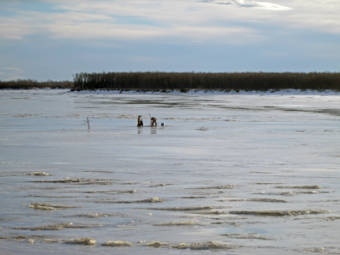
Federal fisheries biologist Rob Cross manages the districts near Petersburg and Wrangell. He says the U.S. Forest Service doesn’t take these decisions lightly.
“Our goal certainly isn’t to close the subsistence fishery,” Cross said. “This year, we have a below average preseason forecast for sockeye. So basically, we just want to give harvesters a heads up and let them make an informed decision about where they’re going to focus their efforts this year.”
The preseason forecast for Stikine sockeye is 56,000 fish. That’s less than half of the 10-year average.
Cross says managing the subsistence fishery is a balancing act.
“Our primary goal is to maximize subsistence opportunity for these communities, because they really depend on the Stikine fishery,” he said. “But at the same time, we need to make sure that there’s a healthy stock for fish as well. So we’re basically just letting people know that there’s a possibility of a closure throughout the season.”
An early closure isn’t guaranteed. The Forest Service says it will be working with Wrangell’s tribe, the Wrangell Cooperative Association, to conduct harvest surveys throughout the summer.
This isn’t the first time in recent years that a low pre-season forecast has led the Forest Service to warn subsistence fishermen of a possible closure for sockeye harvest. In 2019, Wrangell District Ranger Clint Kolarich closed the subsistence sockeye fishery nine days before the set close date because of low escapement.
Cross says that possible closures to the sockeye subsistence fishery up the Stikine would not affect the coho subsistence fishery in the area.
The federal subsistence fishery for chinook salmon has been closed since 2017 due to low return numbers and mature fish being smaller than average.
Kuskokwim River at Bethel on January 25, 2014. (Ben Matheson/KYUK)
State and federal fishery managers are waiting on more information to determine which government entity will have the authority to manage king salmon on the lower Kuskokwim River this summer.
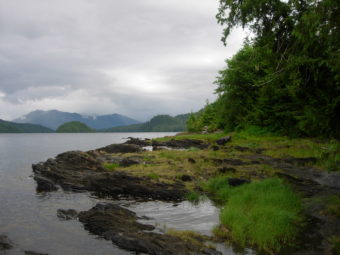
Since 2014, federal officials have managed the harvest of kings in the lower Kuskokwim to conserve the salmon species at the request of local subsistence users. Federal officials managed the harvest in federal waters within the Yukon Delta National Wildlife Refuge, but it’s unclear if federal managers will have that authority this summer.
Last week, Gov. Mike Dunleavy sent a letter to President Joe Biden saying that the state was taking control of Alaska’s submerged lands beneath navigable waters, citing the 2019 U.S. Supreme Court decision in Sturgeon v Frost, which affirmed the state’s right to manage travel on a navigable river.
Alaska’s congressional delegation supports Dunleavy’s assertion. The Sturgeon decision includes language that upholds federal authority over subsistence management in waters that pass through federal lands. Dunleavy said that the state will release maps showing which waterways the state plans to assert control over.
Yukon Delta National Wildlife Refuge Manager Boyd Blihovde would serve as the Kuskokwim River federal fishery manager if federal authority assumed management of the lower Kuskokwim king salmon. Blihovde said that he and his staff are waiting to see if the refuge waters will be included on the state’s forthcoming maps.
“Until forced to do something differently,” Blihovde said, “we will continue to work very hard to collaboratively manage the Kuskokwim River with all partners who have a stake in its conservation.”
Charles Brazil, state fishery manager with the Alaska Department of Fish and Game, said that the management authority under the new state policy “has not been fully determined. However, the department’s intent is to take the same management approach this season as in recent years.”
At stake is co-management with Kuskokwim tribes. Federal managers have an agreement to consult with the Kuskokwim River Inter-Tribal Fish Commission on salmon management. State managers do not have this obligation.
Tongass National Forest near Ketchikan, Alaska. (Creative Commons photo by Mark Brennan)
New research reaffirms the global importance of Southeast Alaska’s temperate rainforest for combating the effects of climate change. That’s according to data released Tuesday by a coalition of environmentalists and tribes opposed to old growth logging in Tongass National Forest.
Oregon-based researcher Dominick DellaSala says protecting forests is key to maintaining their function as a carbon sink.
“There’s no magic wand,” DellaSala said. “We only have a big vacuum cleaner that we can [use to] just suck CO2 out of the atmosphere and store it safely. Forests are doing that for us.”
He and his colleagues at the Woodwell Climate Research Center analyzed carbon data and found that the Tongass National Forest holds 44% of all the carbon stored by the United States’ national forests.
“Basically, when you go through an old growth forest, you’re walking through a stick of carbon that has been built up into the forest for many, many decades. Centuries,” DellaSala said. “And the largest trees in those forests store about 50% of the above ground carbon, so they are enormously important from a carbon standpoint.”
Trees store carbon by using photosynthesis to transform carbon dioxide from the air into food, which then fuels tree growth.
DellaSala introduced the findings Wednesday at a press conference organized by the Southeast Alaska Conservation Council, a Juneau-based conservation group opposed to clear cuts.
Exempting Tongass from the Clinton-era Roadless Rule was widely supported by state leaders and Alaska’s congressional delegation, who say it hindered resource development on federal forestlands. The state of Alaska recently joined a federal lawsuit seeking to oppose efforts to overturn the Trump administration’s exemption for the Tongass.
But tribal president Joel Jackson of the Organized Village of Kake added that the erosion control that healthy forests provide is key to sources of subsistence food from fish to wild game.
“My focus has always been the protection of the Tongass old growth — the remaining timber — for providing shade and pristine water for our salmon to return to the streams,” Jackson said. “That’s the most important thing to me because our life is salmon. We rely on being able to put away enough salmon for the winter — for a whole year until the salmon return. That’s our people’s main staple.”
Salmon returns to Southeast Alaska have plummeted in recent years. Last year’s commercial harvest was one of the lowest on record.
DellaSala was one of 111 scientists to sign a letter earlier this month urging the Biden administration to protect old growth and roadless areas of Tongass National Forest as part of its climate plan expected to be presented at the United Nations 2021 Climate Change Conference in November.
Close
Update notification options
Subscribe to notifications
Subscribe
Get notifications about news related to the topics you care about. You can unsubscribe anytime.