Subsistence

Tazlina tribe hopes to buy traditional land from Archdiocese for Copper River access

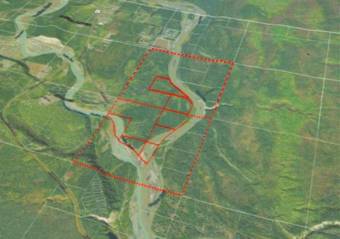
The property boundaries are illustrated in solid lines over an aerial photo of the general area of Tazlina and the property currently owned by the Archdiocese of Anchorage. (Photo courtesy of Native Village of Tazlina/from the “Homeland Recovery Report” (2020) by the University of Minnesota School of Architecture)

A federally recognized tribe in the Ahtna region of the Copper River area hopes to buy more than 450 acres of its traditional homeland and return it to the tribe.

A permanent village of Tazlina was established in the early 1900s near the confluence of Tsedi Na, or Copper River, and Tezdlen Na, or Tazlina River.

Tezdlen or Tazlina is one of eight villages in the Ahtna region. It’s about 70 miles north-northeast of Valdez and about 150 miles northeast of Anchorage.

And now the Native Village of Tazlina hopes to buy back 462 acres of land east of the village from the Catholic Church and return it to traditional and cultural use.

Village Council President Gloria Stickwan said the land would give the tribe better access to traditional fish camp and fish wheel sites.

Stickwan also works for Ahtna Incorporated as its customary and traditional environmental coordinator, where she reviews proposed state and federal hunting and fishing regulations and brings comments to the Cultural and Traditional Use Committee.

“We don’t have any other place to fish to use a fish wheel, because … we just don’t go to someone’s fishing site and start fishing there,” Stickwan said. “We really don’t have a place to fish unless we go to Chitina,” which is about 60 miles southeast of the village, about an hour and 15 minutes of driving. Stickwan said a lack of roads to the fish wheel site limits access to the Copper River.

The 460 acres equates to just shy of three-quarters of a square mile. But the land has historical and cultural significance to the tribe.

Tribal Administrator Marce Simeon started her position in May 2020 but has worked with the tribe for about 15 years.

“The families of Tazlina tribal members in our community have been utilizing that land right there specifically for generations to harvest salmon,” she said. “It’s such an incredible part of people’s diet day-to-day, even through the winter season.”

The Catholic Church bought the property from the federal government in the early 1950s so that the church could open a boarding school.

The Copper Valley School operated in the area for 15 years. But the school closed in 1971, and five years later a fire destroyed its main building. Over the years the remaining structures deteriorated.

“That land was essentially left vacant from the 70s until some years, I believe it was 2011, the Native village of Tazlina had a strategic planning process where we had identified that there were contaminants on that site because of the old school,” Simeon said. “Through our village, we were able to secure funding under the Environmental Protection Agency. Our brownfield program was a response program that identified that as a contaminated site in our community.”

A brownfield is a property or site that potentially is contaminated with hazardous substances or pollutants.

According to Alaska Division of Spill Prevention and Response, potential contaminants included asbestos, underground fuel storage tanks, lead-based paint and other pollutants.

“With the assistance of EPA, we reached out to the Catholic Church to clean up the debris that was left on that property, and they did,” Simeon said. “That was the last action that had taken place. And it’s my understanding that the archdiocese had incurred incredible expense in remediating that contaminated site.”

The Archdiocese completed the EPA- and DEC-mandated cleanup in 2014.

Now the federally recognized tribe is dedicated to buying back the land for cultural use, conservation and restoration.

Simeon says the church has since decided to liquidate the property to cover its costs. Since the church and the village had worked together previously, particularly to grant certain access to a fish wheel site, the Archdiocese reached out to the village.

“They wanted to see if we were interested in purchasing that lot, and we definitely were,” he said.

In 2011, tribal members prioritized a fish research center, a new meeting hall and open spaces for recreation and a community garden — for use of the property.

Simeon says the village currently works with the Catholic Church to monitor limited authorized use of fish wheels on the property.

Plans for the parcel would include turning it into a cultural gathering place, a tribal college, a place to host subsistence use fish wheels, as well as contribute to fisheries research.

“The process of harvesting salmon and consuming salmon is a lot more than just food,” Simeon said. “It’s such a huge part of a lifestyle here that individuals it’s really imperative to how hard it is to be a person in the Copper River.”

The Archdiocese of Anchorage declined to comment, other than an email response from chancellor John Harmon: “The Archdiocese of Anchorage-Juneau generally does not discuss details of its business transactions,” the email says. “The Archdiocese has established a very good working relationship with the Village of Tazlina and looks forward to the sale of the property.”

While the total asking price is $1,856,000, the village says the archdiocese will knock off $50,000 if the tribe can raise $50,000 by June 1, 2021.

While Tazlina has until next year to purchase the land, it is trying to get funding committed by this fall and secure one of its largest sources of funding to this point.

“We are pursuing some larger-scale funding sources because if you’re trying to come up with almost 2 million dollars, it’s nice to be able to get them in as big chunks as possible,” said Kristin Carpenter, who working as a fundraising consultant for the village on the project. Carpenter also served as the executive director of the Copper River Watershed project for a little more than 20 years. “But we also there’s a piece of that that is going to have to come from individuals and donors and, you know, smaller-scale sources.”

Interested donors can find more information on the tribe’s GoFundMe page or call the Native Village of Tazlina.

(Special recognition: Thanks to Phillip Sabon for pronunciation and translation help on the Ahtna river names.)

State of Alaska, cities, business groups file to defend exemption of Tongass from Roadless Rule

Tongass National Forest
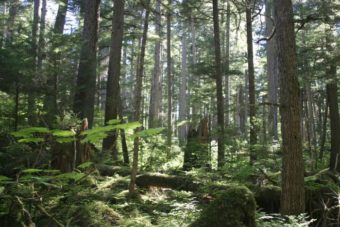
Part of the Tongass National Forest on Douglas Island pictured in 2004. (Creative Commons photo by Henry Hartley)

The state of Alaska and a former governor along with a host of municipalities, trade groups and businesses have filed to defend the Tongass National Forest’s exemption from a Clinton-era rule that limits development on federal land.

The Trump administration decided to get rid of the Roadless Rule for the Tongass last year. Shortly afterwards, a group of tribes, conservation groups, fishermen and tourism companies sued the federal government, seeking to overturn the decision. They say the decision to lift the rule on more than 9 million acres of the Tongass is based on a flawed environmental analysis and ignores the input of Alaska Native tribes and the public.

But the state and the rest of the coalition looking to defend the exemption for the Tongass say the rulemaking process was proper and that an exemption is critical to the state’s economy.

“The Tongass holds great economic opportunity for not only Southeast Alaska, but the State as a whole,” Gov. Mike Dunleavy said in a news release. “From resuming our timber industry to attracting tourism, this region has the potential to create good-paying jobs and it is my administration’s intent to defend our state’s rights and improve access to public lands.”

Robert Venables is executive director of Southeast Conference, an economic development group. He said projects in the Tongass are already held to high standards under state and federal laws and regulations.

“What really is the issue, in my mind, is having a conversation of, how does Alaska really access and control and have more of a conversation about how the forest is managed? Because this is very unique, where you have almost 96% of the region in direct federal control,” Venables told Alaska’s Energy Desk in a phone interview.

He said the Roadless Rule places unnecessary hurdles in front of development, pointing specifically to renewable energy projects. While developers can apply for exemptions to the Roadless Rule — and most are granted — he said the rule adds to the cost and time required to complete projects.

“This is not about extraction of resources. This is about every single economic sector meeting having unique needs for the forest, and we need a management plan that can reflect that,” Venables said.

Roadless Rule supporters disagree. They see increased resource extraction and development as an inevitable consequence of the rule going away in Alaska.

President Joel Jackson from the Organized Village of Kake said he’s concerned development could hurt the region’s other economic drivers.

“Our region, before COVID, was heavily reliant on tourism, and sport fishing, and commercial fishing and subsistence fishing. And it still is. And those areas provide way more jobs and more economic value to Southeast Alaska,” Jackson said in a phone interview.

Jackson said it’s also a threat to Alaska Native tribes’ way of life, since they harvest food and medicine from the forest and nearby waters.

Ketchikan’s city and borough have joined the state in defending the exemption. City Mayor Bob Sivertsen said development doesn’t have to harm the environment.

“Well, there are mitigations for everything we do,” Sivertsen said via phone. “We have the technology these days to do construction and other things that would lessen the impact on environmental issues, whether we’ve got to put in fish culverts, silt fences, the design and placement of the roads, all those types of things.”

Roadless Rule advocates say that logging and other development could accelerate climate change because the Tongass stores vast amounts of carbon.

Other parties defending the exemption include the city of Craig, statewide and Southeast chambers of commerce, electric utilities, shipping companies and resource development advocacy groups.
‘Herring Protectors’ gather at Sitka’s courthouse as commercial fishery gears up

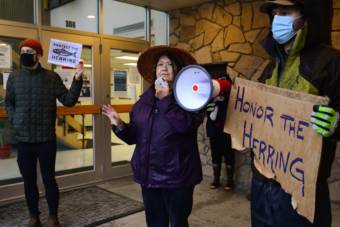
Demonstrators gathered outside of Sitka Courthouse earlier this week as a commercial herring fisher is slated to begin. (KCAW/Berett Wilber)

Herring season is underway in Sitka, and a commercial fishery is likely to happen, after a two-year hiatus. Earlier this week, demonstrators gathered outside Sitka’s courthouse, to catch the attention of the Alaska Department of Fish and Game, calling for changes to management of the fishery.

A group of around 60 demonstrators marched around the Sitka Courthouse in the pouring rain.  Some participants drum and sing, others held signs that read things like “honor the herring” and “33,000 tons? You’ve got to be crazy.”

The demonstration was organized by a local activist group called the Herring Protectors. The group advocates for herring and subsistence harvesters, and calls into question the state’s management of the commercial herring fishery. They chose this location because the Alaska Department of Fish and Game office is inside the courthouse, and they want to catch the department’s attention, as the commercial herring season approaches
Standing in front of the courthouse doors, Louise Brady spoke to the crowd.

“I really appreciate you being out here because the voices of our Tribal Elders, the voices of our culture bearers have spoken loud for several decades at the Board of Fish with no response,” she said. “With no response. Because our herring are so precious to us.”

Brady pointed at sign that reads “Respect Tlingit science.” She said Tlingit people took care of the land and waters for thousands of years, successfully. Elders have been testifying before the state’s Board of Fisheries for decades now, concerned about changes to the herring spawn and a species in decline.

“They have been trying to tell the state that without herring, we all are going to be in trouble because the herring, the spirit of the herring, they feed us every spring,” she said. “They feed the salmon, they feed the birds, they feed the whales. They feed us.”

The commercial fishery didn’t open last year or the year before. The fish were too young and small to be marketable abroad. But this year, a fishery is looking more likely. Based on their models, state managers believe it’s sustainable to open the fishery this year, with the highest forecast of fish since the state started recording data in the 1970s. The Department of Fish and Game met on March 12 to review data from the past two years, and talk about projections for 2021.

“We expect to see a high number of 5-year-olds and the forecasted average weight has now gotten up to 112 grams. And that’s for all the fish in the population,” said state fisheries biologist Sherri Dressel.

Fish and Game is predicting around 210,000 tons of herring will return to Sitka Sound this year. Of those fish, it has set a harvest limit of 33,000 tons. So far this spring, state aerial surveyors haven’t observed herring spawn in Sitka Sound. Spawning could begin any time between now and April.

But subsistence harvesters continue to report harvesting challenges, and Sitka isn’t the only place where access to the traditional food has become more difficult. Alaska Native Sisterhood Grand President Paulette Moreno noted a court order filed in Canada earlier this month. The Gwa’sala-‘Nakwaxda’xw Nations, a First Nations government in British Columbia, filed an injunction on March 9 to stop a commercial herring fishery near Vancouver because they found stocks were too low to sustain a harvest. 

Sitka Tribe of Alaska sued the state over management of the commercial fishery in 2018. The case is still being litigated, but the Tribe has already won some ground in the fight. Last year, a Juneau judge ruled that the state had not demonstrated that it allowed for  ‘reasonable opportunity for subsistence” in the management of the fishery, and ordered the department to make some changes.

According to a press release, the Tribe is working with the state to conduct in-season subsistence harvest monitoring this year– a result of the court’s ruling. The daily data they collect will be considered by state biologists throughout the commercial fishery, to ensure subsistence harvesters have “reasonable” access to the resource.

The commercial fishery goes on ‘two hour notice’ on March 20th.  And the Herring Protectors say they will continue to organize in the coming weeks.

Heavy winter snowfall may become more common in Y-K Delta

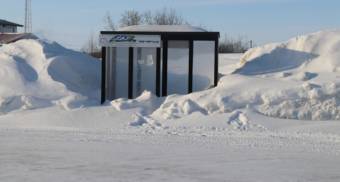
A bus stop in Bethel surrounded by deep snow. March 12, 2021. (Gabby Hiestand Salgado/ KYUK)

Recent storms have battered the Yukon-Kuskokwim Delta coast and dumped many feet of snow in various places. Some are saying this is more snow than they’ve seen in decades. Scientists say that heavy snowfall may become more common in Alaska in the future.
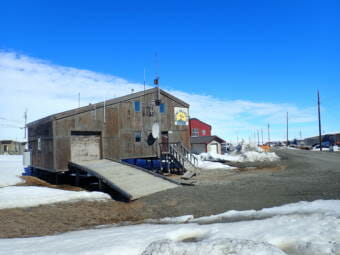
Blizzards and deep snow have made travelling around Bethel more dangerous recently. Last week, Bethel Search and Rescue engaged in four searches for overdue travelers. One woman from Kasigluk was found dead just south of Bethel; the others made it home safely.

BSAR President Mike Riley said that in all four instances, heavy snow was a factor.

“With the recent searches we had, they didn’t anticipate this much snow on the tundra, on the trails, and they burned all their gas up because of plowing through snow pulling a heavy load. And they weren’t able to travel anymore,” Riley said.

He commended one of the travelers who, after getting stuck, dug a hole in the snow, covered himself with a tarp and remained close to his snowmachine until searchers found him.

Riley said the fresh snow was 3 feet deep in many areas on the tundra. Like several other people KYUK talked to, he said that he hadn’t seen this much snow around Bethel in decades.

“We haven’t seen this for a while since the mid 90s, 2000s. We haven’t had this much snowfall for quite some time,” Riley said.

There are no official measurements for snow depth in Bethel. The National Weather Service stopped measuring snowfall there in 2018. However, Alaska climate scientist Rick Thoman said that more snow would make perfect sense, given the Earth’s warming climate.

“Why? Well the average temperature in Bethel is way below freezing in the winter. So even though it warms, say, on average 5 degrees [Fahrenheit], it’s still more than cold enough for snow,” Thoman said. “In the wintertime, where are we getting moisture from for snow? Mostly from the oceans. And we know the oceans are warming. That means there’s more evaporation.”

Thoman said the southern Bering Sea has been 1 to 3 degrees Fahrenheit warmer than average this year. To summarize: warmer ocean temperatures lead to more evaporation, which then becomes more precipitation than normal. Thoman said that big winter storms with heavy snowfall could become more common in the Y-K Delta and other parts of Alaska in the future. But with a warming climate, he said that comes with a few caveats.

“There will almost surely be more rain events in the future in winter,” Thoman said. “And on average, getting snow in October, say in Bethel, will become much less common. And the same, maybe, in November.”

This winter in Bethel has been a degree and-a-half warmer than the historical 30-year average.

It’s unclear how extra snow during the winter will impact flooding along the Yukon and Kuskokwim Rivers in the spring. National Weather Service hydrologist Celine Van Breukelen said that there is up to 50% more snow than normal in the mountains near the headwaters of the Kuskokwim. but she said that whether that causes more flooding this year will depend on how fast the snow melts.

“If we have a quick warmup, that means that the snow is going to melt before the ice in the river has a chance to degrade, which is going to increase our chances for breakup flooding,” Van Breukelen said.

Van Breukelen expects to have better flood predictions in April, based on a more accurate assessment of the season’s snowpack and temperatures during the river breakup.

Heavy snowfall is not all doom and gloom, though. Many people, like Chevak Elder and longtime teacher of Cup’ik culture John Pingayak, welcome the snow.

“When there’s a lot of snow, there’s always a positive effect on our subsistence way of life,” Pingayak said.

While deep, fresh snow can be difficult to travel on, Pingayak said that oftentimes after it snows, a south wind brings moisture from the ocean and wets the snow. Once the wet snow freezes, he said that the tundra becomes a smooth surface.

“And then it’s like a roadway,” Pingayak said. “That’ll keep the hunters safer on the land, on the tundra.”

And he said that the snow will have lasting impacts that linger past winter and spring. He said that the extra snow will help water the tundra and provide for an abundance of berries this summer.

Berry pickers will be glad to hear that there is more snow forecast for much of the Y-K Delta this weekend. There is a blizzard warning for the Kuskokwim Delta coast on March 13.

Kaktovik tribe says Biden didn’t reach out before agreement with Canada over caribou in Arctic refuge

The building that houses the Native Village of Kaktovik
The Native Village of Kaktovik building in June 2018. (Photo by Jennifer Pemberton / Alaska’s Energy Desk)

The Native Village of Kaktovik is speaking out against the Biden administration, claiming their tribe wasn’t consulted about an agreement President Biden made with Canadian Prime Minister Justin Trudeau regarding protections of the Porcupine caribou herd in the Arctic National Wildlife Refuge.
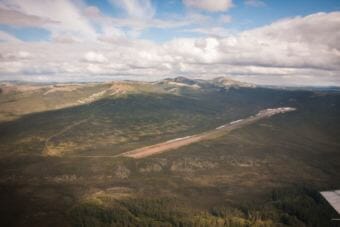
Last week, in a joint statement with Prime Minister Justin Trudeau, President Joe Biden pledged to “help safeguard the Porcupine caribou herd calving grounds that are invaluable to the Gwich’in and Inuvialuit peoples’ culture and subsistence.”

The herd’s migration takes them through both Canada and the United States.

It’s the latest in a series of moves from the Biden administration to stop oil drilling in the Arctic National Wildlife Refuge. Shortly after taking office, Biden placed a halt on lease sales in the refuge.

Eddie Rexford Sr. is the president for the Native Village of Kaktovik, an Iñupiat tribe and the only one located within the refuge. He says they weren’t consulted by the Biden administration before the announcement. Despite their opposition, Rexford says the tribe is committed to protecting subsistence resources.

“We certainly like to protect our homelands also, but we want to utilize the natural resources that our creator provided to us,” Rexford said. “Oil and gas, so we can get use the natural gas to get away from using diesel.”

Rexford went on to say that Biden’s actions run counter to his recent memorandum to respect tribal sovereignty and self-governance.

“He promises to work with the tribes and the Native groups in Alaska, and it’s not coming to fruition to our community and tribe,” Rexford said.

The Porcupine Caribou Herd in the Arctic National Wildlife Refuge on July 3, 2019. The Gwich’in live outside of the refuge but harvest caribou from the Porcupine Herd, which breeds in the refuge. (Danielle Brigida via Creative Commons)

Rexford says the tribe had successes with the Trump administration and former Interior Secretary David Bernhardt. He’s hopeful that, if confirmed, Biden’s Interior nominee Deb Haaland, of the Laguna Pueblo people, will make more efforts to work with the tribe.

“Have her come to our community to meet with our folks,” Rexford said, “to let her know that we live here and there’s no Gwich’in homelands here in the refuge, like it’s being purported in the news nationally, internationally and statewide.”

The Gwich’in are an Alaska Native people who reside primarily in the Yukon-Koyukuk region in Interior Alaska. The Inuvialuit are a First Nations people from Northwest Canada. Both oppose opening the refuge to drilling.

Beyond the agreement with Canada last week, the Biden administration has not made any concrete plans to address how they will safeguard the caribou herd.

This is the second scuffle Kaktovik has had with the Biden administration in recent weeks. Last month, the local Alaska Native corporation Kaktovik Iñupiat Corporation was informed by the Interior department that they missed a deadline to do oil exploration in ANWR. The corporation says the federal Fish and Wildlife Service held up the process, resulting in the deadline passing.

Bethel tribe protests 15-day comment period for Donlin Gold water permits

Donlin runway and camp site in summer 2014.
The proposed Donlin Gold mine would be one of the biggest gold mines in the world if completed. (Photo by Dean Swope/KYUK)

The Alaska Department of Natural Resources gave the public 15 days to comment on 12 water right permits for the proposed Donlin Gold mine in December 2020. The Orutsararmiut Native Council claims that wasn’t enough time, especially as villages locked down to slow the spread of the coronavirus, and taking into account limited access to the internet in rural Alaska.

Bethel resident and Orutsararmiut Native Council member Bev Hoffman has protested the proposed Donlin Gold mine for years and is frustrated that the Alaska Department of Natural Resources only gave tribes 15 days to comment on a dozen water right permits that it has granted to Donlin Gold. The comment deadline was December 15, 2020.

According to Hoffman, there are a lot of barriers to getting public comment in the Yukon-Kuskokwim Delta.

“Communities are in lockdown; they’re not meeting,” Hoffman said. “They don’t have internet data to hold big Zoom meetings.”

Hoffman is also worried that Donlin Gold’s plans for those streams will disrupt people’s way of life in the YK Delta. The Donlin Gold mine would be one of the biggest in the world, if completed, and will require a lot of water to treat the mercury and other toxins released during its operations. These 12 water right permits give Donlin Gold permission to draw down the water of 12 streams for its operations.

The Orutsararmiut Native Council’s letter to DNR echoed Hoffman’s concerns. ONC wrote:

“First, the Department must not proceed with approving these water rights applications without providing the public the opportunity to review and comment on those applications. Notwithstanding the inadequate information provided, we ask that the Department deny these applications pursuant to Alaska Statute 46.15.080 to 46.15.090 because they are not in the public interest and the existing uses of the waters that would be appropriated by these applications are far more important.”

Both Hoffman and the letter written by ONC said that the water permits further endanger the region’s food security.

“For them to be able to get this water permit that jeopardizes that food security in the manner that it’s happening, it’s so wrong and dangerous. Dangerous to the people that choose to live a way of life out here,” Hoffman said.

The Yukon-Kuskokwim Delta is one of the most food insecure regions in the country; many of its residents cannot access three meals a day.

Roughly 22% to 24% of YK Delta households are food insecure, according to Feeding America, a national nonprofit focusing on hunger relief. The organization reports that 21% of households in the Bethel Census Area are food insecure. In the Kusilvak Census Area, which includes villages along the lower Yukon River and Bering Sea coast, those rates are even higher, ranging from 25 to 29%. This makes it the second most food insecure region in the nation, just after Jefferson County, Mississippi. Feeding America reports that one in four Alaska Native households cannot access three meals per day, a rate double that of white households.

Most YK Delta residents depend on subsistence foods for the majority of their diet. The Kuskokwim River is the primary food source, and the Donlin Gold mine site would sit near one of its tributaries. The company has emphasized its commitment to building the mine as safely as possible.

A spokesperson for the state, Dan Saddler, said that the process was legal; state statute allows a 15-day comment period. The state can extend that deadline period, but Saddler said that they haven’t gotten a request to do that from any of the tribes or organizations who commented.

Correction: An earlier version of the article incorrectly said Donlin Gold was granted the 12 water right permits in December. That is incorrect. The public comment for the permits was in December. The article and headline have been updated to include a letter and comment from the Orutsararmiut Native Council that said that DNR did not give adequate time or information for public comment.

Site notifications
Update notification options
Subscribe to notifications