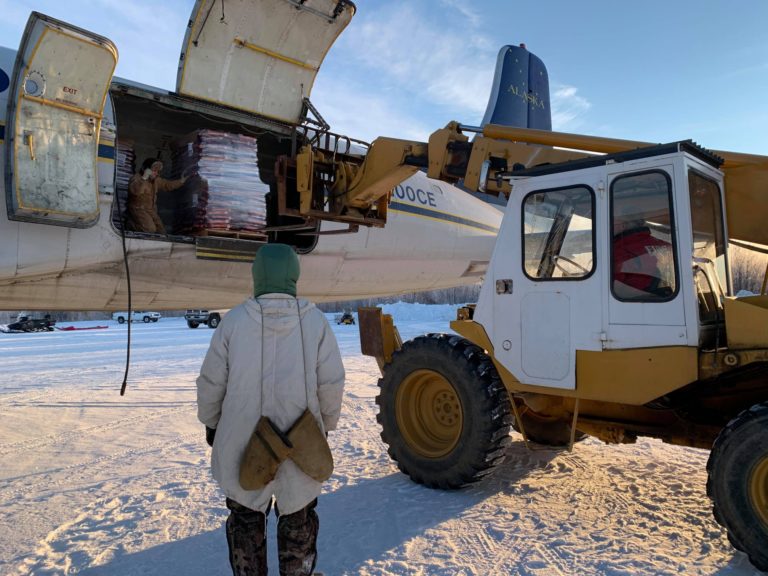
Residents help unload bags of Purina dog food in Tanana (Photos courtesy of Courtney Agnes in Tanana via Stephanie Quinn-Davidson)
Donated dog food is making its way to some Yukon River communities where poor salmon runs have left mushers without fish to feed their teams.
When village mushers reached out to her back in September, Yukon River Intertribal Fish Commission Director Stephanie Quinn Davidson says she wasn’t able to take official action.
So Quinn Davidson says she decided to launch her own online effort to seek help.
“I took to Twitter and Facebook, my personal pages, and just posted kind of the plight that we are facing on the Yukon River with these low salmon runs, what it means for these traditional dog mushers,” she said. “I tagged a bunch of large dog food companies in that post and one of them, Purina, responded.”
Davidson says Purina agreed to provide 39,000 pounds of premium dog food, and shippers Tote Maritime and Carlisle got the kibble to Fairbanks. She says she started a GoFundMe page to cover the cost of flying the food to villages. And the mushing community responded with hundreds of donations
“We raised enough money to ship it out to rural Alaska, but then I had an individual, Rocky Riley, in Fairbanks reach out to me and say, ‘Hey, I might be able to get Everts Air Cargo and donate the freight for you, and then you would have more money to be able to buy even more dog food and help out even more mushers,’” she said.
Quinn-Davidson says Everts shipped the initial batch of Purina-donated dog food to Fort Yukon and Tanana in mid-November
“The mushers are so so grateful,” she said.
Tanana musher Pat Moore credits Quinn Davidson with leading the effort to help village mushers get their dogs through the winter.
“In my mind, she’s kind of like a saint,” he said.
Moore says the village received 26,000 pounds of kibble, which was divided on a per dog basis among local mushers.
“I’ve heard that everybody in Tanana has enough to last them through the end of April.”
Ongoing donations from individuals and businesses are expanding the effort. Quinn-Davidson said mushers in additional communities including Circle, Huslia, Hughes, Holy Cross, and Old Crow in the Yukon Territory are also receiving food for their dogs. In all, she said they’re helping feed 500 dogs.
Quinn-Davidson says the effort has so far raised over $120,000 in food, transportation and cash donations.
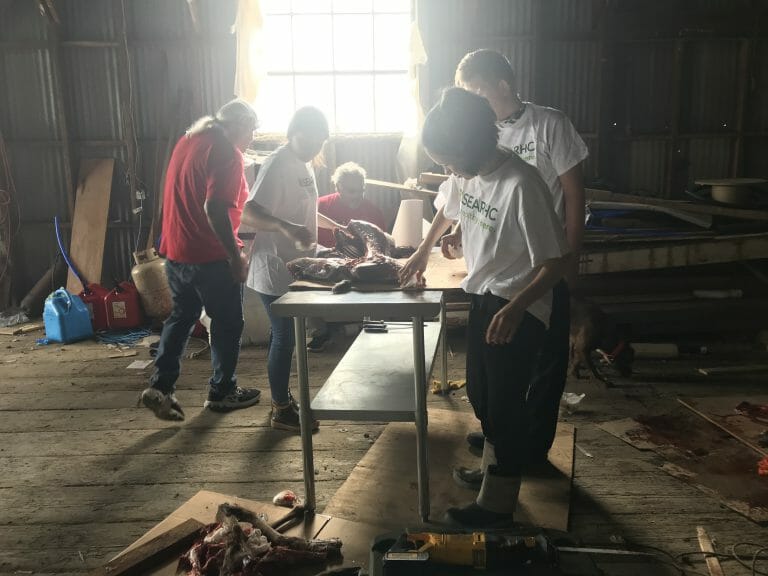
Kake Youth Conservation Corps (YCC) help butcher one of five deer obtained under the emergency season. (Photo courtesy of the Organized Village of Kake)
A judge ruled the feds were within their rights to allow a Southeast Alaska tribe to organize a hunt out-of-season because of the COVID-19 pandemic. The Dunleavy administration has sued to block future hunts, arguing that Kake’s special moose and deer harvest this summer was federal overreach.
During the early days of the COVID-19 pandemic, a federally recognized tribe on Kupreanof Island was alarmed by the low supply and high price of fresh meat.
The Organized Village of Kake petitioned the Federal Subsistence Board for a hunting party to harvest five deer and two moose out of season and distribute the meat within the community. It was green-lit in June. The State of Alaska filed suit, alleging the feds had illegally pre-empted the state’s rights to manage wildlife.
Assistant Attorney General Cheryl Brooking says there are only narrow reasons for federal jurisdiction to trump state management.
“When Alaska became a state, one of the main drivers of statehood was to get control over fish and game management because the feds were making a mess of it,” Brooking told CoastAlaska on Friday. “But since statehood, the state has been the manager of fish and game.”
There are notable exceptions, such as when a species is listed under the Endangered Species Act and Marine Mammal Protection Act. But she argued in court filings that the food security issue was never proven, and the federal government exceeded its authority in allowing the hunt.
“So that’s what the state’s primary concern is,” she added.
District Court Judge Sharon L. Gleason denied a preliminary injunction that would have prevented special hunts in the future.
In a 46-page order issued on Wednesday, Gleason wrote that federal officials had taken both conservation and public safety concerns into account when it reached its decision. She also noted that when federal officials reached out to state wildlife managers, they didn’t respond.
Judge Gleason says state attorneys had warned that absent the court’s intervention, more special COVID-19 hunts could be authorized by federal authorities behind closed doors and without transparency.
“Yet the court is only aware of a single emergency hunt authorized by the [Federal Subsistence Board] — the Kake hunt — and that was authorized at a public meeting,” Gleason wrote.
It’s not the end of the case. The lawsuit will continue to move forward with both sides filing arguments before a final ruling. But the upshot is that federal officials aren’t blocked from authorizing out-of-season hunts in special circumstances.
Tribal leaders in Kake don’t see that likely in the near future.
“We just got done with our moose season and our deer season — so I think we’re good for now,” Kake’s Tribal President Joel Jackson said in an interview.
He notes that the village’s groceries are mainly shipped on the occasional state ferry or barge.
“Anything happens to those cranes down there, where they load all the stuff coming to Alaska — we’d be in a world of hurt,” he said.
He says Alaska Natives never voluntarily ceded their hunting and fishing rights on their traditional homeland. And he sees it an issue of tribal sovereignty.
“Of course, if we’re in a real bad situation, I wouldn’t hesitate to get a hunting party together, go out and get what we need,” he added. “But I want to stay within the law.”
It’s the state’s second legal setback in the case. The judge earlier blocked the state’s motion to open a federal subsistence hunt for big game hunting near the Glenn Highway to all state licensed hunters.
The Native American Rights Fund has joined the lawsuit on behalf of Kake’s tribe and the federal government.
Anchorage-based staff attorney Erin Dougherty Lynch welcomed the court’s ruling.
“The Federal Subsistence Board was well within its authority to approve the Organized Village of Kake’s emergency hunt, and we are pleased the court recognized that the state’s claims otherwise are unlikely to succeed,” she wrote on Friday. “Alaska Native communities are experiencing myriad hardships caused by the COVID-19 pandemic, and we encourage the State of Alaska to treat Tribes as partners, not adversaries.”
It’s unclear if any future special hunts are being considered. Federal wildlife officials declined to comment, citing the state’s litigation.
The case State of Alaska, Department of Fish and Game v. Federal Subsistence Board continues.
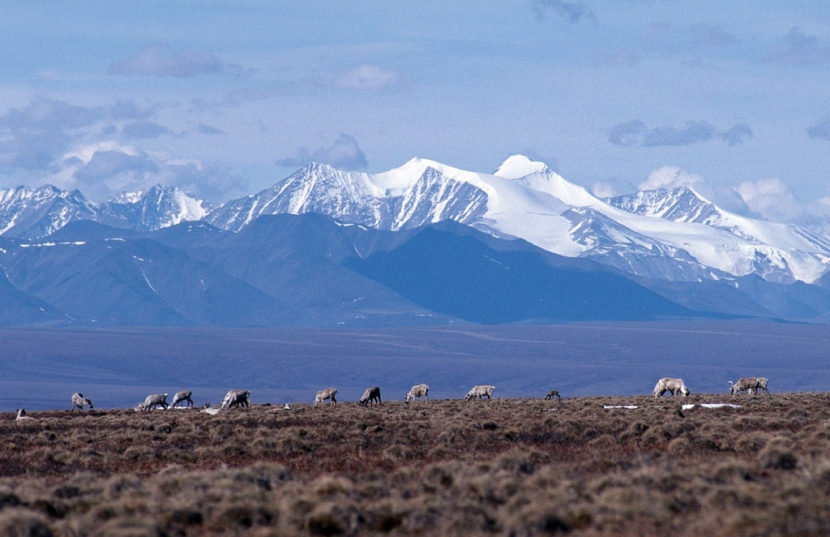
Caribou graze on the coastal plain of the Arctic National Wildlife Refuge, with the Brooks Range as a backdrop. (USFWS)
Starting Tuesday, oil and gas companies can pick which parts of the Arctic National Wildlife Refuge’s coastal plain they’re interested in drilling. It’s the latest push by the Trump administration to auction off development rights in the northeast Alaska refuge before President-elect Joe Biden takes office.
The official “call for nominations” launches a 30-day comment period. It will also allow the Bureau of Land Management to move forward with a lease sale, which it must announce 30 days in advance. The exact timing is not clear, but it raises the possibility that a sale might happen just days before Biden’s inauguration.
“It’s been quite a lot of work to get to this point,” said Kevin Pendergast, Deputy State Director for Resources with the BLM in Alaska. In a separate statement, the agency said the lease sale will be a historic move “advancing this administration’s policy of energy independence.”
In a dramatic shift after nearly four decades of protections, a Republican-led Congress in 2017 approved legislation that opened up part of the refuge to oil development. It called for two lease sales in the coastal section of the Arctic Refuge within seven years, with the first one to be held by the end of 2021.
But conservation groups are blasting the Trump administration’s decision to move forward with the first lease sale now, just a couple months before Inauguration Day, saying it’s rushing the process “to open one of the nation’s most iconic and sacred landscapes to oil drilling.”
The Arctic Refuge’s coastal plain is about 1.6 million acres — an area roughly the size of Delaware that makes up about 8% of the vast refuge. It’s a place where caribou migrate, polar bears den and migratory birds feed. It’s also an area believed to hold billions of barrels of untapped oil.
“This timeline indicates that they’re trying to cram this through in a way that would cut out consideration for public concern,” said Brook Brisson, senior staff attorney at Trustees for Alaska, an Anchorage-based environmental law firm.
Trustees for Alaska is among several groups, and a coalition of 15 states, that filed lawsuits earlier this year aimed at derailing drilling plans for the Arctic refuge. The suits are still winding their way through the court system.
The American Petroleum Institute, a national trade association, welcomed the call for nominations on Monday, saying in a statement that development in the Arctic refuge is long overdue, will create good-paying jobs and provide more revenue for Alaska. It said the industry will work with wildlife organizations and local communities, and use new technology “to safely and responsibly develop these important energy resources.”
Alaska’s all-Republican congressional delegation is also celebrating the news of the government taking another step closer to a lease sale. U.S. Sen. Lisa Murkowski said a sale could be held as soon as January.
“While we face headwinds, from global economic conditions to an organized effort to prevent leasing, the Department’s rigorous environmental review has provided a solid framework to ensure responsible exploration and development,” Murkowski said in a statement. “We are now within sight of the first-ever lease sale on the Coastal Plain, and I appreciate the continued good work of (Interior) Secretary Bernhardt and his team to help us reach this point.”
Residents of the villages closest to the coastal plain are split on the development issue, with some seeing opportunity from drilling while others decry the impact on wildlife, most notably the Gwich’in, whose culture and diet revolve around migrating caribou.
“Any company thinking about participating in this corrupt process should know that they will have to answer to the Gwich’in people and the millions of Americans who stand with us,” said Bernadette Demientieff, executive director of the Gwich’in Steering Committee, in a statement.
But it’s not clear how much interest there will be in drilling. For one thing, it’s expensive in such a remote area.
“There’s a lot of potential oil there that could be harvested,” said Andy Mack, a former Alaska commissioner of natural resources who’s pushed for the refuge’s opening.
“The real trick,” he said, “is doing the math around the marginal cost of producing a barrel of oil in that area of the world.”
Other challenges are low oil prices, the coming change in administration, and the risk of more litigation over environmental concerns. Some investors have also said they won’t fund new oil and gas projects in the Arctic.
Meanwhile, Biden says he plans to permanently protect the Arctic refuge and ban new oil and gas permitting on all public lands and waters.
If drilling leases are finalized before Biden takes office, they could be difficult to revoke, said Mack. But even if not, Biden would still face that federal law that mandates a lease sale by the end of 2021.
Still, Mack said, the next administration could impose restrictions.
“What they would try to do is make it so difficult and so onerous to get the array of permits,” he said, “that the companies just say, ‘Well, we’re not going to spend 10 years just trying to get a simple permit, we’re going to put our money and our investment elsewhere.’”
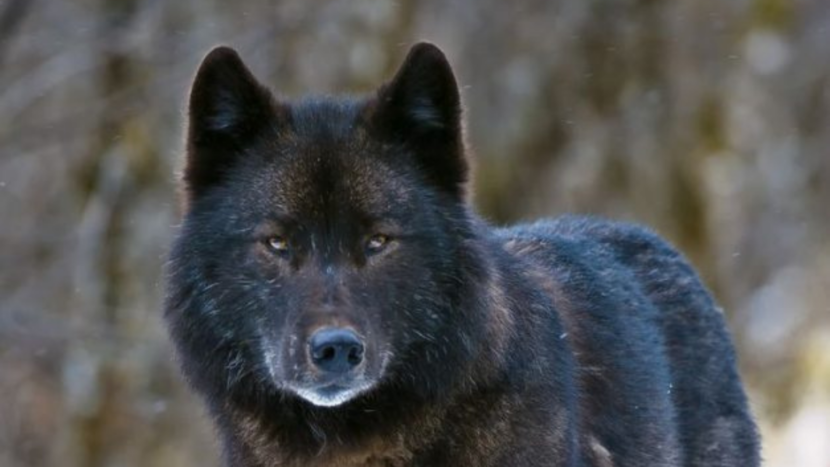
An undated photo of an Alexander Archipelago wolf in Southeast Alaska. (Photo courtesy of Robin Silver/Center for Biological Diversity)
An estimate of Prince of Wales Island’s wolf population is complete and in the hands of state and federal wildlife managers. But officials refused this week to share their numbers with a regional council tasked with making key decisions on hunting and trapping on federal land. This comes as a petition is pending to list Southeast’s wolves as a threatened species.
State officials told the Southeast Alaska Subsistence Regional Advisory Council — which has a record of supporting the state’s wolf management — that there will be an open season for wolves on Prince of Wales Island.
But hard limits on harvesting wolves were eliminated last year. And that allowed hunters and trappers to redouble their efforts and take a record 165 wolves on and around Prince of Wales Island — nearly as many as the state’s 2018 estimate of the island’s total wolf population.
That’s led conservationists to cry foul and ask that this winter’s wolf season be cancelled. Hunters say the wolf population is healthy and blame the predator for keeping down the deer herds. Another view is that deer habitat has been lost to commercial clear cuts, especially on Prince of Wales.
But before any decision on the wolf hunt is announced, the state and feds need to release their 2019 population estimate to justify their strategy. That was supposed to happen last month. But state officials have blamed COVID-19 for delays in completing laboratory and field work.
Fast forward to Tuesday’s subsistence regional advisory council meeting, where members expected to digest the latest 2019 wolf data.
“I’m not going to release a population estimate and we don’t have a specific plan for the trapping season,” Regional Wildlife Supervisor Tom Schumacher of the Alaska Department of Fish and Game told the council on Tuesday. He says that data wouldn’t be released until the details of the upcoming wolf season were finalized by his agency and the U.S. Forest Service.
“What I can tell you is that the 2019 fall estimate is higher than 2018,” Schumacher continued. “And there will be a trapping season. And that trapping season will be shorter than it was last year.”
That withholding of data didn’t sit well with members of the council.
“I’m a little unclear on the population estimate, because if that’s a piece of data and it’s final, we want to hear it,” said Bob Schroeder, a member of the council from Juneau. “I can understand how releasing a management plan depends on negotiations and agreement with Forest Service, but a piece of data — we need to see it.”
The state has provided that information in the past. But that hasn’t happened this year. And won’t happen until the length of the wolf season is announced, Schumacher said.
“Given the controversy surrounding this population — the population estimate, the management strategy and the context in which those fall; it’s all part of the same thing,” Schumacher said. “At this point, the department is not comfortable releasing that number. So I’m not going to do that today.”
A public records request for last year’s wolf estimate filed by CoastAlaska early Thursday is pending.
It’s the third such petition since the 1990s. But Schumacher told the council on Tuesday that the U.S. Fish and Wildlife Service is considering it, with a decision expected early next year.
“Our people at headquarters who deal with Endangered Species Act matters on a regular basis tell me that the bar for accepting a petition is relatively low,” Schumacher said. “And they think that Fish and Wildlife Service will accept that petition.”
He says the federal government could list the grey wolf subspecies as threatened.
“If they make that determination, that has some pretty serious implications,” Schumacher said.
In other words, no state or federal hunting or trapping season for Southeast’s wolves. And subsistence would be regulated by a different division of the Fish and Wildlife Service that manages hunting and trapping more conservatively.
Reached during a break in the council’s meeting on Thursday, regional advisory council chair Don Hernandez says the state agency still hasn’t shared its wolf population estimate with the council.
“We want to see a well-managed wolf population that, you know, allows for hunting and trapping, if the population numbers justify it,” he told CoastAlaska.
The Point Baker resident of Prince of Wales Island says the subsistence council had supported the state’s wolf strategy. But they’re supposed to take input from regional councils, which are in close contact with residents affected by these decisions. Withholding information doesn’t make that possible.
“All these decisions are going to be made in the next few weeks,” Hernandez said. “And we’re meeting now — and we don’t have the information — and they do.”
The advisory council only meets twice a year, with its next meeting tentatively scheduled for March.
Kiley Kanat’s Burton (left) of Cordova and Rev. Traditional Chief Trimble Gilbert (pictured with his wife Mary) of Arctic Village were the keynote speakers for the 2020 Elders and Youth Conference. (Diana Riedel and Crystal Dzehgak Frank / Courtesy of First Alaskans Institute)
This year, the Elders and Youth Conference went virtual for the first time, in response to the COVID-19 pandemic.
This year’s meeting was a little different, conducted mostly through pre-recorded messages and live Zoom calls. However, both keynote addresses highlighted the desire to keep thousands of years of Native culture moving forward, pandemic or not.
The four-day annual meeting seeks to strengthen the bonds between the oldest and youngest generations of Indigenous people, with Alaska Native people from around the state participating.
Speaking over a Zoom call, Arctic Village elder Rev. Traditional Chief Trimble Gilbert, who is Gwich’in, spoke of lessons he’d learned from elders throughout his life. In his roughly 35-minute keynote, he touched on his love of Native food, the importance of being prepared for winter and the importance of keeping Native languages alive.
He says it is vital to make sure that younger Alaska Natives can continue to experience their cultures and ways of life.
“We are very lucky to have all the resources we have in Alaska, but this summer there’s no fish in the Yukon,” Gilbert said. “Slowly, we get into a lot of change. I know it, since the last maybe two years.”
This year’s commercial salmon runs in the Yukon River, Kotzebue and Bering Straits regions were all considerably lower than in past years. While there’s no definitive reason why, some have speculated it may be due to a warming Arctic climate.
Additionally, Gilbert discussed the importance of safety in the face of the pandemic.
“I hope young people listen to me when you go home, a lot of them going to cities,” Gilbert said. “We need you for the future. Make sure you take care of yourself. Wash your hands.”
Gilbert says he’s eager for the day when the virus blows over.
“So we want someday, hopefully, we might get together again to talk to each other face to face,” Gilbert said.
While the Elder keynote address focused on passing down traditional knowledge, the Youth address took aim at blood quantum. Blood quantum is an imposed standard of measuring “Indian blood,” often used to denote whether someone is eligible for tribal enrollment. Some tribes and federal agencies use blood quantum to also determine eligibility to participate in some cultural activities.
Fifteen-year-old Kiley Kanat’s Burton is Eyak, Aleut, Inupiaq and Koyukon Athabascan and is from Cordova.
Since she was 5, she grew up beading and sewing seal skin, learning from her mother and aunt. However, under some blood quantum standards, Burton says she’s less than a quarter Native and unable to participate in some cultural activities.
“Many members of the Alaska Native community are deeply concerned with the growing numbers of young tribal members who are unable to hunt or utilize marine mammals,” Burton said. “Hunting marine mammals, proper hide preparation and skin sewing are essential components to Alaska Native culture.”
The Marine Mammal Protection Act limits hunting and harvesting of marine mammals to only Indigenous people with at least one-quarter Native blood quantum. Additionally, most regional shareholder corporations require a one-quarter blood quantum to enroll and receive shares.
There are estimates that roughly 60 percent of Alaska Natives living in and around the Gulf of Alaska don’t meet that criteria. Burton says that she’s worried for the future for herself and other Native descendants.
“With blood quantum still used as an identifier of Native people, they will one day lose their status and recognition,” Burton said. “The moment when tribal members are no longer Native enough, based on colonial tactics that were used to assimilate, is the moment Indigenous people are bred out of existence.”
Burton ended her speech by urging others to speak out against regulations that limit who can identify as Native. For her part, she says she plans on educating her children one day about where they came from.
The 37th Annual Elders and Youth Conference will wrap up on Wednesday with the reading and passing of several resolutions. This year’s Alaska Federation of Natives Convention will take place starting Thursday, and is also virtual this year.
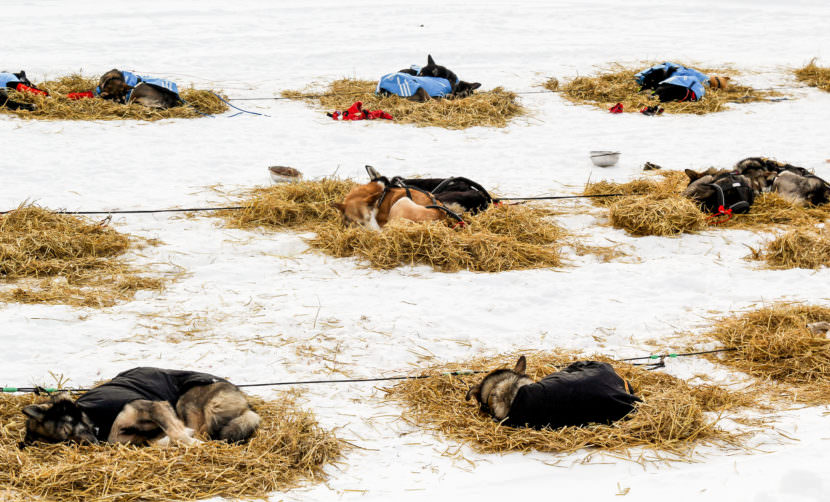
Sled dogs belonging to Pete Kaiser, Ray Redington, Jr, and Jason Mackey rest at Galena during the Iditarod. (Photo by Zachariah Hughes/Alaska Public Media)
It takes about 4,000 salmon to feed all of the dogs in Pat Moore’s dog yard. He mixes it up a little with kibble and red meat, but mostly salmon fills his dogs’ bellies.
But the weak king and chum salmon runs this year compelled the Alaska Department of Fish and Game to halt subsistence fishing entirely in some parts of the Yukon River. That left many mushers, like Moore, without their main source of dog food.
Moore is one of perhaps nine mushers who live in the Yukon River village of Tanana — but he’s not sure how many of them can keep it up.
“After this is all over, it won’t be nine,” he said.
Moore has about 20 dogs in his yard. He was trying to sell most of them when the coronavirus pandemic shut down interstate travel in March.
“I’ve got no market in the lower 48,” Moore said. “And nobody in Alaska wants to take a chance on them because they don’t know when the next race is going to be. So I’ve got plenty race dogs.”
Gerald Alexander is a musher in Fort Yukon. He says he’s feeding his dogs mostly dry food, which is expensive to ship to Alaska bush communities off the road system.
“It costs so much for a bag of friskies,” he said. “Actually 32 pounds for $60 dollars a bag.”
Alexander, who is a member of the Yukon River Inter-Tribal Fish commission, reached out to its director for help.
That director, Stephanie Quinn Davidson, says Yukon River communities rely on two types of salmon for their food: the kings and the chums. But communities have turned more to chum salmon over the years as king salmon runs have dwindled.
“Now the fall chum didn’t come in at all,” Davidson says. “And there’s been no fishing.”
Davidson says these are the lowest harvest numbers in a long time.
“You know, we have a situation where subsistence harvests are probably the lowest they’ve been in two decades.”
Davidson pleaded for help for the mushers through Twitter earlier this month.
Looking for a major assist from dog food companies: We have many dog teams on the Yukon River that won't have enough food this winter due to the very poor salmon returns. Their owners are facing difficult decisions and I'm hoping to to round up some help. 1/
“So I’ve been really surprised at the response that we’ve gotten, she said. “I don’t even know how many times now I’ve had professional identified mushers reach out to me and say, we want to help you, you know, we’ll put you in touch with the dog food companies that that we use.”
But so far, only one dog food company is actively figuring out how to ship dog food to Yukon River mushers. Davidson hopes for more.
Pat Moore says the dog food shortage could kill mushing altogether in Tanana.
“A lot of us are kind of long in the tooth. And this is gonna be the final nail in the coffin, I think.”
Moore says he has enough food to make it through December — three months away. But soon he and other mushers will have to make tough choices about the futures of their dogs.
Close
Update notification options
Subscribe to notifications
Subscribe
Get notifications about news related to the topics you care about. You can unsubscribe anytime.