Subsistence

Dead whales wash up near Unalaska, but pandemic complicates necropsies

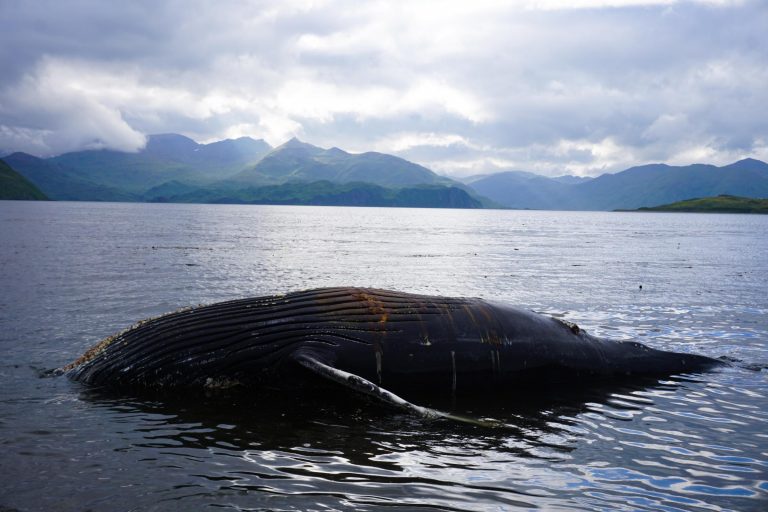
A juvenile humpback whale was spotted in Unalaska Bay on Sunday night. Alaska Sea Grant biologist Melissa Good took tissue samples, but was unable to perform a full necropsy. (Hope McKenney/KUCB)

Two dead whales have washed up on Unalaska’s shores in the past week: an adult fin whale — which is the second largest mammal in the world — and a juvenile humpback.

While local biologists hoped to determine the cause of deaths of both whales, they likely won’t be able to because of COVID-19.

That’s because it takes a large team of individuals to do a whale necropsy — or animal autopsy — which would make protecting public health and adhering to social distancing requirements impossible, according to Melissa Good, the local marine advisory agent with Alaska Sea Grant.

“Human safety is always the number one priority,” Good said. “Other places have difficulties with doing necropsies, whether the animal floats into a remote area or there’s bears in the area — you’re always putting human safety first and then going, ‘okay, can we get a sample after that?’ Right now, it happens to be that COVID-19 is at the forefront of all of our minds. And it’s something that we all need to be cognizant about, and continue to protect ourselves and the community. So we just can’t take those risks.”

Unalaska typically sees about one dead whale wash up on its shores every year, according to Good. When that happens, a team of biologists often perform a necropsy to determine the cause of its death.

But when the dead fin whale showed up floating in the waters of Captains Bay near Westward Seafoods on Friday, and a juvenile humpback washed up on the shores of Unalaska Bay on Monday, Good said biologists were unable to do the necropsies because COVID-19 prevented a large enough team from coming together to perform the task.

Good said that, with support from the Alaska Department of Fish and Game and NOAA Office of Law Enforcement, she was able to collect skin, blubber, and muscle samples from both whales, as well as some fluid from the juvenile humpback’s eye, to send to the state pathologist.

“We weren’t able to do a full necropsy,” she said. “I was able to take a tissue sample [of] skin and blubber, and we’ll be able to look at the skin and get DNA work off of that, and you can get some toxins from the blubber. So we’ll have a small bit of information on the whale.”

Good said the biologists looked for signs of human interaction with both baleen whales that would indicate human involvement in their deaths. But, she said, they didn’t see any fishing lines wrapped around them or any obvious signs of scarring or cut marks due to an entanglement.

“We could have missed something because we couldn’t see the whole body. But there wasn’t really anything obvious right up front,” Good said. “That certainly doesn’t eliminate other human interactions like vessel strikes or anything like that. But we just weren’t able to get that close of a picture of it.”

The juvenile humpback did have a small 5-inch rupture along its throat region, Good added. She said she’s not sure if the rupture was caused by gas buildup as the whale decomposed, or whether it was caused by human interaction, like a vessel impact.

Although they chose not to in these cases, the Qawalangin Tribe often harvests meat and blubber from whales that wash up on shore, which Good said could have provided a great opportunity to get samples to see if paralytic shellfish poisoning or other toxins were a factor in the whales’ deaths.

“We could have gone in with a very small team and possibly gotten some samples that could have been telling,” she said. “I would have been really interested in fecal samples or urine or stomach samples to see if PSP was an issue in this case. That would have been some information we would have looked for and sought after, but we just didn’t have that opportunity.”

In July, Alaska state and local health officials started warning of dangerously high levels of toxins in shellfish after a person died of PSP from mussels and snails in Unalaska. And, Good said, larger mammals like whales can die from ingesting algal toxins.

She said she would have some concerns about people harvesting these two whales for subsistence because they don’t know when or how they died. And, she added, because they were unable to perform necropsies, they probably never will.

Good considered it a missed opportunity. While a dead humpback generally washes ashore once a year, she said she hasn’t seen a dead fin whale in Unalaska since she took her position with Alaska Sea Grant six years ago. Although Unalaska is within their natural range, she said fin whales tend to stay offshore and don’t generally come into the bay.
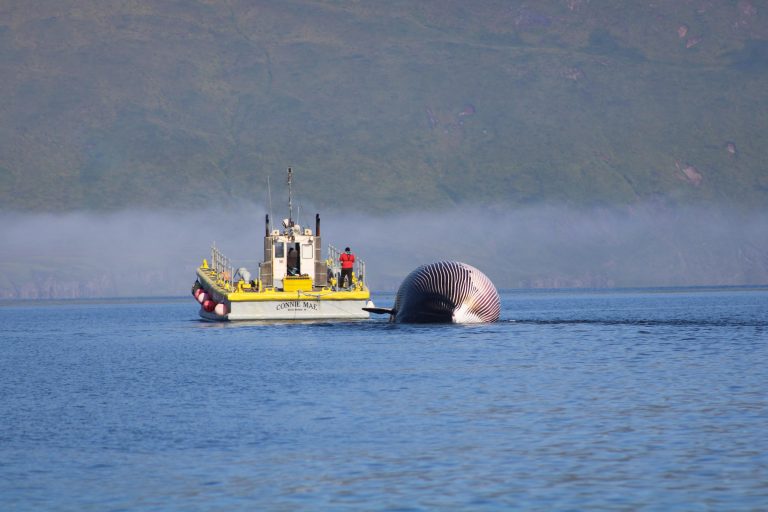
The fin whale was towed to Wide Bay after biologists took blubber and skin samples to send to the state pathologist. (Maggie Nelson/KUCB)

“Outside of COVID times, we could have flown in a very experienced veterinarian team that would really help us get down and make sure we’re collecting the right samples,” Good said. “And I know there’s a lot of willing people here in the community that would step in and help out with the necropsies — the Qawalangin Tribe would certainly step in and help with that. And so we have the people here that can do it, and it’s definitely a missed opportunity. But no matter what we do, human safety is always the number one priority.”

Although this marks two dead whales washing up in Unalaska in the past week, Good said she can’t speculate if the two deaths are related.

According to the state pathologist, they will process the samples from the two dead whales to confirm things like species and sex, but they will likely be unable to determine cause of death without a necropsy.
Tribal groups question state’s lawsuit over pandemic hunting requests

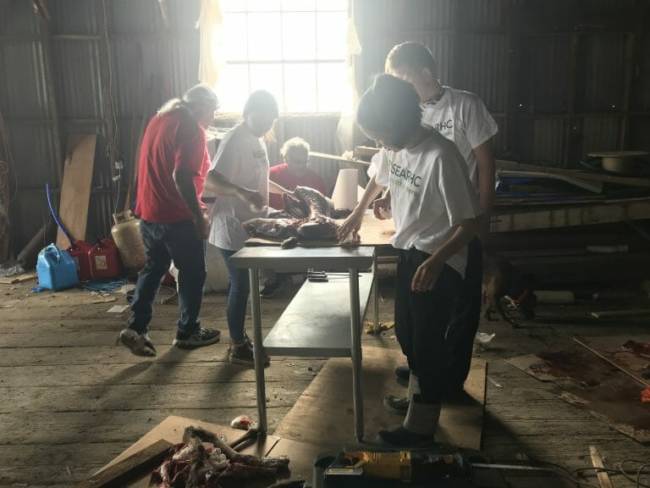
Kake Youth Conservation Corps (YCC) help butcher one of five deer obtained under the emergency season
Kake Youth Conservation Corps help butcher one of five deer obtained under the emergency season. (Photo courtesy of the Organized Village of Kake)

Alaska tribal governments and organizations are asking the State of Alaska to withdraw a lawsuit filed recently in federal court. The lawsuit alleges the federal Office of Subsistence Management overstepped its authority when it granted the Organized Village of Kake a special hunting action during the pandemic. 

Richard Peterson, the President of Central Council Tlingit and Haida Indian Tribes of Alaska, says he wasn’t surprised by the state’s lawsuit, but he was disappointed. 

“I think our state should have better things to do right now than sue its own people and communities during a time of the pandemic,” he said.

Over the summer, the federal Office of Subsistence Management granted Kake’s request. The community was able to harvest up to two moose and five male Sitka black-tailed deer. But the Alaska Department of Fish & Game Commissioner didn’t think that was warranted. A state emergency command unit deemed there wasn’t a food security issue. However, Kake’s Tribal President maintained it wasn’t just about food scarcity. It was about the health of village Elders and having access to culturally nourishing food during the pandemic. 

The joint-statement issued by President Peterson and other tribal leaders calls the state’s lawsuit “a disgraceful continuation of outdated, exclusionary, racist management practices.” 

“They should be working with us,” Peterson said. “They should’ve been applauding a community, a tribe providing for a community during this time.”

In an emailed statement, the Alaska Fish & Game Commissioner Doug Vincent-Lang said, “The State of Alaska is not opposed to the indigenous way of life of native Alaskans.” The agency will continue to pursue the lawsuit because they believe recent decisions are illegal under federal policy.

According to the federal Office of Subsistence Management, 12 special action hunting or fishing requests have been made across Alaska since the start of the pandemic. 

The Federal Subsistence Board OK’d an emergency hunt in Kake. Now it faces legal challenges.

Kake residents and Elders process moose meat to be distributed to the community
Kake residents and elders process moose to be distributed among the community. (Photo courtesy of the Organized Village of Kake)

The State of Alaska is filing a lawsuit in federal court alleging the U.S. Office of Subsistence Management has overstepped its authority. 

Over the summer, the federal agency restricted one hunting area in the Interior to only local subsistence users, citing public safety concerns. It also granted permission to the Organized Village of Kake to hunt out of season during the pandemic

Alaska Department of Fish & Game Commissioner Doug Vincent-Lang says the state fundamentally supports subsistence activities, but it objects to how the subsistence board is following bedrock law — namely the Alaska National Interest Lands Conservation Act, which suggests the federal agency should cooperate with the state. 

“In the last six months, we’ve seen a rapid diversion from that, actually going well beyond what we feel are their legal authorities,” Vincent-Lang said. “So, we thought it was the proper time to challenge those.”

This isn’t the first time the state has conflicted with the federal agency over whose hunting and fishing needs should be prioritized. The state contested a decades-long case regarding subsistence fishing rights along the Copper River.

As the pandemic played out, rural residents became increasingly concerned over disruptions to the food supply chain. The federal Office of Subsistence Management received at least six requests to hunt or fish out of season. 

Vincent-Lang says the state had an agreement with the federal subsistence board. They were supposed to ask the State of Alaska if food shortages existed. A state emergency command unit determined that wasn’t an issue. However, the Office of Subsistence Management still granted Kake’s request

Vincent-Lang thinks that wasn’t justified. 

“We believe it’s time to allow the state to be the principal manager of subsistence in these areas,” he said.

Throughout the ordeal, tribal government leaders said the special action request wasn’t just about food scarcity. It was about the overall health of village elders and having access to traditional foods during a pandemic. 

Kake was able to harvest up to two moose and five male Sitka black-tailed deer, which were distributed to the community. 

The state is asking for the Office of Subsistence Management to immediately halt its first order and to no longer grant special hunting requests under these circumstances. 

After moving to new village, Mertarvik residents say they are living healthier, more traditional lives

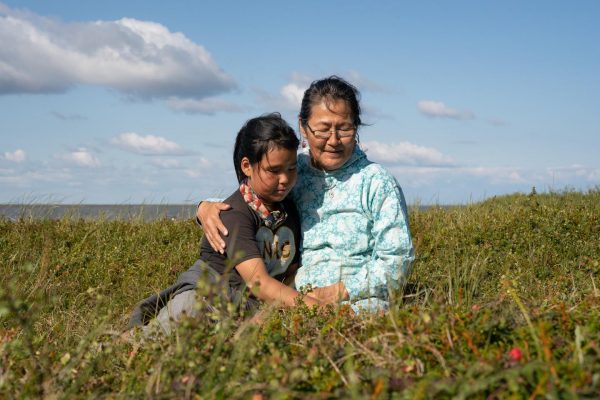
Lena Ayuluk and her grandmother, Albertina Charles, sit surrounded by berries and Labrador tea behind Charles’ home in Mertarvik, Alaska. (Katie Basile/KYUK)

It’s been almost a year since a third of Newtok’s residents moved away from their eroding village. Nine miles away in Mertarvik, they’ve gained more than just stable ground. Many say that they are healthier and living a more traditional Yup’ik lifestyle.

A slight breeze blows in Mertarvik most days, carrying fresh air from the Bering Sea. Catherine Charles, who moved here last October, says that her kids are breathing easier.

“When we were in Newtok, seems like their lungs were always chunky or we could hear them; there’s something in their lungs,” Catherine said. “But ever since we moved here, they hardly get sick.”

Catherine says that’s because the air is better in Mertarvik, both indoors and outdoors.

“My house in Newtok really had bad molding problem,” Catherine said.

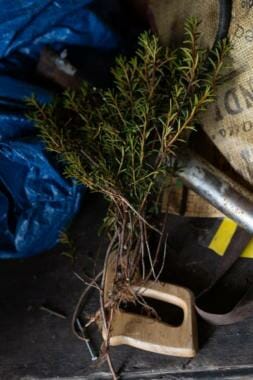
The scent of ayuq, or Labrador tea, fills the air in Mertarvik. The plant is harvested and brewed for its health benefits by many people in the community. July 14, 2020 in Mertarvik, Alaska. (Katie Basile/KYUK)

Mold is common in Newtok homes. As the permafrost thaws, the entire village sinks, with flooding an expected event in both spring and fall. Tribal Administrator Andrew John says that the air quality in Newtok is bad outdoors because people dump their honey buckets right next to town.

“That stench,” Andrew said. “From the raw sewage that people have nowhere else to dump but the river. And when the sun starts baking and all those fumes get in the air, everybody smells it.”

In Mertarvik, low-flush toilets keep the smell of sewage out of the air. Instead, the piney scent of Labrador tea flows from the hillside into every yard. Albertina Charles says the plant has medicinal properties.

“That’s why we barely get sick, cause of the Labrador tea,” Albertina said.

She says that the tundra is not just good for your lungs, it’s good for your soul.

In Newtok, if you step off the boardwalk, the mud sucks you in. But at Albertina’s new home, whenever she feels sad she steps onto the solid tundra, and her sadness fades away.

“No more hurt,” Albertina said. “Tundra have healings.”

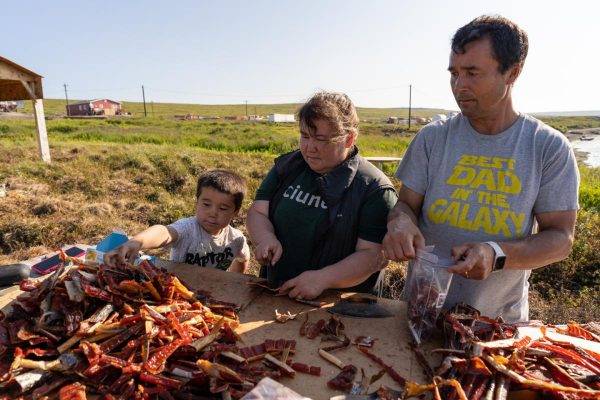
Jeffrey Charles Jr. grabs a quick snack while his parents, Lisa and Jeffrey Charles, cut strips near their smoke house in Mertarvik, Alaska. Lisa says that limited access to a grocery store has them eating more subsistence foods. July 15, 2020. (Katie Basile/KYUK)

People’s diets have changed in Mertarvik too, according to Lisa Charles.

“Since we moved over here, we’ve started eating a lot more subsistence food since we don’t have access to a store,” Lisa said.

There is a store in Mertarvik, but with no commercial airport it has been sparsely stocked. So without groceries, Lisa says, people in Mertarvik are eating more seal, moose, halibut and salmon. She says some of her friends have lost weight, and she’s noticed other benefits too.

“I think we’ve had more energy and improved mood,” Lisa said.

There’s also better access to subsistence activities in Mertarvik. Due to the eroded banks in Newtok, people have a short window during high tide to get on the river. Otherwise they are surrounded by mud. Tribal Administrator Andrew John says that this year, some families are suffering as a result.

Teddy Tom is building his dream maqii, which he says will feature a large porch so he can walk around as he cools off. (Greg Kim/KYUK)

“There’s a lot of families that haven’t had the opportunity to fill their fish racks completely to prepare for the oncoming winter,” John said.

In Mertarvik, people can get on the river any time of day.

Outside his new home, Teddy Tom is building his dream maqii, or steamhouse. In Mertarvik, he can be on the river whenever he wants. And he can explore because he isn’t trapped in the village by un-navigable mud.

Tom is one of the Newtok Village Council members. He says that they are all trying their best to get the entire village moved over so that they can all begin their new lives in Mertarvik together.

“At the new site we are living more in new lifestyle, what we used to do when I was young,” he said. “I’m showing it to my sons.”

The Newtok Village Council invited KYUK to see how people are living in the new village. Before traveling, KYUK reporters consulted with medical professionals and received negative COVID-19 test results. While in the village, reporters wore masks when invited into peoples’ homes.

Scientists say Sitka herring is on the rebound, while subsistence users remain skeptical

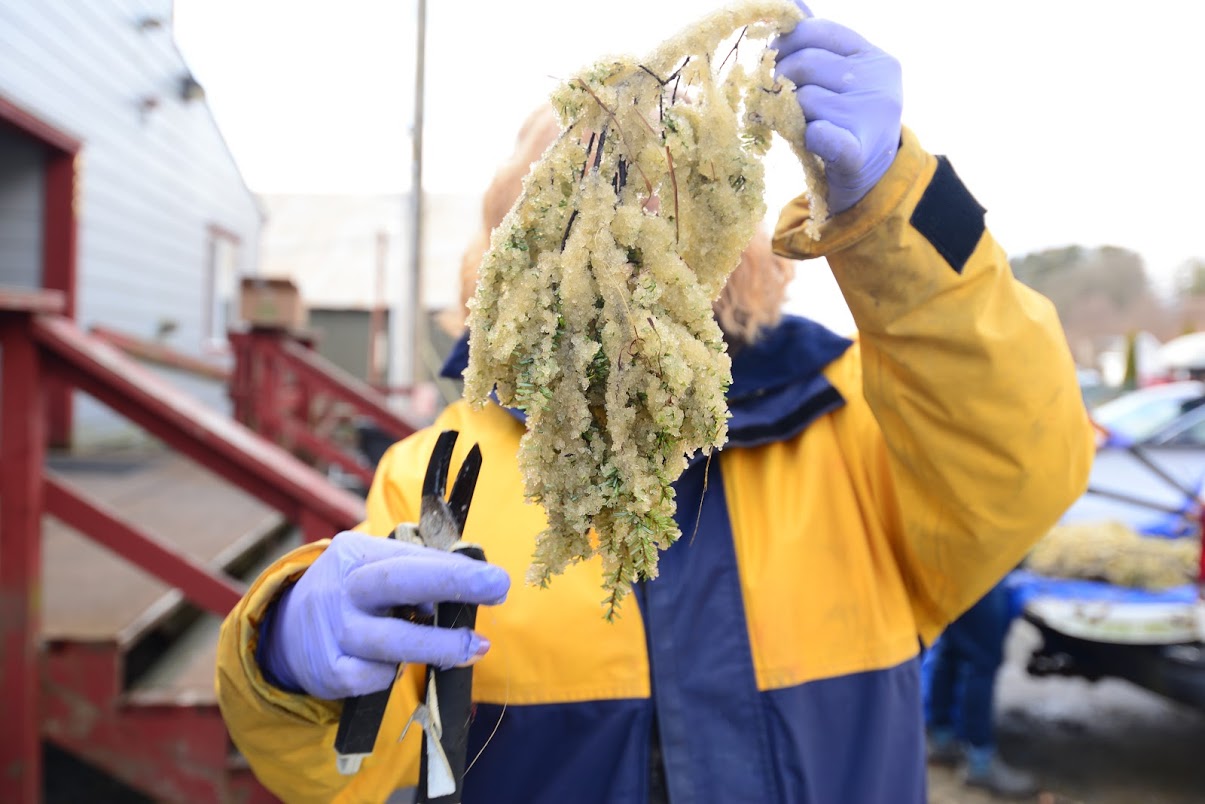
A person holding up herring eggs
Pulled out of the ocean by Sitka Tribe’s Resource Protection staff, herring eggs are bagged and delivered to elders and tribal citizens by drive-through pick-up. Sitka, Alaska. April 9, 2020. (Berett Wilber / KCAW)

After two seasons without a commercial fishery, herring stocks in Sitka Sound are on the rebound, according to state scientists tracking the data. But subsistence users are skeptical: What herring there are in the Sound seem to be both thinly distributed and moving farther out of reach, suggesting that stocks remain stressed.

Sitka’s commercial herring fishery never opened this past spring, and several factors contributed. In an industry where size matters, the fish were too young and too small for seafood markets in Asia. By early March, most processors had decided that a fishery wouldn’t pencil out. Then, the global coronavirus pandemic disrupted markets completely, ending any possibility that there would be a harvest.

Nevertheless, state biologists believe the herring biomass is rebounding.

“We ended up with twice the number of eggs we had in 2018. And that’s just an absolute humongous jump in the number of eggs,” said Sherri Dressel, a biologist for the Alaska Department of Fish and Game.

She says that surveys in 2019 suggested large increases in the number of eggs and fish. That year, just over three-quarters of the fish in Sitka were three-year-olds — still too small to attract seafood buyers, but a good indicator that subsequent years would be better. Dressel says 2020 brought some improvement in the stock — just not enough.

“Our forecast biomass was primarily age four fish. And the average weight of the population was about 97 grams,” Dressel said. “This year, market-wise, I think that they were looking for an average of about 110 [grams]. It was just pretty unlikely they would have gotten it, that’s why they chose to stand down this year.”

Pacific herring mature early, and spawn every year into their mid-teens. Although stocks are on the young side, Dressel says communities around Sitka saw dense spawns in 2020: Craig, for example, had record spawn this year, and Sitka’s miles of spawn were higher than average.

“The spawn on Kruzof was one of the overall highest densities that the divers have ever seen,” Dressel said.

Even so, she says it’s important to be conservative. Although the Sitka herring fishery was non-existent the last two seasons, the 2018 season was a near-disaster, with fishermen falling far short of the state’s guideline harvest level.

“I think the last couple of years have helped the herring specifically, but it would probably take another maybe eight years or more of the same before we could even say that we’re safely getting close to where we should allow any type of [commercial] harvesting again,” said Tom Gamble, a subsistence harvester and former Tribal Councilmember.

“That is no longer a large spawning biomass when the bulk of your age class that is supposed to be spawning biomass is really small,” he said.

He’s one of many critics of the state’s management of the fishery who has been calling for the state to change its management model for years. He believes that the state’s failure to do so has had ripple effects throughout the ecosystem. Where the state saw spawn this year, he often saw spawn too, but it wasn’t always in large volume, and the absence of large amounts of predators near Sitka was concerning.

“Where we used to hear those gulls crying from Seamart,” he said, “You couldn’t tell that herring had ever come in or out of the sound from the Sitka shore.”

Dressel agrees that, though they did record a little spawn near Sitka at the end of the 2020 cycle, the absence of spawn near town over the last few seasons, typically full of spawning hot spots, is very unusual.

And rather than blanketing the inner islands and shoreline of Sitka with spawn, fish have been moving to more remote areas, even showing up on the outside of Kruzof Island for the first time in over 20 years.

While some subsistence harvesters did well this year, Gamble says that the unusual spawn patterns makes things far more challenging than in the past.

“Eighteen miles on a Kruzof shoreline away for most of our harvesters in Sitka Tribe or subsistence gatherers in general from Sitka in general don’t have the means to travel [that far] by boat that small,” Gamble said.

And just as the pandemic played a role in halting the commercial fishery, Gamble says the coronavirus affected the day to day operations of subsistence harvesters. Some businesses were closed, so getting gear and gas was challenging. Businesses that were open weren’t taking cash — a significant hurdle for small cash-only businesses like Gamble’s. And travel was grinding to a halt, making it harder to distribute boxes of eggs.

“Honestly it was a pretty frantic time as I recall,” Gamble said. “Airplanes were shutting down…typically our family would be coming and going, taking their boxes with them, so outreach and everything else changed quite a bit.”

Even with poor market conditions and coronavirus concerns, some commercial fisheries in Alaska still happened. In Togiak, the biggest purse-seine fishery in Alaska, only one processor bought fish, even though the quota was huge, set at around 80 Million pounds, many fishermen didn’t participate due to poor market conditions.

Icicle Seafoods set up a floating processor, in an attempt to reduce community exposure to the coronavirus. Even though they were able to make the fishery happen, we don’t know much about the catch in Togiak. In mid-June, Alaska fish and game announced it would keep data from May’s fishery confidential due to low participation.

As much as the state knows about herring stocks, the forecast for 2021 involves many factors — any combination of which could lead people to different conclusions about Sitka’s herring. But biologist Sherri Dressel is genuinely optimistic about the future health of the population.

“If you put all of the details aside- whether we’ve got a commercial harvest, where the spawn is, how that works for subsistence, all of those are really important concerns. And how you tease that out, different people will come to different conclusions on what this has meant,” she said. “From somebody who works with the population, the fact that we’ve got a humongous year class throughout the gulf can only be good.”

Tom Gamble, for his part, says his goal has never been to shut down the commercial fishery. Like the Sitka Tribe of Alaska, which is actively litigating the issue in court, he wants it to be managed sustainably so the fish one day thrive again.

“Sitka Tribe and the state, while they try to decide who’s right or who’s wrong, the herring don’t have a voice,” he said.

But if they did, they might ask if there will be a home for them in Sitka Sound in the future.

It’s not just people who need to worry about getting sick from eating shellfish; pets can get PSP too

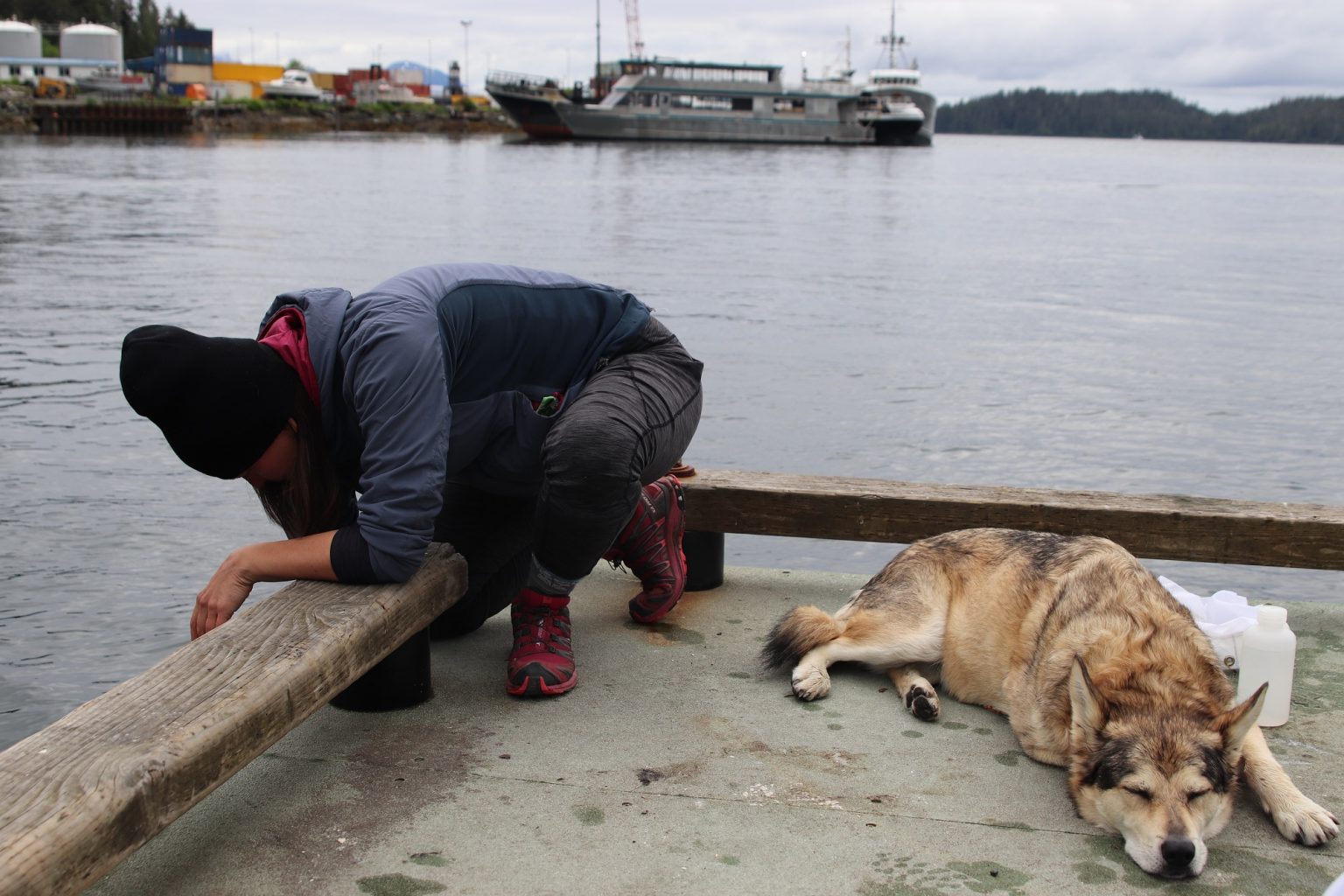
EnviroNaomi Bargmann conducts tests at the Starrigavan Dock in Sitka while her dog Chickie sleeps beside her.
Sitka Tribe of Alaska Environmental Lab Specialist Naomi Bargmann conducts tests at the Starrigavan Dock while her dog Chickie sleeps beside her. (Erin McKinstry/KCAW)

Most coastal residents have heard about Paralytic Shellfish Poisoning and the dangers that it poses to humans. But it’s not just people that can get sick or even die from eating toxic mussels, clams or other shellfish. Pet owners need to watch out for their pups too.

Naomi Bargmann leans over the edge of the Starrigavan dock to dip a frosted plastic bottle attached to a net into the cold waters of Sitka Sound with her dog Chickie lounging on the dock beside her.

“Chickie’s not very good at helping,” she said.

She’s doing something called a plankton tow. Her lab conducts one once a week to get a snapshot of what’s going on with the water’s microscopic life.

“So, the most important thing is make sure you don’t lose the bottle,” she said. “Make sure it’s screwed on tightly. Throw it in the water. Try to get the water in the bottle until sinks. Do that again. Then one more time. And then we’re gonna let it go to its watery grave at the bottom.”

She then slowly drags the net through the water for three minutes.

Bargmann works as an environmental lab specialist for the Sitka Tribe of Alaska Environmental Research Lab. They opened a lab in 2016 in partnership with Southeast Alaska Tribal Ocean Research to monitor for harmful toxins that cause Paralytic Shellfish Poisoning or PSP. What Bargmann’s doing today helps track harmful algal blooms that can produce those toxins. Blooms can serve as an early warning sign for people who harvest shellfish or pet owners with shellfish-loving dogs.

“Fortunately, we haven’t seen the harmful algal species in high concentrations lately,” she said.

The lab also tests shellfish directly and has a free testing program for Sitkans. Bargmann said around 80 percent of the butter clams they’ve tested since September have been over the FDA limit.

“Butter clams, I like to say that they don’t know how to socially-distance themselves from PSP because once they get high levels of PSP, they tend to hang onto them for months to even years,” Bargmann said.

A dog was recently hospitalized after eating a clam at South Starrigavan Beach. Dr. Toccoa Wolf from Sitka Animal Hospital treated the sick puppy.

“Really the only thing you can do is the tincture of time, supporting them through the toxicity if it’s severe, sometimes that means giving them nausea medication, IV fluids, warming their temperature up. And monitoring their heart rate because it can cause a very fast heart rate,” Wolf said.

Dr. Wolf started practicing in Sitka last August. Since then, she’s heard of about four suspected cases from other vets in town. But this is the only one she’s treated here where the dog had a known history of eating shellfish. She says most dogs make a full recovery by the next day, including the one she treated.

Initial signs of PSP in a dog include unstable walking, excessive drooling, weakness and vomiting.

“I would say the most important thing is you know not to panic,” she said. “It doesn’t mean your dog can’t take a nice casual walk on the beach. It’s something to be aware of. If you see the signs, it’s good to get to a veterinarian.”

Because it could be something else that needs to be treated. And, even though it’s rare, dogs can die from PSP, just like people.

“But it can progress to muscle paralysis or respiratory depression and there have been reports of pets having to be put on a ventilator to see through it,” Wolf said.

After completing the plankton tow, Naomi Bargmann takes her pup for a walk along North Starrigavan Beach. Recently, the lab found high levels of PSP in a butter clam just south of here, on the other side of the creek: the same place where the dog Dr. Wolf treated got sick. As Chickie roams with her nose to the ground, Bargmann doesn’t keep too close of an eye. She’s not much of a shellfish eater.

“Fortunately for me, I’m not that worried. She eats other disgusting things instead,” she said.

But for dog owners whose pets are into digging up and munching shellfish, the best thing they can do is keep them on a leash at the beach and keep watch for local advisories.

Site notifications
Update notification options
Subscribe to notifications