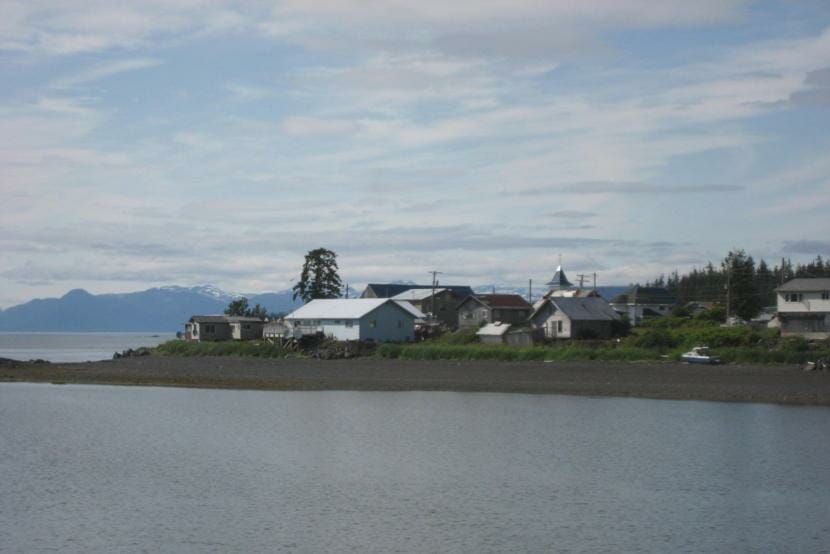
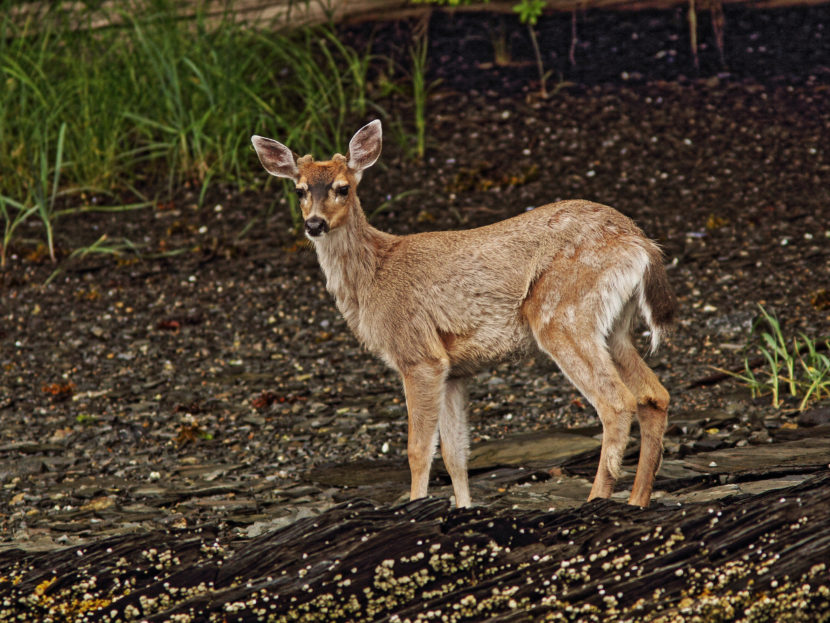
Kake photographed in 2012. (Department of Commerce, Community and Economic Development; Division of Community and Regional Affairs’ Community Photo Library.)
The federal subsistence board approved a special hunting request on Monday that permits the Organized Village of Kake to harvest deer or moose out of season.
The tribal government expressed concern at the beginning of the COVID-19 pandemic that grocery store shelves weren’t fully stocked with items like meat. Kake’s Tribal President also added he was worried about the health of village Elders.
Dave Schmid is the regional forester at the U.S. Forest Service Alaska region. He voted to approve the measure, which passed 7 to 1.
“I would say given the level of food insecurity that you heard from here facing this community, approving this special action — it’s the right thing to do,” he said.
Schmid said that he didn’t foresee any conservation issues related to wildlife population numbers in the vicinity of Kake.
The federal subsistence board has been handling multiple requests across the state. Some communities are worried about the impact of the pandemic on the food supply chain.
Earlier in the month, the agency tried to speed up that process by delegating local land managers to make the call. That process was stalled when a state emergency response group suggested there wasn’t a disruption in the food supply chain.
The Alaska Department of Fish & Game has yet to approve emergency hunting actions on state land.
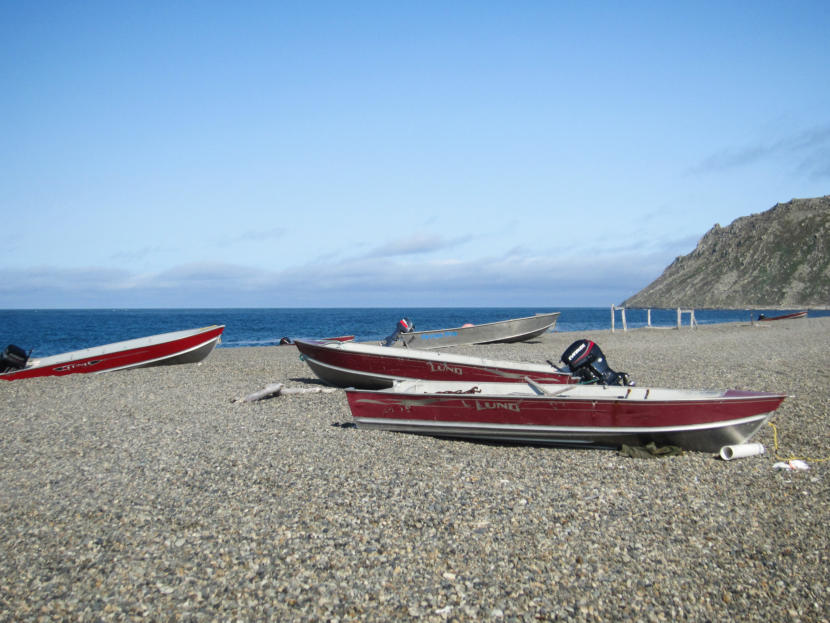
Local hunters’ boats in Gambell in 2017. (Photo by Davis Hovey / KNOM)
Fuel rations have been imposed on all Gambell residents for about a month, after a barge shipment from last year failed to deliver the community’s supply of fuel. The community’s ability to subsistence hunt and stock up on food for the future is being negatively impacted by this fuel shortage.
According to multiple sources, the community’s summer fuel delivery from Crowley could not be unloaded in Gambell last June. City Clerk Charlotte Apatiki said there are a couple reasons why Gambell was left without its yearly supply of fuel, including a leaking fuel line.
“So they (the barge) couldn’t deliver the first run of fuel because of the fuel leak. And then their second attempt was later on in the summer. We were stormy for about a week then or maybe a little over a week, and they couldn’t get to the fuel line over there at north beach to deliver the gas, so they (the barge) just turned back,” she said.
Crowley Fuels was the fuel barge operator trying to unload fuel at Gambell on those occasions. The company is also one of the main fuel providers for many other communities in the Bering Strait region.
The U.S. Army Corps of Engineers has noted that several fuel barge operators say landing a vessel at Gambell is always weather dependent. But residents say the Crowley barge captain could have landed on at least one of the attempts made last year.
After reaching the last of their fuel reserves last month, Gambell’s Native Store, which is owned by the Native Village of Gambell (IRA/Tribal Council), had to put restrictions on resident’s fuel purchases. These make for trying times for Jeremiah Apatiki, the local store manager.
“It’s hard…I have to limit everybody, their ATV. For boating, it’s really hard now because it’s spring time and its boating season and everyone needs their gas. So we limit them now, we limit them [to] two gallons a day per ride and the boat captains (get) 30 gallons for now, per trip,” he said.
For now, Gambell’s Native store has paid for the community to receive three emergency fuel deliveries via airplane at 3,900 gallons a piece, while ANICA is facilitating the delivery. The hope is that these shipments will support Gambell’s needs until this summer’s fuel barge delivery comes in June. Jeremiah Apatiki said their first 3,900-gallons lasted about a week.
Apaitiki said Gambell’s three main entities: the IRA Council, city, and village corporation, were concerned the cost of flying in emergency fuel would gradually get more expensive and wouldn’t last until the next fuel barge arrives.
“(So) they made a resolution to the governor, asking for assistance, requesting that the National Guard bring shipments in so our [fuel] prices wouldn’t rise. ANICA is probably going to raise the price every time they fly a shipment of gasoline in(to Gambell),” she said.
It is unclear what the state’s response will be to Gambell’s emergency situation as a spokesperson for Governor Mike Dunleavy’s office could not be reached for comment. According to a spokesperson with the National Guard, as of this week they have not been involved in any aviation-mission related to delivering fuel to Gambell.
Apatiki said the community restrictions on fuel usage will be in effect until sometime next month, whenever the next fuel barge can unload.
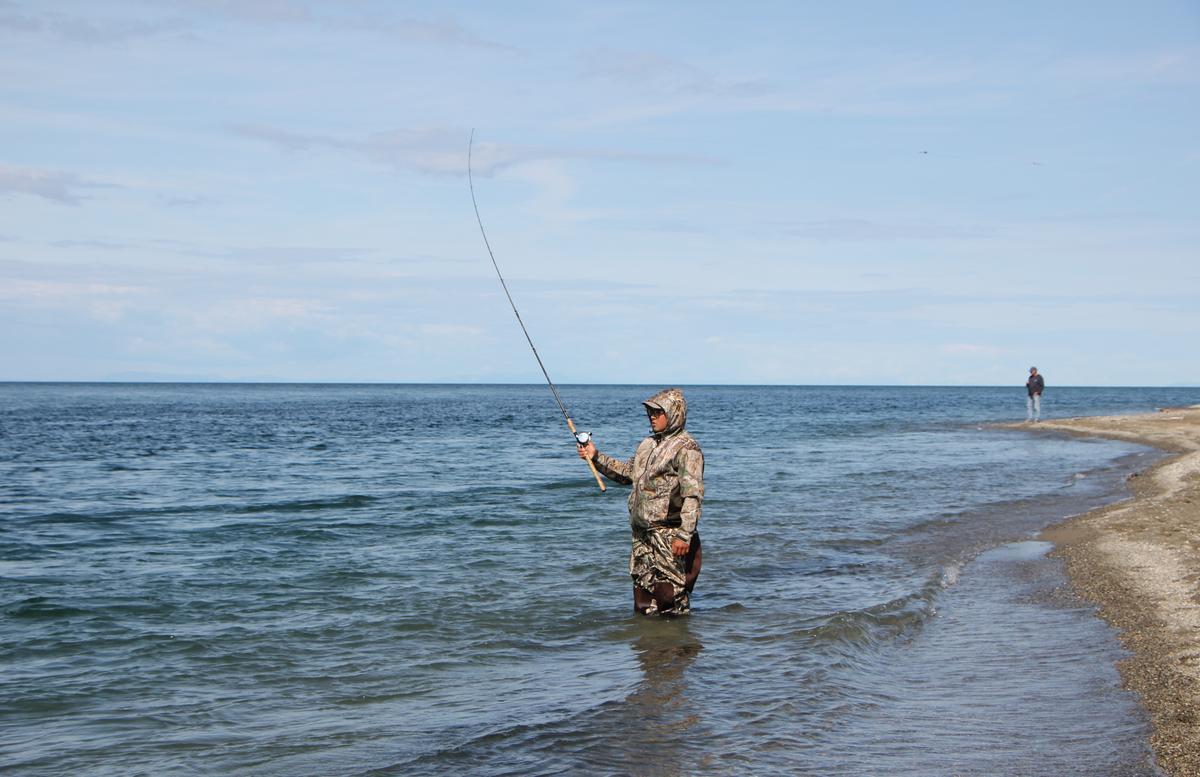
Aiden Salmon fishing at the mouth of the Kvichak River on July 17, 2019. Igiugig normally does business with nearby sport fishing lodges. Now the community is hunkering down to protect against coronavirus. (Photo by Isabelle Ross/KDLG)
Gov. Mike Dunleavy and the Alaska Department of Fish and Game released specific guidelines last week for people who want to sport fish in Alaska.
Sport and personal-use fisheries remain open, and the public may still travel to fishing locations. But guidelines issued by the state aim to eliminate exposure to communities near those destinations. Fishers are required to take precautions like social distancing and wearing masks.
They will also have to bring their own provisions from home to prevent them from going into communities for food or fuel, and must abide by the local mandates of their destination.
Alaska Health and Social Services Commissioner Adam Crum said in a news conference that the state is meeting twice a week with a group consisting of sport and personal-use fishers.
“They’re trying to put together recommendations,” Crum said. “We’ve got members of both our health department team and our industry sustainability group talking with them about what are some of the protocols we can implement — other practices. Some of these things we can look towards to make sure we have some sort of action down there.”
Rick Green, special assistant to the Fish and Game commissioner, said the guidelines were put into place to fulfill subsistence needs for Alaskans.
“This thought was really for Alaskans to have the ability to get out and fill their freezers. With the 14-day quarantine mandate for any out-of-stater coming into Alaska, I don’t think we’re going to see the out-of-staters come in,” he said.
Summer tourism generates important revenue for Bristol Bay communities, like Igiugig. People start traveling to the village in June when lodges open for sport fishing.
The village council met last week to discuss the upcoming season.
“We’ve had lodges calling in and asking, ‘Do we even come out? Should we land and walk directly to the river and drive straight to our lodge with no interactions in the community at all? Or do you just not want us out totally?'” said council member Christina Salmon-Bringhurst. “But we told them as of yesterday, we’re taking this day-by-day because every week it’s something new.”
She said several families who own businesses in the village of around 70 residents also depend on that revenue.
“It would be sad to not have it open here, but at the same time our village council is not going to do anything to compromise the health of anyone here,” she said. “We’re so small that losing one person would be devastating for us. The health of our people is above and beyond anything else at this moment.”
Brian Kraft owns the Alaska Sportsman’s Lodge just south of the village — one of the businesses working with the community. The lodge averages around 500 guests in the summer. Tourists spend between $6,000 and $9,000 for three- or five-day trips, including airfare.
Kraft said the quarantine would have to be lifted for lodges to operate realistically.
“Not many guests come up here for 14 days,” he said. “Quite honestly, if quarantining is still in effect, masks and gloves are required and COVID-19 is still rampant throughout the country and spreading still, that’s not the experience we want to have. We don’t want to subject our clientele, the staff. Or if we have an influx in the community, we don’t want to be a part of that.”
Kraft also owns the Bristol Bay Lodge in Aleknagik. They average around 300 tourists per season.
Another regional lodge owner who asked not to be named is considering closing due to travel restrictions and quarantine requirements.
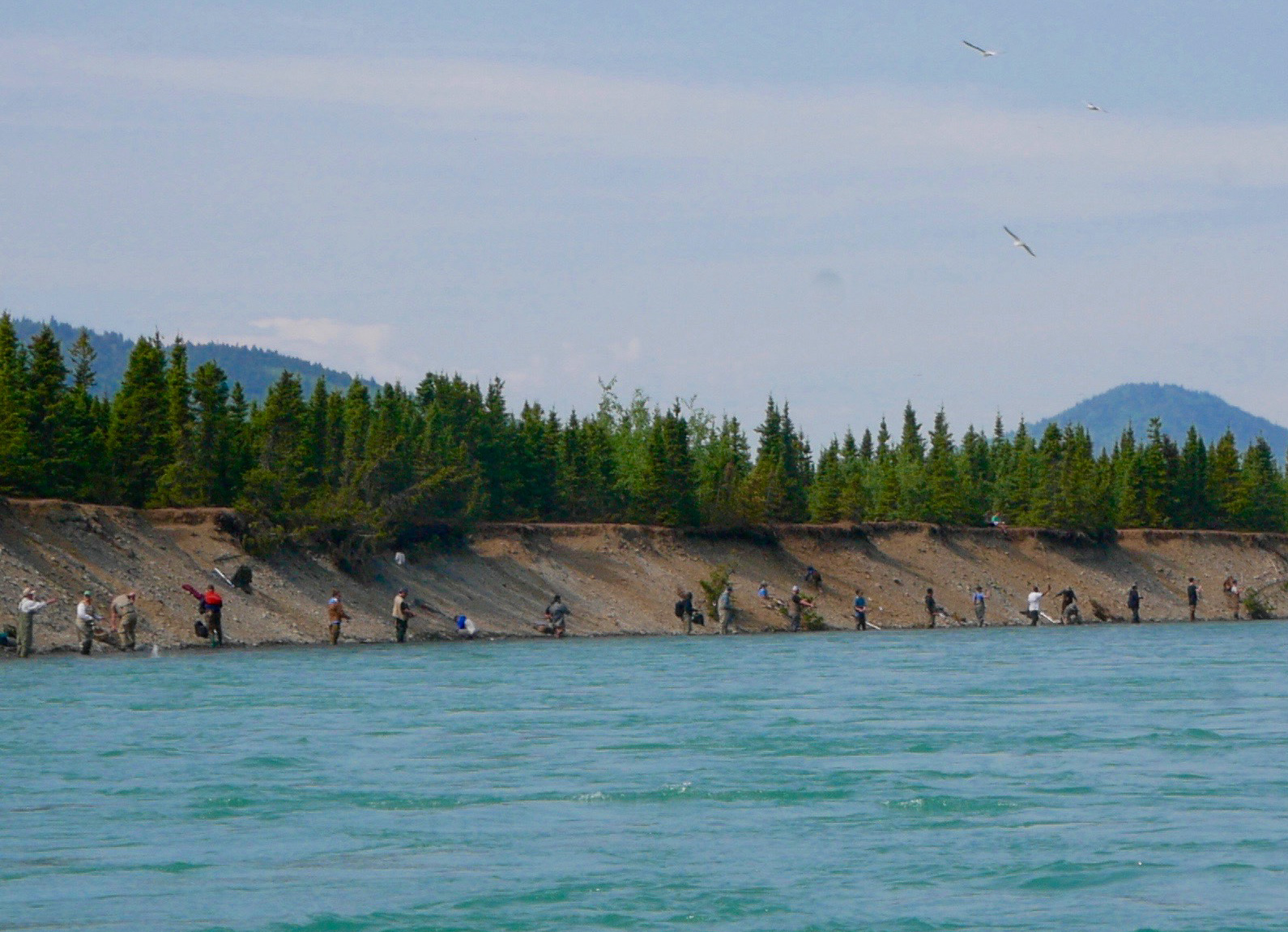
Fishers line the banks of the Russian River in June 2019. (Photo by Abbey Collins/Alaska Public Media)
The COVID-19 pandemic will not prevent Alaskans from fishing this summer.
But residents are being asked to take precautions to prevent the spread of the coronavirus.
“We’re not closing anything,” said Rick Green, special assistant to the commissioner of the Alaska Department of Fish and Game. “Every fishery out there is going to run as they would normally.”
On Monday, Fish and Game released guidelines aimed at allowing Alaskans to participate in sport and personal use fisheries, while following state health mandates.
“We came up with the guidelines of how basically you can get through a community without interacting with the locals to stave off any possibility of spreading of COVID,” said Green.
According to the guidelines, residents should fish as close to home as possible and should not plan on stopping for supplies outside of their home communities. Fish and Game says fishers should know and abide by any local health mandates. While fishing, the department encourages the use of face coverings and says fishers must practice social distancing.
Social distancing could be challenging in popular fishing spots. For instance, when salmon are running the Russian River, a few hours south of Anchorage, fishers historically line the river banks in close proximity to one another.
Green said he’s hopeful Alaskans will adapt if they need to.
“It’s going to be a challenge at the Russian River,” said Green. “There’s no doubt, having 6 feet between them when usually you’re shoulder-to-shoulder. But we could be through this by then, we just don’t know. We just wanted to give people an avenue to get out while these mandates were in effect, and how they could do it safely.”
The Cook Inlet herring and hooligan fisheries opened April 1.
Subsistence fishing remains open and unrestricted under state health mandates.
As uncertainty about the COVID-19 virus continues to mount, tribal governments and remote communities across the state are concerned about disruptions in the food supply chain.
That’s led to numerous requests for emergency hunts, which are now piling up for federal and state agencies.
Last week, Tribal President Joel Jackson made a request on behalf of the Organized Village of Kake for an emergency use permit to hunt deer and moose out of season. The Southeast Alaska village hasn’t made a request like that before.
But as the pandemic plays out, Jackson said grocery store shelves have looked different.
“Pretty empty, and also their dairy products didn’t make it,” he said.
Kake isn’t on a road system. So when an Alaska Marine Lines barge arrived without some of its normal shipments, like meat, Jackson was alarmed.
It can take up to a week for a barge to arrive from Seattle. This system felt fragile before the COVID-19 virus struck.
“You know, if this thing gets any worse and we really get in a bind, then we’re going to be hurting here for a while,” Jackson said.
But Kake has an abundance of wild, local foods at its doorstep: the Tongass National Forest.
The village is requesting emergency access to it, and the community isn’t alone.
Chris McKee, a Wildlife Division supervisor at the federal Office of Subsistence Management, said so far the branch has received six special action requests across the state on federal land — from a mixture of tribal entities, communities and individuals. And McKee anticipates they’ll probably receive more.
His office has handled these types of requests before, like when a storm occurs and a shipment of food is delayed.
But the coronavirus is a different kind of storm, affecting everywhere in Alaska all at once.
“They’re in a unique situation, and the program is in a unique situation of having to respond to — not only how quickly folks want us to take action, but also just the sheer number of requests,” McKee said.
McKee said he understands there’s a lot of anxiety right now.
But the Office of Subsistence Management still has to follow federal regulations. He said they’re working hard to speed up the process so they can quickly grant special actions, if necessary.
“We don’t want to have communities like Kake, and the other folks that we’ve been getting these requests from, to have to sit around for weeks on end to find out to get a decision made,” McKee said. “We’re trying to be as timely as we can. But at this point, I can’t give a specific answer about when that’s going to be.”
This can be a complicated issue for another reason.
The federal subsistence board approves special actions on federal lands, like emergency hunts. And the state of Alaska has its own process for state lands.
Ryan Scott with the Alaska Department of Fish and Game said they’ve also received requests from across Alaska. But as long as communities are still receiving shipments of food, and hunting seasons like bear and waterfowl remain open, they’re proceeding carefully. Spring is a time when animals give birth — that’s why deer hunting isn’t open right now.
“I think it’s really easy to say, ‘Open a season and go harvest animals for food,’ and recognize the importance of that and the availability of that. However, we need to consider the biological implications of that as well,” Scott said.
In an emailed statement, the barge company Alaska Marine Lines said “there shouldn’t be any concerns over the food supply chain from the barge perspective” during the pandemic.
But Jackson said for village Elders and families, the situation is about more than food scarcity.
“Right now, the meat we’re getting is processed,” Jackson said. “And that’s not nearly as good our wild resources we have around here, like moose and deer.”
Jackson said people should have access to their traditional foods for optimal health.
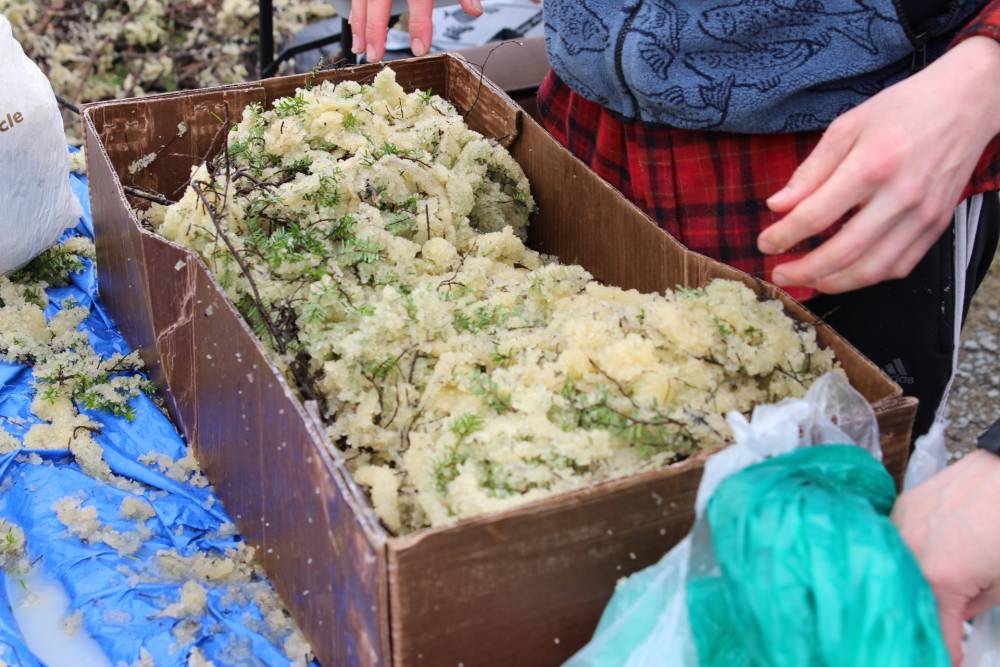
A box of herring eggs from the 2019 harvest in Sitka. (Photo by Enrique Pérez de la Rosa/KCAW)
The Sitka Tribe of Alaska has won a round in its longstanding suit against the state over the management of the Sitka Sound sac roe herring fishery.
In oral arguments before Judge Daniel Schally last January, counsel for the Tribe claimed that the Alaska Department of Fish and Game was not allowing for a “reasonable opportunity” to harvest the amount of herring spawn necessary for subsistence users, in violation of its own regulations. The Tribe also claimed the state had failed to lawfully document how it was attempting to provide that reasonable opportunity.
In a judgment on Tuesday, Schally agreed, writing that the state’s implementation of current regulations was unlawful.
In his 12-page opinion, Schally said that the Department of Fish and Game’s interpretation of the state code in question was “a hodgepodge,” and that “discerning exactly what ADFG’s interpretation is has proven to be an elusive task.”
In its defense, the state argued that its press releases had provided adequate documentation of subsistence opportunity, but Schally saw things differently. His ruling states that Fish and Game had not provided a sufficient record explaining how (or even if) it determines if a reasonable opportunity exists for subsistence harvest before opening the fishery.
“If adequate explanations for ADFG’s determinations do exist in the record, the state’s record does not clearly reflect them,” Schally said.
In a press release, STA Tribal Chair KathyHope Erickson said the Tribe is pleased with the initial victory.
“We will continue in our steadfast manner as this litigation proceeds to protect the herring, not just for subsistence users and Tribal citizens, but for all users of herring as a resource,” Erickson said.
Though this is the first win for the Sitka Tribe, the fight over future management of the commercial herring fishery in Sitka Sound isn’t over yet. The full case is scheduled for trial at the end of July.
Last year at this time, Schally ruled against the Tribe’s request for an injunction against Fish and Game in the days prior to the opening of the commercial herring fishery, saying that the Tribe had not demonstrated that it faced “irreparable harm” if the injunction wasn’t granted before the fishery occurred.