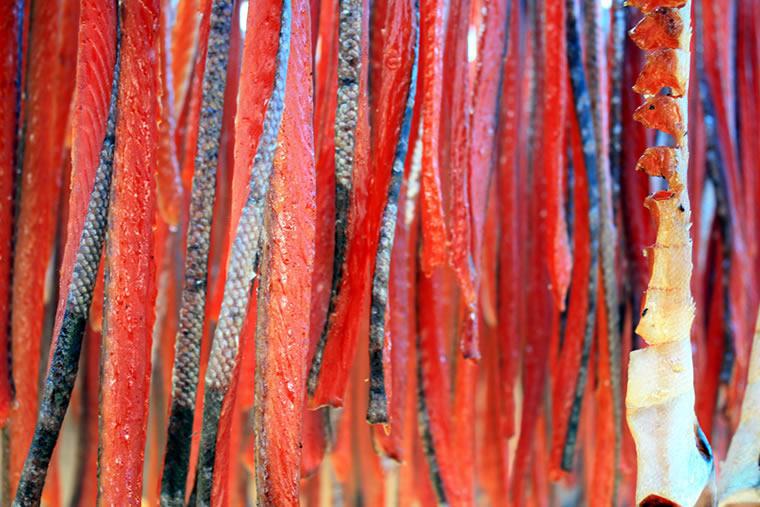
Organizations representing Yukon River communities are drafting a letter to Gov. Mike Dunleavy seeking a fishery disaster declaration for this summer’s salmon season.
Yukon River Drainage Fisheries Association Executive Director Serena Fitka says it’s been an especially tough year, with high water impeding fishing for much of the summer and runs coming in weak, particularly the fall chums many were counting on to save the season.
“The numbers are so low after the mixed stock analysis at the Pilot Station sonar,” Fitka said. “The numbers are below 200,000. So that’s a record low number of return fall chum.”
Fitka said that disaster status would bring funding that could be used for a variety of purposes.
“There’s a lot of suggestions out there. We’ve heard it should go to the people, but does that really help figure out what’s going on and why the fish aren’t returning? That’s the main question that’s being asked on the river,” Fitka said.
Fitka emphasized that a fishery disaster declaration will not provide quick relief, as the process can take one to two years before funding becomes available. She said the Yukon River Drainage Fisheries Association will hold a series of off-season teleconferences to discuss fishery issues with village residents, beginning with a session on the disaster declaration Oct. 20.
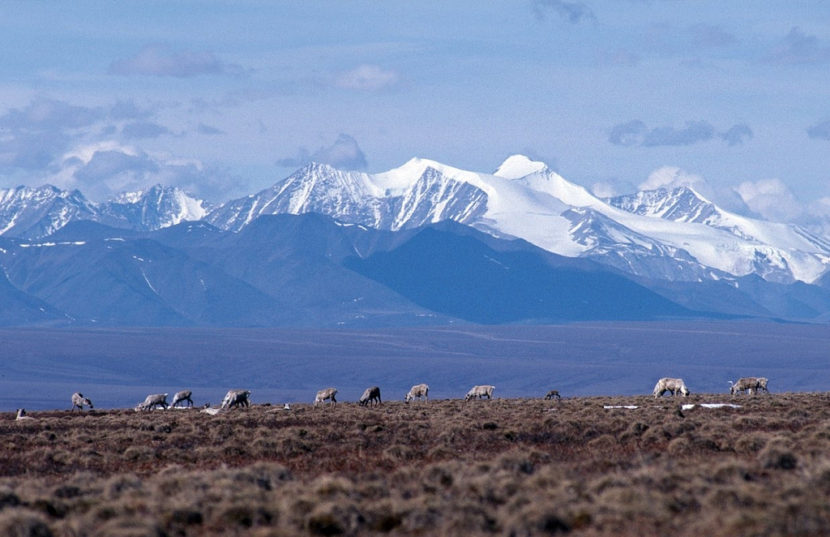
Caribou graze on the coastal plain of the Arctic National Wildlife Refuge, with the Brooks Range as a backdrop. (Public domain photo by U.S. Fish and Wildlife Service)
Alaska Native groups, environmental groups and, most recently, a coalition of 15 states have filed a flurry of lawsuits over the past month that aim to derail drilling plans for Alaska’s Arctic National Wildlife Refuge and National Petroleum Reserve.
These are separate lawsuits over separate pieces of land — a lot of land — and it’s a lot to keep track of.
Listen to the interview or read the transcript of Alaska Public Media’s Tegan Hanlon and Casey Grove trying to sort through it all.
[GROVE]: Well, let’s just get right into it. Can you briefly summarize what triggered these lawsuits?
[HANLON]: Yes. So there have been two big, recent developments when it comes to oil and gas drilling on Alaska’s North Slope.
Number one: The Trump administration announced in August its official plan for opening up part of the Arctic Refuge to oil and gas development. It’s an area called the coastal plain, and it sits to the east of Prudhoe Bay. The coastal plain makes up about 8% of the whole refuge. But the whole refuge is massive, so 8% of it is about the size of the state of Delaware.
It’s a place believed to hold billions of barrels of untapped oil, but it’s also an area where caribou migrate, polar bears den and migratory birds feed. And environmental groups have long fought to keep drilling rigs out.
And so, this official plan for oil and gas development on the land comes out in August, and Interior Secretary David Bernhardt says that the federal government could auction off drilling rights in the coastal plain to oil and gas companies by the end of the year. (Once leases are issued, it will be harder for a future president to reverse course.)
All of it is a very big deal.
[GROVE]: OK. I got that part. So, what’s number two.
Significant development number two: On the other side of Prudhoe Bay, to the west, sits Alaska’s National Petroleum Reserve, also called the NPR-A. There’s already some oil and gas development going on in the NPR-A, but there’s also land that is off-limits to drilling under the current Obama-era plan for the reserve.
But the Trump administration is working on a new management plan for the reserve, and it released its final environmental impact statement for that plan in June. The proposal would make about 80% of the NPR-A open to drilling instead of the current 50% or so. And that includes opening up the Teshekpuk Lake area — in the reserve’s northeastern corner — to drilling.
The next step is the government issuing what it calls a record of decision — or you might hear it referred to as a “ROD” — basically it’s just the final decision.
Again, all of it is also a very big deal.
And, like the Arctic Refuge, the NPR-A is also thought to hold billions of barrels of oil but it’s also an important habitat for birds and caribou and other wildlife. In both areas, there’s also concerns about impacts to subsistence, the climate and the land.
[GROVE]: And then came the lawsuits, right?
[HANLON]: Yes! And then came an avalanche of lawsuits.
Actually, two of the lawsuits related to development in the Arctic Refuge’s coastal plain were filed Wednesday.
One by a tribal government and two village councils and another by a coalition of 15 states including New Jersey and New York and Washington, but not including Alaska.
Taken together, the lawsuits are hundreds of pages.
At the most basic level the claims very broadly boil down to alleging that the federal government glossed over the impacts that oil and gas development could have on the land, wildlife, climate and subsistence. And, they say, the government failed to follow numerous environmental laws when developing the plans.
Here’s how EarthJustice attorney Kate Glover summarized the claims in one of the Arctic Refuge lawsuits:
“The problem is that BLM is pushing prioritizing oil and gas over all other purposes… all of the claims in the lawsuit are targeting their failure to take into account the impacts on Indigenous communities, wildlife, subsistence and recreational wilderness values of the refuge.”
The Bureau of Land Management counters that its actions are lawful and based on the best available science.
[GROVE]: So what’s the status of the lawsuits currently?
Well, they’re all in U.S. District Court in Alaska, so federal court. We’ve got the two just filed. And there are at least four others that are still really early on in the process.
Lawyers say the NPR-A lawsuits will likely start moving through the court process once the federal government issues its final decision on a management plan.
And, lawyers who filed two other Arctic Refuge lawsuits say they’re now waiting on the federal government to answer the complaint. One lawyer I spoke with said a ruling from the judge may not come for a year or so.
[GROVE]: Can the federal government move ahead with a lease sale with lawsuits ongoing?
[HANLON]: The short answer is: Right now, yes.
The Bureau of Land Management says “there is no legal prohibition” right now for it to move forward with a lease sale, in the case of the Arctic Refuge, or a final decision on a management plan, in the case of the NPR-A.
Then if a judge rules in a way that makes the lease sale or the management plan invalid, well, that’s a whole other conversation for us to have.
Also: I was curious if the filing of the lawsuits would have any impact on oil companies’ decisions on where to drill.
Lawyers who filed the lawsuit are hopeful that’s the case.
But Kara Moriarty who leads the Alaska Oil and Gas Association says she doubts it. She says the lawsuits aren’t surprising.
“Lawsuits have just become a way of life. And it was not surprising to us. If the industry was concerned about lawsuits these days, they’d probably never invest in Alaska anymore in the oil and gas industry. Trying to use lawsuits to keep resources in the ground has become a tried and trued page out of a playbook by groups.”
[GROVE]: Well, to close out: Any ETA at this point on a lease sale or official decision on the NPR-A management plan?
[HANLON]: No, no set date announced publicly at this point. That’s the million-dollar question.
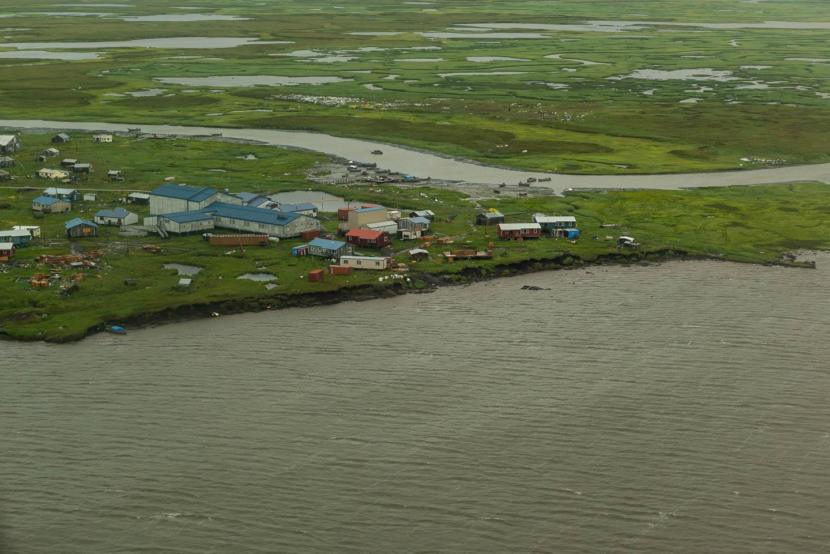
The Ninglik River shoreline in Newtok on July 26, 2019. (Photo by Katie Basile, KYUK – Bethel)
People in Newtok have been without power for almost three weeks. Families without personal generators have seen their freezers thaw out and watched a summer’s worth of subsistence harvest go to waste.
When the power went out in Newtok on Aug. 23, many homes flipped on their personal generators. Sandra Ayuluk didn’t have one strong enough to power her two freezers. After the outage continued into the third week, Ayuluk opened her freezers and discovered the worst.
“My food in the freezer is ruined,” Ayuluk said.
Her husband, Jonah Ayuluk, knew all too well the list of food items that were supposed to last them through the winter.
“Moose meat, salmon fillet, halibut, berries,” he listed.
Many of Sandra and Jonah’s friends and family, even if they had their own generators, couldn’t help. One of the Ayuluk’s neighbors, Carolyn George, said that’s because it’s nearing the end of the summer subsistence season.
“I don’t have any room in my freezer,” George said. “It’s just heartbreaking. All that subsisting they did over the summer. All that hard work, just down the drain.”
Carolyn said that even for families that do have their own generators, it can cost $50 a day for fuel to keep them running.
Newtok’s electric power system is extremely fragile. The village’s power company has two generators, a main and a backup. Tribal Administrator Andrew John said the main one was almost 30 years old when it broke down permanently a few years ago. Since then, Newtok has relied on the smaller backup generator, which just barely manages to power the whole village and couldn’t last forever.
“We knew early on it was just a matter of time,” John said. “And unfortunately, that little backup generator finally gave up.”
Newtok had a plan for that. The village ordered a backup for the backup, leaving it on the runway this past year, but couldn’t move it when they needed it. That’s because the village’s Bobcat tractor broke down. Andrew said workers struggled to move the generator parts without the tractor.
“We’re talking 800 pounds a piece, and there’s two of them,” John said.
It’s taken almost three weeks, but he said that the workers were able to muscle those parts over to the powerhouse.
“They went to the store and bought a can of mussels, took a big bite, and said, ‘Let’s go,’” John said.
With the parts now in place, John said that the workers should hopefully finish the installation by the end of the week.
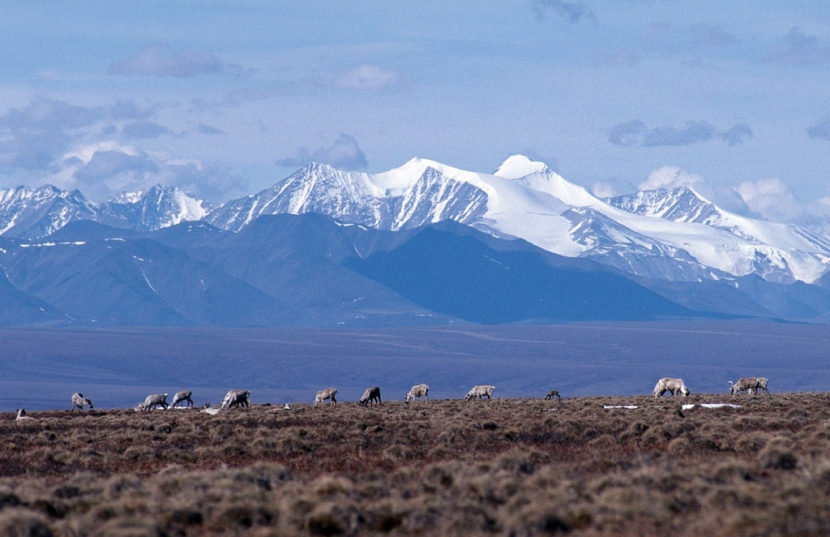
Caribou graze on the coastal plain of the Arctic National Wildlife Refuge, with the Brooks Range as a backdrop. (Creative Commons photo by USFWS)
Fifteen states have filed a lawsuit aimed at derailing the Trump administration’s plan to allow oil drilling in the Arctic National Wildlife Refuge.
Their legal challenge joins a growing stack of others from more likely plaintiffs. Gwich’in tribes also filed one Wednesday. They’ve fought to block drilling for decades.
The attorneys general of the 15 states argue that they have standing to sue because what happens in the Arctic Refuge affects their fish, wildlife and physical environment.
New York, for instance, says tundra swans, American golden plovers and whimbrels migrate between the Arctic Refuge and the Empire State, contributing to New York’s $4 billion birdwatching industry.
Michigan says waterfowl hunting is a significant source of income for that state, and some of the targeted species nest in the refuge.
The other states bringing the suit are California, Connecticut, Delaware, Illinois, Maine, Maryland, Massachusetts, Minnesota, New Jersey, Oregon, Rhode Island, Vermont and Washington.
The states say the environmental studies of proposed oil drilling in the refuge underestimate the damage to habitat and the greenhouse gas effect that would result from using petroleum products pumped from the refuge.
They want a judge to overturn Interior Secretary David Bernhardt’s record of decision last month to proceed with an auction of drilling rights. They also want the final environmental impact statement thrown out.
Bernhardt, in his decision, said Interior does recognize that ANWR provides habitat for many species. He said climate change was also taken into account. In an appendix to the final environmental report, the Bureau of Land Management wrote that there is no climate crisis and that past warming didn’t make the planet unlivable.
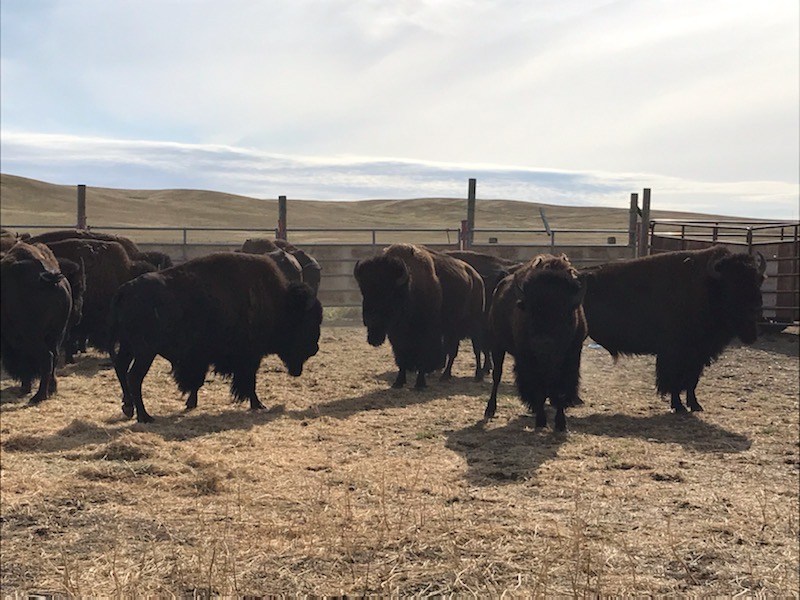
Bison in Montana. (Photo courtesy of the Old Harbor Alliance)
It was a journey that took three bison thousands of miles from a remote Montana Indian reservation. They traveled by land, by air, and then by sea to reach their new home near Old Harbor on Kodiak Island. They finally arrived Thursday night.
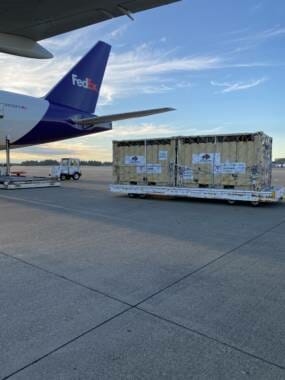
The buffalo left Montana for Alaska on Monday — three hardy bulls, which weigh about a thousand pounds each. They had to be loaded in specially-built shipping containers and trucked to Seattle — then flown to Alaska on a FedEx plane, which landed in Anchorage. And from there, they were driven to Homer, where they set out for Kodiak Island on a 60-foot landing craft.
Their final destination: tiny Sitkadilak Island, right across from Old Harbor.
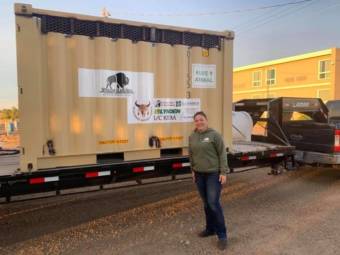
Melissa Berns-Svoboda stands in front of one of the shipping containers the bulls traveled in. She checked on them regularly throughout their journey to Alaska and said they seemed to handle the ride OK. (Photo courtesy of the Old Harbor Alliance)
Melissa Berns-Svoboda manages the herd and kept a watchful eye on the bison from start to finish.
“There was really no signs of stress,” she said. “They clearly wanted to know, like, ‘What are we doing in this container?’”
Berns-Svoboda said they seemed to make the trip just fine.
“They were very calm, laying down and doing what they should have been doing, which was eating and drinking,” Berns-Svobda said.
These are bulls from Yellowstone National Park, brought to Alaska by the Old Harbor Alliance – a group which includes Old Harbor’s Alutiiq Tribe, its Native corporation, and other organizations.
They are to join a herd of about 70 animals, to help improve their health and genetic diversity. When the Sitkalidak herd had its DNA tested, traces of an aggressive gene were found. Three bulls in the current herd will be culled, to allow the new bulls to bring new blood to the group. Researchers say genetic diversity helps the herd adapt to changing conditions and improves survival.
Berns-Svoboda says the move from Montana probably cost about $9,000 per bull, but the money is an investment in Old Harbor’s future — because the buffalo will help feed the community, a place so isolated that groceries have to be flown in, which makes them expensive.
Some of the buffalo have already been harvested — and the meat shared in the community of about 200. One day, the Alliance would like to sell the meat, as well as hunting permits, to bring some income to this cash-poor community. The bulls are key to those dreams.
When the landing craft arrived on the shores of Sitkadilak Island, it dropped its bow and opened the containers. The bison were free to cross the deck and head down a ramp to the beach, but they had to be coaxed to get off the boat.
But eventually, Berns-Svoboda says, they scrambled across a rocky beach, slippery with kelp, and headed right towards a valley, where their new herd was grazing.
“The valley was full of just green, green grasses,” Berns-Svoboda said. “There were alders. It was just beautiful.”
The Old Harbor Alliance bought a small part of that herd three years ago – and so far, they’re holding their own against the bears.
“There is really no conflict. They were kind of doing their own thing. They have their own respective areas. It was really neat to see,” Berns-Svoboda said.
Sitkalidak Island, save for a cabin, is virtually uninhabited, so the bears and the buffalo have the island all to themselves. In the spring, they both enjoy eating the green shoots of plants, that in the summer turn the island to emerald green.
Fed Ex flew the specially-made shipping containers from Seattle to Anchorage. One bull road alone. Two others shared a container. (Photo courtesy of the Old Harbor Alliance)
The InterTribal Buffalo Council helped Old Harbor move the bison from Montana to Seattle. Members from the Blackfeet Nation were hired to assist – and Berns-Svoboda says that created a special bond.
“We built relationships that are lifelong relationships,” she said. “We’re going to have them come down here. They’re going to help us work our animals, then help us get to know them.”
Berns-Svoboda says both the Blackfeet and the Old Harbor Alutiiq see the bison as more than just a source of food. She says the Blackfeet will also teach them how to fully appreciate the role the bison play in tribal culture – how they bring the community together through sharing. Berns-Svoboda says she has also seen how the buffalo can help bridge generation gaps and promote spiritual connectedness.
It took a web of connections from Montana to Alaska to bring the bison here. Some federal COVID-19 money to improve food security was used to pay for their trip. Many community organizations helped to make the move possible.
Lynell Bullshoe, a member of the Blackfeet Nation, had this post on the Sitkadilak Island Herd’s Facebook page, where you can also find short video clips of the bisons’ journey to Alaska.
“So very emotional watching them being loaded,” she wrote, “thinking of history being made and the people/generations that will be positively impacted by this.”
Lois J. Red Elk-Reed, a member of the Fort Peck Sioux, wrote, “What a journey for these Tatanka. There are telling us a story. They are educating us once again, and they will continue blessing us.”
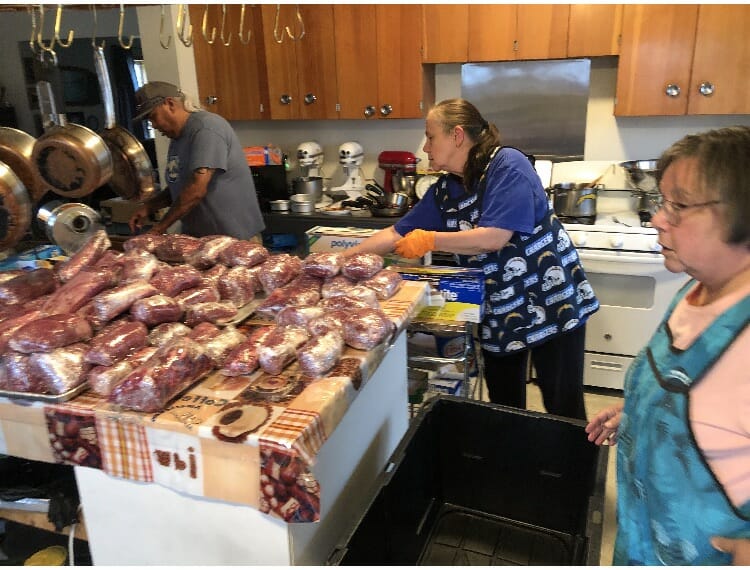
Kake residents and Elders process moose meat to be distributed to the community (Photo courtesy of the Organized Village of Kake)
An Alaska Native rights group is backing the federal subsistence board’s decision to allow a village in Southeast Alaska to hunt out of season during the pandemic. The Dunleavy administration has challenged that move, which will soon get its day in court.
The Native American Rights Fund (NARF) is asking the court to intervene on behalf of the Organized Village of Kake which took advantage of the emergency hunt to take two moose and five deer. The meat was distributed in the community during the early days of the COVID-19 pandemic.
NARF attorney Erin Dougherty Lynch in Anchorage says the state’s legal challenge to special subsistence hunts like Kake’s is part of a larger tug of war between the state and federal managers.
“Really, the state is seeking to disrupt the federal regulatory scheme that has governed subsistence hunting for decades. And, you know, in general, I would say that the state’s actions are extremely disappointing, and part of a long pattern of fighting Alaska Native subsistence rights in the courts and the press,” she said.
The Federal Subsistence Board also cited public safety concerns to restrict an area north of the Glenn Highway to local subsistence hunters. The state Department of Fish and Game filed a lawsuit against the feds last month alleging both actions violated federal law.
It’s asking a federal judge for an injunction that would immediately reopen caribou and moose hunting to non-subsistence users.
In filings, it says the subsistence board’s action has hamstrung its responsibility to manage fish and wildlife in the state.
Assistant Attorney General Cheryl Brooking says the state isn’t going after tribal sovereignty but sees discrimination against non-Natives.
“We’ve got a situation where they’ve shown that they’re going to disregard their own guidelines that they don’t have to have any facts that indicate that there’s actually a food security issue,” she said. “And that they’re going to discriminate between whether you’re native or non native.”
Tribal members have testified that it wasn’t just about scarcity — elders needed access to traditional foods including wild game, not just store-bought meat that wasn’t fresh and relatively expensive. Brooking says the state doesn’t see that as reason enough to allow hunting out of season.
“The meat wasn’t wild game and they prefer the wild game, but there wasn’t any shortage,” she said. “The only shortage that they had was paper products and cleaning supplies.”
A federal judge will hear oral arguments from both sides on Sept. 8th whether to grant a preliminary injunction. Attorneys for Sealaska, the region’s Native corporation have also joined the case in support of the federal government and tribes.
Close
Update notification options
Subscribe to notifications
Subscribe
Get notifications about news related to the topics you care about. You can unsubscribe anytime.