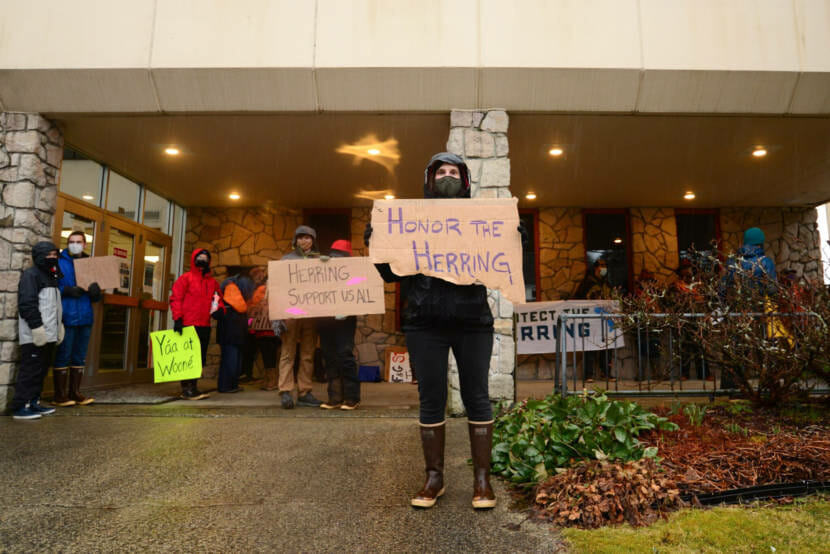
Demonstrators gathered outside of Sitka Courthouse earlier this week as a commercial herring fishery is slated to begin. (KCAW/Berett Wilber)
After several years of litigation, the case between the Sitka Tribe of Alaska and the Alaska Department of Fish and Game and Board of Fisheries has been resolved and will not go to trial this summer.
Sitka Tribe of Alaska filed suit against Fish and Game in 2018 over the department’s management of the Sitka Sound sac roe herring fishery. On April 26, Judge Superior Court Judge Daniel Schally signed the order vacating the trial, which had been scheduled for June 1.
Over the last year, Schally made three separate rulings in the case that will affect how the fishery is managed in future years.
Last March, Schally ruled that the state had not adequately documented how it was ensuring “reasonable opportunity for subsistence” in its management of the commercial fishery. In November, he ruled that the state had failed to clearly show how it considered the “quality and quantity” of herring spawn when making management decisions. Both rulings were wins for Sitka Tribe of Alaska.
Judge Schally’s third and final ruling last month came down in favor of the state. Attorneys representing Sitka Tribe of Alaska argued that Fish and Game is required under certain clauses of the Alaska State Constitution to use the “best available information” when making management decisions about the fishery. They argued that the state had not used the “best available information” during the 2018 season when it failed to provide a subsistence harvest data report and a scientific study reviewing the state’s model to the Board of Fish.
“STA is considering its options and the implications of this decision going forward,” General Manager Lisa Gassman said in the press release. “Sitka Tribe of Alaska has not yet decided whether to appeal the court’s ruling or seek changes from the Alaska Legislature or Board of Fisheries to explicitly require ADF&G to use the best available information.”
Nevertheless, the Tribe considers the principal litigation resolved and has asked the court to enter final judgment in the case.
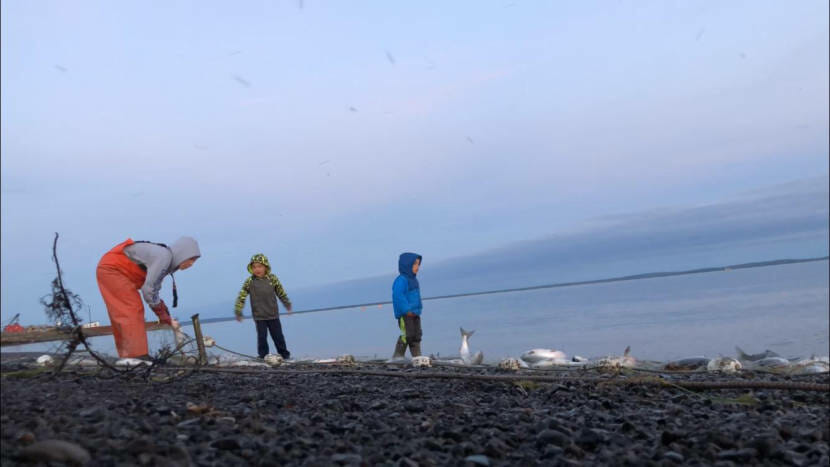
Apay’uq Moore subsistence fishes each summer. Moore has put nets out in Aleknagik, Wood River and Scandinavian Beach. (Photo courtesy of Apay’uq Moore)
A third of the state’s subsistence salmon harvest was caught in Bristol Bay in 2017, according to a new report from the McKinley Research Group. The subsistence economy is critical to Bristol Bay’s culture, and it’s the oldest and most continuous use of salmon.
The report, “The Economic Benefits of Bristol Bay”, attempts to quantify what it would cost to replace subsistence salmon with other protein sources from stores in the region.
Bristol Bay subsistence fishers caught over 500,000 pounds of salmon in 2017, according to the latest data available. The research group estimates that it would cost $5-$10 million to replace that catch with other sources of protein. Rebecca Braun is one of the researchers who worked on the report.
“Because the world speaks in dollars, we tried to translate the subsistence harvest into dollars,” Braun said. “And it’s kind of an inherently impossible exercise because subsistence values goes beyond economics.”
Braun and her colleagues recorded meat prices from six different stores. They found that meats like chicken and ground beef are about $6 a pound, and steak was projected as high as $18 a pound.
Two of those stores also sell salmon. One imports farmed salmon for $17 a pound and another offers smoked Alaska salmon for $25.
“We called grocery stores and it’s funny,” she said. “We asked, ‘What would it cost to buy salmon local, wild caught?’ They laughed and said, ‘Why would anyone do that?’ Because people catch their own out there. We discovered it would be quite difficult to replace it in a grocery store.”
More than 750 residents in Bristol Bay reported a subsistence harvest in 2017. Artist Apay’uq Moore lives in Aleknagik, a small community north of Dillingham. She grew up in the region and participates in the subsistence fishery each summer.
“Yeah, I’ve done it for five years now as the head of my smokehouse. Well, my mom helped me out for the first few years,” Moore said. “I’ve put a net out in Aleknagik, I’ve gone down the Wood River a little bit and I’ve worked with my friend Suzie a lot at her sight down on Scandinavian [Beach].”
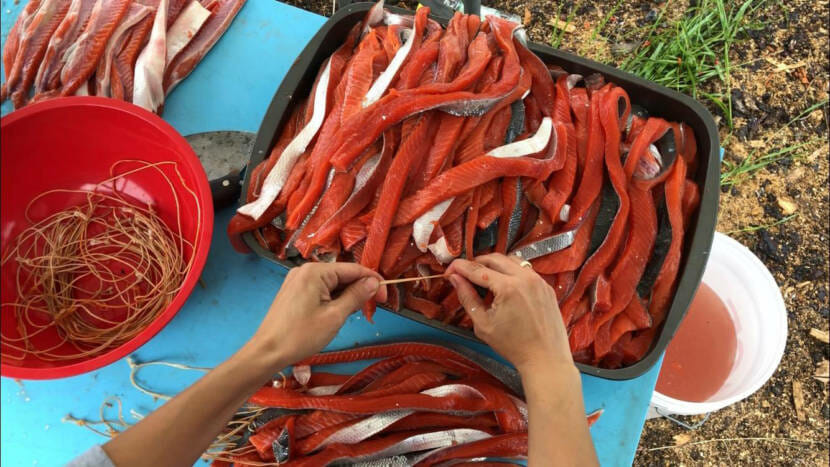
Strips of salmon (Photo courtesy of Apay’uq Moore)
Moore agrees that the value of subsistence fishing goes beyond protein replacement and dollar figures. She says it’s a generational practice and provides a mental getaway from day-to-day stress.
“It shares a little bit of the values that we have here as Indigenous people,” she said. “And that there isn’t just one economy out there; we have our spiritual economy and emotional economy. Those are the returns and gains that we’re looking for when we’re subsisting, practicing our humble beginnings and sort of connecting with our ancestors through that emotional and spiritual space.”
Alaskans elsewhere harvested just under a quarter of Bristol Bay’s subsistence catch. Half of those residents came from Anchorage and the remainder were from 26 communities across the state.
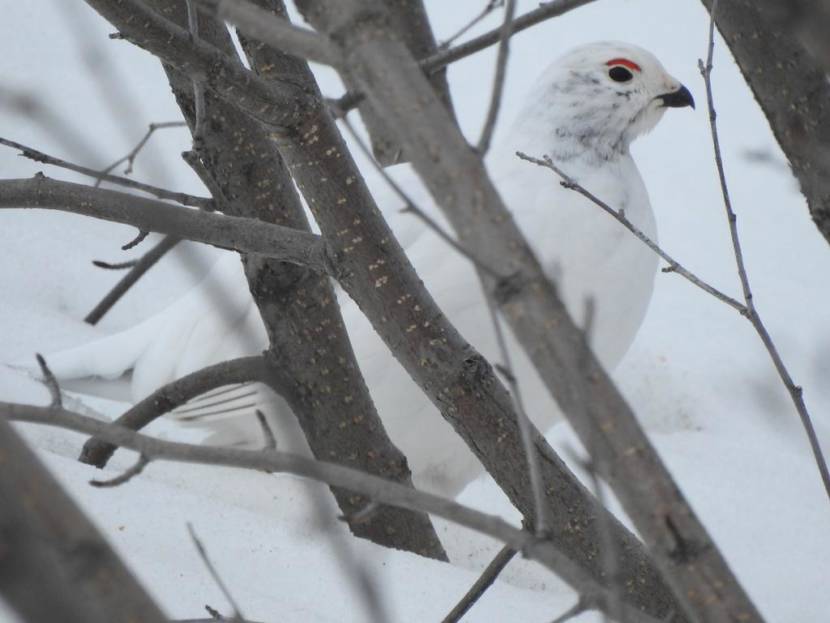
A ptarmigan in Bethel on April 17, 2021. (courtesy Danny Nelson)
Hunters along the lower Kuskokwim River have been reporting an abundance of ptarmigan this year after a relative dearth of the birds in years prior. But whether that’s because there really are more ptarmigan — or if people are just seeing more — is unclear.
Hunting ptarmigan in the Yukon-Kuskokwim Delta has been relatively easy this year, compared to the last few years.
“This year we’ve got lot of ptarmigan all over,” said Daniel Nelson, an elder who lives in Napakiak. “They were kind of declining in number, you know. The past two or three years I’d go ptarmigan hunting and I’d barely see some, just a few flocks. Most of the time I get home with nothing, but this year I return with average of 12 ptarmigan per trip.”
Neither the U.S. Fish and Wildlife Service nor the Alaska Department of Fish and Game track the number of ptarmigan in the Yukon-Kuskokwim Delta. However, state biologist Phillip Perry said that based on his own experience and what people are telling him, ptarmigan sightings are much more common this year than in the past five or six years.
“People are telling me, ‘Wow, there’s a bunch around this year, I’m doing really well,’” Perry said.
Many people are connecting the increased sighting of the birds to the weather this winter.
“I think it’s due to more snow this year,” said Maxine Gray, who lives in Kasigluk. “The last few springs, because of the rain and the lack of snow, I’ve heard that they were harder to find.”
The amount of snow impacts ptarmigan in a number of ways, like helping the birds stay warm to survive the winter.
“They do this thing called snow roosting,” Perry said. “They’ll go down in the snow, and then they’re insulated away from, you know, cold, bitter temperatures.”
And when there’s less snow on the ground, Perry said that the white birds are more visible and more likely to be eaten by predators.
On the other hand, it could be that there are a similar number of ptarmigan in the Y-K Delta as years prior. Rick Merizon is the small game program coordinator for the Alaska Department of Fish and Game. He said that the extra snow this year may just be pushing the ptarmigan down from the mountains into places where hunters normally look for them.
“Ptarmigan are a high elevation critter,” Merizon said. “And typically they’re pushed down to lower elevation only by the depth of the snow. So it buries up their food source, and they have to move somewhere to find food.”
Merizon said that biologists in other parts of the state have observed ptarmigan traveling over 100 miles in a single season. He also said that if the ptarmigan population is actually larger this year than in years past, a bigger factor than this winter’s snow would likely be last summer’s weather. Warm, dry weather usually means more chicks survive to adulthood.
“You get these hot, dry, buggy, late Junes and July and gosh, we might have 80% chick survival,” Merizon said.
Nelson in Napakiak said that he believes that last summer’s weather conditions allowed ptarmigan chicks to thrive, and he said that will also mean more geese and ducks this season.
Merizon said that the Alaska Department of Fish and Game planned to conduct a survey of ptarmigan population numbers and movements last year, but with COVID-19 travel restrictions and budget cuts, that study has been postponed until spring of 2022.
For now, with the increased number of ptarmigan sightings this year, Gray in Kasigluk said that she’s been enjoying more of the spring treat.
“I love it. My grandma made it all the time. It’s just something we grew up on. And it’s, you know, it makes me think of spring,” Gray said. “I like to dry it. It seems to be the favorite. It’s chewy, it’s got a distinct flavor. A little more gamier than dried moose, and it’s really good with seal oil.”
The snow is melting along the Kuskokwim River. With that, Warren Nicolai, a hunter in Bethel, said that he’s starting to see flocks of ptarmigan migrate to the coast.
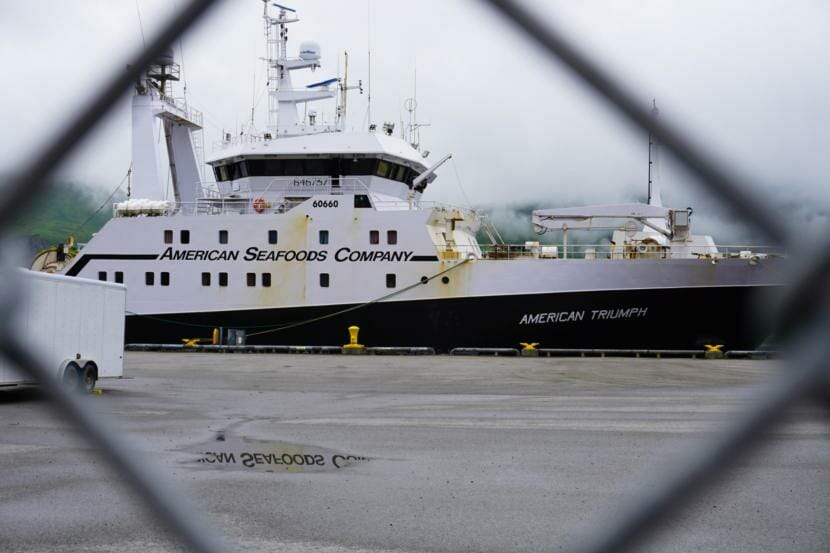
The American Triumph — a 285-foot factory trawler with an onboard processing plant — sits in the Port of Dutch Harbor. (Hope McKenney/KUCB)
Alaska’s commercial fishermen have been speaking out against big trawlers for years, complaining that the large vessels in federal waters are scooping up mature and juvenile fish. The regional council that manages federal fisheries recently heard from hundreds concerned about the number of salmon and other species that end up as bycatch in trawl nets.
For Alaska’s troll fleet, king salmon is their money fish. In state waters, small crews on these 40-to-50-foot boats — or on even small skiffs — will catch a fish at a time, and it’s worth it: chinook salmon can fetch $6 a pound from a processor.
But there’s another big-money fish in Alaska: Pollock. It’s the white fish found in a McDonald’s Filet-O-Fish or an imitation crab stick. And the factory trawlers that ply the Bering Sea and Gulf of Alaska in search of pollock and other groundfish scoop up chinook salmon and other species in their wide nets.
Federal fisheries data shows trawlers in the North Pacific took about a tenth of the chinook — or king salmon — caught by Alaska’s commercial salmon fleet last year. And those numbers are tracking the same this year. But none of that catch happens on purpose.
Preliminary ADF&G data shows about 263,000 kings were commercially harvested last year statewide. As of April 15, bycatch in the Bering Sea and Gulf of Alaska areas for 2021 was around 16,000 fish, over six percent of last year’s statewide commercial harvest. Last year’s trawler bycatch was 26,000 kings, or about a tenth of the 2020 commercial chinook harvest in-state.
The trawlers can’t keep or sell the kings. Those salmon are bycatch and have to be donated or thrown overboard.
Lexi Hackett is a Sitka-based troller. She says the waste of the industrial trawl fleet is a black eye on Alaska’s other well-managed and sustainable fisheries.
“I’m sitting here and trying to explain sustainability of fisheries — Alaska seafood, and Alaska sustainability, and how we have this great managed system up here,” Hackett said. “And of course, there’s always going to be room for improvement. But for me, the big elephant in the room is this kind of mismanaged, wasteful bycatch issue with trawlers that happens. And honestly, it’s just unacceptable.”
This isn’t a new issue. But recently the North Pacific Fishery Management Council, which manages federal fisheries, invited testimony on the issue of bycatch. Hundreds of fishermen, industry workers, and Native people and organizations from around the Pacific Northwest and Alaska wrote and called in over three days of this month’s meeting.
Crew members shovel pollock on the deck of a Bering Sea trawler last year. (Nathaniel Herz/Alaska’s Energy Desk)
By nature, trawl fisheries incidentally catch all kinds of species — salmon, herring and halibut, to name a few. It’s a tiny proportion of what they catch — roughly 1% according to NOAA Fisheries — but trawlers harvest such massive volumes that it’s an issue. Especially for species like chinook salmon, which are by far the most threatened.
Becca Robbins Gisclair, the director of Arctic Programs at the Ocean Conservancy, an environmental nonprofit, says commercial and subsistence harvests of kings in Alaska have been dropping for years.
“Fifteen years ago, when I was first working on the Yukon River and we were first having these conversations about salmon bycatch, you could buy Yukon chinook salmon in a grocery store — there were marketing campaigns to try to expand those markets,” Robbins Gisclair testified to the council. “Now the idea of buying a Yukon chinook salmon in a grocery store in Washington seems as bizarre as hugging someone outside of your household.”
There are a variety of federal measures already in place to try and reduce wasted bycatch. One is what’s called the “Mothership Salmon Savings Incentive Plan Agreement” (MSSIP). It basically allows some flexibility in bycatch limits for processors and fleets by letting them earn credits for minimizing bycatch. Those credits can then be used in later years to take even more when industry analysts say bycatch is less avoidable.
Some in the industry say that’s a good system.
“The incentives are clearly forcing the fleet to fish in the same general areas of lowest chinook bycatch,” said Austin Estabrooks. He’s with the At-Sea Processors Association, which represents some of the largest factory trawlers.
But others associated with groundfish and pollock trawl fisheries in Alaska point out that rolling closures and strict bycatch limits can be, well, limiting. In the vast expanses of the Gulf of Alaska and Bering Sea, the places trawlers need to avoid can vary wildly year to year. Last year, the winter savings area of the Bering Sea and Aleutian Islands fishing area closed — a stretch of water the size of Maryland.
“It’s a huge problem to manage bycatch when you have mandatory closure areas for other species or other reasons,” explained John Gruver, the intercoop manager for United Catcher Boats, a fishing trade association.
Many of those who testified to the council noted the destructive impacts on subsistence fisheries. Rural Alaskans, many of them in Native communities, rely on this to feed their people.
“The continued waste of salmon and halibut in the federal fisheries at the current levels are unacceptable, and action must be taken to reduce bycatch,” said Mellisa Johnson. She’s the executive director of the Bering Sea Elders Group, a tribal association from 39 tribes in the Yukon-Kuskokwim Delta and Bering Strait regions.
“Our elders have always taught us not to waste our different food sources, whether they be birds, different greens from the land, berries, and, most importantly, a lot of us throughout the state of Alaska and into the Lower 48 and other areas around the world can we all can relate about a type of fish,” Johnson said.
Raychelle Daniel is Yup’ik, and an officer with the Pew Charitable Trusts. She said she appreciates what has already been done by the industry and council to reduce bycatch, but she still sees a glaring hole in the discussion — formal invitations to Native people and organizations to share their ways of knowing.
“To gain a deeper understanding about the issue, you should also invite Indigenous organizations and regional management bodies to share more information, not only to gain a better understanding about what food security and cultural perspectives mean, but about observations and measures that people are taking to conserve salmon,” she told the council.
Members of the powerful North Pacific Fishery Management Council say they’re listening.
Council member Andy Mezirow says he hopes to get a formal report that can shed light on this issue that puts it in plain terms that anyone can understand.
“Not for the average person with a Master’s degree in marine biology, because I think we’re seeing a lot of engagement on this issue,” he said. “And I think the more public can understand the good work that’s being done to figure out how many — where these salmon are coming from, and the impact on the exact streams that they’re worried about, the more informed the public is, the better they’ll become aware of the extraordinary efforts that we’re making to try to figure out the impacts on these communities.”
After hearing public testimony and invited presentations, the North Pacific Fishery Management Council formally requested more information on where salmon would have been returning if they hadn’t been bycatch, as well as updated information to update matrices that correlate salmon length to age — another vital part of determining the total impact of bycatch to Alaska’s chinook salmon populations.
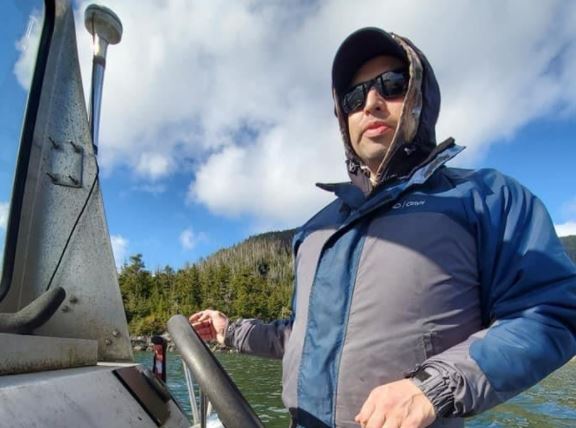
The mechanical failure threw the skiff’s occupants, Theodosius “Dosy” Merculief and James “Jimmi” Jensen, into the water near the Starrigavan boat ramp while they were harvesting herring eggs on Friday, April 9. Troopers found a broken steering cable during an investigation of the 17-foot skiff.
Jensen and Merculief were pulled out of the water by good Samaritans and transferred to the Mt. Edgecumbe Medical Center, where Merculief was pronounced dead. A preliminary investigation by the medical examiner points to hypothermia and drowning as the cause of death. Merculief was wearing a personal floatation device.
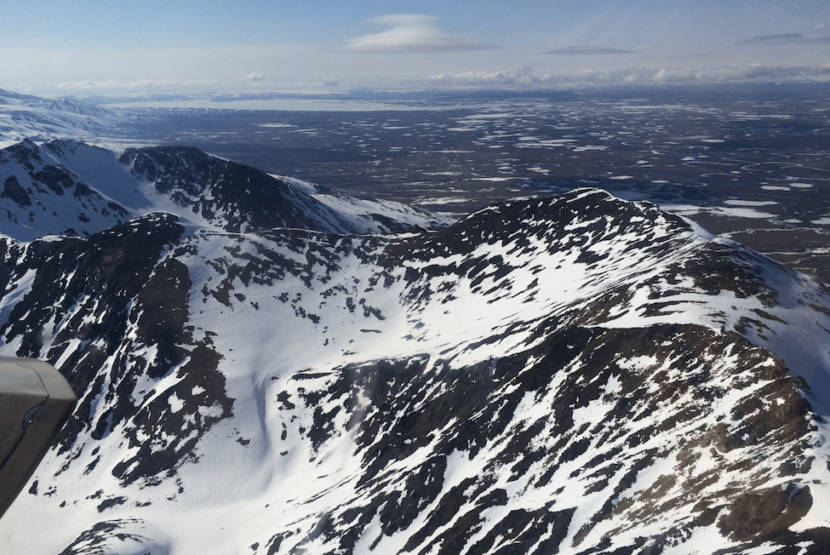
Some of the public lands impacted by the decision are parts of the Kigluaik Mountains. (Jenn Ruckel/KNOM)
The Department of the Interior is delaying plans that could have opened 28 million acres of Bureau of Land Management lands in Alaska to mining and mineral development.
In January of this year, the Trump Administration made plans to open the land.
The delay will affect BLM land in five different areas of Alaska, but the most notable halt is on 9.7 million acres in the Kobuk-Seward Peninsula resource management area. That area includes the entire Seward Peninsula and large sections of coastal and interior areas of the Northwest Arctic Borough.
The lands that would have been opened to extraction include areas upstream of Norton Bay. That’s a huge concern for Doug Katchatag of Unalakleet, who is especially worried about impacts to fresh water. Katchatag is the President of the Norton Bay Inter-Tribal Watershed Council. He has been watching fish dying in warmer waters for years now as climate change warms Alaska faster than anywhere else in the country
“If they were to go ahead and mine, that would kill all our fish and the country they are mining in. We would be hurting, we would be put on the extinction list. That’s our source of survival,” Katchatag said.
The Department of the Interior said in an April 15 media release that they would use the extra time to correct “defects” in the initial analysis. The Interior Department notes that the orders given in January used outdated environmental impact analysis that dated back over a decade ago.
The department wrote that public engagements and tribal consultations with the BLM would be part of this additional review. Katchatag is hopeful that the new department, led for the first time by a Native American, Secretary Deb Haaland — might work better with Alaska Native Tribes.
“We do need help from Washington,” he said.
The Kobuk-Seward public lands contain areas open for selection by Alaska Native Vietnam veterans as part of the Alaska Native Claims Settlement Act and authorizations from the Dingell Act. Under this new decision, veterans can still make land selections.
Close
Update notification options
Subscribe to notifications
Subscribe
Get notifications about news related to the topics you care about. You can unsubscribe anytime.