Subsistence

Bering Sea survey finds Yukon River chinook populations are low and staying closer to shore

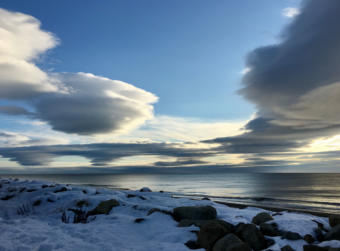
Bering Sea coastline near Nome, October 2017.
The Bering Sea coastline near Nome in October 2017. (Zoe Grueskin/KNOM)

Salmon abundance is down and population distributions have changed, according to NOAA’s 2021 surface trawl survey. Besides focusing on salmon, the survey also examined aspects of Bering Sea life such as zooplankton, sediment, sharks, marine birds, pacific herring, capelin and saffron cod.

Like the bottom trawl presentation on Zoom earlier in November, the top trawl presentation examined decreasing fish populations occurring in several Bering Strait species.

According to the survey’s preliminary estimates, young Yukon River chinook salmon populations continue to be low.

“Juvenile abundance was below average in 2021 and has been below average since 2017,” research biologist Jim Murphy said.

Besides lower populations, Murphy also noted the distribution of chinook salmon observed this year was unusual. While one typically finds chinook salmon distributed throughout the Bering Sea area, the area which NOAA typically surveys, most chinook salmon were found near Alaska’s shores.

Graphs on juvenile chinook salmon. (Courtesy of NOAA)

Like chinook salmon, Murphy’s team observed chum salmon almost exclusively near Alaska’s shores.

“And this is even more atypical for chum salmon as they tend to be much more broadly distributed than chinook salmon,” Murphy said.

Juvenile chum salmon populations have actually been above average since 2018, according to Murphy. 2021’s population is estimated to be one of the largest juvenile populations seen since then. A large juvenile fish population usually correlates with a large returning adult population.

But past observations, the correlation between adult and juvenile chum salmon tends to be more variable than the relationship between juvenile and adults in other fish species, Murphy said.

To illustrate, he pointed out that there was a large population of juvenile chum salmon in 2016 but a significantly low adult population. Murphy and his team postulated that this is because chum salmon are dying at greater rates later in their lifecycle. That would explain the great decline of chum salmon in the Yukon River, despite the high juvenile populations observed in the survey, Murphy said.

Pink salmon saw the same kind of low numbers and near-shore distribution during 2021. Murphy noted that his team combined pink salmon from Norton Sound and the Yukon River into the same graph because of their genetic similarity.

“With this model we are expecting to see low numbers of pink salmon returning to the region in 2022,” Murphy said.

In contrast, NOAA’s preliminary biomass index of coho salmon was close to the highest in the history of the survey. Hopefully, this means a strong run of coho in North Bering Sea salmon next year, Murphy said.

Besides salmon, multiple fish populations surveyed were found to be lower than average. These species include capelin, saffron cod, young pollock and cod and pacific herring.

In general, forage fish populations are low.

NOAA conducts both its bottom and surface trawl surveys annually to study the status of marine life in the Bering Sea.

Dunleavy administration announces formation of bycatch task force

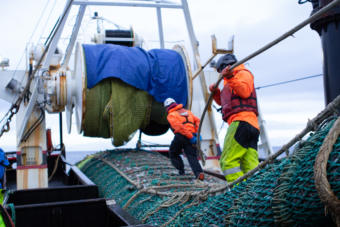
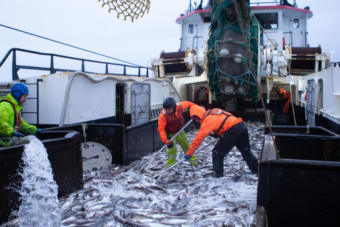
Crew members work to unload a trawl net full of pollock on Jan. 24, 2019. (Nathaniel Herz/Alaska’s Energy Desk)

Gov. Mike Dunleavy’s office recently announced that it’s setting up a task force to tackle the thorny issue of trawler bycatch.

Bycatch is what fishermen catch unintentionally — fish they aren’t targeting that get caught up in their nets, anyway. Federal bycatch data shows trawl fisheries in the Bering Sea and Gulf of Alaska this year have caught tens of thousands of chinook salmon, millions of pounds of halibut and hundreds of thousands of crabs.

Meanwhile staple species like chinook salmon, red king crab and halibut have been on the decline, forcing subsistence, sport and commercial fishermen to pack up nets or reduce harvest.

“We’ve had a reduction in or closure of the crab fisheries in the Bering Sea. The [North Pacific Fishery Management] Council is discussing how to deal with halibut bycatch, and I think there’s a lot of perception that there are bycatch issues associated with what’s happened with salmon in Western Alaska systems,” said Alaska Fish & Game Commissioner Doug Vincent-Lang.

And, he says, his boss has taken notice.

“I think the governor was hearing loud and clear that there was just a lot of noise around the issue of bycatch,” Vincent-Lang said Friday, “And I think he wanted to get Alaskans together, discuss what the issue is, what we know about it, what we don’t know about and identify different strategies that we all could take to try to reduce bycatch or manage bycatch better.”

The executive order establishing the task force says its goal is to study the impacts of bycatch on what it calls “high-value” state fisheries, recommend policies based on that impact, advise state agencies on how to address bycatch and use science to inform policy-makers and the public about how bycatch is felt in Alaska fisheries.

Vincent-Lang says that “high-value” designation is meant to be more expansive than just cash value.

“It could have value to coastal communities in terms of jobs and collateral benefits of the value back from collecting fish taxes to those communities,” he said. “You can have high value for food security, it could have a high value for cultural purposes.”

The task force will be made up of 13 voting members, nominated by the governor, meant to capture a swath of Alaska fishing interests. That means seats for state administration officials, various fisheries, Alaska Native organizations and the general public.

The task force will also include two non-voting members from the state legislature, nominated by the leadership of the House and Senate. The chair and vice-chair of the task force aren’t set yet — they’ll be selected by the governor once the voting seats are filled.

Bycatch critics warn that the task force’s effectiveness will depend on its composition.

“That task force initiative is definitely welcome,” said David Bayes, a longtime sport charter business owner in Homer. “It shows a level of commitment from the governor’s office which we’ve rarely seen.”

In addition to his charter business, Bayes is also an online activist of sorts, moderating a Facebook group called STOP Alaskan Trawler Bycatch that has more than 15,000 member.

“We’ve seen, a lot of times, especially at the NPFMC, that undercurrents of the trawl industry run pretty deep in Alaska commerce and politics,” he said.

Bayes is talking about the North Pacific Fishery Management Council, which has been criticized for giving too much clout to big-money industry trawlers who are responsible for much of Alaska’s bycatch.

“One of the named seats or positions [on the task force] is a representative from the NPFMC,” Bayes said, “There’s also a trawl rep on [the task force]. Again, it’s kind of this question of: Are they speaking towards conventions and practicability in the industry? Or are they going to try and derail the conversation by saying it’s all a facade, or something that we shouldn’t worry about in the first place?”

Bayes says he’s planning to apply for a seat on the governor’s task force. He says he’s optimistic that this could be a new opportunity for fisheries users to have a voice.

Most bycatch happens in federal waters, beyond the 3-mile line. Vincent-Lang says the Dunleavy administration hopes the bycatch task force will have an impact on federal fisheries management.

“I have a seat on the North Pacific Fishery Management Council,” Vincent-Lang said, “[So] hopefully the information we collect will be used to inform federal decision making — Council decision-making regarding bycatch moving forward.”

But he also says that bycatch in state waters deserves scrutiny, and ideas that come out of the task force could inform decisions at the state Board of Fisheries or within the administration.

The bycatch task force won’t have funding to allocate towards research. Vincent-Lang says that’s a piece of the puzzle that will come once it issues recommendations to policymakers next year.

“Funding will probably be some joint effort between industries associated with bycatch, users, as well as state and federal efforts,” he says. “But before we identify the money for it, we need to identify what it is we want to do.”

Vincent-Lang says he hopes the administration can convene the group early next year to meet on a monthly basis, as outlined in the governor’s order. The task will be dissolved on Nov. 30, 2022.

The deadline to apply to serve on the task force is Dec. 3.

Biden administration begins Roadless Rule do-over for Tongass

A portion of the Tongass National Forest along Peril Strait is seen from the ferry Chenega in Sept. 3, 2015. (Photo by Ed Schoenfeld/CoastAlaska News)
A portion of the Tongass National Forest along Peril Strait seen from the ferry Chenega in Sept. 3, 2015. (Photo by Ed Schoenfeld/CoastAlaska)

The Biden administration announced Friday the start date of its formal process to reinstate the Roadless Rule, which protects about 9 million acres of Tongass National Forest.

“Restoring the Tongass’ roadless protections supports the advancement of economic, ecologic and cultural sustainability in Southeast Alaska in a manner that is guided by local voices,” U.S. Agriculture Secretary Tom Vilsack said in a statement.

Successive Alaska governors have opposed the Roadless Rule since the Clinton administration put it in place in 2001. It’s been an on-again, off-again situation since then, with legal battles and politics coming into play.

The most recent whip-saw came last year, when the Trump administration exempted the Tongass from the rule.

Vilsack, who oversees the Forest Service, is again calling a do-over. He says a two-month comment period will be its first step to reinstate the Roadless Rule. And it’s a similar announcement to one made earlier this year that the Trump-era rule would be reversed.

“I don’t know how many times Vilsack can announce the same thing and have it sound like news,” said Juneau attorney Jim Clark, who has been coordinating a legal effort with some local governments and resource industries to preserve the Tongass exemption from the Roadless Rule.

He says the rhetoric around the rule’s protections of ancient forests is overblown.

“All this new exemption would do is open up 168,000 acres to timber harvest that wasn’t previously previously open,” he said Friday. “You wouldn’t know that from listening to the news — you’d think that all of the Tongass is going to be subject to clear cutting.”

And it’s true that while the rule change could affect more than 9 million acres, less than 170,000 acres of that would be old growth timber that could be logged under the current exemption.

Alaska state lawsuit rejected by federal Court of Appeals

Gov. Mike Dunleavy directed the state to join a lawsuit filed by resource industries, but the Court of Appeals dismissed the lawsuit earlier this week saying last year’s Roadless exemption is still in force, and the case was moot. But the governor’s office says the fight isn’t over.

“I would anticipate a very big vigorous response to the the efforts to control Alaska out of Washington, D.C.,” said the governor’s chief of staff Randy Ruaro, who hails from the former logging boomtown of Ketchikan. He told CoastAlaska on Friday that the Biden administration’s freeze on old growth timber sales ignores laws on the books that direct the Forest Service to make timber available to industry.

“We dispute the discretion of the Secretary to arbitrarily decide from Washington, D.C., to not follow those federal statutes and impose the Roadless Rule on the Tongass,” Ruaro added.

But opinion polls and the public record from hearings show healthy support for the Roadless Rule both in Alaska and Outside.

In Southeast, it has defenders from growing non-extractive industries like commercial fishing and tourism. Tribes whose traditional homelands are in what’s now Tongass National Forest also railed against the Trump administration’s rollback, both at hearings and in court filings.

Commercial logging of Tongass impacts subsistence

That’s because the legacy of clear-cutting and other development conflicted with rural residents’ hunting and fishing traditions.

Don Hernandez chairs the Regional Advisory Council on federal subsistence. It spent hours taking testimony over the Roadless Rule.

“It had just become pretty obvious over a long period of time that the areas of the Tongass that were most significantly impacted by past logging were all suffering harms to subsistence uses,” he said from his home on Point Baker on the northern edge of Prince of Wales Island, which is almost completely blanketed by federal forestland.

Hernandez is a commercial fisherman. He says the council heard loud and clear that people were worried about more old growth logging.

“And to expand that into other areas of the Tongass that people have come to rely on to meet their subsistence needs was just not going to be acceptable,” Hernandez said.

Tongass National Forest’s value as a carbon sink

To federal policymakers, the Tongass is seen less from a lens of conserving hunting and fishing grounds and more as a bulwark against climate change.

The Pew Charitable Trusts’ Ken Rait, who worked on developing the Roadless Rule under the Clinton administration in the 1990s, says there’s a recognition by the Biden administration that forests need to be kept intact to sequester carbon.

“And you know, there’s nowhere in the U.S. where this is more important than the Tongass National Forest,” Rait said from Portland, Oregon. “And so the decision is the right one for the Tongass, but it’s also the right one for the nation as a whole.”

The resource extraction industry and many of Alaska’s elected leaders complain that red tape will further lock up federal lands to energy and mining.

But Rait says there are safeguards in the rule. The Forest Service can — and does — issue waivers for projects in the public interest. More than two dozen to date have been granted, he says.

“The view that this is a blanket rule that will stop any development whatsoever from occurring on the Tongass just has not been borne out by the history of this issue,” Rait said.

How exactly the Biden administration plans to reverse the Trump administration policy still isn’t clear, says Clark, who served as chief of staff to former Governor Frank Murkowski, another strident Roadless Rule critic.

“It’s just a situation where we have to wait and see what the administration is actually doing,” he said.

Nov. 23 is when the Biden administration rolls out its plan for bringing back the Roadless Rule. If the last go-around is any indication, it’ll be a drawn out affair. It took more than two years to exempt the Tongass from the rule.

The federal government says more than 95% of people nationwide supported keeping the Roadless Rule in place during those hearings.

The Trump administration overturned it anyway.

A 60-day comment period will begin on Nov. 23, 2021 with the publication of a proposal to repeal the 2020 Alaska Roadless Rule. Comments can be submitted electronically using the Federal eRulemaking Portal; mailed to: Alaska Roadless Rule, USDA Forest Service, P.O. Box 21628, Juneau, Alaska 99802–1628; hand-delivered to Alaska Roadless Rule, USDA Forest Service, 709 W. 9th Street, Juneau, Alaska 99802 or emailed: sm.fs.akrdlessrule@usda.gov

Kuskokwim River working group tackles trawler salmon bycatch

Crew members shovel pollock on the deck of a Bering Sea trawler last year. (Nathaniel Herz/Alaska’s Energy Desk)
Crew members shovel pollock on the deck of a fishing vessel after a harvest on the Bering Sea in 2019. (Nat Herz/Alaska Public Media)

It is still a mystery to state biologists why king and chum salmon numbers are decreasing in Western Alaska. But ask any local fishermen on the Kuskokwim, and they’ll likely tell you commercial fishing trawlers in the Bering Sea are the problem.
“We have these restrictions for, like, almost 10 years and the fish count is always low every year,” said Kotlik subsistence fisherman Patrick Black in a June meeting of the Kuskokwim River Salmon Management Working Group, which advises state fishery managers.

“It doesn’t seem to get any better with these restrictions. Why not just go out there and deal with the other half of the problem,” Black said. “The trawlers, the pollock big fleet fisheries.”

Black is not the only one pointing fingers at trawlers.

“Everybody on this river is talking about that this summer,” said Mary Peltola on KYUK’s Fish Talk in June. Peltola is a member of the state’s Kuskokwim River Salmon Management Working Group and executive director of the Kuskokwim River Inter-Tribal Fish Commission.

“We are definitely concerned about bycatch and trawlers,” Peltola said. “It is definitely our number one priority going forward.”

In its last meeting on Nov. 11, the state working group took multiple actions to try to reduce the amount of bycatch salmon that ends up on trawlers. To do so, local tribal managers would have to convince federal managers to tighten restrictions. The North Pacific Fishery Management Council, a federal body, manages commercial trawlers in the Bering Sea.

The Kuskokwim River Inter-Tribal Fish Commission wrote a letter to the council with two main asks: eliminate salmon bycatch from trawlers completely and add seats on the council for Alaska Native tribes to have a say in commercial trawling in the Bering Sea.

Akiak’s Mike Williams Sr., a member of the state’s working group and chairman of the Kuskokwim River Inter-Tribal Fish Commission, was one of dozens of Y-K Delta residents who made the plea to the North Pacific Fishery Management Council at its last meeting.

“On the Yukon there was zero fishing this summer,” Williams said. “And we haven’t met our levels of harvest on the Kuskokwim River for the last 10 years either. So we’ve been really struggling along, and now I think the council needs to take action.”

Federal managers were resistant to the subsistence fishers’ requests. In a separate interview, Dr. Diana Stram, a senior scientist with the North Pacific Fishery Management Council, said that only a small percentage of the Chinook salmon bycatch in the Bering Sea would be headed toward Western Alaska rivers.

“About 16% is from coastal West Alaska, and less than 1% is from the upper and middle Yukon. And the vast majority of the rest of it is of Asian origin,” Stram said.

Tribal fishery managers say they have several problems with that explanation. They say the data being used to determine whether the salmon are from Western Alaska is outdated, and it’s not measuring the amount of chum salmon bycatch from Western Alaska. With record low chum runs across multiple rivers, they want to know that information, too.

The state’s local advisory group is adding its support for these requests. During its Nov. 11 meeting, the Kuskokwim River Salmon Management Working Group passed a motion to write a letter to federal managers supporting the Kuskokwim River Inter-Tribal Fish Commission’s requests to eliminate salmon bycatch and to include tribal representation. The state’s working group’s membership overlaps with the Kuskokwim River Inter-Tribal Fish Commission.

In the same meeting, the state’s working group passed a resolution asking the Alaska Department of Fish and Game to get the latest data on how many Chinook and chum salmon from Western Alaska trawlers catch by gathering new genetic samples from salmon caught on trawlers and in Western Alaska rivers.

This was actually the second time the group made this request. Back in July, the working group sent a letter to Gov. Mike Dunleavy requesting this genetic sampling work to be done. The state’s response did not provide a yes or no answer to this request, much to the disappointment of Peltola and the working group.

“You know, maybe we can just remind the commissioner and the governor of our initial questions,” Peltola said.

In the end, the state working group is an advisory body and has no legal authority over state or federal managers.

Members of the working group acknowledged that commercial trawlers are likely just one part of the reason that salmon numbers are depressed. The working group has also asked the North Pacific Fishery Management Council to examine how climate change is impacting salmon.

November sea ice extent in the northern Bering is the best since 2012

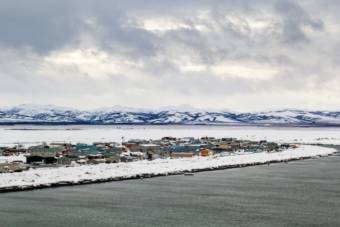
An aerial view of Unalakleet, with open water along the coast in 2019. (Zachariah Hughes, Alaska Public Media)

Through the weekend of Nov. 13, sea ice extent in the Chukchi Sea was well above the average from the last thirty years.

“So far, Chukchi Sea ice is developing much quicker this year than it has in all recent years,” climatologist Rick Thoman explained.

Thoman, with the Alaska Center for Climate Assessment and Policy, or ACCAP, has Chukchi Sea ice data going back to 1979. Current sea ice extent in Northern Alaska waters is the highest it’s been since November 2001, according to the National Snow and Ice Data Center’s sea ice index.

https://twitter.com/AlaskaWx/status/1459928137077182466

As of Nov. 13, the main ice pack had already reached the northern coast of the Seward Peninsula, Thoman said.

“What we have right now is fairly typical in the sense that ice tends to start to grow out from the Alaska and the Chukotka coast. This year it’s actually kind of met down towards the Bering Strait, so there’s really no open water now just north of the Bering Strait, between Chukotka and the Alaska side,” Thoman said.

Thoman suspects the rest of open water in the Chukchi Sea could be ice covered by the end of November.

As of Nov. 17, sea ice in the Bering Sea has covered much of the Eastern Norton Sound along the coastline of the Seward Peninsula except for an area in front of Nome. Sea ice had also started forming on the southern edge of St. Lawrence Island.

This is much more favorable for Western Alaska compared to the sea ice conditions the region experienced last year. The last couple winters in the Bering and Chukchi Seas have featured record low sea ice extents.

Thoman says all the pieces for sea ice growth, like colder surface temperatures and sustained northern winds, came together this year in the Bering Strait region.

“Really since early October, we’ve been in a persistently cold pattern,” he said. “Not quite every day was below normal, but most days below normal (temperatures). And so we didn’t have our thumbs on the scales with very warm waters that had to be extracted out, and we’ve had a weather pattern that has been conducive for ice formation.”

Based on current forecast models, the entire Norton Sound could be covered in ice by the end of November. There’s also a good chance of sea ice extending all the way south to the Pribilof Islands this winter, which hasn’t happened in recent years, according to Thoman.
New research shows how Alaska subsistence harvesters are having to adapt to climate change

A man ice fishes in northwest Alaska. (Kristen Green)

It’s no secret that climate change has affected how — and when — Alaskans harvest subsistence foods.

But what are the biggest impacts? How much has the warming climate changed things? And how are subsistence harvesters dealing with that change?

Well, a new study in the journal Ecology and Society aims to answer those questions, specifically as they pertain to the Northwest Alaska communities of Kotzebue and Kivalina.

Kristen Green is a co-author on the study and an Alaska-based Ph.D. student in environment and resources at Stanford University. She says a lot of research on subsistence adaptations due to climate change has been theoretical, so she and her fellow researchers went to interview the harvesters themselves.

Listen here:

The following transcript has been lightly edited for clarity.

Kristen Green: Well, since we were working with Alaska Native communities, it was really important to us to partner with them through every step of the research project. So, as we were first coming up with the idea, we started conversations with the Native Village of Kotzebue first and then later Kivalina, and trying to understand what questions might be meaningful to the community. From there, we started to focus on this idea of access and harvest, and developed a research protocol where we decided that we would interview expert harvesters throughout the region and ask them about what was most impacting the ways that they got to where they hunted and harvested. We asked them what changes they were seeing with respect to animal availability. And we also asked them how they’re responding to those changes and what their ideas were going forward.

Casey Grove: Just to be clear, what animals are we talking about?

Kristen Green: We asked people what was most important to them with respect to harvesting and caribou. The people there often refer to themselves as caribou people. It’s a symbolic animal for cultural and nutritional sustenance. So that was a of course a very important species. Ice seals, especially bearded seal, beluga whale are also really important. And as you get out to Kivalina, marine species become even more important based on their location. So marine mammals and fishes as well, particularly things like chum salmon and sheefish.

Casey Grove: So a pretty big range of things it sounds like.

Kristen Green: That’s right. harvesters in the region definitely have a range of food sources that they rely on because they do harvest seasonally throughout the year. And when you look at the seasonal harvest, you do see in every month of the year, people are harvesting things. And that’s actually one thing that we’ve found: some of those harvesting seasons are shifting a little bit relative to the past. And we believe that’s correlated with sea ice retreats.

Casey Grove: The season changing and how much?

Kristen Green: We saw changes in three key species. For bearded seal, harvest is now beginning in early May instead of late May. For chum salmon, harvest is now starting sometime in June, mid-June, when it used to start in early July. And for beluga whale, it’s now beginning in mid- to late May. And anywhere from two to three weeks earlier for all those species in that total window of harvest is also often more narrow and more unpredictable with some of the changes in the weather.

Casey Grove: Is the quantity of pounds of food is changing too?

Kristen Green: We didn’t specifically ask about pounds of food harvested in our study, it was outside the scope of our work. But we did hear from the two years that we asked people questions about this, that there were some years where it was much harder for them to get bearded seal. And we suspect that people are relying on other things to fill in for food that they’re not able to get — sometimes relying more on the fish in a year where they can’t get seals or they’re trading more with other communities or their families.

Casey Grove: And it kind of stands to reason if you have to spend more energy, more time or money trying to harvest the same amount of food that that’s just an overall greater difficulty than in the past.

Kristen Green: Absolutely. And that’s one of the things that we found is the amount of time you have to harvest, the amount of financial resources you have — whether it’s gasoline to be able to travel farther to find animals, or whether it’s access to multiple types of transportation. So having a snowmachine and boat and a four-wheeler, if you have access to all those, you may be able to access harvest more than someone who can’t.

Casey Grove: This study, it strikes me as very intensive on the talking, almost in a journalistic sort of way, that you’re you’re getting a lot of information by talking to people. And I wonder what was that like? I mean, it sounds like a lot of interviews and a lot of direct communication with folks?

Kristen Green: It was a really meaningful aspect of this study that people in Kivalina and in Kotzebue were so willing to share their stories with us and we spent time at people’s houses and fish camps, having coffee with folks and really hearing the stories of change that they’d experienced and also some of their optimism for the future. We also did look at some of the quantitative environmental trends to see how they compare to what the harvesters’ stories were and they both had similar stories about climate change. But I think the nuances, that when you’re talking to people, you’re able to gather a much broader context for climate change and potential ways to adapt to them than when you just are looking at the numbers.

Site notifications
Update notification options
Subscribe to notifications