Subsistence

Ketchikan Indian Community’s new president says she’ll push for greater access to traditional foods

""
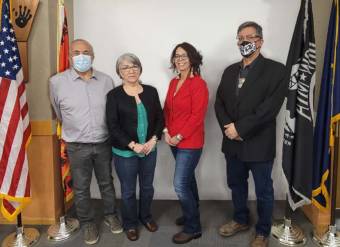
Ketchikan Indian Community’s newly-elected 2022 Tribal Council executives. From left to right, Vice President Norm Skan, Secretary Judy Leask Guthrie, President Trixie Bennett and Treasurer Chas Edwardson. (Photo courtesy of Ketchikan Indian Community)

Ketchikan Indian Community’s Tribal Council elected a new president this week. Trixie Bennett says she plans to lead the community’s advocacy to preserve Indigenous ways of life.

Ketchikan Indian Community’s new president says ensuring tribal members have access to traditional foods and medicines is among her highest priorities.

“File it under sovereignty if you want, but right up there with sovereignty is our food,” Bennett said in a phone interview.

Trixie Bennett, Lingít from Wrangell, is the new president of Ketchikan’s 6,000-member federally recognized tribe. She’d previously served as the council’s vice president.

In her new role, Bennett says she plans to continue pushing for stricter environmental standards for mines near rivers that flow from Canada into Southeast Alaska. Conservationists and tribes say mine waste threatens salmon runs in the region. Bennett says she plans to continue working with groups like Salmon Beyond Borders and the Southeast Alaska Indigenous Transboundary Commission to push for a ban on tailings dams that hold back mine waste along cross-border rivers.

“Part of my priority is to keep putting some attention on that because salmon is our way of life,” she said. “It’s our canary in the mine for the environment.”

She says she’s planning trips to Washington D.C. and Ottawa in the coming months to keep the pressure on.

Closer to home, Bennett says she plans to continue a push to have Ketchikan designated as a rural area under a federal law that governs who can participate in certain subsistence hunts and fisheries.

“Access to the land is equals access to our foods. It’s been that way — my great grandfather was Chief Shakes in Wrangell in … the 1890s, and he was fighting for the same thing: access to our lands and our foods. So that will continue to be a focus for me and this tribe,” Bennett said.

As it stands, the Federal Subsistence Board considers most of Ketchikan, with the exception of Saxman, to be a non-rural area. And that means most people in Ketchikan can’t hunt or fish under subsistence rules on federal lands.

“We fought for the fishery to open for subsistence users on the Unuk (River) for eulachon every spring, and we actually won — people could go out and get five gallons each. But we didn’t get to go ourselves as a community, and our tribal people weren’t allowed because of that rural designation,” she said. “It’s just not right.”

Bennett says another area of focus is addiction, mental health and homelessness.

“It all goes together,” she said. “We have a lot of amazing programs and services and a treatment center in the works that we’re working on plans for. We’ve gotten through a feasibility study, so that’s coming down the pike, and (we’re) looking forward to collaborating with the rest of the community. We know it’s a real need here.”

Beyond that, Bennett says she plans to put her new business and management degree and her experience on staff to use making KIC a better place to work and get health care.

Before assuming the presidency, Bennett worked for the tribe’s clinic for more than a decade before winning a seat on the tribal council in 2018. These days, she runs a small online traditional medicine store called Tongass Tonics and says she’s in talks to purchase another downtown business.

“Our traditional foods, a lot of our people never have had to this day because they get shipped out to the highest bidder. I’d like to see more of those things offered by businesses in town,” she said.

Bennett replaces Gloria Burns as president. Norm Skan, who preceded Burns, will return to council leadership as vice president. Treasurer Chas Edwardson and Secretary Judy Leask Guthrie round out the 2022 executive committee.

Board of Fish will not move Southeast meeting back to Ketchikan

""
Fishing in Zimovia Strait (Photo by Sage Smiley/KSTK)

The Alaska Board of Fisheries will hold its Southeast meeting in Anchorage after all.

The board voted 4-2 against moving the meeting back to Ketchikan despite dozens of comments from Southeast’s fishermen, tribal entities, elected officials and others urging it to hold the meeting inside the region that would be affected by more than 150 proposals.

The Board of Fish had been set to hold its Southeast Finfish & Shellfish meeting in Ketchikan earlier this month, but a coronavirus outbreak caused it to be postponed.

When the meeting was rescheduled for Anchorage two months later, fishermen, subsistence harvesters and others complained, pointing out that a March meeting could cut into fishing seasons or cut off constituents from the process.

So the Board of Fish — which sets regulations for commercial, subsistence and sport fisheries around the state — met Thursday to decide whether to move the two-week Southeast meeting back to Ketchikan.

Dozens wrote comments to the board, including Ketchikan’s PeaceHealth Medical Center. The health provider commented in support of the Southeast meeting taking place in Ketchikan in March, despite the risk of COVID-19, saying the medical system in the area is well-equipped to handle tens of thousands of visitors.

But despite comments urging the move back to Southeast, a four-member majority of the board voted to keep the meeting in Anchorage. John Jensen, the board’s only member residing in Southeast Alaska, said he appreciated the public comment but was concerned about logistics.

“A lot of people have made their plans based on our plan to go to Anchorage — like myself,” Jensen told the board Thursday afternoon. “[…] much to the disappointment of a lot of my people that live around here in Petersburg, I’m going to get chewed out for this — but my vote is going to be to keep the meeting in Anchorage and keep the plans we’ve already made along with that.”

Jensen also suggested the possible solution of skipping the Southeast Alaska meeting this cycle and resuming in 2024. The last regional finfish & shellfish meeting was in Sitka in 2018.

After the move to Anchorage was announced, Ketchikan Rep. Dan Ortiz worked with local officials and board staff to arrange availability in March at Ketchikan’s Ted Ferry Civic Center. Other state senators and representatives from Southeast Alaska wrote to the board in favor of holding the meeting in the region.

Board member Israel Payton criticized what he termed “political interference” by Alaska lawmakers.

“I’ve heard from, quite honestly, the politicians that have been involved with us to keep politics out of the Board of Fish, and I feel a tremendous amount of political pressure from those same politicians to get in the board business and try to augment what’s what we view as best for the board and the process,” Payton explained. “I don’t take kindly to that. That being said, I appreciate what they’re doing for their stakeholders.”

Petersburg’s Jensen, who also serves on the North Pacific Fishery Management Council, agreed.

“The reason this state came into being was to take government out of [the] management of fish,” Jensen stated, “And being respectful for our legislators, and I’m not trying to make it sound bad, but governmental agencies running fisheries has never worked very well in the history of the United States — or any other country for that matter — as far back as [1215] when the Magna Carta was written.”

Board of Fish chair Märit Carlson-Van Dort reiterated the challenges of trying to hold large public meetings with many postponed and rescheduled.

“It is literally almost balanced on a pinhead, considering all of the fisheries and all of the other timing and scheduling conflicts that present and have been presented,” Carlson-Van Dort explained.

But McKenzie Mitchell of Fairbanks said her priority was holding the meeting where the fisheries are.

“I understand that the schedules are challenging and it will be challenging to have both the statewide and the Southeast meetings back to back,” Mitchell stated, “But I am okay with doing that. It’s important for me to make sure that we have a Southeast meeting in Southeast Alaska.”

Mitchell and Willow-based board member John Wood — who called for the special meeting — voted in favor of moving the meeting back to Ketchikan, but the motion failed, keeping the Southeast meeting location in Anchorage.

The comment period for the 153 proposals before the Board of Fish for the Southeast Alaska meeting has been extended until February 23.

The Alaska Board of Fisheries’ Southeast finfish & shellfish meeting will take place in Anchorage at the Egan Center from March 10-22. Given the location of the meeting, the board stated it will accept remote public testimony from select Alaska Department of Fish & Game offices. The board has not specified whether that is the only form of remote testimony that will be accepted.

Fishing groups hold hope and skepticism before first bycatch task force meeting

""
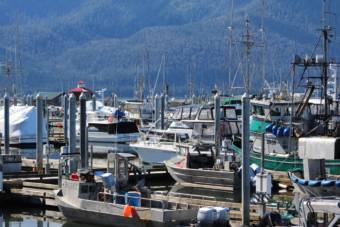
Heritage Harbor in Wrangell. (Photo by Sage Smiley/KSTK)

Earlier this month, Gov. Mike Dunleavy named 11 appointees to the Alaska Bycatch Task Force, which will work to recommend solutions to the thorny issue of bycatch in Alaska’s state and federal fisheries. Some see the force as a possible turning point, but others say they’re skeptical of what it can accomplish.

Bycatch — or species accidentally caught while targeting a different fish — has been a hot-button issue in Alaska for decades. But it rose to the forefront last year when Alaska Native organizations and fishing groups called for dramatic reductions to halibut, crab and salmon bycatch at federal fisheries meetings.

The state legislature took notice, holding a special meeting on bycatch in mid-November. Also in mid-November, Gov. Mike Dunleavy announced the formation of the Alaska Bycatch Task Force.

On the Yukon and Kuskokwim rivers, subsistence and small commercial salmon fisheries were severely curtailed or completely shuttered last year. That same year, federal data show that trawlers in the Bering Sea scooped up more than half a million chum, pink and silver salmon and almost 14,000 king salmon. In the Gulf of Alaska, groundfish harvesters caught more than 17,000 king salmon as bycatch. That fish can’t be sold, although some of the bycatch is donated.

For more than a decade, commercial and subsistence fishermen in Western Alaska have felt the impacts of declining salmon runs and didn’t have a task force to address the problem.

During a recent tribal listening session with the National Marine Fisheries Service, John Lamont from Lamont Slough on the lower Yukon River told federal fisheries managers that he supports the idea of a bycatch task force.

“This should have happened a long time ago,” he said.

Lamont also called on the federal government to follow suit.

“I’m not really sure if the federal government is establishing a bycatch committee yet to discuss the same issues that are being brought up today by all users all stakeholders in Alaska,” he said. “The impact of no fishing, no nets in the water this past summer has really opened the eyes, I think, of politicians, of managers, and of tribal leaders.”

The state’s task force will study the impacts of bycatch on what it calls “high-value” state fisheries. The administrative order establishing the force doesn’t specify what it means by high-value. Monetarily, that would include the state’s salmon and crab fisheries. The order does not mention subsistence interests but does designate a spot for a sport or personal-use representative. That seat was assigned to a former head of ADF&G’s sport fish division.
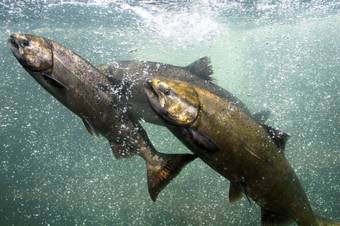
The task force will also make recommendations and advise state and federal agencies on how to address bycatch, though there isn’t much data on bycatch in state-managed fisheries. It’s also tasked with working to inform policy-makers and the public about how bycatch affects Alaska’s fisheries.

The force will be chaired by Petersburg crab and halibut fisherman John Jensen. He also sits on the Alaska Board of Fisheries, which sets most of the rules for fishing in state waters. Jensen also holds a voting seat on the North Pacific Fishery Management Council, which manages fisheries past the 3-mile line and in federal waters.

Dunleavy’s 11 appointees cover a range of interests, though only one currently resides in one of the Native communities where bycatch has arguably affected subsistence the most.

The seat on the task force reserved for Alaska Native interests was assigned to a non-Native consultant who represents two Alaska Native corporations. And that’s led to some criticism.

“Looking at the composition of the task force, I don’t feel that the tribal representation is really there,” said Brooke Woods, the executive chair of the Yukon River Inter-Tribal Fish Commission, a nonprofit representing 30 tribes along the Yukon River that advocates for tribal fishing rights and the protection and restoration of Yukon River salmon.

Woods says she’s skeptical that listening sessions or task forces will make the change that organizations like hers are asking for.

“I honestly didn’t even encourage any tribal members to take on yet another voluntary position to make change for themselves, their families and their communities, because it’s just not fair,” Woods said. “You have non-Natives in career positions that are supposed to be doing the work of subsistence, but there’s no accountability. So it’s hard — these career-minded folks making an income with no accountability to subsistence management or policy and then asking an Alaska Native to volunteer.”

The seat reserved for an Alaska Native organization will be filled by Duncan Fields, a Kodiak resident and former state House candidate, who has also served on the North Pacific Fishery Management Council.

Fields says he’s not Alaska Native but works closely with Native and tribal organizations.

“I didn’t make the determination whether I was an adequate representative or not, the governor’s office did that. And I’m appreciative that they thought that I was qualified,” Fields said in an interview with KSTK.

He’s been recognized for his work by the Alaska Federation of Natives, which gave him the Denali Award in 2004 — an award recognizing a non-Native person who has made significant contributions to the Alaska Native community.

“I understand the weight of responsibility, being a representative of Native organizations, ANCSA corporations and tribes,” Fields said. “I can’t be all things to all people. And as you well know, there’s great divergence in this both geographically and tribally relative to issues like bycatch. But I can be a listening ear.”

Another Kodiak resident, salmon seiner Raymond May has been appointed to fill the seat reserved for a salmon fisherman. May also holds permits for herring roe and crab, finfish and sablefish pot fishing around the state. May is a council member for the Native Village of Port Lions and an enrolled member of the Native Village of Afognak.

Cordova’s Tommy Sheridan, a fisheries consultant and former Silver Bay Seafoods executive, has been appointed to fill the seat designated for a member of the general public. He’ll serve as vice-chair of the task force. Sheridan also serves on the North Pacific Anadromous Fish Commission, an international organization dedicated to stock conservation of salmon and other anadromous fish.

The seat for a crab harvester will go to Erik Velsko, a Homer-based crab fisherman who also fishes for halibut and owns a Bristol Bay salmon permit. Velsko is also a member of the North Pacific Fishery Management Council Advisory Panel.

Kodiak-based Linda Kozak will hold the seat designated for a halibut fisher. Kozak is the United Fishermen of Alaska representative for the Fishing Vessel Owners’ Association, a longline industry group, and is a fisheries consultant and sport fisher.

Mike Flores will hold the seat designated for a charter operator. Flores owns and operates Ninilchik Charters, a fishing and hunting charter operation on the Kenai Peninsula. He also serves on the state’s Big Game Commercial Services board.

Kevin Delaney, the former director for the ADF&G Division of Sport Fish, will fill the personal use or sport fish seat on the task force. Delaney is a resident of Windsor, Colorado, and is a retired consultant specializing in fisheries consulting and wealth management.

And the seat for a mayor from a coastal Alaska community will be filled by Kenai Mayor Brian Gabriel. KDLL reported earlier this month that Gabriel is a longtime set-netter and has experience guiding and sportfishing on the Kenai River.

The task force also has seats designated for a trawl industry representative and a representative from a community group that receives a share of Bering Sea trawl catch for economic development in western Alaska.

Alukanuk’s Ragnar Alstrom, the executive director of the Yukon Delta Fisheries Development Association, will hold that community group seat on the task force. YDFDA represents six Native villages at the mouth of the Yukon River, and owns shares of multiple pollock trawl vessels and other catcher-processor boats targeting crab and cod in the Bering Sea. The organization has also funded and helped to organize salmon research on the lower Yukon River.

The executive director of trawler group the At-Sea Processors Association, Stephanie Madsen, will hold the seat designated for her industry. Juneau-based Madsen previously served as the chair of the North Pacific Fishery Management Council.

Two cabinet officials of the Dunleavy administration — the commissioners of Fish & Game and Commerce — will also be voting members on the task force.

And legislative leaders will nominate two lawmakers to sit in non-voting seats. House Speaker Louise Stutes announced earlier this month (on January 7) she would nominate former House Speaker Bryce Edgmon, a state lawmaker from Dillingham to one of the non-voting legislative seats.

Fish & Game commissioner Doug Vincent-Lang told KSTK in November that the task force will meet on a monthly basis until late this year when it will submit a report with recommendations to state and federal policymakers. The task force’s first meeting is scheduled for January 28 and will be open to the public via videoconference.

Tribal groups petition federal government to eliminate or limit Bering Sea salmon bycatch

(U.S. Fish and Wildlife photo)

In their latest bid to halt or limit chinook and chum salmon bycatch in the Bering Sea, tribal organizations in Western Alaska have signed onto a petition calling on the federal government to take action.

The petition asks the U.S. Department of Commerce to eliminate chinook salmon bycatch in the Bering Sea completely and to put a cap on chum salmon bycatch. It does not specify an acceptable limit for chum bycatch.

The tribal groups signing the petition mostly represent areas of Alaska where salmon runs have crashed or declined dramatically in recent years. They include the Kuskokwim River Inter-tribal Fish Commission, the Yukon River Inter-Tribal Fish Commission, the Association of Village Council Presidents, Kawerak, Inc., the Bering Sea Elders Group and the Aleut Community of St. Paul Island.
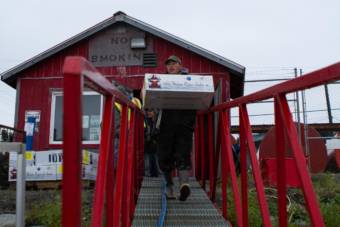
“The recent crashes of Chinook. And now the chum on the Kuskokwim River is pretty evident that we need to take emergency action on this issue,” said Mike Williams Sr., chair of the Kuskokwim River Inter-Tribal Fish Commission. “I think we need to begin to take drastic measures.”

A spokesperson for the National Oceanic and Atmospheric Administration inside the U.S. Department of Commerce wrote in an email to KYUK that the agency does not comment on petitions. He did not answer whether the department was even aware of the petition.

The National Marine Fisheries Service estimates that more than 13,000 chinook salmon and more than 500,000 chum salmon were caught as bycatch in the Bering Sea in 2021. The groups petitioning the federal government to bring these numbers down say at least some portion of those fish would end up in Western Alaska rivers, where subsistence fishermen have not been able to meet their needs for quite some time now.

Subsistence fishermen and organizations from Western Alaska have intensified their pressure on both the state and federal government in the past year to reduce or eliminate salmon bycatch in the Bering Sea. This petition is the latest effort in that campaign.

Federal disasters declared for 14 Alaska fisheries

Daren Jennings loads up his skiff to deliver Bristol Bay salmon to Lower Yukon River communities. The Yukon salmon fisheries saw their lowest runs ever in the summer of 2021. Yukon River families were not allowed to fish for subsistence, and the commercial fishery remained closed. (Olivia Ebertz/KYUK)

Fourteen Alaska fisheries have been declared federal disasters by the U.S. Secretary of Commerce. Gina Raimondo issued the declarations last Friday, and the announcement could lead to federal funding for fishermen.

The disaster declarations include the 2020 Kuskokwim River salmon fishery and the 2020 and 2021 Yukon River salmon fisheries. These fisheries saw significant salmon declines both years, with the Yukon salmon fishery seeing its lowest runs ever in the summer of 2021. Yukon River families were not allowed to fish for subsistence, and the commercial fishery remained closed.

Executive director for the Yukon River Drainage Fisheries Association, Serena Fitka, helped lead a group of Yukon River tribal and fishing organizations to campaign for the Yukon disaster declarations.

“I give the credit to the Yukon River communities, everyone that pulled together to make their voices heard that we are in crisis mode right now,” Fitka said.

The groups issued a letter last fall that listed the impacts of the salmon collapse on residents, “which include cultural loss, food security, psychological impacts, and the overall wellness of the people along the river.”

With the disasters now declared, Congress could choose to allocate federal funding for assistance. It’s an action that both Alaska’s U.S. senators signaled that they are ready to push for in a statement celebrating Secretary Raimondo’s decision.

“Our great fisheries resources provide a pillar within Alaska’s economy and culture. Now that a fishery disaster has been declared, we can work to secure appropriations to fund these fishery disaster declarations,” Alaska Republican Sen. Dan Sullivan wrote in a statement.

On the Yukon River, Fitka is once again mobilizing the same groups that campaigned for the disaster declarations. This time they will campaign for federal funding.

“That’s really making sure that the fishermen get the assistance they need. Not only for commercial, but for subsistence users as well,” Fitka said.

On the Kuskokwim River, Mike Williams Sr. chairs the Kuskokwim River Inter-Tribal Fish Commission. He said that he hopes the disaster declarations will provide relief to Kuskokwim and Yukon River families. For years, these families have not met their subsistence needs through king salmon, and other species runs are also declining.

“I just hung two chums on my rack all summer, and our hearts go out to people on the Yukon, because they got zero,” Williams Sr. said.

He criticized how long it took the federal process to declare the fisheries as disasters. Some of the fisheries listed in other areas of Alaska are from as far back as 2018.

“Right now, the only thing I can say is better late than never,” Williams Sr. said.

He said that he hopes some federal funding will go toward researching why the salmon are declining.

Secretary Raimondo issued determinations that fisheries disasters occurred in:

  • 2018 Upper Cook Inlet east side set net
  • 2018 Copper River Chinook and sockeye salmon
  • 2019 Eastern Bering Sea Tanner crab
  • 2020 Prince William Sound salmon fisheries
  • 2020 Copper River Chinook, sockeye, and chum salmon fisheries
  • 2020 Eastern Bering Sea Tanner crab
  • 2020 Pacific cod in the Gulf of Alaska
  • 2020 Alaska Norton Sound salmon
  • 2020 Yukon River salmon
  • 2020 Chignik salmon
  • 2020 Kuskokwim River salmon
  • 2020 Southeast Alaska salmon fisheries
  • 2020 Upper Cook Inlet salmon fisheries
  • 2021 Yukon River salmon fishery

Skagway’s blue mussels were nearly wiped out last year

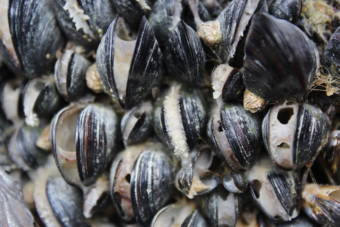
A close-up of blue mussels with their shells partly open
Blue mussels before the mortality event. (photo courtesy of Reuben Cash)

Reuben Cash says blue mussels are best served steamed with melted butter. But this year, he doubts you could find enough for a meal.

Cash is the environmental coordinator at the Skagway Traditional Council. He says that last summer, 70-90% of the population died in what he calls a massive mortality event.

“You can see all the shells from what happened this summer. And for a while, I mean, it was thick,” he said. “Where the high tide comes in was just probably four inches deep, and empty mussel shells and dying mussels with meat still on it — it was widespread.”

The Skagway Traditional Council samples local mussels to test for paralytic shellfish poisoning because they work well as an indicator species for the toxin. In late June, they realized something was wrong.

“We noticed that there was kind of a funky smell about a week earlier,” Cash said. “They kind of had a sweet, slightly putrid smell. And in the weeks leading up to that, temperatures were in the 60s, maybe the 70s.”

He says there was a heatwave in the Pacific Northwest further south that caused many blue mussels to die, but the upper Lynn Canal stayed relatively cool.

“I kind of discounted the temperature theory right off the bat because it just didn’t get hot enough,” Cash said. “Blue mussels are pretty tolerant of high temperatures — they can tolerate up to about 85 degrees.”

Cash also considered that it could have been some sort of pathogen, like a virus or bacteria affecting the shellfish, but blue mussels are highly resistant to them.

He says it was probably a combination of things that caused the mussels to die.

A stretch of rocky beach covered with blue mussel shells
Dead blue mussels line the beach at Nahku Bay. (photo courtesy of Reuben Cash)

One thing is the salt. Typically sea water levels are 35 parts per 1,000.

“Starting in June, in 2021, it was down below one part per 1,000 — like, as fresh as river water,” Cash said.

And Cash says when the salt levels drop, blue mussels aren’t as tolerant of temperature shifts.

Another issue is sediment.

“Not only does the freshwater dilute the amount of salt that’s in the water, it also introduces a lot of sediment,” Cash said. “Sediment covers up the muscles. Now, they’re filter feeders, they’re not going to be able to function as well as they would if the water was clear.”

Last winter there was record snowfall in the mountains above Skagway and Dyea. Then the area went through a cool spring, which kept the snowpack in place later than usual. As temperatures warmed up, the snow melted and brought fresh water and heavy amounts of silt into areas like Nahku Bay.

Then around the summer solstice, an extreme low tide occurred.

“So they were exposed at the low tide for longer and with a little bit higher temperatures, probably being smothered by sediment with low salinity,” Cash said.

Normally, the mussels can handle any one of these things — but all of them combined? It may have been too much.

Cash says the blue mussels that are left will be the strongest of the population and the most resilient. But he’s asking harvesters to avoid collecting mussels until the population rebounds.

“If you want blue mussels next year, hold off this year,” advised Cash.

Blue mussels tend to spawn mid-summer, so it may be late summer before the area sees an increase in their numbers.

Site notifications
Update notification options
Subscribe to notifications