Subsistence

Task force’s final report calls for new rules and more research to address seafood bycatch

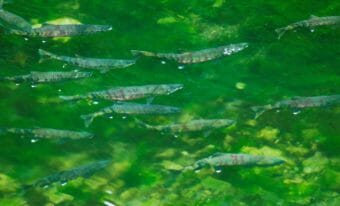
Spawning salmon in green water
Spawning chum salmon spawning swim in 1990 in Kitoi Bay near Kodiak. With Western Alaska chum and Chinook salmon runs collapsing, there are widespread complaints that too many salmon are being intercepted at sea by large trawl vessels. A task force created by Gov. Mike Dunleavy has recommended multiple steps to address bycatch of salmon, halibut and crab. (Photo by David Csepp/NOAA Alaska Fisheries Science Center)

New controls on how fish are commercially harvested and more research to understand the effects of climate change in the ocean and in freshwater spawning grounds are some of the key recommendations of an Alaska task force examining ways to address bycatch, the term for capture of untargeted species in commercial seafood harvests.

Gov. Mike Dunleavy, who created the task force a year ago, released the group’s final report late Thursday.

“I look forward to working with task force members and stakeholders to do everything we can to get more fish to return to Alaska’s waters,” Dunleavy said in a statement.

The collapse of salmon runs vital to western Alaska — and public complaints that too many salmon were being intercepted at sea before returning to spawning grounds — triggered the creation of the Alaska Bycatch Task Force. However, its work extended to bycatch of various crab species and halibut.

Crab stocks, like salmon, have also collapsed. Population crashes spurred closures this year for two important harvests, the Bering Sea snow crab fishery and the Bristol Bay red king crab fishery.

To some degree, bycatch is unavoidable, the task force said.

“All fisheries have bycatch. Through our work we saw a need, and made recommendations for, continued work on incentives and methods to avoid and reduce bycatch. In regards to the long term, there is a need to find ways to better utilize unavoidable bycatch,” John Jensen, the task force chairman, said in an introductory statement in the final report.

One recommendation in the report is for the state to establish a “scientific-based” firm cap on chum salmon bycatch in the Bering Sea pollock fishery.

Such a cap has long been in place for Chinook salmon, a species that is the subject of a U.S.-Canada treaty. However, the North Pacific Fishery Management Council, the panel that regulates commercial fishing in federal waters, has so far declined to set any cap on bycatch of any other salmon species.

Another recommendation is to expand the number of people observing the trawl fleet operating in the Gulf of Alaska. To better track bycatch of prohibited species, all vessels conducting bottom trawling in the Gulf should have certified fishery observers posted onboard, the report said. Trawling is a term for fishing with a large, wide net that a ship drags, often to harvest groundfish near the sea bottom.

Those observers are already required on all pollock trawlers operating in the Bering Sea, but only partial observer coverage is currently required for vessels operating in the smaller Gulf of Alaska harvests.

The North Pacific Fishery Management Council is scheduled to review the task force findings at its ongoing meeting in Anchorage. The council is meeting through early next week to set 2023 groundfish harvest levels and take other actions.

The council on Friday rejected a proposed emergency rule that would bar fishing for six months in an area measuring about 3,900 square nautical miles that is considered to be essential habitat for red king crab.

The rule was requested by Bering Sea crab harvesters, who say the ban would prevent crabs from being injured or killed by trawl gear that scrapes the seafloor.

Emergency action is justified, Jamie Goen, executive director of the Alaska Bering Sea Crabbers organization, said in a letter to the council. “Time is of the essence for protecting this stock,” she said.

Representatives of the trawling harvesters oppose the emergency rule, questioning its efficacy. In their written comments to the council, leaders of the At-Sea Processors Association and United Catcher Boats say there is exceedingly low red king bycatch by the trawl fleet, and that pushing trawl vessels out of the designated red king crab protected area would increase the risk of bycatch of salmon and other species.

Ultimately, council members decided that the rule sought by the crab harvesters was not supportable.

“I agree most cerntaintly that this is an emergency. It just doesn’t merit the criteria of the emergency action,” member Andy Mezirow said before voting to with the rest of the council to reject the proposed rule.

This story originally appeared in the Alaska Beacon and is republished here with permission.

The EPA is now one step away from a veto that would ban Pebble mine

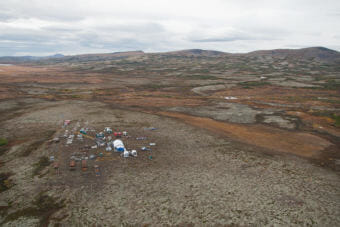
The proposed site of the Pebble Mine.
The proposed site of the Pebble Mine. (Photo by Jason Sear/KDLG)

Federal regulators are one step away from action that would protect the Bristol Bay watershed and crush the dreams of those who want to see a mine developed to extract ore from the massive Pebble deposit in Southwest Alaska.

Casey Sixkiller, the Region 10 administrator for the Environmental Protection Agency, on Thursday announced he sent a recommendation to EPA headquarters to protect the area by vetoing the proposed mine.
“If affirmed by EPA’s Office of Water during the fourth and final step, this action would help protect salmon fishery areas that support world-class commercial and recreational fisheries, and that have sustained Alaska Native communities for thousands of years, supporting a subsistence-based way of life for one of the last intact wild salmon-based cultures in the world,” he said in a written statement announcing the action.

The announcement is the latest in a long string of setbacks for the Canadian-owned company that wants to mine gold and copper from the Pebble deposit.

Pebble Partnership Chief Executive John Shively said it’s a massive federal overreach and goes beyond what the Clean Water Act allows.

“Perhaps the most egregious aspect of this entire process is the EPA’s blatant dismissal of, and complete lack of consideration for, the significant economic benefits this project could have for the region and for the state,” Shively said in an emailed statement.

Shively said if the EPA finalizes the veto, it would preclude “any development” on more than 300 square miles.

But for mine opponents, protecting that watershed is a top concern.

“After twenty years of Pebble hanging over our heads, the Biden Administration has the opportunity to follow through on its commitments by finalizing comprehensive, durable protections for our region as soon as possible,” United Tribes of Bristol Bay Executive Director Alannah Hurley said in an emailed statement.

The project has always faced strong opposition because the deposit sits upstream from Bristol Bay, home to lucrative salmon fisheries. Economists have estimated the fisheries are worth more than $2.2 billion, including the value to subsistence users.

It’s the pristine waters and healthy upland fish habitat that makes a banner harvest like this summer’s possible, said Katherine Carscallen, director of Commercial Fishermen for Bristol Bay.

“Our fishermen were able to deliver 59 million wild sockeye to the market — something that isn’t happening anywhere else in the world,” she said.

The Pebble deposit is on state-owned land, but to develop the mine, the Pebble Partnership would need federal permits under the Clean Water Act.

Under the Obama administration, the EPA regional office also set out to ban the mine. That proposed action was called a “pre-emptive veto” because it was proposed before Pebble filed for permits.

The “pre-emptive veto” proposal was withdrawn in the Trump administration and the company finally submitted a permit application in late 2017. The U.S. Army Corps of Engineers denied the permits in 2020. Pebble is appealing.

Meanwhile, a coalition of fishermen, tribes, lodge owners and environmental groups has been clamoring for EPA to start a new veto process, to ensure Pebble or another company can’t reapply with a new project design.

The process EPA has to follow to issue a veto is long, with steps that seem to repeat themselves. A regional administrator has to propose a ban, seek public comment, then recommend a ban, and then submit it to headquarters for final approval.

EPA Region 10, the region that includes Alaska, proposed the ban in May, having concluded that operating the mine — specifically, the dumping or dredge or fill material in waterways — could result in “unacceptable adverse effects” on fish spawning and breeding areas. Region 10 Administrator Casey Sixkiller proposed to ban any future use of the streams in that area for that kind of dumping.

More than 600,000 people commented on the proposal. Most opposed the mine, though some tribes near the site favor the project, as does the state of Alaska.

Sixkiller’s move now puts the matter in the hands of Radhika Fox, the assistant EPA administrator for water. Fox could impose the veto, make changes or reject it entirely. She has 60 days to consider it.

The US promised tribes they would always have fish, but the fish they have pose toxic risks

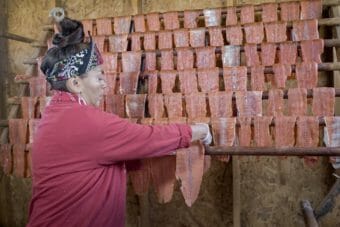
Lottie Sam, front right, and other women prepare salmon in Toppenish, Wash., before a ceremony held by the Confederated Tribes and Bands of the Yakama Nation. (Photo by Tony Schick/OPB)

This article was produced for ProPublica’s Local Reporting Network in partnership with Oregon Public BroadcastingSign up for Dispatches to get stories like this one as soon as they are published.

Salmon heads, fins and tails filled baking trays in the kitchen where Lottie Sam prepped for her tribe’s spring feast.

The sacred ceremony, held each year on the Yakama reservation in south-central Washington, honors the first returning salmon and the first gathered roots and berries of the new year.

“The only thing we don’t eat is the bones and the teeth, but everything else is sucked clean,” Sam said, laughing.

Her mother and grandmother taught her that salmon is a gift from the creator, a source of strength and medicine that is first among all foods on the table. They don’t waste it.

“The skin, the brain, the head, the jaw, everything of the salmon,” she said. “Everybody’s gonna have the opportunity to consume that, even if it’s the eyeball.”

Sam is a member of the Confederated Tribes and Bands of the Yakama Nation. They are among several tribes with a deep connection to salmon in the Columbia River Basin, a region that drains parts of the Rocky Mountains of British Columbia, Canada, southward through seven U.S. states into the West’s largest river.

It’s also a region contaminated by more than a century of industrial and agricultural pollution, leaving Sam and others to weigh unknown health risks against sacred practices.

“We just know that if we overconsume a certain amount of it that it might have possible risks,” Sam said as she gutted salmon in the bustling kitchen. “It’s our food. We don’t see it any other way.”

But while tribes have pushed the government to pay closer attention to contamination, that hasn’t happened. Regulators have done so little testing for toxic chemicals in fish that even public health and environmental agencies admit they don’t have enough information to prioritize cleanup efforts or to fully inform the public about human health risks.

So Oregon Public Broadcasting and ProPublica did our own testing, and we found what public health agencies have not: Native tribes in the Columbia River Basin face a disproportionate risk of toxic exposure through their most important food.

OPB and ProPublica purchased 50 salmon from Native fishermen along the Columbia River and paid to have them tested at a certified lab for 13 metals and two classes of chemicals known to be present in the Columbia. We then showed the results to two state health departments, U.S. Environmental Protection Agency officials and tribal fisheries scientists.

A laboratory analyst processes salmon filets for testing at a lab in Washington. (Photo by Kristyna Wentz-Graff/OPB)

The testing showed concentrations of two chemicals in the salmon that the EPA and both Oregon and Washington’s health agencies deem unsafe at the levels consumed by many of the 68,000-plus Native people who are members of tribes living in the Columbia River Basin today. Those chemicals are mercury and polychlorinated biphenyls, or PCBs, which after prolonged exposure can damage the immune and reproductive systems and lead to neurodevelopmental disorders.

The general population eats so little fish that agencies do not consider it at risk, which means that government protocols are mostly failing to protect tribal health. In fact, the contaminants pose an unacceptable health risk if salmon is consumed even at just over half the rate commonly reported by tribal members today, according to guidelines from the EPA and Washington Department of Health.

Source: Data obtained by Oregon Public Broadcasting and ProPublica. Average diet figures from EPA surveys of the Nez Perce Tribe and the general population, and fish advisory guidance from the EPA. Additional information can be found in the methodology section below. Illustration by Irena Hwang/ProPublica.

The potential for exposure extends along the West Coast, where hundreds of thousands of people face increased risks of cancer and other health problems just by adhering to the salmon-rich diet their cultures were built upon.

Chinook salmon, like the ones OPB and ProPublica sampled, migrate to sea over the course of their lives, where they pick up contaminants that Northwest waters like the Columbia and other rivers deposit in the ocean. EPA documents obtained under the Freedom of Information Act show that even with minimal data available, agency staff members have flagged the potential for exposure to chemicals in salmon caught not just in the Columbia but also Washington’s Puget Sound, British Columbia’s Skeena and Fraser rivers, and California’s Sacramento and San Joaquin rivers.

The Columbia River faces many pollution threats, including from mining. Two reports have found that a tailings dam at British Columbia’s Copper Mountain, 25 miles north of the Washington border, has a probability of failing and flooding communities and tributaries of the Columbia with poisonous sludge. (Photo by Kristyna Wentz-Graff/OPB)

Tribes entered into treaties with the U.S. government in the mid-1850s, ceding millions of acres but preserving their perpetual right to their “usual and accustomed” fishing areas; the Supreme Court later likened this right to being as important to Native people as the air they breathe.

But time and again, the U.S. has not upheld those treaties. Damming the Columbia River destroyed tribal fishing grounds and, along with habitat loss and overfishing, drove many salmon populations to near extinction, wiping some out entirely. Previous reporting has shown how the federal government failed in its promises to compensate tribes for those losses and in some cases worked against tribes’ efforts to restore salmon populations. In addition, the EPA has allowed cleanups to languish, and state regulators have been slow to rein in industrial pollution. That toxic pollution impairs the ability of salmon to swim, feed and reproduce.

Continually poor and declining salmon numbers have prompted the White House to acknowledge an environmental justice crisis in the Columbia River Basin.

The results of our testing for toxic chemicals point to yet another failure.

Salmon, first image, is prepped for a variety of tests, including evaluating for the presence of mercury, second image. (Photo by Kristyna Wentz-Graff/OPB)

A toxic mystery

Questions over fish safety go back generations in some tribal families, predating government concerns by decades.

Karlen Yallup remembers tribal elders telling her the water had been clean enough to drink at Celilo Falls, their primary fishing site on the Columbia River. Yallup’s great-great-grandparents, members of the Warm Springs tribe, lived near the falls and would fish there every day.

As the industrial revolution boomed, farming, industry and urban sprawl grew throughout the basin. In 1957, the falls were submerged by water that pooled behind The Dalles Dam — one of 18 built on the Columbia and its main tributary, the Snake River, to turn the river into a shipping channel, irrigate farmland and generate hydroelectricity. By then, pollution from those new industries had dirtied the water.

Tribal elders told Yallup they knew the water was no longer clean enough to drink when they could see changes and hear differences in the way it ran. They also worried about the health impacts of Hanford, a sprawling nuclear weapons production complex dozens of miles upstream. Hanford became one of dozens of heavily polluted sites across the Columbia basin, considered one of the largest and most expensive toxic cleanups in the world.

Yallup said her elders began to suspect that whatever was getting into the water was getting into the fish. They became “very worried about the salmon getting the family sick,” she said.

It wasn’t until the 1990s, however, that the government and the broader public drew attention to the risk to people eating those fish.

In 1992, despite two decades of improving water quality under the Clean Water Act, an EPA study found chemicals embedded in carp from the Columbia River. The results alarmed the region’s tribes, which responded by working with the agency to test more fish and survey members about their fish consumption rates.

Those efforts revealed that tribal people, on average, eat six to 11 times more fish than non-tribal members. They also detected more than 92 different contaminants in the fish, some at levels high enough to harm human health.

In the years that followed, EPA staff expressed concerns over toxic contamination in report after report, but little happened in response. The issue officially became an agency priority during the administration of President George W. Bush, but the EPA repeatedly fell short of its goals to clean up toxic sites as responsible parties fought over how much it would cost, who would pay and how quickly it needed to be done.

The agency also never had the money to fulfill its plans for continuous monitoring, said Mary Lou Soscia, the Columbia River coordinator for the EPA, leaving the agency unable to determine whether the river was getting cleaner.

“Nobody wanted to pay attention to toxics,” said Soscia, who has been working on river cleanup since the late 1990s. “But there are small amounts of studies that give us like those yellow blinking lights. And when tribal people eat so much fish, it’s something we have to be really, really concerned about.”

Finally, Oregon delivered in 2011 what was hailed as a breakthrough moment: It adopted new water-quality standards to protect tribal people’s health. The state vowed to restrict the amount of chemicals released by industrial facilities and wastewater plants so that people could eat over a third of a pound of fish per day without increasing their risk of health problems. That amount of fish was based on a survey of tribal members done in the 1990s.

Other states that share the Columbia River or its tributaries were slow to follow suit. Washington waited a decade to adopt equally protective standards; Idaho and Montana still have not.

But while Oregon was ahead of its neighbors, state regulators took few steps to ensure polluters actually met the state’s new limits. For as many as half the contaminants at issue, the state said it didn’t have the technology to measure whether polluters met the new stricter criteria.

The Oregon Department of Environmental Quality also said it didn’t have the staff to keep pollution permits updated. It let more than 80% of polluters operate with expired permits, meaning they weren’t even being held to new standards.

When asked in September for evidence of how the state’s highly touted standard has actually improved water quality, the DEQ said it “does not have significant amounts of data on the concentration of bioaccumulative pollutants in the Columbia River, and therefore does not have any trend information.”

Jennifer Wigal, DEQ’s water quality administrator, said the standards were implemented not because of pollution but to ensure that tribal diets were represented.

Wigal also said that when companies release harmful contaminants into the river, most are at such low concentrations that they are below the agency’s ability to detect them. Additionally, most of the contamination affecting fish, the DEQ said, comes not from those polluters but from runoff and erosion from industries like agriculture and logging.

But the DEQ also has yet to curtail that source of pollution. Along the Willamette River, which flows through Oregon’s most populated areas and feeds into the Columbia, the EPA determined last year that the state needed to cut mercury pollution from these sources by at least 88% if it was going to meet its standards for protecting human health.

Congress tried to take matters into its own hands, but it fell into the same pattern of bold plans and delayed action. In 2016 it amended the Clean Water Act, the seminal law governing water pollution nationwide, to require the EPA to establish a program dedicated to restoring the Columbia. It took four years and a nudge from the Government Accountability Office for the program to actually begin. That same year, in 2020, an EPA regional staffer found that broad swaths of the river were polluted with toxic chemicals and were below the standards of the Clean Water Act.

In an emailed response to questions, the EPA repeatedly said Congress gave the agency orders to clean up the Columbia but failed to provide the agency with funding to carry out the work. Even after the agency designated the Columbia an EPA priority, finally elevating the river to the same status as other major ecosystems like the Great Lakes and the Gulf of Mexico, it received no additional funding and staff for cleanup or long-term monitoring.

“That needs to happen,” Soscia, the agency’s Columbia River coordinator, said. “It hasn’t happened.”

A disproportionate risk

Had the government followed through on its plans for monitoring, it might have found what OPB and ProPublica’s testing revealed: that contamination was high enough that it would warrant at least one of the state health agencies to recommend eating no more than eight 8-ounce servings of salmon in a month.

For non-tribal people, who on average eat less than those eight monthly servings, the risk is minute. But surveys show members of some tribes in the Columbia River Basin on average eat twice as much fish as the agency’s recommended eight monthly servings.

The testing also revealed the potential for increased cancer risks from PCBs and another class of chemicals known as dioxins. Given an average Columbia River tribal diet, according to recent surveys commissioned by the EPA, the risk is as much as five times higher than what the EPA considers sufficiently protective of public health. This means that, based on the news organizations’ samples, roughly 1 of every 20,000 people would be diagnosed with cancer as a result of eating the average tribal diet — about 16 servings of fish each month — over the course of a lifetime.

The harm goes beyond the raw numbers. That’s because the risk is compounded by exposure from other fish and other toxic chemicals, such as pesticides and flame retardants in those same waters, that weren’t included in OPB and ProPublica’s testing because of cost constraints. Those chemicals are known to accumulate in fish. Beyond fish contamination, tribal populations already experience disproportionately high rates of certain cancers.

Public health officials caution that any cancer risks must be weighed against the many health benefits of eating fish, including the potential to lower the risk of heart disease. The Oregon and Washington health departments, like those of many states, do not assess cancer risk when setting public health advisories.

We showed the result of our testing to public health officials in both Washington and Oregon. Both groups said they would be taking further steps to assess salmon and the exposure risk to tribes.

Emerson Christie, a toxicologist with the Washington Department of Health who analyzed the results, said the department will consider whether to issue an official public health advisory based on the news organizations’ findings. “These results do indicate that there’s a potential for a fish advisory,” Christie said.

David Farrer, an Oregon Health Authority toxicologist who also reviewed the results, said the agency would coordinate with state environmental regulators and the Columbia River Inter-Tribal Fish Commission about additional testing or potential advisories.

Public health advisories and cooking guidance are a last-resort attempt to protect people when larger cleanup efforts fall short or don’t happen at all.

These advisories can also be plagued with delays. When tribes collected and tested tissue from the Pacific lamprey back in 2009, they found that the culturally important eel-like fish contained dangerous levels of mercury and PCBs. The Oregon Health Authority responded by issuing a consumption warning in October — but the process took 13 years.

And while advisories put constraints on tribes’ traditional diets, they don’t help with the larger issue: that the waters from which they are eating fish are still contaminated — with no plan to clean them up.

“The long-term solution to this problem isn’t keeping people from eating contaminated fish — it’s keeping fish from being contaminated in the first place,” Aja DeCoteau, executive director of the Columbia River Inter-Tribal Fish Commission, said when the lamprey advisory was issued.

Members of the Yakama Nation scale the slippery rocks in the Willamette River near Oregon City, Ore., during the annual lamprey harvest in 2017. (Photo by Ian McCluskey/OPB)

Wilbur Slockish Jr. is a longtime fisherman who serves on the inter-tribal fish commission.

It is wrong, Slockish said, for the government to allow pollution and then, instead of cleaning it up, decide it can tell people not to eat the fish they always have.

“That’s on the back of our people’s health, the health of the land, the health of the water,” he said. “We’re not disposable.”

A fight too big to ignore

Slockish eats a lot of fish.

He relies on stockpiles of jarred, dried or smoked salmon to get him through the winter. He said it’s not uncommon for him to eat more than a pound of salmon or lamprey in one sitting, sometimes multiple times per day.

He’s a direct descendant of the Klickitat tribe’s Chief Sla-kish, who signed the Yakama Treaty of 1855, guaranteeing his people’s right to the fish. At that time, studies estimate that, on average, Native people in the region ate five to 10 times more fish than they do today. Slockish is not going to stop eating fish because of warnings about chemical contamination.

He doesn’t see the alternatives as any better. Many in his family have struggled with heart disease, diabetes and cancer. He connects it to their being forced away from the river and made to eat government-issued commodity foods full of preservatives.

“All of our foods were medicine,” he said. “Because there were no chemicals.”

Research across the globe has connected the loss of traditional diets with spikes in health problems for Indigenous populations. In one West Coast tribe, the Karuk of Northern California, researchers found a direct link between families’ loss of access to salmon and increased prevalence of diabetes and heart disease.

Public health experts agree that wild salmon, wherever it’s caught, remains one of the healthiest sources of protein available, and that chemicals can also contaminate other foods beyond just fish.

A member of the Confederated Tribes of Warm Springs prepares wind-dried salmon the traditional way, inside a drying shack, in September 2021. After she removes the heads and bones, the salmon is sliced into strips, salted and hung to dry for several days. (Photo by Arya Surowidjojo/OPB)

Tribal leaders also worry more about their members getting too little fish than too much of it. And because salmon are a primary income source for many tribal fishers, they worry that fears over fish safety will drive away customers.

But for Columbia River tribes, fish are also a cultural fixture, present at every ceremony. They are shared as customary gifts. Babies teethe on lamprey tails. Salmon heads and backbones are boiled into medicinal broths for the sick and elderly.

Tribes up and down the river continue to fight for their right to a traditional diet and to clean fish.

Yallup, from the Warm Springs tribe, decided to become an advocate for salmon after hearing from her grandmothers how much more limited their traditions had become.

She’s on track to graduate in December from Portland’s Lewis & Clark Law School. Yallup chose the law profession to fight for salmon, she said, and to change laws to protect the river from pollution.

“If I had a choice, I would just be a fisherman. I felt the responsibility to have to leave the reservation and have to go to law school,” Yallup said. “It’s such a big fight now. It’s kind of impossible to ignore.”

Earlier this year, tribes successfully lobbied for one of their Columbia River fishing sites just east of Portland, known as Bradford Island, to be added to the list of polluted places eligible for cleanup money from the federal Superfund program.

The east end of Bradford Island, where the U.S. Army Corps of Engineers dumped toxic materials into the Columbia River. The island was added to the list of polluted places eligible for cleanup money from the federal Superfund program. (Photo by Monica Samayoa/OPB)

In August, the EPA received $79 million to reduce toxic pollution in the Columbia River as part of President Joe Biden’s Bipartisan Infrastructure Law. It is the most money ever dedicated to reducing Columbia River contamination. It’s also a fraction of what tribes and advocates say is needed.

The Yakama Nation is using some of that EPA money to lead a pilot study into the kind of long-term monitoring that has been a recognized need for decades.

Laura Klasner Shira, an environmental engineer for Yakama Nation Fisheries, said the tribe put together four federal grants to pay for its pilot study, which is limited to the area around Bonneville Dam, east of Portland. They hope someday it could grow to span nearly the entire length of the Columbia, up to the Canadian border. But it took 10 years to get as far as they are now.

“It’s disappointing that the tribes have to take on this work,” she said, noting that government agencies not only have treaty and legal responsibilities but better funding. “The tribes have been the strongest advocates with the least resources.”

They will sample resident fish, young salmon on their way to the ocean, and adult salmon after they’ve returned.

They have two years to finish the work. After that, funding for their monitoring becomes a question mark.

Methodology

Oregon Public Broadcasting and ProPublica reporters conducted interviews and listening sessions with tribal leaders, toxicologists and public health experts, many of whom became informal advisers throughout the project. Tribal leaders expressed support and interest in additional fish testing. Based on these conversations, the reporters developed a preliminary methodology to test salmon for toxics in a stretch of the Columbia River. The reporters sent this methodology to the same informal advisers for review.

A reporter purchased 50 salmon from tribal fishers upriver of the Bonneville Dam, in the zone of the river reserved for tribal treaty fishing. The majority of the fish were fall Chinook salmon, with two coho salmon and one steelhead. The fish were caught in late September 2021. With the salmon in hand, a reporter gutted the fish, removed the heads and cut them into pieces so they would fit into five coolers. The fish were placed on ice in five different coolers, with 10 fish of roughly the same size placed in each cooler.

Testing of fish can be done on the whole body of the fish, on a fillet with the skin on or on a fillet with the skin removed. Although many people, particularly in tribal communities, consume the head of the fish, reporters asked the laboratory to test fillets with skin because it was determined to capture the best approximation of what’s most often consumed in tribal diets.

A reporter sent the fish samples to ALS, a certified laboratory, and followed ALS protocols for the collection and delivery of samples. The laboratory combined fish to create five new composite samples, each one with 10 fish. (Creating composite samples enables more fish to be tested without raising laboratory costs.) Then, ALS technicians conducted testing to assess levels of 13 metals and two classes of chemicals in each of the five fish samples. In March 2022, ALS sent OPB and ProPublica an analytical report that included the case narrative, chain of custody and testing results, which we again shared with experts and public health officials as we developed a plan to analyze the results.

As a first step, the reporters conducted quality assurance checks on the testing and processed the data. While doing so, the reporters encountered testing limitations that prompted them to make two choices that are standard in both national and international approaches to fish toxics testing:

  1. ALS tested for general mercury, yet methylmercury is the form that is most concerning to public health. The EPA and European Food Safety Authority assume 100% of mercury sampled in fish tissue is methylmercury. The reporters adopted the same approach.
  2. ALS tested for arsenic, yet inorganic arsenic is the form that is most concerning to public health. The reporters found that there isn’t as much of a cohesive approach toward identifying the proportion of arsenic that is inorganic without directly testing for it. The Idaho Department of Environmental Quality recently launched a sampling effort where researchers found that, on average, about 4% of the arsenic in fish is inorganic. The department’s study is one of the most robust examinations of inorganic arsenic concentrations near the Columbia River. The Oregon Health Authority takes a different approach. David Farrer, a toxicologist with the agency, said they would initially assume 10% of arsenic is inorganic and, if the results signaled the levels could harm human health, they would then reanalyze any leftover sample specifically for inorganic arsenic. If that were not possible, the health department would not use the data at all. Given these uncertainties, OPB and ProPublica chose not to move forward with assessing cancer risk of inorganic arsenic since the news organizations did not specifically test for it.

The reporters then calculated the average concentration of chemicals across each of the wet weight samples. They then assessed how these results compared to EPA, Oregon Health Authority and Washington Department of Health standards.

Of the 13 metals and two classes of chemicals tested, three contaminants surpassed federal and local standards at varying levels of fish consumption: mercury, or methylmercury; polychlorinated biphenyls, or PCBs; and dioxins/furans.

The reporters shared their methodology and findings with experts for review. Toxicologists with the Oregon Health Authority and the Washington Department of Health, as well as former and current EPA scientists, reviewed the results and, in some cases, conducted their own calculations to assess how the testing findings compared to their respective standards. The reporters then met with each of these individuals to talk through the findings, ask and answer questions, and ultimately update their own findings to incorporate feedback. The experts’ feedback was consistent with one another. This process led to the finding that concentrations of mercury (methylmercury) and PCBs would warrant the EPA and at least one state health agency to recommend eating no more than eight 8-ounce servings of salmon in a month. The equation used for these calculations can be found in this Oregon Health Authority report (Page 4) and this Washington Department of Health report (Page 35).

Simultaneously, OPB and ProPublica calculated the estimated cancer risk from consuming salmon with the contaminant levels found through our testing. For each contaminant, a reporter calculated the levels of exposure for multiple scenarios based on how different populations eat, including general population consumption and average and high rates for Columbia River tribes, which were based on consumption surveys. The amount of contamination assumed in this calculation was taken from the 95% upper confidence limit of the test results. Current and former EPA scientists reviewed the methodology and calculations.

To calculate lifetime cancer risk, the dose of a probable carcinogen must be multiplied by a cancer potency factor, which estimates toxicity. Cancer potency factors, also known as slope factors, were sourced from this EPA report. Former and current EPA officials, as well as an epidemiologist, reviewed the calculations and results.

We also factored in the following consideration: Under EPA guidance, when calculating safe levels of exposure to different chemicals, the agency calculates monthly limits to the exact number of meals a person should eat. But it then rounds that down to the nearest multiple of four in an effort to make risk communication easier to follow. For example, if one were to find that the levels of dioxins would warrant that someone only eat five fish per month to avoid excess cancer risks, that would be rounded down to the four fish per month.

Ultimately, this led to the finding that, based on the levels of dioxins in our samples, anything above four 8-ounce servings of these tested fish each month would create an excess cancer risk beyond the EPA’s benchmark of 1 in 100,000. That means of 100,000 people exposed to these levels of contaminants, one of them would develop cancer as a result of the exposure.

Activists blockade road leading to Nenana-area agricultural project

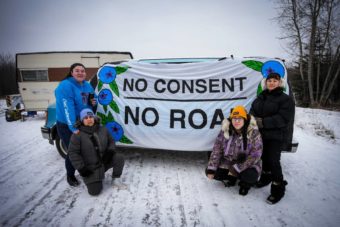
Four people on a snowy road holding a sign that says no consent, no road
Native Movement activists and others participating in the two-blockade included, from left: Nenana Native Association First Chief Caroline Ketzler, Enei Begaye, Deloole’aanh Erickson and Lindsey Maillard. (Photo by Jeff Chen/Native Movement)

Activists blocked a road leading into the Nenana Totchaket Agricultural Project for two days last week.

Members of Alaska-based Native Movement set up the blockade after work began on a road leading into the agricultural project, located in the Interior just west of Nenana. The activists want state officials to reconsider their plans for both the road and agriculture project.

“The state is proposing to expand a road through Nenana traditional territory, hunting and fishing grounds,” Fairbanks Native-rights advocate Enei Begaye said in a Facebook livestream from the scene on Oct. 31. “And it’s gotten to the point now where construction is about to start, and the tribe is out here blockading the road.”

Begaye is executive director of Native Movement, an Alaska-based nonprofit that promotes social justice and sustainability through Indigenous environmental practices. Members of the organization and their local allies say the state hasn’t fully consulted with local tribal and community members. And they say it’s moving too quickly to develop the 140,000-acre Nenana project.

So they blocked the road leading into the project just as the contractor apparently was about to begin work.

State officials say they’ve been planning to develop the land for about 40 years and have held several public meetings during that time. They say it’s now time to move ahead on the project, which they say will improve Alaska’s food security. The state Department of Natural Resources auctioned the first 2,000 acres of agricultural land this summer, and it’s planning a second sale within the next couple of years.

But local tribal and community members say the state’s approach to developing the agriculture project is a form of industrialized farming that will deplete the land and disrupt its ecology. They say the state should include traditional farming practices and uses for the land that don’t have such a large environmental footprint.
“The tribe asked Native Movement to organize and physically blockade the bridge before any equipment could be moved across to the road,” said Lindsey Maillard, an environmental justice coordinator with Native Movement. She and fellow members of the group and others from the Nenana Native Association and Village Council, participated in the blockade, along with members of the community.

Blockade activists say more than two dozen members of the community stopped by to offer help and support for the protest. From left, Marcus Titus, Tara Colleen and Nathan, who didn’t give his last name, stopped by to split some wood and start a fire to cook up a big pot of moose stew. (Photo by Jeff Chen/Native Movement)

Maillard said they wanted to prevent construction equipment from entering the area. But local residents were allowed to trap, cut firewood and other traditional uses.

“Anyone could go through, but we were just not wanting the equipment to make it to the other side,” she said.

State Transportation Department spokesperson Danielle Tessen said that’s not what the workers were doing.

“Our construction team was not on-site,” she said, “meaning, we weren’t crossing the bridge.”

Tessen said the activity the protesters saw was preparation for beginning work on the project by Brice, the Anchorage-based contractor that was awarded the $5.8 million contract to improve the 12-mile road into the Totchaket. A second phase of the project would extend the road another 19 miles to the Kantishna River

“Crews are mobilizing equipment,” she said, “and we’re working around the construction site at our material sites. Which is what we would do at the start of any construction project.”

Tessen said DOT and contractor representatives decided last week to delay moving ahead on the road project after meeting with local residents and tribal members to talk about their concerns.

“We’ve been taking time to really reflect on that conversation,” she said. “And we will be hosting another listening session that will be open to the public.”

Tessen said the meeting will be held later this month, and DOT’s still working on when and where it’ll happen.

Maillard said Native Movement would welcome more talks, and she assumes local tribal officials would be, too.

Nenana Native Association First Chief Carolyn Ketzler wasn’t available Thursday to comment.

Tessen said officials with other state agencies involved in the project also may be invited. That likely would include the Department of Natural Resources, which is overseeing the agriculture project. DNR officials didn’t respond to requests for comment Thursday.

Western Arctic Caribou Herd decline continues, bringing population to a third of peak size

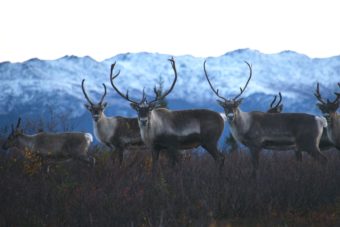
Five caribou seen up close, with snowy mountains behind them. Three of the caribou are looking straight at the camera.
A group of Western Arctic Herd caribou pause in front of mountains in Kobuk Valley National Park during fall migration in 2016. The Western Arctic herd, one of the largest in the world, has been in decline for the past two decades. The 2022 census shows that the decline is continuing. (Photo by Kyle Joly/National Park Service)

One of the world’s biggest caribou herds is continuing a long-term population slide, according to new numbers released this week by the Alaska Department of Fish and Game.

The Western Arctic Caribou Herd is down to 164,000, a decline of 24,000 from the population count made last year and roughly a third of the peak herd populations last reached in the early 2000s, according to the numbers.

There is no obvious reason for the past year’s decline, but it is not surprising, said Alex Hansen, a Kotzebue-based Alaska Department of Fish and Game biologist who is part of the team monitoring the herd. “We’ve seen, for the last number of years, reduced cow survival,” Hansen said.

The Western Arctic Caribou Herd is, in most years, the largest of Alaska’s 32 herds. Its range covers a nearly California-sized swath across Northwest Alaska that stretches from the North Slope in the summer to the eastern Seward Peninsula in the winter.

The annual census is the product of radio tracking, on-site North Slope observations and high-resolution aerial photography that allows biologists to count and categorize individual animals. The work is meticulous, Hansen said. “If we report a number, it’s a good estimate,” he said, noting that the population figures reported include a range known as a confidence interval.

Caribou herds are known to fluctuate widely in size, and the Western Arctic herd’s record since 1970 shows it is no exception. Since then, the herd has veered between a low of about 75,000 in the late 1970s to a high of nearly 500,000 in 2003.

The herd is important to Indigenous villagers in northern Alaska who depend on the animals for food and for cultural traditions. That potentially makes the herd’s decline a problem.

“I can’t say that it isn’t concerning. It depends on what your needs and purposes in life are,” Hansen said. There has been local concern expressed about the caribou’s present population, he said, “because folks rely on them.”

The herd has been at the center of a debate over the proposed Ambler Mining District Industrial Road, a 211-miles project that would cut through the Brooks Range foothills – and a large swatch of the caribou’s range – to connect an isolated copper-mining district with Alaska’s existing road system.

The road, proposed by the Alaska Industrial Development and Export Authority, is needed to make mining commercially viable, argue proponents. But tribal governments and other organizations have consistently opposed the road, citing threats to the Western Arctic herd. In the past, members of the Western Arctic Caribou Herd Working Group, which comprises community residents, hunting guides, environmentalists and other interested parties, have expressed opposition.

The working group makes recommendations about hunting regulation and other management issues. It is scheduled to hold its annual meeting in December.

Caribou and reindeer populations have been declining around the circumpolar north.
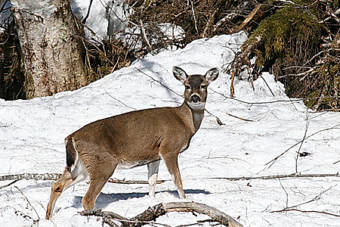
The 2018 Arctic Report Card issued by the National Oceanic and Atmospheric Administration noted that the migrating populations of caribou and reindeer have declined 56% over the prior two decades. . Only two of the cited 22 regularly monitored herds had populations at or near historic highs, and some once-large herds in Canada have collapsed almost entirely, that report said.

Arctic climate change is considered to be a likely culprit. Threats from climate change include vegetation changes and a shift in both summer and winter conditions. Through “shrubification,” plants covering tundra are transitioning from the lichen and mosses that are ideal caribou food to woody shrubs that are not, scientists have said. Warmer winters increase the frequency of dangerous rain-on-snow events, and warmer summers increase risks of disease spread, scientists say. Other threats to caribou populations come from development that has fragmented habitat, they say.

The decline of the Western Arctic herd may leave the Porcupine Caribou Herd, which has a range that straddles northeastern Alaska and northwestern Canada, as the state’s largest. The most recent census, conducted in 2017, put that herd population at between 202,000 and 235,000. The Porcupine herd has long been at the center of another development controversy: long-proposed oil drilling in the coastal plain of the Arctic National Wildlife Refuge. That coastal plain is the heart of the herd’s calving grounds.

This story originally appeared in the Alaska Beacon and is republished here with permission.

Scientists present theories for deer decline at Prince of Wales Island deer summit

Participants in the three-day unit II deer summit walk around Harris River to view thinning techniques on Oct. 15. (Photo by Raegan Miller/KRBD).

On Prince of Wales Island, an important food source is disappearing. For years, populations of Sitka black-tail deer have slumped, leaving residents without a staple source of protein.

A three-day summit held in Craig last month prompted lengthy discussions about the problem. Scientists have a few theories about why deer populations have declined.

On a Saturday afternoon, and 30-odd biologists, residents and local leaders walked along the looping Harris River trail, 20 or so miles east of Craig, the biggest town on Prince of Wales Island.

The 2022 Unit II Deer Summit was a three-day event that packed the Craig Tribal Hall with representatives from wildlife agencies and conservation groups, as well as interested locals who wanted to share their opinions.

The summit was organized by a steering committee made up of Alaska residents like Dennis Nickerson from the Prince of Wales Tribal Conservation District, Ross Dorendorf and Tessa Hasbrouck from the Alaska Department of Fish and Game, and representatives from the Natural Resources Conservation Service, the University of Alaska Fairbanks, and the Southeast Alaska Conservation Council.

It was more than two years in the making, and officially kicked off on Oct. 13, ending Oct. 15.


Attendees mingle during the summit at the Craig Tribal Hall. (Photo by Raegan Miller/KRBD).

The Harris River walk capped the summit. It was meant to drive home the theories presented for why the island’s deer population is plummeting – such as poor habitat management and a legacy of clear-cut logging.

When loggers cut down a section of old growth Sitka spruce, hemlock and cedar in the Tongass National Forest, there’s no need to replant — trees grow back on their own.

And while that sounds like a good thing, it can wreak havoc on the food web.

U.S  Forest Service Wildlife Technician Ray Slayton stopped to take in the sights. He pointed to a stand of trees packed tightly together. It’s all natural regeneration from a clear cut in 1960. He pointed to the forest floor, lined with dead leaves, sticks, moss and dirt.

“What you see is there’s no forage for deer at all,” he said.

It’s what scientists call an “even-aged forest.” When trees all start growing at the same time, they create a dense canopy that prevents light from reaching the ferns and berry bushes that black-tail deer love to snack on. And because the trees grow close together, they end up long and spindly — not the massive, thick, tight-grained trunks that make old growth lumber so highly valued.

One big way to address the problem is by cutting down some immature trees to open up the canopy. It’s called thinning.

Mike Sheets, from the U.S. Forest Service, explained on the walk that half the trail has been thinned in various ways. Some stands were cut in a kind of herringbone pattern, while others were thinned near the top or the bottom. This was all done to try and encourage more foraging opportunities and open up travel corridors for deer.

Habitat loss is one of the major theories for why deer have been disappearing from the island.

Back at the Craig Tribal Hall, biologist John Schoen from the Alaska Department of Fish and Game told summit attendees that old growth forests are a key habitat for deer. He says old growth keeps too much snow from accumulating on the ground and provides plenty of food beneath the trees.

But second growth is another story – without management, there’s little to feed deer.

Jim Baichtal is the regional coordinator for the Mule Deer Foundation. He said forest managers need to prioritize habitat restoration.

“What we need most now is a commitment for radical large-scale restoration … that focuses on fixing the right places,” he said.

He said strict management of young growth is essential. He said managers should use radar to determine where trees need to be thinned. And he said that the Forest Service should figure out how to make thinning an attractive business proposition for loggers.

“We need to write prescriptions for stem exclusion phase young growth that will remain wind firm and create meaningful, accessible forage for the near future. We need to develop these prescriptions knowing that multiple entries may be needed through time to continue creating forage. We need to have a market for the logs produced by these prescriptions and plan for utilization of the biomass created to allow access through the stands,” read a slide from Baichtal’s presentation at the summit.

But habitat loss isn’t the only theory. A number of factors are thought to be at play — including the management of predators.

As one attendee put it,  “… Wolves and weather and habitat and hunting, that sums up a lot of it.”

Ecology professor Sophie Gilbert presented data that showed it could be due to how aggressively black bears prey on fawns. In one study, Gilbert said her research shows that black bears will kill 50% of fawns sometime within their first two weeks of life. Gilbert says does are known to keep twin fawns apart from each other, so if one is eaten, the other still has a chance at survival.

“Black bear just dominate neonatal mortality,” Gilbert said.

Gilbert also said that harsh winters — known as killing winters — can quickly cull a deer population. She said there hasn’t been a killing winter since 1976. But some attendees worried climate change could cause problems.

“So basically, if there’s not snow, everybody can usually make it to the fall or the spring, but if there’s snow, a bunch of fawns are going to die,” Gilbert said.

One of the most popular theories among Prince of Wales Island residents is that wolves are behind the drop in deer numbers.

Craig’s mayor, Tim O’Connor, said wolves need to be thinned out. State wildlife officials estimate that somewhere between 100 and 200 wolves live on the island. But O’Connor said that’s a substantial undercount — he said based on what local hunters bring back, the real number is somewhere around 700 or 800.

Ross Dorendorf is the state’s Department of Fish and Game area biologist. He explained Prince of Wales Island’s wolves prey primarily on deer — it’s more than half their diet.

He said deer can be a safer option for a hungry wolf than taking on a goat or a moose.

There’s different challenges for a wolf, in going after these critters,” Dorendorf explained. “A moose is a lot bigger and requires a certain skill set to not be killed yourself, when you’re trying to eat that animal. They can stomp you, they’re pretty dangerous. And then other challenges for (hunting) a mountain goat might be really steep terrain and running after it, (the wolf) falls off a cliff. That’s not very good.”

A graph from Ross Dorendorf’s presentation showing the breakout of a wolf’s diet. (Courtesy of Jess Forster and Mandy Park).

But he said there’s more to study to understand what role wolves play in the declining deer population.

The meeting wasn’t meant to end with a plan to fix the problem. Organizers pitched it as a place to voice concerns and opinions and learn more about the issue. Some attendees suggested cutting back on old growth logging. Others suggested thinning out predators and cutting deer bag limits.

But one thing is clear: there are no easy answers.

Raegan Miller is a Report for America corps member for KRBD. Your donation to match our RFA grant helps keep her writing stories like this one. Please consider making a tax-deductible contribution at KRBD.org/donate.

Site notifications
Update notification options
Subscribe to notifications