ProPublica

Alaska says it’s now legal ‘in some instances’ to discriminate against LGBTQ individuals

The Alaska Capitol on Tuesday, June 1, 2021. (Nat Herz/Alaska Public Media)

This article originally appeared in the Anchorage Daily News and ProPublica and was produced in partnership with ProPublica’s Local Reporting Network. ProPublica is a Pulitzer Prize-winning investigative newsroom. Sign up for The Big Story newsletter to receive stories like this one in your inbox.

In June 2020, after the U.S. Supreme Court ruled that workplace discrimination against people based on their sexual orientation or gender identity was illegal, Alaska quickly moved to follow suit.

It published new guidelines in 2021 saying Alaska’s LGBTQ protections now extended beyond the workplace to housing, government practices, finance and “public accommodation.” It updated the website of the Alaska State Commission for Human Rights to explicitly say it was illegal to discriminate against someone because of that person’s sexual orientation or gender identity.

The executive director for the state commission co-wrote an essay describing the ruling as a “sea change under Alaska law for LGBTQ+ individuals’ rights to be free from discrimination.”

But a year later, the commission quietly reversed that position. It deleted language from the state website promising equal protections for transgender and gay Alaskans against most categories of discrimination, and it began refusing to investigate complaints. Only employment-related complaints would now be accepted, and investigators dropped any non-employment LGBTQ civil rights cases they had been working on.

An investigation by the Anchorage Daily News and ProPublica found the decision had been requested by a conservative Christian group and was made the week of the Republican primary for governor, in which Gov. Mike Dunleavy was criticized for not being conservative enough. The commission made the change on the advice of Attorney General Treg Taylor and announced it publicly via its Twitter feed — which currently has 31 followers — on Election Day.

The LGBTQ advocacy nonprofit Identity Alaska called the reversal “state-sponsored discrimination.”

The group noted that discrimination against LGBTQ people can occur in a variety of domains, including housing, financing and other decisions by the state. “The real-world consequences of these policies are harms to LGBTQIA+ Alaskans,” Identity Alaska’s board said in a written statement to the Daily News and ProPublica.

“Without regard to sexual orientation or gender identity, all Alaskans should be protected against discrimination at the Alaska State Commission for Human Rights,” the statement said.

Robert Corbisier, who has been executive director of the Alaska State Commission for Human Rights since 2019, said the attorney general directed him to make the change in an email, though Corbisier said he would not provide the news organizations with a copy of it. He said that Taylor said the Supreme Court case, known as Bostock v. Clayton County, was limited to employment discrimination and therefore the agency should limit its own enforcement to employment matters, unless the state Legislature expanded its authority.

Taylor is Dunleavy’s third attorney general appointee. The governor’s first choice, Kevin Clarkson, resigned in August 2020 when the Daily News and ProPublica reported he sent hundreds of unwanted texts to a colleague. Dunleavy’s next nominee to lead the Alaska Department of Law, Ed Sniffen, resigned as the newsrooms were preparing an article about a woman who had accused him of sexual misconduct that occurred in 1991. (Based on those accusations, the state charged Sniffen with three felony counts of sexual abuse of a minor. He has pleaded not guilty and is awaiting trial.)

Alaska Gov. Mike Dunleavy follows Deputy Attorney General Treg Taylor into a news conference at the governor's Anchorage office on Friday, Sept. 27, 2019.
Alaska Gov. Mike Dunleavy follows Deputy Attorney General Treg Taylor into a news conference at the governor’s Anchorage office on Friday, Sept. 27, 2019. (Photo by Nat Herz/Alaska Public Media)

Taylor refused to be interviewed. In response to questions about the timing and purpose of his communications with the commission, his office provided a written statement.

“The Department of Law’s role is to provide legal advice to state government based on the law. The department does not make policy. Policy decisions are left up to the department’s clients, which include most executive branch departments, divisions, agencies, boards and commissions, including ASCHR,” Taylor said. “As necessitated by changes in the law or the need to correct prior advice, the department will update the advice it has previously provided to its clients.”

The office noted that Alaska joined other states in suing the federal government in August 2021 to block the application of the Bostock decision to LGBTQ people in schools and government jobs. A federal judge sided with the states and issued a preliminary injunction last year; the federal government is appealing.

Dunleavy declined interview requests. In a written statement, a spokesperson said, “The Governor’s office was not involved in the Department of Law’s legal advice on LGBTQ+ discrimination cases.”

Asked why the commission changed its policy based on a brief communication from the attorney general, Corbisier said, “The attorney general is counsel to the agency. And, I mean, I’m a lawyer. I’ve been in private practice. I think you should do what your lawyer tells you to do.”

The human rights commission describes itself as an impartial, nonpartisan arm of state government. Dunleavy ordered an investigation into the former executive director in 2019, for example, after she made a post to the agency’s Facebook page criticizing a “black rifles matter” sticker as racist.

The post drew an outcry from Alaska conservatives and gun owners, and the director was suspended for 15 days. She soon resigned, followed by the commission chairman, a gay Black man. Both said at the time that they hoped their departures would help the commission put the controversy to rest and allow it to resume its work.

The current commission chairperson said he once filed an equal opportunity employment complaint claiming he had been passed over for a job in the U.S. Army because he is a man. He has in the past year posted tweets questioning the validity of transgender identity.

“So this Roe v. Wade leak is said to be a preview of an attack against women. To the Left, what’s a woman,” the chair, Zackary Gottshall, tweeted on May 3, 2022. Two months later he retweeted a statement by Rep. Jim Jordan, R-Ohio, saying, “Crazy this needs to be said, but men can’t get pregnant.”

Asked by the Daily News and ProPublica about his views on transgender issues, Gottshall wrote: “As per my religious beliefs and convictions, I believe in the family unit as a whole, that being a primary social group consisting of parents and children. Everyone has the right to define themselves and/or identify themselves as they see fit. Everyone also has the right to respectfully disagree based upon the protections under the 1st Amendment.”

Gottshall’s wife, Heather Gottshall, served as campaign field director for Kelly Tshibaka, who lost to incumbent Republican Sen. Lisa Murkowski last year. As a Harvard Law student, Tshibaka wrote in support of an organization that advocated for gay conversion therapy, stating that “unlike race or gender, homosexuality is a choice.” Heather Gottshall also is one of three registered directors for a nonprofit called Preserve Democracy, created by Tshibaka in December.

The commission reelected Zackary Gottshall as chairman at its annual meeting on Feb. 22.

State law does not explicitly offer civil rights protection to gay and transgender people.

But under federal law, Title VII of The Civil Rights Act of 1964 “prohibits employment discrimination based on race, color, religion, sex and national origin.”

With the Bostock ruling, the U.S. Supreme Court found sex discrimination includes discrimination against people based on sexual orientation or gender identity. In Alaska, the state Supreme Court has found that Title VII of the Civil Rights Act provides the framework for Alaska’s civil rights laws.

It was based on that precedent that the Alaska State Commission for Human Rights began accepting all categories of anti-LGBTQ discrimination complaints in 2021.

“The guidance we received from the Department of Law was, ‘You should be taking all LGBTQ cases’” in the areas in which the commission has jurisdiction, Corbisier said in a recent interview. “So employment, public accommodation, sale and rental of real property, credit and financing, and government practices. Retaliation is also a covered jurisdiction.”

That legal advice, he said, came from Kevin Higgins, an assistant attorney general assigned to advise the commission.

Neither Higgins nor Corbisier would provide the written advice, saying it was covered by attorney-client privilege.

Even so, the advice from the state Department of Law suggested that the Bostock decision had broader implications for LGBTQ rights in Alaska.

“We started thinking we had the ability to take cases across the board,” Corbisier said.

Jim Minnery, the president of the conservative Christian group Alaska Family Council, became aware of the new policy. The family council does not hesitate to criticize Republican candidates for what it considers to be too liberal a view of LGBTQ issues.

“The AK State Commission on Human Rights is simply another bureaucracy trying to seize power to make its own laws. This can’t pass in Juneau through elected office holders so they’re trying to pull an end run,” Minnery said in a text message.

Minnery said his group informed the Dunleavy administration in the beginning of 2021 that “the ASCHR was trying to use the Bostock ruling to circumvent having to pass legislation.”

The attorney general’s office said Minnery’s group did not influence its guidance.

What is clear, however, is that around the time of last year’s primary election, the attorney general personally got involved.

Unlike in most states, the Alaska attorney general is appointed by the governor rather than elected.

Dunleavy appointed Taylor as acting attorney general after Sniffen resigned in January 2021. Taylor had twice run unsuccessfully for local political office. Since becoming attorney general, he has appeared on public records as the director for a group that paid for attack ads on Democratic candidates during the 2022 election cycle and is advertised as the host for a $15,000-a-head fundraiser the group is planning this summer.

Dunleavy entered the summer facing two well-funded Republicans who positioned themselves as more conservative than the incumbent.

On a July 8 talk radio show in Kenai, host Bob Bird called on the governor’s spokesperson to explain why Dunleavy had settled a federal lawsuit that now allowed public funds to be used for transgender surgeries and hormone treatments.

What would Dunleavy do, Bird hypothesized, if the Supreme Court “ruled that white males were not fully human,” according to an account by the conservative faith-based news website Alaska Watchman.

“At what point would say a governor, a so-called conservative governor, say we’re just not going to obey that because white males are human beings?” Bird asked, according to the website.

The Dunleavy spokesperson, Dave Stieren, said he had asked the same question in an effort to understand the state’s choices for paying for gender-affirming surgeries, the site reported. He said his understanding, at the time, was that Alaska’s federal Medicaid funding was at risk if the state refused the payments.

Bird at one point told the governor’s spokesperson: “The people will rally to somebody who shows spine.”

On July 11, the commission received a briefing on the status of LGBTQ protections in Alaska at the request of Gottshall. According to a copy of the briefing, provided by Gottshall, the commission at that time was still investigating all categories of discrimination against Alaskans based on gender identity and sexual orientation.

Within the next few weeks, the director for the state human rights commission received a new email about the Bostock ruling and LGBTQ rights law in Alaska. This time it was from the attorney general himself, Corbisier said in a phone interview.

He said the email was “not a formal AG opinion.”

“The substance of it was, you know, ‘Your jurisdiction is for LGBTQ, is just employment,’” he said.

The Department of Law has not yet responded to a records request for the email.

It’s unclear when Taylor sent the email, but Corbisier said it was just before the commission posted a note about the change to Twitter and Facebook on Aug. 16, the day of the primary election.

“Based upon updated legal advice, ASCHR will only be able to take LGBTQ+ employment discrimination cases filed under AS 18.80.220. Our position that LGBTQ+ discrimination applied to places of public accommodation, housing, credit/financing, and government practices is void,” the social media posts said.

The agency issued no press release saying it was rolling back enforcement of equality laws. There was no essay or editorials. The human rights commission’s social media posts reached only a smattering of followers on the day of the statewide primary elections.

The commission also began deleting language from its website.

The homepage, as of Aug. 15, had stated, “In Alaska it is illegal to discriminate in employment, places of public accommodation, sale of rental or real property, financing and credit, practices by the state or its political subdivisions because of race, color, religion, sex, sexual orientation / gender identity or ‘expression,’ national origin, physical disability.”

According to the Internet Archive, the page was changed sometime between Aug. 16 and Aug. 18 to remove the words: “sexual orientation / gender identity or ‘expression’” from the list of reasons it is illegal to discriminate against someone.

A line was added lower on the page saying that it is “in some instances” illegal to discriminate against someone based on sexual orientation and gender identity.

Elsewhere on the website, the commission removed a link to a document called “ASCHR LGBTQ Discrimination Guide.”

In the meantime, the commission stopped accepting complaints of LGBTQ discrimination except for those that are workplace related.

It’s unclear how many non-workplace complaints the commission received during the year it was accepting those cases. At first, Corbisier said he couldn’t provide that number because complaints are confidential under state law.

When reminded that the commission does publish an annual report that provides the number of complaints received based on the category of discrimination, Corbisier said, “You might have just caught me because I know we started tracking LGBTQ (complaints) when that jurisdiction originally changed.”

The director later called back to say no statistics would be available on the number and nature of anti-LGBTQ complaints the commission received because that information was not tracked within its database. (Any such complaints would have been filed under the more broad category of sex discrimination, he said.)

The commission’s 2022 annual report showed 134 complaints were filed in 2022, including 25 based on sex.

Brandon Nakasato served on the human rights commission from 2016 to 2019. He resigned as chairman around the same time the former director was suspended for publicly criticizing the “black rifles matter” sticker she saw on a truck in the agency’s parking lot.

It hasn’t been a smooth ride since. The agency made headlines in November 2022 when its former executive director, a black woman, sued the state saying that she was subjected to a hostile work environment, underpaid compared with past directors and fired because of her gender, race and status as a military veteran. The state denied the claims in a November answer to the lawsuit; the case is awaiting trial in federal court.

Nakasato had been part of an effort in 2016 to try and convince the Alaska Legislature, unsuccessfully, to change state law to enshrine civil rights protections for gay and transgender people so that the commission wouldn’t have to rely on the whims of judges.

“I think legislators need to hear how this lack of protection is hurting people,” he said. “I was one of those little gay kids that considered killing themselves, living in a rural area, who believes that they were the weirdest person on earth. And there are teens like that in the (Alaska) Bush right now who need to hear that their leaders are caring for them too.”

The US promised tribes they would always have fish, but the fish they have pose toxic risks

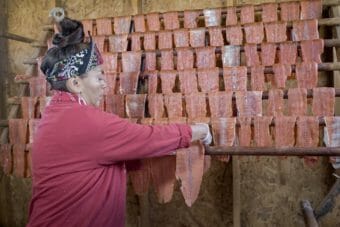
Lottie Sam, front right, and other women prepare salmon in Toppenish, Wash., before a ceremony held by the Confederated Tribes and Bands of the Yakama Nation. (Photo by Tony Schick/OPB)

This article was produced for ProPublica’s Local Reporting Network in partnership with Oregon Public BroadcastingSign up for Dispatches to get stories like this one as soon as they are published.

Salmon heads, fins and tails filled baking trays in the kitchen where Lottie Sam prepped for her tribe’s spring feast.

The sacred ceremony, held each year on the Yakama reservation in south-central Washington, honors the first returning salmon and the first gathered roots and berries of the new year.

“The only thing we don’t eat is the bones and the teeth, but everything else is sucked clean,” Sam said, laughing.

Her mother and grandmother taught her that salmon is a gift from the creator, a source of strength and medicine that is first among all foods on the table. They don’t waste it.

“The skin, the brain, the head, the jaw, everything of the salmon,” she said. “Everybody’s gonna have the opportunity to consume that, even if it’s the eyeball.”

Sam is a member of the Confederated Tribes and Bands of the Yakama Nation. They are among several tribes with a deep connection to salmon in the Columbia River Basin, a region that drains parts of the Rocky Mountains of British Columbia, Canada, southward through seven U.S. states into the West’s largest river.

It’s also a region contaminated by more than a century of industrial and agricultural pollution, leaving Sam and others to weigh unknown health risks against sacred practices.

“We just know that if we overconsume a certain amount of it that it might have possible risks,” Sam said as she gutted salmon in the bustling kitchen. “It’s our food. We don’t see it any other way.”

But while tribes have pushed the government to pay closer attention to contamination, that hasn’t happened. Regulators have done so little testing for toxic chemicals in fish that even public health and environmental agencies admit they don’t have enough information to prioritize cleanup efforts or to fully inform the public about human health risks.

So Oregon Public Broadcasting and ProPublica did our own testing, and we found what public health agencies have not: Native tribes in the Columbia River Basin face a disproportionate risk of toxic exposure through their most important food.

OPB and ProPublica purchased 50 salmon from Native fishermen along the Columbia River and paid to have them tested at a certified lab for 13 metals and two classes of chemicals known to be present in the Columbia. We then showed the results to two state health departments, U.S. Environmental Protection Agency officials and tribal fisheries scientists.

A laboratory analyst processes salmon filets for testing at a lab in Washington. (Photo by Kristyna Wentz-Graff/OPB)

The testing showed concentrations of two chemicals in the salmon that the EPA and both Oregon and Washington’s health agencies deem unsafe at the levels consumed by many of the 68,000-plus Native people who are members of tribes living in the Columbia River Basin today. Those chemicals are mercury and polychlorinated biphenyls, or PCBs, which after prolonged exposure can damage the immune and reproductive systems and lead to neurodevelopmental disorders.

The general population eats so little fish that agencies do not consider it at risk, which means that government protocols are mostly failing to protect tribal health. In fact, the contaminants pose an unacceptable health risk if salmon is consumed even at just over half the rate commonly reported by tribal members today, according to guidelines from the EPA and Washington Department of Health.

Source: Data obtained by Oregon Public Broadcasting and ProPublica. Average diet figures from EPA surveys of the Nez Perce Tribe and the general population, and fish advisory guidance from the EPA. Additional information can be found in the methodology section below. Illustration by Irena Hwang/ProPublica.

The potential for exposure extends along the West Coast, where hundreds of thousands of people face increased risks of cancer and other health problems just by adhering to the salmon-rich diet their cultures were built upon.

Chinook salmon, like the ones OPB and ProPublica sampled, migrate to sea over the course of their lives, where they pick up contaminants that Northwest waters like the Columbia and other rivers deposit in the ocean. EPA documents obtained under the Freedom of Information Act show that even with minimal data available, agency staff members have flagged the potential for exposure to chemicals in salmon caught not just in the Columbia but also Washington’s Puget Sound, British Columbia’s Skeena and Fraser rivers, and California’s Sacramento and San Joaquin rivers.

The Columbia River faces many pollution threats, including from mining. Two reports have found that a tailings dam at British Columbia’s Copper Mountain, 25 miles north of the Washington border, has a probability of failing and flooding communities and tributaries of the Columbia with poisonous sludge. (Photo by Kristyna Wentz-Graff/OPB)

Tribes entered into treaties with the U.S. government in the mid-1850s, ceding millions of acres but preserving their perpetual right to their “usual and accustomed” fishing areas; the Supreme Court later likened this right to being as important to Native people as the air they breathe.

But time and again, the U.S. has not upheld those treaties. Damming the Columbia River destroyed tribal fishing grounds and, along with habitat loss and overfishing, drove many salmon populations to near extinction, wiping some out entirely. Previous reporting has shown how the federal government failed in its promises to compensate tribes for those losses and in some cases worked against tribes’ efforts to restore salmon populations. In addition, the EPA has allowed cleanups to languish, and state regulators have been slow to rein in industrial pollution. That toxic pollution impairs the ability of salmon to swim, feed and reproduce.

Continually poor and declining salmon numbers have prompted the White House to acknowledge an environmental justice crisis in the Columbia River Basin.

The results of our testing for toxic chemicals point to yet another failure.

Salmon, first image, is prepped for a variety of tests, including evaluating for the presence of mercury, second image. (Photo by Kristyna Wentz-Graff/OPB)

A toxic mystery

Questions over fish safety go back generations in some tribal families, predating government concerns by decades.

Karlen Yallup remembers tribal elders telling her the water had been clean enough to drink at Celilo Falls, their primary fishing site on the Columbia River. Yallup’s great-great-grandparents, members of the Warm Springs tribe, lived near the falls and would fish there every day.

As the industrial revolution boomed, farming, industry and urban sprawl grew throughout the basin. In 1957, the falls were submerged by water that pooled behind The Dalles Dam — one of 18 built on the Columbia and its main tributary, the Snake River, to turn the river into a shipping channel, irrigate farmland and generate hydroelectricity. By then, pollution from those new industries had dirtied the water.

Tribal elders told Yallup they knew the water was no longer clean enough to drink when they could see changes and hear differences in the way it ran. They also worried about the health impacts of Hanford, a sprawling nuclear weapons production complex dozens of miles upstream. Hanford became one of dozens of heavily polluted sites across the Columbia basin, considered one of the largest and most expensive toxic cleanups in the world.

Yallup said her elders began to suspect that whatever was getting into the water was getting into the fish. They became “very worried about the salmon getting the family sick,” she said.

It wasn’t until the 1990s, however, that the government and the broader public drew attention to the risk to people eating those fish.

In 1992, despite two decades of improving water quality under the Clean Water Act, an EPA study found chemicals embedded in carp from the Columbia River. The results alarmed the region’s tribes, which responded by working with the agency to test more fish and survey members about their fish consumption rates.

Those efforts revealed that tribal people, on average, eat six to 11 times more fish than non-tribal members. They also detected more than 92 different contaminants in the fish, some at levels high enough to harm human health.

In the years that followed, EPA staff expressed concerns over toxic contamination in report after report, but little happened in response. The issue officially became an agency priority during the administration of President George W. Bush, but the EPA repeatedly fell short of its goals to clean up toxic sites as responsible parties fought over how much it would cost, who would pay and how quickly it needed to be done.

The agency also never had the money to fulfill its plans for continuous monitoring, said Mary Lou Soscia, the Columbia River coordinator for the EPA, leaving the agency unable to determine whether the river was getting cleaner.

“Nobody wanted to pay attention to toxics,” said Soscia, who has been working on river cleanup since the late 1990s. “But there are small amounts of studies that give us like those yellow blinking lights. And when tribal people eat so much fish, it’s something we have to be really, really concerned about.”

Finally, Oregon delivered in 2011 what was hailed as a breakthrough moment: It adopted new water-quality standards to protect tribal people’s health. The state vowed to restrict the amount of chemicals released by industrial facilities and wastewater plants so that people could eat over a third of a pound of fish per day without increasing their risk of health problems. That amount of fish was based on a survey of tribal members done in the 1990s.

Other states that share the Columbia River or its tributaries were slow to follow suit. Washington waited a decade to adopt equally protective standards; Idaho and Montana still have not.

But while Oregon was ahead of its neighbors, state regulators took few steps to ensure polluters actually met the state’s new limits. For as many as half the contaminants at issue, the state said it didn’t have the technology to measure whether polluters met the new stricter criteria.

The Oregon Department of Environmental Quality also said it didn’t have the staff to keep pollution permits updated. It let more than 80% of polluters operate with expired permits, meaning they weren’t even being held to new standards.

When asked in September for evidence of how the state’s highly touted standard has actually improved water quality, the DEQ said it “does not have significant amounts of data on the concentration of bioaccumulative pollutants in the Columbia River, and therefore does not have any trend information.”

Jennifer Wigal, DEQ’s water quality administrator, said the standards were implemented not because of pollution but to ensure that tribal diets were represented.

Wigal also said that when companies release harmful contaminants into the river, most are at such low concentrations that they are below the agency’s ability to detect them. Additionally, most of the contamination affecting fish, the DEQ said, comes not from those polluters but from runoff and erosion from industries like agriculture and logging.

But the DEQ also has yet to curtail that source of pollution. Along the Willamette River, which flows through Oregon’s most populated areas and feeds into the Columbia, the EPA determined last year that the state needed to cut mercury pollution from these sources by at least 88% if it was going to meet its standards for protecting human health.

Congress tried to take matters into its own hands, but it fell into the same pattern of bold plans and delayed action. In 2016 it amended the Clean Water Act, the seminal law governing water pollution nationwide, to require the EPA to establish a program dedicated to restoring the Columbia. It took four years and a nudge from the Government Accountability Office for the program to actually begin. That same year, in 2020, an EPA regional staffer found that broad swaths of the river were polluted with toxic chemicals and were below the standards of the Clean Water Act.

In an emailed response to questions, the EPA repeatedly said Congress gave the agency orders to clean up the Columbia but failed to provide the agency with funding to carry out the work. Even after the agency designated the Columbia an EPA priority, finally elevating the river to the same status as other major ecosystems like the Great Lakes and the Gulf of Mexico, it received no additional funding and staff for cleanup or long-term monitoring.

“That needs to happen,” Soscia, the agency’s Columbia River coordinator, said. “It hasn’t happened.”

A disproportionate risk

Had the government followed through on its plans for monitoring, it might have found what OPB and ProPublica’s testing revealed: that contamination was high enough that it would warrant at least one of the state health agencies to recommend eating no more than eight 8-ounce servings of salmon in a month.

For non-tribal people, who on average eat less than those eight monthly servings, the risk is minute. But surveys show members of some tribes in the Columbia River Basin on average eat twice as much fish as the agency’s recommended eight monthly servings.

The testing also revealed the potential for increased cancer risks from PCBs and another class of chemicals known as dioxins. Given an average Columbia River tribal diet, according to recent surveys commissioned by the EPA, the risk is as much as five times higher than what the EPA considers sufficiently protective of public health. This means that, based on the news organizations’ samples, roughly 1 of every 20,000 people would be diagnosed with cancer as a result of eating the average tribal diet — about 16 servings of fish each month — over the course of a lifetime.

The harm goes beyond the raw numbers. That’s because the risk is compounded by exposure from other fish and other toxic chemicals, such as pesticides and flame retardants in those same waters, that weren’t included in OPB and ProPublica’s testing because of cost constraints. Those chemicals are known to accumulate in fish. Beyond fish contamination, tribal populations already experience disproportionately high rates of certain cancers.

Public health officials caution that any cancer risks must be weighed against the many health benefits of eating fish, including the potential to lower the risk of heart disease. The Oregon and Washington health departments, like those of many states, do not assess cancer risk when setting public health advisories.

We showed the result of our testing to public health officials in both Washington and Oregon. Both groups said they would be taking further steps to assess salmon and the exposure risk to tribes.

Emerson Christie, a toxicologist with the Washington Department of Health who analyzed the results, said the department will consider whether to issue an official public health advisory based on the news organizations’ findings. “These results do indicate that there’s a potential for a fish advisory,” Christie said.

David Farrer, an Oregon Health Authority toxicologist who also reviewed the results, said the agency would coordinate with state environmental regulators and the Columbia River Inter-Tribal Fish Commission about additional testing or potential advisories.

Public health advisories and cooking guidance are a last-resort attempt to protect people when larger cleanup efforts fall short or don’t happen at all.

These advisories can also be plagued with delays. When tribes collected and tested tissue from the Pacific lamprey back in 2009, they found that the culturally important eel-like fish contained dangerous levels of mercury and PCBs. The Oregon Health Authority responded by issuing a consumption warning in October — but the process took 13 years.

And while advisories put constraints on tribes’ traditional diets, they don’t help with the larger issue: that the waters from which they are eating fish are still contaminated — with no plan to clean them up.

“The long-term solution to this problem isn’t keeping people from eating contaminated fish — it’s keeping fish from being contaminated in the first place,” Aja DeCoteau, executive director of the Columbia River Inter-Tribal Fish Commission, said when the lamprey advisory was issued.

Members of the Yakama Nation scale the slippery rocks in the Willamette River near Oregon City, Ore., during the annual lamprey harvest in 2017. (Photo by Ian McCluskey/OPB)

Wilbur Slockish Jr. is a longtime fisherman who serves on the inter-tribal fish commission.

It is wrong, Slockish said, for the government to allow pollution and then, instead of cleaning it up, decide it can tell people not to eat the fish they always have.

“That’s on the back of our people’s health, the health of the land, the health of the water,” he said. “We’re not disposable.”

A fight too big to ignore

Slockish eats a lot of fish.

He relies on stockpiles of jarred, dried or smoked salmon to get him through the winter. He said it’s not uncommon for him to eat more than a pound of salmon or lamprey in one sitting, sometimes multiple times per day.

He’s a direct descendant of the Klickitat tribe’s Chief Sla-kish, who signed the Yakama Treaty of 1855, guaranteeing his people’s right to the fish. At that time, studies estimate that, on average, Native people in the region ate five to 10 times more fish than they do today. Slockish is not going to stop eating fish because of warnings about chemical contamination.

He doesn’t see the alternatives as any better. Many in his family have struggled with heart disease, diabetes and cancer. He connects it to their being forced away from the river and made to eat government-issued commodity foods full of preservatives.

“All of our foods were medicine,” he said. “Because there were no chemicals.”

Research across the globe has connected the loss of traditional diets with spikes in health problems for Indigenous populations. In one West Coast tribe, the Karuk of Northern California, researchers found a direct link between families’ loss of access to salmon and increased prevalence of diabetes and heart disease.

Public health experts agree that wild salmon, wherever it’s caught, remains one of the healthiest sources of protein available, and that chemicals can also contaminate other foods beyond just fish.

A member of the Confederated Tribes of Warm Springs prepares wind-dried salmon the traditional way, inside a drying shack, in September 2021. After she removes the heads and bones, the salmon is sliced into strips, salted and hung to dry for several days. (Photo by Arya Surowidjojo/OPB)

Tribal leaders also worry more about their members getting too little fish than too much of it. And because salmon are a primary income source for many tribal fishers, they worry that fears over fish safety will drive away customers.

But for Columbia River tribes, fish are also a cultural fixture, present at every ceremony. They are shared as customary gifts. Babies teethe on lamprey tails. Salmon heads and backbones are boiled into medicinal broths for the sick and elderly.

Tribes up and down the river continue to fight for their right to a traditional diet and to clean fish.

Yallup, from the Warm Springs tribe, decided to become an advocate for salmon after hearing from her grandmothers how much more limited their traditions had become.

She’s on track to graduate in December from Portland’s Lewis & Clark Law School. Yallup chose the law profession to fight for salmon, she said, and to change laws to protect the river from pollution.

“If I had a choice, I would just be a fisherman. I felt the responsibility to have to leave the reservation and have to go to law school,” Yallup said. “It’s such a big fight now. It’s kind of impossible to ignore.”

Earlier this year, tribes successfully lobbied for one of their Columbia River fishing sites just east of Portland, known as Bradford Island, to be added to the list of polluted places eligible for cleanup money from the federal Superfund program.

The east end of Bradford Island, where the U.S. Army Corps of Engineers dumped toxic materials into the Columbia River. The island was added to the list of polluted places eligible for cleanup money from the federal Superfund program. (Photo by Monica Samayoa/OPB)

In August, the EPA received $79 million to reduce toxic pollution in the Columbia River as part of President Joe Biden’s Bipartisan Infrastructure Law. It is the most money ever dedicated to reducing Columbia River contamination. It’s also a fraction of what tribes and advocates say is needed.

The Yakama Nation is using some of that EPA money to lead a pilot study into the kind of long-term monitoring that has been a recognized need for decades.

Laura Klasner Shira, an environmental engineer for Yakama Nation Fisheries, said the tribe put together four federal grants to pay for its pilot study, which is limited to the area around Bonneville Dam, east of Portland. They hope someday it could grow to span nearly the entire length of the Columbia, up to the Canadian border. But it took 10 years to get as far as they are now.

“It’s disappointing that the tribes have to take on this work,” she said, noting that government agencies not only have treaty and legal responsibilities but better funding. “The tribes have been the strongest advocates with the least resources.”

They will sample resident fish, young salmon on their way to the ocean, and adult salmon after they’ve returned.

They have two years to finish the work. After that, funding for their monitoring becomes a question mark.

Methodology

Oregon Public Broadcasting and ProPublica reporters conducted interviews and listening sessions with tribal leaders, toxicologists and public health experts, many of whom became informal advisers throughout the project. Tribal leaders expressed support and interest in additional fish testing. Based on these conversations, the reporters developed a preliminary methodology to test salmon for toxics in a stretch of the Columbia River. The reporters sent this methodology to the same informal advisers for review.

A reporter purchased 50 salmon from tribal fishers upriver of the Bonneville Dam, in the zone of the river reserved for tribal treaty fishing. The majority of the fish were fall Chinook salmon, with two coho salmon and one steelhead. The fish were caught in late September 2021. With the salmon in hand, a reporter gutted the fish, removed the heads and cut them into pieces so they would fit into five coolers. The fish were placed on ice in five different coolers, with 10 fish of roughly the same size placed in each cooler.

Testing of fish can be done on the whole body of the fish, on a fillet with the skin on or on a fillet with the skin removed. Although many people, particularly in tribal communities, consume the head of the fish, reporters asked the laboratory to test fillets with skin because it was determined to capture the best approximation of what’s most often consumed in tribal diets.

A reporter sent the fish samples to ALS, a certified laboratory, and followed ALS protocols for the collection and delivery of samples. The laboratory combined fish to create five new composite samples, each one with 10 fish. (Creating composite samples enables more fish to be tested without raising laboratory costs.) Then, ALS technicians conducted testing to assess levels of 13 metals and two classes of chemicals in each of the five fish samples. In March 2022, ALS sent OPB and ProPublica an analytical report that included the case narrative, chain of custody and testing results, which we again shared with experts and public health officials as we developed a plan to analyze the results.

As a first step, the reporters conducted quality assurance checks on the testing and processed the data. While doing so, the reporters encountered testing limitations that prompted them to make two choices that are standard in both national and international approaches to fish toxics testing:

  1. ALS tested for general mercury, yet methylmercury is the form that is most concerning to public health. The EPA and European Food Safety Authority assume 100% of mercury sampled in fish tissue is methylmercury. The reporters adopted the same approach.
  2. ALS tested for arsenic, yet inorganic arsenic is the form that is most concerning to public health. The reporters found that there isn’t as much of a cohesive approach toward identifying the proportion of arsenic that is inorganic without directly testing for it. The Idaho Department of Environmental Quality recently launched a sampling effort where researchers found that, on average, about 4% of the arsenic in fish is inorganic. The department’s study is one of the most robust examinations of inorganic arsenic concentrations near the Columbia River. The Oregon Health Authority takes a different approach. David Farrer, a toxicologist with the agency, said they would initially assume 10% of arsenic is inorganic and, if the results signaled the levels could harm human health, they would then reanalyze any leftover sample specifically for inorganic arsenic. If that were not possible, the health department would not use the data at all. Given these uncertainties, OPB and ProPublica chose not to move forward with assessing cancer risk of inorganic arsenic since the news organizations did not specifically test for it.

The reporters then calculated the average concentration of chemicals across each of the wet weight samples. They then assessed how these results compared to EPA, Oregon Health Authority and Washington Department of Health standards.

Of the 13 metals and two classes of chemicals tested, three contaminants surpassed federal and local standards at varying levels of fish consumption: mercury, or methylmercury; polychlorinated biphenyls, or PCBs; and dioxins/furans.

The reporters shared their methodology and findings with experts for review. Toxicologists with the Oregon Health Authority and the Washington Department of Health, as well as former and current EPA scientists, reviewed the results and, in some cases, conducted their own calculations to assess how the testing findings compared to their respective standards. The reporters then met with each of these individuals to talk through the findings, ask and answer questions, and ultimately update their own findings to incorporate feedback. The experts’ feedback was consistent with one another. This process led to the finding that concentrations of mercury (methylmercury) and PCBs would warrant the EPA and at least one state health agency to recommend eating no more than eight 8-ounce servings of salmon in a month. The equation used for these calculations can be found in this Oregon Health Authority report (Page 4) and this Washington Department of Health report (Page 35).

Simultaneously, OPB and ProPublica calculated the estimated cancer risk from consuming salmon with the contaminant levels found through our testing. For each contaminant, a reporter calculated the levels of exposure for multiple scenarios based on how different populations eat, including general population consumption and average and high rates for Columbia River tribes, which were based on consumption surveys. The amount of contamination assumed in this calculation was taken from the 95% upper confidence limit of the test results. Current and former EPA scientists reviewed the methodology and calculations.

To calculate lifetime cancer risk, the dose of a probable carcinogen must be multiplied by a cancer potency factor, which estimates toxicity. Cancer potency factors, also known as slope factors, were sourced from this EPA report. Former and current EPA officials, as well as an epidemiologist, reviewed the calculations and results.

We also factored in the following consideration: Under EPA guidance, when calculating safe levels of exposure to different chemicals, the agency calculates monthly limits to the exact number of meals a person should eat. But it then rounds that down to the nearest multiple of four in an effort to make risk communication easier to follow. For example, if one were to find that the levels of dioxins would warrant that someone only eat five fish per month to avoid excess cancer risks, that would be rounded down to the four fish per month.

Ultimately, this led to the finding that, based on the levels of dioxins in our samples, anything above four 8-ounce servings of these tested fish each month would create an excess cancer risk beyond the EPA’s benchmark of 1 in 100,000. That means of 100,000 people exposed to these levels of contaminants, one of them would develop cancer as a result of the exposure.

‘God, no, not another case.’ COVID-related stillbirths didn’t have to happen

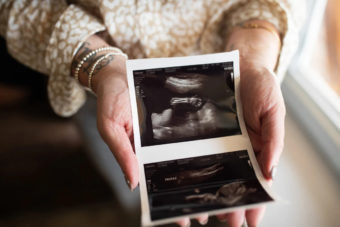
Ginger Munro holds the sonogram of her daughter Elliotte at her home in Ohio. Munro was hospitalized with COVID-19, placed on life support, and delivered her stillborn daughter at 27 weeks. Part of the image is blurred to conceal personal medical information. (Photo by Maddie McGarvey for ProPublica)

This story was originally published by ProPublica.

Content warning: This story contains descriptions of stillbirths.

Late one afternoon last October, Dr. Shelley Odronic sat in her office and, just as she had thousands of times before, slid a rectangular glass slide onto her microscope.

A pathologist who works in rural Ohio, Odronic leaned forward to examine tissue from the placenta of a woman who had recently given birth. She increased the magnification on the microscope. Never had she seen so many tiny, congealed reservoirs of blood or such severe inflammation of the tissue, a sign the placenta had been fighting an infection.

“Right away, I knew it wasn’t compatible with life,” Odronic said.

She asked her secretary to print out the patient’s chart. In dark letters were the words “fetal demise.” A stillbirth, the death of a fetus at 20 weeks or more of pregnancy. But that didn’t solve the mystery. Odronic had examined many placentas from pregnancies that ended in stillbirth. None looked like this — withered and scarred.

Dr. Shelley Odronic works in her office in Lima, Ohio. Odronic, a pathologist, noticed severe damage in the placentas of pregnant people who had COVID-19. (Photo by Maddie McGarvey for ProPublica)

Odronic kept reading. No chronic medical conditions. Good prenatal care. Then, buried in the middle of the report, she spotted something. Seven days before the stillbirth, the mother had tested positive for COVID-19. Odronic wondered if the virus could explain the damage to the placenta. In the world of placenta pathology, a new affliction is unusual, especially one so dramatic in presentation and so devastating in effect.

Her mind traveled to Dr. Amy Heerema-McKenney, a pathologist at Cleveland Clinic and an expert on the placenta, who had trained Odronic during residency. Odronic went to sleep that night with a pit in her stomach and a plan to call her former teacher in the morning.

Heerema-McKenney was in her office when the phone rang. As she listened, she knew that what Odronic was describing was what she and her colleagues had observed repeatedly over the past several months: a patient positive for the coronavirus, a placenta destroyed by COVID-19, a baby stillborn.

Their next discovery was equally stunning. None of the stillbirths they studied involved a pregnant person who had been fully vaccinated. The doctors checked with colleagues across the country and around the world. The fatal pattern held.

Placenta slides in Dr. Amy Heerema-McKenney’s office at the Cleveland Clinic. (Photo by Maddie McGarvey for ProPublica)
Heerema-McKenney, a placenta pathologist, works in the lab. She noticed the impact COVID-19 was having on placentas and stillbirths. (Photo by Maddie McGarvey for ProPublica)

Unvaccinated women who contracted COVID-19 during pregnancy were at a higher risk of stillbirths. They also were more likely to be admitted to the intensive care unit, give birth prematurely or die. Yet their greatest protection — the COVID-19 vaccine — sat largely untouched, buried under doubt, polluted by disinformation.

Pharmaceutical companies and government officials failed to ensure that pregnant people were included in the early development of the COVID-19 vaccine, a calamitous decision made amid the urgency of a rapidly spreading pandemic. That decision left pregnant people with little research to rely on when making a critical decision on how best to keep the babies growing inside of them safe.

At the same time that research was excluding pregnant people from vaccine trials, a full-scale assault on vaccination was unfolding online. Taking advantage of the lack of data, conspiracy theorists, anti-vaxxers and even some medical professionals spread false claims about the vaccine’s safety in pregnancy, leading many pregnant people to delay or refuse the vaccine. Even now, with numerous studies unequivocally announcing the safety of the vaccine for pregnant people, some doctors have failed to communicate the dangers of COVID-19 to pregnant people or the vaccine’s role in mitigating it.

The Centers for Disease Control and Prevention contributed to the confusion with vague early messaging about whether pregnant people should get vaccinated. While Americans lined up at pharmacies and stalked vaccine websites in hopes of securing a shot last year, pregnant people had some of the lowest vaccination rates among adults, with only 35% fully vaccinated by last November. Meanwhile, many Americans were already moving on to their boosters after federal officials that month expanded eligibility for the additional shots to anyone 18 or older. And much of the country was beginning to return to pre-pandemic life. The Sunday after Thanksgiving, for instance, set the record for the busiest day of air travel since March 2020.

November also marked a key moment in the understanding of COVID-19’s impact on stillbirths. A CDC study looking at 1.2 million births in the first 18 months of the pandemic found that more than 8,000 pregnancies ended in stillbirths, including more than 270 of them in patients with a documented COVID-19 diagnosis at the time of delivery.

Although stillbirths were rare overall, babies were dying. The risk of a stillbirth nearly doubled for those who had COVID-19 during pregnancy compared with those who didn’t. And during the spread of the delta variant, that risk was four times higher.

Odronic inspects a placenta. The placenta is vital to keeping a growing fetus alive, delivering oxygen and nutrients as their organs develop. (Photo by Maddie McGarvey for ProPublica)

Indeed, doctors discovered that some stillbirths resulted from COVID-19 directly infiltrating the placenta, a condition they named SARS-CoV-2 placentitis. Cases were found even in people whose COVID-19 symptoms were mild or nonexistent. In some cases, however, placentas were discarded with medical waste without being tested for COVID-19, and parents never learned what led to their baby’s stillbirth.

COVID-19 also led to stillbirths among pregnant people who became exceedingly ill after contracting the virus. It damaged their lungs and clotted their blood, putting their babies in such severe distress that they were born before they could take their first breath.

“These are pregnancies that should not have ended,” Heerema-McKenney said.

She and others had tried to alert the CDC as well as maternal and state health organizations to their findings, but she said they either didn’t get a response or were told they needed to collect more data and publish studies. Pathologists are experts in disease diagnosis, dealing with death and illness from the safe distance of their labs. Convincing obstetricians who met with patients daily or doctors who were making policy recommendations was a challenge.

“I tried to sound the alarm. We tried so hard to get people to listen,” Heerema-McKenney said. “It was a really frustrating place to be as pathologists doing these autopsies, looking at these placentas and saying, ‘God, no, not another case.’”


Around the same time Heerema-McKenney was examining the damaged placentas, Ginger Munro was on life support in a hospital 250 miles away in another part of Ohio.

She and her husband, Kendal, had been trying to have a child for five years. They hadn’t expected that she’d get pregnant in the middle of a pandemic. But when her pregnancy test came back positive in the spring of 2021, she rushed to post a picture of it in an online pregnancy group. “Is it just me or can you see the 2 lines??” she asked.

The pandemic had already brought much change to their lives. Ginger, who lives in the small town of Washington Court House in southwest Ohio, quit her job as assistant nutrition director with the county’s Commission on Aging. She stationed hand sanitizer throughout her house and in her car, and she only went grocery shopping early in the morning. If she noticed someone in an aisle, she skipped it.

“I knew the virus was real,” she said, “but I was terrified to take the vaccine.”

Ginger Munro sits in her home in Washington Court House, Ohio. (Photo by Maddie McGarvey for ProPublica)

Ginger worried that the vaccine’s development had been rushed, and she hadn’t seen any data showing it was safe for pregnant people. At this point, the CDC had not explicitly recommended the vaccine during pregnancy. Ginger already worried she was tempting fate by getting pregnant at 40; she said she didn’t want to risk endangering her baby by taking the vaccine.

Besides, if it was really important, her doctor would have mentioned it, and, she said, she would have followed his advice. But, she said, he never did. Her family hadn’t gotten vaccinated either. In a mostly rural county where less than half of the residents were vaccinated, they were hardly alone.

Her doctor declined to comment through a spokesperson at the hospital system where he works; the spokesperson said the hospital couldn’t disseminate information about the vaccine to pregnant patients before it was recommended.

Ginger’s pregnancy progressed without complications. She and Kendal shared the news of a new baby with Ginger’s two daughters from a previous marriage. At their kitchen table, near a sign that read “eat cake for breakfast,” Sophia, then 14, covered her mouth with both hands while Hailee, then 18, simply beamed.

At a backyard gender reveal three months later, Ginger’s growing belly resembled a basketball against her tiny frame. She leaned in to kiss her husband, her long, dark hair falling onto her shoulders. Red confetti rained down on the deck.

Kendal, an aircraft maintenance and avionics manager at an airport two counties away, worked through the pandemic. In the summer, when they realized his cough was actually COVID-19, it was too late. Ginger was sick.

Having trouble reaching her doctor, she went to two different emergency rooms. One, she said, declined to treat her with monoclonal antibodies, which research had shown can be an effective treatment for pregnant people with COVID-19. The other, which described her in medical records as “an exceedingly pleasant individual admitted with symptomatic COVID-19 pneumonia,” transferred her about an hour away to the University of Cincinnati Medical Center. There, records show, she was admitted with acute respiratory distress syndrome due to COVID-19.

The University of Cincinnati doctor asked Ginger and Kendal — who was on FaceTime because of the hospital’s COVID-19 protocols — about “fetal priority.” Ginger made her wishes clear: Save the baby, their baby, the baby they had tried so hard to have. Kendal, who was worried about both his wife and their unborn child, said he went along with Ginger in that moment.

“You were so scared,” Kendal wrote in a notebook that night. “We told each other over and over how much we loved each other.”

They hung up so the doctors could insert a breathing tube. Before they could begin, Kendal called back three more times just to hear her voice.

Doctors put Ginger on ECMO, a form of life support reserved for the sickest patients. Kendal, Hailee, Sophia and Ginger’s mother and sister were later allowed in the hospital two at a time, and they prayed at her bedside nearly every night. Ginger was sedated, her face swollen and obscured by tubing, her cheeks flattened by the crush of the ventilator straps, her wrists tied down so she wouldn’t accidentally pull out her breathing tube.

Her family took solace in knowing the baby’s heartbeat was steady and her ultrasounds were normal. The doctors gave Ginger medication to help the baby’s lungs mature in case she was born early. After more than 30 days on ECMO, doctors took Ginger off the machine only to put her back on the next morning. She was the first patient in the hospital’s history to be placed on ECMO twice.

The plan, records show, was to deliver at 28 weeks. But the day after Ginger was put back on life support, Kendal got the call telling him the baby was on her way. As doctors prepared for the delivery in Ginger’s intensive care room, the family camped out in the waiting room, jittery from excitement and vending machine snacks. They talked about baby names and future family outings. They pulled the waiting room chairs together to form makeshift beds and covered themselves with blankets they brought from home.

They don’t know if they actually fell asleep before a nurse burst through the doors screaming at them to follow. “She’s coming! She’s coming!” They didn’t make it far before they were blocked by doctors and nurses, some huddled over an incubator in the middle of the hall and the rest crowded around Ginger.

Hailee tried to peer over the sea of blue scrubs to catch the first glimpse of her little sister. She smiled beneath her black mask. She’ll be OK, she said to herself.

But after a few minutes of trying to revive the baby, a doctor told Kendal it was time. Kendal nodded, asked for a chair and collapsed as he tried to process his daughter’s death.

Then another wave of grief washed over him. Someone would have to tell Ginger.

Ginger’s medical records describe a baby born at 27 weeks “without signs of life” after an “uncomplicated delivery.” Her placenta had separated from the wall of the uterus, the risk of which studies have shown increases with COVID-19.

Ginger and Kendal Munro visit their daughter Elliotte’s grave. She was stillborn at 27 weeks. (Photo by Maddie McGarvey for ProPublica)

When Ginger woke up, she looked down at her sunken belly and realized she had given birth. She assumed her daughter was in the newborn intensive care unit. Ginger was barely able to speak around the tube in her trachea, but after a few days in which no one brought the baby to her, she couldn’t wait any longer. Ginger turned to her mother and sister and mouthed the words, “Where’s the baby?”

The room fell silent. They called Kendal, who rushed to the hospital. He told her what had happened. He described their daughter’s dark hair and her long fingers and toes, just like her mother’s.

Ginger, who had always loved the sweet smell of a newborn’s breath, whispered to her husband.

“Did you smell her breath?”

“She wasn’t breathing,” he said.


In the hurried quest for a safe and effective COVID-19 vaccine, pharmaceutical companies and government officials did not include pregnant people in their initial plans. It’s a failure that continues to reverberate.

“They absolutely should have been included in COVID vaccine trials from the beginning,” said Kathryn Schubert, president and CEO of the Society for Women’s Health Research, a Washington, D.C.-based nonprofit that advocates for the inclusion of women in research and clinical trials.

Researchers and advocates have spent more than four decades trying to dismantle the belief that it’s unsafe or unethical for pregnant women to participate in clinical trials. A couple years ago, it seemed like they had finally prevailed.

Shortly before leaving office, President Barack Obama signed into law the 21st Century Cures Act, which established the Task Force on Research Specific to Pregnant Women and Lactating Women. The group found longstanding obstacles, including liability concerns, to including pregnant and lactating people in clinical research. It concluded that recommending halting medication or forgoing treatment while pregnant may actually endanger the health of the mother and her fetus more than the treatment itself.

The need for everything from asthma to depression medication doesn’t stop when a person gets pregnant, and when a catastrophic event such as a pandemic hits, experts said, pregnancy should not preclude someone from receiving life-saving treatment.

Around the same time, researchers discovered that the Zika virus, which was mainly transmitted through mosquitoes, could pass from a pregnant person to their fetus and cause severe birth deformities. A second group of experts joined together to develop separate guidance on including pregnant people in the research, development and deployment of pandemic vaccines.

Both groups pushed to remove pregnant women from a list of vulnerable populations that required additional review before being allowed to participate in research. Instead of proving that pregnant women should be included, manufacturers would need to provide compelling evidence for why they shouldn’t.

In 2018, the federal task force issued recommendations calling for including pregnant and breastfeeding people in biomedical research, and the Department of Health and Human Services adopted some of the guidance. But a gap remained between what the task force and others insisted was needed and what was actually happening.

“We were frustrated because COVID-19 provided an opportunity to implement the recommendations of the task force,” said Dr. Diana Bianchi, the director of the Eunice Kennedy Shriver National Institute of Child Health and Human Development and the chair of the task force.

In February 2021, Bianchi and her colleagues published an article lamenting the exclusion of those who were pregnant or breastfeeding from the initial COVID-19 vaccine clinical trials. “Pregnant and lactating persons should not be protected from participating in research, but rather should be protected through research,” they wrote.

Ruth Faden, the founder of the Johns Hopkins Berman Institute of Bioethics, helped lead the group that issued the guidance after Zika. She and others urged manufacturers to include pregnant people in the development of the COVID-19 vaccine as part of Operation Warp Speed, the federal program that provided billions of taxpayer dollars to pharmaceutical companies to speed up vaccine production.

“There is a playbook in place so that when the U.S. launches Operation Warp Speed, it should be pretty obvious what should be done,” she said. “It’s not like no one knows how to do this, either ethically or technically.

“Nevertheless, it doesn’t happen,” Faden added. “Once again, pregnant people are left behind.”

A spokesperson for Pfizer said the company followed guidance from the Food and Drug Administration. Although pregnant people were not included in the initial vaccine clinical trials, Pfizer tested its vaccine on pregnant rats and did not identify any safety concerns. The company subsequently launched a clinical trial with pregnant women but halted it because at that point the vaccine had already been recommended for pregnant people.

Similarly, Moderna also studied its vaccine on pregnant animals, but the company said it made the decision “to prioritize the study of the safety and efficacy” of the vaccine in adults who weren’t pregnant. It called that approach “consistent with the precedent to study new vaccines in pregnant women only after demonstration of favorable benefit and risk in healthy adults.”

In response to questions from ProPublica, Johnson & Johnson referred a reporter to its website, which didn’t address the relevant issues.

Some government officials, including several from the Food and Drug Administration, said they support having pregnant women take part in clinical studies of vaccines for emerging infectious disease, including COVID-19. A spokesperson for the National Institute of Allergy and Infectious Diseases, which is part of the National Institutes of Health, said the agency did not “dictate the protocol development” for the trials and said that responsibility lies with the companies.

The failure to include pregnant people early on in COVID-19 vaccine trials was, at least in part, a casualty of the tremendous urgency to respond to an intense public threat and develop the vaccine as quickly as possible, Faden said. But multiple groups had published road maps on how to ethically include pregnant people without slowing down that process.

“I can’t tell you how many pregnant people might not have died or how many stillbirths might not have occurred if the playbook had been followed,” she said, “but I’m willing to bet it was a significant chunk that would have been prevented if there had been a full-throated, evidence-based recommendation for COVID-19 vaccines in pregnancy almost simultaneous to when it was available for the rest of the adult population.”


By the time the CDC specifically recommended the vaccine for pregnant people, in August 2021, the damage had been done.
A dizzying and vague series of advisories led to confusion and delayed vaccinations. When the COVID-19 vaccines were first made available in December 2020, the CDC said health care workers and residents of long-term care facilities should be prioritized, but the shots were not explicitly recommended for pregnant people. Instead, the agency said on its webpage for vaccines and pregnancy that pregnant health care workers “may choose to be vaccinated.” In explaining that decision, the CDC said that experts had considered how mRNA vaccines, which do not contain the live virus, work. They concluded that the vaccines “are unlikely to pose a risk for people who are pregnant.”

“However,” the CDC added, “the potential risks of mRNA vaccines to the pregnant person and her fetus are unknown because these vaccines have not been studied in pregnant women.”

In January, the World Health Organization recommended against pregnant people getting the vaccine unless they faced increased risk, such as complicating comorbidities or exposure to the virus due to a job in health care, but the agency later reversed course.

A few months later, in March 2021, the CDC continued its lukewarm messaging that pregnant people “may choose” to be vaccinated. The agency listed some points for pregnant people to consider discussing with their health care providers, starting with how likely they are to be exposed to COVID-19.

After a promising study showed that the vaccine was safe for pregnant people, CDC Director Dr. Rochelle Walensky said at a White House briefing in late April that the CDC was recommending the vaccine for them. But the CDC did not update its website to reflect her comments and said the agency’s guidance had not changed: Pregnant people “may choose to be vaccinated.”

Once again, pregnant people were put in the precarious position of receiving ambiguous and inconsistent recommendations. In May 2021, the CDC reiterated that pregnant people faced an increased risk of getting severely ill from COVID-19, but the language surrounding the vaccine — “If you are pregnant, you can receive a COVID-19 vaccine” — was noncommittal.

A CDC spokesperson, responding to questions from ProPublica, said in an email that pregnant people were part of the first recommendations in December 2020 that encouraged people 16 and older to get vaccinated. At that time, data about the safety and efficacy of the vaccine during pregnancy was limited “because pregnant people had been excluded from pre-authorization clinical trials,” so the CDC included additional supporting language for pregnant people, saying they were eligible and could choose to receive the vaccine. The agency said its recommendations were based on available evidence and evolved throughout the pandemic.

Before making changes to its guidance, the CDC had its team of scientists review available data to ensure that there was “an abundance of evidence.”

“For each update to the statement of risks during pregnancy, multiple types of studies and the strength of evidence for each were reviewed,” another CDC spokesperson said. “These reviews of the evidence were accompanied with discussions among subject matter experts both internally and externally with clinical partners for an ultimate determination of risk.”

Dr. Cynthia Gyamfi-Bannerman, a perinatologist and chair of the department of obstetrics, gynecology and reproductive sciences at the University of California, San Diego School of Medicine, shared the daunting task of making vaccine recommendations for pregnant people as part of COVID-19 task forces for two leading organizations, The American College of Obstetricians and Gynecologists and the Society for Maternal-Fetal Medicine.

In the beginning, she said, the only pregnancy-specific data they had came from a few dozen participants who were inadvertently included after becoming pregnant during the clinical trials and from some pregnant animal data.

“It played out in real time in the COVID pandemic because we see the effects of not including pregnant people in these trials,” Gyamfi-Bannerman said. “We couldn’t make a strong recommendation, so pregnant people were hesitant. I think that directly led to fewer people using the vaccine than we would have wanted.”

At the end of June 2021, the CDC added a general update to its website to reflect the dangers of the delta variant tearing across much of the country. “Getting vaccinated prevents severe illness, hospitalizations, and death,” it wrote. “Unvaccinated people should get vaccinated and continue masking until they are fully vaccinated.”

But it wasn’t until Aug. 11, eight months after the first vaccine was administered, that the CDC issued its formal recommendation that pregnant and breastfeeding people get vaccinated.

“The vaccines are safe and effective,” Walensky said in a statement at the time, “and it has never been more urgent to increase vaccinations as we face the highly transmissible Delta variant and see severe outcomes from COVID-19 among unvaccinated pregnant people.”

August would prove to be the deadliest month for COVID-19-related deaths of pregnant people. The CDC issued an emergency call the next month strongly recommending the vaccine to pregnant people, noting that approximately 97% of pregnant people hospitalized with COVID-19 were unvaccinated. The dangers to symptomatic pregnant people included a 70% increased risk of death, and their developing babies could face a host of perils, including stillbirths.

Researchers have yet to determine exactly why some pregnant people with COVID-19, vaccinated and unvaccinated alike, deliver stillborn babies, while others do not. Attempts to answer that question have been hindered, in part, by incomplete data. The CDC’s statistics on COVID-19-related fetal and maternal deaths are undercounts. The CDC has data on less than 73,000 birth outcomes following a mother’s confirmed COVID-19 diagnosis in 2020 and 2021, of which 579 were pregnancy losses.

That information was sent in by fewer than three dozen health departments, and those estimates don’t include states like Mississippi, which in September reported 72 COVID-19-related stillbirths since the start of the pandemic, nearly double what the state would have expected, according to data from the Mississippi State Department of Health. Preliminary state data shows total stillbirths increased there in 2020 then dipped in 2021, but were still higher than pre-pandemic numbers.

A separate CDC database shows more than 220,000 COVID-19 cases and at least 305 deaths among pregnant people.

“CDC recognizes that pregnant people faced challenging decisions about how to best protect themselves in the setting of uncertainty related to both the infection and the COVID-19 vaccine,” a CDC spokesperson said, adding, “COVID-19 vaccination remains one of the best ways to protect yourself and your family from serious illness from COVID-19.”

Heartbroken and determined, Jaime Butcher has emerged as an unofficial ambassador for the vaccine, posting in online pregnancy and stillbirth forums about the risks of being pregnant and unvaccinated.


No one, she said, told her of the risks. Doctors, the CDC and health officials, she continued, aren’t doing enough to inform people. Even now, well into the pandemic’s third year, the message still isn’t getting through.

“I kept seeing it happening more and more to women and it wasn’t talked about,” she said. “They just say, ‘Oh, get the vaccine,’ which is great, but they don’t talk about what getting the virus can do to pregnant women.”

As a wedding planner, Butcher was surrounded by love. She found it with her husband, then in the daughter growing in her belly, who they named Emily after Butcher’s grandmother.

Butcher suffered five miscarriages before, she said, she opened an email from an in-vitro fertilization clinic confirming her pregnancy in the summer of 2020. She screamed, and her husband rushed to wrap her in a hug.

They waited until she was five months along to announce her pregnancy at Thanksgiving. The next day, Black Friday, they bought a high chair, a tummy time mat and pink onesies.

They were taking precautions, Butcher said, especially since the vaccine wasn’t yet available to her or her husband. But a week later, she woke up with a runny nose, though she didn’t think much of it. Still, she went to the hospital to make sure everything was OK. An ultrasound came back normal.

When her daughter’s kicking slowed the next morning, she called her doctor’s office again. They told her to eat something sweet to get the baby moving. She tried everything she could find: orange juice, Cheerios, Twix, graham crackers, peanut butter and jelly. Nothing worked.

A few hours later, Butcher drove herself to the hospital, where she followed her daughter’s heartbeat on the screen. Steady. Then slow. Then still.

She delivered at 23 weeks. Butcher didn’t know she had COVID-19 until they tested her at the hospital. A lab report later revealed extensive damage to the placenta.

“I was in shock. I was in shock that I lost my daughter, in shock that I had COVID,” Butcher said. “She should be alive, but it’s because of COVID that I lost her.”

A week later, she parked in front of Kohl’s to return the high chair, the clothes still on tiny hangers and the stroller her mom gave her. As she made her way to the register, she saw a baby in an identical stroller. The tears stung all the way down her cheeks.

“You see what you want right in front of you,” she said, “and it’s like, ‘My baby should be here. This shouldn’t have happened.’”

Even before the pandemic, almost a quarter of all stillbirths may have been preventable. The stillbirth crisis has simmered silently in the U.S., claiming the lives of more than 20,000 babies annually. But parents often suffer alone, overwhelmed by grief and guilt.

Butcher, now 45, scheduled her vaccine as soon as she could. Her second dose fell on what was supposed to be Emily’s due date. After getting the shot, she and her husband drove up to Cleveland to visit their daughter’s grave and tell her that her mother got the vaccine in her honor. They let her know how much she was loved and how desperately they wished she was still safe inside her mother’s womb.

They didn’t linger long that spring day. It was a quiet visit. Butcher brought Emily pink flowers, always pink, and said goodbye.

They didn’t know it at the time, but they’d be back in a year to introduce her to her little brother.


Amid the devastation of the pandemic, Heerema-McKenney sees a glimmer of hope. The antibodies from the vaccine have been shown to transfer through the placenta. That immunity in the womb, research shows, reduces the risk of the youngest infants being hospitalized with COVID-19. She continues to encourage pregnant patients to get vaccinated and boosted. If not for them, for their baby.

Heerema-McKenney stands outside the hospital in Cleveland. (Photo by Maddie McGarvey for ProPublica)

While 71% of pregnant people were fully vaccinated as of mid-July, a figure not much lower than national vaccination rates for people 18 or older, only around 2% received at least one of their shots while they were pregnant — suggesting that persuading people who are already pregnant to get vaccinated remains a challenge. Research points to a substantial waning in immunity five to eight months after getting the first vaccine, yet only 58% of pregnant people were boosted. Like with booster rates among those who aren’t pregnant, Black and Hispanic people trail behind.

Heerema-McKenney said obesity, high blood pressure, age and diabetes may also increase the risk of stillbirth, but, she said, it appears the strongest risk factor is not being vaccinated.

“We have a set of data saying that the vaccination is safe, and we have a set of data saying that COVID causes an increase in stillbirth. When you’re seeing those two,” she said, “to me it says, ‘Get the vaccine.’”

Another reason for optimism is that the height of SARS-CoV-2 placentitis appears to have coincided with the dominance of the delta variant; Heerema-McKenney said she has not seen a case of COVID-19 directly infiltrating the placenta for months.

Neither has Odronic, who is relieved to get back to her routine work of cancer biopsies after the punishing period last fall when she saw one to two stillbirths a week. Her hospital honored her in November as Physician of the Year for the “tireless leadership she demonstrated during the COVID response,” the first time the award was given to a pathologist.

Odronic saw one to two stillbirths a week last fall. (Photo by Maddie McGarvey for ProPublica)

But, doctors warn, the virus continues to mutate and the risk of stillbirth remains.

“Maybe we’re out of the woods with this, but we just don’t know,” Heerema-McKenney said. “There’s nothing more tragic than seeing a healthy pregnancy end because of something that’s potentially preventable.”

Back in southwest Ohio, doctors released Ginger from the hospital at the end of October, two and a half months after she was admitted. Her oldest daughter, Hailee, who is now 19, got vaccinated shortly after her mother was hospitalized. Ginger said she wanted to get vaccinated when she awoke in the hospital, but she said her doctors told her to wait a bit.

Since then, she said, her fear of the vaccine came flooding back.

At a recent appointment, Ginger listened carefully as her doctor urged her to get vaccinated, which, the doctor said, would be even more important if she were to get pregnant again. Ginger trusted her. “There’s no agenda behind it,” Ginger said. “I will get the vaccine.”

Ginger continues to wrestle with feelings of gratitude and guilt for surviving when her baby did not. In December, the family held a memorial service for the daughter they named Elliotte Jo and called Ellie. Ginger and Kendal were still too grief-stricken to speak, so Hailee and her uncle prepared remarks.

“You have the best dad that I know would have given you everything under the sun and protected you with every ounce of his being,” Hailee said. “And you also have the best mom to guide you through life. Having two older sisters, you would have had the best wardrobe and many visits to Starbucks.”

She breathed laughter into the room, if only briefly.

In June, the family traveled to Florida. As the waves lapped against the shore and the sunrise turned the sky pink, they etched Elliotte’s name in the sand.

A photo of Kendal with Hailee and Sophia, who are holding their stillborn baby sister, Elliotte. (Photo by Maddie McGarvey for ProPublica)

The U.S. Has Spent More Than $2 Billion on a Plan to Save Salmon. The Fish Are Vanishing Anyway.

Tens of thousands of juvenile king salmon are kept in cold water tanks at DIPAC’s largest hatchery in Juneau. The hatchery has had to move its fry out to net pens earlier than ever this year because of warmer water flowing from reservoirs. (Photo by Jacob Resneck/CoastAlaska)
Tens of thousands of juvenile king salmon are kept in cold water tanks at DIPAC’s largest hatchery in Juneau. (Photo by Jacob Resneck/CoastAlaska)

ProPublica is a Pulitzer Prize-winning investigative newsroom. Sign up for The Big Story newsletter to receive stories like this one in your inbox.

The fish were on their way to be executed. One minute, they were swimming around a concrete pond. The next, they were being dumped onto a stainless steel table set on an incline. Hook-nosed and wide-eyed, they thrashed and thumped their way down the table toward an air-powered guillotine.

Hoses hanging from steel girders flushed blood through the grated metal floor. Hatchery workers in splattered chest waders gutted globs of bright orange eggs from the dead females and dropped them into buckets, then doused them first with a stream of sperm taken from the dead males and then with an iodine disinfectant.

The fertilized eggs were trucked around the corner to an incubation building where over 200 stacked plastic trays held more than a million salmon eggs. Once hatched, they would fatten and mature in rectangular concrete tanks sunk into the ground, safe from the perils of the wild, until it was time to make their journey to the ocean.

The Carson National Fish Hatchery was among the first hatcheries funded by Congress over 80 years ago to be part of the salvation of salmon, facilities created specifically to replace the vast numbers of wild salmon killed by the building of dozens of hydroelectric dams along the Northwest’s mightiest river, the Columbia. Tucked beside a river in the woods about 60 miles northeast of Portland, Carson has 50 tanks and ponds surrounded by chain-link fencing. They sit among wood-frame fish nursery buildings and a half-dozen cottages built for hatchery workers in the 1930s.

Today, there are hundreds of hatcheries in the Northwest run by federal, state and tribal governments, employing thousands and welcoming the community with visitor centers and gift shops. The fish they send to the Pacific Ocean have allowed restaurants and grocery seafood counters to offer “wild-caught” Chinook salmon even as the fish became endangered.

The hatcheries were supposed to stop the decline of salmon. They haven’t. The numbers of each of the six salmon species native to the Columbia basin have dropped to a fraction of what they once were, and 13 distinct populations are now considered threatened or endangered. Nearly 250 million young salmon, most of them from hatcheries, head to the ocean each year — roughly three times as many as before any dams were built. But the return rate today is less than one-fifth of what it was decades ago. Out of the million salmon eggs fertilized at Carson, only a few thousand will survive their journey to the ocean and return upriver as adults, where they can provide food and income for fishermen or give birth to a new generation.

Federal officials have propped up aging hatcheries despite their known failures, pouring more than $2.2 billion over the past 20 years into keeping them going instead of investing in new hatcheries and habitat restorations that could sustain salmon for the long term. At the largest cluster of federally subsidized hatcheries on the Columbia, the government spends between $250 and $650 for every salmon that returns to the river. So few fish survive that the network of hatcheries responsible for 80% of all the salmon in the Columbia River is at risk of collapse, unable to keep producing fish at meaningful levels, an investigation by Oregon Public Broadcasting and ProPublica has found.

These failures are all the more important because hatcheries represent the U.S. government’s best effort to fulfill a promise to the Northwest’s Indigenous people. The government and tribes signed treaties in the 1850s promising that the tribes’ access to salmon, and their way of life, would be preserved. Those treaties enshrined their right to fish in their “usual and accustomed places.” The pacts between sovereign nations did not stop the U.S. from moving forward with a massive decades-long construction project in the middle of the 20th century: the building of 18 dams that transformed a free-flowing river into a machine of irrigation, shipping and hydroelectric power.

The dams meet nearly 40% of today’s regional electricity needs. But they decimated wild salmon.

Many species of salmon are at or near their lowest numbers on record. Native fishermen say their way of life has been stolen from them and from future generations. But the government didn’t invest in making hatcheries better equipped to grow more resilient and abundant stocks. Instead, officials ushered in endangered species restrictions. They knew that hatchery fish were genetically weaker than wild salmon, so they put limits on the number of hatchery fish that could be released into rivers, where they might spawn with wild fish and weaken the gene pool. These restrictions hampered the productivity of the hatcheries, squeezing tribal fishing even more.

In recent years, salmon survival has dropped to some of the worst rates on record. The numbers of returning adult salmon have been so low that dozens of hatcheries have struggled to collect enough fish for breeding, putting future fishing seasons in jeopardy.

Each passing year of poor returns worsens the outlook for salmon. While salmon runs fluctuate from year to year and this year’s returns have been higher than those of the past few years, human-caused climate change continues to warm the ocean and rivers, and the failure to improve salmon survival rates has left the region’s tribes facing a future without either wild or hatchery fish. Federal scientists project that salmon survival will decline by as much as 90% over the next 40 years.

The federal agencies responsible for more than 200 hatchery programs — including the National Oceanic and Atmospheric Administration, the U.S. Fish and Wildlife Service and the Northwest Power and Conservation Council — have failed to implement recommendations from their own scientists about how to improve outcomes at the hatcheries they support.

Allyson Purcell is the director of West Coast hatcheries for NOAA, which oversees endangered salmon recovery, sets regulations for hatcheries and funds roughly a third of all Columbia River hatchery production. In an interview, she conceded that federal hatchery reform efforts have historically focused on saving wild salmon, but said that her agency is now researching ways to create more resilient hatchery fish.

“As soon as we have actionable science, we will implement changes,” Purcell said. She also acknowledged that hatcheries will need to change to sustain fish populations as the climate continues to change.

“We want to stay nimble,” she said. “In some cases you may want to change the goal of the hatchery. If you find that you need to rely on it to keep a population from going extinct, you’re going to operate that hatchery program differently.”

People like John Sirois, a former chair of the Confederated Tribes of the Colville Reservation in northeast Washington, have been waiting a long time for changes. Nearly a decade ago, he cut the ribbon at the opening of the Chief Joseph Hatchery, 545 miles upriver from the mouth of the Columbia. That hatchery, one of 23 facilities overseen by the Northwest Power and Conservation Council, opened in 2013.

But it is now struggling to return enough fish, and the upper Columbia’s spring Chinook population has fallen to one of its lowest levels on record. Last year the Colville Tribes, whose diet was once as much as 60% salmon, caught less than one fish for each of its 10,000 people.

“Despite all the efforts that we’ve done, the salmon run is looking pretty on the ropes.” Sirois said. “If it’s more difficult for hatcheries to produce salmon, it is the beginning of the end.”

“A Finger in a Dike”

There are many reasons that Columbia River salmon die, whether they were born in the wild or in hatcheries. Millions don’t survive their trip down the river, which has become a gantlet of dams and slackwater reservoirs, hot and polluted waters, and invasive predators. Millions more die in the ocean or get snared by commercial fishing ships, ending up as grocery fillets or pet food before they can return upriver toward their spawning grounds.

Some die-off is natural. But the dismal survival rates of salmon bred on the Columbia today are neither natural nor sustainable.

Oregon Public Broadcasting and ProPublica examined the yearly survival of eight Columbia River Basin hatchery populations of vulnerable salmon and steelhead trout, detected at a federal dam on their way out to sea as juveniles and on their way back upriver as adults. This dam-to-dam measure provides one of the only consistent indexes of how well salmon are surviving. But it’s a high-end estimate, because it only measures how well they’re surviving in the ocean. These numbers don’t account for the millions of juvenile fish that die migrating downriver before they’re counted at the dam or the many adults who pass the dam but die before reaching their destination upriver. Our analysis of the publicly available data provides a high-level and easily understandable snapshot of hatchery performance; previously, assessing the health of the hatchery system would have required combing through thousands of pages of government reports and academic research.

Even with this generous estimate, however, the survival rates of these hatchery fish have been well short of the established goals for rebuilding salmon populations, according to the Oregon Public Broadcasting and ProPublica analysis.

According to our analysis, salmon populations released from 2014 to 2018, the most recent years for which complete data was available, had some of the worst survival rates on record. In that time period, none of the eight populations had average returns exceeding 4%, the threshold necessary for a population to recover, which was adopted by the Northwest Power and Conservation Council and vetted by independent panels of experts. But even in the previous six years, when ocean conditions were favorable for salmon, only two achieved average returns above 4%.

That 4% goal was established for wild populations, but in a 2015 report to Congress, 17 scientists recommended that survival rates of hatchery fish would have to be high relative to wild fish “to effectively contribute to harvest and/or conservation.”

Most hatcheries, however, aren’t even aiming to meet the council’s recovery goals. Some aim to get less than half a percent of their fish back. But lately, they aren’t even getting that.

“It’s not self-sustaining. We don’t have the numbers,” said Aaron Penney, a member of the Nez Perce who spent more than 20 years managing his tribe’s hatchery on the Clearwater River in Idaho. Penney, now a biologist for the Coeur d’Alene Tribe in northern Idaho, says raising hatchery fish in worsening river and ocean habitat is like “putting a finger in a dike to stop a leak.”

Records obtained from NOAA show that over the past five years, dozens of hatchery programs have fallen short of their typical production levels, some by more than half. Some have tried to address that shortfall by capturing more wild fish to breed. Others used eggs that were shared by nearby hatcheries.

But major shortages across the Columbia basin in 2018 and 2019 left hatcheries scrambling to find enough egg-bearing female fish. Tribal hatcheries, which are located farther upriver where salmon face a longer, harder journey, bore the brunt. They’ve been planning for shortages to become commonplace as rivers and the Pacific Ocean get hotter.

In 2019, Idaho’s Nez Perce Tribe needed an influx of hundreds of fish from hatcheries 300 miles away in Washington to keep breeding salmon. Staff at the time called it a “dire emergency.”

In central Washington, the Yakama Nation’s share of eggs was so small that its hatchery on the Klickitat River was down to 30% of the number of fish it usually raises.

“It’s impacting the Indians a lot, man,” said Shane Patterson, a member of the Yakama Nation who fishes the Klickitat and works as a catch monitor for the tribe. “The seasons ain’t as long as they used to be, they’re smaller runs, everything.”

Between spring and fall, Patterson and his friend and fellow tribe member Chance Fiander spend evenings atop plywood scaffolds built into the rock face of the Klickitat River canyon, plunging dip nets 30 feet into the waters, awaiting the jolt of a salmon fighting its way upstream.

The Klickitat hatchery provides Patterson and Fiander fish to catch for their families and for the tribe’s longhouses, spiritual gathering centers that need salmon for weekly ceremonies, annual feasts, funerals and coming-of-age ceremonies known as name givings.

This April, there were so few spring Chinook salmon for the annual spring feast Patterson attended — held to honor the first foods of the new year — that it took donated bags of frozen salmon to feed everyone at the longhouse that day.

“That defeats the purpose. That ceremony was for that first food coming up the river,” Patterson said. “It’s just … kinda backwards.”

Power and Fish

From the very start, federal agencies had evidence of hatcheries’ failures. But they didn’t leave themselves any other solutions.

Within two decades of enshrining in treaties the right of Northwest tribes to fish for salmon as they always had, the United States government had let commercial fishing deplete salmon runs to the point that the nation’s fish commissioner was devising ways to produce more of them.

In 1872, Spencer Baird, the founder of the agency now known as NOAA Fisheries, built the West Coast’s first salmon hatchery in California and three years later recommended the same solution for the Columbia River’s problems with habitat loss and overfishing.

Baird told fishermen and cannery operators that artificial production would “maintain the present numbers indefinitely, and even … increase them.” Oregon fishing commissioners seized on the idea, declaring that salmon required less labor and care to raise than vegetables.

But the early hatchery efforts faded. By the 1920s, the first analysis of hatcheries at the time found “no evidence” to suggest hatcheries had effectively conserved salmon. Similar research reached the federal Department of Fisheries, a precursor to what is now NOAA Fisheries, in 1929. Amid the poor results and the Great Depression, state and federal fisheries agencies largely abandoned costly large-scale efforts to breed salmon.

Overfishing was the first blow to salmon populations. Dams were the biggest. Between 1933 and 1975, 18 dams were built on the Columbia and Snake rivers. Nearly half of all salmon habitat in the Columbia basin was completely blocked; the rest was drastically altered as humans turned a free-flowing river system into a series of reservoirs and built farms and communities.

The dams destroyed the river’s most important tribal fishing sites and pushed many populations of wild salmon nearly to the point of extinction or wiped them out entirely. But despite the hatcheries’ failures in the early days, the federal government turned to them after damming up the Columbia and the Snake. It was the best offer officials made to the tribes that depended on salmon.

The federal government laid out its position in a 1947 memo, signed by the secretary of the interior: “The overall benefits to the Pacific Northwest from a thorough-going development of the Snake and Columbia are such that the present salmon run must be sacrificed. Efforts should be directed toward ameliorating the impact of this development upon the injured interests and not toward a vain attempt to hold still the hands of the clock.”

Biologists for the Fish and Wildlife Service knew at the time there was no evidence to suggest hatcheries could make up for the impact. But four of those scientists, including the author of the 1920s research casting doubt on hatcheries, suggested hatcheries anyway; after seeing the government’s plans for dam construction, biologists knew that preserving existing salmon runs would be essentially impossible.

Hatcheries again failed to offset the damage. By the late 1970s, hatcheries were releasing three times more juvenile salmon than scientists estimate the wild fish ever produced themselves. But fish counts at federal dams showed that while tens of millions more juvenile salmon were heading downriver each year, the number of returning adult salmon kept dropping.

Part of the problem was how the fish were bred. Salmon have lasted millions of years, across multiple ice ages, because of the diversity in their populations. But in the hatcheries, that diversity started to disappear and fish developed traits that make it harder for them to survive in the wild.

Rob Jones, the former head of NOAA’s hatchery division, said the agencies running hatcheries have known this for as long as he can remember, which is why they have always depended on wild populations to bolster their stocks.

“Without infusing hatcheries, from time to time, with better-fit fish,” Jones said, “hatchery fish might taper off and not return anymore. Because their fitness is just so poor.”

In the early 1990s, several salmon populations landed on the endangered species list. Scientists and environmental advocates began to argue that hatchery fish posed a threat to wild salmon recovery.

“Fisheries scientists, by promoting hatchery technology and giving hatchery tours, have misled the public into thinking that hatcheries are necessary and can truly compensate for habitat loss,” Ray Hilborn, a prominent fisheries scientist at the University of Washington, wrote in a 1992 paper. “Hatchery programs that attempt to add additional fish to existing healthy wild stocks are ill advised and highly dangerous.”

By the end of the 1990s, a panel of scientists for the Northwest Power and Conservation Council concluded that hatcheries had failed in their objective to mitigate habitat damage and were harming wild populations by competing for food and spreading weaker genes. And, they noted, other scientific reviews had reached the same conclusion.

“Scientists and fish culturists should be concerned about the findings of three independent scientific panels that concluded hatcheries have generally failed to meet their objectives,” they wrote.

Congress created a task force to reform hatcheries in 2000, aiming to minimize competition between wild and hatchery fish and to keep weaker hatchery-fish genes out of the wild. Soon, hatcheries faced limits on which fish they could breed, how many wild fish they could capture, how many fish they could release, and how many of their fish were allowed to escape to spawn in the wild. Each hatchery program now requires a genetics management plan.

“There was a lot of work on genetics the past couple of decades, and that’s because that’s probably where our biggest concern was,” said Purcell, who succeeded Jones as head of NOAA hatcheries.

But as it focused on wild genetics, NOAA’s reforms largely ignored how hatcheries grow and release their fish. The agency did not require updates to outdated facilities, nor did it order changes to how hatchery fish were penned, fed or released.

Tribes had begun experimenting with new methods of breeding in their own hatcheries. At its hatchery in Cle Elum, Washington, the Yakama Nation painted concrete tanks to match streambeds, tried filling them with woody debris found in streams, and used underwater feeding tubes so fish didn’t get used to being fed at the surface by humans. They bred captured wild fish instead of hatchery stock and used a collection of earthen ponds to acclimate fish to the wild before they’re released. They documented some success at increasing abundance while minimizing the harm to wild genetics.

But endangered species regulations and environmental lawsuits alleged that releases of hatchery fish were threatening wild salmon and compromising their recovery. Tribes found that their only tool for putting fish back into rivers — and for exercising their treaty rights — was under threat.

The National Congress of American Indians in 2015 issued a resolution calling for the protection and maximization of hatchery production. In it, the tribes said that salmon production had been “reduced, restricted, and threatened” by endangered species protections, lack of funding and inaction by NOAA, adding that “a disproportionate burden of conservation” had been “placed on the tribal harvest and hatchery requirements.”

Purcell said NOAA has for many years been backlogged in reviewing hatcheries to make sure their breeding programs adequately protected wild fish. Those delays left hatcheries exposed to lawsuits from environmental groups that have blocked or reduced releases of hatchery fish. Purcell said the agency to date has reviewed about 75% of hatchery programs across Oregon, Washington, California and Idaho.

Purcell acknowledged concern for wild fish has led to some hatchery reductions, but said the agency has tried to avoid that when possible for the sake of tribes.

“NOAA Fisheries understands how important hatchery programs are to the tribes,” she said, “so we work hard to find solutions that work for all involved.”

“It’s Not Hopeless”

When salmon return each June to north-central Washington’s Icicle Creek, Sirois, the former chair of the Colville Tribes, drives with a rod and tackle box to the Leavenworth Fish Hatchery, where he sleeps in his car so he can be there when the sun comes up.

He’ll spend a weekend casting for salmon from Icicle Creek. During last June’s run, Sirois fished beside his cousin, with his young nephew perched atop a concrete bridge, watching from above. Across the water, his friend Jason Whalawitsa was fishing with his son atop scaffolds they had built.

The Wenatchi people, part of 12 bands making up the Colville Tribes, spent decades battling in court to reclaim their legal right to fish for salmon in Icicle Creek.

Now, they worry how long the supply of fish will last.

“Our warmer ocean waters don’t allow our fish to get here,” Whalawitsa said.

Salmon numbers have always fluctuated, but salmon biologists say the latest downturn is different: Climate change is making temperatures increasingly inhospitable to salmon, which need cold water. They’ve died by the hundreds of thousands in unusually hot rivers. And in warmer oceans, fish starve without adequate food.

A 2021 study led by NOAA ecologist Lisa Crozier found that warming ocean temperatures could cause salmon survival to decline by roughly 90% within the next 40 years.

“We can imagine all kinds of new situations that could occur. Unfortunately, most of them don’t seem to be favorable for salmon,” Crozier said.

The obstacles to saving salmon are myriad. Large swaths of the Columbia River Basin remain impaired by the effects of excessive heat and chemical pollution, and biologists say habitat restoration efforts are far behind what is needed to give salmon a real chance of rebounding. Advocates of removing the four dams on the lower Snake River to save salmon have gotten the attention of elected officials, but that would only benefit one subset of the basin’s salmon. It wouldn’t help the Wenatchi on the upper Columbia. And salmon there and elsewhere would still need a major boost in fitness to survive the ocean journey.

But Crozier’s study also recommended “desperately needed” actions to restore freshwater habitat, improve river flows and change hatchery practices to give salmon a better chance in the ocean.

“My biggest concern about publishing that paper was that people would say, ‘Oh, salmon are doomed. Let’s give up on them,’” Crozier said. “It’s not hopeless.”

Barry Berejikian, the top hatchery scientist at NOAA’s Northwest Fisheries Science Center, agrees. He points to changes in fish tanks, water temperature and feeding schedules that can all increase hatchery fish’s survival odds. Facilities could also adjust how many fish are released and when: Longtime hatchery philosophy has been to flood the river with fish. But scientists have found that overloading the environment with too many fish can slow population growth, and that varying release times gives fish a better chance of survival.

As climate change damages the habitats of wild salmon, hatchery fish become all the more important.

“As we increasingly rely on them, we need to do them better,” Berejikian said of hatcheries. “Right now, the emphasis is not there.”

Officials at federal agencies governing hatcheries said they know salmon survival needs to improve, but demurred when asked about adopting the strategies Berejikian mentioned.

Most production at the 13 hatcheries run by the Fish and Wildlife Service is governed by legal agreements or settlements, giving the agency little flexibility, spokesperson Brent Lawrence said. He touted the agency’s success in keeping fish alive while they’re at the hatchery and said that fish survival in the wild is largely outside the agency’s control.

“We strive to release the healthiest salmon possible from our hatcheries to give the fish the best chance of survival,” Lawrence said.

Guy Norman, chair of the Northwest Power and Conservation Council, acknowledged changes are needed at hatcheries to produce stronger fish. But the council’s latest program called for no such changes. Norman said the council would help facilitate research and improvements, but that it has a limited role in prescribing operations at the state and tribal hatcheries in its program. However, the council has ordered changes in the past, such as stipulating that all hatcheries funded through its program needed to follow recommendations for protecting wild salmon.

Purcell, the NOAA hatcheries official, said her agency is limited in what it can require of hatcheries if the changes aren’t directly impacting an endangered population. And, because most of the region’s hatchery facilities are between 40 and 100 years old, she said recommended improvements like more natural rearing conditions “are not an option without a major rebuild.”

According to documents obtained from NOAA, much of the Columbia River Basin’s hatchery tanks and rearing facilities are near the end of their lifespans, and the basin’s capacity for hatchery production has diminished as failing infrastructure has been decommissioned or put into limited operation.

“That creates a lot of limitations to what we can implement,” Purcell said.

Existing operations at Northwest hatcheries are already underfunded by hundreds of millions of dollars, and in some cases parts of their infrastructure have literally crumbled and killed thousands of fish in the process.

At the Lookingglass Hatchery in northeast Oregon, outdated concrete “fish ladders” meant to help salmon escape upstream to spawn are instead blocking them, but the hatchery doesn’t have the $3.4 million needed to fix the problem. Meanwhile, the Lyons Ferry Hatchery in southeast Washington lost 250,000 fish this year because of a crumbling rubber gasket. Last year, it spent more than $5 million on a burst pipe and a pump failure.

In all, records show staff at federally funded hatcheries have identified more than $320 million in repairs and equipment upgrades they can’t make unless the government provides funding.

Congress has kept hatchery funding essentially flat for more than a decade, leaving those needs unaddressed. Sen. Maria Cantwell, a Democrat from Washington, sought to include $400 million for hatcheries as part of President Joe Biden’s Build Back Better plan. It would have been the single largest expenditure on hatcheries ever. That effort failed along with the bill. Cantwell did not respond to requests for comment.

Overhauling hatcheries to withstand climate change will cost hundreds of millions more. For instance, the Fish and Wildlife Service predicts that warming waters will lead to more disease and harm the growth of its fish, and that droughts could lead to water shortages on site. The agency has not yet requested additional funding to address what it calls “climate vulnerabilities” at Leavenworth or elsewhere.

More than a decade ago, Whalawitsa and his son Chris began fishing beside the Leavenworth National Fish Hatchery, where the current system only supports about half the promised production levels.

Whalawitsa and Chris fish hook-and-line by day and with traditional dip nets all night, trying to fill orders for tribal elders, family members and sick neighbors to help sustain them through winters on the reservation.

“We’re doing the best we can to keep this alive,” Whalawitsa said. “All I can do is pray and hope that this gets better because I want to see my grandchildren fish this.”

When they first started, they’d easily fill five coolers in a single trip and end up racing back and forth to the reservation to make room for more.

Now, they say, they’re lucky to fill one.

About the Data: How We Analyzed Salmon and Steelhead Trout Survival

Oregon Public Broadcasting and ProPublica obtained data from Columbia Basin Research at the University of Washington describing fish in several salmon and steelhead trout populations that were embedded with electronic tags. Tagged fish can be detected by special technology, often at dams, and tag data can provide a window into fish migration and survival. Our approach took a basin-wide view of the hatchery program to create a meaningful, accessible and representative picture of hatchery efforts to support vulnerable salmon and steelhead populations in the region.

We focused our analysis on eight fish populations, all of them Columbia River Basin stocks that are highly vulnerable and monitored by the National Oceanic and Atmospheric Administration with the goal of restoring populations to healthy and harvestable levels. Focusing on fish populations that originated in the middle and upper Columbia and Snake rivers had two benefits: First, these were areas that were significantly impacted by the building of hydropower dams in the basin, and second, these were regions for which data was available. The upper Columbia River spring Chinook and Snake River sockeye populations are listed as endangered under the 1973 Endangered Species Act. The Snake River fall Chinook, Snake River spring/summer Chinook, Snake River steelhead and upper Columbia River steelhead populations are listed as threatened. The Mid-Columbia Coho Restoration Program includes all coho released in the Wenatchee and Methow basins, and the population was considered by NOAA for designation as threatened or endangered, as were upper Columbia River summer/fall Chinook; though these populations ultimately were not listed, they are still monitored by Columbia Basin Research and NOAA. These eight monitored populations are supported by more than 30 artificial propagation programs along the Columbia River and its tributaries.

The University of Washington’s Columbia Basin Research center provides data about these eight populations at any one of three federal dams: Bonneville Dam, Lower Granite Dam and McNary Dam. The tags, called passive integrated transponders, help generate data including the number of tagged juveniles released each year on their outbound journey downriver and the number of fish from each release year that were later detected as adults returning upriver from the ocean. Comparing these two quantities taken at Bonneville Dam, the nearest dam to the ocean on the Columbia River, provides an estimate of how many fish survived the ocean.

We calculated survival rates across two time periods: 2008-2013 and 2014-2018. During the first period, coastal conditions and climate conditions in the Pacific Ocean were particularly favorable for salmon and steelhead trout. Conditions changed around 2014, the beginning of our most recent span of data. Though Chinook, coho, sockeye and steelhead trout all mature at different times and follow distinct migration patterns, the majority of adult fish from these species return to fresh water to spawn after four years in the ocean, which is why we ended our analysis with the 2018 population: Any juveniles released after that may not yet have had time to return as adults, so that was the most recent population for which data was reliable.

We compared survival rates to benchmarks established by the Northwest Power and Conservation Council. In 2003, the council set a goal of 4%, on average, of all juvenile salmon who headed for the ocean would return to fresh water as adults, although it allowed for a range of between 2% and 6% annually. According to the council, these rates should be sufficient to ensure the recovery of the salmon species that are listed as endangered and to help reach the council’s goal of 5 million total salmon and steelhead returning to the Columbia and its tributaries each year. We used this approach for a couple key reasons. While individual hatcheries assess their programs using a variety of measures, we found that these assessments aren’t standardized and very few people are looking at the overall success of the hatchery system; the 4% benchmark allows us to look at the health of the system as a whole. We also listened to the advice of experts in looking at the data across multiple years because the results from any given year are too volatile to be meaningful.

In 2008-2013, only two of the eight populations we examined had average returns exceeding 4%: mid-Columbia coho and Snake River fall Chinook. In 2014-2018, none of the populations had average returns exceeding 4%. For the statistically minded, some further notes: To characterize the uncertainty in average survival rates for the two time periods, we ran bootstrapping experiments on the data using 1,000 trials within each time period to calculate 95th percentile confidence intervals around the bootstrap mean. The confidence intervals for three additional populations (Snake River spring/summer Chinook, upper Columbia River summer/fall Chinook and upper Columbia River steelhead) included the 4% recovery goal between 2008 and 2013. Between 2014 and 2018, the confidence interval for one population, the mid-Columbia coho, included the 4% minimum threshold.

It is important to note that fish biologists evaluate salmon and trout using a variety of performance indicators and metrics, with ocean survival being only one of them. Other metrics include the total number of juvenile fish released by hatcheries, the total number of adult fish returning to fresh water, the proportion of adult returns that started as hatchery juveniles, the state of local habitats, and even fish genetics. However, many of these measures are complex and difficult to compare across a variety of fish management practices, geographies and fish populations. By contrast, estimates of survival are readily available and offer a relatively holistic picture of how a population is doing. They also allow us to see the return on investment of the resources that have been allocated to hatcheries programs — a crucial measure given the limited amount of money available for this effort.

This estimate of ocean survival has some caveats. Only a portion of the salmon released each year are tagged. Furthermore, only a fraction of juvenile salmon survive the journey from release sites far upstream of Bonneville to the dam, and not all adult salmon that make it to Bonneville on the return trip will survive the full freshwater journey back through the hydropower system. That means the estimates drawn from these numbers are generous — the highest that they’ll be on the journey upriver. Nevertheless, these ratios of adult to juvenile tag detection can be considered an index that reflects the trends in populations that can be compared across species, migration patterns and release sites.


Her story brought down Alaska’s attorney general. A year later, she feels let down.

Nikki Dougherty White. (Photo courtesy of Nikki Dougherty White)

More than a year after the acting Alaska attorney general suddenly resigned, the criminal investigation into his alleged sexual contact with a teenager decades ago is not complete, and two special prosecutors hired to look into the case have billed for less than two weeks’ time.

Nikki Dougherty White told the Anchorage Daily News and ProPublica in January 2021 that Ed Sniffen began an illegal sexual relationship with her in 1991 when she was a 17-year-old high school student and Sniffen was the coach of her school’s mock trial team. Sniffen was 27 years old at the time.

Under Alaska law, it is a felony for an adult to have sex with a 16- or 17-year-old if the adult is the minor’s coach. (In most other cases, the age of consent in Alaska is 16.)

Sniffen resigned as the Daily News and ProPublica were preparing an article about the allegations.

Alaska Gov. Mike Dunleavy, who appointed Sniffen to the role, has said through a spokesperson that he was unaware of the allegations against Sniffen until the newsrooms began investigating White’s story. The governor then directed incoming Alaska Attorney General Treg Taylor to “appoint a special outside counsel, independent of the Department of Law, to investigate possible criminal misconduct by Mr. Sniffen.”

Billing records obtained by the Daily News and ProPublica show two special prosecutors hired to look into the case have spent a combined total of 70.5 hours investigating the matter. As of Feb. 11, the state of Alaska had spent about $19,500 of a budgeted $50,000 on the investigation.

White, who has cooperated with the investigation, says she’s tired of waiting for answers.

“I feel like the state’s letting me down,” she said. “There doesn’t seem to be a high level of interest from the government in getting this right.”

A spokesperson for the state Department of Law referred questions to the independent prosecutor and said the department “is not involved in this investigation in any way and has no input or influence over the timing or status.” The special prosecutor, Gregg Olson, said this month that he cannot proceed until he receives a final report from the Anchorage Police Department.

“I anticipate that the investigation is near its conclusion,” said Olson, a retired state prosecutor who worked in the office of special prosecutions and as the district attorney in Bethel and Fairbanks. “But I don’t make any conclusions, form any opinions about a case until the investigation is complete.”

The Anchorage Police Department declined to answer questions about the investigation, which according to Olson is being handled by a detective within the Crimes Against Children Unit.

Sniffen has turned down repeated interview requests and, through his attorney, Jeffrey Robinson, would not say if he has cooperated in the investigation. Neither Olson nor the Department of Law spokesperson would say whether Sniffen has cooperated.

“Mr. Sniffen disputes any allegation of wrongdoing, and out of respect for the process undertaken by Mr. Olson, declines to comment any further,” Robinson wrote in an email.

One Resignation Followed Another

Dunleavy appointed Sniffen to the attorney general position on Jan. 18, 2021, pending confirmation by the state Legislature. Sniffen was a longtime attorney for the Department of Law’s consumer protection unit but was unfamiliar to many Alaskans until he was named as the replacement for Attorney General Kevin Clarkson.

Clarkson had resigned in August 2020 after the Daily News and ProPublica revealed that he had sent hundreds of personal text messages to a junior state employee. (In his resignation letter, Clarkson acknowledged errors in judgment but characterized his texts to the woman as “‘G’ rated.”)

When Sniffen resigned, a spokesperson for the Alaska Department of Law said the new attorney general had determined that it would have been a potential conflict of interest for one of the state attorneys who had been working for Sniffen to investigate the case, and the state would “contract with special counsel to ensure an independent and unbiased investigation into any possible wrongdoing.”

That was 397 days ago.

The Department of Law originally selected former sex-crimes prosecutor Rachel Gernat to oversee the case. Gernat said at the time that she did not know Sniffen personally and was not a current or recent state employee.

Former acting Alaska Attorney General Ed Sniffen. (National Association of Attorneys General)

Potential witnesses told the Daily News and ProPublica they were contacted for interviews in the first six months of 2021, and White said the investigation seemed to be moving swiftly.

White and her attorney, Caitlin Shortell, said they held multiple Zoom meetings with Gernat, providing additional details and the names of other potential witnesses.

“One thing that we heard from Rachael Gernat was that this case is astonishingly well corroborated despite the fact that it happened so long ago,” Shortell said. “That it is more well corroborated than cases that happened last month.”

Shortell said she doesn’t know what remains to be done in the investigation and that as far as she knows, “almost all of the witnesses were able to be contacted.”

But on June 8, 2021, while still under contract with the Department of Law, Gernat applied for a job within the agency.

“Based on that inquiry, I was replaced as the special prosecutor,” she wrote in an email to the Daily News and ProPublica. “This replacement was to avoid any appearance of bias and to ensure the confidence in the neutrality of the special prosecutor.”

Olson replaced Gernat as special prosecutor a month later, on July 12, 2021. Gernat had worked 49 hours on the case.

The next day, Gernat emailed White’s attorney to inform her of the change, noting that the “investigation itself is coming to a conclusion.”

To White and her attorney, there has appeared to be little movement in the case since Gernat’s departure.

“It’s been months and months of nothing but radio silence,” White said. “It’s difficult to have gone through first the article, and then to go through the three intense interviews with the Anchorage Police Department, and then to have multiple calls with the previous prosecutor.”

“And I feel like now it’s just kind of gone into this void of nothing,” she said.

Olson said that after his initial request for the police to take additional steps in the investigation, he has been waiting too.

“Honestly I personally would have hoped that I was going to get this case, get the report, make a decision and move on,” he said. “I’m still waiting for that. Hopefully, it will happen soon.”

Compelled to Speak Out

In 1991, when, according to White, she and Sniffen began a sexual relationship on a high school trip to New Orleans, the Alaska Legislature had recently changed state law to ensure that educators and other authority figures could not legally have sex with teenagers under their care or influence. The legislation was seen as closing a loophole that had been revealed two years before when an Anchorage teacher and newspaper columnist was charged with having a sexual relationship with one of his 17-year-old students. A judge at the time found there was no law against the relationship.

The Legislature amended the sexual abuse of a minor law in 1990 to make it a crime for a teacher, coach, youth leader or someone in a “substantially similar position” to engage in sexual activity with someone who they are teaching or coaching and who is under the age of 18.

That law took effect on Sept. 19, 1990, according to state law library records. A substantially similar version remains on the books today.

State prosecutors have used the law to file criminal charges against 12 people over the past five years, according to sex crimes data provided by the Alaska Court System.

One of the most recent cases, filed June 8, 2021, involves a village public safety officer accused of having sex with a high school student who had asked for a ride home from a party. The officer was 27 years old at the time; the alleged victim was 17.

Alaska State Troopers learned of the alleged crime when the VPSO confessed to another law enforcement officer and that officer reported the case as required by state law, according to charges filed in state court. The former officer has pleaded not guilty.

Another two cases resulted in convictions, two were dismissed and seven are awaiting trial.

Under current Alaska law, there is no statute of limitations on felony sexual abuse of a minor, although Gernat said at the time of her appointment that it can depend on the severity and timing of the offense. In one 2016 case, an Anchorage jury found a man guilty of sexually abusing a 16-year-old while acting as an authority figure, for abuse that occurred in 2005.

Asked if he had concluded whether any statute of limitations might apply to allegations against Sniffen, Olson said only, “I have not made any final legal determinations in the case.”

White said she does not regret going public with her story despite the delays. She is Athabascan and Alaska is her home state, she said, and when she heard Sniffen had been named as the state’s top law enforcement officer, she felt compelled to speak out.

“This means a lot to my family and I wouldn’t have been able to sit by and say, ‘Oh I just need to let this go,’” she said. “If Clarkson was drummed out for text messages to an adult woman, I felt that Sniffen had absolutely zero business sitting behind the desk of the attorney general.”

This story was originally co-published by ProPublica and the Anchorage Daily News.

Citizens hide from active shooters as Alaska fails to deliver on 2019 promise of village troopers

A view from above of a houses in Russian Mission, clustered together amid forest.
It took the Alaska State Troopers 110 days to capture one of three people accused of an ambush in the village of Russian Mission this year. (Loren Holmes/ADN)

This article was produced in partnership with ProPublica as part of the ProPublica Local Reporting Network.

RUSSIAN MISSION — As the summer months stretched into fall, Justin Edwards would sometimes bump into the man wanted for his attempted murder. In the street or by the schoolhouse or village store.

“He’d say, ‘Hi,’ and act like nothing happened,” said Edwards, 46, who has about 30 shotgun pellets seeded from forearm to bicep in his right arm. Edwards usually said hi back.

“I know that he was on the run,” he said. “But there was nothing I could do about it.”

In this Yukon River village, population 330, residents have long said that if someone is wanted for a serious crime, all they have to do is hide. The Alaska State Troopers might fly in to look for them, but within a few hours the officers would be gone, and even someone targeted in a manhunt could return home like nothing happened.

It took troopers 110 days to catch 20-year-old Tyler Housler, one of three people accused of ambushing Edwards on the edge of the village on July 28. Before Housler was caught in November, neighbors said they slept with rifles under their beds and shotgun shells on the windowsill, ready for anything.

It wasn’t supposed to be this way. Two years ago, the Anchorage Daily News and ProPublica documented major law enforcement gaps in rural Alaska. In response, then-U.S. Attorney General William P. Barr declared the public safety crisis in Alaska villages to be a federal emergency and Gov. Mike Dunleavy proposed a spending plan to deliver 15 more troopers to rural communities that cannot be reached by road.

Standing before the largest annual gathering of Alaska Native leaders on Oct. 17, 2019, Dunleavy specifically promised to put state troopers in the villages of St. Michael and Ambler and add officers in rural hub cities in the following year. After that, he told the crowd, the state would add troopers for the first time in recent history in four additional villages: Stebbins, Kobuk, Eek and Chevak.

As Dunleavy, a Republican, prepared to address the group again on Monday, his promises from two years ago had not come to pass.

Instead of growing the number of troopers deployed in individual, isolated Alaska Native villages by one-third in a single year, as promised in budget documents, the number increased only half that much over the past two years, the Daily News and ProPublica found by reviewing trooper staffing and spending plans from the Department of Public Safety.

On top of that, less than $100,000 of the $6 million that the Justice Department gave to the state to combat the lack of public safety infrastructure has been approved for reimbursement to villages.

Gov. Dunleavy sits behind a desk wearing a Copper River fleece jacket, with the Alaska state flag behind him
As Gov. Mike Dunleavy prepares to address a group of Alaska Native leaders, his promises of more state troopers in villages have not come to pass. (James Brooks/ADN)

The months of unease and moments of terror in Russian Mission underscore how little has changed in some isolated communities and highlight the latest in a string of half-filled government promises.

At the time of the emergency declaration in 2019, Alaska’s sexual assault rate was highest in the nation, about nearly four times the national average. Since then, even as the pandemic forced people inside and drove down every other major category of crime, the rate of reported rapes in Alaska has climbed even higher.

“I’m very disappointed, obviously,” said Joel Jackson, president of the Organized Village of Kake. The Southeast Alaska community reported an active shooter last month and waited hours for troopers to arrive. “It’s an ongoing problem for rural communities everywhere,” Jackson said.

In Russian Mission, a Yup’ik village 70 miles from the Western Alaska hub city of Bethel, there has been no long-term, certified police officer since the village public safety officer died by suicide in 2005. In April, it took troopers a week to arrive there to investigate a report of a child being clubbed over the head, kidnapped, bound with duct tape and sexually abused. No law enforcement came to the village until the offender tried to take another child.

An aerial view of Stebbins and the Bering Sea coast
Communities like Stebbins have at times resorted to hiring people with criminal records as local police or simply handing troublemakers themselves. (Bill Roth/ADN)

The Western Alaska region is so understaffed by troopers that sergeants based there have reported delayed response times to calls for help and sometimes no response at all, according to a July 2020 study by the University of Alaska Anchorage’s Alaska Justice Information Center.

A spokesman said Dunleavy was not available to answer questions about his 2019 speech promising troopers in specific villages. The governor’s office deferred questions to Public Safety Commissioner James Cockrell.

Cockrell said in a Friday interview that he could only speak to the staffing decisions made since he became head of the department in April, but that troopers face an array of recruiting challenges.

One of the biggest obstacles to placing troopers in villages and hubs, he said, has been finding local housing. The agency has been working to repurpose old National Guard armories and rent Federal Aviation Administration housing in some areas, he said, but was likely unable to secure housing in Ambler and St. Michael.

The state added $20,000 bonuses for new trooper recruits in August, which led to a spike in applications, he said. But the department is still rebuilding from budget cuts that reduced the workforce and forced post closures beginning in 2015, he said.

Cockrell said he is making a “substantial ask” of the governor in his next budget request. In Western Alaska, he said, the department is adding an investigative unit in Bethel and investigators in Nome, Dillingham and Kotzebue. Those additional, specialized troopers might be able to focus on, say, a complicated homicide investigation in the region while patrol troopers handle daily calls in villages.

“Our quality of investigations will be consistent around the state,” Cockrell said. “This is huge, I think. A game changer for the department.”

A Daily News and ProPublica investigation in 2019 found that even as remote villages lacked troopers, the Department of Public Safety had deployed more than 50 officers to patrol the Matanuska-Susitna Valley where the mostly white, partly suburban population has resisted paying property taxes for police services and relies on troopers to serve as their de facto borough police force. The trooper program was created in 1953 to provide basic law enforcement in areas too small or too remote to employ local police.

“I think Mat-Su Borough, Fairbanks and Kenai Peninsula should pay us something. We’re providing services for, essentially for free, to areas of the state that could afford to pay for it,” Cockrell said.

“And then we can also focus some of the state money on rural Alaska because, you know, the heart and soul of the Alaska State Troopers is not urban Alaska, it’s rural Alaska,” he said.

Fending for themselves

As the pandemic made travel to villages even more difficult, some communities where residents have long desired reliable local law enforcement dealt with active shooters, domestic violence deaths and jailbreaks.

Alaska state leaders have said that the Department of Public Safety would never be able to place a trooper in every village. Local village police officers and tribal police often keep the peace while serving their friends and neighbors. And the village public safety officer program, intended to draw recruits from rural communities, can provide lifesaving officers guided by regional tribal consortiums. But each year the state of Alaska has an opportunity to dedicate some of the best-trained and best-paid law enforcement to any given community. When two or three troublemakers can essentially hold a village hostage by forcing people indoors, residents say, a nearby trooper would make a world of difference.

Daisy Lockwood Katcheak, acting city administrator in Stebbins, said that following Dunleavy’s speech, residents there believed a trooper would soon be placed in the community of 612 people or at least in nearby St. Michael. They worked to find housing in the Norton Sound village and thought there was state funding for the job, she said, but no one ever came. (Cockrell, the state public safety commissioner, said Friday he hadn’t heard about available housing in Stebbins and would reach out to the community to learn more.)

“We had three individuals walking the town with bats and batons. Swinging them at people,” Lockwood Katcheak said of an incident last year. “Our community members had to make themselves become police officers and detain them.”

Things are more peaceful when a trooper is in town, she said.

Stebbins has a small force of VPOs who were able to arrest one of the three men attacking people in May 2020, but the others armed themselves with steel pipes and broke into the jail. They held down a local police officer and freed their friend, according to charges later filed in state court.

It was up to the community to catch all three. Lockwood Atcheak said the officer who was attacked, her nephew Troy Lockwood, later had a hard time with depression and anxiety. In October, he too was arrested, on charges of attempted murder. (Lockwood had been working as a tribal police officer, his aunt said, paid with CARES Act funds. He pleaded not guilty and declined an interview request.)

When there are no other options, communities like Stebbins have at times resorted to hiring people with criminal records as local police or simply handling troublemakers themselves. Lockwood was working as an officer in 2020, for example, despite convictions for domestic violence assault in 2016 and 2018.

The difference between having village police officers and troopers is stark. VPOs are hired by local governments to enforce city laws like curfews but often end up responding to all manner of public safety emergencies. They are unarmed and not paid much, earning $15 an hour in Stebbins and as low as $10 an hour in some villages. Troopers are highly trained state employees whose pay starts at $75,000 a year.

Stebbins is not the only town that was promised a trooper and hasn’t received one.

A few hundred miles to the north, between the Kobuk River and the Brooks Range, the state is backing a proposal to spend hundreds of millions of dollars to build private roads and bridges to make it easier to extract the region’s rich copper, zinc and gold deposits. In the nearby village of Ambler, a man called state troopers early one morning in July to report someone was shooting at his house. Forty minutes later, a different caller said the same shooter had put a rifle barrel to the caller’s face and threatened to kill him. A trooper flew 130 miles to the village, arriving four hours later to investigate. The man was at home, asleep in his bed, when the trooper showed up.

In St. Michael, population 383, another year ends without an arrest or explanation in the 2017 death of a 19-year-old woman. She had been preparing to leave for college before her body was found on the beach, a local mystery that made no national headlines even though her family believes she was beaten to death and the killer or killers still live nearby.

“It’s like an open wound that can’t shut,” said Lockwood Katcheak, who said the young woman, Chynelle “Pretty” Lockwood, was her niece.

“The not knowing part is what’s killing us. The not knowing, and that person’s still out there,” she said.

A Department of Public Safety spokesperson said that troopers investigated the case as a homicide and forwarded their findings to prosecutors. The Department of Law decided not to file charges, citing insufficient evidence, a spokesperson for that agency said.

Homes and a church in St. Michael, Alaska, with the bay in the background
Funding for troopers in St. Michael, pictured, and Ambler were included in each of Dunleavy’s past two budgets, but the positions were left vacant. (Bill Roth/ADN)

Dunleavy told the Alaska Federation of Natives conference in 2019 that the state expected to hire 35 new troopers in 2020 to fill positions in rural Alaska. As of October 2021, the number of working troopers — not counting vacancies — has increased by only 10 statewide. Funding for troopers in St. Michael and Ambler was included in each of the governor’s past two budgets, but the positions were left vacant, meaning no troopers were actually posted in the villages.

Department of Public Safety officials said the money intended for those village troopers was likely spent on personnel costs such as overtime.

The number of active troopers decreased by two in the fall when a Soldotna-based trooper was arrested Oct. 13 on seven charges of sexual abuse of a minor and a Palmer-based trooper was arrested Nov. 15 on multiple charges of felony domestic violence assault. Both have pleaded not guilty.

In a state where influenza epidemics nearly wiped out entire Alaska Native communities a century ago, one of Dunleavy’s efforts to recruit more law enforcement has been to invite police officers who were fired for refusing to be vaccinated against the coronavirus to come work in Alaska.

In the meantime, communities continue to face down active shooters while waiting hours or days for troopers to arrive.

After a man emptied a pistol early in the morning on Nov. 2 in the Tlingit village of Kake, people saw him walking toward the school with a rifle. Jackson, the tribal president, said a trooper on the phone asked him to grab a couple of other men and do a welfare check on the shooter’s mother.

Jackson said no. “I wouldn’t do it. I wouldn’t put other people’s lives at risk either.”

That morning he had considered calling the Department of Fish and Game, instead of troopers, and telling them that someone had illegally shot a moose in the village. “He would have been out here at first light, or even before.”

A trooper spoke to multiple people in Kake that morning, a Department of Public Safety spokesman said. “Troopers advised residents to only take action to apprehend (the man) if it was necessary to defend themselves or others.”

As for the notion that troopers could have responded faster, the spokesman wrote that officers chartered a flight to the village at first light from Juneau, the closest trooper post. “There was no faster means for either the Alaska State Troopers or Alaska Wildlife Troopers to respond to this incident.”

Cockrell said he plans to travel to Kake soon to discuss public safety with residents there.

“I’ve got guns and blades ready”

The months-long manhunt in Russian Mission started with an ambush over painkillers. That’s what Edwards, the shooting survivor, figures that Tyler Housler and two others were after when they attacked him in the early morning hours of July 28.

“They thought I had pain medication on me. Tramadols,” said Edwards, referring to a prescription pain medication that is sometimes ordered online and received by mail in Alaska villages. “They were trying to rob us.” (The charges against Housler and others make no mention of a motive for the shooting. Through the Alaska Department of Corrections, Housler declined an interview request.)

A man pulls up his shirt to reveal the recently healed scars from shotgun pellets
Justin Edwards shows the scars from being shot twice with a shotgun over the summer. The man charged with attempted murder in the shooting, Tyler Housler, was on the run for months and was one of three terrorizing people recently. (Kyle Hopkins/ADN)

Charges filed in state court say Housler, Jalen Minock, who was 20 years old at the time, and a then-14-year-old boy ambushed six people along a trail that leads into the village. Edwards was standing next to his 8-year-old daughter when he was shot, he said.

Another of the people ambushed, Simeon Askoak II, said that once the shooting started he and others ran to his house at the end of the trail, where the shooters fired into his home as children lay prone inside. Pellets lodged in the wall. The chimney pipe from the wood stove, in the center of the room, is shiny with pockmarks.

Whenever the family cleans the living room, they find more shotgun pellets.

A man inside a house points at a boarded-up window
Simeon Askoak Jr. points out the window that was broken by shotgun fire. Askoak kept shotgun shells and a handgun on the windowsill for protection. (Kyle Hopkins/ADN)

Askoak is the son of the last VPSO to work in Russian Mission. Simeon Askoak I had testified before a panel created by Congress to look into the lack of police in rural Alaska in 2005, then two days later he shot and killed himself near the same trail where the ambush occurred.

“I’ve got guns and blades ready, thinking about protecting my family,” his son said recently.

A man standing in a kitchen
Simeon Askoak Jr. is the son of Simeon Askoak Sr., the VPSO who killed himself in 2005. (Kyle Hopkins/ADN)

Even as he was wanted for attempted murder and the subject of a sporadic Alaska State Troopers manhunt, Housler walked free in Russian Mission. During that time, Russian Mission residents said they never knew what might happen. In November, Housler and others were charged with terrorizing the village, invading a home across the road from the school, beating a man inside and threatening to murder the occupants.

One family fled to Bethel. The village health aide quit and moved away, residents said.

Troopers said they visited the village and neighboring communities multiple times, looking for Housler and the others charged with attempted murder.

“AST went back to the village numerous times in an attempt to arrest the suspects,” the agency wrote in an online dispatch. “Tyler Housler was observed on several occasions to take a boat and flee in extremely hazardous weather conditions on the Yukon River. On one attempt AST rented a boat and driver and went upriver checking fish camps and sloughs but were unable to locate the suspects. AST has also used borrowed ATVs to check fish camps and outlying areas of the village.”

Troopers and U.S. marshals arrested Minock on Aug. 4 when they traveled to Russian Mission and surrounded his house.

“Jalen eventually bailed out the window and we apprehended him,” said trooper Lt. Lonnie Gonzales, who is based in Bethel. Minock has pleaded not guilty to 15 felony charges included attempted murder, robbery and assault. The 14-year-old suspect also was taken into custody at his home, troopers said.

A woman who described herself as an acquaintance of Housler’s and who asked to remain anonymous for her protection said he went to hide in the hills and bluffs around the villages when troopers came. She said one of Housler’s friends, Stephan “Blacky” Duffy, would keep an eye on incoming flights using an aviation app or website.

Things escalated on Nov. 10 when, according to troopers, Tyler Housler, his brother Bryce Housler and Duffy “were involved in assaulting and strangling at least three victims in separate events.”

One young woman said the three ambushed her and her boyfriend and threatened to kill her. “Tyler said he’d hunt me down like an animal,” she told troopers. Another woman, who is pregnant, said Tyler Housler rammed a snowmobile into her family’s home and told her to look in his eyes, threatening to shoot her. (Bryce Housler and Duffy also declined interviews through the Department of Corrections.)

During the home invasion, as many as 50 people crowded into the nearby house of a local teacher who had planned a memorial feast. The adults crouched below windows in case shooting began and placed children far from the walls, around the dinner tables filled with spaghetti, Mongolian moose meat and akutaq. Two young men with rifles stood guard at the house that night, the teacher said.

The Russian Mission school locked its doors for days while the shooters were on the loose, said another teacher at the school, Steve Jennette.

“One of the kids that got arrested was a student here last year and threatened to kill me,” Jennette said. He said the boy was angry about having his phone taken away at school.

“He pointed at us with his hand, like making a gun and shooting at us. He said, ‘I will come to your house,’” Jennette said.

Troopers arrived in Russian Mission at 6 p.m. Nov. 15 and arrested Tyler Housler, Bryce Housler and Duffy. Tyler Housler pleaded not guilty to more than 40 charges, including a new charge of attempted murder related to the November assaults. Duffy has pleaded not guilty to 10 felony charges including assault, robbery and burglary. Bryce Housler pleaded not guilty to attempted murder, robbery, assault and harassment.

Unspent money

A 2019 investigation by the Daily News and ProPublica found 1 in 3 Alaska communities had no local law enforcement of any kind.

By the end of that year the Department of Justice had vowed to spend tens of millions in funding public safety in Alaska.

Asked for an accounting of that spending, a Department of Justice spokesperson provided a two-page list of grants and awards to the state, tribes and individual villages, including money for victim services, renovating buildings and the hiring of VPSOs. Much of the funding, $42 million, fell under federal grant programs that were active before the emergency declaration but that the Justice Department described as additional funding for Alaska.

An additional $7 million was awarded through the Justice Department’s Office for Victims of Crime and transferred to the Denali Commission, an independent federal agency, which was to distribute the money using a “micro-grant” program.

The commission, established by then-Sen. Ted Stevens, who died in 2010, has an annual budget of about $20 million and distributes money to improve infrastructure in rural Alaska. The top executive for the commission resigned in April 2020 after four female employees filed civil rights complaints against him.

As of Nov. 30, the commission had allocated only $978,000 of the $7 million in federal emergency funding for Alaska crime victims, with an additional $913,000 in grants pending. About $525,000 of the $7 million will go to overhead costs of distributing the grants. Only 13 communities or tribes have submitted applications to date.

The villages of Russian Mission, St. Michael and Stebbins were eligible for the funding but did not apply, according to the Denali Commission. Commission Federal Co-Chair Garrett Boyle said the first round of grants was limited to applicants who had not recently received certain federal victim services funds. Eligibility was expanded for the second round of grant awards.

An additional $6 million in emergency rural public safety money was awarded from the Emergency Federal Law Enforcement Assistance program directly to the state Department of Public Safety. The state awarded that money to tribal consortiums and villages to pay for projects like installing prefabricated public safety buildings in 30 communities. But as of December, only about $93,000 out of the $6 million had been approved for reimbursement.

The projects are behind schedule “due to meeting the numerous requirements in the environmental review process that precedes construction,” said Nichole Tham, operations manager for the Alaska Division of Community and Regional Affairs.

This story was originally published by the Anchorage Daily News and is republished here with permission.

Site notifications
Update notification options
Subscribe to notifications