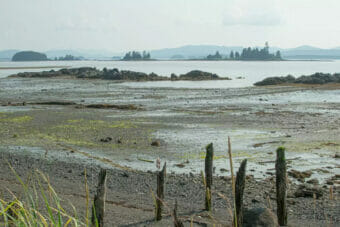
Kake’s northern shore, close to where volunteers laid the foundation of the community clam garden. (Shelby Herbert/KFSK)
The Organized Village of Kake laid the foundation for Alaska’s first modern clam garden in early August. The community hopes the project will preserve an important food source and keep traditional knowledge alive.
A group of eight Kake community members got up at the crack of dawn to beat the tide. They needed to pile a line of stones 60 feet long on the village’s shoreline. They’ll slowly add to it over the course of the summer until it’s about two feet high. That wall, they hope, will eventually house thousands of clams and cockles.
Aiden Clark is a junior at Kake High School, and a member of the Alaska Youth Steward Program. He was all in to spend a morning out of his summer vacation hauling around big rocks for the clam garden.
“It’s a lot of rock to move, but it’ll do good for the community,” said Clark. “The clam population is starting to go down a lot…”
Clark is right — the clam population is starting to go down — by a lot. The EPA projects that shellfish harvests across the U.S. could fall by nearly a half by the end of the century. The administration said human-caused climate change is the culprit: warming waters are inviting predators into bivalve habitat, and that ocean acidification is dissolving their delicate shells.
Simon Friday is the natural resources coordinator for the Organized Village of Kake, the village’s tribal government. Friday said the garden will help make local shellfish more resilient to climate change in three ways. The first: by helping them weather the storms that tend to tear up the coastline.
“So, shellfish gardens provide protection to the beach from erosion due to storms,” said Friday. “That’s something that’s likely to occur [more frequently] with climate change.”
The second reason: clam gardens increase the number of shell fragments in the area, boosting the minerals baby clams need to create their shells.
“We’re hoping that will help out with the ocean acidification, due to the calcium in the shells,” said Friday.
And the third reason: the rock fortress could help trap food for the clams.
“The gardens change the drainage of the beach, which allows more phytoplankton to be readily available,” said Friday. “So they have more food to eat, which allows them to grow faster and stronger and bigger — and all that good stuff.”
However, Friday said Kake’s clam garden isn’t just for the benefit of local marine life. During the COVID-19 pandemic, shipments of food weren’t coming in on time, and the shelves of the village’s only grocery store were laid bare. Now that things have settled down, Kake is preparing for the next crisis.
“We also realized that with climate change that we needed some sort of localized protective measures, to ensure that we continue to have the foods that we enjoy,” said Friday. “One of those being: clams.”
They’re also hoping it’ll help fix the limited and expensive food options available to them right now. Eloise Peabbles manages the Alaska Youth Steward Program in Kake, and she’s helping rally youth volunteers to move boulders for the garden. Supporting local food security is a huge priority for her.
“[And that’s] particularly because of the fact that we are already limited in our food — by having a small grocery store, and then having those prices be extremely expensive,” said Peabbles. “In order to have a healthy diet, we need to rely on the land and water around us.”
For thousands of years, many Indigenous communities up and down the Pacific Coast gardened shellfish. Over time, their practices not only increased shellfish production, but also expanded their habitat and improved species diversity according to a study of ancient clam gardens from Simon Fraser University.
The Swinomish Indian Tribal Community of Washington State built the very first modern clam garden in the United States last year. Friday visited it a few times to learn from the garden-builders and help with some construction tasks. Now, he’s thrilled to see his community invested in building a shellfish garden of their own.
“You’re literally just moving heavy rocks,” said Friday. “You need as many hands on deck as possible. So when it comes to constructing these gardens, it’s a community event. It just requires a lot of work — and a lot, a lot of people to move rock.”
With the foundation laid out, the last thing left for them to do is stack it all the way up to two feet. Friday said the main point of the exercise is education. So the bivalves that do take up root in the garden are just a bonus.
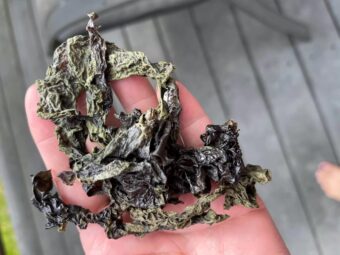
This dried, black seaweed has a light green color that traditional harvesters say isn’t normal and “tastes off.” (Photo courtesy of Irene Dundas)
Irene Dundas has harvested black seaweed her whole life – near Kake when she was young and near Ketchikan as an adult. The harvest happens in May when the seaweed is exactly the right size. Dundas and family members travel by boat to specific large rocks far from shore. It must be low tide so they can pull the seaweed off the rocks.
“When you’re grabbing it in your handful, it looks like you’re grabbing a handful of long, thick black hair,” Dundas said.
Black seaweed is found in more treacherous areas. It needs nutrients that only come from lots of moving water.
Dundas harvests about 50 gallons to share with family and friends. Processing is lengthy, drying the seaweed into bite-sized pieces.
“It’s kind of crunchy like a piece of popcorn,” she said. “But the flavor is like the black seaweed that you put on sushi. It’s that exact flavor. So delicious.”
Dorian Dundas, Irene Dundas’ daughter, collects black seaweed. (Photo courtesy of Irene Dundas)
She transfers the wet seaweed in pillowcases and puts it outside on several large tables to dry. But in the years 2021 and 2022, she noticed something was wrong.
“The seaweed that I picked had a very distinct strong, strong smell,” Dundas said. “There was a discoloration, this light green color. I felt like it had a little bit more metallic taste to it.”
To get any good seaweed this year, she traveled for hours by boat near the Canadian border. Her past harvests, she threw away.
“I was alarmed and very, very, very upset,” said Dundas. “I had no clue what was going on.”
Keolani Booth has similarly concerns. He collects black seaweed on the outer waters near Metlakatla and southern Prince of Wales Island.
“This year, I hardly had anything of a harvest,” he said. “I usually give out quite a bit to our community members that can’t go out. And I was only able to get a minute amount and it was kind of heartbreaking because you know, some of these people depend on me to bring them some seaweed for the year.”
Booth says black seaweed could be like a canary in a coal mine – a warning of what could come from climate change.
“It’s a very hard seaweed to try to cultivate,” Booth said. “It’s very sensitive, which you know, you realize that in the open ocean, it’s a precursor to all the things that are stronger in the ocean.”
The Metlakatla tribe got a grant to start researching the problem two years ago. That research is ongoing. And last month, Dundas and Booth carried their concerns to a meeting in Juneau, hosted by the Sealaska Heritage Institute. Harvesters and scientists discussed what to do.
Jennifer Clark from Vancouver brought a Western science perspective. She works for a kelp company but studied the effects of climate change on seaweed for her Ph.D. In a post-doctoral project, she worked with Indigenous groups in central British Columbia about black seaweed disappearing there.
“In 2016, it’s almost completely missing from the intertidal shoreline,” she said.
Clark’s research linked the disappearance to an enormous hot water mass in the Northern Pacific known as The Blob. In 2014-2015, The Blob moved from the Gulf of Alaska down to California. It was followed by more heat from El Nino, which elevated seawater one to two degrees, enough to destroy the black seaweed.
“These heat waves are kind of unprecedented,” said Clark. “They just cause disruptions in life cycles and disturbances in the intertidal, which most of the seaweeds that you find are intertidal-subtidal, so they’re getting extreme changes in their habitat.”
She learned that black seaweed couldn’t survive past 64 degrees. As temperatures cooled in the years after The Blob and El Nino double whammy, BC’s seaweed started to come back. But not like before. Clark doesn’t know if Alaska’s black seaweed problem was also affected by The Blob – she says it would take more research. But she does know that black seaweed anywhere has challenges ahead if climate predictions come true.
“I think if it was persistent, like if we were to increase two degrees – 2050, I think that’s the projection is one and a half degrees – then maybe they won’t be so resilient, and they’ll just kind of exist as much as they can until they’re, they’re wiped out,” Clark said.
Wet black seaweed dries on tables outside. It will be ground into bite-sized pieces. Harvesters in Southeast Alaska collect it by the gallons. (Photo courtesy of Irene Dundas)
Rosita Worl is the president of Sealaska Heritage Institute. She says the seaweed is critical to many communities in and out of Alaska because it’s shared and traded.
“Black seaweed is really important to us as a food source, but also for its cultural components,” Worl said. “It’s like a glue that binds our community together through our widely sharing patterns. It also has spiritual dimensions. Black seaweed is distributed and consumed during our ceremonies.”
Sealaska Heritage Institute is creating a committee comprised of harvesters and scientists to start researching the problem. They’re also documenting the historical practices of the harvest and how it’s changed in recent years.
They hope the information will help them figure out if there’s any way to save black seaweed.
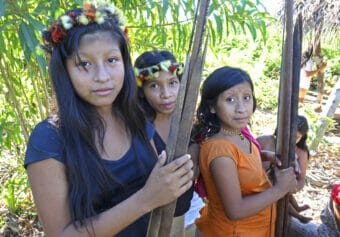
A group of young women from the Awa people in Brazil hold their bows and arrows as they return from a hunt. A new reexamination of ethnographic studies finds female hunters are common in hunter-gatherer societies. (Scott Wallace/Getty Images)
For decades, scientists have believed that early humans had a division of labor: Men generally did the hunting and women did the gathering. And this view hasn’t been limited to academics. It’s often been used to make the case that men and women today should stick to the supposedly “natural” roles that early human society reveals.
Now a new study suggests the vision of early men as the exclusive hunters is simply wrong – and that evidence that early women were also hunting has been there all along.
Specifically, the new research upends one of the key strands of evidence that scientists have relied on to infer what life was probably like during the period that started roughly 200,000 years ago, when homo sapiens first emerged as a species.
Direct evidence is limited because that phase ended about 9,000 years ago, as people slowly began to develop agriculture and settlements. But all over the world, there have been groups, often in remote areas of low- and middle-income countries, who still live a hunting and foraging life. So scholars look to them as a sort of window into humanity’s past. Anthropologists and other specialists have gained these groups’ permission to live alongside them and have produced detailed observational reports.
Until now, the general sense among scientists has been that these accounts overwhelmingly pointed to men mainly hunting and women mainly gathering, with only occasional exceptions, says Robert Kelly, professor of anthropology at the University of Wyoming and the author of influential books and articles on hunter-gatherer societies.
But Kelly says that the views he and others held of the typical gender divisions around hunting were based on anecdotal impressions of the reports they’d been reading, combined with the field work many had engaged in personally. “No one,” says Kelly, had done a systematic “tally” of what the observational reports said about women hunting.
Enter the researchers behind the new study: a team from University of Washington and Seattle Pacific University. “We decided to see what was actually out there” on hunting, says the lead researcher Cara Wall-Scheffler, a biological anthropologist.
A fresh look at old evidence
Wall-Scheffler and her collaborators combed through accounts from as far back as the 1800s through to present day. And rather than relying on summaries of those accounts – as scientists often do when analyzing large numbers of them – Wall-Scheffler notes “our goal was to go back to the original ethnographic reports of those populations and see what had actually been written about the hunting strategies.”
Their findings — published in the journal PLOS One this week — is that in 79% of the societies for which there is data, women were hunting.
Moreover, says Wall-Scheffler, this wasn’t just opportunistic killing of animals that the women happened upon. The vast majority of the time, she says, “the hunting was purposeful. Women had their own toolkit. They had favorite weapons. Grandmas were the best hunters of the village.”
In other words, “the majority of cultures for whom hunting is important train their girls and their women to make their tools and go hunting,” she says. Wall-Scheffler says she was expecting to find evidence of women hunting – but not to this extent. “That piece has just been really underappreciated,” she says, “even though it’s right there in literature.”
The implications of these results are potentially enormous, says Kimberly Hamlin, a professor of history at Miami University in Oxford, Ohio who specializes in ways that evolutionary science has figured in the wider culture.
“I think that next to the myth that God made a woman from man’s rib to be his helper, the myth that man is the hunter and woman is the gatherer is probably the second most enduring myth that naturalizes the inferiority of women,” says Hamlin.
It has fueled the idea, she says, that “men are supposed to be violent, they’re supposed to be aggressive – one of the core elements in the soup of toxic masculinity” used to excuse damaging male behaviors, including rape.
The popular narrative of man as the sole – or at least almost exclusive – hunter has also been used implicitly and even explicitly to argue for policies that prioritize men’s role as the “natural breadwinner” – and that also limit them to that role by, for instance, denying them paternity leave, adds Hamlin.
By the same token, she maintains, “this idea that somehow women are naturally preordained to be caretakers and maternal figures, whether they like it or not,” often underlies policies that effectively “force motherhood on women” – including policies that restrict access to abortion and contraception.
So the new study’s findings are “thrilling,” concludes Hamlin. “It’s really going to encourage us to call into question a lot of these ideas about what men and women are supposedly naturally like.”
For scientists, a shifting narrative about hunters
As to how consequential the study’s findings are for science, scholars say they add to a body of evidence that has been building for years.
Kelly says that notwithstanding the endurance of stereotypes around early human hunting in popular culture, scientists had already moved to a more nuanced picture.
As far back as the mid-1960s, says Kelly, scientists were coalescing around evidence that most of the diet in hunter-gatherer societies has come from plant food gathered by women. “People were saying, ‘We should call them ‘gatherer-hunters’ to emphasize that.’ ”
By the 1980s, adds Kelly, many more women had entered the field of anthropology. Compared to their male predecessors, these women scientists were often able to gain more access to women in foraging societies. The result was a slew of new descriptions of women’s activities – including more accounts of women hunting.
So Kelly’s initial reaction to Wall-Scheffler’s study is that, while its organization and tabulation of the data is “genuinely new and useful,” when it comes to the picture it paints of the hunting practices of women, “there wasn’t anything that struck me as eye-opening. I sort of knew all of this.”
Yet one finding did stick out to Kelly. He says that the current consensus view holds that even when women do some hunting, they engage in a very different form of hunting than the kind done by men.
“The general pattern is that men intentionally go out to hunt large game,” says Kelly. “And women intentionally go out to gather plant food and also intentionally or opportunistically will hunt the smaller, more reliably-gathered game” – meaning animals like lizards and rabbits.
By contrast, the new study found that in a third of societies for which there is data, the women hunt large game. In other words, they do go after the kind of big mammals associated with the stereotype of male hunters.
“I would consider that something new,” Kelly concedes, adding “I’d really like to go look at those ethnographies” that were the source.
Vivek Venkataraman of the University of Calgary is another anthropologist expressing doubts.
He notes that Wall-Scheffler and her colleagues had to limit themselves to societies for which there were explicit accounts of not just hunting practices, but precisely who was doing the hunting. The result is that the study is based on observations of 63 groups.
“But of course there are several hundred foraging societies,” says Venkataraman. “We need to know what’s going on there before we can draw any sweeping conclusions.”
Key clues that were overlooked
Randy Haas disagrees with the critics of the study. An anthropologist at Wayne State University, Haas notes that the societies Wall-Scheffler’s study analyzes are well distributed across the globe. Furthermore, says Haas, “more data is not always better. My sense is that [the evidence used in the study] is a well-structured, high quality sample that is actually more likely to yield a reliable result than a larger sample of lower quality observations.”
What’s more, Haas says, his own experience illustrates how the “near universal” view of men as the sole big-game-hunters may be warping researchers’ ability to recognize data to the contrary. In addition to creating blind spots in the understanding of modern hunter-gatherer societies, Hass says it also appears to have led scientists to overlook key clues from the other main source of evidence on early humans: ancient burial sites and the human remains and artifacts found there.
In 2018 Haas was part of a team in Peru that found a 9,000-year-old person buried with an unusually large number of hunting tools. “We all just assumed this individual was a male,” he recalls. “Everybody is sitting around, saying things like, ‘Wow! This is amazing. He must have been a great hunter, a great warrior. Maybe he was a chief!’ ”
Haas didn’t even think to question the person’s gender until about a week later, when a colleague who specialized in analyzing bone structure arrived and delivered a bombshell assessment: The remains seemed to be female.
The team then used a technology newly available to the field. Scraping the enamel from the teeth found in the grave, they found proteins that confirmed it unequivocally: This apparent master hunter was female.
Stunned, Haas and his collaborators decided to review the records of similar finds across the Americas over the previous 70 years. In 27 gravesites of individuals found with hunting tools, they found 11 cases in which the person was female.
They ran a statistical analysis that finds that this ratio is associated with the probability that between 30-to-50% of individuals buried with hunting tools in ancient American gravesites are female. In other words, says Haas, “Large mammal hunting during this time in the Americas was a gender neutral activity, or at least nearly so.”
Why did this take so long?
Why hadn’t these findings commanded the world’s attention sooner?
Haas says in one of the excavation records he and his collaborators re-analyzed – the 11,000-year-old remains of a female found in the 1970s with a pointy stone tip laid under her head – the scientists who had originally uncovered the grave had effectively ignored their own discovery.
Says Haas, “They had written something to the effect of, ‘Had this [pointy stone] been associated with a male we would have assumed this to be a hunting weapon. But given its association with a female, its use as a kitchen tool would make more sense.” Haas and his co-authors decided it should be reclassified as a hunting tool.
Yet what’s even more notable, says Haas, is that in all but one other case, his team did not need to revise the conclusions of the original excavators: Those scientists had already determined that the individuals they’d found were females buried with hunting weapons. Just as with the findings in Wall-Scheffler’s study, the archaeological evidence had been available the whole time – hiding in plain sight.
“Everybody had just taken this man-the-hunter hypothesis for granted. So no one really decided to evaluate it,” says Haas. “It wasn’t really a question on a lot of people’s minds.”
But Cara Wall-Scheffler had seen Haas’s findings, and they were precisely what prompted her to launch her review of the modern-day accounts.
Wall-Scheffler says the episode offers a reminder of why it’s so important to ensure the scientific community includes people of diverse backgrounds.
“The preconceptions that we all have when we look at a data set really shape the outcome,” she says. “I’m really hoping that people take second looks at some of the data that they already have to see what new questions we can ask.”
Copyright 2023 NPR. To see more, visit https://www.npr.org.
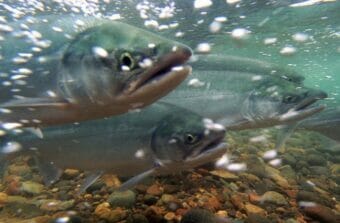
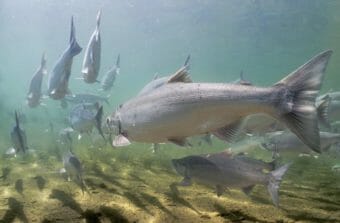
Chum salmon migration. (USFWS/Togiak National Wildlife Refuge)
Among the projects Gov. Mike Dunleavy vetoed from the state budget on Monday was salmon research to help determine the causes of the chinook and chum crisis in western Alaska.
Dunleavy vetoed $513,000 for research on the origins of salmon caught by accident in the Bering Sea pollock fishery, as well as the origin of salmon intercepted by fishermen off the Alaska Peninsula in what’s known as “Area M.” Dunleavy vetoed the project last year, too.
“You never know what’s going to come of these budgets. But this is quite a disappointment, again,” said Karen Gillis, program director of the Bering Sea Fishermen’s Association. The association was to receive the money and pass it on to a partnership of federal and university scientists.
The veto documentation said the funding was cut to save money. Dunleavy spokesman Jeff Turner added that the Alaska Department of Fish and Game did not believe the study would meet its objectives and that $100,000 would have gone to the University of Washington for overhead.
The research results would have policy implications, and could fuel the fury already burning in communities on the Yukon and Kuskokwim rivers. For the fourth season in a row, subsistence salmon fishermen in the region are shut down or severely restricted. Chinook and chum are returning to those rivers in numbers so low that there’s barely enough to meet escapement targets for spawning. Meanwhile, thousands of chinook and chum are caught every season in the Bering Sea and Area M fisheries.
Prior research has shown that only a portion of that salmon bycatch was destined for western Alaska rivers, with many of the fish originating from Asia. Gillis said more research is needed to aid management decisions.
“The genetic work that’s been done to date lump the Norton Sound, Yukon, Kuskokwim and Bristol Bay stocks into something called ‘coastal western Alaska,’” she said. “And so what this work does is studies from otoliths of adult salmon to determine their geographic location or their birthplace, basically.”
Otoliths, or ear bones, of salmon bear the chemical fingerprint of the freshwater the fish has swum through, allowing scientists to determine not just which side of the Pacific the fish originated, but which river system.
Gillis said last year’s veto halted the project, but there may be another source for the funding.
The governor’s office referred questions about the veto to the Department of Fish & Game, which did not respond in time to be included in this story.
Delegates participate at the 4th Annual Indigenous Leaders Summit in Lummi Nation, Washington last week. (Photo courtesy of SEITC)
Tribes in Southeast Alaska and across the border in Canada have declared an emergency for salmon facing environmental risks. Leaders with the Southeast Alaska Indigenous Transboundary Commission made the announcement at the 4th Annual Indigenous Leaders Summit in Washington last week. The transboundary commission represents 15 Tsimshian, Lingít, and Haida Nations.
They say that Pacific salmon are facing habitat loss and degradation of critical waterways on both sides of the border.
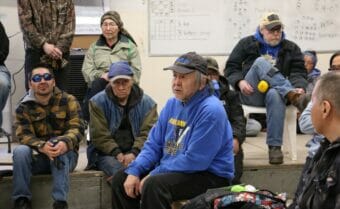
Guy Archibald is the commission’s executive director.
“We’re seeing declining salmon stocks across the board, especially king salmon or chinook,” said Archibald, “and we’ve come to the conclusion that there’s no time to waste.”
At the summit, participants talked about what they experienced at home.
“Our people no longer have salmon running in our streams. Salmon only live in our stories,” said Violet Gatensby, a youth representative from Carcross, Yukon.
Archibald says the commission wants two specific things to come from the salmon emergency declaration. They hope to unify tribes in Alaska and Washington along with First Nations in Canada to strengthen their message. And they want recognition for the traditional territories of Southeast Alaska tribes that run across the border. Archibald says the lands are now in British Columbia and are subject to several large mines – some operating and some that are being proposed.
“Canada has to recognize, you know, those traditional boundaries and give Alaska tribes a real seat at the table on how these mines are developed,” he said.
Archibald gave the example of the Unuk watershed east of Ketchikan, which has several mining projects – like the Brucejack goldmine, the proposed KSM goldmine, and the Eskay Creek Revitalization Project, which is an old gold mine looking to reopen.
Inside Hooper Bay’s brown tribal council building, nearly 50 people gathered to hear more from state officials on why they decided to close chinook salmon fishing in the coastal area from the Naskanat Peninsula up to Point Romanof. That closure includes Hooper Bay, Scammon Bay, Chevak, Emmonak, Kotlik, Nunam Iqua and Alakanuk.
State biologists said that the closure is intended to protect chinook salmon while they migrate upriver to spawn in Alaska and Canada. But most in the crowd were subsistence fishermen and fishing means survival.
“It’s like taking away food from our table,” said one person who testified.
Alaska Wildlife Trooper Sergeant Walter Blajeski arranged the meeting. He said that he wanted to give the community an opportunity to ask questions they might have on both fishing opportunities and restrictions.
“And, you know, I think the meeting was a success. Our goal was just that: to be available to answer questions and to provide maybe some explanation as to why restrictions were going to be occurring. And I think we accomplished that,” Blajeski said.
Non-salmon fishing will still be permitted during the closures, but with restrictions. Gillnets will be limited to 4-inch or smaller mesh and 60 feet or less in length. These nets must be operated as a setnet and should be set near shore.
Blajeski said that troopers can’t always enforce these regulations; they do it when weather and time permits.
“We don’t often get to the coastal villages. But when we do, we usually go there, you know, for the day. And those types of enforcement patrols are usually conducted, you know, onshore in the village, walking around the village because we just don’t have the resources to get out there,” Blajeski said.
Blajeski warned that anyone caught violating the regulations will be fined up to $500, though there is wiggle room.
“What we’ve seen over the last couple years, for people that don’t have a history of violations, is a about $300 fine. We don’t recommend to the court that we forfeit any fishing gear that would otherwise be legal,” Blajeski said.
Blajeski said that the troopers don’t normally seize the fish either.
“And if we do seize fish, we would donate those fish to qualified charities such as Elders or people in need in the region,” Blajeski said.
Deena Jallen, an Alaska Department of Fish and Game biologist and the Yukon River summer season manager, traveled to Hooper Bay for the meeting. She said that residents asked a lot of questions about commercial fishing in other areas of Alaska that may catch the same fish subsistence users are supposed to avoid.
In her role as the Yukon River summer season manager, she said that she often fields the same questions from all over the region.
“We often get questions and [statements] about Area M and the pollock fleet. We hear that a lot at every meeting that we come to,” Jallen said.
What makes Hooper Bay different from others is that it is a coastal community.
“In previous years, the coastal area has not been closed. They’ve had restrictions to 6-inch mesh, but they’ve typically been left open. They do catch some kings and summer chum as they migrate up along the coast of the Yukon River. So unfortunately, when there’s no harvestable surplus, we do feel the need to close that district as well to hopefully reduce the harvest of king salmon as they travel up along the coast,” Jallen said.
Jallen said that she was happy to see the turnout as well as the level of participation.
“It’s very understandable that people are very frustrated with the salmon and with the management actions in recent years,” Jallen said.
Jallen said that the salmon in Hooper Bay are either bound for the Yukon River, where runs have been very low in recent years, or they could be headed to other streams either along the coast or in other areas of the state.
She also has concerns for king salmon runs across Western Alaska and particularly in the Yukon River area. Jallen said that the region didn’t meet any of the escapement goals for king salmon last year.
“So any king salmon that’s coming back either to the Yukon River or to a nearby spawning stream is likely to have a pretty low abundance this year, and so we’re concerned for all of them. So even if that fish isn’t specifically Yukon-bound, we haven’t really seen anything that says, like, oh, well, this river is doing better or the stream is doing better,” Jallen said.
Fisheries managers said that they could loosen restrictions if the run is stronger than they’re projecting, but right now Jallen said that every district of the Yukon is going to be closed to king salmon fishing. Based on salmon run timing, those closures will work their way up through the entire Yukon area through all the districts and all the tributaries.
“I think just the main takeaway is that we know these management actions are very, very intensively managing subsistence. And we know it’s incredibly frustrating. But we’re only taking these actions because the runs are so low that there’s no fish available for harvestable surplus,” Jallen said.
The frustration was palpable.
“You know, they wanted to ask questions, but a lot of the community members that were attending, after the meeting thought that, you know, they really didn’t get any answers,” said Native Village of Hooper Bay Tribal Administrator Jan Olson.
Community members said that they need access to their subsistence foods.
“We don’t do any commercial fishing, you know, we don’t even go up to the Yukon or Black River to do any type of commercial fishing. All we do is stick around here and do subsistence fishing,” Olson said.
Olson said that there’s still confusion as to why they are being regulated. They need to fish to survive.
“We’re not in it for the money. We are in it to put fish in our freezers for future use. And, you know, that’s a big part of our diet there. You know, that’s one thing that we missed,” Olson said.
Remnants of Typhoon Merbook, which happened in fall 2022, caused major flooding in Hooper Bay. Families were displaced, homes were lost, people’s stores of salmon and other subsistence foods were destroyed. The community relied on state assistance as well as donations of fish.
“You know, we’re not bad people, you know, we just want to fish and, you know, it’s just, we want the fish that we’re accustomed to,” Olson said.
Olson, along with several other members of the community, said that these restrictions will make winter more challenging as many residents don’t make enough money to buy more groceries.
Close
Update notification options
Subscribe to notifications
Subscribe
Get notifications about news related to the topics you care about. You can unsubscribe anytime.