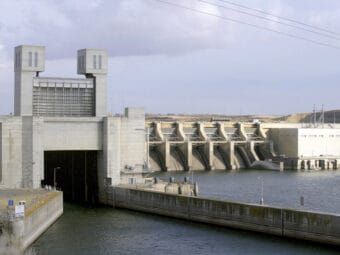
FILE – This Oct. 24, 2006 file photo shows file photo shows the Ice Harbor dam on the Snake River in Pasco, Wash. (Jackie Johnston/AP)
BOISE, Idaho — The White House has reached what it says is an historic agreement over the restoration of salmon in the Pacific Northwest, a deal that could end for now a decades long legal battle with tribes.
Facing lawsuits, the Biden administration has agreed to put some $300 million toward salmon restoration projects in the Northwest, including upgrades to existing hatcheries that have helped keep the fish populations viable in some parts of the Columbia River basin.
The deal also includes a five year stay on litigation and a pledge to develop more tribally run hydropower projects and study alternatives for farmers and recreators should Congress move to breach four large dams on the Snake River, a Columbia tributary, which tribes say have long been the biggest impediment for the fish.
“Many of the Snake River runs are on the brink of extinction. Extinction cannot be an option,” says Corrine Sams, chair of the wildlife committee of the Confederated Tribes of the Umatilla Indian Reservation.
The agreement stops short of calling for the actual breaching of those four dams along the Lower Snake in Washington state. Biden administration officials insisted to reporters in a call Thursday that the president has no plans to act on the dams by executive order, rather they said it’s a decision that lies solely with Congress.
A conservation bill introduced by Idaho Republican Congressman Mike Simpson to authorize the breaching of the dams has been stalled for more than a year, amid stiff opposition from Northwest wheat farmers and utility groups.
When the details of Thursday’s salmon deal were leaked last month, those groups claimed it was done in secret and breaching the dams could devastate the region’s clean power and wheat farming economies that rely on a river barge system built around the dams.
“The agreement announced by the Biden Administration commits the U.S. Government to spending hundreds of millions of dollars that will ultimately end up being paid by electricity consumers in communities throughout the West,” said Heather Stebbings, interim executive director of Northwest RiverPartners in a statement.
Copyright 2023 NPR. To see more, visit https://www.npr.org.
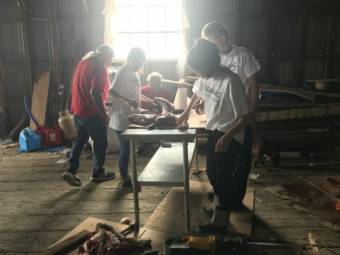
Kake Youth Conservation Corps (YCC) help butcher one of five deer obtained under the emergency season. (Photo courtesy of the Organized Village of Kake)
An emergency subsistence hunt held in Kake at the start of the COVID pandemic has been found to be lawful, over the objections of the state.
The hunt was authorized by the Federal Subsistence Board, and managed by the Forest Service, Petersburg Ranger District, after a request from the tribal government of Kake.
The Organized Village of Kake petitioned the Federal Subsistence Board in 2020 shortly after nationwide lockdowns and supply chain disruptions threatened the food supply to the 500 residents of the community, located on Kupreanof Island, about 50 miles east of Sitka.
Hunters designated by OVK were allowed to take two bull moose, and five male Sitka blacktailed deer per month, outside of the state-regulated seasons for these animals. Meat from the harvest was distributed to 135 households in Kake.
The hunt prompted a swift legal response from the state, essentially a new challenge to a three-decade old conflict in Alaska: the discrepancy between the 1980 Alaska National Interest Lands Conservation Act,or ANILCA, which – in the simplest terms – grants a rural subsistence priority, and the Alaska Constitution, which does not.
The Nov. 3 ruling by U.S. District Court Judge Sharon Gleason reaffirmed that, when push comes to shove, federal laws supersede state laws in matters of subsistence.
Gleason concluded that the ANILCA gave the US Secretary of Interior broad discretionary power to authorize emergency hunts, even though they’re not strictly spelled out.
“The Court finds that the Secretary’s regulation (at 50 C.F.R. § 100.19) which authorizes the Federal Subsistence Board to ‘open . . . public lands for the taking of fish and wildlife’ for ‘public safety reasons,’ is valid as applied to the emergency hunt that the board authorized for Kake,” she wrote.
And Gleason let the state know they should have seen it coming. Citing one of the first major subsistence cases following ANILCA, “Katie John,” Gleason wrote, “Congress was clear in ANILCA’s text that enforcement of the subsistence priority would entail altering the traditional balance of power between the State of Alaska and the federal government.”
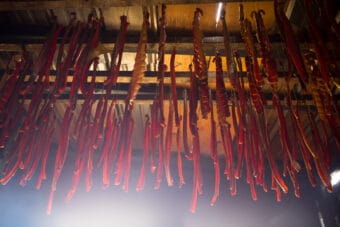
Strips of salmon are seen hanging in a smokehouse on the Kuskokwim River on July 19, 2017. Salmon has been a mainstay of diets in the region, providing high-quality protein that helps residents avoid numerous physical ailments, the head of the region’s tribal health provider testified on Friday. Lack of salmon therefore has negative health consequences, he said. (Photo provided by U.S. Fish and Wildlife Service)
The salmon crisis in the Yukon and Kuskokwim rivers is harming more than local economies, food security and culture, according to people in the region. It is also harming human health.

That was a message emphasized on Friday at a field hearing held by U.S. Sen. Lisa Murkowski, R-Alaska, in Bethel, the regional hub for the Yukon-Kuskokwim Delta. Field hearings, held outside of Washington, D.C., are often located in sites directly affected by specific issues.
Murkowski said she convened the Senate Committee on Indian Affairs hearing in Bethel so that Alaskans there could explain the impact of the salmon collapses to people outside the region and outside the state who might not grasp its severity.
“Part of my job is to convey the urgency here,” she said at the start of the five-hour hearing.
Among those testifying was Dan Winkelman, president of the Yukon-Kuskokwim Health Corp., the tribal organization that is the region’s main health provider. Friday’s event was held at the organization’s Bethel headquarters.
Lack of salmon, Winkelman said, “is not just negatively affecting our culture and well-being but our good health,” he said.
He ticked off the numerous well-known nutritional benefits of salmon. It is a complete, high-quality protein that builds lean body mass and helps people’s bodies function correctly, he said. It is rich in Omega-3 fatty acid and essential minerals key to heart health, brain health, immune function and control of inflammation, he said. It is a nutrient-dense food that helps people maintain healthy body weights and avoid diet-related health problems, he said.
For these and other reasons, the U.S. Department of Agriculture has recommended that people eat at least two servings a week of fish like salmon, Winkelman said. In the past, with widespread daily consumption of salmon, residents of the region easily met that recommendation, he said.
“However, when fish is not available, meals are supplemented with store-bought, highly processed foods that contain added sugars, salts, and saturated fats, and often less protein,” he said. “Diets become more energy dense instead of nutrient dense, which can lead to an increase in unhealthy weight gain and increased rates of chronic disease development. Often, I have providers tell me that his has become a problem or the last decade or so in the in the Y-K region.”
Migrating salmon are seen in late 2011 in the waters of Western Alaska’s Togiak National Wildlife Refuge. (Photo provided by U.S. Fish and Wildlife Service)
In rural areas across the state, wild foods generally provide all the required dietary protein, according to studies by the Alaska Department of Fish and Game. Salmon has been the dominant wild food in many rural regions, and that is especially so in the Yukon-Kuskokwim region, according to state and federal experts.
Additionally, salmon harvesting itself is physical exercise that keeps residents fit, Winkelman said in his testimony.
The scarcity of salmon also affects mental health, said residents testifying at the hearing.
Jonathan Samuelson, executive director of the Kuskokwim River Inter-Tribal Fish Commission, described salmon harvesting as part of a holistic approach to wellness.
“When we’re forced to deviate from our traditional ways of life, it only amplifies our unwellness. Our way of life and our cultural knowledge and the way that we be in the world is our path to wellness, and we know that,” he said.
Kara Dominick of Bethel spoke about how a return to salmon-harvesting traditions helped her recover from a serious opioid addiction.
“The river and the tundra became my peace. In the end, it was what made my life feel whole and meaningful again. I may not have been here today if I didn’t have that connection and access to my culture and subsistence opportunities,” she said in her testimony.
The “deeper connection to our culture and our way of life” is critical to addressing the substance-abuse crisis that is gripping much of the population, Dominick said. But now that avenue of recovery is under threat, she said.
“With the decline in salmon numbers comes further separation from our culture. How is this going to affect our mental health? How much worse will it get? I fear for our people,” she said.
Charles Menadelook, subsistence resources program director for Kawerak Inc., a Nome-based tribal consortium, expressed similar fears.
He talks to his young family members about the importance of subsistence harvesting, he said, his voice faltering with emotion. “I tell them, they need to go fishing. They need to go snow hunting. Because I don’t think it’s going to be around much longer,” he said.
A moose is seen in an Anchorage neighborhood near Kincaid Park on April 27, 2022. (Photo by Yereth Rosen/Alaska Beacon)
A federal judge in Anchorage has ruled that U.S. government officials did not overstep when they allowed an emergency hunt near the Southeast Alaska town of Kake during the first year of the COVID-19 pandemic.
The decision, published Friday by Judge Sharon Gleason, is the latest chapter in a long-running dispute between the state of Alaska and federal officials over who has the authority to regulate subsistence hunting and fishing on public lands in Alaska.
Gleason is also overseeing a separate but unrelated lawsuit by the federal government against the state of Alaska over management of Kuskokwim River subsistence salmon fishing, and the newly announced verdict could shed light on how Gleason interprets that case.
In Friday’s decision, Gleason concluded that the Federal Subsistence Board, FSB, was within its rights to open an emergency deer and moose hunt near Kake when the COVID-19 pandemic disrupted rural food supplies.
The hunt, which successfully distributed deer and moose meat to 135 households in Kake, was authorized under a section of the Alaska National Interest Lands Conservation Act, ANILCA, that requires federal land managers to prioritize subsistence hunting and fishing by rural residents.
Alaska’s constitution forbids treating rural and urban subsistence hunters differently, so the Alaska Department of Fish and Game filed suit in 2020.
Gleason previously declined to issue an order preventing other, similar hunts, and in 2021, she ruled that the issue was moot because the hunt had concluded.
But the state appealed to the 9th U.S. Circuit Court of Appeals, which ruled that Gleason should consider the merits of the issue because an emergency hunt could happen again.
That left Gleason to hear further arguments, leading to Friday’s decision.
At the heart of the issue, Gleason said, was the state’s contention that nothing in ANILCA gave the federal subsistence board the authority to open a hunt when the state had closed a season.
“The state maintains that it ‘cannot effectively manage wildlife populations if the federal government goes beyond what Congress authorized and continues to open seasons all the time,” Gleason wrote.
But Gleason noted that a federal regulation, in place for more than 30 years, allows the subsistence board to “‘immediately open or close public lands for the taking of fish and wildlife for subsistence uses’ in an emergency situation.”
That regulation is valid, Gleason said, because Congress specifically allowed the Secretaries of Interior and Agriculture to write regulations needed to enforce the parts of ANILCA that deal with hunting and fishing.
“The Court finds that the FSB did not exceed its statutory authority under Title VIII of ANILCA when it opened an emergency subsistence hunt for the Organized Village of Kake at the outset of the COVID-19 pandemic for public safety reasons, when it delegated the authority to open emergency hunts to local federal land managers, and when it delegated to the OVK the limited authority to choose who would participate in the emergency hunt for the benefit of the community of Kake and how the meat would be distributed,” she wrote.
The Alaska Department of Law, representing the Department of Fish and Game, has not decided whether to appeal Gleason’s verdict.
“We’re disappointed in Judge Gleason’s decision. We will continue to review and evaluate our options,” said Patty Sullivan, a spokesperson for the agency.
Correction: Patty Sullivan is a spokesperson for the Department of Law, not an attorney.
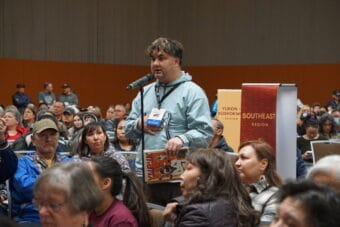
Jonathan Samuelson, chair of the Kuskokwim River Inter-Tribal Fish Commission, speaks Friday at the Alaska Convention of Natives convention about the effects of salmon crashes in his region. (Photo by Yereth Rosen/Alaska Beacon)
Members of this year’s Alaska Federation of Natives conference in Anchorage voted Saturday to ask Congress and the federal government to protect and increase subsistence hunting and fishing rights for Alaska Native people in rural Alaska.
The request puts the state’s largest Alaska Native organization at odds with the state government, whose constitution forbids laws that give rural residents a greater subsistence right than urban residents and likely forbids giving Native people a preference over others.
AFN has already sided with the federal government in a subsistence-fishing lawsuit against the state of Alaska, and Saturday’s resolution suggests the disagreement may grow into hunting and trapping and outlast the court case.
Conference attendees approved 28 of the 29 resolutions on the agenda, including one calling for the preservation of Alaska’s new ranked choice voting system. Opponents of the system were active outside the convention, gathering signatures for a proposed ballot measure that seeks its reversal.
Another resolution, supported by the Alaska chapter of the American Civil Liberties Union, advocates an independent federal investigation into Alaska Native deaths within Alaska state prisons and jails.
Alaska Native people make up 22% of the state’s population but more than 41% of Alaska’s prison population. Last year, 18 people died in state prisons and jails; half of those were Alaska Native.
The lone resolution to not pass a final vote was one asking the Environmental Protection Agency to not grant further extensions of water treatment waivers for urban municipalities. That proposal was withdrawn to a committee for further work.
Past AFN conventions have seen delegates divided by resolutions. Since 2019, three regional Alaska Native corporations and two large tribal groups have quit AFN.
Last year, extensive debates over salmon shortages put some Native groups at odds.
This year’s resolution debates were much more sedate and finished an hour ahead of the schedule set on the official agenda.
Subsistence issues — those covering the traditional harvest of fish and game for personal, noncommercial use — garnered the most attention during the three-day convention.
Before Saturday’s votes, delegates spent hours on Friday afternoon discussing the need to preserve traditional subsistence fishing amid a drastic decline in salmon returns to mainland Alaska rivers.
Under the 1980 Alaska National Interest Lands Conservation Act, the federal government guarantees subsistence preferences for rural Alaskans, but not Alaska Native people specifically. AFN delegates contend that Alaska Native people should be granted special permission, something the state rejects.
“A Native-only preference is a non-starter for the state and questionable under both the state and federal constitutions,” said Patty Sullivan, communications director for the Alaska Department of Law.
The state and federal government are also currently fighting in court over who should have management authority over fisheries in rivers that flow within federal parks and preserves.
As part of its defense, the state has argued that a federal judge should reexamine a series of cases known collectively as Katie John, after an Ahtna elder who waged a lengthy legal battle.
The Katie John decisions underpin current subsistence management, and AFN has joined the federal government in arguing that they should continue to stand.
For its part, the state says that it is being forced into revisiting Katie John because of federal actions, not because it wants to overturn precedent.
The ongoing disputes remain unresolved in federal district court in Anchorage. If the judge rules in favor of the federal government and AFN, current precedent will remain.
That isn’t good enough, some Alaska Native people said at the convention, which is why they’re pushing for congressional action that would grant more rights for rural Alaska Native people.
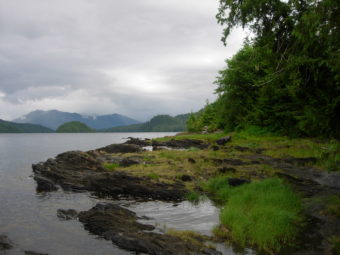
The Tongass National Forest near Ketchikan, Alaska. (Creative Commons photo by Mark Brennan)
Ketchikan’s tribe wants to change the community’s designation under federal subsistence rules to give residents more access to subsistence resources. The tribe is asking to change from urban to rural status, which would apply to all 14,000 residents in the Ketchikan Gateway Borough — and the tribe hopes that recent changes to the designation process will help it win approval.
Most communities in Alaska are designated by the federal government as rural, recognizing a lifestyle that is inextricably tied to the land. But there are urban exceptions, like Anchorage, Juneau and Ketchikan. It’s a status that’s overseen by the Federal Subsistence Board.
The urban communities don’t have a subsistence priority like the rest of the state. That means they have limited access to subsistence resources on federal lands.
Tony Gallegos is with the Ketchikan Indian Community.
“It’s an unfairness to the system because we’re urban,” he said. “We’re not considered to have access to those resources.”
For example, Ketchikan residents, including tribal members, can’t fish for eulachon in the Unuk River while residents from smaller nearby communities can — even though their ancestors have been harvesting the little smelt species for thousands of years.
Gallegos has been working on a proposal to change the community’s status from urban to rural through the Federal Subsistence Board.
“The tribe wants to remove impediments from their access to traditional foods that they depend upon. And by being in a community that’s considered urban, nobody in the community has the designation of a federally recognized subsistence user, and therefore cannot hunt and fish and gather under subsistence regulations,” he said.
Rural and non-rural status go back to 1980, when the Alaska National Interest Lands Conservation Act or ANILCA was put into law. It designated more than 100 million acres of federal land in Alaska into parks, recreation areas and refuges. And it was then that communities were labeled rural or urban.
“It’s a big deal to rescind these things,” said Brent Vickers, an anthropologist with the federal Office of Subsistence Management. His office will make a recommendation on the proposal next fall. He says the process to change a community’s status now takes at least four years, much longer than it used to.
That’s because public input is now a major part of the process. Until 2015, it was decided mostly by numbers – things like the average household income and the number of hotels and grocery stores in a community.
“It really didn’t have opportunities for much input. It was really just based on these kinds of quantitative metrics,” Vickers said.
The process changed in 2015, after complaints and a review, to a more comprehensive approach. Now, Vickers says the board considers more factors and relies heavily on the recommendations of the Subsistence Regional Advisory Councils.
“Now, the analysis will look at all sorts of things – basically painting a picture of what these communities are like, what it’s like to live in these communities,” he said.
In Ketchikan’s case, there are about 14,000 people in the borough. But it’s also isolated on an island, off-the-road system. The community has a large Indigenous population. The tribe has over 3,000 members living locally and there are residents who belong to other tribes as well.
But the rural status wouldn’t just affect tribal members. It would qualify all Ketchikan borough residents as subsistence users, no matter their background, as long as they have been a resident for one year. Wildlife officials also would be required to prioritize their needs over commercial and sport users.
Gallegos says it’s the third time the Ketchikan tribe has sought a change. But he hopes for a different result this time. He says both Ketchikan’s city and borough have passed resolutions in support of the change.
“Right now, the tribe is trying to work within the system as it’s structured with the rules and regulations that are in place, trying to see if we can go ahead and break down this barrier,” he said.
Since the designation process changed in 2015, the federal subsistence board has only considered one proposal in Alaska. That was for the community of Moose Pass near Seward on the Kenai Peninsula. It had been considered part of the urban Seward area but gained rural status in 2021.
Close
Update notification options
Subscribe to notifications
Subscribe
Get notifications about news related to the topics you care about. You can unsubscribe anytime.