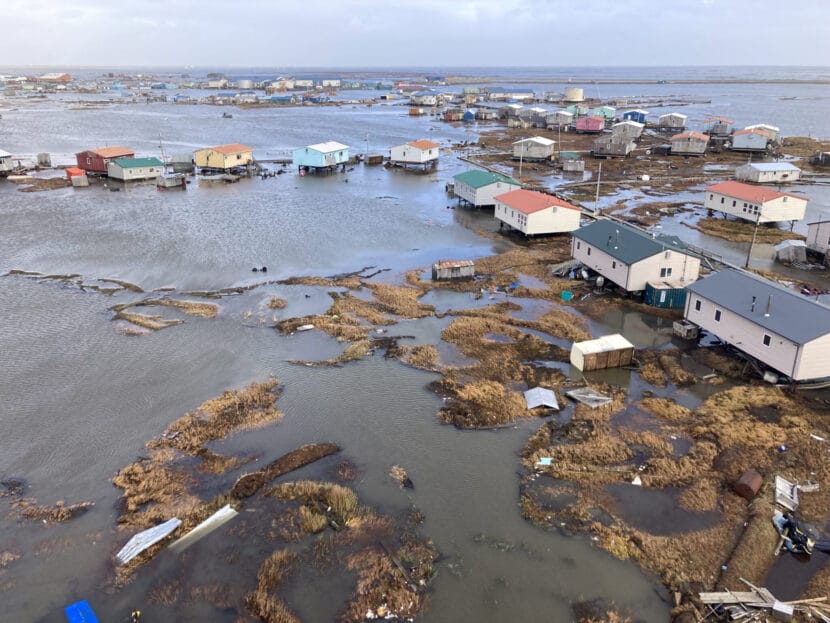
On Wednesday, the Alaska Department of Fish and Game will open an emergency moose hunt in Southwest Alaska, near the town of Quinhagak, in order to help victims of ex-Typhoon Halong, which devastated communities in the Yukon-Kuskokwim delta last month.
It’s the second emergency hunt that Fish and Game has opened to help storm victims refill their freezers before winter deepens, and it’s only the latest example of how Alaska state agencies have helped in unlikely ways after last month’s disaster, which killed at least one person and displaced hundreds.
Elsewhere, officials from the Alaska Department of Education and Early Development have been coordinating new schools for evacuees who needed to move to Bethel or Anchorage.
The Alaska Department of Environmental Conservation has been helping wrangle fuel tanks set adrift in floods. Workers from the Division of Forestry and Fire Protection have been helping muck out homes, remove debris and deliver supplies to villages alongside the Alaska Department of Transportation and Public Facilities and the Alaska National Guard.
In Anchorage, hundreds of miles away from the villages hardest hit by the storm, about 20 employees of the state-owned Alaska Housing Finance Corporation worked for weeks to find long-term shelter for hundreds of Alaskans who lost their homes in the disaster.
On Monday, state and city officials in Anchorage said they had closed the last mass shelters being used by evacuees because everyone had found hotels or apartments suitable for long-term use.
“This isn’t something we normally have done,” said AHFC CEO/Executive Director Bryan Butcher on Oct. 22 of the push to help evacuees find housing. “There have been different times … that people have reached out to us and asked for assistance, and we try to help when we can.”
Butcher said AHFC employees spent time checking for available state-owned housing and tried to connect evacuees with available apartments and housing across the state.
“We’ll play whatever role we need to play,” he said in late October. “And at this point, it’s just the gathering of units and then trying to help kind of piece it together so it makes the most sense and has the least amount of disruption.”
At the Department of Fish and Game, Ryan Scott is the director of the Division of Wildlife Conservation, which oversees hunting practices and issued the emergency hunting order this week.
“Our staff has been in communication with the communities, plus people who evacuated to town. And you know, I’m very proud of them, but I’m super thankful that we could help out where we could,” he said.
Scott said the department frequently gets requests for emergency hunts, but they’re only allowed in places where the population of prey animals is large enough to support them.
While the two emergency hunts in Southwest Alaska are intended to help people affected by the disaster, any state resident can participate if they meet the guidelines.
The food generated by the hunt may even be able to help people who evacuated from the area; Alaska has a system of proxy hunting that allows someone to hunt on behalf of someone else who is elderly or disabled.
In addition, evacuees may be able to take advantage of winter hunts or small-game hunts, or other subsistence activities, Scott said.
“We get into this type of work not only for the wildlife resources, but across the board it’s about the people too, you know? And then whatever we can do to help Alaskans, that’s what we want to do.”