Southwest

Federal agency designates Alaska’s Donlin gold mine for fast-track permitting

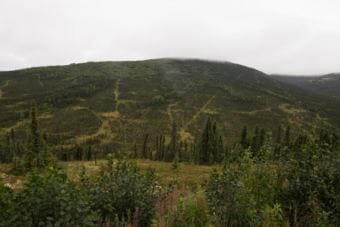
The proposed Donlin mine could be one of the biggest in the world — if completed.
The proposed Donlin mine could be one of the biggest in the world — if completed. (Katie Basile/KYUK)

The long-planned Donlin Gold mine in Southwest Alaska is the latest Alaska project to gain the support of a federal agency seeking to streamline permitting.

The Federal Permitting Improvement Steering Council announced in late October that it had added the massive proposed open-pit mine to a list of projects covered by an obscure Obama-era law meant to speed development, the Fixing America’s Surface Transportation Act. It’s part of a larger push by the Trump administration to expand resource development in Alaska and around the country.

In an interview, Donlin Gold’s environmental and permitting manager, Enric Fernandez, said the designation will likely not accelerate the mine’s timeline. But the so-called FAST-41 designation gives the company more confidence that it’ll be able to move toward a final investment decision in 2027, he said.

“What the program is going to provide is more certainty on the permitting schedule, you know, and also, you know, accountability for the agencies and transparency on the process,” Fernandez said.

The designation does not allow the mine to skip any steps in the lengthy process to make the mine a reality, he said. Work will begin soon on an updated environmental analysis ordered by a federal court to evaluate the possible impacts of a large spill of mine waste, or tailings, he said.

The project has been in the works for years — the company submitted its first federal permit back in 2012, Fernandez said. The head of the Federal Permitting Council, Emily Domenech, said in an interview that the designation was in line with the Trump administration’s resource development and national security goals.

“Up until this administration, the average time to complete a mine to get through the full federal permitting process was just shy of 30 years, which is just completely unacceptable and makes it impossible for us to really effectively compete with China and other adversaries looking to develop critical minerals around the world,” she said.

The project is controversial. Mine tailings would be stored approximately 10 miles from the Kuskokwim River near the village of Crooked Creek, upstream from communities that depend on the river’s salmon for their food supply. More than a dozen tribal governments and a regional tribal consortium, the Association of Village Council Presidents, have opposed the mine, and some have challenged it in court citing the potential for contamination.

“This insensitive federal action is particularly inappropriate while our region’s Tribes are waiting on the mine’s federal permitting agencies to address flaws identified by a federal court and, more importantly, responding to the humanitarian crisis following the hit our region took from Typhoon Halong,” the Mother Kuskokwim Tribal Coalition said in a statement. “A rushed permitting process threatens to override critical environmental protections and silence Yukon-Kuskokwim communities who depend on healthy rivers for survival.”

Some other tribal groups have backed it — notably, the Calista Corp. which owns the resources the mine would target. The company says it would generate royalties for the Native corporation and its shareholders across the region and Alaska Native corporation shareholders across the state, and improve the region’s economy.

Environmental groups have also opposed the mine. Lindsey Bloom with the group SalmonState said in an interview the fast-track designation was inappropriate for a gold mine.

“Gold is not a critical mineral,” she said. “There’s plenty of it already, and … whether or not we develop Donlin will have no effect on our national security.”

Bloom said she saw the designation as an effort to make the project more attractive to investors.

King Cove officials say new land swap agreement brings them closer than ever to building a road to Cold Bay

The road out of King Cove ends at the old hovercraft landing on the shore of Cold Bay, about 7 miles from the city of the same name.
The end of the road leading out of King Cove. June 2024 (Theo Greenly/KSDP)

Department of the Interior Secretary Doug Burgum announced a land exchange agreement Thursday with King Cove’s Native corporation, making way for the controversial construction of what many consider to be a lifesaving stretch of road.

It’s not the first time an agreement like this has been approved for the road, which would connect two eastern Aleutian communities. But according to local leaders, there’s one important difference this time around.

“Having the land exchange agreement already signed, and the ownership of the land now a done deal, that’s never happened before, so that’s big,” said longtime King Cove City Administrator Gary Hennigh in a phone interview Thursday afternoon.

King Cove sits near the western tip of the Alaska Peninsula. It’s a small fishing community that is only accessible by air or water, weather permitting, and its short gravel airstrip is difficult to fly into.

But with the addition of about 11 miles of road, residents could access a neighboring all-weather airport in Cold Bay. King Cove community leaders have fought for that road for decades, arguing that it would provide lifesaving access to emergency medical care.

The problem, though, is that the road would pass through the Izembek National Wildlife Refuge. Environmental groups and several Alaska tribes have said that land shouldn’t be developed in order to protect wildlife.

In 2018, the Trump Administration approved a land swap, which was later revoked by the Biden administration. But Hennigh said this is the first time the land has actually switched hands.

Alaska’s congressional delegation celebrated the agreement at an Alaska Day ceremony Thursday in Washington D.C.

At a press conference after the event, Republican Sen. Lisa Murkowski said the property conveyance, including the patent and the deed to the land, would be recorded Thursday afternoon.

She applauded King Cove’s perseverance.

“They are weary,” Murkowski said. “They are tired of kind of this ‘up and down, and back and forth, and maybe or maybe not.’ They want the certainty that’s going to come with this very small connector road.”

Murkowski said the U.S. Fish and Wildlife Service is swapping 490 acres of federal land for the road. The King Cove Corp. — the local Alaska Native village corporation — will hand over acreage in return.

Some western Alaska tribes have opposed the road, saying it threatens important subsistence species. And federal biologists have acknowledged the road would impact the habitat of Pacific black brant and emperor geese.

Murkowski said she recognizes the significance of those resources and that requirements are in place to ensure the animal populations remain strong.

Nobody’s talking about a multi-lane paved road, moving lots of big trucks back and forth,” she said. “It is still an 11-mile, one-lane gravel, non-commercial-use road.”

The congressional delegation said in a statement that the swap will ultimately “result in the net expansion of the Izembek refuge, clearly adding to its conservation and subsistence values. Under the agreement, Interior will receive or maintain roughly 14 times more land than it gives up.”

Hennigh said there’s still a lot to be done, with things like permitting, public commentary periods and funding to secure. After years of seeing progress toward a road fall back, he said he’s optimistic but cautious.

“We also are not so naive to think that there won’t be some lawsuits along the way,” he said.

Hennigh hopes to see construction begin by 2027.

The Alaska Desk’s Theo Greenly contributed reporting.

Woman missing from Kwigillingok found dead, two still missing

The Alaska Department of Public Safety unveiled its draft policy for body-worn cameras for state troopers on Wednesday. Officials anticipate outfitting officers with cameras this spring.
An Alaska State Trooper uniform. (Alaska Department of Public Safety)

A woman has been found dead in Kwigillingok, two days after a devastating storm hit the Kuskokwim Delta coast.

The woman’s name has not been released publicly. Alaska State Troopers say they’re working to notify her next of kin.

Reached by phone Monday evening, spokesperson Austin McDaniel said troopers are actively searching for two people who are still missing from Kwigillingok.

Kwigillingok was one of the hardest-hit communities in the Oct. 11 storm. Kipnuk, roughly 30 miles west, was also battered by high winds and record-breaking flooding, but troopers say everyone from that community has been accounted for.

Dozens of evacuees from the two communities are arriving in Bethel, according to the regional tribal healthcare provider. They’re being housed at Bethel’s National Guard Armory, which has been turned into a 100-bed shelter.

This is a developing story and may be updated with additional information.

Fat Bear Week starts Tuesday. Who will be the chubby champ?

Two bears vying for a prime fishing spot near Brooks Falls. (Brian Venua/KMXT)

The brown bears in Katmai National Park and Preserve have been packing on the pounds this summer. Starting Tuesday, you can vote online for the chunkiest bear in the annual Fat Bear Week competition. The name of the event says it all, said Katmai park ranger Sarah Bruce.

“We celebrate how fat the bears get,” she said. “Fat equals survival. A fat bear is a healthy bear.”

Fat Bear Week started as a one-day celebration over a decade ago, but has grown into an international phenomenon. Over a million people from more than 100 countries voted in the bracket-style competition last year.

Bruce called the face-off the park’s hallmark event.

“Fat Bear Week brings the park into the living room of anybody who wants to enjoy this place,” she said. “Even just this past week, we had a bear cam fan who visited the park from New Zealand.”

Bruce is originally from Maryland and she’s hooked, too.

She said it’s stunning to watch the bears transform as they feast on fish in the Bristol Bay watershed – home to the world’s largest sockeye salmon run.

“It really is quite a sight to see these bears go from 5, 6, 700 pounds and they come out of the den over 1,000 pounds by the end of the season,” she said.

Most bears in the area start making their way to their dens in October and November. While hibernating, bears will drop a third of their body weight because they don’t eat or drink.

#32 Chunk is a big bear. Last year, Chunk lost to Grazer by a difference of over 40,000 votes. Last summer, Chunk killed Grazer’s cub after it slipped over the waterfall. The whole incident was caught on the live cameras on explore.org (Christine Loberg/NPS)

Park rangers are still finalizing this year’s 12 chunky competitors but Bruce said there may be some familiar faces – like potentially Grazer, the reigning champion, along with Chunk, last year’s runner up. Online voting in the bracket-style challenge opens at explore.org Tuesday and runs through Sep. 30.

But if you want to get in on the action early, Fat Bear Week also has a junior division where the plumpest cub advances to the main bracket. Voting for the juniors starts Thursday and closes Friday.

‘We got a tired Tustumena’: State to open bids for long-awaited ferry replacement

A man on a ferry deck, seen through a rain-splattered window, brings down an Alaska state flag in the rain.
A crew member on the Tustumena in August 2024. (Theo Greenly/KUCB)

The Trusty Tusty, the Rusty Tusty — the Alaska ferry Tustumena has a few different nicknames. In the Aleutians, where the ship doubles as the only restaurant for many small villages along the route, people call it the McTusty.

“We’re going to have dinner,” Ellie Hoblet said when the Tustumena docked in False Pass on Aug. 8. “There’s no other places to get food.”

Hoblet was there with a handful of others from the fishing village of about 30 residents.

“Best restaurant in town,” Calum Hoblet said. “The clam chowder and the chicken strips, that’s the best.”

Herman, Timothy and Anna Tepper have grown up in False Pass and Kodiak, where they frequently travel on the ferry. “My favorite food on the Tustumena is the chicken tenders,” Timothy said during the ferry’s stop in False Pass in August 2025. (Theo Greenly/KUCB)

The Tustumena is more than just a ferry: it’s a lifeline for Aleutian communities. Barging in freight can be prohibitively expensive, so the ferry is a cheaper alternative. And a $350 ferry ticket is often the only way people in the Aleutians can afford to travel out of their communities — a one-way flight from False Pass to Anchorage costs more than $1,000.

But the aging vessel doesn’t make it up and down the chain as often as it used to. Meanwhile, the state’s efforts to replace it have been postponed and delayed for years, leading to reduced service and canceled sailings while the ferry undergoes repairs.

A vehicle waiting for the Tustumena on the dock in Cold Bay in August 2025. (Theo Greenly/KUCB)

The ship also doesn’t sail as late into the year anymore. Captain John Mayer says one reason for that is to avoid inclement weather.

“I’m far more prudent in the weather I choose to go out in because she is a 61-year-old ship,” Mayer said. “When I first started here, it wouldn’t be unusual to leave the harbor in 20-foot seas. Now I don’t even think about that.”

Before the pandemic, the Tustumena made two Aleutian chain runs each month during the summer. In earlier years, they sailed into October, when the crew handed out pumpkins for the famed “Pumpkin Run.”

“When we would pull into port, say, for Sandpoint, the whole town would be on the dock,” Mayer said. “Total chaos.”

Akutan residents collecting pumpkins from the Tustumena in October 2011. (Ian Dickson/Alaska Desk)

Mayer has worked on the Tustumena for about 25 years, working his way up to captain in 2015. He says he hopes a new ferry will mean they can sail as late and as often as before.

“Maybe with the new ship we can, because it could just be more resistant to heavier weather,” he said.

But improved ferry service won’t happen until the state builds the Tustumena’s replacement. That’s been in the works for over a decade, but it wasn’t made official until Gov. Mike Dunleavy announced the project in 2021. The Alaska Department of Transportation solicited for builders the next year, but nobody bid.

The Tustumena crew prepares to leave Sand Point in June 2024. (Theo Greenly/KUCB)

Craig Tornga, the ferry system’s marine director, told the marine highway’s advisory board at its July 25 meeting that they’d finally be going out to bid this fall.

“We got a tired Tustumena that needs a replacement,” Tornga told the board.

He said one of the biggest challenges is a requirement that 70% of the money spent on the project goes to American companies, a point that Captain Mayer also made.

“That’s been very exasperating,” Mayer said. “They simply do not make the systems you need for a new ship in this country.”

The original target date for replacing the Tustumena was 2027. Despite the fact that the project hasn’t gone out to bid yet, and despite the fact nobody bid on it the last time, Tornga told the board that they’re still trying to get the replacement ferry on the water at the end of 2028. But he said that date could change once they accept a bid and get a more realistic timeline.

Tornga said the marine highway system is meeting with potential bidders later this month, when he’ll give another progress report.

The Tustumena’s galley in August 2024. (Theo Greenly/KUCB)

Back in False Pass, on board the Tustumena, the galley was packed at 6:30 p.m., right when the ferry was supposed to leave. Standing in the galley, Mayer started to sound more like a restaurant manager than a boat captain.

“To-go order? Anybody here to go? Everyone staying on board?” he asked.

He said he didn’t want to set sail for Akutan while folks from False Pass were still waiting for food from the best restaurant in town.

Yup’ik climate advisor appointed by UN secretary general

Charitie Ropati, a young Alaska Native engineer with roots in Kongiganak, has been appointed as a youth climate advisor to the United Nations. (Photo courtesy of Charitie Ropati/KYUK Public Media)

Twenty-four-year-old Charitie Ropati is Yup’ik and Samoan, and has roots in the Bering Sea coastal village of Kongiganak. She said that the community has inspired her.

Following a flood event in 1966, many members relocated from the village of Kwigillingok to higher ground, a settlement which would become known as Kongiganak. Now, the permafrost under the village is thawing and Kongiganak is facing its own set of climate impacts.

“It really started with the story of my community,” Ropati explained. “And it’s because of that story of survival, I think, that brought me to where I’m at now.”

“Now” for Ropati means working in New York City as an engineer designing public housing infrastructure for Indigenous communities across the country. Ropati has also started her own nonprofit education organization called LilnativegirlinSTEM and was recently named to the Forbes 30 under 30 list.

Ropati said that she was back in Alaska, driving around Anchorage with her mom and her partner, when she got the news that she’d been selected as a youth climate advisor to the United Nations (U.N.)’s secretary general.

“It really meant a lot to be there, especially with my mom where these stories of survival really originated from her and specifically that story of relocation,” Ropati said. “Just our ability as Yup’ik people to do these type of things. Not only for survival, but for the love of each other and community.”

As a youth climate advisor, Ropati will be part of a cohort working with United Nations Secretary-General António Guterres to provide “practical and outcome-focused advice, diverse youth perspectives” around climate action, according to a press release from the U.N.

The youth advisor roles are pretty new to the U.N. In 2025, the number of selected advisors doubled from seven to 14. According to the press release, that’s to help support young people who don’t often have a seat at the table. Ropati is one of the first Alaska Native youth to be appointed as an advisor.

“I think this is a huge win, especially for youth in the Arctic,” Ropai said. “Because I don’t think we’ve ever been given this type of platform before.”

It’s a big year to be involved. The United Nations’ annual climate conference will take place this November in Brazil. Also this coming year, countries in the U.N. are required to submit new climate plans.

The plans will follow the Paris Agreement, a commitment to reduce greenhouse gas emissions to keep the global surface temperature below 1.5 degrees Celsius. It’s a figure the U.N. has emphasized as a tipping point for damaging climate impacts, a point Ropati said affects the human rights of Indigenous people in the Arctic.

“We know that if that happens, and if our world does do that, that’s going to have devastating impacts, not only on these nations or states, but it’s going to have devastating impacts on Indigenous peoples, and especially on us, on Yup’ik, on Inuit, on Inupiaq, on all of us in our state,” Ropati said.

Ropati said human rights form the foundation of her climate advocacy. She said that Indigenous people on the front lines of climate change are often left out of the discussion when it comes to climate solutions. But she said they’re a group well-equipped with answers.

“When we talk about the climate work we’ve been doing, this is work that has been carried on through generations,” Ropati said. “This is work that didn’t start with me. It started with my great grandfather, to my grandmother, to my mother, and now me.”

Ropati said that climate conversations in the Western world often involve looking for quick fixes. But in Yukon-Kuskokwim Delta villages facing relocation, Ropati said that it’s understood that climate solutions can take generations. The recent relocation of the village of Newtok to a new site, Mertarvik, was one that was decades of planning and discussions in the making.

“It’s not just up to our youth to do this, and it needs to be intergenerational,” Ropati said. “I think this is something we as Indigenous people have always understood and continue to do, especially in our communities.”

In her capacity as a U.N. youth climate advisor, Ropati will work for the next three years alongside appointees from around the world, including Kenya, Sweden, and Indonesia.

Ropati said that she’s looking forward to bringing Indigenous perspectives to the forefront of the international climate discussions.

Site notifications
Update notification options
Subscribe to notifications