Southwest

How is climate change impacting life in rural Alaska? Researchers are looking for answers.

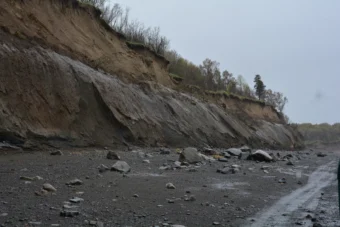
An eroding bluff in Dillingham. (Erika Gavenus)

Researchers have been spreading across rural Alaska to conduct a long-term study on the regional effects of climate change, collecting evidence in parts of Bristol Bay.

The Polaris Project is a research initiative led by scientists from universities across the country, funded by the National Science Foundation. It’s in its fifth and final year of studying how climate change is impacting social well-being, subsistence lifestyles, and community infrastructure in Arctic communities.

“We know that the Arctic is one of the regions that has been studied the least,” said Dr. Guangqing Chi, professor of rural sociology, demography, and health sciences at Penn State, and lead researcher on the Polaris Project.

Chi’s team has been conducting research in Dillingham, Port Heiden, Kotzebue, and Chevak, focusing on three key areas: food, migration and erosion.

According to the National Climate Assessment, Alaska is warming at a rate twice the global average, leading to changes in habitat, receding sea ice, and thawing permafrost.

The assessment indicates that as permafrost thaws and sea ice retreats, coastal bluffs become increasingly vulnerable to erosion.

In Dillingham, Polaris Project researchers established erosion monitoring sites at community-selected locations throughout the city.

They found that in certain areas, the shoreline is eroding at a rate of 5.21 meters per year. In other areas, that number is 10.69 meters per year.

A map of coastal erosion in Dillingham. (Michael Letzring/The Polaris Project)

“We also heard that the cave in the hospital area has been falling off, kind of becoming dangerous,” Chi said.

Erica Gavenus is a postdoctoral scholar at Penn State and a researcher on the project. She says the data can help the community prepare for potential futures.

“There’s been work on the assessment of the rate of erosion and then projecting out how long it will be before it reaches certain points,” Gavenus said. “They’ve learned some of those findings, and have shared those back with the city of Dillingham to help with planning in those ways.”

Coastal erosion is already creating a need for community migration and mobility across Alaska.

For example, in Newtok, a Yup’ik village on the Ninglick River, coastal erosion has forced the entire community to relocate – a project that’s still underway.

But, Gavenus says moving is not always an option. In other cases, it may be a tough decision.

“I think one of the things that was coming out in some of the research is that, especially in rural Alaska, there’s a lot of reasons why people are very committed to staying,” Gavenus said. “Whether that’s staying in their physical location or staying with that family and broader community and the social networks they have.”

The researchers are also examining the impact of climate change on food security.

In partnership with the Alaska Department of Fish and Game, the Polaris Project conducted a subsistence study in 2021, finding that 97% of households in Dillingham utilized subsistence resources, either by harvesting them themselves or through community sharing.

Gavenus says they observed consistency in the resources being harvested, but the composition has changed, and the amount has decreased by roughly 18 percent over the last four decades.

The study found that harvesting certain wild resources, such as Chinook salmon and large land mammals, is becoming more challenging than in the past.

They also found that food security is higher in Dillingham than in both Alaska and the U.S. as a whole.

A 2021 comparison of food-security assessments from Dillingham, Alaska and the U.S. overall. (Graph courtesy of Alaska Department of Fish and Game- Division of Subsistence)

Chi says subsistence practices have an impact on migration.

He says a lack of access to food resources can force people to leave their communities, but food can also drive people back.

“There’s also the food and the culture driving people back,” Chi said. “You know, not necessarily just the food as food, but it’s the culture. You get together with your family, with your friends. So it’s really two directions for that.”

The Polaris Project will conclude on Aug. 31, with final reports available to the public on their website. But the researchers say their work in the study regions will continue, helping communities adapt as the Arctic continues to change.

Trump’s EPA could revive controversial Pebble Mine in southwest Alaska

Donald Trump Jr. and his son in river shallows. Trump jr. holds in front of him a sockeye salmon that is bright red with a green head.
Donald Trump Jr. is among the opponents of the Pebble Mine. He posted this photo of himself on Facebook in 2014. (Photo via Facebook)

The Trump administration is reviving the hopes of the company behind the proposed Pebble Mine in southwest Alaska.

Vancouver, B.C.-based Northern Dynasty, the parent company of the Pebble Limited Partnership, says it’s in talks with the Environmental Protection Agency and hoping the agency will swiftly withdraw its veto of the project.

The proposed open-pit copper and gold mine would be upstream from Bristol Bay and is widely opposed in Dillingham and the region, where it is seen as a threat to the bay’s prolific salmon runs.

Environmental studies found it would damage or destroy miles of salmon streams and more than 2,000 acres of wetlands.

National sportfishing groups have also campaigned against the mine.

Northern Dynasty has a pending lawsuit in U.S. District Court in Anchorage to get a prior EPA veto of the project thrown out. A document filed in that case says the company and the agency are discussing a possible settlement and expect to reach an agreement by July 17.

In his first term, President Trump seemed to run hot and cold on Pebble. His first EPA administrator in 2017 let the project move forward, then reversed course a few months later. The mine proposal seemed to get back on track, but then the U.S. Army Corps of Engineers denied Pebble’s permit application in 2020.

That came after Donald Trump Jr., a sportfisherman who visited the region, publicly announced his opposition.

Compensation program for health damage from Alaska weapons tests is extended

Harlequin Beach on Amchitka Island is seen in this undated photo. The island, now part of the Alaska Maritime National Wildlife Refuge, was the site of atomic weapons tests in 1965, 1969 and 1971. (Photo provided by the U.S. Fish and Wildlife Service)

People who might have been exposed to radiation from atomic weapons tests conducted in the Aleutians half a century ago have extra time to apply for compensation from a federal program, under the sweeping tax and budget bill passed by Congress and signed into law last week.

The bill, which was signed by President Donald Trump on July 4, includes a provision reviving the Radiation Compensation Exposure Act, which was enacted in 1990.

The act’s compensation system distributed one-time payments to people who were exposed to radiation from the weapons tests and who later were diagnosed with certain types of cancer. The program has distributed about $2.7 billion to date, according to the U.S. Department of Justice.

While most of the tests covered by the act were conducted in Nevada, the program also covers health damages from underground weapons tests conducted on Alaska’s Amchitka Island in 1965, 1969 and 1971.

The program covers former uranium mine workers, as well, many of whom were Navajo Nation members.

The compensation program had been on track to expire, with a previous deadline of June 10, 2024, for any new claims.

The budget bill extends the deadline for new claims to Dec. 31, 2027, and it sets a Dec. 31, 2028, sunset date for the trust fund that administers the claims.

The bill also raises compensation amounts. For “downwinders,” people who were not on site at the time of the tests but may have been exposed to radiation carried by the wind, the compensation is hiked from $50,000 to $100,000. For on-site workers, the compensation is raised from $75,000 to $100,000.

Of the Alaska weapons tests, the third — called Cannikin — was the most controversial.

It was the biggest underground nuclear test ever conducted by the United States. The tested bomb was 5 megatons, about 250 times as powerful as the bomb dropped on Hiroshima, Japan, in 1945. There was widespread opposition to the project, including from environmentalists who later founded the organization Greenpeace.

Legal opposition to the test went all the way to the U.S. Supreme Court, which ultimately allowed the project to proceed.

The test created what was the equivalent of a magnitude 7 earthquake, killing up to 2,000 sea otters and thousands of fish.

The island continues to undergo environmental monitoring, for which the U.S. Department of Energy is responsible. The Alaska Department of Environmental Conservation and the Aleutian Pribilof Islands Association, a tribal organization, are partners.

Paralytic shellfish poisoning moves beyond Alaska’s shoreline

The beach in Sand Point July 2023.
The Knik Tribe tested for marine toxins along the coast in Sand Point. Typically found during the summer months, paralytic shellfish poisoning is becoming more prevalent throughout the year, due to Alaska’s warming climate. (Theo Greenly/KSDP)

Just back from the beach in Sand Point, Jackie McConnell carried a bucket of clams and cockles into her motel room at the Anchor Inn.

McConnell is the project coordinator for the Knik Tribe’s program for monitoring paralytic shellfish poisoning, or PSP — a dangerous and often fatal neurotoxin that can show up in local shellfish.

PSP is typically found during the warm summer months, but McConnell says the toxin has been showing up in butter clams and cockles for much longer.

“They are basically hot all year round,” she said.

McConnell was sorting through the bucket of shellfish with Bruce Wright, the tribe’s chief scientist. He’s studied PSP levels in Alaska for about 20 years. On this trip, he said he is particularly interested in Arctic surf clams — also called pink-neck clams — a favored food of walruses.

“There’s people that, when they catch a walrus, they like to take the stomach and eat the undigested clams,” Wright said.

That’s one example of how saxitoxin moves through the food web — starting in shellfish, then traveling into larger animals. But the researchers say they’re also finding high levels of saxitoxin in animal droppings far from the coast.

“We’re finding that wolves, bears, their scat in areas where they’re not even feeding from the ocean, that they can have moderate levels of PSP in their scat,” Wright said.

They’ve concluded the inland contamination comes from cyanobacteria, a type of blue-green algae found in ponds and lakes. That suggests a second, freshwater source of saxitoxin is entering the food web.

Saxitoxin — one of about 50 neurotoxins found in shellfish — commonly accumulates in freshwater systems in the Lower 48, where warm weather creates favorable conditions for the bacteria. Its presence in Alaska’s cooler climates is relatively new.

Despite the elevated readings, the researchers said local shellfish can still be safe to eat if it’s been tested first.

“We’ll pay for the shipping, we’ll pay for the analysis, and we’ll and we’ll take care of that consultation after the data comes back,” Wright said.

He said residents can leave their harvest in a bucket and send a sample to the tribe. Results are typically returned within one or two days.

Archaeologists find evidence of villages and one site from 7,000 years ago on Shuyak Island

Archaeologists with the Alutiiq Museum dig into layers on layers site at Karluk Lake called site 309, which revealed a ‘super structure’. This is separate from what was surveyed on Shuyak Island. (Courtesy of Alutiiq Museum Archaeology Department & Repository)

A archaeological survey of an island near Kodiak has discovered new Alaska Native village sites, including one believed to be the island’s oldest.

Shuyak Island is one of several located in the Kodiak Archipelago and like many islands in the area has a rich history. The Alutiiq Museum’s archaeological team has been surveying sites on the island for a couple years and they have pieced together more of the historical timeline of the island’s use.

Patrick Saltonstall, the archaeology curator with the Alutiiq Museum, is heavily involved in site surveys and excavations around the Kodiak Archipelago.

This spring, Saltonstall and staff from the museum’s archaeology team finished surveying Shuyak Island, which is located approximately 54 air miles north of Kodiak.

“A lot of the old research had focused on the northwest part of Shuyak Island and we surveyed the whole island. And we found a lot of really big villages on the east side,” he said.

Last summer they surveyed the western half of the island and this year they did the eastern half. Saltonstall said they surveyed one site that dates back to roughly 7,000 years ago, which he suspects is the oldest found on that island thus far.

“I think we found that one village that had 11 house pits, probably had two to three hundred people living in it, you know, 300 years ago,” he explained. “Shuyak has always sort of been a place where I think it seems like there were fewer people up there. But finding that, you know what your preconceptions are and what you actually find often don’t match.”

Alutiiq/Sugpiaq people have inhabited areas around Kodiak Island for at least 7,500 years, according to archaeologists. And thousands of archaeological sites have been documented across the archipelago.

According to the Alutiiq Museum, Shuyak Island was an integral part of that history with at least two established Alutiiq villages. But Russian fur trader Gregorii Shelikov destroyed one of the villages and by the late 1700s there were no communities left on the island.

By the 1920s the island was home to a herring saltery and family fishing operations providing food for human consumption and animal feed for a, “growing fox farming industry.” The Sklaroff & Sons smoked fish establishment from 1892, in Port William on the south end of Shuyak Island, was turned into a fish processing facility or cannery, which was operated by the Washington Fish and Oyster Company until 1976.

After the Exon Valdez oil spill in 1989, part of the cleanup work involved surveying and protecting various archaeological sites on the island. According to Saltonstall, many of those sites were reported to be eroding and at risk of disappearing into the water.

The word Suu’aq [Shuyak] in Alutiiq means “rising out of the water”. And true to its name, Saltonstall said the island itself is rising at a faster rate than the sea level is; so the threat of eroding sites is not as prevalent today.

“What we found up there is that’s not happening anymore. All the sites are much more stable,” he said. “You see grass growing on all the beaches, and it demonstrates…the land sank in 1964 and it’s rebounded ever since, and it’s outpacing sea level rise up there.”

Molly Odell, the director of archaeology at the Alutiiq Museum, said that growth provides natural protection for the sites on Shuyak Island.

“It’s really good news that the sites aren’t eroding as much as they were even 30-40 years ago, because it means they’re stable and they’re not being lost. And it also makes them a little bit more protected from looting,” she said. “You know people going and collecting artifacts off the beach or digging them up used to be more of a problem.”

Odell adds that people should not dig in archaeological sites and should not collect artifacts, which are owned by the landowner even if they’re on the beach. [WEB: If you come across artifacts or cultural sites around the island, you can report that information and share pictures with the Alutiiq Museum by calling 844-425-8844.

Most of the island is now owned by the state and is included in the Shuyak Island State Park.

Odell said the museum was doing survey work in partnership with the Shuyak Island State Park and Alaska State Parks system. Later this summer they plan to update the archaeology display at the Big Bay Ranger station on the island.

Alaska’s longest-serving state legislator, Lyman Hoffman, will not run for reelection in 2026

Sen. Lyman Hoffman, D-Bethel, talks with Sen. Matt Claman, D-Anchorage (facing away from camera), on Tuesday, Jan. 16, 2024, the first day of the 2024 legislative session. (Photo by James Brooks/Alaska Beacon)

After nearly 40 years in Alaska’s state Capitol, Sen. Lyman Hoffman is calling it quits.

On Wednesday, the Bethel Democrat confirmed that he will not seek reelection in 2026 and will end a political career that has left him as the longest-serving state legislator in Alaska history.

“Forty years is enough,” Hoffman said on Wednesday.

“I’m going to go back and become a civilian, and I’m going to talk with Rep. Edgmon and encourage him to file for my seat,” Hoffman said, referring to Speaker of the House Bryce Edgmon, I-Dillingham.

Hoffman was elected to the state House in 1986 and to the state Senate in 1994. That year, his closest opponent was Edgmon.

“He’s from the region. He’s been in politics for over 20 years. I think we would have more continuity in having a seasoned person to represent the Senate district,” Hoffman said of Edgmon.

By text message, Edgmon said he is “taking a serious look” at running for Senate.

“Senator Hoffman’s announcement today was not unexpected; however, it still comes as a bit of a gut punch because of what he has meant not just to rural Alaska but to the state as a whole,” Edgmon said. “His departure is going to be a huge loss to the Legislature.”

Hoffman confirmed that he doesn’t intend to run for governor or any other office.

“The family life — that’s the toughest part. Leaving home, leaving family, leaving friends for three to six months out of every year, it puts a big strain,” he said. “So a lot of kudos out to my wife Lillian for putting up with me to do what I love to do.”

In a 15-minute phone interview, Hoffman reflected on his career, saying that in addition to a law that requires the state to fund rural schools, his biggest achievements were those related to energy. He successfully created an endowment fund for the Power Cost Equalization program, which subsidizes rural power costs, and that endowment now is worth more than $1 billion.

Other successes also were related to energy.

“We passed legislation to set up a weatherization program, and we’ve weatherized over $600 million worth of homes,” he said.

If the trans-Alaska natural gas pipeline is built, 20% of gas-sale royalties will be reserved for rural energy development, thanks to Hoffman’s work.

“I think that overall, the work I’ve done on energy is probably the most important thing,” he said.

Asked what has changed in the Capitol during his 40 years, he said the power of rural legislators is now taken for granted. Earlier in his career, it wasn’t.

For the past 10 years, rural legislators have played a kingmaking role in the closely divided state House and Senate, frequently determining whether a Republican-led coalition or a Democratic-led coalition controls each body.

“There were times when rural Alaska wasn’t at the table, and I think that’s the biggest change,” Hoffman said.

“Even if you talk to urban legislators, I think the caliber of and the participation of rural legislators is well respected today,” he said.

When asked what advice he would give a new legislator, he said that it’s important to know that “the relationships you make directly affect your influence,” so it’s important to make friends.

“The top people that are out there — Senator (Gary) Stevens, Senator (Bert) Stedman, Senator (Donny) Olson. All of us have over 20 years of experience in the Senate, and we are good friends, and so I think it’s all about relationships and keeping your word to each other.”

During his time in office, the state’s population has grown, as has the influence of Alaska Native corporations, including Native health corporations.

“I’m chairman of the Bethel Native Corporation, and have been for around 30 years. Our wealth has multiplied by 20-fold. You know, I think that in the state … Native corporations have changed the state of Alaska for the better,” he said.

As he prepares to leave office, Hoffman said he thinks the state’s biggest unresolved issue is the affordability of living in Alaska, particularly with regard to the cost of energy.

“That’s why I spent so much time on it,” he said of energy issues.

“The unfinished business, I think the biggest one that is going to have a major impact on energy, is the gas line,” he said.

The high cost of energy in rural Alaska is also why he’s been interested in micronuclear reactors.

“Right now, people in rural Alaska are spending up to 50-60% of their disposable income on energy, and if they had that 50-60% reduced down to 10%, that would be a windfall to them, and that would change the way people look at Alaska, because it’s in many instances, it’s pretty expensive to live here because of energy,” he said.

“If we can crack the energy equation in the next two decades, I think that’s going to change the face of Alaska.”

Site notifications
Update notification options
Subscribe to notifications