Southwest

Canonized on the Kuskokwim: Orthodox faithful descend on Kwethluk for the glorification of St. Olga

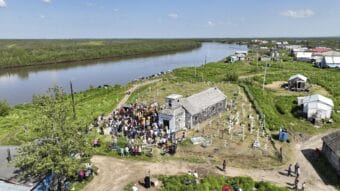
Orthodox pilgrims and clergy gather in the old St. Nicholas Russian Orthodox Church cemetery to take part in the glorification ceremony for St. Olga in Kwethluk on June 19, 2025.
Orthodox pilgrims and clergy gather in the old St. Nicholas Russian Orthodox Church cemetery to take part in the glorification ceremony for St. Olga in Kwethluk on June 19, 2025. (Photo by Katie Baldwin Basile)

Shots rang out over the Kwethluk River as a mass of pilgrims lining the muddy banks sang a hymn of blessing on the eve of the summer solstice. At last, leaders of the Orthodox church had arrived in Kwethluk for the glorification of St. Olga – the first-ever Yup’ik saint and first female Orthodox saint in North America.

Metropolitan Tikhon, leader of the Orthoodox Church in America arrives in Kwethluk, Alaska for the glorification of St.Olga on June 19, 2025. (Katie Baldwin Basile)

For Kwethluk, the glorification is a long-awaited honor for Olinka “Arrsamquq” Michael, or Matushka Olga, a local midwife who gained a reputation as a gifted healer of deep-seated trauma during her life. Since her death in 1979, accounts of her miracles have spread throughout the Orthodox world, culminating in this historic moment.

In the crumbling cemetery of the old St. Nicholas Russian Orthodox Church, priests set Olga’s wooden casket on blocks, just feet from the spot where they exhumed her remains seven months earlier. It’s something that hadn’t been done in Alaska since the exhumation of St. Herman on Spruce Island near Kodiak in 1970.

As local priest Fr. Vasily Fisher explained, before Olga could be venerated as a saint, her final funeral rite, or panikhida, needed to be performed. Going forward, the day of her death will be celebrated instead as her birth as a saint.

“Everything is done as if going backwards; they come back to the church in the presence of life. Our faith is about life. Sainthood is about life,” Fisher said.

Some gathered in the cemetery had tears in their eyes. Others patted beads of sweat from their foreheads. Olga’s descendants stood transfixed among headscarved pilgrims from nearby villages and from as far away as Romania and Australia. The head of the Orthodox Church in America (OCA), Metropolitan Tikhon, traveled from Washington, D.C.

As Archbishop Alexei of Alaska read a passage from the Book of Psalms, a sudden gust of wind from nowhere cut through the otherwise still afternoon. It was hard to not get swept up in the feeling that something miraculous was afoot.

After the funeral rite, a procession featuring flowing robes, golden banners, puffs of incense, and a couple curious village dogs bore the casket along a short dusty track to the church in the section of Kwethluk known as downtown.

During the four-hour service that followed, it was standing room only, which worked out well for a religious tradition that doesn’t make use of pews. The chanting and choreography, what Alexei referred to as an “elaborate, beautiful dance,” ended when St. Olga’s casket was opened for pilgrims to kiss her sacred relics and receive her blessing.

One of Olga’s nieces, Bertha Howard, summed up her memories of her aunt succinctly.

“Ikayurluki yuut, naklegtarluni (she helped, she was compassionate), that’s all I can say,” Howard said.

For Olga’s granddaughter, Atan’ Winkelman, the inclusion of Yugtun in many of the glorification services was a highlight.

Atan’ Winkelman, granddaughter of St. Olga. (Katie Baldwin Basile)

“It’s very cool to see actual Yugtun words… to recognize the Yupik people, to use the word ‘Elders’ in song. I’ve never heard that anywhere else in any of our venerating any other saint,” Winkelman said.

As pilgrims filed by outside the church, Winkelman said that the scene was a lot to process.

“I’m finding the whole exhuming of her body, the whole glorification, canonization, very strange. Because she was an actual person to me that would hold me, and piggyback me, and we would sit and eat together, or I would sit and watch her sew,” Winkelman said.

Olga’s youngest surviving daughter, Matushka Helen Larson, remembers the many women who would pay visits to her childhood home in Kwethluk to sit down to tea with her mother.

Matushka Helen Larson is the youngest daughter of St. Olga of Kwethluk, Alaska, who was glorified as a saint in the Orthodox Church in America this past week, June 19-20, 2025. (Katie Baldwin Basile)

“They’d talk for hours, but I wouldn’t listen because she wouldn’t want me to listen,” Larson said. “But I knew she was helping someone. [They would] come in looking very heavy, you know. And then when they go, they’re lighter.”

With Kwethluk cast further into the spotlight of the Orthodox world, Larson said that she hasn’t lost perspective.

“I still think of her as just my mom,” Larson said.

For many others, Olga has become “St. Olga, Matushka of All Alaska,” a symbol of compassion, modesty, and empathy that appears to resonate just as much across the Yukon-Kuskokwim Delta as it does the world.

Katie Basile contributed reporting to this story.

Restraining order on Alaska bear cull to be in place until state fixes identified legal flaws

A subadult brown bear sniffs the air as it walks across the tundra in Katmai National Park and Preserve on Aug. 10, 2023. Critics of the state’s predator-control program say officials failed to adequately analyze impacts to bear populations, including animals that roam in Katmai. (Photo by F. Jimenez/National Park Service)

A state judge has extended a restraining order that bars the Alaska Department of Fish and Game from killing bears in a controversial predator-control program.

Superior Court Judge Christina Rankin, in an order issued late Monday, said the department’s decision to shoot bears earlier this month in violation of a previous court ruling justified her decision to keep the temporary restraining order in place beyond the 10 days that is standard in Alaska law.

The department will be prohibited from conducting its planned bear cull in the Mulchatna caribou herd range until it corrects the legal flaws identified in a March 14 ruling issued by a different judge, Rankin said.

She rejected the state’s request to lift the restraining order and its argument that the prohibition was no longer needed.

“Despite the State’s stated intention of discontinuing its bear predator control measures this season, due to its prior position that it would continue bear abatement unless specifically enjoined, this Court thinks it is prudent to specifically state that the TRO will not expire after ten days and extends the TRO until further order of the Court or until the State obtains proper legal authority, consistent with the March 14 Order, and the May 7, 2025 Order,” she said in her order.

It is the latest development in a lawsuit filed in 2023 by the Alaska Wildlife Alliance that challenged the predator control program.

State officials say the program is needed to boost Mulchatna caribou herd numbers, and it must be conducted in spring and early summer, when newborn caribou calves are vulnerable to bear predation. But the Alaska Wildlife Alliance and other critics say the program lacks scientific validity and was put into place without proper public input.

Superior Court Judge Andrew Guidi ruled on March 14 that the department and the Alaska Board of Game had violated state constitutional requirements when approving and starting the program. He agreed with the Alaska Wildlife Alliance’s argument that public notice and opportunity for public input was inadequate. He also found that state officials violated the constitution’s mandate that replenishable resources be maintained for sustained yield, by failing to properly analyze the program’s impact on bear populations.

After Guidi’s ruling, and after Rankin ruled on May 7 that a Board of Game emergency regulation allowing the program to resume was legally void, the department restarted the bear culls on May 10 anyway.

Eleven brown bears and one wolf were killed that weekend, the department said. That toll added to the 175 brown bears, five black bears and 19 wolves that the state said were killed during 2023 and 2024.

That weekend action led to Rankin’s determination that the state had acted in “bad faith” and her decision to impose the temporary restraining order.

The Alaska Wildlife Alliance has also served notice that it may ask for the department to be held in civil contempt for its bear kills earlier in the month.

The Mulchatna caribou herd numbers about 15,000 animals, after hitting a peak size of about 200,000 in the 1990s, according to the department. The department’s goal is to have the herd expand to between 30,000 and 80,000 animals, big enough to support a hunt. Hunting of that caribou herd was closed in 2021.

Oregon seafood company looks into buying Peter Pan’s King Cove plant

Peter Pan's King Cove facility, pictured in June 2024, has been out of operation since January of that year.
Peter Pan’s King Cove facility, pictured in June 2024, has been out of operation since January of that year. (Theo Greenly/KUCB)

Representatives from Oregon-based Pacific Seafood could be interested in buying the shuttered Peter Pan processing plant in King Cove, according to local officials from the Alaska Peninsula community.

At Thursday’s Aleutians East Borough Assembly meeting, King Cove Mayor Warren Wilson said that representatives from the seafood company had visited the plant the week before.

“They were very impressed with the plant, and they are moving forward with some talks on acquiring the facility,” he said during the public comment period, speaking as a community member. “So there is interest yet.”

Peter Pan ceased operating in King Cove in January of last year and was placed into a court-ordered receivership a few months later. After a legal dispute, the property was awarded to Peter Pan Chief Executive Rodger May. May has faced criticism over Peter Pan’s business practices, including failing to pay fishermen for the 2023 salmon season.

The plant was a major economic driver for the Alaska Peninsula community of about 800 residents. City Administrator Gary Hennigh said it generated about 70% of the city’s revenue.

“We’re not quite living on borrowed time yet, but we’re getting pretty darn close,” he said in an interview Tues.

Hennigh said he’s encouraged by the interest but cautioned that, even if there should be a deal for the plant, it is too late to restart operations for the upcoming salmon season, which opens early next month.

“Common sense just tells me it’s just not meant to happen for this summer salmon season,” he said.

Pacific Seafood has expanded in recent years. The family-owned company says it operates about 40 facilities across the U.S., Canada and Europe, including a former Trident plant in Kodiak that it acquired last year. The company did not respond to a request for comment.

Processors haven’t announced prices for the upcoming salmon season, but fishermen are expecting a higher payout for sockeye after several years that saw historic lows.

Judge says Alaska bear-killing program remains void, despite emergency authorization

A brown bear walks on the tundra in Katmai National Park and Preserve on Aug. 11, 2023. Critics of the state’s bear-culling program, which is aimed at boosting Mulchatna Caribou Herd numbers, say Alaska Department of Fish and Game officials have failed to adequately analyze impacts to bear populations, including impacts to bears that roam in Katmai. (Photo by F. Jimenez/National Park Service)

The Alaska Department of Fish and Game does not have the right to carry out a controversial plan to kill bears this spring, at least for now, a state judge has ruled.

Superior Court Judge Christina Rankin found that the department’s predator control program, aimed at boosting a caribou population that has declined dramatically since the 1990s, remains unconstitutional, despite an Alaska Board of Game emergency authorization for the bear-killing to resume.

Through the program, which began in the spring of 2023 after the board first authorized it in 2022, the department has killed 175 brown bears, five black bears and 19 wolves.

Rankin’s order, released late Wednesday, was in response to a request by the Alaska Wildlife Alliance for a restraining order barring the department from carrying out this year’s predator control. The department had planned to start culling bears this weekend.

A restraining order is not needed because the program is already legally invalid, under a ruling issued by Superior Court Judge Andrew Guidi on March 14, Rankin said.

Neither the Department of Fish and Game’s March 21 petition for an emergency nor the Board of Game’s March 27 approval of the emergency changed the fact that there is an existing court ruling that the predator control program violates the constitution, Rankin said.

The state has not satisfied the requirements in Guidi’s order for adequate public notice and analysis of the predator control program’s impact on the bear population, Rankin said. Because of that, “the Court specifically finds that the requirements of the Order have not been met and are still binding on the State,” she said.

Critics of the state’s program argue that bears are not to blame for the Mulchatna Caribou Herd’s decline. They point to numerous other factors, including a changing habitat in which tundra vegetation favorable to caribou has been replaced by woody plants favorable to moose.

They also argue that the predator control program poses a threat to bear populations, including those that roam through Katmai National Park and Preserve.

The Alaska Wildlife Alliance sued the state in 2023 to block the program, and that lawsuit resulted in Guidi’s March ruling.

On Thursday, the alliance counted Rankin’s ruling as a victory, even though it did not result in a restraining order blocking the state’s plans to start roving bears on Sunday.

“The Superior court ruled that the existing predator control program was unlawful, which means that the State poached almost 200 bears over the past few years, including dozens of cubs, from planes and helicopters,” Nicole Schmitt, the organization’s executive director, said in a statement. “Instead of remedying those legalities, the State and the Board tried to skirt the public process again. We’re grateful the Court saw this process for what it was: an attempt to run-around a Court order without meaningful engagement from the public.”

In their petition to the Board of Game for emergency authorization, state officials argued that they were under a time crunch to remove bears from the caribou herd’s range.

The bear culling has to be conducted during the spring and early summer, the time when caribou are giving birth to calves on which the bears might prey, department officials argued in their petition and at the March Board of Game meeting.

But Rankin, in a hearing Tuesday, expressed skepticism about the justification for the emergency finding.

She peppered Kimberly Del Frate, an assistant attorney general for the state, with questions about how the emergency action would not be seen as an end run around Guidi’s ruling.

“I know it’s a hard fact, but you need to just admit it: The emergency was created because you lost with Judge Guidi. You wouldn’t have needed to do it if you didn’t have this decision,” Rankin told Del Frate.

Department of Fish and Game officials did not provide information Thursday on their plans now for predator control in the Mulchatna area. The department was still evaluating Rankin’s decision, a spokesperson said.

Joe Geldhof, one of the attorneys representing the organization, said he fears that state officials will carry out their predatory control program in defiance of the ruling.

He and fellow attorney Joel Bennett, a former Board of Game member, see parallels with the Trump administration’s defiance of court rulings.

To try to bolster the case against the bear-killing program – and potentially give Rankin legal grounds to issue a restraining order against the Department of Fish and Game — Geldhof and Bennett on Wednesday filed an amended complaint that adds the Board of Game’s emergency authorization to the list of state actions that they want to overturn.

ICE arrests Philippine national in Kodiak

An aerial view of the City of Kodiak, April 9, 2025.
An aerial view of the City of Kodiak, April 9, 2025. (Brian Venua/KMXT)

U.S. Immigration and Customs Enforcement, commonly known as ICE, arrested a Philippine national in Kodiak last week, according to a post on X on April 16.

When contacted, the family declined to comment and asked for privacy so KMXT is not publishing his name. KMXT could not confirm his immigration status or if this was the only arrest made during the agency’s visit to the island.

Both Alaska State Troopers and Kodiak Police say ICE did not request any assistance for the arrest. The city’s police chief, Tim Putney, said that’s normal when federal agents plan arrests on the island.

“There are times they might need a patrol car to transport somebody,” he said. “But normally, they take care of all their logistics – so to speak – the paperwork and conducting the arrests.”

ICE presence is unusual for Kodiak though, and comes as the Trump administration has ramped up deportation activities. The agency also arrested a Mexican citizen in Sitka according to another post on X last month.

ICE posted on X that the Kodiak man was picked up over a previous conviction for sexual assault of a minor. According to court documents, he pleaded guilty after felony charges were filed in 2017. He was also a minor at the time and was in compliance with terms of his release per court records when he was picked up by ICE.

Margaret Stock, an Anchorage-based attorney and expert on immigration law, said it’s hard to get exact information about his particular case. But she said individuals picked up in these circumstances still have a right to a hearing with a judge and hire an attorney. Serious crimes are still a deportable offense even for legal immigrants.

“Ordinarily, when somebody gets charged with a crime in Alaska, after they finish their criminal case and they get out of criminal custody, at that point immigration steps in and tries to do the immigration court case – which is a civil matter,” Stock said.

The man is currently being detained at the Anchorage Correctional Complex, according to ICE’s website.

Alaska’s congressional delegation addresses federal changes at ComFish 2025

Sen. Lisa Murkowski smiles as she’s introduced to the room with a short biography at the ComFish convention in Kodiak on Tuesday, April 15, 2025. (Brian Venua/KMXT)

It was standing room only during Sen. Lisa Murkowski’s address at ComFish in Kodiak on Tuesday. Murkowski broke some of the tension with a joke about giving a talk to high schoolers, who she met with ahead of her remarks to the conference.

“My team that was with me said afterwards ‘Toughest interview ever,’ so questions from you guys? Gonna be easy peasy after your high school students,” Murkowski said.

Then she took a turn to talk about the elephant in the room since the Trump administration took over – tariffs.

“We don’t have the certainty that we would like with regards to the tariffs coming out of Washington, D.C. right now. I think the certainty that we know is that even without knowing, even without having the tariffs put in place, we’re already seeing and feeling the impacts on Alaska’s economy and really, the economy as a whole,” she said.

Murkowski said she’s aware that tariffs could increase the costs of consumer goods and how that can be exacerbated in rural places like in Kodiak.

“When we’re talking about the issues that you are all engaged with when it comes to Alaska – seafood and your ability to access and to compete fairly on the global markets – the reality is that tariffs just make everyday life more expensive,” she said.

Murkowski said she’s also concerned about the layoffs at NOAA, particularly as preparations are underway for the summer trawl survey for various species.

She said she’s reminding anyone who will listen why the National Oceanic and Atmospheric Administration’s fisheries departments are important.

Sen. Sullivan checks his notes during his talk at ComFish via zoom. The junior senator from Alaska attended ComFish in person in 2024. (Brian Venua/KMXT)

Sen. Dan Sullivan has faced criticism recently for not speaking with constituents amidst the federal changes. He called into ComFish via video conferencing this year, and focused on some of the Trump administration’s policies he believes are helping Alaska.

“What I keep doing is brandishing this executive order from the president on Alaska,” Sullivan said. “This thing is all about unleashing Alaska’s economy (and) resources, including fish and our fisheries.”

He said he reminds other officials of that when working with Elon Musk’s controversial Department of Government Efficiency, or DOGE. President Trump and DOGE have already slashed NOAA staff. The administration is proposing massive cuts to the organization’s budget by about $1.5 billion next year.

Sullivan, however, didn’t address the proposed cuts directly.

“I’ve been working with the DOGE guys, the leadership, and when they’ve made mistakes, particularly as it relates to anything in this executive order that’ll hurt Alaska’s economy, including our fisheries,” he said. “I have very strongly advocated for ‘Hey guys, you got to reverse some of this stuff. Can’t do stuff that hurts our economy.'”

He said he’s also trying to work with administration officials on how to provide some consistency for the seafood industry despite the president’s on-again-off-again tariffs. Sullivan said he wants to get fisheries included on a relief program available to farmers negatively affected by trade wars. Although, any efforts to get seafood related support into the farm bill have so far stalled in Congress.

Rep. Nick Begich III speaks at the podium at ComFish 2025. (Brian Venua/KMXT)

Alaska’s newest member of the congressional delegation, Rep. Nick Begich III, faced criticism during a telephonic town hall early in the Trump administration, and this time spent time in person at ComFish. He told the crowd he’s generally in favor of Trump’s changes and that one of his top concerns for fisheries is to improve domestic markets.

“When it comes to seafood exports, Alaska should have the advantage, not just the level playing field,” Begich said.

He also said he wants to see better representation of Alaska seafood in programs like school lunches and distinguishing Alaska-origin products in stores.

Begich echoed some of the same rhetoric on tariffs as Sullivan. He said it’s unfair for Russia and China to undercut Alaska and sell in U.S. markets.

“We’re looking at ways to harmonize those international standards and ensure that there is full reciprocity,” he said. “When folks want to enter our markets, we should be able to enter their markets on the same terms – that is the backdrop for this tariff discussion.”

Begich said he’s concerned about the national debt and applauded DOGE’s efforts to curb excess spending.

Site notifications
Update notification options
Subscribe to notifications