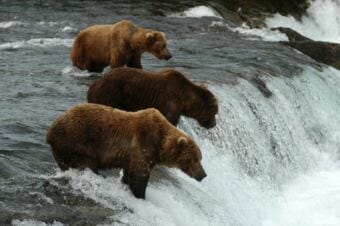
Katmai bears fish at Brooks Falls. (Photo courtesy National Park Service)
The Alaska Department of Fish and Game’s decision to kill almost 200 brown bears in order to boost a struggling caribou herd violated due process and was unconstitutional, an Anchorage Superior Court judge ruled Friday.
Judge Andrew Guidi’s 10-page decision means at least a temporary end to the state’s controversial bear-killing program, which was intended to aid the struggling Mulchatna caribou herd.
“Unless they want to seek a stay of this decision, they’ve got to stop killing bears,” said attorney Joe Geldhof, who represented the Alaska Wildlife Alliance in a lawsuit that prompted Friday’s decision.
The Alliance sued the state in 2023 to challenge the application of Alaska’s “intensive management” project in Southwest Alaska.
Originally designed to kill wolves in order to boost the populations of prey species that hunters pursue, the program was expanded in 2022 to cover bears that have been preying on the Mulchatna caribou herd.
Anchorage attorney Michelle Bittner filed a separate lawsuit, also challenging the state’s bear-killing program.
Both lawsuits argued that the state’s Board of Game failed to follow adequate due process standards before beginning the program.
Before a judge could consider the merits of either case, state attorneys argued that Bittner did not have the standing to bring a lawsuit on the issue. That argument went all the way to the Alaska Supreme Court, which ruled in February that Bittner could bring her case.
That cleared the way for the Alaska Wildlife Alliance’s lawsuit to advance as well, with oral arguments taking place in March.
Ruling Friday on the merits, Guidi concluded that the Board of Game violated due process and did not provide adequate public notice when it began its bear-killing program.
“The notice provided by the BOG contemplating extension of an existing wolf control program to lands managed by the federal government that was altered to include a bear removal program on state lands substantially changed the subject matter of the proposal,” Guidi wrote. “These changes went far beyond varying, clarifying or altering the specific matter of the proposal addressed in the original notice. As a result, the BOG failed to adhere to mandatory due process standards.”
Guidi also found that the Board of Game violated the Alaska Constitution’s principle of sustained yield because it valued the sustainability of caribou herds but didn’t adequately study what would happen to bear populations.
“The issue of the bear population and distribution is an obvious salient issue touching on sustainability,” he wrote. “Addressing the sustainability of a constitutionally protected resource like bears almost certainly requires the BOG to engage in more than a rudimentary discussion about a bear population or engage in conclusionary opinions when considering a proposal to initiate a program calling for the unrestricted killing of bears.”
A spokesperson for the Alaska Department of Law, which represented the Board of Game in the lawsuit, said the state is reviewing the order and considering its options for how to proceed.
The road out of King Cove ends at the old hovercraft landing on the shore of Cold Bay, about 7 miles from the city of the same name. (Theo Greenly/KUCB)
Boosting Alaska’s energy sector was a priority among President Donald Trump’s executive orders on his first day back in office. The list of projects he supported included opening drilling in the Arctic National Wildlife Refuge and reinstating support for the Ambler Road. But one item seemed out of place among the energy projects: a road from King Cove to Cold Bay’s all-weather airport.
The proposed road has long been a point of contention. King Cove, a remote fishing community on the Alaska Peninsula, can only be reached by air or water. But the community’s harsh weather and short gravel airstrip mean it’s often impossible to fly in or out.
Residents argue that an 11-mile road through the Izembek National Wildlife Refuge — linking them to Cold Bay’s longer, all-weather runway — would save lives by ensuring access to Anchorage’s medical services.
“It was a little bit of a surprise, but a pleasant surprise,” said King Cove City Administrator Gary Hennigh, reacting to the executive order. “He has it somewhere in his brain, or with his people, that there’s something about a road in rural Alaska that the right thing to do is to build it, and you got a bunch of environmentalists jumping up and down that don’t like it, and that’s probably all the more reason why President Trump says, ‘Let’s do it.’”
For decades, conservationists have fought the road, arguing it would set a dangerous precedent by undermining conservation laws. The road would require a land swap between the federal government and King Cove’s Native corporation. King Cove would give up land adjacent to the refuge in exchange for the land required for the road.
Opponents see a dangerous precedent
Rob Rosenfeld, a consultant for dozens of tribes opposing the project, says allowing the land swap would weaken the Alaska National Interest Lands Conservation Act, a landmark law that has protected Alaska’s wildlands for more than 40 years.
“This means that all refuge lands, all ANILCA lands, all designated wilderness and even national park lands are vulnerable to the whims of changing administrations,” Rosenfeld said.
A road has never been built through conservation lands under ANILCA, and land exchanges typically require congressional approval.
Ian Dooley is an attorney with Earthjustice, a nonprofit group that represents some of the opposition. He, too, says the King Cove road could open the door to similar projects across the state.
“This would be the first land exchange under ANILCA that allows for divesting protected lands out of a conservation system unit for the purpose of putting a road through it,” Dooley said. “That has never happened before.”
Statewide subsistence concerns
King Cove residents say the road is crucial for more than just medical access. Dean Gould, president of the King Cove Corporation, says many residents in the largely Unangax̂ community struggle to reach their hunting and fishing areas without it, making subsistence difficult.
“We just can’t get there,” Gould said. “If the road to Cold Bay was there, we’d be able to use them a lot more often.”
But protecting subsistence is also at the heart of the opposition. Dozens of western Alaska tribes have filed formal resolutions opposing project, arguing that it threatens Pacific black brant and emperor geese, both key subsistence species.
But protecting subsistence is also at the heart of the opposition. A coalition of 78 western Alaska tribes has filed a lawsuit to stop the project, arguing that it threatens Pacific black brant and emperor geese, both key subsistence species.
The U.S. Fish and Wildlife Service’s 2013 environmental impact statement concluded that constructing a road through the refuge likely would cause significant impacts on the brant and emperor geese.
Dooley represents the Native Village of Hooper Bay in the Yukon-Kuskokwim Delta, which has taken a leading role in the fight. The Izembek refuge supports one of the largest eelgrass beds in the country, a critical habitat for the geese.
“Nearly the entire globe’s population of these two species of birds rely on both Izembek and the Yukon-Kuskokwim Delta for different parts of their life cycles,” Dooley said. “Disrupting these species in Izembek can have population-level effects that extend to the Y-K Delta as well.”
That could create significant challenges for subsistence communities like Hooper Bay, which are already dealing with the decline of salmon populations.
Edgar Tall Sr., the tribal chief of the Native Village of Hooper Bay, says most people there rely on subsistence species like the brant and emperor geese.
“We can save those, you know, during the winter, where we can freeze them and then eat them while we’re trying to look for other things to survive,” he said.
Despite the opposition, King Cove residents remain hopeful the project will move forward. Gould, the president of the Native corporation, noted that even former President Joe Biden’s administration endorsed the road near the end of his term.
“Seems like we’re more on a positive note, but we’ve been there before too,” he said. “One second you’re smiling, and the next one you’re holding your breath.”
The decision now rests with the Department of the Interior, as King Cove officials await word on the next steps.
Correction: An earlier version of this story said that a group of Alaska Native tribes filed a lawsuit to stop the road. The tribes passed formal resolutions against it.
Nick Katelnikoff learned to fish from his father, and he says his first paycheck as a fisherman came when he turned 8 years old. Now 76, pictured aboard his boat, the MZ L, he’s the last skipper running a commercial fishing vessel from his home village of Ouzinkie, on an island just north of Kodiak. (Photo by Nathaniel Herz/Northern Journal)
This story was produced as part of the Pulitzer Center’s StoryReach U.S. Fellowship. It was reported and edited by Northern Journal and APM Reports, with support from Alaska Public Media.
KODIAK — On an early, foggy summer morning, Nick Katelnikoff steered his boat through the treacherous waters off Kodiak Island’s Spruce Cape and chuckled.
“Trust a blind guy through the rock pile?” he asked.
Katelnikoff, 76, is a veteran fisherman — the kind of guy who, friends say, can call his catch into his boat.
He’s made a career chasing the bounty of the North Pacific, building up a storehouse of knowledge about his maritime backyard that allows him, even with failing eyesight, to confidently steer his 38-foot craft away from rocks that have sunk other vessels.
The MZ L motors past Kodiak Island’s Spruce Cape in July. (Photo by Nathaniel Herz/Northern Journal)
Katelnikoff describes his heritage as Aleut; he’s one of the Indigenous people who have been pulling fish out of these waters for millenia. Their catches helped sustain trading networks long before white people arrived on Kodiak and began setting up fish traps and canneries — businesses that were supplied, in part, by the harvests of Katelnikoff’s more recent ancestors.
When Katelnikoff was still beginning his career in the 1970s, he was one of a dozen or so skippers in Ouzinkie — a small Indigenous village on an island just off Kodiak’s coast.
But today, that tradition is all but dead: Katelnikoff is the last skipper running a commercial fishing boat from Ouzinkie’s harbor.
A similar story has played out in villages up and down the Gulf of Alaska coast. Angoon, Nondalton, Old Harbor — each of those small Native communities is home to a fraction of the commercial salmon fishermen who were once the lifeblood of their economies.
Over the last 50 years, hundreds of Alaska’s most valuable salmon permits have drained out of its Indigenous coastal villages. Now, the profits flow increasingly to those who live in Alaska’s population centers or in other states.
“We used to be people who fished,” an anonymous respondent wrote in a recent survey of thousands of Indigenous people with ties to the Gulf of Alaska. “Now, we don’t have access to our resources located in our backyard.”
Salmon dry on racks in Old Harbor in 1889. (U.S. Fish Commission photo via National Archives)
The outflow was set in motion in the early 1970s. At the time, new fishermen were flooding into the industry as salmon harvests had plummeted from historic highs, making it more difficult for each boat to turn a profit.
In response, Alaska’s government made a monumental change in the way it regulated those fisheries.
No longer could just any commercial fisherman set out in a boat and cast their net — even Alaska Natives whose ancestors had fished for generations. The new system, approved by voters in 1972 and put into effect three years later, placed caps on the number of permits available in each fishery.
The policy was known as “limited entry” because it restricted who could enter the industry, and it created permits that have since been valued collectively at more than $1 billion.
Scholars diverge on how effective the policy has been at preserving the salmon population, with critics arguing that limiting the number of fishermen on the water doesn’t necessarily prevent overfishing.
But one result is clear: The policy has dragged down the economies of many Indigenous villages along the Gulf of Alaska. Places that once called themselves “fishing towns” have been hollowed out, with little-used harbors and even dilapidated boats grounded on shore.
Rural local ownership in Alaska salmon purse fisheries
Alaska salmon permit values
Estimated earnings
Data source: Commercial Fisheries Entry Commission Zac Bentz for Northern Journal
The people who live in those Gulf communities, which are disconnected from the road system and reachable only by plane or boat, are overwhelmingly Alaska Native.
They face high prices for groceries, fuel and other supplies, which have to be flown or barged in from afar. Jobs outside of fishing are scarce, and fishing jobs are increasingly sparse, too. Residents who can’t afford permits have to leave their homes, families and cultures to find full-time jobs.
“If you’ve got young people who live in the fishing communities where the fisheries occur and they don’t see that as an opportunity, that’s bad public policy,” said Rachel Donkersloot, a researcher who grew up in the Bristol Bay region and has spent more than a decade studying obstacles to fisheries access. “Being able to provide for yourself from that fishery should be a birthright.”
When limited entry started in 1975, many Alaska Natives in coastal villages received permits without having to buy them, based on their long histories working in the industry.
With some exceptions, the permits were permanent — entitling holders to fish until they died or retired, then pass the permit on to an heir. But a controversial provision known as “free transferability” also meant that they could sell them to the highest bidder at any time.
Where did Nondalton’s permits go?
A total of 15 Bristol Bay salmon drift gillnet permits were issued in the Native village of Nondalton in the early years of limited entry. Today, none remain. Here’s where they went.
Data source: Commercial Fisheries Entry Commission Zac Bentz for Northern Journal
The limited supply turned those permits into valuable assets. At their peak in the 1980s and early ’90s, prices for some permits hit more than $500,000 in inflation-adjusted dollars, before the advent of farm-raised salmon began depressing their value. Still, just three years ago, some Bristol Bay permits were selling for $250,000.
Those eye-popping sums created a powerful incentive for rural fishermen to cash out. And those who sold at the top of the market likely came out ahead.
But the one-time windfalls severed an Indigenous tradition of commerce tied to Alaska’s ocean harvests — a trade that could now require a permit to access. And the high prices put them out of reach for many rural Alaskans who lacked a credit history or who didn’t have collateral for a loan.
“We should never have been allowed to sell them,” said Freddie Christiansen, a tribal member and longtime fisherman from the Kodiak Island village of Old Harbor. “We’re Indigenous people. We’re from here. We take care of it. Everyone else comes and goes.”
Freddie Christiansen flies in a bush plane between the city of Kodiak and the village of Old Harbor. Christiansen, an outspoken critic of the limited entry system, grew up commercial fishing in Old Harbor, where, at the time, “everybody fished,” he said. Today, the village has a fraction of the salmon permits once held there. (Photo by Nathaniel Herz/Northern Journal)
Some of the exodus can be explained by rural fishermen relocating to urban areas, bringing their permits with them. But many permits were simply bought up by city dwellers who had better access to capital — and far more experience working with western institutions like banks and government-sponsored loan programs.
At the time, many of Alaska’s Indigenous communities were just beginning to encounter those systems. And in some cases, sophisticated urban operators took advantage of that inexperience to buy their permits at low prices, according to people who witnessed the transactions.
The state has dozens of fisheries and types of fishing gear, and the losses vary across different regions and classes of permits. But they’ve tended to be more acute in fisheries where more money is at stake.
Each permit’s sale effectively marked the loss of a small business from the rural villages. Those businesses produced cash for captains and crew to feed families and heat homes over the winter, along with extra fish to eat and share during the off-season.
Old boats sit onshore in Angoon. The Tlingit village, 50 miles south of Juneau on Admiralty Island, used to have a fleet of small salmon fishing vessels, but many have fallen into disrepair and few permits remain in the village. (Photo by Johnny Hunter for Northern Journal)
“It’s just terminated this ability to be self-sufficient and self-determined,” said Jonathan Kreiss-Tomkins, a former state legislator from Sitka who tried and failed to reverse the permit losses before he left office in 2023. He described spending time in struggling rural villages in his district that were once “thriving, bustling communities 40 years ago that ran on commercial fishing.”
“That contrast was stark and depressing,” he said.
Kreiss-Tomkins described limited entry as “the opposite of a panacea”: Instead of a cure-all, it turned out to be the root of countless ills.
“It was an alien construct that got dropped onto all these communities. And even if they’re as good or better fishermen, or as good or harder workers, it didn’t really matter,” he said. “The structure was so foreign. And once in motion, it just got worse.”
Scholars have been raising alarm about the problem since the 1980s. But Alaska’s elected leaders, most of whom live in regional or urban hub communities, have largely ignored it. And many people who currently own permits are leery of change, which they fear could reduce the value of their investments.
Some larger Alaska communities like Kodiak, pictured here, and Homer have seen an increase in permits since the limited entry system was created. (Photo by Nathaniel Herz/Northern Journal)
After decades of inaction, state lawmakers are reconsidering parts of the limited entry system amid a broader effort to aid the fishing industry. Alaska’s seafood businesses and fishermen have faced major upheaval in the past two years, stemming from reduced demand and low-priced competition from Russian harvesters.
In a draft report released in January, a legislative task force noted the “large loss of permits held in rural and Alaska Native fishing communities.” And the new speaker of the state House, Bryce Edgmon, believes there’s growing interest from legislators in addressing the issue.
But he said it also faces competition from other policy problems like school funding and a shortage of the natural gas used to heat urban Alaska homes.
Most lawmakers still do not see stemming permit losses in villages “as a public policy change that’s urgently needed at this point,” said Edgmon, an independent from Dillingham, a fishing town of 2,100 in Bristol Bay.
‘It was what would work’
Terry Gardiner still remembers fishing outside Ketchikan in the 1960s and seeing all the other boats.
There were hundreds of them, nets stretching almost continuously a couple of miles out into the ocean from shore.“It was just, like, a wall,” he said.
Bristol Bay fishing boats sit at a dock, likely in the 1960s. (Amos Burg, Alaska Department of Fish and Game Historical Photograph Collection, 1950-1991, Alaska Resources Library and Information Services, on behalf of Alaska Department of Fish and Game)
Scores of new fishermen had entered the industry in the 1950s and 1960s amid Alaska’s postwar boom. Many were newcomers to the state, and fishing wasn’t their main occupation. Often they were teachers or out-of-staters with office jobs who could afford to take summers off to fish.
Gardiner wasn’t a full-time fisherman, either. He was still in high school, just looking for a fun way to earn a few bucks. He and a buddy made perhaps a “couple grand” in profit each summer, he said.
So, at the end of one season, Gardiner was surprised when a seafood processing company told him that his boat was one of the highest earners in the fleet.
“It was like, ‘Holy smokes, we’re a top boat? This is a joke,’” he said. “How would a family make a living?”
A poster advertising Terry Gardiner’s campaign for the Legislature, featuring his 36-foot fishing boat. (Photo courtesy Terry Gardiner)
Gardiner’s experience was a symptom of what he describes, more than a half-century later, as a “sickness” that was afflicting Alaska’s fishing industry.
Salmon populations had crashed in the 1950s and were starting to rebound in the 1960s just as the number of fishermen exploded.
In 1972, Gardiner ran for the state House at age 22. His campaign slogan, he said, was “too many fishermen, fishing for too few fish, at too low a price.” At the Capitol, he became one of the most vocal advocates for limiting the number of fishing boats on the water.
It was an approach supported by influential natural resource economists, who argued against what they called open access to the ocean. Fisheries in the United States at the time were “marked by obsolescence, waste, and poverty,” James Crutchfield and Giulio Pontecorvo wrote in a 1969 book about the economics of Pacific salmon harvests.
When fisheries are “common property,” they said, there are no ways to prevent “declining yields and the disappearance of net revenues to the industry.”
The economists said that far fewer boats and nets could catch the same amount of fish, allowing the industry to return to profitability.
Fishing boats are tied up at a dock in Juneau in a historical photo. (Alaska Department of Fish and Game Historical Photograph Collection, 1950-1991, Alaska Resources Library and Information Services, on behalf of Alaska Department of Fish and Game)
The limited entry program was not Alaska’s first attempt to restrict the number of fishermen. Legislators had initially approved policies aimed at making it harder for people from other states to access its waters.
The courts, however, struck down those efforts, saying, in one case, that they violated the U.S. Constitution’s Equal Protection Clause.
So the final limited entry legislation prioritized permits for the fishermen who were most financially dependent on the industry for their livelihoods.
That meant that when the permits first rolled out, nearly half of them went to Alaska Native people, who at the time represented some 18% of the state’s population.
Ouzinkie’s harbor in the 1950s. The village had as many as 17 salmon seine permits in the 1970s, but just three remain, with only one commercial fishing boat operating out of the harbor. (Arnold Granville/Alaska and Polar Regions Collections, University of Alaska Fairbanks)
But after that, there was nothing to stop permits from leaving rural, Indigenous communities.
Gardiner said that “nobody was really a big fan” of the transferable permits.
“But it was what would work, what would be constitutional,” he said. “And everybody was tired of passing a law, getting everyone excited, spending all this effort and then boom, it fails after a year or two.”
Alaska voters approved a constitutional amendment paving the way for the limited entry system in 1972, and state lawmakers passed a bill to implement the policy the following year.
Lawsuits and a statewide referendum campaign both challenged the new system. But the program held up.
And in rural Alaska, the invisible hand of the market went to work.
‘They all went one way’
Jerry Liboff grew up in Southern California, and in his early 20s he signed up with Volunteers in Service to America, a program that has since become part of AmeriCorps. In 1969 the program dispatched Liboff to Koliganek, a Yup’ik village of 140 in the Bristol Bay region.
Liboff didn’t know it, but he had arrived just in time to witness an immense change to the economic and cultural fabric of his new home.
At the time of Liboff’s arrival, Koliganek, like many other Native villages, was barely connected to urban Alaska.
Bush planes, the only way to reach the road system, arrived in the village just once or twice a week, Liboff said. Many Koliganek residents spoke no English, only their Indigenous Yup’ik language. Most finished school after eighth grade; there were just a handful of full-time jobs.
Subsistence harvests of fish and game were essential to survival. There was, however, one strong link connecting Koliganek to the cash economy.
Each spring, about half the village’s 30 families would push their fishing boats into the water, run the 120 miles down the Nushagak River into Bristol Bay and spend the summer catching salmon that they would sell to local canneries.
Their harvests would pay for the fuel and food they needed to get through the winter. Fish canning businesses in Bristol Bay, like others across the Gulf of Alaska, formed close ties with the Native skippers and would often float them with supplies on credit if they had a bad year.
“You didn’t need a full-time job to survive,” Liboff said. “People got by. I don’t remember anybody being hungry.”
Liboff’s fluency in English and in navigating bureaucracy made him useful in the village, and he decided to stay, developing a passing facility with the Yup’ik language. He also drummed up a tax preparation business — working with residents of Koliganek and, eventually, more than a dozen surrounding villages.
Jerry Liboff works in his home office in the Bristol Bay hub town of Dillingham in January. (Photo by Margaret Sutherland for Northern Journal)
Many of his clients were fishermen, giving him a unique chance to observe the effects of the new permit system in the years after its approval.
In Koliganek, Liboff said, residents hadn’t been informed or consulted about the limited entry program beforehand, though at first, it seemed to work. All the village’s boat owners initially got permits, and “nobody really thought much about it,” he said. But after a few years, troubling signs began popping up.
A man with a drinking problem in a neighboring village went on a weeks-long bender after selling his permit for $1,500 in cash and a rickety snowmachine that the buyer claimed was worth $2,500, Liboff recalled.
Two brothers who had fished in an equal partnership realized that only one could pass their single permit on to their children.
Liboff said he witnessed teachers and pilots — non-Natives who lived in and traveled through the villages — acting like speculators. They found local fishermen in Bristol Bay who needed money and bought their permits on the cheap, then flipped them for a profit, Liboff said.
“In villages, we had a bum season, they couldn’t meet their family needs, they sold their permits,” said Robin Samuelsen, a Native leader from Bristol Bay. “It reoccurred, reoccurred, reoccurred, reoccurred. Anything of any value, like a permit, you sold — you had to feed the family. You had to buy stove oil.”
Robin Samuelsen poses for a photo at an office in Dillingham, the Bristol Bay salmon fishing hub town, in October. His father harvested Bristol Bay salmon from a sailboat — powered boats were banned in the area until 1951. Samuelsen says he initially supported limited entry as a way to limit the number of outsiders in the fishery. “But the problem with limited entry permits is, you could sell them,” he said. (Photo by Nathaniel Herz/Northern Journal)
In another village, Liboff knew a Native woman who didn’t speak English and had what he said was a common misunderstanding about the permit system. She thought that if her children needed to generate some cash by selling the permits they initially qualified for, they could simply earn new ones later.
“That was her very incorrect version of how the law worked: If you fished enough years, you’d get another permit,” Liboff said. Today, he added, “there’s one permit left in the family, out of eight.”
Liboff spent his career as a tax preparer trying to find ways to stop the outflow of permits from the villages — as did other advocates, researchers and local and regional groups.
But they were fighting the pervasive power of the market.
“There are a whole ton of different reasons why permits went. But the bottom line is they all went one way,” Liboff said. “Whether a guy lost it because his taxes were bad. Whether a guy lost it because he bought a boat he couldn’t afford. Whether a guy lost it because he didn’t want to give it to one of his kids and have the rest of his kids pissed at him.”
Limited entry is one of multiple ways in which 1970s-era policymakers imposed Western systems of private ownership on Alaska’s natural resources and lands — systems that fundamentally changed Native people’s relationships to their ancestral territory.
Congress also passed legislation in 1971 that terminated Indigenous land claims in Alaska. In exchange, the Alaska Native Claims Settlement Act transferred some 10% of the state to Indigenous people — but it did so through newly created, for-profit corporations. Native leaders and advocacy groups, in recent years, have increasingly questioned how well that for-profit model serves their interests and aligns with their culture.
“This Westernized model, one-size-fits-all, does not work,” said Christiansen, the tribal member and fisherman from Old Harbor, on Kodiak Island. “We’ve proven it over and over and over again.”
Years of warnings, little action
Rural Alaska residents weren’t the only ones to notice permits trickling out of the villages.
Within a decade of limited entry’s passage, scholars and government agencies had begun to document the phenomenon.
A 1980 paper by Anchorage anthropologist Steve Langdon described a “clear and escalating trend” of diminishing rural permit ownership.
“The outflow of permits that has occurred and that potentially can occur must be regarded as (a) significant threat to the rural Alaskan economic base and the well-being of rural Alaskans,” Langdon wrote.
Four years later, the state agency that oversees commercial fishing permits said that Indigenous ownership of Bristol Bay salmon permits had fallen 21% since the new system went into effect — a dynamic that called for “serious attention,” according to the agency’s commissioners.
One driving force that appeared to be behind the trend, according to Langdon: The permits were worth more money to fishermen who could catch bigger hauls with them.
Urban and out-of-state fishermen were more likely to own cutting-edge boats and gear that allowed them to catch more fish and reap bigger profits. As a result, they were willing to pay more for a permit than fishermen without those advantages.
Courtney Carothers speaks at a community meeting in Ouzinkie in July. (Photo by Nathaniel Herz/Northern Journal)
“The economic rationale of why you want to privatize the rights to fish is all about efficiency. It’s eliminating inefficient users,” said Courtney Carothers, a University of Alaska Fairbanks anthropologist whose scholarship has focused on Native fishing communities on Kodiak Island. “The ideology is that those who don’t fish efficiently could better serve society by getting other jobs.”
Carothers said that logic may make sense in an urban environment where there are lots of employment opportunities. But, she added, it breaks down in intensely isolated rural areas like the coastal villages. “Their lives are from the sea, and if you’ve displaced people from sea-based livelihoods, there’s not a whole lot to pick up.”
A view of Old Harbor from the mountainside that looms behind the village. (Photo by Nathaniel Herz/Northern Journal)
There were a few efforts in the early years of limited entry to keep more permits in Alaska Native hands — one, started in 1980, was a short-lived loan program targeted at residents of rural communities.
But it was shut down a few years later, after a state agency said it had the unintended effect of driving up the cost of permits. Langdon’s research concluded that an earlier state loan program had actually contributed to the losses from rural areas, because it was used mainly by urban residents.
Langdon has suggested that the state allow tribes to own permits, so they can stay in Indigenous hands. But those and other ideas got little traction. Most legislators, Langdon said in an interview, live in more urban areas where their constituents are buying up permits — not selling them.
“They’re the ones benefiting,” he said.
Where did the Kodiak village permits go?
There were 73 Kodiak salmon purse seine permits initially issued in the island’s six Native villages. Ten remain, along with roughly a dozen more that have come into the villages from other communities. Here’s where the rest of the initial-issue permits are now.
Data source: Commercial Fisheries Entry Commission Zac Bentz for Northern Journal
Kreiss-Tomkins, the former Sitka legislator, is the only lawmaker who’s made a major push to tackle the problem in recent years.
He said he and his aides put thousands of hours into developing and pushing legislation that would have allowed local trusts or regional organizations to buy and own permits, then lease them to new fishermen.
But the bill never got to the House floor for a vote. Kreiss-Tomkins said he thought the proposal “bewildered” some of the legislators from urban communities who weren’t familiar with the limited entry system. There was also a wariness from fishing industry stakeholders who represented existing permit holders, he said.
“I think, to some extent, the idea was written off at the outset because of political cues from opponents in the commercial fishing world,” he said. “There was never a rich, policy-based conversation or understanding.”
Gardiner, the legislator who promoted the limited entry bill in the 1970s, put it more bluntly: “There’s not a whole lot of votes in all those small, coastal communities.”
The sale of permits isn’t the only factor driving the losses in rural Alaska. Migration — when a rural resident moves with their permit to urban Alaska or out of the state — has also been responsible for the loss of hundreds of rural permits statewide. Experts say the closure of many remote processing plants in coastal villages also makes it harder for rural fishermen to turn a profit.
Empty slips in the harbor in Angoon. (Photo by Johnny Hunter for Northern Journal)
But residents across coastal Alaska say that permit costs remain a significant barrier for people seeking to enter the industry. In the Kodiak island villages, there are “a bunch of young guys” who would love to be a skipper and the owner of a boat, Christiansen said. But the cost of a modern vessel, combined with a seine permit and gear, is out of reach, he added.
“They love fishing. But they don’t have the opportunity,” Christiansen said. “How are you going to be able to come up with half a million dollars to get in?”
Christiansen is one of many Alaska Native people and groups — including Kodiak’s and Southeast Alaska’s regional Native corporations — that are increasingly agitating for reforms to the limited entry system.
Those two Native corporations, working with nonprofit organizations and scholars, released the January survey of Indigenous people with ties to the Gulf of Alaska. Some 80% agreed that villages are in “crisis” because of loss of access to fisheries.
“We’re ready to go to work” on policy reforms, said Joe Nelson, interim president of Sealaska, the Southeast Alaska Native corporation. “We’re working all together.”
In the meantime, communities like Ouzinkie — the home of Katelnikoff, the aging skipper with the failing eyesight — face existential questions.
At a community meeting last summer, as Katelnikoff was finishing up a trip, residents described how the village is steadily shrinking. A few decades ago, there were more than 200 people there, with dozens working in commercial fishing. The population is now down to just 100.
Jimmy Skonberg is retired from commercial fishing in Ouzinkie, but he still owns a salmon seine permit there. He’s skeptical that the commercial fishing culture can be revived in the village. “It’s gone forever,” he said. “Limited entry, I have to blame that.” (Photo by Nathaniel Herz/Northern Journal)
The community, through a federal program, has purchased rights to a small halibut harvest that it wants to make available to residents to fish. But many of the young people that old-timers hope would get into fishing have moved out of Ouzinkie, making them ineligible to participate.
“Our younger generation can’t afford to buy a skiff, or the equipment, or the permits,” said Sandra Muller, who once fished commercially with her husband and young children. “It is a big crisis for our young people. I feel for them.”
The village’s sole remaining commercial fishing boat, meanwhile, motors on.
Katelnikoff has renewed his state permits for 2025. More than six decades after he began fishing, he says he’s still “too young” to retire. But when he does, he’ll likely pass his operation on to a daughter, who was onboard for his summer trips.
Nikolai Katelnikoff’s boat, the MZ L. (Photo by Nathaniel Herz/Northern Journal)
Other Ouzinkie old-timers say it’s too late to resurrect the village’s commercial fishing culture, that the loss of collective knowledge and experience is too great to overcome.
But Katelnikoff isn’t so sure. He pointed out that permit prices have fallen in recent years — making it, he said, a good time for aspiring fishermen to buy in.
“Things could happen where it could come back,” he said.
Brian Venua contributed reporting, and Zoë Scott contributed research and reporting.
Do you have a story about the loss of a permit from your family or village, or do you have feedback on this piece? Take Northern Journal’s brief survey that will inform future reporting on fisheries access in Alaska.
Nathaniel Herz welcomes tips at natherz@gmail.com or (907) 793-0312. This article was originally published in Northern Journal, a newsletter from Herz. Subscribe at this link.
Sled dogs line up along the frozen Kuskokwim River for the start of the 2025 Holiday Classic sled dog race on Jan. 16, 2025. (MaryCait Dolan/KYUK)
In an archival video of the 1988 Kuskokwim 300 Sled Dog Race or K300, the start line of the race looks distinctly of its time: spectators wear aviator glasses, turtlenecks, and a lot of teal. But it’s not just the people that look different from today, it’s also the dogs.
Broad-chested sled dogs bark at the start line, black and white fuzzy arctic coats alive with energy. Decades later, the dogs at the 2025 start of the K300 Race Committee’s Season Opener look different. They sport slender builds and thinner fur of brown and black.
Spectators gather and dogs bark eagerly at the 1988 Kuskokwim 300 start line. (KYUK File)
The tradition of dog mushing has changed a lot throughout its rich history in Alaska. While some changes come from development in the sport, others have been forced by a changing climate. One part of the story is told in the DNA of the dogs themselves.
It’s a shift Carl Erhart has noticed. His personal history with mushing goes back to his grandmother, a Koyukon Athabaskan Alaska Native from Tanana.
“She was the one who originally had dogs back then for transportation,” remembered Erhart. “Everybody had dogs.”
Erhart, a third-generation musher, lives in Fairbanks with his team of 35 dogs. He and his wife, Jennifer Probert Erhart, train and compete in global competitions. They’ve raised their kids on the sport and Erhart said that he cooks for his dogs daily. To say it’s a huge part of their lives would be an understatement. Dog sled racing is their life, as is true for mushers across Alaska.
But growing up in Tanana, Erhart heard stories about a different time. His dad remembers days when dogs pulled sleds to haul wood and water, protect from predators, and travel between villages. Back then, most families had a small team of three to five Alaskan malamutes, and later Siberian huskies, built for the Alaskan cold with thick fur coats and strong builds.
“But these weren’t race dogs by any means,” Earhart distinguished. “These were your companions, your work dogs, you know. A lot different, a different breed than we have now.”
Today, Erhart’s dog team and the life he leads as an Alaskan musher is a game of telephone away from what it was mere generations ago. A series of, in some cases, literal mutations have re-molded the mushing his dad remembers.
“How dog mushing and racing kind of came about in the villages a long time ago was exactly that. In the springtime, they would have carnivals and festivals where everybody gathered,” Erhart said. “And then it would just be human nature to say, ‘Hey, I bet my team is faster than yours.’ ‘Well, oh no, I bet my team is faster than yours.’”
As snowmachines were introduced and commercial goods became a more reliable supplement to subsistence, the tradition survived primarily as a competitive sport. And that posed a problem for work dogs.
“Those dogs could survive the elements really well, not burn a lot of food to stay warm,” said Erhart. “And they were really strong, but something they lacked was those big Siberian huskies don’t have good stamina, so they can’t go on long, long runs like we do nowadays.”
Suddenly, new traits emerged as favorable in the sled dog gene pool. A dog that was lean and fast and could muster a lot of energy was the kind of dog you needed to win a race. Around the early 1900s, the breeding game began.
The Alaskan husky, with ancestral roots in the native village dogs of Alaska’s interior and coast, began being bred selectively to yield a faster race dog. But Erhart said that at the same time, a shifting set of climate conditions played a role in what traits could make for the most competitive canine athlete.
“And then global warming kind of comes around, right? And we get less favorable snow conditions in the winter, and then we’re a little bit warmer in the spring. So now, when we’re having these races, these old Alaska(n) huskies, we’re having to perform in this hotter climate,” Erhart said.
A 1940s Pictoreels film depicts Chinook sled dogs , a popular breed at the time, frolicking in New Hampshire snow. (Courtesy of Pictoreels)
Genes from dogs in climates around the world entered the mix to match the Arctic’s shifting conditions. The Alaskan huskies have been mixed and matched with Irish setters, greyhounds, German shorthaired pointers, and Saluki hounds.
“And the result of that is you have dogs that can perform well in hot, humid weather,” Erhart said.
On the Yukon-Kuskokwim Delta, musher Myron Angstman was a long-time competitor in the K300 and now chairs the race’s committee.
“The basic dog in Bethel in the 1970s was bigger, thicker. Heavier dogs with way more hair, and those kinds of dogs had existed in the villages for a long time,“ Angstman recalled.
Angstman said that in the K300 race specifically, you can still find some dogs that have lineage from breeds along the Yukon River. Less stocky than the Bethel village dog, he said that they were some of the earliest successful dogs in long distance racing, and had the kind of sleekness usually attributed to sprint dogs.
But Angstman remembers when a wave of sleeker breeds hit races in the ’70s, ’80s, and ’90s. Often, the faster breeds of dogs would come in with teams from Anchorage or Fairbanks. They quickly changed the game.
“And they’d look at the dog and they say, ‘Boy, that’s a fast dog,’” Angstman remembered. “And so rather than breed those, interbreed those with the slow dogs from the villages, they would often just breed the ones from Anchorage and Fairbanks with another Anchorage, Fairbanks dog. So they did a whole team full of faster dogs. And so the changeover was quick and dramatic.”
Mushers Maurice Andrews (left) and Aaron Alexie take off in the mass start of the 2024 Akiak Dash on Jan. 27, 2024. (Josiah Swope/KYUK)
But breeding for a warmer climate has had a ripple effect. The modern breeds can’t all be kenneled outside like the Alaskan malamute or the Siberian husky can. Some of the fastest dogs need to live in the house, which Erhart said isn’t feasible for someone like him with kids and grandkids. He said that it has caused a shift in the sport and who can do it.
“I’m like, ‘Yeah? At what cost to the Alaska(n) Husky are you the best right now?’” Erhart said. “Your dog literally cannot live outside. So in definition, it’s not an Alaska(n) husky sled dog. It’s a pet dog that’s fast.”
What was meant to keep a tie to the old ways has in some ways caused a divide. The tradition looks different than it once did, but there are also other domino effects at play when it comes to mushing and climate change.
The process of fueling dogs has changed as salmon crises build along the Yukon and Kuskokwim rivers. And shifts in the training of the sport are a new piece of the champion’s puzzle as snow has become more of a question than an Alaska staple. We’ll dive into those developments in stories to come.
This story is part of a series looking at the development of sled dog racing and the impact of climate change on mushing in the lead-up to the 2025 K300 race on Feb. 7. Stay tuned for the next parts of the series on KYUK 640AM and online at KYUK.org.
Blue Origin’s New Glenn on the launch pad at Launch Complex 36 in Cape Canaveral, Fla., on Dec. 27 2024. Rocket launches like these are increasing across the nation’s three main spaceports, resulting in more demand for additional spaceport space. (Blue Origin)
No rocket launches are scheduled as of yet for this year at the spaceport on Kodiak Island, but the head of the Alaska Aerospace Corporation is hoping to capitalize on what’s becoming a national shortage of launch space in the Lower 48.
The bulk of these launches are conducted by the U.S. government and companies like SpaceX or Blue Origin, which had its New Glenn rocket successfully launch from Florida on Jan. 16 for its inaugural flight into orbit. These entities mainly use three key spaceports: Cape Canaveral in Florida, which is federal, Vandenberg Space Force Base in California, which is also federal, and the SpaceX Starbase in Texas.
Alaska Aerospace’s president and CEO John Oberst went on NBC’s “Today” show earlier this month to discuss what is being described as a “traffic jam” at the country’s spaceports and how Alaska’s facilities could relieve that congestion.
“Now is the time because we offer availability. We can take a customer and get them up on time,” Oberst said. “We are not congested.”
At the Pacific Spaceport Complex-Alaska, near Narrow Cape on Kodiak Island, potential customers could launch satellites, support space missions or test government defense projects.
The spaceport is licensed by the Federal Aviation Administration to have up to nine launches per year. That facility’s last successful launch was in 2022. Two other attempts, one each in 2023 and 2024, all failed.
But at this point, Oberst said via email that no commercial launches are on the books yet for the island spaceport. He added that new customers are interested in launching from Kodiak Island. But he said he cannot release any more information until they sign commitments.
California-based companies ABL Space Systems and Astra are already usual customers. SpaceX is not one of those customers and does not launch from the Pacific Spaceport Complex-Alaska on Kodiak Island, but the company does have an antenna set up at the facility.
Oberst previously told KMXT that he expects at least a few launches this calendar year, featuring both commercial and government customers.
When a launch is scheduled, a public notice must be given 30 days in advance.
The finish line of the 45th annual Kuskokwim 300. (MaryCait Dolan/KYUK)
The 2025 Kuskokwim 300 has been pushed back two weeks because of poor snowfall and looming above-freezing temperatures, according to a release from the K300 Race Committee.
The 300-mile race from Bethel upriver to Aniak and back will now start on Friday, Feb. 7.
Race officials say that limited snowfall and unseasonably warmtemperatures in the Yukon-Kuskokwim Delta throughout the winter have made it near-impossible to check or mark trails.
And that pattern is set to continue. In the lead-up to the region’s premier sled dog race, the race committee wrote that the “current forecast for Bethel and checkpoint communities of Tuluksak, Kalskag, and Aniak calls for 5 days of temperatures in the 30s and 40s leading into the middle of next week, which made it impossible to determine whether there would be a trail that is safe for human and canine athletes come race time.”
It’s not yet clear whether the February running of the K300 will have a modified trail route, but race officials say no route modifications were planned as of Jan. 16.
As of late Wednesday evening, no registered teams had dropped out of the race despite the reschedule.
A two-week delay for the K300 is not common. In its 46-year history, the race committee says it’s been delayed “several” times due to extreme weather, usually for a day or two. And in 2021, the Kuskokwim 300 was delayed as part of COVID-19 mitigation plan.
This is a developing news story and may be updated with additional information.
Close
Update notification options
Subscribe to notifications
Subscribe
Get notifications about news related to the topics you care about. You can unsubscribe anytime.