Southwest

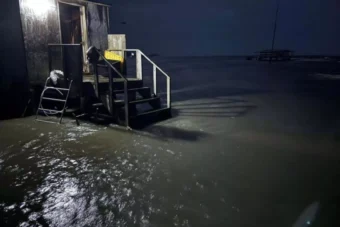
Tidal action and fierce winds flood low-lying areas of Kwigillingok

Flooding in Kwigillingok on Jan. 10, 2025. (Courtesy Lewis Martin)

Strong tidal action and fierce southerly winds inundated low-lying areas of the Kuskokwim Delta coastal community of Kwigillingok on Friday evening.

Michael Brown, with the National Weather Service in Anchorage, said that wind gusts as high as 55 miles per hour pushed waters well above the normal high tide line.

“When you combine 3 to 4 feet of extra water with a tide that’s already 2 feet above the normal high tide, we’re looking at 5 to 6 feet all of a sudden above the average high tide line. And that’s what we had,” Brown said.

According to Native Village of Kwigillingok Tribal Administrator Gavin Phillip, multiple boardwalks were submerged in the lower part of the community and water levels were on par with severe flooding seen in August 2024.

Phillip did not report any significant damage as of Sunday afternoon, but said that he had to act quick Friday to move his snowmachine and boat to higher ground.

“While me and my son were moving that boat, the tide was incoming and it was very swift. Maybe on a matter of half hour I almost lost my trail to home,” Phillip said. “Roughly maybe 27 homes were isolated.”

Phillip said that on Friday evening, the tribe put out the word on VHF radio and social media to residents of the low-lying areas to shelter in place until waters receded.

Phillip said that dozens of Orthodox followers observing Slaviq starring and feasting, including his wife, had to wait out the high waters in one community member’s home for around three hours. He said that both Slaviq celebrations and Moravian church services are on hold until a coastal flood advisory expires late Monday.

The community of roughly 600 people has grappled for decades with flooding, permafrost thaw and erosion of as much as 15 feet per year of the banks of the Kwigillingok River, which empties into the Bering Sea just below the community.

On Saturday Kwigillingok’s tribe joined Kipnuk in being among the first Alaska tribes ever to receive a federal disaster declaration from the Federal Emergency Management Agency for damage wrought by the August 2024 floods.

In Kwethluk, the relics of the first-ever Yup’ik saint are unearthed

Fr. Michael Nicholai pauses to offer the shovel to another clergyman while uncovering the grave of Matushka Olga during the process of her exhumation in Kwethluk on Nov. 16, 2024. (Courtesy Katie Baldwin Basile)

Puffs of feathery snow drifted among the crowd gathered at the cemetery of the St. Nicholas Orthodox Church in Kwethluk on a bitter cold Saturday, Nov. 16. Clergy, Kwethluk residents, and people from as far away as Eastern Europe stood packed between the tight rows of graves, while dogs weaved through the crowd. The people sang a final blessing to St. Olga of Alaska before the task at hand began.

“We’re going to begin now the process of uncovering the relic of a saint,” said Bishop Alexei, the head of the Russian Orthodox Diocese of Sitka and Alaska, wearing a heavy fur-lined robe and holding a golden crozier topped with two serpents.

Bishop Alexei traveled to Kwethluk alongside clergy from across the state. With the blessing of Orthodox faithful from the region, the church is completing the next step in making Olinka “Arrsamquq” Michael, or Matushka Olga, the first female Orthodox saint in North America, and the first-ever Yup’ik saint.

“All of us, I think, must ask in our heart that holy Matushka Olga will help us, will bless us to do this thing which is not done anywhere,” Alexei said.

Fr. Nicholai Larson (third from left) advises his fellow clergymen to dig safely so no one is hurt during the process of uncovering Matushka Olga in Kwethluk on Nov. 16, 2024. (Courtesy Katie Baldwin Basile)

Half a dozen priests huddled under a tarped enclosure and drove steel bars into the frozen tundra where St. Olga was laid to rest 45 years ago. The ground quickly began to crack and peel away to reveal soft, sandy soil that the mid-November frost hadn’t yet touched.

For the entire, hours-long exhumation process, clergy took turns continuously chanting from the Gospels, the biblical account of the life and teachings of Jesus. Others kept a constant supply of incense and charcoal burning, which wafted through the crowd and over the growing hole.

Orthodox disciples from up and down the Kuskokwim and as far away as Slovakia watch as the remains of Olinka Arrsamquq Michael, known as Matushka Olga, are unearthed over several hours in Kwethluk on Nov. 16, 2024. (Courtesy Katie Baldwin Basile)

St. Olga’s granddaughter, Margaret Michael, stood placidly as the pile of dirt grew next to the grave. She said it’s an honor to see her grandmother made a saint, and to hear faraway accounts of her healing powers after her death. But Michael said, for her, St. Olga simply represents the strength and compassion of Yup’ik culture.

“For the most part, Yup’ik people are like how she was. So I thought of her, like, as a normal human being until those people started dreaming about her,” Michael said.

At the graveside, dirt from the grave was carefully packed into Ziploc bags, which were distributed through the crowd and tucked into backpacks and coats. The holy soil will be used as a tool for healing among the people that fill the cemetery and their congregations back home.

It’s been more than 50 years since a saint’s remains were exhumed in Alaska, but soil from St. Herman’s resting place on Spruce Island near Kodiak is still used in the same healing way today.

Dirt from Matushka Olga’s grave, a holy relic to Orthodox disciples that will be used for healing and ceremonial purposes, is carefully packed and distributed throughout the crowd during her exhumation in Kwethluk on Nov. 16, 2024. (Courtesy Katie Baldwin Basile)

At one end of the growing pile, Zoya Ayapan gathered up soil. She said she became sick as a newborn in Kwethluk, and that when she suddenly got well her parents named her after Matushka Olga.

“One of my names is Arrsamquq. I was born like a month before she passed away,” Ayapan said.

Ayapan said that the recognition of St. Olga is a blessing for Kwethluk.

“The stories that I’ve heard of Matushka Olga, she goes to anybody, and I think the healing is for everybody that needs healing,” Ayapan said. “I was talking to Fr. Vasily (Fisher) before all this, and I said, ‘I think Kwethluk is going to be on the map for a good thing this time, you know.’”

Up from the grave

After more than four hours of digging down into the tundra, the splintered wood cover overlaying St. Olga’s metal casket came up from the grave.

The priests fastened ropes to the corners of the casket, just as they were fastened on Nov. 8, 1979, when Matushka Olga was lowered into the ground.

The ropes stretched tight and held fast to the casket as it rose from the grave. Laypeople, priests, and pilgrims who persevered through the bitter cold suddenly began to sing a prayer for mercy in the ancient Church Slavonic language used throughout the Orthodox world.

A crowd of roughly 100 people follow Orthodox clergy as they carry the unearthed remains of Matushka Olga into St. Nicholas Orthodox Church in Kwethluk on Nov. 16, 2024. (Courtesy Katie Baldwin Basile)

There was some anxiety in the air. Despite detailed plans for the first exhumation by the church in Alaska in more than 50 years, it wasn’t clear what the condition of the grave would be, or whether the casket might fall to pieces under its own weight.

But under the bishop’s direction, a dozen priests found a way to carry the casket through the decaying headstones and along the snowy lane leading the short distance to the new church as the crowd followed behind, transfixed.

The priests worked as a team to make a final push up the stairs. As St. Olga’s relics disappeared inside, the church bell triumphantly rang out to announce her arrival.

The crowd was too large to fit inside the St. Nicholas Orthodox Church, and it spilled down the stairs and onto the boardwalk below. Inside, the bishop and priests transferred St. Olga’s relics to a new wood coffin crafted by monastic nuns from California.

When the nave of the church finally opened – more than five hours after the ceremony began – there was no speech or grand exaltation. The mood was solemn. Tears flowed across some of the faces in the crowd.

Matushka Olga’s body is laid to rest in a wooden coffin made by monastic nuns in California and adorned with her image, salmonberries and the words “God is wonderful in his saints” in Kwethluk on Nov. 16, 2024. (Courtesy Katie Baldwin Basile)

The new resting place was adorned with an icon of St. Olga, surrounded by salmonberries. Matushka Olga’s relatives were first in line to kneel and kiss the coffin. The blessings they received from their family member turned saint will soon be shared with pilgrims from across the world.

In June 2025, Bishop Alexei and leaders throughout the Orthodox Church in America will be back in Kwethluk for the final step in making her sainthood official, a process known as glorification.

“This is to allow the larger church to also show their love for blessed Matushka Olga. But the primary service is really for the Yup’ik people who have been so extremely gracious, so very giving,” Alexei said. “Our entire time here, they have literally given everything they have, precisely the way Matushka Olga had taught them.”

The glorification will be unprecedented. But the same can be said for everything that has happened over the past year to the woman and wife of a priest from Kwethluk known as a mother, a midwife, a healer, and now a saint.

Matushka Olga’s relics will remain on display in the nave of the Kwethluk church as the community prepares for the final step in her canonization.

‘I thought I died’: Burn victim recalls Kodiak bonfire explosion

Cassandra’s face and arms were both badly burned. (Courtesy Gustavo Canaveral)

One of eight Kodiak teenagers severely injured in an explosion on a local beach is talking about the aftermath, as well as her hopes and worries about her recovery.

“I thought I died, because, just, that’s all I saw,” Cassandra Canaveral said in an interview from her hospital bed. She was among the five victims medevaced after the Nov. 10 blast, caused by a fuel drum thrown into a bonfire. “All I saw was light for a couple seconds, and then the fire got extinguished.”

Cassandra was about a week from her 17th birthday, at a bonfire in the middle of a stormy weekend, when the explosion on White Sands Beach sent her to a hospital in Anchorage. She was still there being treated last week when she discussed the incident.

Cassandra said she noticed her head and facial injuries first.

“I started feeling my hair and I could pull out some chunks, and I was like, ‘I got burned bad,’” she said. “So I looked for my friends and I was kind of just – I remember what I was saying the whole time. I was just talking like, ‘I got burned.’”

Her friends tried to reassure her as they poured cold water on her face as a sort of first aid, but she knew she needed to see a doctor. Her brother called their parents. Gustavo Canaveral, their father, agreed.

“I met her at the hospital and then I just learned from what she and my son told me – that the kid threw the barrel into the fire and exploded,” he said.

It was a harrowing reunion.

“She said, ‘Papi, I got burned,’ and I’m thinking like, ‘Yeah, you sure did,’” Gustavo recalled. “It was like the blisters on the skin was sort of like, melting off her face, and her hands were just bloody and black. It was pretty shocking and frightening.”

Cassandra was glad to see him though.

Cassandra Canaveral before a Nov. 10, 2024 explosion on Kodiak’s White Sands Beach sent her to the hospital. (Courtesy Gustavo Canaveral)

“I had a small wave of relief then because it was like, OK. It was kind of grounding to (be) seeing my dad there and being like ‘OK, I’m going to get through this,’” she said.

And she did. Or at least, she’s still getting through it.

By the time she comes home, Cassandra will have spent about two weeks in the hospital. Some of her peers might be there longer. Their injuries have spurred an outpouring of support from the community. But recovering from the explosion – physically and emotionally – will take time.

Scott Ellis is the chief of the Bayside Fire Department. He was the first emergency responder on the scene. The initial call was for an uncontrolled fire. Then he heard that several children were injured. But when he got there, all the teenagers had left.

Ellis and his team found the metal barrel about 10 feet away from the still-burning fire, and the area smelled of fuel. He said he’s glad the barrel didn’t rupture, or injuries could have been much worse.

“That would have been catastrophic,” he said. “You would have had the metal of an everyday 55-gallon metal barrel fracturing catastrophically and moving at very high speeds in multiple directions, shrapnel everywhere.”

He said he hopes people will pay more attention to fire safety now.

Alaska State Troopers have said an unnamed suspect who allegedly threw the fuel drum was taken into custody and held by the state Division of Juvenile Justice.

The explosion shook the Kodiak community, but people didn’t just reel – they organized. At least six GoFundMe pages were set up, and nearly all of them hit their goals right away. Some even doubled their original asks, including the one for Cassandra’s family. Other victims who solicited donations included Alexia CobbanMia VasquezBrian Dierich, and Kavik Wolfe. The only page that hasn’t hit its goal is for a victim who wanted to be anonymous.

One community member, Chislyn Hoen, even set up an account at a local Credit Union 1 branch for donations, to avoid GoFundMe’s fees. That money is expected to be split evenly among the affected families.

Artists and businesses are supporting the victims, too. Robert Wagner auctioned off a painting, while Highmark Marine and Outdoor Kodiak are hosting a drive-in movie and paintballing as fundraisers.

The support has helped give Cassandra hope.

“I feel so blessed and lucky to have such a tight-knit community,” she said. “For a wide majority of people I see everyday come together and be so willing to give so much money to people they don’t even know.”

Her father said he’s grateful, too – he’s not sure if their insurance will cover the emergency flight.

Teachers and school administrators have already begun preparing for Cassandra and her peers to return. The school district’s superintendent, Cyndy Mika, said there’s already a policy for it called a medical 504 – a sort of specialized education plan to help kids with specific needs.

“If the burns are to the hands, they probably won’t be able to use their hands for a while. So schoolwork is going to look different for them, right?” Mika said. “So that’s what we will be working individually with each family: to come up with plans to meet the needs of their students.”

The district is also prepared for the mental health impacts – it increased its counseling services after the explosion, and the superintendent acknowledged it might be a while to heal what she called “hidden injuries.”

Cassandra said she knows things will be different when she comes back. She still wants to play basketball, but she won’t be as competitive as she had hoped. And her teachers and friends all know why she’s been away.

She just hopes things don’t change too much.

“I am looking forward to seeing everybody again,” she said. “I hope that my recovery is kind of at a good point, to where people aren’t going to be shocked when they see me. Because I don’t want my appearance to change the way people treat me.”

She also knows that she’s probably changed, too.

“My biggest takeaway that’s always going through my mind is valuing life,” she said. “It was just so crazy how quickly my life just could have been gone, and I didn’t realize how much I cherished my life until I was just sitting in the car, realizing that I almost, fully, could have died.”

Cassandra was hoping to be discharged from the hospital and back in Kodiak soon.

‘Enough is enough’: King Cove officials hail Biden Administration backing for Izembek road

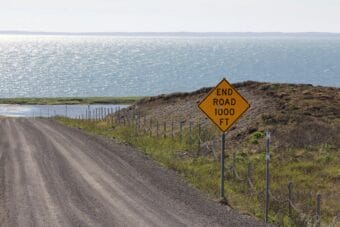
The road out of King Cove ends at the old hovercraft landing on the shore of Cold Bay, about 7 miles from the city of the same name. (Theo Greenly/KUCB)

A gravel road leads out of King Cove, a small fishing town near the tip of the Alaska Peninsula. The road passes a small airport and goes on for another 18 miles before ending at the shore of Cold Bay, a large inlet on the south side of the Alaska Peninsula.

King Cove’s mayor, Warren Wilson, helped build the road about 12 years ago. For now, it ends at a defunct hovercraft landing. You can see the city of Cold Bay from the landing, seven miles across the water.

“It’s just a skip and a hop,” he said. “That’s where we’d connect this last 11 miles of road.”

Those 11 miles are what it would take to connect the communities’ roads to each other. That would make it possible for King Cove residents to reach Cold Bay’s all-weather airport by land. Often, flying out of King Cove is impossible due to the weather.

For decades, King Cove’s roughly 800 residents have called for such a road — a link they say could save lives in emergencies. Neither city has a hospital, so residents rely on medical evacuations to reach Anchorage for urgent medical care.

The Biden administration last week endorsed the proposal, recommending a land exchange with King Cove’s Native corporation so the road can be built. But that road would go through a federally protected wilderness area. While residents argue it’s a matter of life and death, environmental advocates say the road could threaten vital wildlife habitat — and set a dangerous precedent.

Twenty deaths since 1980

draft environmental impact statement, released last week by the U.S. Fish and Wildlife Service and the Department of the Interior, supports a land exchange between the federal government and King Cove’s Native corporation to allow construction of a road through the Izembek National Wildlife Refuge. The administration’s endorsement does not actually approve the exchange, but it sets the stage for President-elect Donald Trump’s administration, which is expected to take up the issue in 2025. Trump supported a similar land swap in 2019 but the 9th U.S. Circuit Court of Appeals vacated the case after the feds pulled out of the agreement.

“We’ve been advocating for this road just to make travel possible,” Wilson said. “We’re stuck now. It’s not good for the community to be unable to travel for medical care, not to mention medevacs. That’s what hurts the most.”

Cold Bay’s all-weather airport, built by the military during World War II, has the fifth-longest runway in the state, capable of instrument landings. Flights there are only grounded about 10 days a year. On average, King Cove’s gravel airstrip is too socked in for flights to land more than 100 days a year.

Since 1980, at least 18 people have died in King Cove while waiting for medical transportation, according to Murkowski’s office.

‘Wilderness areas are all threatened’

Environmental groups have opposed the King Cove road for decades, arguing that a road through the Izembek National Wildlife Refuge would threaten critical habitat including Izembek Lagoon, one of the largest eelgrass beds on earth. It hosts hundreds of thousands of birds, like the Pacific black brant, a species of goose whose entire population relies on the refuge.

Brook Brisson, an attorney with Trustees for Alaska, an Anchorage-based environmental organization that went to court to stop the Trump-legacy land exchange, said the group is already taking steps to oppose the exchange.

“I am literally, today, actively reviewing the draft statement,” Brisson said. “I’m going to be working with our clients and our partners to raise concerns about the protection of those subsistence food resources and about the conservation lands and identifying legal concerns with the program, and we will be submitting comments on the draft statement in the coming month.”

While the group says Izembek is important, their larger concern is the precedent it could set.

“Wilderness areas are all threatened by a land exchange for a road in Izembek” Brisson said. “There is a precedential concern here.”

U.S. Sen. Lisa Murkowski, who has long championed the road, thinks it can be built while still protecting the environment. In a Wednesday statement, she praised Biden’s support for the exchange, saying it was the only way to “truly protect the people of King Cove.”

Brisson recognizes King Cove’s challenges but hopes the community will find another solution to cross the bay.

“We have heard the concerns from the community of King Cove, and we understand them. We support transportation solutions, and we think there are viable marine options that have been studied and funded so that the people in King Cove can get the access to the health care and the emergency services that they need,” Brisson said.

At the hovercraft landing site, a yellow road sign, pocked with bullet holes, says “END.” The hovercraft stopped running in 2013, when King Cove officials concluded that the weather was too rough to operate it consistently.

“It only took a couple years to figure out it wasn’t going to work,” Wilson said.

They’ve tried other solutions, like plane charters and ferries, but Wilson said all of those solutions failed due to high costs and the region’s relentless weather. The municipality, Native corporation, and tribal government are all steadfast that a road is the only viable option.

“We’re stopped from going across a refuge because of an environmentalist crowd that has a lot of money, and they could stop a project like this. But in America, you’re supposed to be able to save lives,” Wilson said. “It’s for the safety and well-being of the public traveling for emergencies and medical travel.”

“Too many deaths have happened trying to transit out of King Cove,” Wilson added. “Enough is enough.”

Despite the opposition, the Biden administration’s decision marks a major step forward for King Cove’s decades-long push. A public comment period for the exchange opened Nov. 15 and lasts until Dec. 30. People who wish to comment on the proposed land exchange can do so on the Fish and Wildlife Service’s website.

Former Pilot Station mayor pleads guilty to felony election interference

The lower Yukon River community of Pilot Station is seen in 2005. (Courtesy Amy Clapp/ARCUS)

The former mayor of the Yukon River community of Pilot Station has pleaded guilty to felony election interference.

As part of a plea agreement accepted on Nov. 14, 68-year-old Arthur Heckman Sr. faces five years of probation for one count of unlawful interference with an election. The charge relates to inducing or attempting to induce an election official to fail in the official’s duty by force, threat, intimidation, or offers of reward.

Heckman Sr. began serving as acting mayor of Pilot Station in May 2022 following the death of then-mayor Nicky Myers, according to the state Office of Special Prosecutions. Assistant Attorney General Erin McCarthy, who prosecuted the case, said that Heckman Sr. broke state election laws in both of the municipal elections that followed.

“After the October 2022 election in Pilot Station, Heckman directed that the ballots be placed in a locked filing cabinet and not counted,” McCarthy said. “And then in October 2023, Heckman directed officials not to hold an election at all.”

Pilot Station City Clerk Ruthie Borromeo was indicted alongside Heckman Sr. in July, and still faces eight felony counts for alleged violations of state election laws for the same time period. Her next hearing is scheduled for Dec. 5 in Bethel Superior Court.

Borromeo is still serving as city clerk for Pilot Station. On Nov. 14, she confirmed that Heckman Sr. had resigned as acting mayor, and that a new mayor and new city council had been elected in municipal elections held on Oct. 1.

McCarthy, with the Office of Special Prosecutions, said that the community deserves recognition for bringing the election violations to light.

“It was investigated by the (Alaska) State Troopers, but the reason that this came to law enforcement attention was because the citizens of Pilot Station and the Pilot Station City Council brought it to their attention. And I think that’s really commendable,” McCarthy said.

The state dismissed seven other felony counts related to election violations as part of Heckman Sr.’s plea agreement. If he violates his probation, he could face up to a year in prison.

Heckman Sr.’s sentencing is scheduled for March 18 in Bethel Superior Court in Judge Nathaniel Peters’ courtroom.

Biden administration gives support to controversial land trade in Alaska wildlife refuge

Brant fly by Mount Dutton in Izembek National Wildlife Refuge on Sept. 11, 2009. The refuge supports nearly the world’s entire population of Pacific brant. The debate over the land trade and the road it would enable have pitted concerns about public safety against those about habitat for migratory birds and other wildlife. (Photo by Kristine Sowl/U.S. Fish and Wildlife Service)

The Department of the Interior has set the stage for a controversial land trade that would allow a road to be built through Alaska’s Izembek National Wildlife Refuge.

In a draft environmental impact statement released on Thursday, the department’s U.S. Fish and Wildlife Service recommended a multi-part swap of land between the federal government and a for-profit Native corporation to free up a corridor for an 18.9-mile road cutting through what is currently designated wilderness in the refuge that lies at the tip of the Alaska Peninsula.

The road would connect King Cove, a mostly Aleut community of nearly 900 people, with the airport at Cold Bay, a community about 18 miles by air to the northwest. While Cold Bay is smaller – with only 57 residents, according to the Alaska Division of Community and Regional Affairs – its airport has a long, jet-accommodating runway. Built by the U.S. Army during World War II, the airport is now owned by the state and can operate year-round.

If carried out, the trade would serve multiple needs, the draft EIS said.

“The purposes of the proposed action are to provide a safe, reliable, year-round transportation system for health and safety purposes, with particular emphasis on emergency medical evacuations, between King Cove and Cold Bay, Alaska, and increase the overall conservation values of lands preserved in the National Wildlife Refuge System and also maintain or increase the opportunity for subsistence uses by rural Alaskans,” the document said.

The idea of an Izembek road made possible through a land trade has a decades-long history. Past plans have made it through various stages of the approval process, but then were either dropped by administrative policy changes or, as was the case in 2019, struck down by a federal court as illegal and, after that, mired in the appeals process.

King Cove residents and their supporters, who include Alaska political leaders, have long argued that a road is needed to allow for emergency medical evacuations, among other purposes. There is currently no safe way to conduct medical evacuations from King Cove year-round, the project supporters argue.

Arrayed against the project are environmentalists and some Native residents and organizations in Western Alaska. They argue that the land trade sets a dangerous precedent and that the road development will damage wildlife habitat, including wetlands vital to migratory bird populations on which the region’s Yup’ik people depend for food and culture.

The biological heart of the Izembek refuge is Izembek Lagoon, site of one of the world’s largest eelgrass beds, according to the Fish and Wildlife Service. Nearly the world’s entire population of Pacific brant uses the lagoon eelgrass during migration, according to the service.

Channels in eelgrass beds are seek on May 24, 2006, in Izembek Lagoon, the heart of Izembek National Wildlife Refuge. The lagoon’s eelegrass beds are among the world’s largest. (Photo by Kristine Sowl/U.S. Fish and Wildlife Service)

Interior Secretary Deb Haaland became immersed in the controversy during her term in office. She visited King Cove in 2022 and has been lobbied by both supporters and opponents of the project.

Last year, she withdrew the Trump-era land-trade plan, which had been struck down by U.S. District Court judge Sharon Gleason. But she promised to keep investigating the issue.

The preferred alternative in the draft environmental impact statement, which is technically a supplemental document building on past studies, would give 490 acres of refuge land to the Native-owned King Cove Corp. in exchange for 31,198 acres. Most of the King Cove Corp. land given to the federal government would be added to the Alaska Peninsula National Wildlife Refuge east of Izembek. The Aleut Corp., the regional for-profit Native corporation, would retain subsurface rights in the 29,459 acres added to the Alaska Peninsula refuge, under the alternative. The road, if built, would cost about $21 million, according to the document. It is envisioned as a single-lane gravel route.

Thursday’s announcement from the Department of the Interior pleased road supporters, including Sen. Lisa Murkowski, R-Alaska, who has been one of the most high-profile advocates.

“I thank everyone at Interior for their work on a strong, defensible analysis that adds to the overwhelming case for a life-saving road. I spoke with Secretary Haaland this morning and thanked her for visiting King Cove with me, for listening to the people who actually live there about the environmental injustices they face every day, and for directing her team to make an honest recommendation to her about the path forward. That path forward is clearly a life-saving road, and we must now finish the job by finalizing the process so that a road can be built as soon as possible,” Murkowski said in a statement.

Opponents said they will continue to fight the project.

Among the opponents making statements Thursday was Edgar Tall, chief of the Native Village of Hooper Bay, the tribal government for that Yup’ik community.

“This is deeply distressing news and flies in the face of the Biden administration’s stated commitment to listen to tribes — we have not been heard. We understand the needs of King Cove and Cold Bay, but reliable solutions exist to improve access between the communities that would not jeopardize our tribe and others throughout Alaska,” Tall said in a statement.

“As Secretary Haaland has noted, respecting tribal sovereignty requires really listening to tribal communities. We hope to meet soon with the Secretary so she can hear from us about the importance of these birds and this critical habitat in the Izembek Refuge that so many of us in Alaska depend on for our continuing ways of life and our survival,” he said in the statement.

The Fish and Wildlife Service said it will accept public comments on the draft through Dec. 30. A final environmental impact statement and, potentially, a decision on action are expected after then.

Final action may fall to the incoming Trump administration, which takes office in January.

Site notifications
Update notification options
Subscribe to notifications