Southwest

Fat Bear Week returns to Katmai National Park

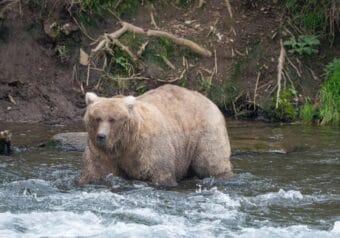
Chunk, a contender in this year’s Fat Bear Week celebration at Katmai National Park and Preserve. (From National Park Service)

Over the last several months, brown bears have been putting on pounds at Katmai National Park and Preserve. The culmination of their efforts is celebrated during Fat Bear Week, where 12 bears are pitted against each other in a bracket-style competition for the adoration of online voters.

The annual observance of Katmai’s bears has exploded in popularity since it started almost a decade ago. Last year, Fat Bear Week saw its highest voter turnout to date, with over 1.3 million participants from over 100 countries.

“It’s an opportunity to share their stories with people around the world, and also to celebrate Katmai’s robust ecosystem,” said Mike Fitz, resident naturalist with Explore.org, a website that livestreams the bears at Katmai’s Brooks River Falls.

Contenders for this year’s Fat Bear Week were announced Tuesday after an incident earlier this week where a large bear killed a rival bear near Brooks River Falls.

In the running are several fan favorites. One of them is Grazer, last year’s Fat Bear Week winner. She grew in popularity because of her dominant nature and hefty stature, often displacing male bears in the park.

This year, though, Fitz says Grazer’s focused more of her energy on raising a new litter of cubs.

“She’s probably not as fat this year, but there’s a lot of stories associated with her that we can admire,” Fitz said. “Her fearlessness, her dedication to her cubs, her work ethic. Bears are single moms, they don’t get any help from the male bears in raising cubs.”

There’s also Chunk, the most dominant bear on the river this year. He packs a punch at about 1,200 pounds. Yet, he’s never won Fat Bear Week.

A number of newcomers are also on this year’s docket. Bucky isn’t the oldest bear, but he’s certainly one of the smartest. He’s discovered a fishing spot all his own – under the cascade of Brooks River Falls. No bear has consistently fished there before.

And Fitz says Bear number 519, a teenager who just split from her mother, is also competing.

“It’s one of those young bears that’s on its own and trying to figure out the world for the first time, and that could be a real challenge for some of these younger bears,” he said.

For the first time, longtime favorite and four-time Fat Bear Week champion, Otis, is not in the running. He’s one of the oldest bears in the park, but has not returned to Brooks River Falls this summer. Fitz suspects he may have passed away.

Although the annual celebration is dubbed Fat Bear Week, the fat bears shouldn’t get all the credit. Fitz says Katmai’s sockeye salmon runs are the healthiest and largest in the world. Without them, there’d be no Fat Bear Week.

“Brooks River is part of the Bristol Bay salmon run, which is one of the last, probably the last great salmon run left on earth,” Fitz said. “To be able to share that story of the sustainable fishery, of Bristol Bay, and what salmon can bring to ecosystems, whatever they happen to be, is a powerful message to bring to the world.”

Fitz says the much-anticipated event isn’t all about who wins, but rather, showcasing the diverse stories of the bears in the running. He says organizers are always looking for new and unique brown bear stories to tell that will resonate with online fans.

“This is an event, an election where all of the bears are worthy of the vote,” Fitz said, “Despite what you see in local and national politics, and you may be apathetic or maybe not like the candidates at your disposal, I think every Fat Bear Week bear is certainly worthy of the vote.”

Online voting for Fat Bear Week opened Wednesday and runs through Tuesday. You can vote for your favorite fat bear and follow bracket results at Explore.org.

What happened to those king salmon caught as bycatch?

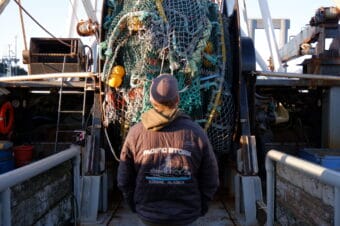
A trawl vessel sits at the dock in Kodiak in July. (Photo by Nathaniel Herz/Northern Journal)

Northern Journal last week published a story on how Kodiak-based pollock trawlers unintentionally caught 2,000 king salmon — forcing the closure of a major Gulf of Alaska fishery.

Afterward, a number of readers responded with similar questions: What happened to those salmon? Were they sold? Donated? Thrown back into the water?

The short answer, according to a federal management official: The salmon were “discarded.”

Some additional context: Salmon bycatch is “prohibited from entering commerce,” Josh Keaton, a top management official at the National Marine Fisheries Service, said in a brief call Friday.

“Nobody gets paid,” he said. “The fishermen can’t take them home.”

The salmon caught by the trawlers were small, he said — four pounds, on average, compared to the 10 pounds that the smallest recreationally harvested salmon weigh.

When bycatch is of “marketable size” and suitable for food quality, Kodiak seafood companies will often process the fish and donate them to an Alaska nonprofit group, SeaShare, Keaton added. But in this case, they were probably too small, and also sat in containers for two days as independent fisheries observers took genetic samples of each one, he said.

Meanwhile, the fallout from the closure of the central Gulf of Alaska pollock fishery, in response to the salmon bycatch, continues. The Kodiak Daily Mirror reported Thursday that one of the city’s processing companies, OBI Seafoods, is laying off some 50 workers, with an executive telling the newspaper that remaining workers would see “significantly fewer hours,” as well.

The closure strands about $9 million of raw pollock in the Gulf of Alaska, which would have been processed into $50 million or more of headed and gutted fish, fillets, meal and oil, according to a preliminary analysis by Garrett Evridge, an Alaska fisheries economist.

The state and local government will also lose hundreds of thousands of dollars in fisheries tax revenue, according to Evridge’s analysis.

Nathaniel Herz welcomes tips at natherz@gmail.com or (907) 793-0312This article was originally published in Northern Journal, a newsletter from Herz. Subscribe at this link.

Philippine consulate visits Kodiak for the first time since before the pandemic

A cohort of nearly 20 people swearing in as dual citizens of the Philippines and the United States. (Brian Venua/KMXT)

The Philippine National Anthem, “Lupang Hinirang,” played for newly sworn in citizens at Kodiak’s Best Western Hotel this week. The hotel’s Harbor Room was packed with people looking to meet with the Southeast Asian country’s visiting consulate.

Daisy Briones is one of them. She lives in Kodiak and works at one of the schools and the library. She’s both a volunteer for, and a beneficiary of the consular outreach to Kodiak.

“This is much better, much faster, and more convenient – and you know everybody,” she said.

For the first time since before the pandemic, a Philippine diplomat visited Kodiak on Sept. 24. The consular team provided services that people would otherwise have to leave the island, or the state, to receive.

The Philippine consulate works as a sort of extension of the country’s embassy in Washington D.C. and serves people outside the Philippines.

Immigration can be complex, but the gist for many is that when some Philippine nationals become U.S. citizens, they end up renouncing their home country’s citizenship. But, they can regain legal ties as dual citizens later. That’s what Briones did.

If she wanted to go through the same process without the outreach to Alaska, she would have had to fly to the nearest consular office, which is in San Francisco.

The swearing in ceremony for dual citizenship lasts about 15 minutes, concluding with an oath in Filipino, the official language of the Philippines, which is largely based on Tagalog.

The Kodiak visit is important, in part because the borough has the second most people with Filipino heritage in the state, according to census data. Kodiak has about 3,253 Filipinos, while Anchorage has an estimated 18,033.

Philippine Consulate General Neil Frank Rivera Ferrer said he tries to serve Alaska at least once a year. Teams mostly have gone to cities like Anchorage and Juneau in recent years, but this is the first time anyone can remember consular outreach to Kodiak in nearly a decade.

“Since I assumed my post in 2021, I made it a priority to service our Kababayans in Alaska,” Ferrer said.

Kababayan roughly translates to countrymen in Filipino.

Ferrer is a career diplomat and works for the Government of the Philippines. (Brian Venua/KMXT)

Ferrer, his consulate staff, and volunteers helped 296 people file paperwork with the Philippine government during their day in Kodiak for a variety of administrative services. He said he’s glad to help people who might not be able to get these services otherwise. All they have to do is bring paperwork that shows previous Philippine citizenship.

While some people regained their citizenship, others registered for overseas voting and renewed their passports – or did all three – in a single day.

“It saves them a lot of money in terms of the cost for traveling, and also the time,” he said. “You’d have to take time off from work – one or two days just to travel and those things. So we try to do that as much as we can.”

A flight to San Francisco can cost over $1,000 – not including money for taxis or hotels.

Ferrer’s office is just one of eight in the U.S. including the embassy in Washington D.C. The others are in Chicago, Los Angeles, Honolulu, New York, Houston and Guam.

Ferrer serves Northern California, Northern Nevada, Colorado, Idaho, Montana, Oregon, Utah, Washington State, and Wyoming in addition to Alaska. The combined population he serves is around 1.3 million Filipino people.

Ferrer brought a team of 11 of his office staff as well as worked with several volunteers for the Kodiak outreach. (Brian Venua/KMXT)

Alaska’s honorary consul, Rebecca Carrillo, was also part of the visit. She can’t provide these services herself, but works as a sort of intermediary between Philippine nationals in Alaska and the consular offices in the Lower 48 and Hawaii. She said she loves meeting people and hearing their immigration stories.

“Their journey from the Philippines to here has transformed their lives, their families’ lives, (for) how many generations,” she said.

Carrillo said she’s heard that many Filipino people have faced discrimination, but retained their identity and love for their homeland despite that. Many of whom did so while building their lives here.

“They are thriving – they own their own homes, they’re able to send their kids to college,” Carillo said. “Those kids are doing well, and it’s the proverbial realization of the American Dream.”

And now many folks who’ve realized that dream want to go back to the Philippines. U.S. citizens can usually only stay in the Philippines for about a month depending on their visa, but dual citizenship allows them to stay longer, or even move back. With a Philippine passport, they can also have a faster process when going through customs and immigration.

Briones, the volunteer, still has siblings there. She said the consular team helped make the process to visit them easier for her.

“The consular team, they’re so accommodating,” she said. “We have plenty of senior citizens here who are applying for their dual (citizenship) or (a) passport. There’s a patience in helping out all these people and we truly appreciate all their efforts.”

The San Francisco consulate office plans to draft its schedule for the next Alaska outreach by the end of the year.

Fat Bear Week delayed after a ‘beloved bear’ dies on camera

Bear 402 with her spring cubs in 2018. (Photo courtesy Maurice Whalen via Katmai National Park and Preserve)

In a shocking live broadcast, one of Katmai National Park’s celebrity bears killed another — just before the start of Fat Bear Week. Viewers from all over the world watched via the live nature cam network explore.org.

The attack took place at the mouth of the Brooks River at roughly 9:30 a.m. Monday. Video footage shows bear number 469 attacking bear number 402 and apparently drowning her after a struggle. He then dragged her body to shore, presumably to eat.

Mike Fitz, a naturalist with explore.org, moderated a livestreamed discussion after the attack.

“402 was a beloved bear by each and every one of us,” he said during the discussion. “Honestly, I think we are all at a little bit of a loss of words.”

Fitz doesn’t know why bear 469 attacked, expending valuable energy. But he said it appeared to be a predatory act.

“I don’t think his behavior is abnormal. It’s well within the spectrum of what we can expect bears to do to one another,” Fitz said. “But how common is this sort of thing? It’s not something that we expect to see.”

The discussion attracted nearly 26,000 viewers. They flooded the comments section with messages like “hugs to all with broken hearts” and “so grateful for the time 402 spent with us.”

Bear 402 was the mother of eight litters and a favorite of bear cam fans going into Fat Bear Week. The annual competition celebrates the bears’ success in fattening up for hibernation. Fans vote for the bear that’s put on the most weight over the summer.

402’s death delayed the release of the Fat Bear Week bracket, which would have come out Monday. The release was rescheduled for 11 p.m. Tuesday.

Judge finds feds failed to consider full impact of Donlin Gold in environmental analysis

The proposed Donlin Gold mine site on Aug. 19, 2017. (Katie Basile/KYUK)

Six tribes from the Yukon-Kuskokwim Delta have won a partial victory in federal court in their suit against the environmental analysis underpinning the permitting of the proposed Donlin Gold mine.

The coalition of tribes from the region filed suit in Alaska District Court last year over the proposed gold mine, which would be located around 10 miles from the village of Crooked Creek on the Kuskokwim River.

In a decision issued Sept. 30, U.S. District Court Judge Sharon Gleason found that the federal environmental impact statement put together by the Army Corps of Engineers for the proposed Donlin Gold project violates two federal laws: the National Environmental Policy Act and Alaska National Interest Lands Conservation Act.

Gleason wrote in her decision that the violations occurred because the Army Corps failed to consider a large enough tailings dam spill in its analysis of potential impacts from the proposed gold mine. Similarly, the court found that the Bureau of Land Management also failed to consider a large enough tailings dam spill in its consideration of the potential impact the mine could have on the use of public lands.

But Gleason also denied two other claims put forward by the tribes, which are represented by environmental law firm Earthjustice.

The court denied the claim that the federal government did not properly consider the potential health impacts of the mine as outlined in a draft Health Impact Analysis compiled by the state of Alaska.

And Gleason also sided with intervenor-defendants Donlin Gold, Calista Corporation, and the state of Alaska, finding that the mine’s proposed barging plan does not violate the federal Clean Water Act. That’s despite its potential impact on rainbow smelt, an important subsistence species on the Kuskokwim River.

Gleason’s decision does not propose a remedy for the federal government’s violation of the law in its environmental analysis of Donlin Gold. The tribes and federal, state, and private defendants will have 24 days to propose a remedy, with an additional two weeks to respond.

Spike in salmon shark sightings near Kodiak stumps researchers

A salmon shark caught as bycatch on a commercial fishing boat and tagged for research. (From NOAA Fisheries)

Salmon sharks appear to be turning up in Kodiak fishermen’s nets and washing up on public beaches around Kodiak Island in greater frequency this summer. But there isn’t enough data to determine if the shark population is growing off the coast of Alaska.

On Sunday, a Kodiak resident stumbled upon a salmon shark washed up on Boy Scout Beach, near the Buskin River. And a few fishermen around Kodiak have reported seeing or catching more sharks than usual in their fishing gear this summer too.

The species is a cousin to the much larger great white shark. It looks menacing, but Oregon State University researcher Alexandra McInturf says it is harmless to humans.

“Historically they were called salmon sharks because they were seen at the river mouths up in Alaska eating salmon,” McInturf said.

McInturf researches salmon sharks, among others species, at what Oregon State calls its Big Fish Lab. Even though Kodiak Island has seen dwindling runs of pink salmon and Chinook this summer, McInturf said salmon sharks are known to eat a variety of forage fish, mainly ones that are commercially viable like pollock, herring and even squid. Salmon sharks’ eating habits also depend on several other factors like their age and gender.

“They do not seem to be salmon specialists,” McInturf stated. “And so if there are poor salmon runs, then they might have to shift their foraging patterns to exploit other resources and that could be why they are being encountered by different (fishermen) than previously.”

Research over the last decade, from 2016-2021, suggests these predators play a role in the dwindling Chinook salmon numbers. But the direct link between king salmon declines and salmon shark predation is unclear.

Similarly, it’s difficult to determine the total number of salmon sharks in Alaska waters and the differences between stocks migrating from place to place up and down the West Coast, along the California current to places like Baja, and into the Gulf of Alaska and Bering Sea. More data is being gathered on the animals’ habitat range as the Alaska Department of Fish & Game is tracking the movements of salmon sharks like Ada, an 8-foot female, tagged in the Northern Bering Sea a couple years ago.

McInturf also points out that even if more sightings of salmon sharks are being reported around Kodiak Island this summer, the sharks could have already been in the area in greater numbers.

“They don’t occupy two-dimensional space, right? Like they could be around but at depth. So in addition to thinking about their distribution geographically, we also have to think about their distribution throughout the water column,” McInturf explained. “So even if we haven’t been seeing them at the surface, they could have been around but perhaps feeding on something more at depth.”

Salmon sharks have been seen as far north as the Bering Strait, around the Nome area, in recent years and could continue to migrate further as climate change pushes their prey into colder waters. They are one of several shark species that can regulate their own body temperatures and are classified as warm-blooded, according to McInturf.

Fisheries biologist Cindy Tribuzio, with the Alaska Fisheries Science Center which is part of the National Marine Fisheries Service, agrees with McInturf; there is not enough catch data to support the idea that the amount of salmon sharks being caught in fishermen’s nets, as bycatch, is increasing in the Bering Sea and Gulf of Alaska.

“What’s being observed (in Kodiak) could represent population changes. It could also just represent the stocks being condensed in a certain area because of a certain food source. There are so many different things that could be leading into this observation that is going on right now,” Tribuzio said.

Tribuzio works at the Auke Bay Lab in Juneau and handles the stock assessments for sharks in the Bering Sea. She said it’s hard to estimate the number of salmon sharks, and other shark species overall in Alaska, partially due to a lack of data coming from the state’s commercial fisheries.

Since salmon sharks are not targeted for a specific commercial fishery, the latest research suggests there is no overfishing occurring in the Bering Sea or Gulf of Alaska (Aleutian Islands region).

The last stock assessment of salmon sharks in Alaska, and others like Pacific spiny dogfish, Pacific sleeper shark, was released in 2022 and the next one won’t be completed until 2026. In the meantime, a new forage study about salmon sharks’ diet from McInturf’s team at Oregon State University is expected to be released later this year.

Site notifications
Update notification options
Subscribe to notifications