Southwest

‘Strange’ bald eagle attacks leave multiple people injured in Kodiak

A bald eagle is seen on Feb. 6, 2018, perched in a tree in the Kodiak National Wildlife Refuge. (Photo by Lisa Hupp/U.S. Fish and Wildlife Service)

Dock users at Kodiak’s biggest boat harbor are being urged to keep an eye out for eagles in the area, as several attacks have been reported in the last week. U.S. Fish and Wildlife staff say this is a rare occurrence, but residents should still be wary when in the area of St. Herman Harbor.

Kodiak’s Harbormaster and Port Director Dave Johnson posted on social media the morning of July 11, warning everyone who is using St. Herman Harbor, also known as Dog Bay, of at least three eagle attacks in a specific area of the dock.

Kodiak Island Borough Assembly member James Turner confirmed the attacks at an assembly work session on July 11, and said a few people required sutures on their heads. Turner is also the local plant manager for OBI Seafoods.

“Be careful over in Dog Bay, walking on L and M floats. There have been multiple eagle attacks,” Turner said. “U.S. Fish and Wildlife is looking into this. But multiple people have been attacked and multiple people have needed stitches.”

Steve Lewis, a wildlife biologist at the U.S. Fish and Wildlife Service, with a focus on eagles and raptors, said this type of encounter is “strange” for the Kodiak area.

“I’ve dealt with eagles in lots of places and normally they just aren’t that defensive. Like I’ve done things like I’ve climbed nest trees. And most of the nest trees, in fact all of them, the birds [the eagles] don’t dive bomb you as you’re climbing, like when you get to the nest,” Lewis explained. “They are definitely aggravated. You can see them flying around and they are calling, but they aren’t diving at you or anything aggressive.”

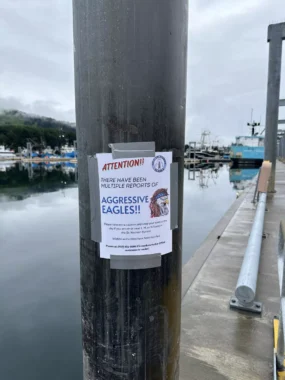
Kodiak Ports and Harbor staff put flyers up near Floats L & M of St. Herman Harbor warning of bald eagle attacks in the area. (Davis Hovey/KNOM)

This sort of attack is rare in Kodiak. Although, further down in the Aleutians, Unalaska is considered to have the most eagle attacks of any city in the country.

For instance, some nesting eagles are known to attack Unalaska residents as they pick up their mail from the local post office or walk in certain areas of town.

But in Kodiak, Lewis suspects this one aggressive eagle was not protecting a nest. Instead its behavior might be due to the abundance of dead fish and food scraps available around the docks. He adds that it could possibly be a pair protecting a nest, but he is not as convinced of that explanation. Bald eagle’s breeding season goes from March to the end of August, according to Lewis, with the young fledglings starting to fly out of the nest at this point in July or earlier.

“I think they are probably getting fed by people around the harbor,” Lewis stated. “And I think that in a similar way that it kind of changes how bears are, if they start getting food from people, they become more aggressive towards people. I think that might be similar to what’s going on with these birds.”

The bald eagle is the national bird of the United States and has certain protections, although permits can be obtained for special uses like for science or to make Alaska Native handicrafts under the Bald and Golden Eagle Protection Act, and Migratory Bird Treaty Act. The USF&WS just updated its permit program for bald and golden eagles earlier this year in April. As such, it is illegal to harm or kill a bald eagle.

Lewis recommends anyone walking in the area of St. Herman Harbor should hold something above their head to protect themselves, or continue to watch the birds so that they won’t swoop down and attack other people. Lewis said eagles tend to attack the highest point of a person that is visible to them, so holding a hat or umbrella above your head could help protect you from injury.

‘The Hungry Games’ offers viewers another helping of Katmai National Park fat bears

Katmai bears fish at Brooks Falls. (Photo courtesy National Park Service)

A new streaming series about Alaska has joined the ranks of TV shows like “Deadliest Catch,” “Bering Sea Gold” and dozens of others, this time focused on the fat bears of Katmai National Park and Preserve.

The latest series, “The Hungry Games: Alaska’s Big Bear Challenge,” features narration from a well-known New Zealand star. Rhys Darby, who has appeared in the HBO comedy series “Flight of the Conchords” and the recent “Jumanji” films, describes himself as a “comedian, actor, leg model, cryptozoologist, artist, and author.”

In a brief preview clip for the series, which premiered Thursday, Darby is narrating a scene where a Katmai bear known as Boldface tries to cross a flowing channel with her three cubs. The mama bear goes in first to test the waters and then calls for the younglings to follow.

“Boldface is waiting for them about halfway across the river. If they can swim to her, she can carry them the rest of the way. C’mon kids, hurry up and get to your mom,” Darby narrated.

Boldface, and other Katmai bears like her, are the focus of a new streaming series that claims to be the first natural history competition show of its kind.

The show will also include a ranking system similar to Katmai National Park’s Fat Bear Week tournament, where several brown bears in the park are pitted against each other and the public votes for their favorite fattest bear. Darby, however, will add more context and commentary to the bears’ activities while they bulk up for winter.

In “The Hungry Games,” the large brown bears are given scores based on their actions, like eating hundreds of pounds of food over the course of 150 days. The three categories they’ll be measured in are Beefiness, Ingenuity, and Grit – an acronym that spells out B.I.G.
Once the show is over, the highest scoring bear will be crowned the Hungry Games champion.

The first season is streaming on Peacock with three episodes released so far.

Division of Elections clears Southwest Alaska legislative candidate after complaint

The facade of the Alaska State Capitol in Juneau on May 22, 2024. (Eric Stone/Alaska Public Media)

The Alaska Division of Elections has confirmed the eligibility of nonpartisan candidate Darren Deacon after a complaint alleged that he didn’t live in the Southwest Alaska district where he’s filed as a candidate for state House.

Deacon is challenging incumbent Rep. Bryce Edgmon, I-Dillingham, for the state House seat covering much of Southwest Alaska.

In a letter dated July 2, division Director Carol Beecher said the division “has determined that Mr. Deacon is an eligible candidate for House District 37 by clear and convincing evidence.”

Deacon’s eligibility had been challenged by Rep. Zack Fields, D-Anchorage, who suggested that social media posts and employment records indicated Deacon lives in Anchorage.

According to the results of a public records request, Deacon showed copies of house payment records for a home in Kalskag, within House District 37, to elections officials. He also showed both travel and employment records indicating that he continues to live in Kalskag.

In a letter to the division, he said his situation is “parallel” to that of Sen. Lyman Hoffman, D-Bethel, who has a secondary home in Anchorage but a primary residence in his home district.

“This comparison underscores that maintaining a secondary residence does not negate one’s primary residency,” Deacon wrote in the letter to the division.

“Kalskag is my home,” he said, “I have ancestral ties to it, and my permanent home is where I make my residence.”

In a separate letter, also dated July 2, the Division of Elections denied the candidacy application of nonpartisan candidate Bruce Wall of Valdez.

In the letter, elections director Beecher said Wall’s candidacy form arrived at Division offices by mail on June 15 but “was not mailed and postmarked in time.”

That decision means incumbent Rep. George Rauscher, R-Sutton, will run unopposed for re-election in House District 29.

Of Alaska’s 40 House seats, nine feature uncontested races. Of the 10 state Senate seats up for election this year, two are uncontested.

Aniak’s tribe sues state, feds over ancestral remains taken from airport site

An aerial view of Aniak’s airport (From Alaska DCRA)

Aniak’s tribal government is suing state and federal agencies for allegedly taking human remains from a burial site discovered beneath the local airport — and not returning them.

The Aniak Traditional Council, the federally recognized tribe for the Kuskokwim River community about 90 miles northeast of Bethel, says the actions of the federal and state agencies are a violation of federal law. Its suit, filed in U.S. District Court, claims they have barred the tribe from practicing its cultural and religious traditions, and have endangered other ancestral remains of Aniak’s tribe that could still be at the community’s airport.

The suit names five defendants: the Alaska Department of Transportation and Public Facilities and DOTPF Commissioner Ryan Anderson; the Federal Aviation Administration and FAA Administrator Michael Whitaker; and the University of Alaska system.

The Traditional Council is represented by Anchorage-based law firm Fortier & Mikko, P.C.

The tribe wants the excavated remains to be returned. It also seeks permission to continue exploring the site to recover and preserve other remains or cultural artifacts.

According to the complaint, filed Tuesday, the suit stems from a project to relocate Aniak’s airport runway to comply with federal aviation standards.

In 2020, a contractor digging trenches for the project found human remains. Almost a year later, the Traditional Council brought in an archaeologist to examine the site. The suit says the archaeologist discovered that the airport project cut a trench through a “previously intact prehistoric burial site.”

The recovered remains and related artifacts were sent to the University of Alaska for examination.

Since then, the Traditional Council says that the University of Alaska has kept the remains. It also claims that the FAA has refused to assist in repatriating them, a violation of the federal Native American Graves Protection and Repatriation Act.

The Traditional Council also claims that the FAA and DOTPF have barred the tribe from conducting further excavation. Aniak’s tribal government is concerned that airport maintenance could further disturb the site.

An FAA spokesperson said Wednesday that the agency does not comment on litigation.

Yukon River communities balance conservation, survival amid near-total salmon fishing closures

Skiffs line the bank near the lower Yukon River community of Emmonak in the summer of 2019. (Anna Rose MacArthur/KYUK)

As the 2024 Yukon River salmon season kicks off, there will once again be little to no opportunity for communities along the Western Alaska river to harvest any actual salmon.

One small exception is summer chum. If the run hits half a million fish, residents of the lower reaches of the Yukon may have the chance to take to the river with dipnets and other non-traditional gear for a brief window like they did in 2023.

But as Holly Carroll, the Yukon River subsistence fishery manager for the United States Fish and Wildlife Service noted in April, these types of opportunities may not be worth the effort for many along the river.

“Who’s going to spend nine bucks a gallon to go out fishing with a dipnet?” Carroll asked. “It might take them four or five hours to get seven chums. Whereas if they had been given their six-inch gillnet, they put it out for a minute, minute and a half, and they’re done. They’ll have 100. Then they’ll spend the next couple of days cutting and smoking, and they’re done for the season.”

While communities cannot count on these types of heavily restricted opportunities to meet their subsistence needs in 2024, one thing they can count on is a total closure of chinook salmon fishing for the next seven years. Carroll said that the recently signed Alaska-Canada agreement was overdue.

“For me as the federal manager, I see this as the bold step that needed to be taken. We’re just not seeing the returns off those runs that we would have liked. I really felt that it was time,” Carroll said. “I also think we really needed to listen to our tribal stakeholders who have been telling us for years that this annual approach is not a great way to manage.”

The seven-year agreement calls for rebuilding chinook stocks to the point that at least 71,000 of the fish cross into Canada each year. It is technically not a moratorium, as meeting this number at any point in the next seven years would in theory lift the closure. But in 2024, fewer than 15,000 fish are expected to complete the journey.

Many believe that trawler bycatch plays an outsized role in keeping chinook and chum from returning to the Yukon River. But Carroll said that the fish are up against a lot in terms of a changing environment.

“I think they’re dealing with a lot more climate changes, certainly warming oceans, different food sources, the food is moving to different areas,” Carroll said. “We’ve seen less healthy fish. Their gas tanks are less full when they go to make that migration. We’re seeing heat stress, we’re seeing warm temperatures when they come into the river.”

Since 2019, Carroll said that chinook numbers recorded on the upper Yukon River at Eagle have fallen drastically below corresponding numbers far downriver at Pilot Station. Biologists believe one thing that may be killing them off somewhere along that nearly 1,100-mile journey is the disease-causing Ichthyophonus parasite.

According to a 2022 report by federal and state biologists to the Alaska Board of Fish, the severity of Ichthyophonus infections has been found to peak somewhere near the midway point of the river in Alaska. But going further upriver, severely infected fish were rarely found, the report said.

Carroll said that scientists are also researching chinook salmon eggs to try and identify potential threats to future stocks. They want to know whether low levels of the vitamin thiamine that have been linked to early salmon mortality are further impacting the fish.

In 2024, the clock is ticking as scientists try to understand what is happening to Yukon River salmon. But as Carroll acknowledged, the clock is also ticking when it comes to communities along the river simply being able to feed themselves.

“How can we get people more food? And if it is with selective gear, how do we get people using them? Because they’re not traditional, they’re not easy, they’re not efficient,” Carroll said. “We all need to get to the table and figure out how to get people some food while still protecting the chinook while we rebuild them.”

The first chinook of the season are likely entering the lower Yukon River at this moment. With luck, they’ll make it to their natal streams, protected by the efforts of communities with whom they are inextricably connected.

Pipeline proposed to power Donlin mine could have impacts from Y-K Delta to Cook Inlet

The proposed Donlin Gold mine site on Aug. 19, 2017. (Katie Basile/KYUK)

If it’s built, the Donlin Gold mine project on the Yukon-Kuskokwim Delta would be one of the largest open-pit gold mines in the world, powered by a gas pipeline that would stretch hundreds of miles across the state to Cook Inlet.

KYUK’s Sage Smiley and KDLL’s Riley Board teamed up from both ends of that potential pipeline to tell this story.

Mile 315 – Crooked Creek

There’s gold in the hills outside of the middle-Kuskokwim River village of Crooked Creek – an estimated 34 million ounces of gold, the weight of five large blue whales.

It’ll take a lot of work to get it out of the ground.

Kristina Woolston is the vice president of external affairs for Donlin Gold, which is trying to develop the mine. She explained the mining process during an Alaska State Senate Resources Committee meeting in early April.

“Donlin Gold is a refractory ore, meaning that microscopic particles are held within arsenopyrite and some pyrite. And so it requires a very energy-intensive process to extract the gold,” Woolston explained. “We will be milling roughly 59,000 tons per day; (that) requires an awful lot of power.”

The Donlin Gold project site sits on land owned by Alaska Native corporations formed under the 1971 Alaska Native Claims Settlement Act. The surface rights are held by the Kuskokwim Corporation, and the subsurface rights are held by the regional Calista Corporation.

Thom Leonard is the vice president of corporate affairs for Calista. He said that the project has gone through a few different ideas of how to power such a hard-to-access site.

“One of the early ideas for the project being so remote, obviously Donlin would have to ship everything in barges. Not just materials for buildings, but also fuel, diesel fuel for all the equipment, and power, and heat,” Leonard said.

But concerns over that potential increase in barge traffic caused pushback from communities on the Kuskokwim.

“We heard from shareholders and residents up and down the Kusko(kwim), ‘Hey, that’s a lot of barges. We’re concerned about that.’ So we reminded Donlin of those comments,” Leonard said. “They went back to the drawing board and said, ‘Hey, we can look at building a natural gas pipeline. And that’ll cut the number of barges on the river by half.’ So we’ve taken in, we’ve learned from the comments of people who have concerns or are opposed to the project.”

The proposed path of the natural gas pipeline that would power Donlin Gold mine, as submitted to the State of Alaska in late 2013. (From Alaska Division Of Oil And Gas)

The project is backed by many in the village of Crooked Creek, less than a dozen miles from the proposed mine site, as well as Calista Corporation.

But plenty of other people on the Y-K Delta are still not entirely happy with the plan, even with the proposed barge traffic reduced. Over recent years, many traditional Native councils and organizations have rescinded support for the project over a variety of environmental concerns.

“It’s skewing our traditional values to fit a mold of corporate infrastructure,” said Sophie Swope, the executive director for Mother Kuskokwim, a nonprofit tribal consortium formed in 2022 in opposition to the Donlin project.

“The fact that there’s going to be a (315)-mile pipeline from Cook Inlet all the way to Crooked Creek, it’s going to be passing so many streams. And of those many streams, we don’t know how many actually are bearing fish,” Swope said. “And I think that is heavily lacking.”

Mile 0 – Cook Inlet

In the Cook Inlet region, more of the conversation revolves around the price of natural gas. Specifically, what happens to residential utility costs if Donlin starts buying up the gas.

Donlin says its pipeline will use about 20 billion cubic feet of natural gas every year. To put that number into perspective, it’s about equal to the amount of gas consumed by every single residential user in the state combined in a year.

Energy consultant Mark Foster is worried about that demand. Foster wrote a report for the Homer-based environmental nonprofit Cook Inletkeeper about Donlin’s potential impact on utility rates.

His conclusion? Donlin’s proposed energy use could increase rates for Southcentral customers by $265 a year.

That’s because Donlin would be buying gas from Cook Inlet, already a hot topic as utilities warn of their gas contracts ending and lawmakers scramble to propose policy solutions.

“The Donlin Mine has a large natural gas demand, based on the documentation it’s provided to prospective investors, and that demand, if it came from local Cook Inlet gas, would be a significant block of demand,” Foster said. “Given the limited reserves we see on the horizon, you can see where their demand would push the price up significantly.”

Not everyone agrees with Foster’s report. Alaska Department of Natural Resources Commissioner John Boyle said that it’s premature to worry about Donlin’s demand when utilities can’t fill contracts in the short term.

“The fact that the existing demand is forecasted to not be met by future supply — absent new investment, new drilling, and new production — it’s fanciful, or I guess illogical, to think that somehow Donlin Mine is going to be able to come in, contract out for somewhere north of 20 billion cubic feet worth of gas, and just exacerbate the overall energy supply imbalance.”

Boyle agrees that Donlin would use a lotof gas, but he actually thinks it would drive prices downHe said that industrial customers like mines tend to provide stability for local utilities.

“The more demand they have from industrial, as well as residential consumers, it enables them to defray those costs out, to spread the cost out,” Boyle said. “So the more cost these industrial consumers bear, the lower the cost, then, for each individual consumer.”

DNR said in Fairbanks, Golden Valley Electric Association members saw a 7% reduction in bills after the Fort Knox Mine came online. And it said that ratepayers in Juneau have saved $70 million since 2009 thanks to Hecla Greens Creek Mine’s investment in hydropower. Those numbers come from the Alaska Miners Association.

During the April Senate Resources Committee, Woolston with Donlin said that she thinks the mine would have a positive impact on the gas market, but said that Donlin has the same worries about Cook Inlet gas as utilities and the state.

“So we’re anxiously watching everybody else, like everyone else, the supply in Cook Inlet and what the solution will be,” Woolston said.

The lawsuit

The pipeline is not a done deal. Its permit is challenged in a civil lawsuit that’s currently before the Alaska Supreme Court.

The state approved a right-of-way permit for the pipeline in 2021, which crosses around 200 miles of state lands.

But four tribes from the Yukon-Kuskokwim Delta region: Orutsararmiut Native Council, Chevak Native Village, Native Village of Eek, Native Village of Kwigillingok, and conservation group Cook Inletkeeper are legally pushing back.

“Unless you look at the whole project, you’re not actually going to understand the impacts on the public interest,” said Olivia Glasscock, an attorney for Earthjustice, which represents the four tribes and environmental nonprofit.

The basic argument of the suit is that the state only considered the pipeline itself, not the impact of the whole project when it permitted the pipeline. Glasscock said that the two are inextricably linked.

“What they missed is the fact that the pipeline, the use of state lands, is for this big project at the end,” Glasscock said. “The pipeline doesn’t have any other planned uses. It’s only planned to be maintained for the life of the mine. It would not be built unless the mine was happening. There’s no other planned projects related to that pipeline, even though it does have additional capacity.”

Oral argument for the case before the Alaska Supreme Court is scheduled for the end of July.

Site notifications
Update notification options
Subscribe to notifications