Southwest

State opens applications for Kuskokwim River breakup flooding relief funds

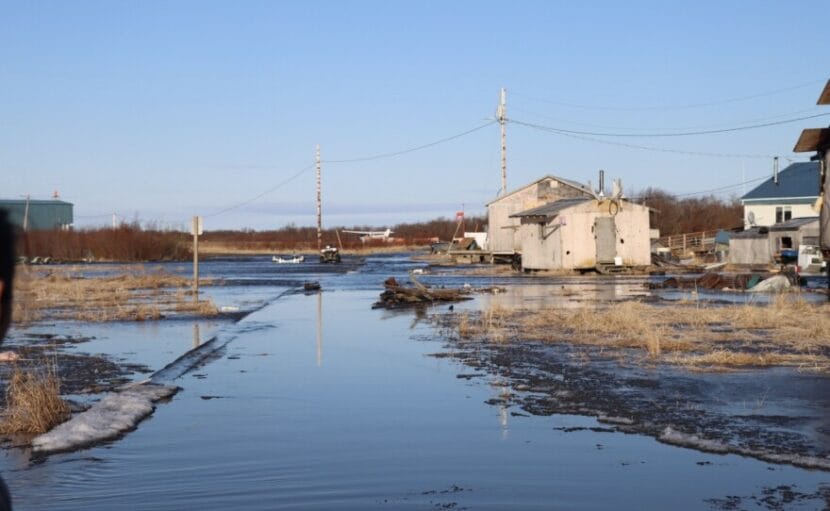
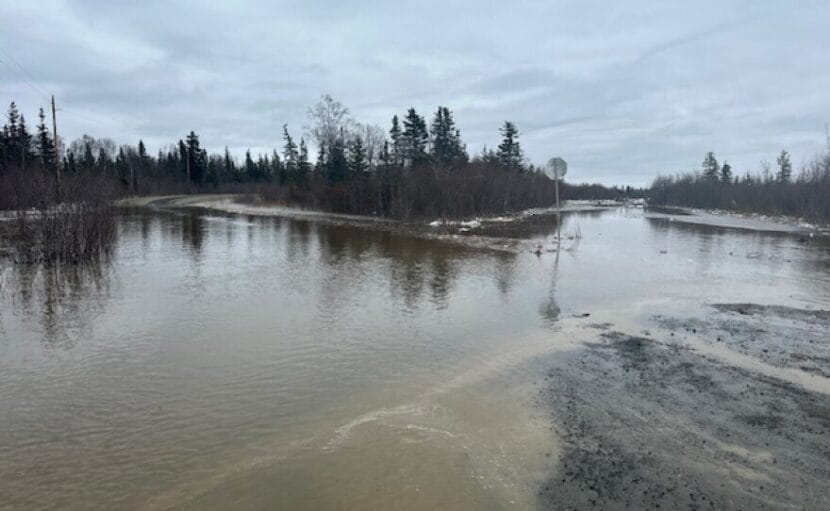
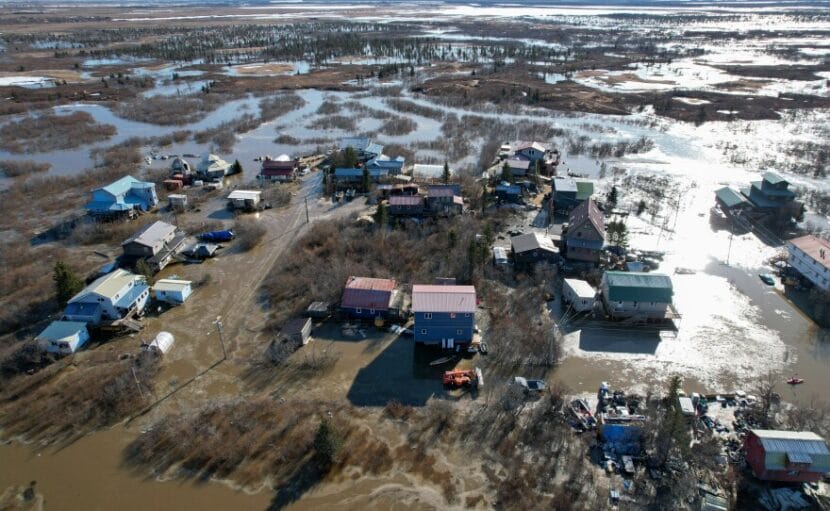
Breakup flooding is seen in the lower Kuskokwim River community of Kwethluk on May 12, 2024. (From National Weather Service)

Breakup has wrapped up on the Kuskokwim River, a week after a series of massive ice floes began wreaking havoc on multiple lower-river communities. Now, individuals affected by flooding have the opportunity to apply for disaster relief funding.

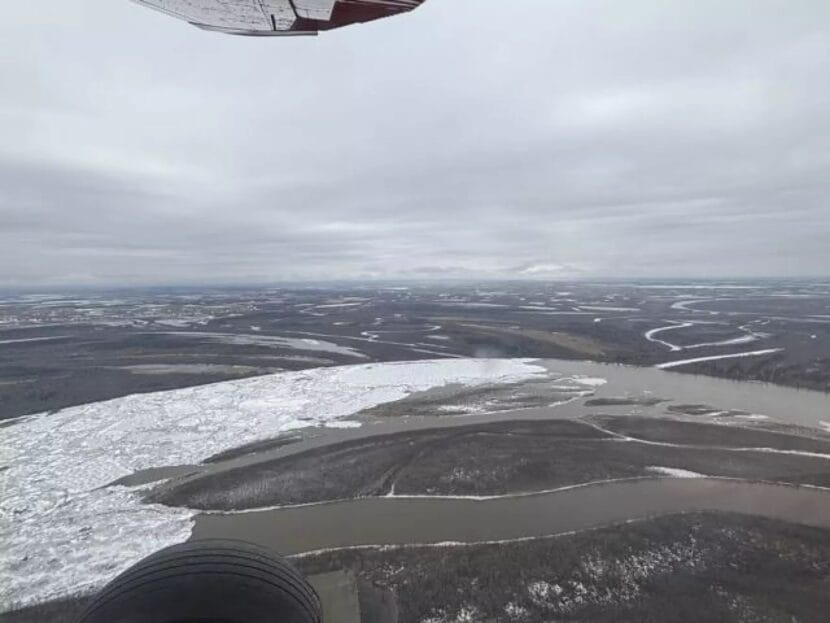
Early this week, the RiverWatch team flew far downriver from Bethel in search of the breakup front. But National Weather Service hydrometeorologist Kyle Van Peursem said that they found that it had basically disappeared.

“There’s usually just a lot of chunk ice pushing up against that strong ice, and that’s what we call the breakup front. There was no chunk ice there. It went from open water to spotty, in-place, rotten ice,” Van Peursem said. “We really have about 30 miles of intact ice left on the Kuskokwim, and it doesn’t look like it’s gonna jam. It’s just melting in place.”

While the breakup front is gone, flooding in some areas is slower to disappear. Due to a combination of multiple ice jams and high meltwater, Kwethluk saw some of the worst of this year’s breakup flooding.

“We were kind of scratching our heads because everyone else around them was receding pretty fast and not even flooding anymore. But Kwethluk still had pretty significant impacts with high water,” Van Peursem said.

As of Monday, low-lying areas remained heavily inundated, though Van Peursem said that the water was down roughly a foot and a half from its peak days earlier.

“The tundra up there is just completely saturated still in spots. You can’t even see where the river is because it’s just completely full of water,” Van Peursem said.
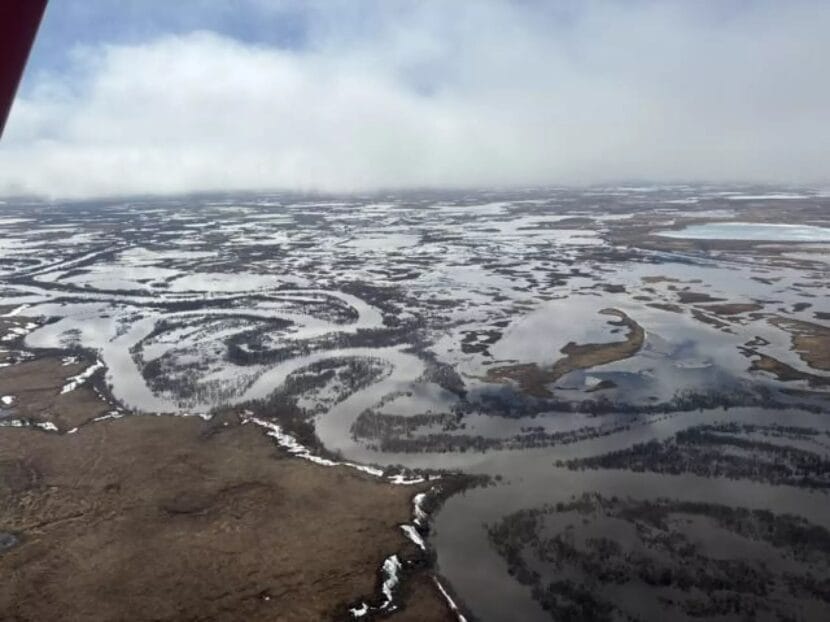
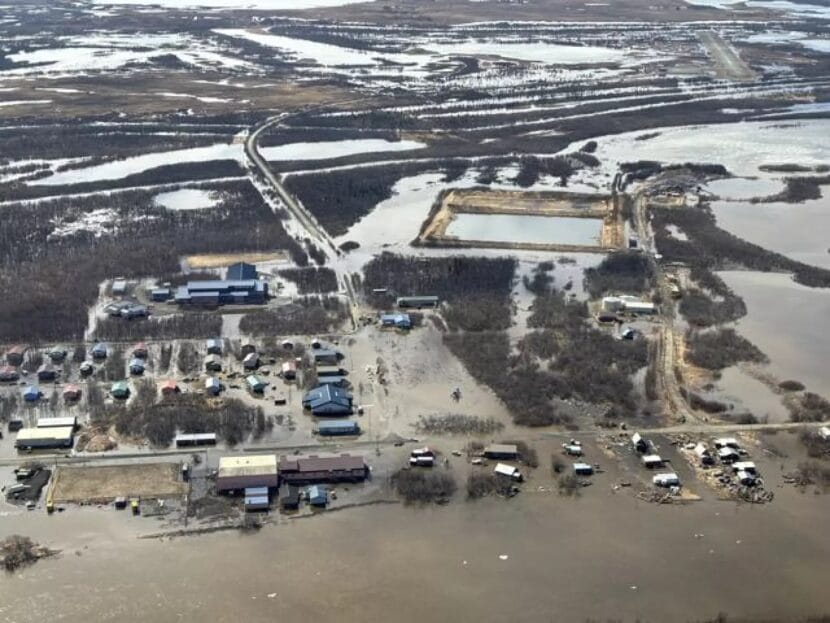
The tundra southeast of Kwethluk is seen inundated by breakup flooding on May 12, 2024. (National Weather Service)

On Sunday, Vanessa Epchook, a spokesperson for the City of Kwethluk, said that the community was still in the process of getting piped water back and running following damage to a water pump early on in the flooding. She also said that the city was waiting to assess potential damage to the foundations of homes subjected to multiple days of standing water.

“All of these homes, they’re probably going to experience some unleveling because of the saturation,” Epchook said. “Some of these houses, their foundation is already bad from last year.”

Downriver in Bethel, water levels were down more than three feet from their Friday peak as of Monday. One resident of the heavily affected Alligator Acres neighborhood took to social media to proclaim: “Land ho.” Others thanked the City of Bethel for making Sunday water deliveries to homes that had been cut off for days by floodwaters.
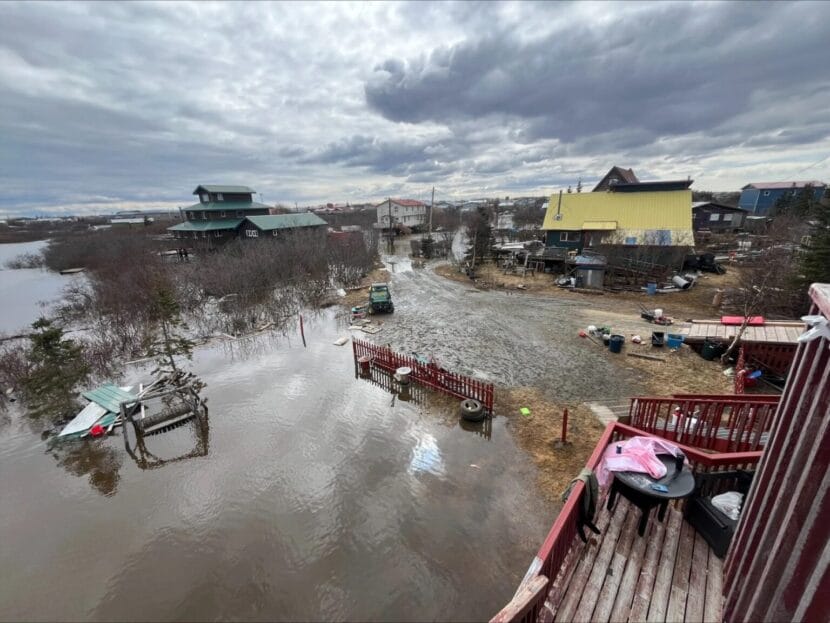
Kuskokwim River breakup floodwaters begin to recede in Bethel’s Alligator Acres neighborhood on May 11, 2024. (Courtesy Katrina Domnick)

As of Monday, residents of communities downriver of Bethel were no longer grappling with high water, but some, like Napaskiak resident Earl Samuelson, were tallying up the damage.

“Did a little assessment through town this morning, a lot of boardwalk damage: uneven, some washed out, some boards gone,” Samuelson said. “One home I could see the insulation was starting to fall down. And I also noticed a lot of erosion where the river came up so fast and formed its own channel.”
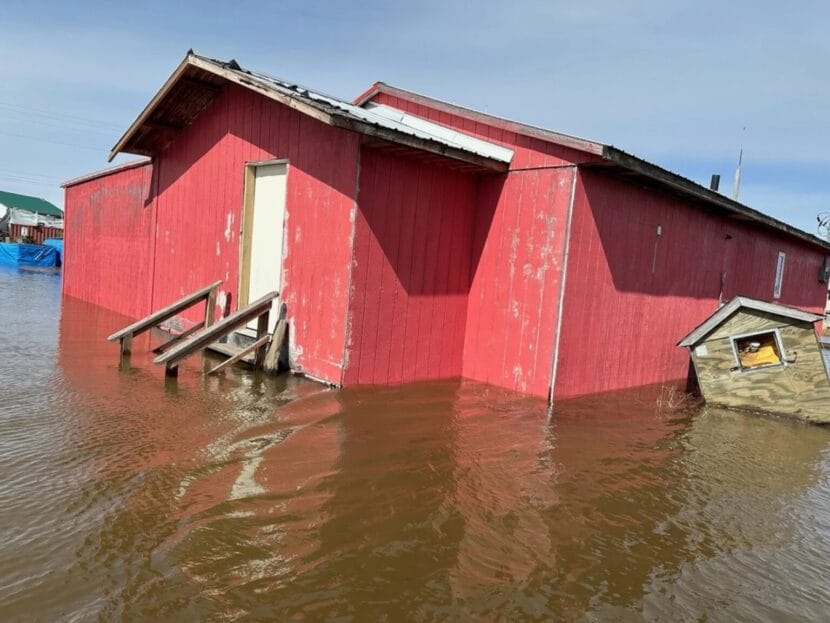
Kuskokwim River breakup floodwaters surround the public safety building in Napaskiak on May 10, 2024. (Courtesy Bethel Search And Rescue)

As of Monday, residents of communities downriver of Bethel were no longer grappling with high water, but some, like Napaskiak resident Earl Samuelson, were tallying up the damage.

“Did a little assessment through town this morning, a lot of boardwalk damage: uneven, some washed out, some boards gone,” Samuelson said. “One home I could see the insulation was starting to fall down. And I also noticed a lot of erosion where the river came up so fast and formed its own channel.”
Dunleavy declares disaster amid historic breakup flooding on the Kuskokwim River

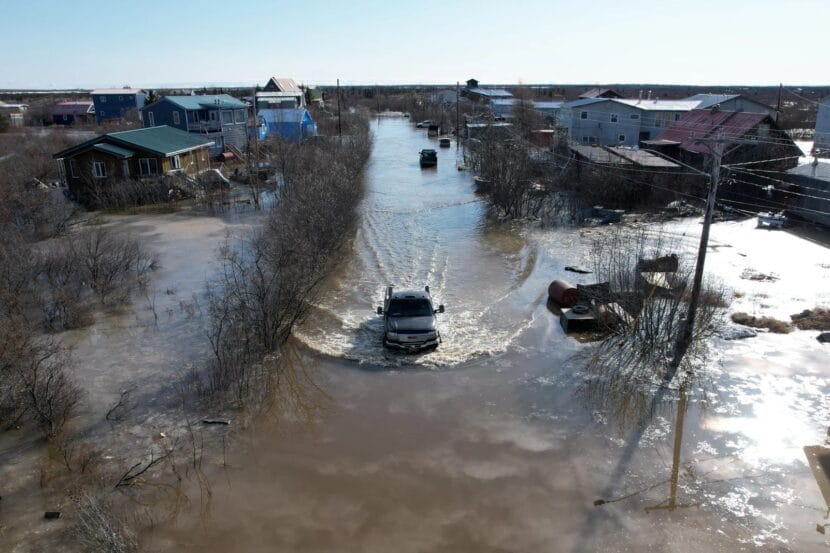
A truck drives through floodwater on Sixth Avenue in Bethel on May 9, 2024. (MaryCait Dolan/KYUK)

Amid historic breakup flooding on the Kuskokwim River, Gov. Mike Dunleavy on Friday issued a disaster declaration for lower Kuskokwim and Yukon River communities. The declaration allows eligible communities and individuals to access state funds for emergency-related costs and provide assistance.

The declaration comes as icy water continues to flood multiple communities on the Lower Kuskokwim.

The Kuskokwim River cut a channel through problematic ice jam below Bethel Thursday night and water levels dropped slightly. But by Friday morning, that area reportedly re-jammed, increasing flooding in Napaskiak, Oscarville, and Bethel. Upriver, Kwethluk continues to see flood impacts as well.

National Weather Service Hydrometeorologist Kyle Van Peursem joined KYUK’s morning show Coffee at KYUK on Friday.

“Until this ice jam can push further downstream, we’re not going to have any improvement,” Van Peursem said. “In fact, it’s probably going to get worse.”

There’s a flood warning in effect for the Kuskokwim River, Brown’s Slough and surrounding areas through Monday morning. Kwethluk is also on flood warning through midday Monday.

Floodwaters rise in Bethel’s Alligator Acres neighborhood on May 9, 2024. (Photo by MaryCait Dolan/KYUK)

Roughly 6 miles downriver from Bethel, waters have continued to threaten Napaskiak, where the community’s airport has become an island only accessible by boat across a roughly half-mile stretch of water, according to Napaskiak resident Earl Samuelson.

As of Friday morning, Samuelson said that water had filled all of the low-lying areas in the community and was within 8 to 10 inches of inundating some homes. He said it is the highest water he has seen in Napaskiak since 1995.

“Folks that are out there traveling by boat, keep the weight down in front of town because these homes are critical right now,” Samuelson said.

Samuelson also said the school in Napaskiak is ready to be used as an evacuation shelter depending on what happens in the coming hours.

“If you’re gonna to go to the school, please have a day pack or a backpack with extra food for a couple of days, water, medications and your important materials,” Samuelson said. “It might be a good time to pack that up in case we decide to do an evac or temporary at the school.”

Van Peursem with the National Weather Service said that small drops in river level are not necessarily an indication that the ice jam is starting to break up.

“We’ve seen the past 24 hours that kind of will go up, drop a little bit, go up, drop a little bit. There’s no sign of it just dropping until that jam breaks,” Van Peursem said. “So expect flooding, and where people have seen flooding in Bethel, for the next day or so, if not more.”

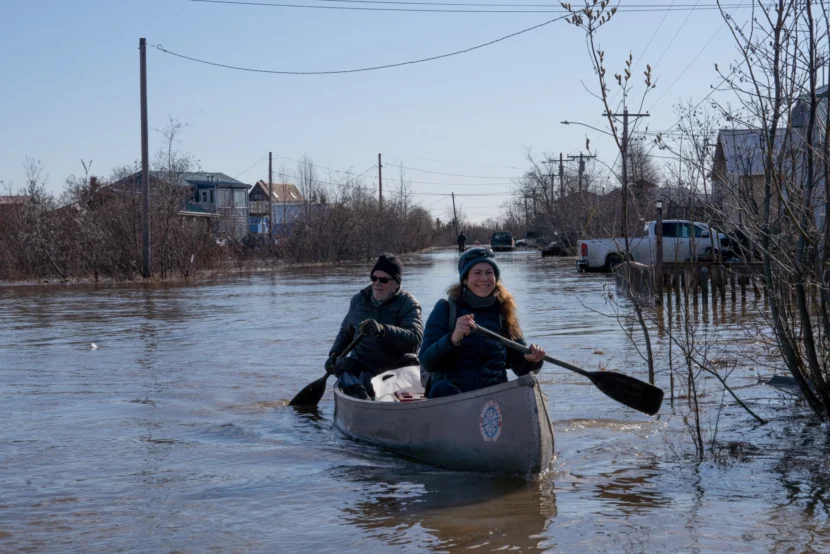
Two canoers paddle their way out of the floodwaters in Bethel’s Alligator Acres neighborhood. May 9, 2024. (Photo by MaryCait Dolan/KYUK)

Bethel’s city government announced Friday morning that areas impacted by flooding will not receive hauled water services until the river water recedes. That includes Main Street, Second, Third, Fourth, Fifth, Sixth and Seventh avenues, Bridge Street, Tundra Street, Alder, East Avenue, Hangar Lake and Osier Avenue.

As of 11 a.m. Friday, water levels at the Brown’s Slough gauge in Bethel were still the highest in decades at 11.48 feet, within a half-foot of what is considered moderate flooding, where evacuation of some homes can become necessary. On Thursday, the city urged residents to prepare for things to get worse, and for vehicles to stay away from the seawall due to soft and hazardous conditions.

Upriver, Kwethluk’s flooding continues to be the worst seen this breakup season so far. As of Thursday night, officials reported flooding rose 1-2 feet in the community.

“The Kwethluk River is completely full. In fact we flew up and you can even tell where the river was because the whole tundra up there was flooded with water,” Van Peursem said. “We did get word this morning that the water levels increase look of stabilize. So I think that’s a good sign that things are trending then in the positive in the right direction for them. So hopefully we’ve kind of crusted in terms of water levels.”

Van Peursem said that ice looks like it’s degrading below Napakiak and toward the Johnson River. He said that based on how the jam has been moving, or not moving, area residents can expect at least another 24 hours of rising water.

Breakup and flood-related information can change quickly, and this article may be updated to reflect more current information.

Share photos or observations with KYUK at 907-543-0223 or by emailing news@kyuk.org.

Widespread high water and flooding continues for lower Kuskokwim communities

Floodwaters rise in Bethel’s Alligator Acres neighborhood on May 9, 2024. (Photo by MaryCait Dolan/KYUK)

Kwethluk remains on flood warning, while Bethel and lower Kuskokwim communities are on flood advisory as the river swells over its banks.

National Weather Service Hydrologist Johnse Ostman said on KYUK morning show Coffee at KYUK on Thursday that high water is widespread throughout the lower Kuskokwim region.

“We’ve seen high water all the way from below lower Kalskag down through Bethel pretty much right to the breakup front, which last night was sitting about two miles downstream of Sunshine Slough between Napaskiak and Napakiak,” Ostman said.

Ostman said the high water isn’t just confined to the Kuskokwim main channel – the tundra is flooding as well. He says he believes that is contributing to the high water throughout the region.

Below is a summary of the flood and ice situations, moving south down the Kuskokwim River: 

Tuluksak and Akiak, which were major points of concern earlier in the week, are still flooding or partly flooding, but Ostman says they’re looking better than they were. Tuluksak continues to have issues with drinking water production after its source pond was inundated in the flooding, while as of Wednesday night (May 8), Akiak’s airport was still surrounded by water.

As of Wednesday evening, Akiachak still had intact ice in front of town, and high water had approached the power plant.

“Even though the water is very high surrounding them, they didn’t have any flood impacts,” Ostman said.

Kwethluk is still experiencing some of the worst flooding in the region. Ostman said that there’s ice running through the area, and that the waterlogged tundra and moving ice may be increasing water levels even more.

“Kwethluk is a real big concern for us today we’re going to be going back up there, taking a look,” Ostman said. “We know that all the whole village has water in it and you know we’re trying to make sure that they know what to do but after speaking with them being on the ground last night with them. They’re pretty prepared and know what their steps are.

Two canoers paddle their way out of the floodwaters in Bethel’s Alligator Acres neighborhood. May 9, 2024. (Photo by MaryCait Dolan/KYUK)

Roads in the neighborhoods around Brown Slough in Bethel are covered with water, and Bethel schools announced early Thursday morning that flooding disrupted bus routes for students.

According to the Kuskokwim River gauge at Bethel, the river level rose around two feet between 8 p.m. Wednesday and 8 a.m. Thursday. The 8 a.m. river level of 10.85 feet puts Bethel well into the minor flooding stage, according to the National Weather Service’s metrics.

Roughly 6 miles downriver of Bethel in Napaskiak, the situation was developing rapidly Thursday morning. Napaskiak resident and Bethel Search and Rescue member Earl Samuelson said as of Thursday morning, ice was jammed in front of town.

“Just looking at the water levels here, we are extremely high right now,” Samuelson said. “All of the low-lying areas are now full of water. Water’s come over multiple places on the bank in front of town, and the north bank and is still gushing in.”

Samuelson continued: “I did an aerial survey with the drone just about 30 minutes ago, it showed that ice jam, the back end of it was right out here by the airport all the way to Oscarville.”

Flooding in Napaskiak on May 9, 2024. (Photo by Kristen Maxie)

As of Thursday morning, water had covered the boardwalk serving as the main access point to the school evacuation point, but Samuleson confirmed the village had a backup plan in place to utilize another boardwalk.

Ostman said Oscarville looks similar to Napaskiak.

“Oscarville has water over their boardwalk this morning. A resident there’s reported that it’s about as high as it was during Typhoon Merbok during that storm they were still able to access their evacuation point which is at the school.”

Ostman said as of Wednesday evening, the breakup front sat between Napaskiak and Napakiak, but that may have moved during the night.

“We had a report last night that they could hear the ice grinding at the breakup front so it it quite possibly as moved down a little bit further.”

Ostman said the National Weather Service plans to fly morning and evening RiverWatch flights where possible.

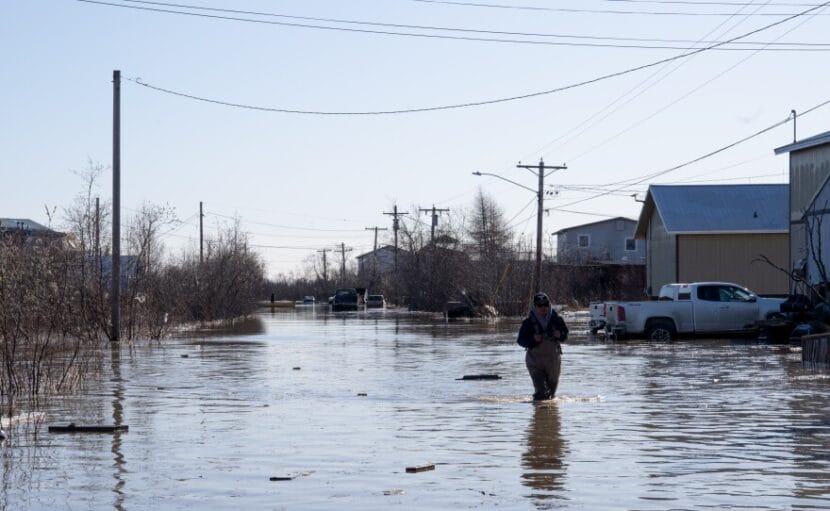
A man wades down a flooded Sixth Avenue in Bethel on May 9, 2024. (Photo by MaryCait Dolan/KYUK)

“Our plans are just to continue to monitor this until flood threats and flooding has ceased for all villages upstream of the Johnson River.”

But, he said, he doesn’t expect additional slugs of ice from far upriver that could compound the lower river jams.

“As far as we know, there should be no more significant runs of ice coming from the upper Kuskokwim,” Ostman said.

He added that warmer temperatures in the coming days should degrade ice at the breakup front, and also increase snowmelt runoff from the upper river. What impact that could have on lower Kuskokwim communities remains unclear.

Breakup and flood-related information can change quickly, and this article may be updated to reflect more current information.

Share photos or observations with KYUK at 907-543-0223 or by emailing news@kyuk.org.

10-mile Lower Kuskokwim ice jam causes flooding, high water

Ice jammed outside of Akiak, May 7, 2024. (From National Weather Service)

Early Wednesday morning, Akiak residents reported slowly rising water and the sound of moving ice. Tuluksak is experiencing what residents describe as some of its “worst flooding” in 10-15 years. A 10-mile-long ice jam had been wedged below Akiak, which is under flood advisory on Wednesday.

Bethel Search and Rescue member Mark Leary joined the RiverWatch team on their Tuesday aerial survey of the Kuskokwim.

“When that ice starts moving, there’s going to be a surge of water. All that water that’s backed up above the jam, it’s going to start coming down and start draining out of the landscape back into the Kuskokwim so there’ll be a surge of water,” Leary said. “How severe it is at Akiak, we don’t know. Akiak has a lot of time to prepare. They’ve been through this before. They’re a well-organized community. I think, you know, they’ll be good.”

Above the massive ice jam, Tuluksak has been upgraded to a flood warning, where waters have filled up surrounding low-lying areas and have inundated parts of the village itself.

Breakup flooding due to a massive ice jam downriver is seen in Tuluksak on Tuesday, May 7, 2024. (Courtesy Bethel Search and Rescue)

“On the front side, the river side, the water’s going down. But on the backside water’s coming in,” Leary said. “ The water is continuing to creep up slowly behind them, coming in behind them, because the land downstream of them is flooding and filling up with water.”

Julia Long is an emergency management specialist with the State Emergency Operations Center. She also joined the May 7 RiverWatch flight. After assessing the situation in Tuluksak, Long says it is still a waiting game, but that the Tuluksak School can serve as a shelter if homes ultimately need to be evacuated.

“So I’ve been in touch with the National Guard, so everybody’s on alert. The dump site is inundated with water. So I’ve contacted the DEC for help with response on that,” Long said. “The water supply, the supply pond has been inundated with water, so it’s disabled the community’s ability to produce water, but the water plant itself is not damaged. We’ve got some response measures in place, and everybody’s on alert, and we’re just kind of waiting to see what the water does.”

Communities downriver of Akiak and Tuluksak, namely Kwethluk and Akiachak, are also waiting to see what the water does.

On Wednesday, the RiverWatch team will continue to fly over the lower Kuskokwim River, keeping a close eye on the situation in Tuluksak, and ensuring that downriver communities have the most up-to-date information available.

Find the most recent flood watches, warnings and advisories for the region here.

Find photos from Tuesday’s RiverWatch flight here.

Breakup and flood-related information can change quickly, and this article may be updated to reflect more current information.

Share photos or observations with KYUK at 907-543-0223 or by emailing news@kyuk.org.

King Cove braces for salmon season with no seafood processor amid historic price slump

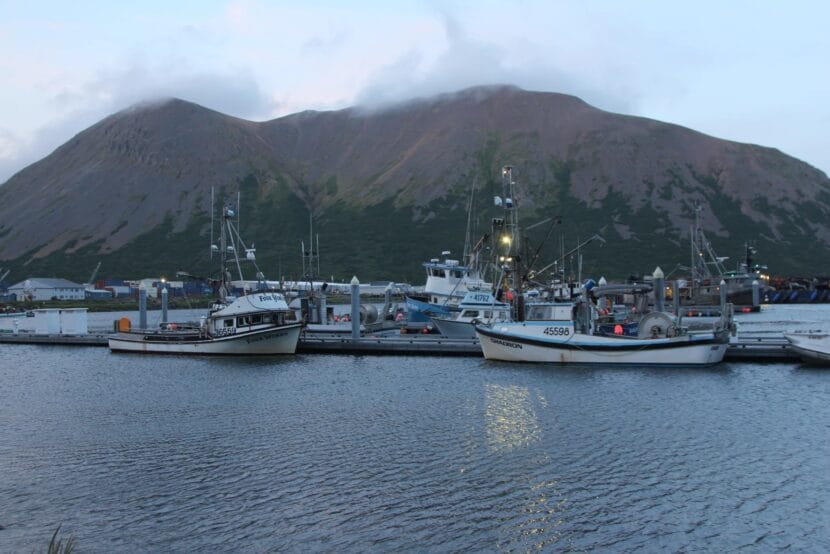
King Cove in August 2023. (Theo Greenly/KUCB)

The city of King Cove is worried about the future after its seafood processor announced earlier this month that it will cease operations. The plant, formerly owned by Peter Pan Seafood Company, is the economic engine of the community on the Alaska Peninsula.

A new owner will take over the processing plant, but it’s unclear when the facility will reopen. Kirsten Dobroth is the Alaska reporter for Undercurrent News, which is a commercial fishing and seafood industry trade magazine. She’s been reporting on what this means just ahead of salmon season.

Listen:

The following transcript has been lightly edited for clarity.

Ava White: Why is this plant closing- at least for now?

Kirsten Dobroth: The seafood industry has been struggling with this historic slump in wholesale and dockside prices. Back in December, Trident Seafoods announced it would sell four of its shoreside processing plants in Alaska because of this market situation. At the time that was kind of a bombshell that got a lot of attention outside the industry.

And within a few weeks of that announcement Peter Pan Seafood Company also said it would temporarily close its facility in King Cove for winter. That’s noteworthy for a number of reasons – it’s the company’s biggest plant, it processes a number of species year round. But at the time Peter Pan said it would reopen for the summer salmon season.

Ava White: And it sounds like now that’s not happening.

Kirsten Dobroth: Right. It was pretty widely reported as time went on that Peter Pan was in some serious financial trouble. And then fast forward to just a few weeks ago – it comes out that Silver Bay Seafoods, which is also a major processor in the state, will take over all four of Peter Pan’s plants as part of this major restructuring plan that’s still being finalized. Silver Bay says in the announcement that it will operate all the Peter Pan plants for the summer – except for King Cove.

Meanwhile, Peter Pan really wasn’t saying anything about what it planned to do with King Cove. But there were some signs that things weren’t looking good – for instance, some fishermen I spoke with were already signing on with other buyers for summer.

And then about two weeks ago the company posted on Facebook that the plant would stay closed and encouraged people to apply to Silver Bay for work. And since then Silver Bay has also confirmed that – at least for now – it doesn’t have plans to open the facility.

Ava White: Okay, so a lot has happened. Why is this Peter Pan news such a big deal in this whole picture?

Kirsten Dobroth: There are a few things that are notable about this announcement between Silver Bay and Peter Pan. One is that it’s a major deal between two of the state’s biggest and more recognizable shoreside processors – and one is effectively ending operations altogether less than two months before the start of salmon season, which is the peak time for most processors and fishermen.

Another noteworthy point to the Peter Pan side of this – the current owners only bought the company back in 2021. One of the financial backers of that sale was McKinley Capital Management, which was using money from the Permanent Fund Corporation’s in-state investment program at the time. I don’t know what the implications of that are. But I think when you look at how quickly this company is halting operations – it’s really indicative of how quickly things have changed for one of the state’s biggest industries.

Ava White: Okay, so let’s go back to King Cove, what does this mean for that community?

Kirsten Dobroth: The implications for the city of King Cove are huge. I’ve talked to city officials there pretty frequently since early this year and this is a big financial hit for them. More than half King Cove’s general fund budget comes from fishing landing taxes. And I think the ambiguous timeline for reopening has people there worried.

Some hurdles to reopening quickly, though, are deferred maintenance at the facility that need to be addressed. Silver Bay has also said it’s prioritizing absorbing as much of Peter Pan’s fleet as possible, including up in Bristol Bay, where Silver Bay will now operate two processing plants because of this Peter Pan deal. So, that will likely eat up some of the company’s more immediate expenses.

But keeping King Cove closed will have a regional impact, too. Fishermen outside of that local fleet have historically delivered to the King Cove plant depending on the species and price at any given point. So, I think there’s a lot of people that are anxiously awaiting word on when things will be back up and running.

Alaska Rep. Peltola stuns home region by defending Donlin gold mine, a project she once opposed

Peltola steers a boat while a cameraman stands next to her, filming
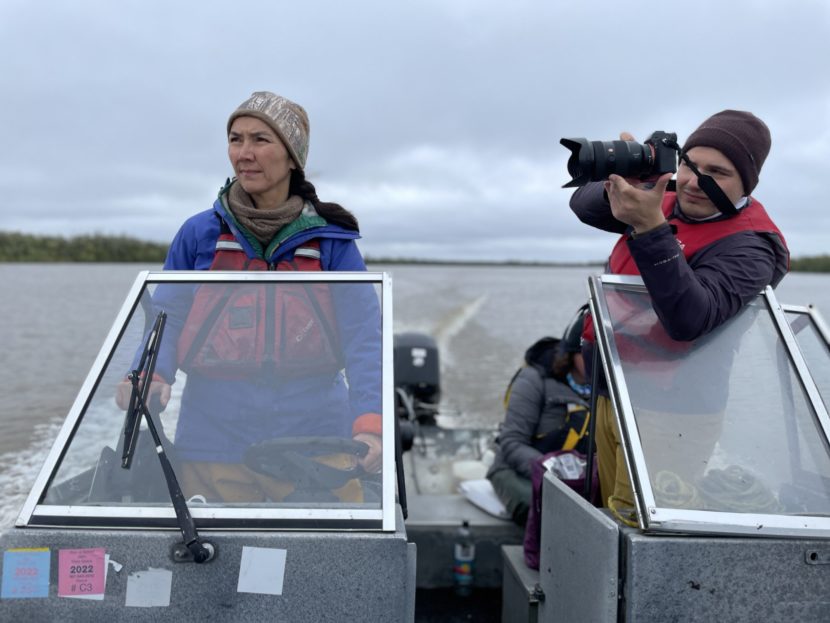
A camera crew documents Mary Peltola fishing. (Photo by Liz Ruskin/Alaska Public Media)

Congresswoman Mary Peltola has joined Alaska’s U.S senators on a legal brief in support of the proposed Donlin Creek Mine in Peltola’s home region of the Kuskokwim Delta.

Tribal and subsistence advocates in the region are shocked that Peltola, whose campaign slogan was “Fish, Family and Freedom,” would take this position. Sophie Swope, executive director of a Bethel-based tribal coalition called Mother Kuskokwim, described herself as heartbroken.

“I do feel slightly betrayed right now,” she said. “My heart —  it’s like, I don’t think I’ve felt this heavy in a little while,” Swope said.

Peltola was against the mine when she ran for Congress in 2022.

She’d been a community manager for Donlin Gold for six years. But in 2014, after a dam at the Mt. Polley mine in British Columbia burst and sent millions of gallons of contaminated material into lakes and rivers, Peltola quit Donlin Gold and became a fish advocate. She was executive director of the Kuskokwim River Inter-Tribal Fish Commission until just before she ran for Congress. Her campaign staff told reporters in 2022 that the Mt. Polley disaster was her turning point.

In the amicus —or “friend of the court” — brief filed late Tuesday, Peltola and the U.S. senators said the mine  “will be an economic engine for the region and provide significant employment opportunities in one of the most impoverished regions of Alaska.”

Peltola’s office hasn’t released a statement yet to explain her change of position and her staffers were not available for an interview.

Donlin would be an open-pit gold mine 10 miles north of Crooked Creek, on lands owned by Alaska Native Corporations. Calista, the regional corporation for the delta, owns the subsurface rights. The mine is projected to produce a million ounces of gold a year and be productive for 27 years. Among its components is a 470-foot high dam to hold back tailings, chemical-laced mining byproducts that would look like silt or wet clay.

Six tribes in the region filed a lawsuit last year against federal agencies, claiming the environmental studies underpinning permission for the mine were inadequate. Among other things, they claim that the agencies only considered the impact of a small leak of contaminated materials from the dam. The tribes say a mining disaster like the Mt. Polley dam breach would contaminate the Kuskokwim, where salmon runs are already diminished.

The congressional delegation’s brief says the tribes are trying to stop development on land Congress intended to be developed for the economic wellbeing of people in the region. Congress, they said, set other lands aside for conservation.

“Respect for this balance is necessary for Alaska to exist,” the brief says, “and to allow the Alaska Natives living in the Yukon-Kuskokwim region to continue their traditional way of life and pursue both beneficial development and self-determination, as promised to them” in the 1971 Native land claims settlement law.

Donlin maintains that its dam would be safe and withstand all environmental conditions of the area. When the mining is done, the company also says it would cover the tailings with soil and vegetation to blend in with the surrounding terrain.

Alaska’s Republican U.S. senators often weigh in with amicus briefs, to support Alaska’s resource development projects in environmental lawsuits. But word that Peltola was considering adding her name to the brief has alarmed mine opponents in the Yukon-Kuskokwim Delta for days.

Swope and a contingent from Mother Kuskokwim flew to Washington, D.C. last week to try to persuade Peltola not to side with the mine.

This is a developing story. Please check back for updates.

Site notifications
Update notification options
Subscribe to notifications