Southwest

State grants will fund two maritime history projects in Bristol Bay

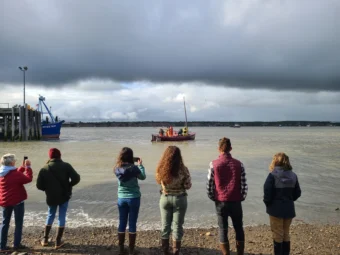
A crowd gathered in Naknek to watch the historic sailboat launch for a morning of fishing. (Corinne Smith/KDLG)

For State Historian and Deputy State Historic Preservation Officer Katie Ringsmuth, Alaska is linked to maritime history – a history dating back thousands of years to when Asia and North America were connected by Beringia.

“So much of Alaska history really is under the umbrella of maritime history,” she said.

The Alaska Maritime Heritage Preservation Program from the state’s Department of Natural Resources is seeking to preserve some of that history. Ringsmuth said the program received federal funds and is now regranting those funds to communities across the state.

“This program helps to preserve maritime resources, whether it’s buildings or whether it’s more educational [activites],” Ringsmuth said. “Really, it’s about helping to remind the rest of the country how important Alaska is in defining its maritime north.”

In total, the program is funding fifteen projects with the grant money. It aims to have most of the projects complete by June of 2025. The program’s website states that these projects were chosen based on grant criteria from the National Park Service.

Axel Widerstrom, cabin boy on Star of France 1919. (National Maritime Museum, San Francisco)

$48,000 will go toward two projects in Bristol Bay. The region has nearly 140 years of commercial fishing history.

The larger of the two grants, totaling $38,000, will support sailing a restored double-ender sailboat from Naknek to Dillingham. This funding is split between the Bristol Bay Heritage Land Trust — a conservation group — and the Bristol Bay Historical Society.

Tim Troll, the Heritage Land Trust’s executive director said the grant funds phase two of the sailboat’s journey. In 2022, the organizations restored the boat and a crew sailed it from Homer to Naknek to commemorate the end of the commercial fishery’s sailboat days. Until 1951, the fishery only allowed sailboats. With the introduction of engine- powered boats however, Troll said that the double enders were quickly retired.

“We’d also like to take [the boat] over to Dillingham which is where the Bristol Bay commercial fishery got started in the Nushagak Bay back in 1884. So that seems appropriate to get the boat over there so people can see it and get in it and sail with it,” he said.

Troll said the aim is to get the boat on its journey to Dillingham by this summer. It takes roughly a day’s journey to sail there, he said, depending on the winds and tides.

The Bristol Bay Heritage Land Trust won the smaller grant, $10,000, as well. The money will fund a project to compile and digitize a historic account from Axel Widerstrom who took photographs as he traveled from San Francisco to Bristol Bay on his father’s ship.

“He was a young man in 1919. His father was the captain of the Star of France, one of the great Star [Fleet] ships [of the Alaska Packers’ Association], and he had a camera with him,” Troll said.

Troll said that Widerstrom completed taped interviews in 1976 that ended up in the National Maritime Museum in San Francisco. The tapes are gone, he said, but the grant money will give the opportunity to travel to California to collect the transcripts and photographs and to digitize them.

Star of India at anchor off Dillingham, circa 1920. (Sam Fox Museum)

Troll said he thinks creating a record is relevant, as many families in the region have ancestors who came up on ships like the Star of France.

State Historian Katie Ringsmuth said she thinks it’s important to keep providing communities with the funds they need to protect their maritime history.

“This allows at least some money to go into communities so they can help preserve those resources, study them and interpret them and share them with the rest of the public,” she said.

She said she hopes the success of this year’s projects will lead to more grants that the program can distribute, so communities can continue to preserve their maritime heritage – from Indigenous technology to historic canneries.

FEMA awards $2.4M to Napakiak as it retreats from Kuskokwim erosion

Napakiak’s village center sits just a few hundred feet away from the rapidly eroding Kuskokwim River bank on September 27, 2018. (Katie Basile/KYUK)

The Federal Emergency Management Agency has announced a new $2.4 million award toward the community of Napakiak’s move away from the Kuskokwim River, as constant erosion threatens local structures.

The edge of the village of Napakiak sits less than 50 feet from the water.

“I measure the erosion every month starting from the time the ice goes out,” said Walter Nelson, who is a primary coordinator for Napakiak’s retreat from erosion.

The Kuskokwim River wasn’t always so close, but in recent years erosion is marching the banks 25 to 30 feet per year toward the community’s well-water source and school building.

“The priority for Napakiak now is our only well-watering point for the community sits at 49 feet from the erosion,” Nelson said.

In 2020, Napakiak came up with a groundbreaking 50-year plan – a roadmap for retreating to a new site.

“We are currently on an island,” Nelson said. “And the new subdivision site is, like, 2 miles away from the Kuskokwim River and the erosion problems that we’re constantly having every year.”

Moving is an expensive endeavor. Napakiak’s retreat is projected to cost upwards of $200 million.

The village received $25 million in 2022 from the Department of the Interior‘s Voluntary Community-Driven Relocation Program, and around $60 million in state funding for the school.

They’ve also tracked down funding for a temporary watering point in the current village, as well as a well-water source in the new subdivision.

“Everything is sort of on the move for us,” Nelson said.

The City of Napakiak, the Native Village of Napakiak, and the Naparyalruar Corporation are all coordinating the retreat. They are seeking out a patchwork of funds from a variety of sources including FEMA, the Department of the Interior, and the Denali Commission.

Altogether, Napakiak will eventually have moved or newly built dozens of houses, a new Native corporation store, a water plant, a multipurpose building, and a school. Nelson said that the erosion is currently around 300 feet from the existing corporation store.

That new school building is now under construction. For now, though, students attend classes in a partly-demolished building that’s roughly 80 feet from the edge of the river – about the length of two shipping containers.

Construction on the new school is set to finish in 2025. The pressing need for a new Napakiak school that’s safe from erosion actually prompted a change in the way the Alaska Department of Education evaluates infrastructure needs when it put the new school at the top of the priority list in 2021.

At the end of February, FEMA announced its grant toward the move.

“The funding awarded today gets us one step closer to a safe, sustainable future for our community,” Nelson said, reached by phone in Napakiak.

Nelson said that the money will go toward around 300 feet of new road and 10 house pads in the new subdivision site.

FEMA Community Resilient Infrastructure Grants Branch Chief in Region 10 Jay Pritchett said that Napakiak is a notable community.

“I think it’s a testament, really, of the community’s goals for resiliency,” Pritchett said. “The permafrost thawing that’s going on in Alaska is expanding on itself. Climate change is clearly having a direct impact on the communities up there and the Native Village of Napakiak, they had the wherewithal and the insight to really look at what was occurring to their community and the land around them. And then looked at ways of leveraging, they had a really solid plan, actually, to put this into implementation, leveraging many different federal resources.”

Napakiak is one of a number of villages in Alaska in the process of planning and carrying out a relocation project. A recent report from the Alaska Native Tribal Health Consortium points to almost 150 villages in the state dealing with accumulating climate-driven threats. The report was harsh. It said that the current system is “inequitable and inefficient.” The federal government isn’t set up to address the needs of those communities, and that’s a point Pritchett makes as well.

“The real challenge, honestly, is time,” Pritchett said. “Climate impacts are only becoming more common and more rapid. There’s a lot that goes into the process of obtaining FEMA funding, and the steps and requirements can be opaque. We’re trying to be more thoughtful about our outreach to communities because we’re realizing information is important, and accessing information is just as important.”

FEMA is just one of several federal agencies that can help fund climate-driven relocation or retreat efforts, all with differing requirements. Pritchett said that as climate impacts hit Alaska communities, governmental agencies need to listen, self-reflect, and figure out how to address their needs while complying with federal laws and regulations on environmental protections and historic preservation.

“What can we do better through the policies, if a policy can be changed?” Pritchett asked.

But he said federal agencies will need to go beyond that as well: “And then really getting that information up to the real decision-makers and saying, ‘Here’s the data that we got, here’s the information we got from the communities,’ and I think people listening and really looking at the most advantageous approach for our communities to meet those, those goals that they need.”

For now, in Napakiak, Nelson works to navigate the complex grant management systems.

“It’s just no easy small task, but, you know, any help that we get, any amount that we get, that’s going to help our community out,” Nelson said.

The new FEMA grant is chipping away at the total cost of getting the community to safer ground, but local authorities will need more.

“We still need millions. Millions and millions more; I can’t give you an exact number,” Nelson said. “But, you know, that’s where we try to get more funds from the state, from FEMA and so forth to help with our retreating efforts.”

In the meantime, every dollar helps the community stay ahead of the advancing banks of the Kuskokwim.

Chignik avalanche leaves community without power for 4 days

A view of the avalanche in Chignik. February, 2024. (Courtesy of Robert Carpenter)

An avalanche spilled across one of Chignik’s main roads on the night of Feb. 16, cutting off some homes and the airport from the rest of the community. Chignik’s mayor, Robert Carpenter, said that there were no deaths or injuries from the avalanche, but that it did destroy a power box, leaving the community’s roughly 100 residents without power. The community lost phone service as well.

“It pushed a container across the road and almost into the slough. Also, [it pushed] a flatbed truck and a skiff, which was in pieces, and [it] took out a power box that controlled power to the main part of town,” he said.

Avalanche debris in Chignik. February, 2024. (Courtesy of Robert Carpenter)

Carpenter said that a city crew was able to clear the avalanche debris off the road a few hours later and the city began to speak with state emergency services the next morning. He said the community had to wait several days before linemen could get to Chignik to repair the damage to its power system.

Chignik’s runway was too soft to land planes at the time, so the Alaska Department of Transportation arranged for a repair crew to travel to the community by helicopter.

Bad weather prevented the crew from reaching the community for four days; the crew restored power on Tuesday evening. Carpenter said that the phone service company GCI also arrived on Tuesday and restored service later that night.

While they waited, the community relied on small generators for power. Carpenter said it took a couple of days to distribute the generators which came from the city, Chignik residents and the nearby community of Chignik Lagoon, who sent them by boat.

Carpenter said that Trident Seafoods sent a tender from Sand Point as well as some food and water. The tender was available to ferry people from point to point, he said, but did not need to.

He said that residents with Starlink, a satellite internet service, helped keep the community connected to the outside world.

Lana Anderson is a temporary office worker for the city. She said that with the small generator, her family prioritized what they needed to power at home.

“We couldn’t have all our appliances on. We alternated between the most important things,” she said.

Avalanche debris in Chignik. February, 2024. (Courtesy of Robert Carpenter)

Anderson said they transferred power back and forth from their heater to their freezer. For a couple of hours, she said, her family turned off their heat to use the internet.

The avalanche came after two days of heavy snow followed by two days of heavy rain. Gabriel Wolken with the Alaska Division of Geological and Geophysical Surveys said those conditions are ideal for generating an avalanche.

“If there’s a recipe for generating an avalanche, you need to have a slope of a certain angle, you need to have a snowpack with weak layers involved, and a trigger is necessary,” he said.

Wolken said that those weak layers of snow get buried in the snowpack and they can act as a sliding surface. He said that subsequent heavy snow, heavy rain or blowing snow can then an trigger an avalanche.

Mayor Robert Carpenter said now that power and phone service have been restored and the road is open, the community doesn’t need anything except reassurance they can use that road safely.

“People are concerned safety-wise of traveling that road. We’re trying to keep traveling down to a minimum,” he said. “If you don’t need to travel on it, don’t. But it is a lifeline to the community because the airport is on that far side.”

Carpenter said Chignik is working with the state to assess the risk of further avalanches.

Alaska’s recent cold snap tested critical infrastructure, including in Mertarvik

The addition of six new homes in Mertarvik means an added draw on power, and a recent state-wide cold snap was too much for the new community’s generators. A three-day power outage has resulted in frozen and broken pipes at the local water plant. (Emily Schwing/KYUK)

A recent cold snap in rural Alaska tested the limits of power plants from Anchorage to the Yukon-Kuskokwim Delta. In Mertarvik, a loss of power meant that other critical infrastructure also saw catastrophic damage.

Multiple social media posts last week called for donations of both bottled water and firewood after the community of roughly 230 people lost power for three days.

“Everything is powered by a generator, but we don’t have a backup generator,” said Calvin Tom, Mertarvik’s tribal administrator.

Tom said that the main generator draws power from batteries that weren’t able to keep up with temperatures that fell to nearly 17 below zero Fahrenheit. That meant that the entire community was without electricity for more than three days.

“For some reason our batteries just drained, so on [Jan. 28] we didn’t have any power all day until the evening. It was all good the following night, and next morning I woke up to no power. So we came to a determination that the batteries were being drained,” Tom explained.

Tom said that they tried a few different methods: insulating the batteries from underneath, lifting them off a cold floor, charging them up and using a space heater to keep them warm, but they simply wouldn’t stay charged and couldn’t keep up with demand.

“The two smaller generators that we are using currently can’t take the load,” Tom said.

In the last year, the population in Mertarvik has increased from just over 180 people to nearly 230. That’s because at least half a dozen new homes were built there last year to house families relocating from Newtok, where permafrost is melting and the land is waterlogged and sinking.

With help from at least one federal agency and the Alaska Division of Homeland Security and Emergency Management, new batteries arrived from Bethel on Jan. 31 and the lights are now on in Mertarvik. But without electricity for a few days, the water plant froze. Now Tom said that Mertarvik is waiting for repair parts to fix broken pipes.

“There’s a little creek, it’s like a fresh spring water. It’s about a quarter mile outside the village and people get their water over there; you just need a four-wheeler or snowmachine to go to it,” Tom said.

According to the Alaska Division of Homeland Security and Emergency Management, both the United States Bureau of Indian Affairs (BIA) and the Yukon-Kuskokwim Health Corporation have shipped pallets of bottled water to Mertarvik. The BIA has also provided a shipment of firewood.

During cold snaps, a spokesperson said that the division often sees problems with critical infrastructure due to spikes in energy usage, just like the one that settled in over most of the state over the last two weeks.

In Bristol Bay, shock and concern follow move to nix management council for nation’s largest state park

The view from the mouth of the Agulawok River, June 7, 2022. (Courtesty of Brian Venua)

Gov. Mike Dunleavy has released an executive order eliminating the management council for the country’s largest state park, Wood-Tikchik State Park in Bristol Bay.

The executive order states that eliminating the Wood-Tikchik State Park’s management council is in “the best interests of efficient administration.” It came as one of 12 executive orders sent to the legislature this month.

Bryce Edgmon said the orders are not typical. Edgmon is Region 37’s House Representative, which includes Bristol Bay and Wood-Tikchik State Park.

“Each executive order is tied to removing a board or commission and it seems laborious and time intensive,” he said. “The usual way would be to go through the public process and involve the legislature. But Gov. Dunleavy has decided to do it very differently and I think very divisively.”

Eight of Dunleavy’s other orders called for the elimination of boards and councils this year, including the Chilkat Bald Eagle Preserve Advisory Council.

Wood-Tikchik State Park is the largest state park in the country, spanning about 1.6 million acres. It is also the only one in Alaska with a management council appointed by the governor.

The seven-person council was formed in 1978 and consists of representatives from nearby village and city councils, the region’s Native association and state officials to advise the government. Three members are nominated by the village councils of Koliganek, New Stuyahok and Aleknagik respectively, one member is nominated by Dillingham’s city council and one is nominated by the Bristol Bay Native Association. The council also includes the Commissioner of the Department of Natural Resources and the Commissioner of the Department of Fish and Game.

Cody Larson is the current chair and represents the Bristol Bay Native Association on the council. Larson said the council met the Friday before the executive order was announced but was not given any notice of its elimination.

“We didn’t have it on our radar, so we weren’t able to put it on the meeting agenda at that time,” he said.

Wendy Sailors, a spokesperson for the Alaska Division of Parks and Outdoor Recreation, said in an email that as executive orders are confidential until they are issued, the orders were not announced.

Larson said that the council has served as somewhere the park receives input from the public on a range of topics and is a space for users to meet.

“Over the past 45 years the park has been a consistent space for the public to provide input and it has also been in the position to encourage park operations,” Larson said.

Board member Dolores Larson, whose Yup’ik name is Myuuraq, represents the Village of Koliganek. She said she thinks it is important to have representation from around Bristol Bay making up the council.

“We live here,” she said. “We know what goes on in the park as well as the region and I believe it’s really important to have tribal representation.”

She said she is concerned that eliminating the council and transferring the park’s responsibilities solely to the Department of Natural Resources and the Department of Fish and Game may make the land more vulnerable to development.

“My biggest concern is that the area will be more open to resource development if it’s led by DNR or Fish and Game,” she said. The park is protected and it should remain that way indefinitely.”

In a written statement to KDLG, Larson wrote that transferring the council to the Department of Natural Resources would be a detriment to the region and the park.

“Our local and tribal representation on the current board play a vital role in the management of the state park that reflects cultural and traditional values and the protection of our valuable resources,” Larson wrote.

The Wood-Tikchik State Park Management Council held a meeting on Feb. 1. A draft of the council’s minutes from the meeting says that the Department of Natural Resources’ Division of Parks and Outdoor Recreation’s director Ricky Gease stated that public input would be received through a citizen advisory board as in other state parks.

Larson wrote that the proposed board would streamline important processes regarding the park.

“And local and Tribal representation would not be put in the statute if it is transferred to the Department of Natural Resources,” she wrote in her statement to KDLG.

Former Board Chair Robin Samuelson also voiced concern that the land might be more available in connection to mining interests.

“I don’t know why he’s doing it. I don’t know who’s pushing him. But I know that there are mining interests that have filed north of the park,” he said.

Samuelson was on the council for more than a decade.

“The park service and laymen board…we had our problems but we always worked out the problem and we always protected the resources in the park, especially the streams and fish,” he said.

The spokesperson from the Alaska Division of Parks and Outdoor Recreation, Wendy Sailors, said in an email that any changes to the park’s management plan must go through a public comment period and meetings must be held in affected communities.

KDLG requested a comment from the governor but was referred to the language in the executive order by the Department of Natural Resources.

Representative Edgmon said the news of the elimination came at a busy time.

“There’s a lot of things going on here in the first few days, but it’s not been lost on me and a bunch of other legislators that these executive orders really need to be looked at very closely and hopefully rejected,” he said.

Legislators have sixty days from the order’s introduction to override it, which would require a majority vote against the order in a joint session. The order was introduced January 16.

Active shooter incident at Dillingham’s hospital leaves no reported injuries

Kanakanak Hospital in Dillingham. January 15, 2024. (Christina McDermott/KDLG)

Dillingham’s Kanakanak Hospital had an active shooter early on the morning of Jan. 14, according to a press release from the Bristol Bay Area Health Corporation. No injuries were reported.

Jennifer De Winne, the Bristol Bay Area Health Corporation’s chief operations officer, said in a call to KDLG that the shooter unsuccessfully tried to enter the hospital’s emergency department. She said doors were locked at that time of day per hospital protocol, but the shooter fired several shots with a shotgun, including at cars parked near the hospital.

De Winne said that multiple members of the hospital’s staff called 911 immediately, and that the hospital followed its active shooter protocols.

She said the shooter eventually fled the scene on a four wheeler and was arrested by Dillingham police further down the road.

The hospital staff, De Winne said, have already met to review the incident and will conduct a formal review this week.

The Dillingham Police Department did not reply to a request for comment in time for this story.

This is a developing story and will be updated as necessary.

Site notifications
Update notification options
Subscribe to notifications