Southwest

Quinhagak’s tribe issues disaster declaration as power outages continue into 5th day

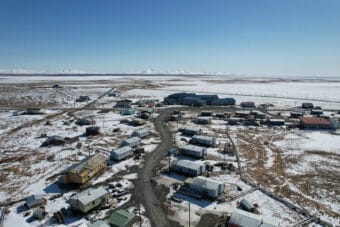
Quinhagak, Alaska on April 19, 2023. (Gabby Salgado/KYUK)

Quinhagak’s tribe has signed a disaster declaration as the community continues to deal with a power outage that left the community without power on Friday, Dec. 8 during freezing weather.

Throughout the weekend, the southern half of the community, which includes most public buildings and more than 50 homes, didn’t have power.

As of the afternoon of Dec. 12, only one of Quinhagak’s three generators was functioning. According to tribal administrator Darren Cleveland, the community was running on a system of brownouts, providing three hours of power at a time to the north and then south side of the community to get heat around, with the hope that short bursts of power would prevent freezing pipes.

“Getting frustrating right now as days continue on without power,” Cleveland said.

The Alaska Village Electric Cooperative runs the village’s electrical utility. Technicians have been working since shortly after the power outages began to fix the generator issues.

Cleveland said that the main goal is to get the power back on. He said that the tribe declared the disaster with the hope of securing state funding and resources to deal with all the costs associated with an extended power outage in freezing temperatures.

“Right now we don’t know any of the damages in the homes because the power’s out,” Cleveland said. “But we’re anticipating that once we get full, once the lights get back on, the power gets back on, we’re anticipating homes with burst pipes once their homes thaw, once everything’s restored. So we’re anticipating a lot of water damages.”

Cleveland said on Dec. 12 that one of the tribe’s biggest concerns is the power outage at the water treatment plant, where some pipes are already frozen. The Native Village of Kwinhagak’s disaster declaration stresses that the water and sewer systems are at immediate risk of freeze up and catastrophic failure.

The local school, clinic, water treatment plant, stores, and other homes and businesses were relying on their own generators for heat. However, Quinhagak City Administrator Tracy Pleasant said that those generators are also starting to have issues since they’ve been running for so long and the power has been on and off.

“Our school canceled today because they were having generator issues,” Pleasant said. “Ours at the water plant broke last night.”

Classes were canceled on Dec. 12 when the school’s backup generator stopped working and were tentatively canceled for Dec. 13 as well. The school had been the emergency shelter for the community.

“Because if the school’s generator’s out, there’s no use for the community to go to the school right now with the power alternating three hours on the north side, three hours on the south side. So at this point, there’s no place in the community to shelter,” said Cleveland.

In the meantime, Quinhagak is at a standstill. Cleveland said that the village has limited service at the clinic. Quinhagak’s airport is the main way in and out of the community, and the runway lights have been out because of the outages. Cleveland said that with limited winter daylight, that’s a major concern in case of medevacs or other emergencies.

“Everything’s closed right now,” Cleveland said. “Even post office is closed. Washeteria’s closed. All tribal offices are closed. School’s down. So this is having an effect on the whole community.”

The tribe’s letter to the state emphasizes that the village doesn’t have the funds or response capability to cover the emergency. In its declaration, the tribe wrote that it has formed a working group with the local government and the State of Alaska Emergency Operations Center. Moving forward, the tribe is requesting the assistance of the State of Alaska for disaster relief aid. The municipal government is also working on its own disaster declaration.

Eric Brown recently stepped down as the Quinhagak power plant operator. He said that parts to repair one of the two broken generators were expected to arrive on the evening of Dec 12.

Brown said that he thinks one of the generators, which they’ve had for more than 15 years, broke down from being too old. He said that the other was installed two or three years ago, but has had multiple issues since it went online.

Rare fin whale found dead near Kodiak

The fin whale washed up on her own without needing to be dragged higher onto the beach. (Courtesy Matt Van Daele/Sun’aq Tribe)

A fin whale washed up in the Pasagshak State Recreation Area, near the end of Kodiak Island’s road system, late last month. It’s unclear how it died, but the whale was in remarkably poor health.

Fin whales are the second largest whale species in the world after blue whales and are usually pretty rare around Kodiak.

Matt Van Daele is the natural resources director for the Sun’aq Tribe in Kodiak. Fin whales can live up to 90 years in the wild but Van Daele said this one was between 10 and 14 years old.

“She was extremely emaciated,” he said. “She was basically like a 53-foot-long snake and that was very sad to see.”

He said when they found the lone whale, she had several bruises all along her body.

“It’s possible that she may have stranded while she was still alive and then died during the night before anyone found her,” he said.

In all, about 40 people including volunteers, veterinary staff, and staff from the Sun’aq Tribe came to help with the necropsy last week.

Van Daele said whales dying near town used to be pretty rare for the island but now this is the second severely unhealthy whale they’ve done a necropsy for this year. The Sun’aq Tribe organized a necropsy for a humpback whale in September.

There isn’t enough data for biologists to declare a trend yet, but these whales are being found on the heels of an unusual mortality event for gray whales in the Pacific Ocean. Van Daele said these two starved whales in a single year doesn’t bode well for populations near the Kodiak Archipelago.

“I personally and scientifically am concerned about what we’re going to be seeing in the next couple of years with our local whales, if these things actually do turn into trends,” he said.

For now, all biologists can do is monitor populations and wait for their samples to get their lab results. Van Daele said the fin whale’s corpse is still on the beach for now, but they plan to bury it in the hopes they can save the skeleton to assemble and display in town.

“Nowhere in Alaska actually has a fin whale skeleton and we’d really like to have this be a community landmark,” he said. “That’d be pretty neat for our fin whale to stay home here so that we can enjoy it.”

The ground in the area is frozen after several days of freezing temperatures, but once it’s buried it will take a few years for it to decay to just a skeleton. Van Daele said while the whale might have had a sad death, they hope displaying it can be a source of pride for the community.

In Bristol Bay and beyond, organizers push for change in tackling MMIP cases

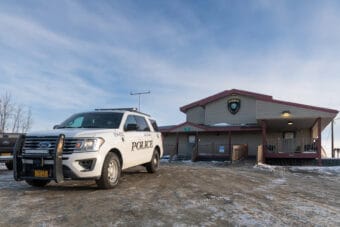
The Curyung Tribal Council building in November 2023. (Christina McDermott
/KDLG)

In Bristol Bay, family, friends and community members have not stopped thinking about Kelly Coopchiak. After the 25-year-old from Togiak went missing in October, search and rescue teams and the Alaska State Troopers spent two weeks looking for her.

Eventually, Troopers stopped the active search for Coopchiak and stated they did not suspect foul play. People from her community criticized the Troopers’ actions on social media, calling for a closer investigation into her disappearance.

Coopchiak is one of dozens of missing people from the region. Nationwide, Indigenous people constitute 3.5% of entries in the National Missing and Unidentified Persons System (NamUs), although they are only about 1% of the U.S. population, according to a 2023 Congressional Research Service report.

The Bureau of Indian Affairs indicates that case data has been missing from NamUs. A 2016 study by the National Crime Information Center found that of 5,712 reports of missing Indigenous women and girls, only 116 cases were logged in NamUs. Alaska ranks fourth nationwide in the number of missing and murdered Indigenous people cases by state, according to a 2018 Urban Indian Health Institute report.

Charlene Aqpik Apok is the executive director at Data for Indigenous Justice, a statewide organization that has documented missing and murdered Indigenous people for about five years.

“We know from our families and our communities that this has been happening for a really long time,” Apok said. “Our understanding is violence is not inherent from our Indigenous communities, and that this is rooted in a history of … ongoing colonialism.”

Apok said victims’ families have often been the main – and sometimes the only – advocates for missing and murdered Alaska Native people, and that it can take years for families to know if anyone will be charged in these cases. That puts the burden of communication and advocacy on individuals, rather than an institution. Further, Apok said families must also contend with troopers who mishandle investigations and meet relatives with skepticism when they provide context for a case.

Apok said that before 2018, no one institution had put together a complete statewide list of cases involving missing and murdered Indigenous persons. That year, she said, families came forward to share their stories.

The testimonies helped inspire Data for Indigenous Justice. She said the data it has collected in the years since has helped to show the scope of these cases.

The Alaska Department of Public Safety followed suit and began to put more effort into tracking MMIP cases. In 2022, the department began assigning investigators to focus solely on cold cases for missing and murdered Indigenous people. There are now four.

This summer, the department published its first quarterly report with a categorized cause for each case. Most of the listed MMIP cases are marked as “environmental,” defined as non-suspicious outdoor deaths or disappearances where human remains are not located.

But Apok said families still have to push to get updates on their case, and that needs to change.

“I think it should be really clear that law enforcement needs to be coordinating (with families),” she said. “Right now, the labor of that is falling on families who are grief-stricken and already trying to deal with their loved ones either being missing or murdered.”

Apok said Data for Indigenous Justice has called on law enforcement to give families regular updates on MMIP cases. She said the organization also wants to see better cultural training for law enforcement to improve communication in Native communities and for more tribal court funding.

Data for Indigenous Justice, Apok said, supports the push for federal-level change to how law enforcement reports these cases, including mandating that law enforcement enter the names of missing people into NamUs.

“It would need legislation and congressional support as it’s a federal initiative,” she said.

Apok recommends that in a missing-person event, families appoint one member as a single contact to keep track of all case information. She said that keeping a case open is important to its continued investigation. That means family or advocates need to frequently engage with law enforcement, with the opportunity to ask questions and have Troopers document all the information they provide.

In recent years, the federal government has also started to dedicate resources to address the number of missing and murdered Indigenous person cases. In 2021, the Department of Justice created a pilot program in Alaska to take on what it has called the “MMIP crisis.” It provided a framework through which participating communities could create response plans. The Curyung Tribe in Dillingham was one of three tribal communities that volunteered to participate.

Courtenay Carty, whose Yup’ik name is Paluqtaq, was the tribal administrator at the time and has served as a liaison between families, law enforcement, and the media for MMIP cases. She said the Curyung tribe was the first in Alaska to adopt a community action plan.

“Our tribe cares very much about working to understand the data and working with all of our community partners in order to begin addressing (the problem),” she said. “The plan was developed to be a living document to be revisited as necessary.”

Carty said the tribe, law enforcement, Dillingham Search and Rescue, KDLG Radio and regional organizations coordinated to build the local plan. It outlines how the community should respond in the wake of a missing or murdered person emergency. Ultimately, the hope is that it will prevent future MMIP cases by helping create a community with strong support systems.

Curyung’s community action plan also supports a holistic approach to healing, including culturally inclusive medical and behavioral health services. Carty said that the plan leaves the definition of culturally appropriate healing open so it can adapt to best suit a victim’s family.

“Whatever the culture is of the family to whom is being served by the plan and receiving response services, their cultural values need to be heard – not just respected, but incorporated into what that response looks like,” Carty said.

Curyung’s plan focuses on Dillingham, but Carty said that a community response plan needs to be created for all of Bristol Bay. She said organizations around Bristol Bay can fund a regional worker to serve as a point of contact in MMIP emergencies, and potentially partner with SAFE, a regional network of domestic abuse shelters, to provide support services to families.

In June 2023, the U.S. Department of Justice launched a missing and murdered Indigenous persons outreach program, which created five regional coordinators and six regional assistant U.S. attorney positions across the United States. A written statement from the U.S. Attorney’s Office, District of Alaska said the role of the Alaska regional coordinator is to inform communities about available federal resources, assist with the development of community action plans and generate conversation about the procedures surrounding MMIP cases with relevant parties.

Carty said Alaska’s branch of the Department of Justice has facilitated regional talking circles in some areas, but as of November 2023, there has not been one in Bristol Bay. She said the region needs one.

Additionally, she said local law enforcement and other organizations within Dillingham need to better integrate into Curyung’s plan, so to address high turnover and the constant need for training.

“Now because of turnover at the tribe, and apparently…turnover at other agencies, this plan is sitting dusty on a shelf and our people are still missing,” she said.

Carty said that people can be uncomfortable talking to law enforcement, so a public event could build better relationships between law enforcement and community members.

“If we had more community dialogue, perhaps between our caretakers and peacekeepers and us people, that could improve things,” she said.

Carty added that the plan’s developers may need to regroup. “Maybe the team that developed this plan needs to call a meeting,” she said.

She also said she sees the opportunity for more preventative activities on violence against Indigenous people, like promoting events on healthy relationships.

It can be challenging not to become numb to the number of missing and murdered Indigenous people in Alaska, Data for Indigenous Justice’s director Apok said.

“We’re trying to deal with something huge and complex. We’ll also live facing it each and every day,” Apok said. “It is really hard for our families and our communities. And I know that we’re going to see it through. We are not going to not look for our people.”

If someone goes missing, law enforcement says you do not need to wait any amount of time to report them. Call 911 or the State Trooper line at 907-451-5100.

Find more information on the Missing and Murdered Indigenous People Tribal Community Response Plans, resources for training and educational material by contacting Alaska’s Missing and Murdered Indigenous Persons Coordinator Ingrid Cumberlidge at Ingrid.Cumberlidge@usdoj.gov or 907-306-0669.

Get in touch with the author at christina@kdlg.org or 907-842-2200.

With law enforcement sparse, Alaska villages build network of safety for survivors

Boats rest on the shore of the Kuskokwim River in Bethel, a hub community in the Yukon Kuskokwim Delta. Boats are a main form of transportation in Western Alaska, where most communities are not connected by roads. (Claire Stremple/Alaska Beacon)

Alaska is notoriously lacking in law enforcement for its remote communities, especially Alaska Native villages off the road system. These limitations put extra pressure on services in those communities to respond to violence after it happens, but a new program aims to help.

In Emmonak, a village of about 800 residents near the terminus of the Yukon River, the women’s shelter has begun to train people known as “victim resource advocates” in the region’s smaller villages to connect people who have experienced violence there with shelter and care.

“The villages don’t have village police officers and we never know who to call, but hiring advocates in their community helps us provide services to those in need that are victims of domestic violence or sexual assault,” said Joann Horn, the executive director of the Emmonak Women’s Shelter.

“In the past it was hard. Sometimes we still have a hard time getting hold of law enforcement,” Horn said. “In the villages it’s hard where they have no law enforcement, it takes days for them to get a response.”

She said in the years before the shelter trained resource advocates, help was difficult to come by for women who experienced domestic violence or sexual assault — they would have to go to the tribal office to call the shelter in Emmonak and then wait in the tribal office until a plane could come get them, Horn said.

Brent Hatch, now a patrol sergeant for the Alaska State Troopers in Fairbanks, spent years responding to domestic violence cases in remote parts of Alaska. He  said the Alaska State Troopers are severely understaffed, but must still respond to crimes over vast distances.

“I think we’re down over 50 troopers; their spots are just empty. And so the troopers that we do have to cover all of the work that our missing troopers are not able to do,” he said. “So just the fact that we’re so incredibly short-staffed, it puts a great burden on a lot of people.”

Hatch described having to “triage” calls when he worked in bush Alaska, and said the troopers that are on duty are responsible for such large geographic areas that travel can slow down the response considerably.

“I’ve had instances where I’ve had to spend over eight hours on a snowmachine to get to a location to investigate domestic violence calls because a flight was not an option due to weather,” he said. “I’ve had instances on numerous occasions where I’ve spent eight to 12 hours in a boat going upriver to deal with situations like this.”

Hatch has been with the troopers since 2008 and said staffing has always been an issue, but that lately it has been even harder.

“The last several years especially, we are losing more people than we’re able to recruit. And the ones we recruit, we’re having a really, really difficult time retaining them,” he said, adding that he attributes some of that to a cultural shift in how law enforcement is perceived by the public.

Village resource advocates

The Emmonak shelter trains the victim resource advocates, who then advertise that they work for the shelter and list their contact information and the services they provide in their communities.

Horn said it has helped get more people from remote villages to safety at the Emmonak Women’s Shelter. “In the past we never used to have a contact person. So having a resource advocate in those villages that we provide services to makes a difference,” she said.

Tammi Long, an employee of the Emmonak Women’s Shelter, said the program is new for them — it started in February of last year.

“That really, really helped us with getting these women and children into safe homes if for some reason they cannot travel to the shelter,” she said. “Before we had these village resource advocates, we’d always have a hard time if it was late at night and the woman or the victim was walking around outside with no place to go.”

The shelter has village resources advocates in Alakanuk, Pitkas Point, Russian Mission, Pilot Station and Marshall. It is working to fill vacancies in Nunam Iqua, Kotlik and Mountain Village. Horn said they also have a trained coordinator who connects with the other advocates weekly.

Horn said the positions are hard to fill. “Once they get a crisis call, they have to take them (the victim) into their homes, and they’re afraid for them to come to their home because the perpetrator might come after that family,” Horn said.

But overall, Horn and Long say the program has helped communities.

“It has been successful so far,” Long said. “We’re getting more and more crisis calls and more and more women and children wanting to come to the shelter. I mean, it’s unfortunate, but we do have more data to report since the village resource advocates started.”

Leaders in solutions to violence

More than 130 miles away in Anvik, Tami Truett Jerue, the executive director of Alaska Native Women’s Resource Center, said there’s the same lack of access to law enforcement, but there are no safe homes for survivors of dometic or sexual violence either.

“In my community, you don’t even have access to 911. There’s no health care, there’s no law enforcement, and you have to get on a plane to get in and out of there.”

Jerue has worked to end domestic violence and increase safety for Alaska Native people for decades. Last year U.S. Interior Secretary Deb Haaland appointed Jerue to the Not Invisible Act Commission, which is an advisory committee that includes law enforcement, Tribal leaders, federal partners, service providers, family members of missing and murdered individuals, and survivors.

Jerue said what the shelter in Emmonak is doing is a good example of how tribes can be leaders in addressing domestic violence statewide.

She said Alaska Native people tend to be on the periphery of victim services and safety even when they are the majority of people who need services — and she wants to see that change.

“We want to change the current rates of violence that we see against our Tribal communities and Tribal people in our community, but outside our communities as well,” she said.

Currently, she said, police reports are necessary to access a main federal funding source for victims of crime, set aside in the U.S. Victims of Crime Act.

That can disenfranchise small, predominantly Alaska Native communities like hers, that do not have law enforcement. But in recent years, the federal government has added a funding stream to address that inequity.

Tribal Victim Services Set-Aside

The federal Tribal Victim Services Set-Aside program brought a historic amount of money to Alaska Native tribes and tribes across the nation to spend on victim services, Jerue said. Her organization is working with Alaska tribes who have not previously had the budgets for such services.

Crime Victim Specialist Kristi Travers has traveled to communities across the state to help tribes build sustainable programs through direct training and technical assistance.

“If we’re here to protect victims and help victims, then their voices need to be front and center every time,” said Travers, who has worked with domestic violence and sexual assault programs that serve Indigenous communities for the past 16 years.

When the Tribal Services Set-Aside program began in 2018 and 2019 there was a huge push for tribes to apply for the funds, she said. But not all tribes had the resources to write grants for competitive funding, even if their communities could benefit from services.

In 2020, at the request from tribes across the country, the federal government changed the program to a formula grant program, instead of making tribes compete for the money.

“We’ve had a massive expansion in the number of villages that are starting or enhancing their victim services programs because of this funding,” Travers said.

This summer, the U.S. Justice Department announced that $22 million will go to 67 Alaska tribes. Jerue said this should add to the number of Alaska Native communities that can build solutions that fit their needs.

This article was produced as a project for the USC Annenberg Center for Health Journalism’s 2023 Domestic Violence Impact Fund. It originally appeared in the Alaska Beacon and is republished here with permission.

A full list of Alaska shelters and victim’s services providers can be found here.

The rivers froze before gasoline arrived in Nunapitchuk

Vitus Energy delivered stove oil and diesel to Nunapitchuk on Nov. 2, 2023. (Courtesy photo)

The Kuskokwim and Johnson rivers are frozen, and Nunapitchuk never received its gasoline delivery before winter. The village did receive deliveries of both diesel and stove oil.

On Nov. 2, two Vitus Energy barges were making their way up the Johnson River on the way to Nunapitchuk when one of the barges got stuck because of north winds, ice forming, and a lack of tide. That was the barge with the gasoline. Now that barge is stuck on the water for the winter.

Northstar Gas CEO John Wagner told KYUK earlier that Nunapitchuk’s late order put the village last on the list for Vitus Energy’s fall fuel deliveries.

The village will have to wait for the ice road to form in order to get its fuel. When the conditions are right, Vitus plans to use trucks or other means to deliver the order, which was for 70,000 gallons of gasoline.

Right now, Nunapitchuk has 13,000 gallons of gasoline. Wassillie Brink, who runs the gas station, said that he’s already started limiting his gas. He said others will probably do the same when they find out there’s not enough gas for winter. Residents can also go to nearby villages to buy gas. Nunapitchuk’s closest neighbor, Kasigluk, is the only other village with a pending order at Vitus, though that’s just a top-off of the tank.

To prevent domestic violence, Alaska schools teach healthy relationships

The dock that leads to the Nunapitchuk school sits in early evening light on October 12, 2023. Social workers from the Lower Kuskokwim School District visit village schools by small plane and boat to deliver counseling services and state-mandated lessons about healthy relationships. (Photo by Claire Stremple/Alaska Beacon)

By the end of the two-hour “healthy relationships” presentation, the seventh and eighth graders in the Anna Tobeluk Memorial School’s auditorium in Nunapitchuk were getting a little antsy.

One girl popped a big, pink bubble on the top bleacher while short, animated videos demonstrated different teen interactions and asked students to gauge them on a scale of healthy to abusive. But when the school’s social worker, Jim Biela, asked the group if sending repeated, unwanted texts are a “green flag” or a “red flag,” she responded quickly and correctly — “Red flag” — before returning to the gum.

Biela paused the video and offered some questions of his own: “‘You’re going to have sex with me or I’ll kill myself.’ ‘You can’t sit with him.’ ‘If you break up with me I’ll kill myself.’ Any red flags there?” The room was pretty quiet, but he clocked a number of raised eyebrows — a nonverbal “yes” in Yup’ik communities.

He is part of a group of itinerant social workers employed by the Lower Kuskokwim School District that travel to the district’s 22 villages, none of which are on the road system. They fly, boat and snowmachine across a region about the size of West Virginia to bring lessons like this one, as well as counseling and support, to some of the hardest to reach parts of Alaska.

High school students wait for a presentation of the state’s Bree’s Law Curriculum in Nunapitchuk, Alaska on October 12, 2023. (Photo by Claire Stremple/Alaska Beacon)

Biela’s lesson was part of a legally mandated Alaska state curriculum intended to reduce adolescent dating violence, which national studies have linked to an increased risk for experiencing domestic violence as victims or perpetrators later in life.

Every once and awhile Biela would punctuate the state’s curriculum with some lessons of his own: “The girls are going to start dating these boys and boys are going to start dating the girls — don’t look at me like that — It’s going to happen,” he said. “How many of you like ice cream? What happens when you eat ice cream really fast?”

“Brainfreeze,” came a few responses.

“So when you eat ice cream slow, do you enjoy it more?” he asked. “If you rush the relationship, how’s it going to taste to you?”

“Terrible,” came some responses.

“Terrible,” he confirmed. “You’re only in the seventh and eighth grade. And as you get older and you’re going to fall in love with each other — take your time. Remember what a healthy relationship is. Any questions?”

Healthy relationships

Biela had flown into Nunapitchuk the day before. Fewer than 600 people live there; boardwalks connect the homes and buildings across the delta’s swampy terrain. The school, like most other buildings, is constructed on pilings to avoid structural damage as the ground freezes and thaws.

Travel from Bethel to the villages is not simple. Biela takes a small plane to the Nunapitchuk airstrip, then the school sends a boat to pick him up and deliver him to the right part of the river. Biela has been making the trip to Nunapitchuk every few months for 11 years. He spends about a week each month at a different village’s school.

A family walked home from school in Nunapitchuk, Alaska on October 12, 2023. (Photo by Claire Stremple/Alaska Beacon)

He said the examples he gave in the presentation — scenarios where one teen may threaten suicide to forestall a breakup or to increase intimacy — were from concerns he has heard from students over the nearly two decades he has spent traveling to support youth mental health and educational development. “Those are real,” he said. “Even for that age group.”

He said the curriculum “definitely” makes a difference. The students get it: over the course of the presentation, which covered topics from gossip to manipulation and gaslighting, they only got one question wrong. And he knows the material is sinking in because of feedback he gets from the students later: “I had a few students this morning from the seventh and eighth graders come in to say ‘You better talk to my sister. Did you do this when my sister was here?’” he said.

He hadn’t. The state began requiring the lessons in 2017, as part of the Alaska Safe Children’s Act, also known as Bree’s Law. The piece of legislation was named for Breanna Moore, a young woman whose parents advocated for teen violence prevention education after she was killed by her boyfriend.

Advocates for nonviolence have criticized the law because there is no enforcement mechanism or support for schools. Biela said he thinks some schools neglect the lessons, but the Lower Kuskokwim School District is strict about them.

“This district is tough on that, which I am really happy to see,” he said. At the end of the year, schools must report when they taught the lessons. He said he teaches some of the tough material that teachers may not be comfortable with.

Four wheelers and bicycles sit outside the Anna Tobeluk Memorial School on a frosty morning in Nunapitchuk. October 12, 2023. (Photo by Claire Stremple/Alaska Beacon)

However remote schools in the Lower Kuskokwim School District may be, Biela said they are not insulated from teen dating violence. He had another presentation with the older students later that afternoon and he predicted “some emotions,” flashbacks or tears — some of the students he cares for have firsthand experience, he said.

Upstream prevention

Schools are recognized by the state as community hubs where public health efforts can take root. The Lower Kuskokwim School District’s itinerant social workers are an example of how Alaska districts can use their reach to bring violence prevention to children.

Mollie Rosier, a manager for the state Division of Public Health, has worked for about a decade in women’s and children’s health. “We know that teens who experienced teen dating violence or perpetrate teen dating violence are more likely to end up in domestic violence situations,” she said.

She said the Alaska Safe Children’s Act is one example of what advocates for nonviolence call primary prevention: an intervention that happens before health effects occur. Another is a state-supported curriculum called The Fourth R, which is used in the Lower Kuskokwim School District.

Mollie Rosier, a manager with Alaska’s Division of Public Health, sat among the materials for various state curricula and programs to support healthy relationships in her Anchorage office on September 25, 2023. (Photo by Claire Stremple/Alaska Beacon)

“From a health perspective, this is too important to not do,” she said, pointing to a stack of workbooks in her office. “We have to continue to give our youth tools to live healthy lives.”

Rosier said it is important for all youth in Alaska to understand what a healthy relationship looks like, and that schools are a place they can gain that understanding if it is not modeled at home.

“If you haven’t grown up in healthy relationships, it’s a chance to look at what a healthy relationship looks like. There should be shared communication, there should not be hitting and belittling and lying,” she said.

High rates of teacher turnover and flat funding from the state threaten the efficacy of policies like the Safe Children’s Act, she said. “We rely on schools and after school programs to implement this work, and they are maxed out,” she said.

“We hear teachers saying, ‘This is so great. And I’m being measured on my reading scores. I can’t add this to my curriculum,’” she said. She said she hopes future policy will support the Safe Children’s Act with staff time and financial support.

The halls are lined with lockers and portraits of elders at the Anna Tobeluk Memorial School in Nunapitchuk, Alaska. October 12, 2023. (Photo by Claire Stremple/Alaska Beacon)

This year, Gov. Mike Dunleavy cut what would have been a historic one-time increase to school budgets in half.

Rosier said she wants to see more state policy that supports the social determinants of health, like access to affordable housing, food and education, which are “foundational” for preventing violence. She said there is a link between chronic disease and growing up in a violent household.

She said while the consequences of violence can be cascading, so, too, can be the positive results from teaching nonviolence. “It’s going to interplay not just in preventing domestic violence and sexual assault, but in being able to maintain employment, to be able to maintain housing,” she said.

Jim Biela, an internerant social worker for the Lower Kuskokwim School District, held up a computer decorated with suicide prevention and mental health messages in Nunapitchuk on October 12, 2023. (Photo by Claire Stremple/Alaska Beacon)

Rosier said the state’s curriculum is just one way to help students build healthy lives. She said that often the same factors that prevent interpersonal violence also protect against other types of risk.

“If youth have protective adults in their lives, a trusted mentor they can talk to, it helps them for suicide prevention, for bullying, for unhealthy relationships, for substance abuse,” she said.

“Welcome home”

Between his presentations, Biela held counseling sessions in the principal’s office while she was out of town. Usually, he has them in a supply closet; its wall is smattered with pencil markings where his students have asked him to mark their heights.

He didn’t get a break that day.

“It’s always like this,” he said, “Every visit, no matter where you go. Everyone wants to see you and there’s no time.”

He sat on a bench briefly and took a deep breath while a teacher delivered another student. “When social workers get to the village, they don’t even have their jackets off before it’s like this,” he said with a laugh.

About 20 minutes later, he returned the girl to her classroom smiling. He poked his head in to pull the next student aside, and three others got up to tell him they wanted a session, too. “You next?” he asked. “OK, you’re number 22. I’m on number 5.”

For the week of his visit, Biela sleeps in a sleeping bag on a cot in a first grade classroom full of tiny chairs and watercolor paintings of wildflowers. He puts dark butcher paper over the windows so he can sleep and showers in the bathroom in the teachers’ lounge. At the end of the day, Biela prepared a plastic-foam cup full of instant ramen on a propane burner while he queued up a movie. He settled into a tiny chair to watch the film on his laptop.

Itinerant social worker Jim Biela set up his cot in a first grade classroom at Anna Tobeluk Memorial School in Nunapitchuk, Alaska. “At my age, I wouldn’t be sleeping on a cot, eating cafeteria food…but it’s the kids. You get to know the kids,” he said. Biela stays for up to a week in villages across the Lower Kuskokwim School District. October 12, 2023. (Photo by Claire Stremple/Alaska Beacon)

He is 65 years old, and he said the work is hard, but community connections keep him coming back. He said in some communities he has been a counselor to multiple generations of the same family; some kids call him “uppie,” or grandfather.

“It’s the kids,” he said. “You get to know the kids. You get to know their parents. You get to know the grandparents. You go to the village and you hear: ‘Welcome home.’”

This article was produced as a project for the USC Annenberg Center for Health Journalism’s 2023 Domestic Violence Impact Fund. It first appeared in the Alaska Beacon and is republished here with permission.

A full list of Alaska shelters and victim’s services providers can be found here.

Site notifications
Update notification options
Subscribe to notifications