Southwest

Katmai’s Fat Bear Junior competition kicks off this week

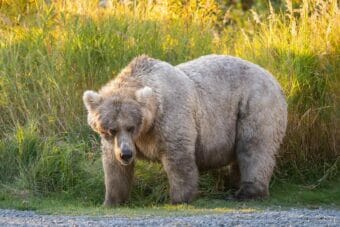
A brown bear in Katmai National Park (Courtesy explore.org)

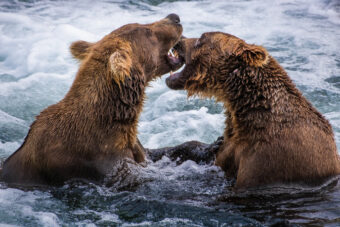
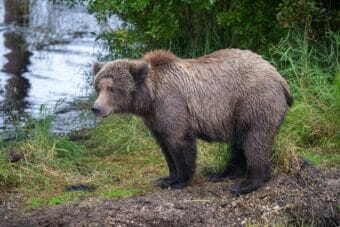
Fat Bear Week, the annual celebration of brown bears gearing up for hibernation at Katmai National Park and Preserve, kicks off this week with its junior bear competition. Pitted against one another for the highest number of votes, four bear cubs will face off in a tournament-style bracket to take home the crown of Fat Bear Junior Champion. The winner has a chance to compete against their senior bear counterparts next week.

The junior competition began in 2021 as a way to get people excited about Fat Bear Week, the nine-year-old festival that brings attention to Katmai’s brown bears with the help of livestream cameras in the park. It focuses on first-year cubs and yearlings, or bears that are about 18 months old.

“Fat is the fuel that powers the survival of brown bears during hibernation, and a fat bear is a successful bear,” said Mike Fitz, a resident naturalist with Explore.org. “Fat Bear Week and Fat Bear Junior is a way for us to celebrate the success of brown bears as they prepare for hibernation. It also celebrates the ecosystem and the health of it that supports these bears, especially the sockeye salmon coming from Bristol Bay into the Naknek River Watershed.”

In addition to a pair of first-year cubs, this year’s junior bear competition will showcase a yearling cub and a singleton first-year cub. It will also feature a junior cub who was separated from her mother and raised by her aunt.

“Adoption is rare among brown bears, and the circumstances that lead to it are often mysterious or unknown,” Fitz said. “What I think led to the adoption this year was the sociability between those bear families and those mothers last year.”

Fitz and rangers at the national park have been keeping tabs on the bear cubs all summer. They can tune in via Explore.org’s livestream bear cams, which provide insight into the lives of the bears living near Katmai’s Brooks River Falls.

While this week’s focus is on the fattest bear cub, Fitz says that they shouldn’t get all of the credit. The junior winner will prove to be a hat tip to the mother who raised it. He spoke of the singleton spring cub who was brought up by a second-time mother.

“The cub itself wasn’t quite comfortable standing on the bank of Brooks River on its own, but the cub really wanted to be next to mom,” Fitz said. “Even when it was only a few months old and got out into the river, sometimes it would get swept downstream. We saw it fall over Brooks Falls several times this year. It’s grown a lot, its overall size shows that bear cubs single, they don’t have litter mates, have advantages because they have access to all of mom’s food.”

Located in the Bristol Bay region of Alaska, Katmai National Park and Preserve is home to the largest and healthiest runs of sockeye salmon left on Earth. The region also has more brown bear inhabitants than humans.

“Each bear in Fat Bear Junior is an individual with a unique story to tell about life and survival,” Fitz said. “This is a really unique wildlife watching opportunity to get to know animals as individuals rather than as populations.”

Fitz says that Fat Bear Week not only showcases the health of the bears, but is a way to raise awareness around the world about the health of the Bristol Bay region.

“Each one of them showcases a slightly different way of living, a slightly different way of surviving, and I think that’s a really special opportunity,” he said. “When we watch wildlife, generally, we don’t know anything about those individuals.”

Online voting for the Fat Bear Junior competition begins on Thursday at 8 a.m. You can vote at explore.org.

Starlink connections among latest round of tribal broadband funding for Alaska

GCI’s wireless tower at Watson’s Corner in Bethel is seen on June 27, 2023. (Evan Erickson/KYUK)

Alaska Sens. Lisa Murkowski and Dan Sullivan are applauding nearly $54 million in additional grants this month under the federal Tribal Broadband Connectivity Program.

Among the grants is $4.5 million to purchase and install Starlink, a low Earth orbit satellite communications network owned by SpaceX, in 1,410 homes and nine community institutions on the Yukon-Kuskokwim Delta.

Alaska has thus far received more than $400 million under the tribal program, most of which is going to fiber-optic network projects spearheaded by GCI, the primary internet service provider for Western Alaska, and its partners. The Sept. 19 grant announcement is the first mention of federal funding for Starlink in Alaska.

Sen. Murkowski’s director of communications, Joe Plesha, said that the summer-long network disruptions experienced by GCI customers following a subsea fiber-optic cable cut in the Beaufort Sea showed a need for backup options.

“It’s great that it’s been repaired and service has been fully restored, but it really underscores the importance of broadband redundancy for our rural communities so that our networks are resilient to outages,” Plesha said.

The remainder of the nearly $54 million in tribal broadband grants is spread among seven other projects, with more than half going to Alaska Tribal Spectrum, a project to bring “2.5Ghz spectrum and/or satellite service” to unserved tribal households, businesses, and community institutions across Alaska.

The specific grants include:

Igiugig Village: $8 million for planning, engineering, feasibility, and sustainability studies. The project will serve 16 Alaska Native Villages and complete in-depth feasibility studies, last-mile design, and construction cost estimates.

Alaska Tribal Spectrum: $29.5 million to install a wireless network using a Tribally-controlled 2.5Ghz spectrum and/or satellite service to directly connect a total of 2,569 unserved Tribal households, 125 unserved Tribal businesses, and 89 Tribal community anchor institutions with qualified broadband speeds.

Alaska Village Initiatives: $7 million to construct last-mile wireless deployment infrastructure in 13 of the Alaska Native Villages in the Consortium by utilizing 2.5Ghz licensed spectrum. Additionally, the project will also deploy fiber to the premise in one Alaska Native Village.

Alutiiq Tribe of Old Harbor: $500,000 to upgrade equipment in the current system in order to deliver qualifying broadband service to 72 unserved Tribal households.

Benhti Economic Development Corporation: $999,997 for the pre-construction planning, engineering, design, and permitting of last-mile network services. The project will create a shovel-ready project to build broadband networks in the Native Village of Minto and of Manley Hot Springs.

Chugachmiut: $991,974 to provide satellite internet service subsidies for the Native Village of Nanwalek and the Native Village of Port Graham.

Huna Totem Corporation: $2,467,546 to provide minimal upgrades to network and customer equipment in addition to providing Native households with three years of subsidies service.

Yukon-Kuskokwim Delta Tribal Broadband: $4.5 million to purchase and install Starlink to 1,410 homes and nine community anchor institutions.

After viral ad offering expense-free living, Alaska community will have school for the first time since 2018

Toni Wilkinson and her kids have been exploring the town since they arrived a few weeks ago. (Courtesy of Toni Wilkinson)

Karluk, a remote village of just 24 residents, will have a school for the first time in five years starting next month.

Until recently, just two of those residents were kids. But schools need at least 10 students to qualify for state funding. In an effort to reopen the school, the Karluk Tribal Council posted an ad offering to pay a year of living expenses for two families to move there.

It worked.

The ad went viral this summer, and nearly 5,000 people responded.

One of those families is the Wilkinsons. Toni and her five children took four flights over 28 hours to get to Karluk from Lexington, Kentucky.

“When we landed in Karluk, there were several people on the airstrip to kind of greet us and show us around and load up all of our luggage and bring us and show us our house and one of the ladies had cooked breakfast for us and so it was very welcoming,” she said.

The family arrived in early September and have been adjusting to life on an island and exploring the beaches. Wilkinson’s spouse as well as their two adult children stayed in Kentucky.

“They put a lot of thought into getting things for us and making us feel comfortable and everybody’s just been so welcoming and kind,” she said.

Between the Wilkinsons and another family on the way, the village has brought in enough students for the Kodiak Island Borough School District Board of Education to agree at its meeting Monday night to reopen the school.

Kathryn Reft is the Karluk Tribal Council’s secretary and treasurer. She says the council sifted through thousands of inquiries to find the right families to move to the island. She said another family with three more children are on their way.

“Well, we’re just all so grateful that we were able to pull this off,” she said. “And it was looking pretty iffy there for a minute, but we can actually now breathe.”

Reft said they hoped to find families with more rural Alaska experience, but with only two available houses right now, they had to prioritize families with enough kids.

“It was kind of like, ‘Oh this one don’t [sic] have enough kids,’” she said. “We were really concerned about a single parent coming in also, but it came down to the amount of kids and how we can work that out.”

But getting enough kids to the village was just the first step. The Kodiak Island Borough School District hasn’t had a school in the community in five years. The district’s board of education voted to open the school with just a few days’ notice. Now staff have limited time to sort all of their paperwork, and figure out what’s next.

“I’ve got to reach out to the borough and see what we need to do to take back over that building as a school site,” said district superintendent Cyndy Mika. “I have to file paperwork with the Commissioner of Education at the Department of Education to request for us to open that school because they’re the ones that ultimately will give us permission.”

That’s just the tip of the iceberg – Mika also needs to certify all of the schools by the end of September and even with the state funding of $371,000 for the school, the district anticipates needing $412,000 to operate the facility and pay staff. That means they need to make up about $50,000 to operate the Karluk school in an already tight budget.

District staff toured the building this summer and said it needs some maintenance but the facility is overall is in good condition. (Courtesy of Toni Wilkinson)

During its meeting on Monday, the school board said its biggest obstacle though is finding and housing a teacher for the Karluk school. The district had a hard time finding staff for rural schools last year. Mika said the Tribal Council renovated two houses for the incoming families, but there isn’t a third home that’s ready for a teacher.

“Not only are we scrambling to find a teacher, we’re scrambling to stand up one of those classrooms in the building as the teacher dwelling and so that’s a hard sell,” she said.

That means a teacher would have a private bedroom and living room, but would have to share the kitchen, bathroom, and laundry rooms that the students use during the day.

Mika said communities around Kodiak have housed teachers in school buildings in the past, but she’s concerned that it will affect the teacher’s work-life balance. For now, the district is planning to send rotating staff to teach in the community for a few weeks at a time.

Despite all of the work though, Mika said it’s worth it.

“Ultimately we do have 10 students in Karluk and we do need to educate them and it’s the right thing to do to open the school,” she said. “It would have been nice if we had a year to plan for the opening instead of rushing it, but now the real work happens.”

Wilkinson, the mother of five who recently moved to Karluk, said the family has loved getting to know the community, seeing bears, and exploring the island.

“It’s just beautiful! I mean Kentucky’s beautiful too, just in a different way,” she said. “So we’re enjoying that and we’re enjoying and looking forward to hopefully the school getting up and going.

The other family headed to the village is coming from California and will arrive  in late September.

Scientists baffled by golden orb found in Gulf of Alaska

The Okeanos Explorer live streams a lot of their expeditions. (Courtesy of Okeanos Explorer crew)

The Okeanos Explorer, an exploratory vessel operated by the National Oceanic and Atmospheric Administration, discovered an unidentifiable golden orb deep in the Gulf of Alaska late last month. The orb ended up making national headlines for stumping the ship’s scientists.

The attention came as a surprise, said expedition coordinator Sam Candio.

“I’m not even sure that that was the most interesting thing on that dive,” he said. “We, aboard, pretty much forgot about it. And then once it started getting all the media attention, it was just like, ‘Oh, that’s what everybody’s focused on.’”

Researchers still haven’t been able to identify the golden orb.

“We don’t know what it is, and I haven’t gotten any compelling ideas from people ashore. But a lot of theories right now are kind of the same ones that we had when we first came across it,” he said. “It could be some sort of sponge, maybe a coral, I’m kind of on the egg-case train.”

It was found about about 2 miles under the ocean’s surface during the ship’s work along Alaska’s coastline.

Underwater, the orb was a bit more circular and had kind of a golden shine, but when their drone brought a sample to the surface, it was a matte brown and had a flaky texture with a hard center.

Scientists used an aquatic drone to bring it to the surface for testing. (Courtesy of Okeanos Explorer crew)

Scientists aboard the ship took several photos and ran tests. Candio said the crew will have to send the orb along with a myriad of other potential new species to the Smithsonian National Museum of Natural History in Washington, D.C., for further analysis.

“We got a lot of things that are new to science, which is really exciting,” he said. We’re processing them, making sure that we get them all packed away safely.”

He said while the orb intrigued the crew, they were more fascinated on this particular dive by seeing octopi tending to eggs – that’s previously been a rare sight. In their time in Alaska, the scientists found several octopi tending to eggs, with 10 mothers off the coast of Kodiak Island.

The Okeanos Explorer is about to complete its work in Alaska. The ship’s last stop is in Seward, and then the crew will head to San Francisco for the winter. Candio said he was glad to visit so many places around the state.

“Just seeing how incredible all the life and the landscapes and the geology and how diverse and beautiful it was with crazy coral forests and chemosynthetic communities, and pretty much everything you could hope to see,” he said. “It’s amazing to see that both on land and at sea.”

The boat is scheduled to begin mapping waters around Hawaii next year.

They logged on to watch the famous fat brown bears. They saved a hiker’s life instead

A livestream set up by Explore.org in the Katmai National Park for bear enthusiasts captured a missing hiker pleading for help on Sept. 5. (Screenshot by NPR/Explore.org)

A handful of wildlife enthusiasts were probably hoping to catch a glimpse of Katmai National Park’s famous brown bears when they logged on to a livestream of a remote Alaska mountaintop last Tuesday. But the resident celebrities were nowhere to be seen when a distressed hiker walked into view instead and pleaded for help.

The scene unfolded on the Dumpling Mountain livestream, one of 12 camera views operated by Explore.org inside the Katmai National Park.

Around 3:30 p.m. local time on Sept. 5, a man in a green rain jacket, wet and disheveled, appeared on screen and looked straight into the lens, clearly mouthing the words “help me.” He returned a few minutes later, giving a thumbs-down signal.

“There is someone distressed on the camera,” one viewer posted in the rolling comments beneath the stream. That message was seen by a volunteer chat moderator, who in turn messaged a Katmai park ranger.

After reviewing the footage, the ranger mobilized a search and rescue team, which found the man just about three hours later, not far from the site of the web camera.

The man was ultimately unharmed, Cynthia Hernandez, a spokesperson for the National Park Service, told NPR in an email. She added that the rangers were notified of the distressed hiker directly thanks to the concerned viewers.

When the chat moderator shared this news with the viewers, there was a flood of kind words and a sweet celebration.

“Aaaand I’m crying because I’m so relieved,” posted the user who originally flagged the man’s appearance. “Those rangers made it up there fast!”

Dumpling Mountain isn’t typically a popular livestream

The cameras have been around since 2012, but really started to take off in 2014, with the advent of Fat Bear Week — a delightful man-made tournament in which the public votes on which of the park’s bears has grown the most rotund as preparation for their winter hibernation. (This year’s Fat Bear Week has yet to be announced, but the competition usually lands in early October).

Roughly 10 million people tuned in to the Katmai live streams last year, according to Mike Fitz, a naturalist with Explore.org who previously worked as a ranger at the park.

But most of those views went to the cameras trained on Brooks Falls, where the bears make daily stops during salmon spawning season.

Sitting about 2,200 feet above sea level, the Dumpling Mountain camera is more of a “scenery cam than a wildlife cam,” Fitz said.

Stunning sunsets, like this one highlighted by Explore.org, are a main reason to tune in to the Dumpling Mountain live camera. (Screenshot by NPR/Explore.org)

The camera auto-pans across a sweeping vista: Colorful alpine tundra shrubs dot the landscape while the largest lake in a U.S. national park (Naknek) stretches out in the foreground. Some of Katmai’s 14 active volcanoes are visible in the distance.

But that height comes with tempestuous weather, which can often obscure the view and offers little in the way of shelter and food for the kind of big-ticket animals viewers crave. When NPR checked the stream on Friday morning, only 12 people were watching.

The camera itself is about 2 miles away from the nearest trail, which is described by the National Park Service as a “strenuous hike” featuring “steep portions” and some overgrown areas.

The climb rises 800 feet over 1.5 miles and ends about 2.5 miles from the actual summit of the mountain, but an unmaintained footpath continues on for a while before petering out.

Fitz says that makes it “a great place to find some quick solitude away from the river, away from the bears,” but also shrouds the path in danger.

It’s still unclear how the hiker found the remote camera

Cell service and shelter can be hard to come by on the rounded and short-shrubbed mountain peak.

And, during poor conditions, like the kind that set in on Sept. 5, “You really have no sense of direction,” Fitz said. “The landmarks you saw on the way up disappear when the clouds come down.”

The 4.1-million-acre Katmai National Park is tucked between the Pacific Ocean and the Bering Sea, making it a prime spot for storms in any season.

Rain and wind were detectable on the camera Tuesday. Due to fog, the visibility appeared to be about 50 feet or less.

It’s still unclear how the hiker found the camera installation. Fitz says the collection of solar panels and wind turbines sticks out amid the short vegetation, but it still isn’t huge — maybe about 20 to 30 square feet total.

“This was certainly a first for us,” Fitz said of the hiker asking for help, though wildlife viewers around the world have flagged pressing emergencies before, like an injured elephant at a Kenyan wildlife sanctuary.

“Our webcam viewers, collectively, are very sharp-eyed and they don’t miss much,” he added.

That was evidenced again on Sunday, when Dumpling Mountain’s viewers, still recovering from the stress of seeing the hiker, caught sight of a big thing in a slim six seconds of the stream: A brown bear, rambling across the camera’s view, miles away from his typical hangouts.

Copyright 2023 NPR. To see more, visit https://www.npr.org.

NTSB investigates mid-air collision over Katmai National Park

Katmai National Park is famous for bear watching and because it’s off the road system, most people get to the park via planes. (Brian Venua/KMXT)

A de Havilland Beaver operated by Alaska’s Enchanted Lake Lodge Inc. and a Bell 206L-4 LongRanger helicopter operated by Maritime Helicopters collided in mid-air over Katmai National Park during Labor Day Weekend. The plane’s pilot and passengers reported no injuries, but the helicopter’s pilot was injured in the crash.

The accident took place at about 4:30 p.m. on Monday, near Lake Coville in a northern area of Katmai National Park and Preserve.

“It was struck in the tail rotor section over there, the back of the helicopter basically was damaged,” said Clint Johnson, the National Transportation Safety Board’s Alaska region chief. “The airplane was able to make an emergency landing in a nearby creek and the helicopter descended uncontrollably into an area of tundra and tree covered terrain.”

The helicopter pilot was able to walk away from the incident, but he was still brought to Anchorage for further medical examination.

Katmai National Park doesn’t have an air traffic control tower to coordinate take-offs and landings. Mark Sturm is the park’s superintendent; he said pilots usually communicate over radios to prevent collisions like this one.

“Pilots that come into the park essentially are in touch with each other and try to manage the traffic locally by talking to each other about how they’re approaching, what they’re doing, and being in contact with planes on the ground,” Sturm said. “But obviously, in this case, these two aircraft were not in communication and the accident happened as a consequence.”

The aircraft were about 1,000 feet above ground when they collided, according to preliminary information. Johnson, with the NTSB, says investigators are still talking to both pilots.

“What we’re trying to do now is trying to figure out how these two airplanes came together – ultimately determine if each one of the pilots were able to see each other and the circumstances that led up to it,” he said.

Johnson says a preliminary report is expected later this month.

In July, a different Bell 206L-4 operated by Maritime Helicopters crashed on the North Slope, killing the pilot and three state scientists.

Site notifications
Update notification options
Subscribe to notifications