Southwest

Qayassiq’s walrus hunt, once banned, now carries traditions of sharing and management to the next generation

A group of walruses on a flat rock at Qayassiq. June 2022. (KDLG photo)

Thirty miles off the coast of the village of Togiak in Southwest Alaska sits Round Island, known in Yugtun as Qayassiq. Surrounded by the Bering Sea, the island’s steep, grassy slopes are covered in shrubs, lichen, and wildflowers, ending in rocky beaches. Seabirds like kittiwakes, murres and cormorants nest here in the spring and summer. During that time, the island becomes home to thousands of massive white-tusked Pacific walruses, which swim to its beaches to rest after the breeding season.

Frank Woods, who is Yup’ik, first hunted walrus at Qayassiq in 1997, though his family has harvested walrus there for generations. “It was an El Niño year, it was really warm in October. Beautiful weather,” recalled Woods, who lives in Dillingham and now works at the Bristol Bay Native Association.

Qayassiq had “the most concentrated herds of walrus in the Bay, and that’s where they traditionally hunted,” Woods said. During that season, 15 walruses were harvested, and the hunts didn’t seriously disrupt the haulout.

Native people in Bristol Bay have harvested walrus at Qayassiq for thousands of years for food, clothing, tools and artwork. But they weren’t always able to hunt there. For decades, starting in the 1960s, the state banned hunting at the island as part of its efforts to preserve walrus habitat. It did so without consulting the tribes, even though state policy cut off their access to traditional hunting grounds. As a result, tribal leaders had to fight for years to regain access to the hunt and in doing so, created a model for communities to act as equal management partners that still exists today.

Woods’ 1997 hunt came soon after the ban was lifted. It was one of the first in more than 30 years. He wanted to go because of his family.

“My family still loves walrus,” he said. “And it was like a spiritual experience to actually have that – being able to take an animal, harvest it efficiently, and then dish it out to the community when you get back.”

Walruses rest on one of Qayassiq’s beaches. June 2022. (Izzy Ross/KDLG)

A sanctuary for walrus

Over the past two centuries, Alaska Native walrus hunting traditions like those in Woods’ family have faced acute threats. In the 1800s, commercial hunting – especially by non-Native whalers – decimated the species, and as a result the federal government banned commercial hunting in 1941. After Alaska became a state in 1959, it also took extreme measures to conserve walrus habitat – without differentiating between who was responsible for the plummeting populations.

In 1960, the Alaska legislature created the Walrus Islands State Game Sanctuary in Bristol Bay and took over management of seven islands in the area. The state banned all hunting at Qayassiq, one of the main walrus haulouts in North America.

During this process, however, the state didn’t hold hearings in Togiak or any other Bristol Bay village before making the decision. This was consistent with the state’s approach to conservation at the time, according to State Lands and Refuges Manager Adam Dubour, who stepped into the role in 2022.

“I think opinions and attitudes and practices in the 1960s were a lot different than they are now,” he said. “I wouldn’t be surprised if there wasn’t any formal consultation with those groups.”

Peter Lockuk Sr, who serves on the Togiak Traditional Council, recalls how the sanctuary was created with no communication between the state and the tribe.

“The community of Togiak never knew Qayassiq Island became a sanctuary. People never knew of it, and some folks got arrested,” he said. “They got in trouble for it, to go down and get walrus.”

The closure lasted for over 30 years.

Read more: The Round Island Walrus Hunt: Reviving a Cultural Tradition

A community effort

Walrus hunting revolves around the community — providing food, but also teaching new hunters how to harvest safely and efficiently. Hunts are grounded in cakarpeknaki, or “with respect and without waste.”

Lockuk said if crews haven’t hunted for a time, the excitement to go out can be palpable.

“You could notice when people are getting restless: ‘When, when, when is that walrus hunt going to be happening?’” Lockuk said.

People used to travel in skin-covered kayaks to hunt walrus at Qayassiq, which means “a place to kayak” in Yugtun.

Now, 18-foot skiffs are common, and depending on where they are, some hunters even use 32-foot power boats to get the walrus back to town. Anywhere from five to 20 people can make up a hunting crew, and they need to decide ahead of time who will shoot, who will drive the boat, and how exactly to wrangle the carcass of a two-ton walrus.

“You got to have everything planned, because to us, it’s a big thing. And it’s only seasonally,” said Mickey Sharp, a Twin Hills hunt captain and a commissioner on the Qayassiq Walrus Commission. (Sharp hunts at another island in the sanctuary and hasn’t been hunting at Qayassiq yet, though he hopes to go one day.)

It takes about two hours to get to Qayassiq from Togiak, riding out into the Bering Sea across open water, which means calm conditions are best.

Daryll Thompson, who has participated in Togiak’s community hunts on and off for years, said it’s better to show newer hunters how to hunt on beaches. It’s easier, and they can choose which animals to kill and butcher quickly.

“It’s a little bit more adventurous when they’re all in the water,” he said. “You got to take your boat and get up and get the good shot, and then you got to harpoon them. With a harpoon, you keep them from sinking, and you can retrieve the animal.”

Hauling a walrus onto a boat can be like “dead weight lifting,” Sharp said. It’s also important for the crew to start gutting the walrus immediately. Otherwise the meat can spoil. Working nonstop, several crew members can butcher a walrus in a few hours.

“It’s just really a lot of work,” Sharp said. “Holy, yeah. It makes butchering a moose like a piece of cake.”

After a successful hunt, the crew will bring the meat back to the village, where it can feed people all year. “We help each other and cut it up into smaller pieces. So we could distribute first of all to the elders, and to the folks that can no longer hunt,” said Lockuk.

Mickey Sharp’s son, Ivan, quartering walrus meat to give away in Twin Hills. (Photo courtesy of Mickey Sharp)

Fighting for the hunt

In the decades following the 1960 hunting closure at Qayassiq, the Togiak Traditional Council and other tribes in the region went through the state’s regulatory system and federal courts to regain access to walrus hunting.

The state limited walrus hunting in western Bristol Bay until 1972, when the federal Marine Mammal Protection Act passed. That act acknowledged Alaska Natives’ right to hunt walrus and other marine mammals as long as the populations were healthy.

But the state regained management authority of Pacific walruses several years later, and again limited hunting outside the sanctuary in western Bristol Bay. The people of Togiak sued, challenging the state’s authority to do so. They won in 1979, when the court ruled that the federal law means Alaska Native people must be allowed to hunt. Because the state held that its constitution couldn’t include such exemptions, walrus management in Alaska returned to the federal government.

Peter Lockuk Sr. stands outside the Togiak Traditional Council office in Nov. 2022 (Izzy Ross/KDLG)

Still, because Qayassiq was in the state game sanctuary, the state was able to keep it closed to hunting.

In 1991, Togiak’s elders petitioned the state Board of Game for a limited hunt on Qayassiq. They had to petition three times to get the hunt authorized. Larry Van Daele, who worked as the regional wildlife biologist in Bristol Bay at the time, said some of his superiors told him not to work with people there. But he thought there was room to compromise.

Recalling the state’s hardline approach, Van Daele said his supervisors would say “they’re going to tell you that they have to be able to hunt on Round Island, because that’s their traditional area. Say no, you can’t have that. Hunt anywhere else you want, but don’t come to Round Island, because that’s illegal to go there.’”

After one rejection of a proposal to establish a subsistence hunt on the island from the state Board of Game, two Togiak residents – Marie and Adam Arnariak – went out to the island and shot a walrus in civil disobedience. That became known as the Arnariak Case, which challenged the state’s authority to regulate walrus hunting at the sanctuary. The case — and the potential of an unauthorized hunt at the island — further pressured government agencies to negotiate with hunters.

Finally, in 1995, tribal leaders from Togiak and other villages successfully advocated for the state to reopen a subsistence hunt. Now, Alaska Native commissioners on the Qayassiq Walrus Commission manage a fall hunt every year on equal footing with state and federal agencies.

“Co-management meant you had equal say in what was going on,” Van Daele said. “That’s what walrus on Round Island ended up being, was a true co-management program.”

A work in progress

At last May’s Qayassiq Walrus Commission meeting at the Bristol Bay Native Association in Dillingham, commissioners gathered around a conference room table near a large screen that displayed the names of the co-management partners. At the far end of the room was a Ziplock bag of herring eggs on kelp that someone had brought from Togiak. A hunter had supplied fresh beluga muktuk, and there was also soy sauce, crackers and salmon dip.

The commission was working to change the hunt dates so that hunters could go out to Qayassiq earlier in September – an effort to avoid some of the stormy fall weather. Members were also re-upping a resolution to restrict the trawl fishery near Togiak to address long-standing concerns about the fleet’s impact on clambeds that walrus feed on.

Understanding how to be part of decision-making within co-management is vital, said the Dillingham hunter Frank Woods, who sat in on the May meeting.

“This type of activity is just as important as the subsistence activities outside the room,” he said in an interview after the meeting.

The Eskimo Walrus Commission is another Alaska Native organization pursuing that work. It was part of the task force that examined the potential of renewing a hunt at Qayassiq in the 1990s and eventually signed the co-management agreement when resurrecting the hunt.

Randy Alvarez speaks during a Bristol Bay Marine Mammal Council meeting, as Moses Toyukak and David Williams, right, listen. May 2023. (Izzy Ross/KDLG)

As communities adapt to the changing climate, the need for Alaska Native organizations to have sufficient support and funding is greater than ever. Sea ice is melting, meaning that female walruses must travel further in order to calve on ice floes. Along with a shrinking habitat, less sea ice means more shipping traffic.

“The issues that we’re facing are becoming bigger and more broad, because we’re also experiencing climate change effects on our communities and the environment,” said Vera Metcalf, the executive director of the Eskimo Walrus Commission. She had just returned to Nome after a June trip to Washington, D.C. to talk with the congressional delegation about funding for co-management agencies.

Read more: 2019 Marine Mammal Commission co-management report

Renee Roque, subsistence outreach specialist for the Bristol Bay Native Association, coordinates the Qayassiq Walrus Commission meeting in May 2023. (Izzy Ross/KDLG)

The ability to meaningfully participate in co-management – traveling to meetings, giving public comments, and conducting research – is closely tied to capacity as well. For instance, Metcalf has sometimes been the commission’s only full-time staff member. She said the responsibilities of co-management must be shared equally by partners in order to best serve Alaska Native communities and the species they rely on.

“We’re facing harmful algal blooms, shipping disturbances and all these things that are affecting us, and we want to ensure that the walrus population and other marine mammal resources are healthy,” she said. “If the environment is healthy, so will our communities remain healthy.”

A hunter looking toward a group of walruses on Hagemeister Island, off the coast of Togiak. (Photo courtesy of Mickey Sharp)

Looking ahead

At 27 years old, David Williams of Ekwok is the youngest member of the Qayassiq Walrus Commission. At the May meeting, he and other members talked about organizing a joint hunt between Bristol Bay communities and involving more young hunters.

“If we could get 20 hunters within the region as one joint hunt, and get 20 walrus for all of our communities, I think that would definitely help everybody here, especially the elderly,” Williams said. “Personally, I would love to get my very first walrus and provide my community with my very first walrus.”

Another key part of sustaining co-management is teaching and involving young people. Last October the Eskimo Walrus Commission held the Young Hunters Walrus Summit, the first of its kind.

Metcalf, the executive director, said the idea for the hunters summit came after she heard about a young fishermen’s summit at the Alaska SeaGrant Advisory meeting.

Along with a focus on laws around co-management, Metcalf said, she also wanted the discussions at the summit to help prepare the young hunters to respond to environmental changes and meaningfully engage in management.

The fundamental purpose of the walrus commission, Metcalf said, is to protect their right to harvest walrus for food and ivory for artwork. She said there are extensive traditional practices around harvesting and sharing the harvest, and doing those things helps to strengthen communities’ traditional values.

“One of our goals is local self-regulation of walrus harvest management,” Metcalf said last year. “Helping to ensure our Indigenous food sovereignty and security is there for us for many years, well into the future.”

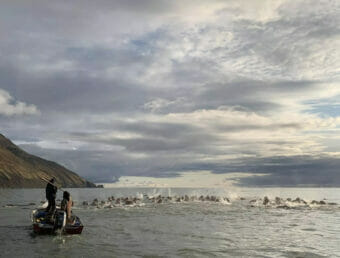
Three walruses in the water around Qayassiq. June 2022. (Izzy Ross/KDLG)

This story was made possible through a field reporting grant from the Institute for Journalism and Natural Resources.

After burying Marshall mother, friends and family ask why it took so long to find her

(Courtesy Of Kimberly Fitka O’Domin’s Family)

On Wednesday, Aug. 9, About 50 people gathered around a coffin centered in the living room floor of Kimberly Fitka O’Domin’s home in Marshall to welcome her home and say their goodbyes

Friends, family, and community members were finally able to bury her almost two months after she went missing from the village on June 15. Many are now asking why it took so long to find her in the first place. Her best friend, Jackie George, led the search to find her.

“Kimberly and I started our friendship when we were teenagers. We used to always go to teen dances and singing. There was times when we danced until three or four in the morning. We had so much fun,” George said. “Eskimo dancing brought us together. Later in life we became parents of our own kids, but our friendship still remained strong.”

The search

George has been leading Marshall’s search and rescue for more than 15 years and he is intimately familiar with the Yukon River. The night Fitka O’Domin disappeared, she told her mother someone had hit her and that she was going to break up a fight. She didn’t return, and her mother reported her missing on June 16. Somehow she ended up in the Yukon River.

“There were some scratch marks on top of the bank, which kind of indicated that we assume that’s where she went in. So we concentrated from her residence all the way down. At least two miles was our target area. And at the time, the river condition here was high water, the current flow is pretty fast,” George said.

(Francisco Matínezcuello/KYUK)

He coordinated with other villages. Even now he has a detailed memory of who did what, when.

“On June 18, [we had a] search and rescue meeting at 10 a.m.,” George said. “At 1 p.m., five boats from Marshall are utilizing drag bars and lead lines with hooks. That’s when the five Marshall boats went back out again to continue the search. At 3 p.m., two boats from Russian Mission, three boats from Pilot Station. At 5 p.m., three boats from Mountain Village join,” he said.

He also reached out to search and rescue in Bethel, where Fitka O’Domin lived for a time.

George said that search and rescue volunteers used boats equipped with fish finder sonar in the hope of finding her body.

“You start doing that figure eight, just back and forth going down the river slowly. That would detect more of what would be, say, the bodies in the river. They would detect it a lot faster using a figure eight grid. So they did that from below Kimberly’s residence all the way down to about 4 miles, 4 miles below Marshall,” George said.

These communities rallied without hesitation. George said that even the mining company Donlin Gold put together a Costco order for the search volunteers. Someone downriver brought up 200 dragging hooks; another sent money from Anchorage.

Troopers’ response

Alaska State Troopers did not send anyone to Marshall until five days after Fitka O’Domin went missing. Online and in private, family and friends have criticized the troopers for what they see as a lack of urgency.

Alaska State Trooper Capt. Andrew Merrill leads the C detachment, which covers Western Alaska. He said that they got a call about Fitka O’Domin’s disappearance on June 16 and started reaching out to village police officers and community members to find out what was happening.

“We did a lot of different things,” Merrill said. “We worked with the cell company to see if there was a way that we could try to locate her cell phone. And GCI, unfortunately, didn’t have the ability to do that. Their system wasn’t working. And so we did some of those investigative steps throughout the 16th.”

Merrill said that the village police officers also pulled video footage from the local stores to search for clues.

(Francisco Marínezcuello/KYUK)

Merrill said that troopers were told that this wasn’t the first time Fitka O’Domin had gone missing.

“That impacts kind of the immediacy of our response and how we’re going to do things,” Merrill said.

Two troopers from St. Mary’s arrived in Marshall on June 19 and spent the day talking to people.

Later, a couple not involved with the volunteer search efforts found her body about 100 miles downriver. 

Friction points

No one is saying that if the troopers had responded sooner, they think that Fitka O’Domin would still be alive today. But George wants accountability.

“We believe that if they had come earlier and properly investigated, this case would have been solved. There was some visible sign that there had been a struggle where her eyeglasses were found. We had also found handprints where someone had been dragged into the beach below her home. All that evidence was gone by the time the troopers arrived. The blood from an assault had pretty much dried up and washed away,” George said. “This was a neglect of duty on part of the Alaska State Troopers. We need answers.”

The trooper response time is not the only point of friction for the Marshall community. Fitka O’Domin’s mother, Elizabeth Fitka, attended the last Governor’s Council on Missing and Murdered Indigenous Persons meeting held in Anchorage on July 24. Trooper Merrill has been involved with that council since it started three years ago.

(Francisco Martínezcuello/KYUK)

Fitka told the council that troopers botched the investigation and she believes that the State Medical Examiner is culpable.

“I was the one that had to go through her contents. They gave me ah, they gave me a sealed muddy wet bag of her contents that were in her pocket. Maybe if they took a couple of seconds to wash those contents, they would have been able to find out that her phone can actually turn on,” Fitka said.

Fitka said that the State Medical Examiner’s Office is located near the Alaska Bureau of Investigations.

“Maybe if they were to took a couple of seconds to go over and ask for her contents. They would have been able to see her credit card that had her name on it. They had her keychain with her “Kim” on it, and then a phone that was in a muddy, wet, sealed bag when I washed it out and ran it to GCI and to Apple. Put it on the charger, it turned right on,” Fitka said.

What isn’t clear about this case is how it happened, who was responsible, and exactly why it took so long to get Alaska State Trooper resources mobilized when Fitka O’Domin was reported missing.

What is clear is that the Marshall community lost their tribal administrator, a woman who was revered in the community, and that Fitka O’Domin’s seven kids will grow up without their mother; the youngest is just two years old.

The family set up a GoFundMe account to help cover the cost of living for her children.

This remote Alaska island is home to hundreds of feral cattle. But should it be?

Cattle investigate some human visitors to Chirikof Island in 2022. (Shanna Baker/Hakai Magazine)

Alaska does not count cows as a native species, but on far-flung Chirikof Island, in the Kodiak Archipelago, feral cattle dominate the harsh landscape.

It’s a hard life out there for an unmanaged herd of roughly 2,000 cows, though, and some have wondered whether the island, trampled by hooves and sitting within the Alaska Maritime National Wildlife Refuge, should instead be returned to seabirds that could desperately use more habitat.

One of those people is Hakai Magazine writer and editor Jude Isabella, who wrote about what she called “The Republic of Cows” in a recent story. With an open mind, Isabella traveled the Chirikof last summer to see the cows for herself.

Listen:

The following transcript has been lightly edited for clarity.

Jude Isabella: I’m terrified of large herbivores. Cows and bulls and horses, and even llamas. I find them all a little bit terrifying and unpredictable. When I do things outside, I’m in British Columbia, and I’m worried about grizzly bears and black bears and cougars and that kind of thing. On Chirikof, when we first see these cattle, we see this one bull that keeps trotting closer and closer to us, and he’s quite large. You turn around, and there’s a herd running towards, I’m thinking, they’re running towards us. And you know, they’re pretty loud. At some point, and it really wasn’t that close, although my heart’s pounding, they turn 90 degrees and just go off somewhere else, and the bull joins them. And, of course, like, “Well, that wasn’t so bad, was it?” I guess not. But, you know, it was funny, because other people had mentioned, when they knew I was going there, some people bring a gun, because they can be very aggressive. And we did bring pepper spray. You know, I was carrying it, I was ready to use it. But we didn’t need it. We really didn’t.

Casey Grove: That’s interesting. It probably makes you feel better to have it, though, I imagine. Well, maybe we should back up: How did the cows get to Chirikof Island to begin with?

Jude Isabella: It’s hard to pinpoint an exact date and time that they came. But it’s most likely the Russians brought them. They were trying to establish colonies. So probably 200 years or so ago, they brought them, but then when they left in 1867, when the U.S. bought Alaska from the Russians, the Americans kind of inherited, you know, these introduced species.

Casey GroveBut I guess, you know, in the years that followed the Russians leaving those cows there, there was at least one attempt to kind of manage that herd. and that failed. And for many years they’ve just been, like, feral cattle out there. So why have they been allowed to stay? I mean, is it that people think they’re valuable still? It’s just too much of a problem to do something about them? What is that?

Jude Isabella: You know, at this point, I think it’s less contentious than it might have been starting like 20 years ago. I think people are starting to understand that a feral herd of cattle is not a healthy herd of cattle, with far too many bulls. If you have one bull, you know, he’ll inseminate the 30 cows around him, right? You don’t need that many bulls, and when you do have a lot of bulls, it’s a kind of an unpleasant cattle society, especially for cows, especially for young cows. And they’re domesticated animals, so they’re meant to be managed by humans.

Also, they live and die by how good the winter is, or how bad the winter is, and how much they have to eat. So the island was just covered with cow bones everywhere. You know, tibias and femurs, and scapulars and skulls and horns and teeth. And, you know, there was a lot of bones, I’m not sure I’ve seen that many bones in one place. So, I think I think the Alaskans I talked to kind of understood that. But why they’re still there, I think it goes back to maybe when Alaska Maritime (National Wildlife Refuge) first came about, in like the 1980s, and they had public consultations. But when it came to cattle, yeah, people got a little emotional. And so partly, I think it comes down to the fact that they didn’t want that top-down edict, or the what they saw as a top-down edict, but it wasn’t one. I think, also cattle ranching has a romance around it, and it’s got some kind of legacy. And the people who maybe speak the loudest care about that legacy a bit more.

Casey Grove: And you made this point in the story, too, that, for seabirds, that you you wouldn’t even see those at your bird feeder, it’s like a problem of people not seeing them and not understanding, maybe, their plight. And then here you have an island that is literally being trampled by cows that, if that grass was a little bit higher, it’d be better habitat for the birds, right?

Jude Isabella: Yeah, yeah, exactly. So I didn’t go into this thinking, “Wow, cattle are getting a free pass.” It really, really was an organic kind of result of being there, of researching, and talking to all sorts of people. Actually the first ornithologist I talked to, he thought of birds, seabirds, more broadly, seabirds and shorebirds, more broadly. One island like Chirikof isn’t necessarily going to make or break a population, but it’s death by a thousand cuts. And that’s what’s happening with seabirds and shorebirds around the world is we don’t see this massive range. Like we see it on a map, but we’re, you know, we’re talking thousands of kilometers. You can’t see us chipping away at that in a broad kind of way, right? It’s kind of tough. Some people think like in the last 200 years, seabird populations have declined by 90%. With what habitat they have left, why give it to another animal, a domesticated animal that really has absolutely no need for it?

An Alaska district aligns its school year with traditional subsistence harvests

Students from the Yupiit School District learn how to prepare freshly caught salmon. (MaryCait Dolan/KYUK)

Seventy miles inland from the Bering Sea, on roadless lands beside the Kuskokwim River, three Yup’ik villages are perfect examples of the educational challenges faced in Alaska.

Teacher turnover in the state runs 25% to 30% a year, and poor attendance and low test scores have been constant issues in many rural schools.

In the mid-1980s, the villages of Akiachak, Akiak and Tuluksak, broke away from a bigger district to form the Yupiit School District. They wanted to provide an education that more fully embraced traditional Yup’ik Native knowledge.

Salmon caught near Akiachak, Alaska is processed with an uluaq. June 23, 2023. (MaryCait Dolan/KYUK)
The Akiachak School in Akiachak, Alaska. June 23, 2023. (MaryCait Dolan/KYUK)

This year, the district was allowed to operate on an academic calendar that’s aligned with seasonal subsistence harvests. School leaders spent much of 2022 working to get it approved by the state.

It starts a week later than other districts in the state, and classes finish 10 days earlier. They make up the difference with an extra half hour of instruction each day.

Students can now take part in the fall moose hunt and the spring migratory bird harvest. The strategy is to pass along traditional knowledge that cannot be gained in the classroom, and attendance was already poor during seasonal harvests.

Students from the Yupiit School District go drift netting for salmon. June 23, 2023 in Akiachak, Alaska. (MaryCait Dolan/KYUK)

Summer culture camp

In the summer, Yupiit schools offer culture camp.

On an overcast day this June, teachers and elders meet students at a large cutting table near teacher housing near the river. Originally, the morning catch of salmon was supposed to be processed at a nearby community fish camp, but those plans were scrapped because a black bear was hanging around.

Literacy coach Evelyn Esmailka wields a large ulu as she explains the differences between chum, chinook, and sockeye salmon to the small group of children. After this lesson, the kids will board drift boats to go fishing for salmon on the river.

Barron Sample, principal of the Akiachak School, prepares to take students out drift netting. June 23, 2023 in Akiachak, Alaska. (MaryCait Dolan/KYUK)
Fish hangs to dry at a fish camp near Akiachak, Alaska. June 23, 2023. (MaryCait Dolan/KYUK)

“They’re getting ready to go out. This will be for the winter supply of fish, [to] supplement the lunch program,” Esmailka said.

After the fish are cleaned, they are loaded into the back of a beat-up truck to be dropped off at the school’s walk-in freezer. Salmon blood, to be returned back to the river, sloshes around in plastic totes as the truck lurches along Akiachak’s heavily potholed main drag.

Woody Woodgate, the school district’s federal programs director, said that staff favor indigenous foods in the district’s cafeterias.

“Not really taking anything away from the [United States Department of Agriculture] and the school lunch program, but most of that stuff that’s on those menus is designed for people in big cities, the lower 48, and a lot of it just goes into the trash can because kids don’t wanna eat the food,” Woodgate said. “So if we can supplement with fish and moose, and especially fish and moose that the kids catch.”

A student from the Akiachak School holds up a king salmon. June 23, 2023 in Akiachak, Alaska. (MaryCait Dolan/KYUK)

Taking part in the harvest

With the exception of sockeye, the salmon runs on the Kuskokwim River are crashing, and the day the kids were out was one of the limited opportunities to fish for them. As time ticked away on the 12-hour salmon fishing opener, the order of the day was making sure that every student gets a chance to take part in the harvest.

Barron Sample was in charge of the drift net fishing component of the summer culture camp. He is in his third year as principal at the Akiachak School.

Salmon caught near Akiachak, Alaska. June 23, 2023. (MaryCait Dolan/KYUK)
A fish camp near Akiachak, Alaska. June 23, 2023. (MaryCait Dolan/KYUK)

“For some of them, it’s the first time actually out here on the river doing this, and the first time they’re actually pulling a net,” Sample said.

The 24-foot boat is one of three owned by the school district.

“There’s three schools in our school district: Akiak, Tuluksak, and us, Akiachak. So, kind of in a little competition, like, ‘how many did you catch today?'” Sample said.

After a 150-foot gillnet was unfurled, the boat drifted slowly down the river. The children intently watched a line of buoys for signs of life.

Students from the Yupiit School District learn how to prepare freshly caught salmon. June 23, 2023 in Akiachak, Alaska. (MaryCait Dolan/KYUK)

“Fifteen more minutes and then we’re gonna reel it in,” a fourth-grader informs the crew.

While the first drift only yields two fish, the second brings in around a dozen: a mixture of reds, kings, and chums. The students scream in delight as the squirming salmon are picked from the net, landing with a thud in a plastic tote.

“I wanna fish again. This is actually a good spot to fish,” a fourth-grader chimes in.

Students from the Yupiit School District go drift netting for salmon. June 23, 2023 in Akiachak, Alaska.

After two drifts, there are plenty of fish to be processed and stored at the school for the coming winter. All the kids can talk about is going out again.

During the narrow window when fishing was allowed, the village of Akiachak felt like a ghost town. But along the river, the fish camps buzzed with activity as families processed the day’s harvest in a way that has changed little over the centuries.

From schooner to salmon tender, the Aleutian Express sails on 100 years of history

The Aleutian Express in Chignik after the 2015 salmon season. (Courtesy of John Clutter)

This summer, an unusual looking salmon tender is anchored in the Naknek-Kvichak District. The Aleutian Express is a historic, three–masted schooner that came sailing up from Washington State for the Bristol Bay sockeye season. With three masts and filled sails, this iconic vessel has been instrumental in many chapters of Alaskan history.

Owner John Clutter first laid eyes on the boat in Chignik waters in 1993. He’s captained the vessel across Alaska and the Pacific Northwest for the last eighteen years, and he says it’s become recognizable in many ports and across many generations.

So this guy was standing there looking up to the boat.” Clutter said. “He had a son with him about 10 years old, and he pointed up to the boat. He said, ‘That’s the coolest boat in Alaska. My dad told me that and his dad told him that.’”

The Aleutian Express was originally built in 1912 as a fire boat for the city of Portland, Oregon. There, the vessel started out under a different name: the David Campbell, in honor of the City’s late fire chief.

The keel was actually probably laid right about the time of the Titanic sinking,” he said. “And it was commissioned a year before that. But they actually started building in 1912 and it was fully operational then for the City of Portland sometime in late May that it actually got underway as a fireboat.”

Clutter says in 1912, the boat’s history started off with a bang.

The first operation, I guess they couldn’t get the boat out of gear and they crashed into the bridge. And I think that dent is still in the bow,” Clutter said.

A postcard depicting the original vessel, then named the David Campbell. (Courtesy of John Clutter)

Over the last hundred years, the ship has had many different names and lived many different lives. It’s been a fur trading boat in the Aleutian Islands, an oil tanker in WWII, a tow boat on the Columbia River, and a crabbing boat in the Bering Sea. Most recently, Clutter has captained the Aleutian Express as a salmon tender in Bristol Bay.

Since 2004, Clutter has retrofitted the 125 foot historic boat to bear resemblance to the ship’s rigging in the 1920s.

The boat, it had a couple of douglas fir masts where they cut them off to give them more of a tow boat look. And so it did have masts on it up until the early 1970s. And then I just decided to put the masts back but I made these out of galvanized pilings,” he said.

He says on long voyages, he’ll set a jib sail in addition to using the engines.

That jib alone would move the boat at three knots, just one big jib dragging the props. So it’s actually pretty efficient,” Clutter said. “And now that I have a mizzen boom built, I do believe it’ll make five to seven knots under the right conditions.”

He says sails not only help with speed, but cut down significantly on fuel use and carbon emissions. On one voyage from Alaska to Washington, Clutter calculated just how much.

I crossed the Gulf, took it down to Port Orchard, Washington and made it in a week and I pretty much ran on one of the engines and sails. And I figured I’d saved about 1500 gallons of fuel on that one week run,” he said.

Clutter says the challenges of owning and operating a historic vessel are extensive, but with his restorations, he hopes the Aleutian Express will be a working boat for generations to come.

It’s a great sea boat, I mean, this is an incredibly smooth ride. They just don’t build it like this anymore,” Clutter said. “I kind of see myself as a curator. With the work I’ve done in the last 18 years on this boat. It’s good for another 50.”

This season, the Aleutian Express is anchored at the Y on the Naknek River, working as a tender bringing loads of sockeye salmon from the water to Naknek’s docks. So keep your eyes peeled on the water this summer, for a 3-masted schooner coming around a bluff—a living piece of Alaskan history.

Marshall’s tribal president speaks on the cultural toll of the Yukon River salmon crash

Christian Mulipola reaches for king salmon strips his grandmother, Diane Ishnook, has hung up to dry. Her king salmon were caught far downriver from Koliganek. (Photo by Avery Lill/KDLG)
Christian Mulipola reaches for king salmon strips his grandmother, Diane Ishnook, has hung up to dry. (Avery Lill/KDLG)

Salmon runs on the Yukon River have been dwindling for years. And the loss of commercial and subsistence fishing has hit communities hard. KYUK sat down with Tribal President Nick Andrew Jr. of Marshall on Aug. 9 to talk about what the salmon crash means for people who have relied on the fish since time immemorial.

Andrew has fished for salmon commercially and for subsistence since he was five. He spoke about the emotional and cultural toll that the salmon crisis has taken on his community.

Listen:

This interview has been edited for clarity and length.

Nick Andrew Jr.: My name is Nick Andrew Jr. I am a tribal citizen of Marshall. I am also the tribal president, but what I have to say is not necessarily a statement on behalf of the tribe.

I’m from Marshall, born and raised. I’ve been part of the salmon fishery, the commercial and subsistence, since I was five years old. I helped my family, my grandparents, my uncles, my aunts, my nieces, my cousins, we all worked together in the past. And yes, salmon does define who I am. It does define my ancestors, my family, my relatives, everyone on the river.

Nick Andrew Jr., Native Village of Marshall Tribal President. (Dean Swope/KYUK)

We’ve been in conservation mode for king salmon for about 40 years. And that’s a long time. I’ve seen the years of plenty. I’ve seen the years of scarcity, and it’s a political issue now.

Loss of salmon hit us really hard on the cultural side. There went our connection to the ancestors. We also lost that family connection. Because a lot of people went fishing and processing, they involve the family. And the last four years have been hard, especially the years we were in strict conservation mode. It was felt in the community and the region on the lower Yukon River. We had a sense of helplessness.

Basically, not knowing was the biggest thing. We thought that the salmon were going extinct, that was one of the thoughts. And we also had a sense of despair. We didn’t have salmon, dried salmon, smoked salmon, salmon strips, salmon dry-fish, king salmon, salted fish, and salmon for the freezer, for the winter. That took a big emotional toll on our people.

Our subsistence rights are not negotiable. We only take a small fraction of any of the runs that pass the river. And it’s not too hard to ask that more be done for the salmon. Because if nothing’s done, within 50 years we’re gonna be on the endangered list, probably extinction at the rate things are going. So we just need a voice at the table, especially on the North Pacific Fishery Management Council. Our input is important. Our traditional knowledge is important. And we, the Native peoples along the river on shore, we matter too. That needs to be kept in mind.

Francisco Martínezcuello: How has this year’s run been?

Nick Andrew Jr.: Well, when we look at the run we get information from the Alaska Department of Fish and Game on their Facebook page and the faxes we’re getting to the tribe, and they’re showing lower and lower numbers. That’s very concerning. And on a different note, we were allowed to harvest the summer chum. And that really helped a lot of people. And that put reassurance that hey, we do matter. Hey, we’ll have salmon for the winter, even though it’s not the king salmon we’ve desperately been wanting for years. So that’s where we are.

Francisco Martínezcuello: What about your memories as a kid fishing around here, to give people like me who are complete outsiders an understanding of how things used to be, especially for your people, your family?

Nick Andrew Jr.: Growing up was a different time. We had plenty of fish: king salmon, summer, fall chum, and the silvers. The village would empty. Families went to fish camp during those years. Everyone was happy. The dogs that were needed for our transportation and subsistence activities back in the day were fed, they relied on salmon too. All the bears, the birds, meaning the eagles and falcons, seagulls, they were happy too, and the world was complete then. So, on any given day, dried salmon, salted salmon were eaten three or four times a day.

Nowadays, as the salmon started to dwindle, people had to find other species. But still that left the void, the void meaning a big part of our staple was gone. And it’s still, the puzzle isn’t complete today because we got all these factors, and that affected our culture, our physiological and our mental well-being as well. You know it does weigh heavily on our minds, and our very DNA are in tune with salmon as our diet, our identity, our culture. So as the salmon continue to dwindle, that’s impacting just about everyone in our region and on the lower Yukon River because it was the common denominator that made us whole.

KYUK’s Evan Erickson helped with this story.

Site notifications
Update notification options
Subscribe to notifications