Southwest

Thousands respond to Karluk’s viral ad for cost-free living

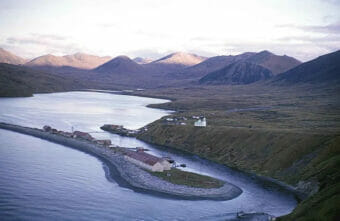
Karluk Spit and village of Karluk. (U.S. Fish and Wildlife Service)

Fishing, camping, kayaking, and a year of all-expenses-paid living: those are some of the promises that the Karluk Tribal Council made in an advertisement that went viral this month.

The community is looking to pay two families with four children each to move to the village in an effort to get state funding and re-establish a school.

Within a week, between four and five thousand people responded to the poster. Kathryn Reft is the Karluk Tribal Council’s secretary and treasurer. She said they never could have anticipated the response.

“We just figured we tried to do something like this just to see if we get any kind of attention,” she said. “We never knew it was gonna blow up to be this huge!”

The Native Village of Karluk is on the southwest end of Kodiak Island. The village has just 37 year-round residents. There’s two children there now, but villages need at least 10 students in order for the state to fund a school. That’s why the Tribe is looking for two families with four children each to move there.

Reft said the remote village has been looking to grow for a while now.

“We had our feelers out there,” she said. “We tried going through agencies and we just couldn’t find any interest and then somebody brought up ‘Why don’t we get a poster out there?’ and that’s what we did.”

The Tribe has heard from families across the country as far as Florida and even internationally from Canada and the Philippines about its ad.

“Our main focus right now is to have the 10 students here in Karluk,” she said.

Karluk’s school closed back in 2018 due to low enrollment and continued to dwindle since.

The Kodiak Island Borough has kept maintaining the former school building by paying for its heat and electricity. Borough staff recently visited the building to assess its condition, and with minor maintenance, it could reopen and host classes again.

In order to get more students, the Tribe is willing to pay housing, utilities, moving expenses, and even a food stipend for a full year. For the right family, they’ll also train them for jobs to become a more permanent fixture in the community.

Cyndy Mika is the Kodiak Island Borough School District superintendent. She said the district was caught off-guard by the poster but is open to helping the village.

“If they make those 10 students, we’ll have to do something,” Mika said. “But at this point, it’s going to be very difficult staffing at this late of a date and it’s not part of this budget at all.”

The school district struggled to fill rural positions last year, and faced huge budget cuts last month.

Mika said she understands the struggle Karluk is facing without a school.

“I know that the villages need schools and that the schools are what makes them be able to grow in population,” she said. “It’s really hard to grow if you don’t have a school for your students or your children out there.”

The clock is ticking, though. The state counts student populations for schools in October. Reft, the Tribe’s secretary and treasurer, said they hope to bring new families soon.

“We’re going to try to get families here before the end of August, before the school year, have them settled in their house, and ready for school,” she said.

The Tribal Council will start looking over applications next week.

Bethel, a place where cars come to die, will host its first auto show

Bethel, in western Alaska off the U.S. road system, is sometimes called “where cars come to die.” (Sunni Bean/KYUK)

Without links to the U.S. road system, it takes longer for cars to find their way to the Yukon-Kuskokwim Delta. Cars are shipped in on the barges or, for a higher price, flown in.

Although there are new models around, the region tends to rely on used cars, and it’s common to see retro cars and trucks parked in lots with broken windows. With icy conditions followed by pothole-ridden gravel roads, some call it “where cars come to die.”

But car lovers and fixer-uppers see something else: a unique hodgepodge of vehicles. Seeing a Tesla or the latest truck brings an extra delight.

This year, Alaska State Trooper Zack Huckstep decided that he wanted to bring together Bethel’s unique collection of vehicles. He has organized Bethel’s first auto show to take place in July.

From noon to 2 p.m. on Saturday, July 22, Bethel will host its first auto show: the Tundra Motor Show, Huckstep’s brainchild. He hopes to showcase between 10 and 20 cars.

“We’re looking for anybody to come out, enjoy the show. Learn a little bit about vehicles, all makes and models,” Huckstep said. “All are welcome to come and get people like-minded, interested in both old and new cars.”

Huckstep hopes that the event will also put local car lovers in touch, create a network for people to learn about the process of rebuilding and renovating cars, and build a community to reach out to when they’re looking for help, expertise, or tools to make the most of what they have.

“I’m hoping that it sparks some interest in the community, not only for vehicle maintenance and getting some of some of the really cool old vehicles I’ve seen in people’s yards or stuck in the woods,” he said. “Maybe some people can get interest, develop some knowledge, and link up with people that know how to do this stuff. Because they’re normally excited about once you put all the elbow grease into putting all the effort into a vehicle.”

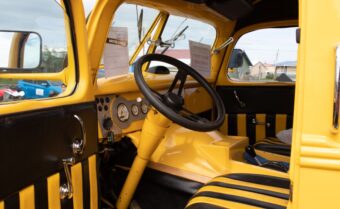
Huckstep doesn’t really know which cars to expect, but he anticipates an Italian sports car, a yellow 1940s truck, an International Scout, and various cars, Jeeps and trucks from the ’40s, ’70s, and ’80s.

Huckstep has his own 1971 vehicle: a long-bed Toyota flatbed truck, commonly known as a “ute.”

“I’m the one that drives around the big brown truck with no doors on it.” Huckstep said.

A local church donated their black food truck for the day. Staff at the NAPA Auto Parts store have volunteered their parking lot for the show, where people can vote for various categories such as Kids’ Choice and Best Truck.

“Sometimes it’s pretty fun to go show it off,” Huckstep said. “So at the end of this, my vision would be to have all the vehicles be able to drive up and down the highway. Not necessarily a parade, but to be able to cruise up and down the highway with all the old vehicles.”

Huckstep’s not quite sure how the event will go, who will show up, or who won’t. He can imagine it may just be him in a parking lot, or it might be packed. He’s excited to find out.

If Huckstep can win anything, he hopes it’s for best truck or best four-wheeler. Maybe somebody will even have a pair of doors for a 1971 Toyota long-bed.

Dunleavy again vetoes research project on salmon bycatch

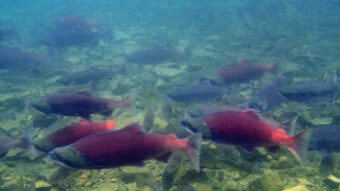
Chum salmon migration. (USFWS/Togiak National Wildlife Refuge)

Among the projects Gov. Mike Dunleavy vetoed from the state budget on Monday was salmon research to help determine the causes of the chinook and chum crisis in western Alaska.

Dunleavy vetoed $513,000 for research on the origins of salmon caught by accident in the Bering Sea pollock fishery, as well as the origin of salmon intercepted by fishermen off the Alaska Peninsula in what’s known as “Area M.” Dunleavy vetoed the project last year, too.

“You never know what’s going to come of these budgets. But this is quite a disappointment, again,” said Karen Gillis, program director of the Bering Sea Fishermen’s Association. The association was to receive the money and pass it on to a partnership of federal and university scientists.

The veto documentation said the funding was cut to save money. Dunleavy spokesman Jeff Turner added that the Alaska Department of Fish and Game did not believe the study would meet its objectives and that $100,000 would have gone to the University of Washington for overhead.

The research results would have policy implications, and could fuel the fury already burning in communities on the Yukon and Kuskokwim rivers. For the fourth season in a row, subsistence salmon fishermen in the region are shut down or severely restricted. Chinook and chum are returning to those rivers in numbers so low that there’s barely enough to meet escapement targets for spawning. Meanwhile, thousands of chinook and chum are caught every season in the Bering Sea and Area M fisheries.

Prior research has shown that only a portion of that salmon bycatch was destined for western Alaska rivers, with many of the fish originating from Asia. Gillis said more research is needed to aid management decisions.

“The genetic work that’s been done to date lump the Norton Sound, Yukon, Kuskokwim and Bristol Bay stocks into something called ‘coastal western Alaska,’” she said. “And so what this work does is studies from otoliths of adult salmon to determine their geographic location or their birthplace, basically.”

Otoliths, or ear bones, of salmon bear the chemical fingerprint of the freshwater the fish has swum through, allowing scientists to determine not just which side of the Pacific the fish originated, but which river system.

Gillis said last year’s veto halted the project, but there may be another source for the funding.

The governor’s office referred questions about the veto to the Department of Fish & Game, which did not respond in time to be included in this story.

Kodiak Filipino American Association brings back in-person celebration for Filipino Independence Day

After Mass, community members and attendees gathered for a group photo in front of the altar, June 11, 2023. (Brian Venua/KMXT)

This week marks the 125th anniversary of the Philippines’ Declaration of Independence. That was when the island nation officially began a revolution from its colonizers.

Festivities take place across the country each year, and this year, celebrations even took place in Kodiak.

St. Mary’s Parish, Kodiak’s Catholic church, dedicated a Mass to the archipelago’s Filipino community on Sunday. After Mass, a celebration was held in the church’s community center across the parking lot.

Some helped serve food as they talked with friends, June 11, 2023. (Brian Venua/KMXT)

“The first time that the Philippine flag was raised was in Kawit, Cavite by the late president (and) general, Emilio Aguinaldo,” he said. “That’s the first time that we as the Filipino [sic], we are free from bondage, we are freed from slavery. ” This is one of the first events Kodiak Filipino American Association has had in a while. Mark Anthony Vizcocho is the association’s president. The United States didn’t officially recognize the Philippines until after World War II, but Vizcocho said most Filipinos recognize the original declaration from June 12,1898.

Some folks even wore traditional Filipino formal clothes for Sunday’s celebration in Kodiak.

Barong tagalogs are usually worn by men and look kind of like a western button up shirt. Filipinianas are usually worn by women and can look like a short jacket or similar to a shawl. Both are usually white or off-white and transparent, but worn with a similar color shirt or dress underneath. They’re traditionally made from pineapple fibers, and adorned with patterns near the collar and chest areas.

Vizcocho said he wants to hold more events like this to bring together the Filipino community and spread awareness about the association’s efforts.

“Let’s bring this back online so that everyone can see that we are here,” he said. “We are proud of who we are and we want to share that celebration with everybody in the community, so this is just a start on just giving back to the community.”

City Mayor Pat Branson also attended the celebration. The Kodiak City Council proclaimed June as Filipino Heritage Month at its meeting last week in honor of the independence day. She said it’s important to acknowledge the historic presence of Filipinos on the island and the impact they’ve had over the years.The small room was lined with tables filled with foods like pancit, a rice noodle dish with chicken and vegetables, and kaldereta which is like a stew. There were also desserts like puto, a steamed rice cake. The room was filled to the brim and attendees spoke both in English and Tagalog, the main dialect of the Philippines.

Four women, just outside the filled room, June 11, 2023. (Brian Venua/KMXT)

Vizcocho said they hope to host a basketball or volleyball tournament next year as well to get more young people involved. “(The) Filipino Community’s been here since the 1800s, a major part of our community, volunteering, working hard,” said Branson. “And celebrating – The FilAm Association knows how to celebrate with great food and laughter – you can hear that going on inside! So, it’s joyous day.”

“Anything that we try to do to get the youth involved,” he said. “That’s one of our main projects, towards the youth.”

The Kodiak Island Borough Assembly will also proclaim June as Filipino Heritage Month in their meeting on Thursday. Vizcocho says this past weekend’s festivities are just the beginning, and is already planning to host more events soon.

Pebble Mine company to pay shareholders who claim they were duped

Spawning Bristol Bay sockeye salmon, with their distinctive red bodies and green heads, swim in the waters of Lake Clark National Park and Preserve in 2003. Potential effects on Bristol Bay’s bountiful salmon runs have been at the heart of opposition to the Pebble Mine, and the Environmental Protection Agency in January invoked a rarely used provision of the Clean Water Act to bar Pebble’s permitting. Some investors in 2020 sued parent company Northern Dynasty Minerals Ltd., claiming that corporate leaders misled them about the project and its environmental effects. The parties have reached a settlement totaling nearly $6.4 million. (Photo by D. Young/National Park Service)

The company behind the controversial Pebble Mine in Southwest Alaska has agreed to pay nearly $6.4 million to a group of shareholders who claim they were misled by corporate leaders.

Vancouver-based Northern Dynasty Minerals Ltd. reached the settlement with the named plaintiffs, according to documents filed last week in the U.S. District Court for the Eastern District of New York.

The settlement is the product of two lawsuits, later consolidated, alleging that Northern Dynasty and the Pebble Limited Partnership had defrauded investors through false and misleading statements. Northern Dynasty is the sole owner of the Pebble Limited Partnership.

The court filings name only a few individual investors, but the lawsuit has become a class-action claim with “likely hundreds, if not thousands of potential Settlement Class Members” to share in the payment, said the settlement memorandum filed on Wednesday. If the court approves the agreement and certifies the class, others who owned Northern Dynasty securities between Dec. 21, 2017 and Nov. 25, 2020 could be eligible for payment from the settlement total, according to the memorandum.

At issue were revelations in recorded conversations released in 2020 that became known as the Pebble Tapes. In those conversations, which were recorded by an environmental organization working undercover, Northern Dynasty Chief Executive Officer Ron Thiessen and Tom Collier, then the Pebble Limited Partnership CEO, described a strategy of getting a relatively small mine plan through the permitting process and following up with a massive expansion. Additionally, the two men touted political connections that they said would ease permitting.

“When the truth emerged through a series of corrective disclosures and materializations of risks that the Pebble Project would not receive a permit, Northern Dynasty’s stock went into a tailspin, wiping out hundreds of millions of dollars in market capitalization and injuring hundreds of thousands of investors,” said the amended complaint filed in 2021 in the consolidated case.

The mine, targeting copper primarily, appears to be administratively blocked; the Environmental Protection Agency in January invoked a rarely used Clean Water Act provision that precludes permitting of the Pebble Mine or any similar mine in the specific sites targeted for development.

EPA said the Pebble Mine would have “unacceptable adverse effects” on salmon habitat in the Bristol Bay region, site of the world’s largest sockeye salmon runs, and the people and ecosystem dependent on that habitat.

A sticker expressing opposition to the Pebble Mine is seen on a coffee shop window in Kodiak on Oct. 3, 2023. Opposition to the mine has been widespread in Alaska’s fishing communities for several years. (Photo by Yereth Rosen/Alaska Beacon)

Northern Dynasty, however, continues to pursue the Pebble project and is gathering information to present to the U.S. Army Corp of Engineers to support issuance of a critical permit to develop that wetlands area. The Corps denied Pebble’s permit in 2020, but in April its reviewing officers ordered a reconsideration of that decision.

In a statement sent to the Alaska Beacon on Monday, a Northern Dynasty official said the company disclosed some information about the settlement in recent financial reports and that the settlement “does not contain any admission of liability.”

“To the contrary, Northern Dynasty firmly believes that the notion of a ‘secret mine plan’ is baseless and the company denies any wrongdoing alleged by the plaintiffs. The Company is confident that it would have prevailed at trial on the merits, when the full context and facts underlying the permitting process would show the allegations to be without merit. Nonetheless, this settlement brings to an end what would have been a costly and protracted legal process, with the settlement amount representing a fraction of the expected costs of litigation to bring this case to verdict,” said the statement, from Mike Westerlund, vice president of investor relations.

Since the total is within the company’s insurance policy limits, Northern Dynasty “does not anticipate corporate funds will be used to fund the settlement,” the statement said.

According to its financial report for the first quarter of 2023, Northern Dynasty has CA$139.5 million in total assets, of which CA$127.2 million was in the company’s mineral property, plant and equipment.

The Bristol Bay Defense Fund, a coalition of community, nonprofit, Indigenous and business organizations opposed to the Pebble Mine, said the settlement “demonstrates yet again how untrustworthy Northern Dynasty Minerals is and always will be.”

“Not only did they mislead investors, they lied to the people of Bristol Bay, and since they aren’t using any corporate funds for this settlement, the Biden administration should order them to remediate the parts of the watershed they damaged and left behind polluted for the community to clean up,” the Bristol Bay Defense Fund statement said.

The Bristol Bay Defense Fund and similar organizations are calling for watershed protections that go beyond the EPA’s action. “Our elected officials must recognize the duplicity of Northern Dynasty and the recklessness of their project, and pass watershed-wide protections to protect all of Bristol Bay, our salmon and our way of life, forever,” the statement said.

This story originally appeared in the Alaska Beacon and is republished here with permission.

Crooked Creek struggles to rebuild after historic breakup flooding

An aerial view of Crooked Creek along the Kuskokwim River. (Kyle Van Perseum/Alaska-Pacific Forecast Center)

As the fishing season on the Kuskokwim River kicks off, many communities are still reeling from the effects of spring breakup flooding.

This is especially true in the upper Kuskokwim community of Crooked Creek, where in mid-May residents found themselves on the wrong side of a 15-mile-long ice jam that inundated homes, led to a significant loss of stored food, and washed away critical fishing gear. For now, Crooked Creek villagers still have a long way to go to get back on their feet.

Located about 200 miles up the Kuskokwim River from Bethel, Crooked Creek is no stranger to severe breakup flooding. In 2011, the village of fewer than 100 people saw what was characterized as a 100-year flood: so severe that it only had a 1% chance of occurring in any given year.

This year’s flooding was even worse, according to Alaska-Pacific River Forecast Center meteorologist Mike Ottenweller.

“We estimate that the flood exceeded the 2011 floods by approximately 4 to 5 feet,” Ottenweller said.

Residents only had about 18 hours to brace for the deluge.

“That rise, 16 feet, actually happened pretty much from Saturday afternoon into Sunday morning,” Ottenweller said. “Because of the conditions with the ice, and also the colder than normal temperatures and the higher than normal snowpack through the spring, all those things came together to create this pretty significant, potentially historic event.”

Amid a state natural disaster declaration, an alphabet soup of organizations came to the aid of the community including the American Red Cross, Alaska Organized Militia, Salvation Army, Samaritan’s Purse, Association of Village Council Presidents (AVCP), and Donlin Gold.

While on-site responders have largely departed, the state will continue to coordinate efforts to rebuild Crooked Creek throughout the summer. Severe damage and power outages have cost the village a large percentage of its stored subsistence foods.

“We’ve been providing a lot of shelf-stable foods to people, but those aren’t the traditional foods that people in that area prefer,” Jeremy Zidek, a spokesperson with the Alaska Division of Homeland Security and Emergency Management, said. “And we understand that it’s a hardship that they can’t eat these foods that they gathered themselves from their area.”

Crooked Creek Tribal President Julia Zaukar has been working around the clock to address the community’s needs.

“The gentlemen who didn’t lose any boats, before the beaver season ended they went out and did beaver hunting so they could supply the food for the shelter. And the families who were on higher ground donated moose meat and fish, but that is all running low now,” Zaukar said. “And so we’re trying to make good with what we have. We’re doing okay, but it’s just very, very stressful.”

Zaukar said that the flood had washed away much of the community’s fishing gear, including boats, dip nets, and three fish wheels. She called into a recent Kuskokwim River salmon management meeting to plead with state fisheries managers to immediately open the river to driftnet fishing to replenish community food stores. This came during a five-day period known as a front-end closure intended to protect king and chum salmon stocks. But Zaukar said that she couldn’t see the justification.

“For us to be closed right now it’s very hard because we need the fish more now to help feed the community and the sheefish and the white fish are there. There’s no salmon this far up,” Zaukar said. “And we would be able to use that fish for the main course of the meals instead of having to try and gather food from, like, Anchorage, you know, different organizations that are helping us.”

Zaukar praised the help coming from around the state to Crooked Creek, but said that she was hopeful that a federal disaster declaration would come and bring additional support.

“Families are living in the school gym. Thank goodness for the Kuspuk School District for allowing us to use it as a shelter feeding station,” Zaukar said. “And we do have three tents set up right now. We’re waiting for AVCP to send more tents because families are living with families. And, you know, that’s pretty rough right now. Thank goodness we did not lose anybody to the flood.”

As Crooked Creek rebuilds, severely affected communities over on the Yukon River are doing the same. According to Zidek there has been no shortage of challenges offered up by Mother Nature.

“We’ve had a very busy couple years. In 2022 we had 14 state-declared disasters and six federal,” Zidek said. “If we look back to 1978 we average about five disasters per year. So 14 is really a big bump for us.”

Site notifications
Update notification options
Subscribe to notifications