Southwest

Hooper Bay residents weigh in on fishing closures: ‘It’s like taking away food from our table’

(Francisco Martínezcuello/KYUK)

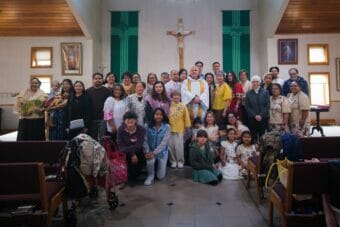
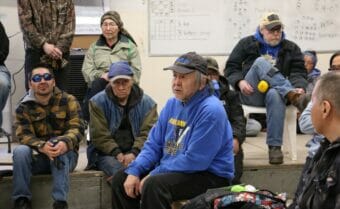
Inside Hooper Bay’s brown tribal council building, nearly 50 people gathered to hear more from state officials on why they decided to close chinook salmon fishing in the coastal area from the Naskanat Peninsula up to Point Romanof. That closure includes Hooper Bay, Scammon Bay, Chevak, Emmonak, Kotlik, Nunam Iqua and Alakanuk.

State biologists said that the closure is intended to protect chinook salmon while they migrate upriver to spawn in Alaska and Canada. But most in the crowd were subsistence fishermen and fishing means survival.

“It’s like taking away food from our table,” said one person who testified.

Alaska Wildlife Trooper Sergeant Walter Blajeski arranged the meeting. He said that he wanted to give the community an opportunity to ask questions they might have on both fishing opportunities and restrictions.

“And, you know, I think the meeting was a success. Our goal was just that: to be available to answer questions and to provide maybe some explanation as to why restrictions were going to be occurring. And I think we accomplished that,” Blajeski said.

Non-salmon fishing will still be permitted during the closures, but with restrictions. Gillnets will be limited to 4-inch or smaller mesh and 60 feet or less in length. These nets must be operated as a setnet and should be set near shore.

Blajeski said that troopers can’t always enforce these regulations; they do it when weather and time permits.

“We don’t often get to the coastal villages. But when we do, we usually go there, you know, for the day. And those types of enforcement patrols are usually conducted, you know, onshore in the village, walking around the village because we just don’t have the resources to get out there,” Blajeski said.

Blajeski warned that anyone caught violating the regulations will be fined up to $500, though there is wiggle room.

“What we’ve seen over the last couple years, for people that don’t have a history of violations, is a about $300 fine. We don’t recommend to the court that we forfeit any fishing gear that would otherwise be legal,” Blajeski said.

Blajeski said that the troopers don’t normally seize the fish either.

“And if we do seize fish, we would donate those fish to qualified charities such as Elders or people in need in the region,” Blajeski said.

Deena Jallen, an Alaska Department of Fish and Game biologist and the Yukon River summer season manager, traveled to Hooper Bay for the meeting. She said that residents asked a lot of questions about commercial fishing in other areas of Alaska that may catch the same fish subsistence users are supposed to avoid.

In her role as the Yukon River summer season manager, she said that she often fields the same questions from all over the region.

“We often get questions and [statements] about Area M and the pollock fleet. We hear that a lot at every meeting that we come to,” Jallen said.

What makes Hooper Bay different from others is that it is a coastal community.

“In previous years, the coastal area has not been closed. They’ve had restrictions to 6-inch mesh, but they’ve typically been left open. They do catch some kings and summer chum as they migrate up along the coast of the Yukon River. So unfortunately, when there’s no harvestable surplus, we do feel the need to close that district as well to hopefully reduce the harvest of king salmon as they travel up along the coast,” Jallen said.

Jallen said that she was happy to see the turnout as well as the level of participation.

“It’s very understandable that people are very frustrated with the salmon and with the management actions in recent years,” Jallen said.

Jallen said that the salmon in Hooper Bay are either bound for the Yukon River, where runs have been very low in recent years, or they could be headed to other streams either along the coast or in other areas of the state.

She also has concerns for king salmon runs across Western Alaska and particularly in the Yukon River area. Jallen said that the region didn’t meet any of the escapement goals for king salmon last year.

“So any king salmon that’s coming back either to the Yukon River or to a nearby spawning stream is likely to have a pretty low abundance this year, and so we’re concerned for all of them. So even if that fish isn’t specifically Yukon-bound, we haven’t really seen anything that says, like, oh, well, this river is doing better or the stream is doing better,” Jallen said.

Fisheries managers said that they could loosen restrictions if the run is stronger than they’re projecting, but right now Jallen said that every district of the Yukon is going to be closed to king salmon fishing. Based on salmon run timing, those closures will work their way up through the entire Yukon area through all the districts and all the tributaries.

“I think just the main takeaway is that we know these management actions are very, very intensively managing subsistence. And we know it’s incredibly frustrating. But we’re only taking these actions because the runs are so low that there’s no fish available for harvestable surplus,” Jallen said.   

The frustration was palpable.

“You know, they wanted to ask questions, but a lot of the community members that were attending, after the meeting thought that, you know, they really didn’t get any answers,” said Native Village of Hooper Bay Tribal Administrator Jan Olson.

Community members said that they need access to their subsistence foods.

“We don’t do any commercial fishing, you know, we don’t even go up to the Yukon or Black River to do any type of commercial fishing. All we do is stick around here and do subsistence fishing,” Olson said.

Olson said that there’s still confusion as to why they are being regulated. They need to fish to survive.

“We’re not in it for the money. We are in it to put fish in our freezers for future use. And, you know, that’s a big part of our diet there. You know, that’s one thing that we missed,” Olson said.

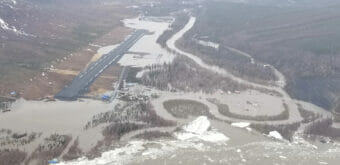
Remnants of Typhoon Merbook, which happened in fall 2022, caused major flooding in Hooper Bay. Families were displaced, homes were lost, people’s stores of salmon and other subsistence foods were destroyed. The community relied on state assistance as well as donations of fish.

“You know, we’re not bad people, you know, we just want to fish and, you know, it’s just, we want the fish that we’re accustomed to,” Olson said.

Olson, along with several other members of the community, said that these restrictions will make winter more challenging as many residents don’t make enough money to buy more groceries.

Salmon are disappearing on the Yukon and Kuskokwim. Here’s what to know about the crisis this summer.

A fisherman pulls a chum out of the Yukon with a Kenai-style dip net. Sometimes nontraditional gear types are permitted to allow for the exclusion of chinook. (Kyle Clayton/KYUK)

People on the Yukon and Kuskokwim rivers are expecting another dismal year for harvesting salmon, the food that used to fill their smokehouses and freezers. It’s a disaster that repeats annually, felt acutely in the region and accepted elsewhere as the new, bad normal.

Here’s a primer on the Y-K Delta salmon crisis and how this year is shaping up.

Which salmon are affected?

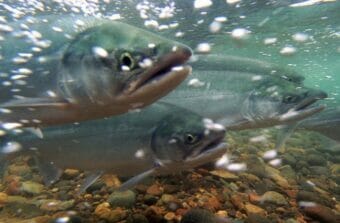
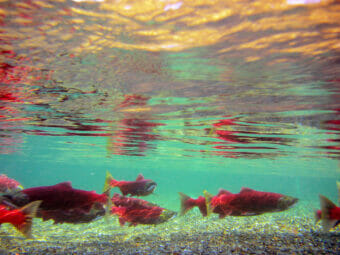
Chinook (king) and chum are the major salmon species on the Yukon and Kuskokwim. They’ve been at historically low numbers in both rivers for years. The coho (silver) returns have also dropped.

How long has this been happening?

This will be the fourth year subsistence fishing has been closed or severely restricted on both rivers.

For the past three years, the Yukon hasn’t seen sufficient numbers of chinook even to meet the top priority – allowing enough salmon to escape up the river to spawn. Most escapement goals for Yukon chum and coho weren’t met either.

But the problem goes back farther than that. The Yukon chinook subsistence harvest has been below the level of need since 2008. Chum dropped significantly in 2017 and haven’t bounced back.

On the Kuskokwim, the picture is only slightly better. The chinook crash there was underway by 2009 and continues. Chum have also collapsed to record low numbers. In 2021, the Kuskokwim saw an 84% decline in chum compared to just a few years prior, with only a slight rebound last year. And coho have been sparse for the past three years.

Are people still fishing there? 

The rivers used to support commercial salmon fisheries. On the Yukon, there’s been no commercial chinook fishery since 2007. Commercial chum opportunities have been spotty.

And now subsistence – harvesting for food, rather than money or sport – is severely restricted, too.

Yukon subsistence fishermen haven’t been allowed to target salmon for two years, with only limited numbers coming from test fisheries or in subsistence nets intended to catch fish other than salmon.

On the Kuskokwim, subsistence fishing for chinook has been severely restricted. Last year, for the eighth year in a row, the harvest was less than half of what the state considers adequate to meet the need. State, federal and tribal fishery managers credit residents for sacrificing their historically normal chinook catch to meet escapement goals.

The Kuskokwim chum harvest has also been well below the level of subsistence need for the past three years.

What’s the outlook for this year?

Yukon chinook are projected to come back in numbers too low to meet the escapement target, the number needed for healthy reproduction. That leaves no likelihood for even a subsistence harvest.

The Yukon chum runs are also expected to be poor, although managers may allow some subsistence fishing for summer chum.

Fish managers of the Kuskokwim expect to meet the escapement goal for chinook, allowing for a very limited subsistence harvest. It’s not clear yet whether chum and coho will meet the escapement target.

Why is this happening?

Multiple factors are at play: Warming ocean temperatures, reduced prey supply in the Bering Sea, warm river temperatures, a parasite that plagues Yukon chinook, bycatch – the accidental catch – of salmon by the Bering Sea pollock fleet, and the interception of fish on the Alaska Peninsula fishery known as “Area M.” The last two items on that list are white-hot political controversies.

The Bering Sea commercial fleet has caught 13,000 chinook so far this year. It infuriates Yukon and Kuskokwim subsistence fishermen who have sacrificed the fish they need to feed their families to allow for escapement. Pollock fishermen say only a tiny number of those fish would have returned to Western Alaska rivers.

Subsistence salmon fishermen acknowledge that climate change and environmental factors are likely huge reasons for the salmon crisis. But, they say, controlling bycatch is one of the few management tools available.

Bethel residents hunt for fiddleheads, before fronds unfurl

Participants in the Finding Fiddleheads Ethnobotany Walk hosted by the Kuskokwim Consortium Library show off their harvest on Thursday, June 1, 2023. (Evan Erickson/KYUK)

Among the many harvestable wild foods on the Yukon-Kuskokwim Delta, fiddlehead ferns are revered for their nutritional value and taste. Before fern fronds have unfurled, they peek out from the previous fall’s decay in tight coils to greet the coming of spring. This short period is when the harvest takes place, and 20 or so participants in the June 1 Finding Fiddleheads Ethnobotany Walk in Bethel showed up just in time to catch them.

Sharmin Shompa and Aiden Keller were both rewarded for showing up on the cold and drizzly Thursday evening. Shompa said that she was able to gather about 100 fiddleheads in an hour, while Keller had brought a larger container and estimated his take to be about 200 fiddleheads.

“[I] didn’t know anything about ‘em until they posted on Facebook. No one’s ever brought it up; I’ve never seen it posted anywhere,” Keller said. “People sell the berries online, people put the fish online, things like that. Whale, seal, furs — never seen fiddleheads online.”

Bethel Community Services Foundation Food Security Coordinator Carey Atchak led the event, which was hosted by the Kuskokwim Consortium Library. She met the group of foragers at a wooded stretch of land along BIA Road.

“I like picking the ones that are close to the ground and they look just like that,” Atchak said as she swept aside a layer of dead leaves to reveal a cluster of recently emerged fiddleheads.

While unsafe to eat raw, fiddleheads are a delicacy boiled, sautéed, roasted, braised, or even deep-fried. If you’re a fan of asparagus, artichoke, and string beans, you’re in luck because the fiddleheads have been compared to all three. They can be tossed into pasta and salads, placed atop pizzas, or on the Y-K Delta, mixed into whipped fat as traditional akutaq.

Just as soon as the attendees had identified the plant, they split off in different directions, trudging through thick stands of alders and willows in search of the fiddleheads. Participant Margaret Herron met back up with Atchak after an hour’s worth of foraging.

“There you are. Oh man you gathered lots over there,” Herron said. “I almost chickened out, but I’m glad I didn’t.”

It is recommended to only harvest fiddleheads from plants with healthy numbers and to leave at least half of the fiddleheads on each plant crown undisturbed to ensure sustainability.

Wildlife Troopers to crack down on ‘performance-enhancing’ add-ons to Bristol Bay fishing boats

A boat in the Dillingham harbor on April 21, 2020. (Isabelle Ross/KDLG)

Bristol Bay’s commercial salmon fishery can be fast-paced and competitive. Many local fishermen support a longstanding regulation they say keeps competition in check by limiting the size of the boats.

Commercial drift gillnet boats must measure 32 feet or less to fish in the bay. And the fleet got a finger-wagging from the Alaska Wildlife Troopers earlier this year — a reminder to keep their boats within that limit.

Wildlife trooper Capt. Aaron Frenzel said they fielded more complaints than usual about big vessels last year. So after the season, they went over to boat yards in King Salmon and Naknek to see what was going on.

“A lot of the stuff is below the waterline that we can’t see… while we’re out on the water inspecting vessels,” he said. “So we started seeing some areas that just kind of expanded.”

Those boats were a little bigger than what’s allowed in regulation, and troopers decided to raise awareness among the fleet ahead of this season. In February, they published a public letter outlining exactly what is included in the 32-foot measurement.

Frenzel said they hope fishermen will bring their boats into regulation this year. For some of the vessels, the extra length comes from equipment meant to help with safety or increase the quality of the fish — like ladders or refrigerated seawater systems. But troopers won’t be targeting boats for transgressions due to safety or quality equipment, he said.

Instead, they will focus more on what Frenzel calls “performance enhancing” additions, like hull extensions.

“Maybe a vessel that’s actually 34 feet in length, or has some kind of adaptation that provides a significant performance benefit to the vessel that’s beyond the allowable length,” he said. “Those are the type of vessels that we’ll be taking a closer look at this summer and determining if we need to take enforcement action on.”

Bristol Bay’s 32-foot rule has been a point of debate in many Board of Fisheries meetings over the years. Some fishermen argue that bigger boats could allow for safer seasons, more efficient harvests, better quality and more money. But others say they would disenfranchise the local fishermen, who may have smaller boats and may not be able to buy into a more competitive fishery.

Rep. Bryce Edgmon of Dillingham is among those who want to keep the status quo. Edgmon said he and Sen. Lyman Hoffman of Bethel met with Alaska Wildlife Troopers and the commissioner of the Department of Public Safety to ensure there was follow-through to protect the 32-foot rule.

“Myself and the senator, we’re going to, you know, really go to the mat on this issue if there were any attempts to deviate from that regulation,” Edgmon said.

Frenzel said people probably started calling out bigger boats last year because they’ve gradually gotten bigger; he said one fisherman compared Bristol Bay boats to accordions.

“It got stretched out here and there, until all of a sudden, there were some vessels that were so stretched out, that the flag started being flown by other fishermen,” he said. “And that’s what we started looking at.”

Frenzel said the fishery has also changed a lot in the past 20 years — newer boats have equipment that may make them bigger.

“The vessels are just a different breed now. So they’re doing things that one would never have thought was possible before,” he said. “So I think that has a lot to do with it is just the new equipment that’s being put on it. And the new engines, the outdrives that are on them, things have just changed. And the regulation just didn’t change with it.”

This isn’t the first time troopers have focused on the issue.

Tom Glass, a commercial fisherman who lives in Dillingham, said troopers cracked down on the 32-foot limit in the early 90s, when he was working as a deckhand. And some fishermen went to drastic measures to comply by shortening the bows of their boats.

“Some would just grind off a couple inches and others would cut off like two feet,” he said. “They were too long by two feet or maybe more.”

At one point, Glass said, someone took a cut-off boat nose and threw it in the brush near the Alaska Commercial grocery store in downtown Dillingham.

“And after a while there was a whole pile up in that area there, of noses from the boats. It’s just kind of funny,” he said, “everybody getting their noses cut off that season.”

Glass said some of those boats are still around – some of the fiberglass vessels have caps bolted on with the help of some sealant, and aluminum boats are welded up.

Today, Glass said, he’s happy with the 32 foot limit, although he could use a few extra feet in his already-crowded engine room.

Troopers say anyone with questions about their boat can call the post in King Salmon at 907-246-3307, Dillingham at 907-842-5351, Kodiak at 907-486-4762 or Capt. Aaron Frenzel at 907-334-2501.

First Lady Jill Biden and Interior Secretary Deb Haaland visit Bethel

First Lady Dr. Jill Biden wears a qaspeq gifted to her by Rep. Mary Peltola and Ana Hoffman, president of the Bethel Native Corporation, on Wednesday in Bethel. (MaryCait Dolan/KYUK)

Bethel was the site of a VIP visit Wednesday, when First Lady Jill Biden and Interior Secretary Deb Haaland arrived to tout a telecommunications project financed with federal infrastructure funds. Part of Bethel Regional High School was secured to receive the dignitaries.

The first lady’s visit occurred just hours after her husband, President Joe Biden, made a refueling stop in Anchorage aboard Air Force One. Both Bidens stopped in Alaska on their way to the G-7 economic summit in Japan.

First Lady Jill Biden and Interior Secretary Deb Haaland are greeted on the tarmac as they arrive in Bethel. (MaryCait Dolan/KYUK)

First Lady Jill Biden is the first spouse of a sitting president to visit the Southwest Alaska hub of Bethel.

She and Haaland touched down at 5:39 p.m. Wednesday. Biden exited their plane first, waving to reporters as she stepped outside onto a mobile stairway. The wind was strong and chilly, with temperatures in the high 30s. It had snowed earlier in the day.

Biden and Haaland were greeted by three Alaska Native women: Congresswoman Mary Peltola, Alaska first lady Rose Dunleavy and Bethel Mayor Rose “Sugar” Henderson.

Biden, Haaland, Peltola and Dunleavy got in vehicles and made their way to the high school. Along the way, the motorcade was greeted by residents along the side of the road.

Bethel residents stand along Chief Eddie Hoffman Highway to welcome First Lady Jill Biden. (MaryCait Dolan/KYUK)

When the motorcade arrived at the high school, Henderson and other Bethel leaders spoke to the crowd. Ana Hoffman, president and CEO of the Bethel Native Corporation also spoke, as well as Dunleavy, Haaland, Peltola and Biden.

In Biden’s speech, she referenced her last visit to Alaska, where she received her Yup’ik name.

“I had the opportunity to visit the Alaska Native Tribal Health Consortium in Anchorage, where I met Valerie Davidson, the president of the consortium and a daughter of Bethel. And through Valerie and her team, I got to know this incredible state a bit better,” Biden said.

First Lady Jill Biden, Interior Secretary Deb Haaland and Rep. Mary Peltola speak at Bethel Regional High School. (MaryCait Dolan/KYUK)

Biden said she understood the connection to family, tradition and the natural world, as well as the importance of subsistence.

“And yet, I also learned about the challenges you face, and how communities in rural areas like this one often feel unseen and unappreciated for their unique contributions to our country,” Biden said.

Biden touted the Biden-Harris administration’s work to invest $100 million in the region to bring an affordable, faster and more reliable internet to Alaska through a partnership of BNC and GCI extending fiber-optic cable inland from the coast of Kuskokwim Bay.

“This is one of the largest tribal broadband expansions in the country. With high-speed internet, you’ll have better access to critical health care, new educational tools and remote job opportunities,” said Biden. “It will change lives. It will save lives.”

After the speech, there was a performance from Ayaprun Elitnaurvik students and Biden was given a qaspaq, a traditional overshirt. The colors? Red, white and blue, of course.

First Lady Jill Biden poses with Ayaprun Elitnaurvik students at an Investing in America event at Bethel Regional High School on May 17, 2023 in Bethel, Alaska. (Katie Basile)

First lady Jill Biden will visit Bethel on Wednesday

First lady Jill Biden speaks at the Alaska Native Tribal Health Consortium in Anchorage on July 21, 2021. (Hannah Lies/Alaska Public Media)

First lady Jill Biden will be in Bethel Wednesday, on a mission to highlight the achievements of the Bipartisan Infrastructure Law of 2021.

Her focus is on the expansion of broadband in the region.

Biden also visited Alaska in July 2021, stopping in Anchorage on her way to the Olympic Games in Tokyo. She met with military families and spoke at the Alaska Native Tribal Health Consortium.

According to her office, this will be the first visit to Bethel by any spouse of a sitting president.

Melania Trump, as first lady, visited Joint Base Elmendorf-Richardson in 2017 and also met with military families.

The Bipartisan Infrastructure Law that Biden will highlight authorizes more than a $1 trillion in spending over 10 years. Alaska’s share includes at least $3.5 billion in highway projects and $100 million from one of its broadband programs.

All three members of the Alaska congressional delegation voted for the legislation, and Sen. Lisa Murkowski helped write it.

Site notifications
Update notification options
Subscribe to notifications