Southwest

Bering Sea storm brings erosion and flooding to Western Alaska communities

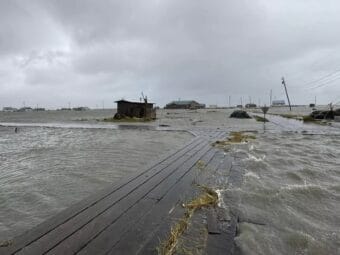
Severe flooding is seen in the coastal community of Kwigillingok on the morning of Sunday, Aug. 18, 2024. (Courtesy Lewis Martin)

A series of large storms have left some Western Alaska communities grappling with flooding and erosion. Some residents report that the flooding is worse than Typhoon Merbok, and that it rivals this year’s historic breakup floods on the Kuskokwim River.

In Tuntutuliak, on the lower Kuskokwim, a community member reported to the National Weather Service that at least two houses had been inundated with water.

In Napakiak, already-rapid erosion marching toward the community’s school has reportedly come within 6 feet of the gym, creating safety concerns for the building. According to Napakiak resident Bethany Hale, water levels began rising rapidly around 1 p.m. on Aug. 18, but appeared to be receding as of that evening.

A drone image shows floodwaters threatening the William Miller Memorial School in Napakiak on Sunday, Aug, 18, 2024. (Courtesy Job Hale)

Upriver in Akiak, community members have reported riverbank erosion of between 10 and 20 feet due to the storm, along with swamped boats and lost fishing nets.

In Bethel, the city government closed the south boat harbor and East Avenue because of flooding. As of the evening of Aug. 18, the Kuskokwim River gauge at Brown’s Slough recorded a level of 9.52 feet, well into the minor flooding stage.

Earlier that afternoon, Bethel Search and Rescue reported water over the roadway at multiple locations along the Bethel riverfront and wind gusts of up to 50 miles per hour.

According to Christian Landry, a meteorologist with the National Weather Service in Anchorage, strong onshore winds have been holding an already swollen Kuskokwim River in place.

“The river wants to pour out and exit into the Bering Sea. It’s having trouble doing that with all of the wave action, and the winds, and all of the new rainfall dropping into the river, so it’s swelling beyond capacity,” Landry said.

The National Weather Service has extended a flood warning for Kuskokwim River communities to include Tuntutuliak and the tundra villages of Kasigluk, Nunapitchuk, and Atmautluak, effective through 6 p.m. on Aug. 19.

A coastal flood advisory for the Kuskokwim Delta was lifted on the evening of Aug. 18. Images posted on social media just hours before showed widespread inundation in Kipnuk and Kwigillingok, where one resident said that the flooding was the worst in more than three decades.

The rain, flooding, and erosion have been caused by the second in a series of storms to hit Southwest Alaska in the past week. The first weather system off the Bering Sea began blasting the region on Aug. 15, tapering off before the weekend.

Earlier this week, a National Weather Service meteorologist said that he believed that the impact of the high winds and surf from the second storm were made more severe by the rare super blue moon that will peak on Aug. 19. According to Landry, meteorologists are still unsure what the impacts will look like for a third storm forecast to hit the region, considered to be the remnants of Typhoon Ampil.

“It appears that this system is going to push mostly to the north of the area. It will bring potentially another round of rain by late [Aug. 20] after noon. However, how potent that wave will be is not entirely certain,” Landry said.

The National Weather Service advises all residents to secure belongings, move items inland when possible, and to be alert and prepared to take action.

Visit the Alaska-Pacific River Forecast Center website for the latest flood advisory updates, or call the 24-hour toll-free Alaska Weather Information Line at 855-937-4977.

Coast Guardsman’s death prompts mental health conversations at Base Kodiak

A U.S. Coast Guard rescue helicopter lands on a runway before it parks near an Air Station Kodiak hangar. (Brian Venua/KMXT)

The death of a Kodiak-based U.S. Coast Guardsman this summer has sparked a new wave of conversations about mental health on the base.

U.S. Coast Guard Air Station Kodiak held a ceremony on July 26 to honor the life and service of a rescue swimmer who died on June 25.

The Coast Guard said the investigation into the service member’s death is ongoing, but no foul play is suspected. It did however renew a push for addressing mental health in the military.

Coast Guard officials declined to say whether the death was a suicide. But a social-media group for Coast Guardsmen described it as one, urging comrades to “find something that keeps you going.”

Cameron Snell, a public affairs specialist for the Coast Guard, said Air Station Kodiak officials have been open about encouraging members to use mental health services.

“The air station had a stand-down to inform everybody working there about what had happened, and they immediately offered grief (and) loss counseling for those service members, also for the service members in the barracks,” he said.

A stand-down means operations were paused for air station staff to meet.

Suicide rates are higher within the military, and in response, mental health programs for service members have been on the rise in recent years. Now that includes pushes from the Coast Guard’s Air Station and Base Kodiak, as well as ships that are homeported on the island too.

Snell said officials have been encouraging people to use CISM, or the Coast Guard’s Critical Incident Stress Management program.

The goal is to serve members who have faced potentially traumatic experiences, like when a peer dies or after stressful search and rescue missions. He said it’s not a perfect system, but those kinds of resources are important.

“Suicide is a troubling statistic in the military,” Snell said. “And we can never completely eliminate that statistic, but we can offer as many resources as we can to prevent that at every step of the way.”

The base also provides other resources to burn stress, like borrowing boats or other outdoor equipment from its Morale, Wellness, and Recreation Department. Snell said the Work/Life Office also provides members services like financial guidance or help finding child care.

Members of the Coast Guard have mandatory mental health screenings as part of their annual health assessments and are encouraged to report their peers if they have any concerns. Snell said commanding officers can also refer members they’re concerned about to counseling.

“(This) incident was a tragedy – one being one too many here – and we hope to be able to make the resources that we have available known,” Snell said.

Mental health emergencies on or off base should be reported by calling 911.

Providence Kodiak Island Medical Center and the Kodiak Area Native Association both offer mental health counseling in town, but waitlists can take months. Providence psychiatrists can be seen much sooner though, and emergency services are always available.

The national suicide and crisis lifeline is available by calling or texting 988. The Veterans Crisis Line is available by dialing 1 during a 988 call or by sending a text message to 838255. Online chats are also available at 988lifeline.org.

The Coast Guard also has plans to promote mental health services in September for National Suicide Prevention Month.

Alaska Public Media’s Chris Klint contributed information to this story.

Kodiak celebrates state ferry Tustumena’s 60 years of service

The Tustumena arrives in Kodiak Wednesday, Aug. 7, 2024 after sailing under the bridge to Near Island. (Brian Venua/KMXT)

Kodiak residents gathered Wednesday to honor the state ferry Tustumena, which began service 60 years ago in 1964 and has become an icon for the Alaska Marine Highway System.

Affectionately known as the “Trusty Tusty,” the boat has been the sole ferry to serve Kodiak Archipelago communities the last few years.

The ferry was a few hours late because of the weather, but still hours ahead of the party planned for her. She has sometimes been called the “Rusty Tusty” when there are delays like this one.

John Mayer captained the ferry as she finally pulled in, greeted by folks waiting for friends and family to arrive. He spent nearly his entire 23-year career with the Alaska Marine Highway System on the Tustumena.

He said his favorite part is getting to meet the people he shuttles between communities.

“I love seeing us bring families into Kodiak and they’ll (be) waving to their family members on the dock and bringing people together,” he said.

Tustumena Captain John Mayer says he never gets tired of the views from the boat, but his favorite part of the ship is his bed, and sometimes the bar. (Brian Venua/KMXT)

He shuttles more than just passengers though. Over the years the Tusty’s brought many cars, vendors for Crab Fest, and even livestock to Kodiak Island.

The Tustumena is an icon in the state ferry fleet. She first arrived in 1964 from a shipyard all the way in Wisconsin. For the last several years she’s been running the Kodiak and Aleutian route and faced some of the toughest weather a boat can.

That wear is starting to show now though – the ship has spent extra time in yards for repairs and her hull has rust and a few cracks on her sides. Sixty years marks about double the amount of time her designers expected her to be in service.

Mayer said that’s why he talked to state Rep. Louise Stutes, R-Kodiak, about throwing the Tusty a 60th anniversary celebration.

“The genesis of this party idea was just over lunch one day, I was speaking with Representative Stutes, I said ‘Yeah, we should have a party,’ and now see what happened!” the captain said.

The Tusty’s horn blared to call the crowd’s attention as state Rep. Louise Stutes, R-Kodiak, began the lineup for speeches. (Brian Venua/KMXT)

Stutes has been a frequent voice of support for the ferry system to the Alaska State Legislature.

For the 60th anniversary, she partnered with several local businesses, nonprofits, and City of Kodiak Police to set up a block party at the ferry dock in town.

“It’s a feel-good for the community,” she said. “It really is a wonderful thing.”

Hundreds of people came for the celebration, with some sporting ferry-themed shirts and hats. People shared stories, learned about the vessel’s history, the Alutiiq Dancers performed, and there were even guided tours of the old boat. There were also free hot dogs and burgers in addition to food trucks nearby.

Kodiak Ferry Terminal Manager Amanda Becker said that although the terminal is visited by other ferries, named after the state’s glaciers, there’s something special between the Tusty and the island town.

“I mean Kennicott comes too and it’s okay,” she said. “But the Tusty is, she’s our old girl and she’s got character, she’s got an incredible crew.”

Becker is also usually the person to announce to Kodiak when the ship has maintenance delays and cancellations.

One of the overarching questions though is: When will the ship be retired?

The Tustumena’s replacement is expected to cost over $315 million, but the state has only set aside about $180 million for it.

The aging ferry has had several renovations like expanding its length and replacing several parts throughout its service. (Brian Venua/KMXT)

Stutes said progress getting funds to replace the Tusty is slow but she’s hoping for the best.

“I’m an optimist – we’re moving forward and in the meantime they’re doing a good job keeping the Tustumena safe for passengers and for operation,” She said.

Mayer said he’s been trying to take care of the Tustumena the best that he can.

“This ship isn’t getting any younger, – and I’m not either,” he said. “Y’know, 20 years ago they would take her out in rougher weather than I’m doing now, but I’m trying to be kind to the ship.”

Ryan Anderson, the commissioner of Alaska’s Department of Transportation, said his team is working to find any way they can to secure more funding from the federal government like through a toll credit program.

“It turns out that the Federal Highway Administration has a program that when you invest in your ship, so all the maintenance, all the overhauls, we use our revenues and we invest in those things, we can get credit for that,” Anderson told KMXT.

State Transportation Commissioner Ryan Anderson shows off his painted piece of the historic ferry’s hull. (Brian Venua/KMXT)

All of that money goes towards the state’s side of matching contributions for federal grants. The department has already started soliciting designs for parts of the replacement ferry like its elevator for cars.

“That elevator that’s on the Tustumena – that’s a very unique thing for a ferry and so we actually have to use that elevator as a model to design the new one,” he said. “So we’ve already got the contracts out for things like the elevator design.”

The Tustumena’s elevator can lift up to about 4,000 pounds at a time and spins to make loading easier. (Brian Venua/KMXT)

He also gave a speech at the party recognizing the importance of Alaska’s ferry system and shared some of the plans for the replacement.

“The new vessel is going to be bigger, it’s going to be longer, it’s going to be wider,” Anderson told the crowd. “It’s going to hold more people, it’s going to hold more cars and it’s going to be more efficient on top of that and the operating costs will be less.”

He said he hopes to have a new boat as soon as 2027.

There were also speeches from other high-profile individuals like Alaska Senate President Gary Stevens, City of Kodiak Mayor Pat Branson, Kodiak Island Borough Mayor Scott Arndt, Homer Mayor Ken Castner, and a poem written by Stutes’ husband, Stormy. U.S. Sen Lisa Murkowski was also slated to make an appearance but had last-minute plans with her family.

Mayer said he hopes to see that new boat and let the “Trusty Tusty” retire soon.

“In the maritime industry, it’s amazingly remarkable yet regrettable that she’s made it to 60 years,” Mayer said. “It behooves us to take a look back and see how much effort and funding and muscle and sweat that went into keeping her going all these years.”

For now though, the Tustumena is scheduled to sail the Kodiak and Aleutian route until it docks in the winter for repairs.

The Tustumena was decorated from the stern all the way to her bow with flags waving in a light breeze. (Brian Venua/KMXT)

All the news that’s fit to reprint: AI and plagiarism drive revamped Tundra Drums website

A screenshot shows the front page of The Tundra Drums website (thetundradrums.com) on July 26, 2024.

For decades, The Tundra Drums newspaper served as a mouthpiece for the issues that mattered most to communities in Western Alaska. Now, a website posing as the former Bethel institution is stealing media content from across the state. But why it’s happening is a mystery.

Earlier this summer, KYUK got a call. Was the shuttered Tundra Drums, once a trusted news source for the Yukon-Kuskokwim Delta, resuming publication?

The caller was referring to thetundradrums.com website, which had been all but defunct for almost a decade. Over the past two months, though, the website has been prolific in its coverage of Alaska issues. One author, Hadiqah Shahid, has managed to stay on top of breaking news from Anchorage and across the state, all while offering up a rich variety of Bethel stories — using copy and imagery taken from KYUK stories posted just days earlier, among other sources. Shahid has also covered stories from Bethel Park, Pennsylvania, Ohio’s Bethel Township, and a Bethel College in Kansas.

A July 18, 2024 Tundra Drums headline and photo (left), alongside a headline and photo from Bethel public radio station KYUK posted three days earlier. The photo, taken by KYUK story author and news director Sage Smiley, is uncredited on the Tundra Drums website. (Screenshot composite)

Kenrick Mock, a computer science professor and founder of the University of Alaska’s Data Science and AI Lab, said that The Tundra Drums website bears the hallmarks of artificial intelligence.

“The website very strongly looks like it was generated by AI. It has a pretty broad range of stories, some of the common keywords, like Bethel, where it’s pulling in other stories about other places that have Bethel in the name,” Mock said. “Just the fact that a website of this scope could be set up in a small town like Bethel is also a little puzzling.”

Frequent contributor Shahid has no author biography or profile photo, and like other names that appear atop stories on The Tundra Drums website, does not appear to be a real person. Nearly all of Shahid’s news stories appear to be rewritten versions of coverage already online, though multiple short public safety stories, like one about a water outage in Bethel, were apparently written based on social media posts alone. Mock said that the content in the stories themselves also contains tell-tale signs of AI writing.

“(There are) lots of bullet points, (and) not going into kind of specific details or quotes. And so if we’re doing a summary, for example, of another story, they look kind of like this,” Mock said.

Online content farms

There are numerous active online content farms reportedly using AI to rewrite news stories from major publications. On the revamped The Tundra Drums website, articles are presented as original content and do not link back to original stories. Multiple stories contain photos republished without permission or attribution, and a line at the bottom of the website reads “All Copyright Reversed.”

However, the website is conspicuously free of ads. This surprises Mock.

“So of course I first thought when I heard about this was, ‘oh they’ve got some ad banner up there so they can make some revenue by people coming to the site,’ but there doesn’t appear to be any of that,” Mock said. “And obviously, it would cost them money to run the site.”

Some of that cost comes with hosting the site, and in mid-July, whatever privately registered entity is paying for the domain renewed their membership for another year.

“They kept that private by registering through a proxy. So it’s not clear who has actually registered this website,” Mock said.

To the undiscerning eye, thetundradrums.com is a legitimate news site – sleek, straightforward, and a one-stop shop for local, state, and world news.

If there were any question of whether the website is really claiming to be the authentic The Tundra Drums, its Facebook page bills it as “Alaska’s trusted news source since 1974,” the year the former Bethel newspaper was founded.

The current owner of The Tundra Drums newspaper, Edgar Blatchford, did not respond to multiple requests for comment regarding the website.

According to an Internet archival tool called the Wayback Machine, The Tundra Drums website has fallen into varying states of disrepair since 2016 when it, alongside the print edition, ceased publishing news.

But on May 10, the new incarnation of the website published what appears to be its first story, a summary of infrastructure projects in Bethel by an author named Rebecca Sean. It features an unattributed photo of an Anchorage intersection snapped by an Anchorage Daily News photographer.

On July 22, another unattributed ADN photo accompanied a story about former Anchorage Mayor Dave Bronson. But this time, The Tundra Drums story also appeared on a massive news aggregator called NewsBreak that does host ads.

NewsBreak pays contributors based on page views, and itself has previously been accused of publishing lifted local news content under fictitious bylines.

Mock, with the AI lab, said that the real endgame of The Tundra Drums website could go beyond simply being listed on profit-driven aggregators like NewsBreak.

“The other thought is it could be basically a test to see what someone can do,” Mock said. “So let’s pick a small place, they’ll mostly go unnoticed, right? But we can try these technologies out, and test them and see what happens, and hone the software for whatever future purpose someone might have.”

As the “About Us” tab on the website explains, “In a world where misinformation is rampant, we believe in the power of responsible journalism to empower individuals and shape society.”

The question of why the namesake of a long-vanished Bethel newspaper has become involved in this mission remains unanswered.

The Tundra Drums did not respond to a request for comment through its website, or through its domain hosting service.

Bristol Bay sees smallest sockeye sizes on record, despite large run

Returning sockeye salmon in a stream near Lake Aleknagik on Sunday, July 21, 2024. (Meg Duff/KDLG)

This year in Bristol Bay, fishing crews have noticed that sockeye salmon were on the small side — an observation confirmed this month by the Alaska Department of Fish and Game.

Fish and Game officials say that at this point in the 2024 season, the sockeye returning to Bristol Bay are on average the smallest they’ve ever seen. This continues a decades-long trend.

So far, the average weight of Bristol Bay sockeye was 4.2 pounds this year. Fish and Game biologist Stacy Vega said that’s the smallest average weight on record.

“Fish are smaller, weigh less than, than they have in the past and against our historical averages,” Vega said.

The exact number could change a bit by the end of the season, but Vega expects it will stay low. That smaller fish size also means a smaller overall catch. By mid-July, Vega said, fishing crews had hauled in almost 130 million pounds of fish. That’s almost 70 million pounds less than this time last year.

Vega said that all kinds of factors go into fish size. The same is true with humans. Age is the most obvious: The tallest toddler is still shorter than the shortest teenager.

But other things also matter: How tall were your parents and grandparents? Did you grow up with enough to eat, or did you experience hunger? And then there are the less obvious things. Over many generations, hotter or colder climates can also impact our body size.

As with humans, so with fish.

“There is nature and nurture to all things that grow,” Vega said.

“Different water temperatures mean not just availability of different food types, they also mean how well you metabolize that food. So temperature, food, wind, currents — there’s so many things that go into how fish grow and how old they get,” she said.

This year, Vega said, the biggest factor for returning sockeye was their age.

“So what we’re seeing here as an overall decrease in weight of fish is a factor of a lot of young fish coming back this year,” she said.

Most of the fish that came back this year are fish that spent one year in the lakes and two years in the ocean. But not all of the fish that came back were the same age. Fish and Game tracks four major age classes. This year, as of July 18, each age group is the smallest they’ve seen, compared to historical data that goes back to the 1970s.

Almost three-quarters of the fish spent one year in the lakes, then two years in the ocean. That age class weighed 3.9 pounds on average. Similar fish that stayed in the ocean an extra year came back heavier, at 5.3 pounds on average.

A smaller group of fish spent an extra year in the lakes before swimming out to the ocean; those fish were just a tenth of a pound heavier than their counterparts, at 4 pounds for fish that stayed in the ocean two years and 5.4 pounds for fish that stayed for three.

For each of those four age classes, Vega said, “We saw the smallest and lightest size of fish we have ever seen in our history. Not by a huge margin — it’s not pounds and pounds — but it definitely is the smallest we’ve ever seen. 2020 was a close second.”

Since 2015, Vega says, more fish have been returning on average. One hypothesis for smaller fish sizes is that when more fish survive early on, there’s less food to go around as they grow. Each fish gets less to eat, and they grow up smaller.

“Ocean conditions, lake conditions, food availability — all that factors into the size of fish and how many return. So it’s all intertwined. But certainly with really big runs we see smaller fish,” Vega said.

And sockeye aren’t just competing with each other. They’re also competing with other species, like pink salmon. Greg Ruggerone, a scientist at the University of Washington, has been testing the hypothesis that pink salmon affect the annual growth of sockeye salmon in the ocean.

Researchers can’t remove all the pinks from the ocean to see what happens to sockeye. But they don’t have to. Because something similar happens naturally: every other year, the number of pink salmon skyrockets.

“Because they have a biennial pattern of abundance: very high abundance and odd numbered years and lower abundance and even numbered years. Sometimes, in some regions, that difference is 25 times more abundant in odd numbered years,” Ruggerone said.

Unlike sockeye, pink salmon stay in the ocean for a set number of years: Odd year and even year populations don’t usually mix. Over the years, one of those populations got big, and one stayed small, so every other year, sockeye have more competitors.

Ruggerone suspected that those competitors might have an impact on sockeye size. With Peter Rand of the Prince William Sound Science Center, Ruggerone analyzed sockeye from the Gulf of Alaska and from Egegik in Bristol Bay for a study in the ICES Journal of Marine Science.

Ruggerone says the data suggest that all of those pinks are indeed having an impact on sockeye size.

“In odd-numbered years when pinks are very abundant, the growth was low. And in even-numbered years, when there were fewer pink salmon, growth during the second and third years at sea was relatively high,” Ruggerone said.

Ruggerone said that pattern is just oneof many factors that made this year’s sockeye smaller. But he said it’s an important factor to keep an eye on, because the number of pink salmon has been growing over time.

Partly, that’s because of hatcheries. But it’s also because wild pinks have been doing really well.

“Going back to the early 1950s, there’s a very strong correlation between pink salmon abundance and the ocean heat index,” Ruggerone said. “Pink salmon are climate change winners.”

Sockeye have also been doing well in terms of the number of fish, despite their shrinking size. But for other salmon species, that abundance of pinks may be a bigger problem. Ruggerone says that complicates traditional management wisdom.

“Fisheries managers, we’re taught to promote abundance in the wild populations, so that there are more fish for fishermen to catch. But here’s a situation where the pink’s are doing extremely well with climate change, and other species are not doing so well,” Ruggerone said.

Now, he says, some people are beginning to question whether maximizing wild pinks for future abundance is still the right approach.

Ruggerone said there will be fewer pinks next year, so sockeye will have less competition for food. Plus, many sockeye that did not come back this year will see another birthday, so Vega said Alaska fishers can also expect more older fish. Both factors may mean larger sockeye next year in Bristol Bay.

Supreme Court’s trawl bycatch case casts a wide net

Fishing boats in the Naknek River. (Jaylon Kosbruk/KDLG)

A recent U.S. Supreme Court decision could have important implications for fisheries in Alaska.

Last month, the Supreme Court overturned a legal principle called Chevron deference. For 40 years, that principle gave federal agencies wide authority to interpret the gray area in laws passed by Congress. Now, more of that authority will go to judges.

The decision came after a legal battle over who should pay for bycatch monitors on trawl boats. The potential effects extend to all federally regulated industries — including fisheries.

Many trawl boats are required to have bycatch observers onboard. And in Alaska, the North Pacific Fisheries Management Council can have trawl boats pay for those observers. That’s the law. It’s spelled out in the Magnuson-Stevens Act, which governs commercial fishing.

But that act is not clear on who should pay for bycatch observers elsewhere. In the Atlantic, a federal agency created a similar funding program and a trawling business sued.

“And so (the National Marine Fisheries Service) used its agency authority to interpret the statute and fill in the gap and say, ‘Well, you know, we’re going to do what we do in the North Pacific region here in the Atlantic region.’ And the court said, ‘Nope, you can’t do that,’” said Anna Crary, an environmental lawyer at the firm Landye Bennett Blumstein LLP in Anchorage. She’s been watching that court case.

That Supreme Court decision, in a case known as Loper Bright, was a reversal. Forty years ago, in an environmental lawsuit called Chevron vs. Natural Resources Defense Council, the Supreme Court established a legal doctrine known as Chevron deference.

That doctrine said that when federal laws are vague, federal agencies should fill in the gaps, and courts should defer to the expertise of those agencies. Crary says that understanding of agency power has become a baseline assumption.

“Administrative law, unbeknownst to many people, really forms the backbone of what we perceive as our everyday life, as modern society. But the extent to which this decision destabilizes that, I think is quite profound,” Crary said.

Now, legal analysts say it will be easier to challenge federal agency decisions — and to win. Crary says that challenges could play out in the agencies that set safety standards for everything from drugs to airplanes. It could also make regulations by the North Pacific Fisheries Management Council or the National Marine Fisheries Service easier to challenge.

Crary is also watching for challenges to decisions by the Federal Subsistence Board, which carries out subsistence fishing rules under ANILCA. And, she thinks the ruling could give a boost to lawsuits that challenge the very existence of that board, since it was created by agency regulation and not by law.

“It’s not just the time, place and manner regulations, but it’s the actual regulations creating the Federal Subsistence Board itself. I think we will probably see a challenge to those regulations that follows the blueprint of what the Supreme Court laid out here in Loper Bright,” Crary said.

Crary says the impact of the loss of Chevron deference will depend on the context, “Chevron was, you could use it as a sword, you could use it as a shield.”

In Alaska, questions about how much power federal agencies have are important for all sorts of projects that could impact salmon habitat. Siobhan McIntire is a lawyer at Trustees for Alaska, whose work includes lawsuits opposing Pebble Mine, which many Bristol Bay fishermen see as a threat to salmon.

“If we’re, for example, in a plaintiff’s posture and holding agencies accountable, the overturning of deference to agencies could be positive for our clients. On the other hand, if we’re in defensive posture, seeking to uphold an agency action, then the opposite could be true,” McIntire said.

McIntire said it’s too soon to say what impact last month’s Supreme Court ruling will have on Pebble Mine or in other lawsuits.

“This decision really cuts both ways, and we can’t project into the future as to what that will look like from here,” McIntire said.

Under the Dunleavy administration, the State of Alaska has been fighting a number of federal agency decisions, including a decision by the Environmental Protection Agency to block Pebble Mine.

Commissioner John Boyle, a Dunleavy appointee, leads the Alaska Department of Natural Resources. He says they are starting to look at what the ruling could mean for a variety of legal challenges.

“We can really look at that in the context of looking at environmental laws that have been passed, the Endangered Species Protection Act, the Clean Water Act, the Clean Air Act, etc. The onus is really now on Congress to be more specific in what they want the agencies to do,” Boyle said.

Boyle said Loper Bright might reinvigorate the state’s effort to limit which streams and lakes are subject to federal wetland protection under the Clean Water Act. That’s the law that the EPA used to block Pebble Mine.

“What may or may not constitute a water of the United States becomes a very big deal again, because it can be the difference between being able to see a successful development project move forward or not. So the state has been very interested to better define and narrowly tailor what constitutes a water of the United States to remove as much federal entanglement as we possibly can,” Boyle said.

The Loper Bright decision will also require judges to decide more highly specific and technical questions. Boyle said maybe that’s a good thing.

“So it will cause uncertainty, there’s no question about it. And I’m sure there’s going to be all kinds of new litigation and all kinds of new case law that’s going to feed into to what extent does a court defer to a federal agency but I don’t think reining in the powers of federal agencies in particular is necessarily a bad thing at this juncture,” Boyle said.

Loper Bright is not the only recent Supreme Court case to limit federal agency power. In 2022, West Virginia v. The Environmental Protection Agency also limited how agencies could interpret laws in a way that echoes the reversal of Chevron deference. Another ruling this summer, Corner Post v. Federal Reserve, makes it possible to challenge federal agency decisions for longer. Both of those rulings may also impact fisheries.

Site notifications
Update notification options
Subscribe to notifications