Southwest

Above the Yukon River, on Native land, Hilcorp is set to drill for oil this summer

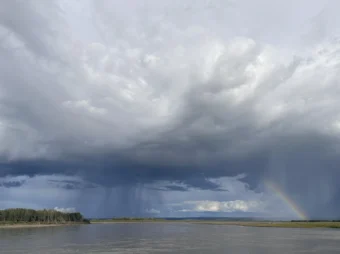
Rain falls along the Yukon River in the Yukon Flats region, where oil company Hilcorp is planning to drill exploration wells this summer. (Bathsheba Demuth)

Later this spring, barges of heavy equipment will pull away from a launch on Alaska’s road system and begin a journey up the Yukon River.

More than 100 miles upstream, a tributary, Birch Creek, branches off.

The equipment’s destination is along that creek, on remote property owned by Alaska Native corporations in a huge basin called the Yukon Flats.

There, an oil company will set up a specially designed rig to drill the basin’s first-ever deep wells, which the landowners hope could lead to the discovery of the state’s next big oil field.

If found, petroleum could create well-paying jobs for Yukon watershed residents and generate big dividend payments for the 20,500 shareholders of Doyon, the for-profit Native corporation for Alaska’s Interior region.

Doyon’s leaders describe the drilling effort as a rare opportunity — one that could deliver a lucrative resource sought from its lands for decades, though never produced.

But the campaign has engendered a broad backlash from tribal governments in the region.

Much of the opposition stems from the track record of the business that will be doing the drilling: Hilcorp, the large, privately held oil company founded by a Texas billionaire, Jeff Hildebrand.

Hilcorp has substantially increased its holdings in Alaska in recent years and now operates the massive Prudhoe Bay field on the state’s North Slope, where it partners with major firms like ExxonMobil and ConocoPhillips.

A Hilcorp drilling rig operates on the shore of Cook Inlet, not far outside Anchorage. The company will use a different rig for its exploratory wells in the Yukon Flats this summer. (Nathaniel Herz/Northern Journal)

But it also has a history of leaks and accidents, prompting fears from Yukon watershed residents about the risks of its new drilling program.

“We’ve seen it so many times, that these big corporations come in and they take and take. They say they’re going to reinvest and it never happens,” said Rhonda Pitka, chief of the tribal government in Beaver, a Yukon River village some 20 miles downstream of the Birch Creek confluence. “What will we end up with at the end of all this?”

Whether the Yukon Flats will support commercial fossil fuel production remains highly uncertain, and likely won’t be known for years. More exploratory drilling will almost certainly be needed to better define a deposit even if Hilcorp finds evidence of petroleum this summer, and the infrastructure to extract and move it to market would require an array of environmental permits.

Even at this early stage, opponents are aggressively fighting the drilling plans. At a meeting last month, Interior Alaska’s consortium of 42 tribal governments, Tanana Chiefs Conference, approved a resolution against oil development by Hilcorp in the Yukon Flats, saying it’s too risky for the “ecologically and culturally significant region.”

But leaders of Birch Creek, the tiny Indigenous community closest to the drilling sites, have endorsed the effort, saying it could produce desperately needed jobs.

Birch Creek’s Native village corporation also owns some of the land where the drilling will take place, and like Doyon, it stands to benefit from a discovery.

“Without the economic activity this exploration project could create, Birch Creek and the other Yukon Flats villages may simply cease to exist, and our way of life will be lost forever,” the community’s tribal government said in a 2020 resolution endorsing the program. Birch Creek’s population is now just 30 people, and its school closed more than two decades ago because it had too few students, according to the state of Alaska.

The support from Birch Creek has given Doyon and Hilcorp the “social license to operate in that area,” Doyon’s chief executive, Aaron Schutt, said in an interview.

If oil is found, Doyon’s agreements with Hilcorp would require the company to hire shareholders and local residents, he added.

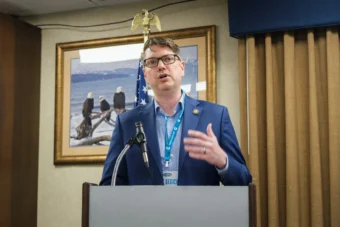
Aaron Schutt, Doyon’s chief executive, stands in his Anchorage office. (Nathaniel Herz/Northern Journal)

Schutt said that Doyon’s early leaders, a half-century ago, chose to claim land in the Yukon Flats specifically because of its potential to yield oil and gas.

“We can’t re-select. We can’t undo those deals that were done by our leaders 50 years ago,” he said. “We’re stuck with the hand we were dealt from 1972 to 1975. And we have to balance all of these various constituencies and opportunities and concerns, and do the best job that we can.”

Birch Creek leaders, through a Doyon official, declined to comment. Hilcorp released its own prepared statement saying it’s “excited to work with Doyon and community stakeholders to advance this meaningful exploration project in the Yukon Flats.”

“Together, we are developing a tailored program to responsibly evaluate the region’s energy and resource potential,” said spokesman Matt Shuckerow.

A geologic enigma

The Yukon Flats basin covers more than 10,000 square miles, bounded by the Brooks Range mountains to the north and the White Mountains to the south. The Yukon River sweeps across from east to west, and the trans-Alaska pipeline snakes over the land from north to south.

The basin began forming at least 60 million years ago, according to Marwan Wartes, a veteran geologist with the Alaska Department of Natural Resources.

It’s still sinking today, making it difficult to study. Often, petroleum-rich regions of the state have experienced uplift, producing rocky outcroppings that give glimpses of their geologic histories — but those clues aren’t present in the flats, Wartes said.

A United States Geological Survey map of the Yukon Flats. (USGS)

Experts suspect that the area contains sedimentary deposits that could produce natural gas, or even oil. But no one has drilled deep wells to confirm those theories, so the flats’ subsurface remains something of a geologic enigma.

“When I look at the whole map of Alaska, it always catches my eye, and I always am frustrated that we know so little about it — because it’s mostly burying itself,” Wartes said. “It is a mystery, and I think most geologists would agree to that.”

Today, the region, home to the Yukon Flats National Wildlife Refuge, is important habitat for as many as 2 million migratory ducks, as well as several species of fish. Its salmon and moose have long sustained the region’s Native people, who now live primarily in seven Indigenous villages within or near the refuge.

For nearly two centuries, the Yukon Flats have also been the source of global commodities — starting in the mid-1800s with furs, and continuing with the 1893 discovery of gold in Birch Creek.

The region has never produced oil; nearly all of Alaska’s petroleum comes from the other side of the Brooks Range, on the North Slope.

But Doyon and oil companies have long eyed the flats for its potential, dating back to the years after the 1971 Alaska Native Claims Settlement Act. That federal legislation terminated Indigenous land claims in the state by transferring some 10% of Alaska’s land to newly formed, Native-owned corporations — which, with certain limitations, could choose the land that they wanted.

Doyon, owned by Alaska Natives with ties to the Interior region, became the state’s largest private landowner.

Working at the time with smaller Indigenous-owned corporations connected to the region’s villages, Schutt said, Doyon selected additional land in the Yukon Flats, hoping that it would yield petroleum. The idea was to capture areas with oil potential while also leaving room for the region’s residents to continue their subsistence-based lifestyles.

A view of the Yukon River near the village of Beaver. (Bathsheba Demuth)

Doyon formalized that strategy, Schutt said, in agreements with five village corporations. A 1974 agreement with Beaver’s Indigenous-owned corporation refers to the “potential for oil and gas” in the area around the village, “the development of which would benefit all of the shareholders of Doyon.”

Pitka, Beaver’s current tribal chief, said that oil was not the driving force behind the village’s participation in the Doyon agreement.

“The village corporations picked land for subsistence,” Pitka said. “People were living on the land.”

In the years after the land deals, major oil companies prospected for oil in the Yukon Flats; Exxon even signed an exploration agreement with Doyon. But Exxon pulled out of the region after its major 1989 oil spill near Valdez.

Studies continued, however.

Doyon contractors have collected hundreds of sediment and soil samples throughout the basin. The corporation has also conducted seismic testing, and it collaborated with federal and state agencies that drilled a research well to a moderate depth in 2004. The United States Geological Survey has estimated that the Yukon Flats contain 173 million barrels of oil, with a smaller chance of as much as 600 million barrels.

“This has been a basin that’s been on everyone’s radar as having potential for a long, long time,” said Wartes.

Hilcorp’s involvement began in 2019, when it signed an exploration agreement with Doyon covering some 2,500 square miles of the Native corporation’s land.

Since then, Hilcorp has flown airborne surveys to gather geologic data, and it’s also drilled more than a dozen shallow test wells. Last year, it narrowed its focus, signing oil and gas leases with Doyon that cover 94 square miles near Birch Creek.

This kind of remote oil and gas exploration work, known as wildcatting, is not Hilcorp’s specialty; the company is better known for buying aging oil fields and making them more productive.

“They must see something that really captivates them, because there’s no shortage of oil on the North Slope,” said Phil Wight, an energy and environmental historian at the University of Alaska Fairbanks.

Even Schutt, the Doyon chief executive, said he’s not sure exactly what’s driving Hilcorp’s interest.

“I actually don’t know the answer to that,” he said. “It’s still kind of a mystery.”

A big upside for Doyon

This summer, Hilcorp plans to drill two exploration wells on separate sites.

The company has not publicly announced its plans, but some details have trickled into public view through documents submitted to the state. Hilcorp’s drilling effort requires an array of permits, among them a contingency plan that includes how the company would respond to a blowout.

The locations of the company’s two planned wells are 10 and 15 miles, respectively, from the Yukon River and the village of Birch Creek, according to the permitting documents. The sites will be supported by a worker camp staffed 24 hours a day.

The area is along a lower branch of Birch Creek and is accessible only by barge, helicopter or skiff, depending on water levels. Schutt said the work will leave a light footprint.

“If there’s no further development, those lands will be indistinguishable from the lands next door in 10 years,” he said.

A stretch of Birch Creek above where Hilcorp’s summer wells are planned. (Craig McCaa/BLM Alaska)

Opponents of the plan have focused their efforts on a pending Hilcorp request to state land managers to pump water from Birch Creek and a nearby lake for its drilling operation.

The company says it will take a maximum of half of one cubic foot per second from the creek, which it describes as 0.05% of its flow. Ten different tribal groups have objected, according to their comment letters released by regulators in response to a Northern Journal public records request.

Allowing Hilcorp’s proposed withdrawal “would degrade water quality and jeopardize the ecological integrity of Birch Creek,” said one comment letter, from the Yukon River Inter-Tribal Watershed Council.

“We, the Indigenous Tribes and First Nations from the headwaters to the mouth of the Yukon River, urge the department to join us and put all of our future generations first,” the letter said.

If Hilcorp finds oil, the discovery would likely be just the start of more intense environmental battles to come.

Given the large cost of building a new oil field, construction would only make financial sense if it contained at least 200 million barrels of oil, according to Doyon’s estimates. Tying a development into the trans-Alaska pipeline would entail crossing federal land and require environmental permits that would face stiff opposition.

But for Doyon, the effort is worthwhile because of its big upside, according to Schutt. The company is already invested in the oil and gas industry; it owns a drilling subsidiary that maintains some of the largest rigs on the North Slope.

A new field in the Yukon Flats could produce a “massive royalty check” each year, much of which would be shared with Alaska’s other Native corporations under federal law, according to Schutt. Doyon’s subsidiaries would be in line for contracts to work on the development, he added, and Yukon Flats villages likely could save money by tapping into newly available natural gas for heating.

“It would economically support the whole subregion and Doyon for generations,” he said. “Those are the types of opportunities that don’t come along very often for us.”

Nathaniel Herz welcomes tips at natherz@gmail.com or (907) 793-0312. This article was originally published in Northern Journal, a newsletter from Herz. Subscribe at this link.

Kodiak family accused of more than 30 fishery violations

Duncan Fields has served on the Kodiak Island Borough School District’s Board of Education for years. (Brian Venua/KMXT)

Alaska Wildlife Troopers are accusing four members of Kodiak’s Fields family as well as their fishing business, Fields & Sons Inc., of allegedly generating $1.17 million in illegal revenue between 2020 and 2024.

That’s according to a dispatch from Alaska State Troopers on Tuesday, April 8.

Duncan Fields, 69; Wallace Fields, 64; Beth Fields, 66 and Leslie Fields, 67 – all of Kodiak – are charged with perjury and lying on fish tickets. Duncan and Wallace Fields are also both charged with multiple counts related to fraud, theft, and other fishery violations.

Duncan Fields serves on multiple boards, including the Alaska Seafood Marketing Institute and the Kodiak Island Borough School District’s Board of Education.

Duncan Fields said in a text message that the family and crew have been gifting permits to each other for 30 years. He said it “is a common practice in the industry,” and added that he thinks his family has “been singled out to try to set an example.”

Fields said that the charges aren’t supported by the facts.

The charges, however, come after a year-long investigation by Wildlife Troopers, according to the dispatch, after they received a tip in March of 2024 about suspicious fishing permit activity. During the investigation, troopers claim to have found the family was falsely gifting salmon setnet permits to crewmembers and later reclaiming them.

Troopers interviewed 21 crewmembers, according to the dispatch, and say there was a coordinated scheme involving family members lying under penalty of perjury as well as defrauding the state and fish buyers.

A new school takes shape in Mertarvik

The new front of the new school in Mertarvik on March 19, 2025. (Glennesha Carl)

Editor’s note: This story is part of “Lessons from Newtok,” which connects youth from Newtok (Niugtaq), Alaska and Provincetown, Mass. through a pen pal exchange exploring the impacts of climate change. Students will document their communities with photography and writing, sharing insights on Indigenous knowledge, science, and local responses. Though Provincetown and Newtok’s new townsite of Mertarvik seem worlds apart, both coastal communities face rising seas, erosion, and environmental change. “Lessons From Newtok” offers a unique perspective on how youth are navigating our changing climate.

This fall season, an essential part of the Newtok relocation project happened. Barges bringing construction materials for the new school arrived at the Mertarvik Project Site.

I watched the barges arrive before ice formed on the river. The arrival of additional school children as the last families moved over to Mertarvik means that a new school must be built. A couple of pickup trucks were pulling a trailer with the school construction materials on them. I watched as they carefully drove from the barge landing to the new school site.

This move was challenging, especially as winter set in and the river is covered with lots of ice regardless of the tide. My family moved from Niugtaq to Mertarvik last fall, and on our last trip we took seven hours to get to Mertarvik from Niugtaq because we were stuck in the ice until the tide moved out.

The new school in Mertarvik is under construction. March 19, 2025. (Rayna Charles)

The Lower Kuskokwim School District (LKSD) has full funding approved by the state for school construction, and now the foundation and basic structure are underway. Students are currently attending school in the Mertarvik Evacuation Center (MEC) while we wait for the new school to be built. The new school is named the Mertarvik Pioneer School and is located by the generator, not too far from the Evacuation Center. It will be a little smaller than the old school at Niugtaq. According to Kim Sweet, LKSD’s director of operations, the new school will hopefully be completed in August 2026. The total cost of new construction for the school is roughly $56 million, but that is not all the school district has to pay for. There is a demolition that has to be paid for as well.

“So part of this project agreement is also the demolition of Newtok. So it’s not just about ‘do I have enough money to build a school, it’s do I have enough money to build a school and demo Newtok?’” Sweet said.

LKSD and the State of Alaska came to an agreement to fund the new school in Mertarvik. The agreement also states that the district has to demolish the old school in Newtok and keep students in school until the new building is ready. The total cost of the project is over $81 million, with $68 million going to new construction and the rest going to demolition and maintenance of the MEC building for educational purposes.

The back of the new school in Mertarvik on March 19, 2025. (Rayna Charles)

The original project agreement between LKSD and the State of Alaska budgeted for a 24,000-square-foot school.

“The original project agreement was much less, like 24,000 square feet, which is barely enough for, I mean, basically it eliminated two classrooms, and then the amount spent was about $55 million,” Sweet said.

After LKSD officials went back to the State of Alaska and said that they needed a bigger school, the district was granted additional funds to build a 31,000-square-foot school.

According to Mertarvik Site Administrator Dawn Lloyd, the building is still in progress with about 30% completed. She said the gym will be three quarters the size of a standard high school basketball court. We are all excited about the gym because basketball is our favorite sport!

5.1 magnitude quake shakes Southwest Alaska

A 5.1 earthquake that struck near Egegik on March 31, 2025 could be felt 190 miles away from its epicenter. (USGS Interactive Map)

A magnitude 5.1 earthquake, Southwest Alaska’s largest temblor in years, shook much of the region on Monday night.

The quake, which struck at about 8 p.m. Monday, was centered about 37 miles east of Egegik. Its shake could be felt up to roughly 190 miles away, according to experts.

Elisabeth Nadin is a geologist and communications manager at the Alaska Earthquake Center.

“The earthquake itself was unusual because of how big it was,” Nadin said. “There hasn’t been an earthquake that big in that area in over a decade.”

The quake occurred at a shallow depth of about seven miles and struck near a fault line. Nadin says it was located between two active volcanic centers but was not directly tied to either. She says the location, depth, and intensity suggest the earthquake was likely caused by normal movement at the fault.

But John Power, a geophysicist with the Alaska Volcano Observatory, says the observatory is still monitoring the region for any volcanic activity.

“It could simply be that this is the normal shifting of the crust of the earth in response to plate tectonics or it could be more associated with volcanic activity,” Power said. “Only time will tell as we get additional data and are able to do additional analysis.”

The region has several volcanic structures and a history of eruptions, including the 1977 eruption of Ukinrek Maars volcano. But Power says most past earthquakes in the area haven’t led to eruptions.

“Naturally we are watching the area now quite closely over the next coming weeks just to see if any additional activity may occur,” Power said. “But right now there is no official warning or cause for additional concern at this time.”

Two aftershocks followed the earthquake with magnitudes of 3.8 and 3.3. Powers says aftershocks are typical for an earthquake of this size.

Powers says individuals reported feeling the shake in Dillingham, Port Heiden, Naknek, and King Salmon.

More information on earthquakes and earthquake preparedness can be found on the Alaska Earthquake Center Website.

Alaska’s draft 20-year ferry plan depends on steady federal funds

The M/V Columbia travels the Inside Passage in October 2023. (Jack Darrell/KRBD)

A draft of the 20-year plan for Alaska’s state ferry system is open for public comment. Officials with the Alaska Department of Transportation are asking residents to weigh in on the plan that will guide the Alaska Marine Highway System through the year 2045.

The long-range plan seeks to increase service to over 30 ports. In recent years, port calls have decreased and coastal communities have repeatedly voiced their concern.

In an online public meeting March 19, AMHS Director Craig Tornga said the system is planning for more reliable service – not increasing it much but bringing it back to pre-pandemic levels.

“We’re really looking at trying to increase the port calls at our current communities and to make sure that we have some reliable service on a regular basis that can be planned,” said Tornga. “And then keeping it as efficient as we can from a cost perspective for the state, so it can be maintainable going forward.”

The state plans to build new hybrid ferries to replace the aging fleet, hire more workers to run them, and improve infrastructure at the ports.

That, plus regular maintenance, will cost about $3 billion. The plan to pay for it includes a combination of state and federal money along with increasing profits from ridership.

In creating the plan, the state hired engineering and research groups to crunch data and gather information from dozens of coastal communities. Economist Katie Berry said the ferry plan anticipates the state to appropriate roughly $120 million a year in operating costs. The 20-year plan also calculates that federal funding remains intact.

“The expectation is that the federal funding sources that have pre-dated the Federal Infrastructure Act will be stable over this time period,” Berry said.

The Infrastructure Law brought in about $700 million in federal funds to the ferry system in the last three years. Meanwhile, Gov. Mike Dunleavy has vetoed millions in state ferry funding that the Alaska Legislature approved.

Efforts for a long-range plan began in 2022 after the Legislature created the Alaska Marine Highway Operations Board to help guide the state’s DOT. The nine-member board is made up of state workers and coastal residents with ferry knowledge.

The public comment period on the long-range plan ends March 30. The operations board will consider the plan in April before it heads to the Legislature. According to state law, the plan will be updated every five years.

Unalaska museum eyes possible drop in revenue as tourists bail amid tense foreign relations

Unalaska’s 2025 cruise ship season is from May till October. (Laura Kraegel/KUCB)

Some international visitors are halting their summer travel to Unalaska as political tensions between countries rise. The Museum of the Aleutians has already received cancellations from international visitors, months before the cruise season begins in May.

Two cruise guests cited “the evolving political situation” between their home countries and the U.S. as reasons for their on-island tour cancellations.

From May to September, many international cruise ships make port calls in Unalaska, allowing visitors to explore the island before they sail off to their next destination.

The Museum of the Aleutians has a gift shop and offers historical tours to those visitors. That can be a significant business for the museum, according to Director Virginia Hatfield.

“The cruise ship season is really important for us,” she said. “Each cruise ship brings in about $5,000 minimum, almost, with admissions and what they purchase. But it depends on the cruise ship.”

Hatfield said the smaller cruise ships generate around $2,000.

“We make $2,000 the whole month of January, right? So having that in one day is amazing,” she said.

Hatfield said many of the cruise ship visitors are foreign tourists. She worries about the organization’s financial survival if there’s a drop in international tourism on the island.

“If they decide that they need to make a point about how the rest of the world is being impacted by American policies and in tariffs, that’s going to be a big impact to our earned revenue,” Hatfield said. “And I don’t know how we’ll make that one up.”

According to the Unalaska Visitors Bureau, the amount of cruises stopping in Unalaska is growing. In 2008, just five cruise ships visited the island. Prior to the COVID-19 pandemic, those numbers had been steadily increasing. This summer, the island expects 19 port calls from cruise ships – 16 of which are international.

But not all local organizations are currently worried about international tourism declining on the island.

Katherine McGlashan, executive director of the Unalaska Visitors Bureau, wrote in an email to KUCB that the tourism trend so far has been positive. She said she’s “feeling confident it will be another good season for UVB.”

Meanwhile, museum staff are waiting to see if cancellations continue to increase as the cruise season approaches.

Site notifications
Update notification options
Subscribe to notifications