Southwest

Kodiak spaceport hosts secretive federal government rocket launch, likely a hypersonic missile test

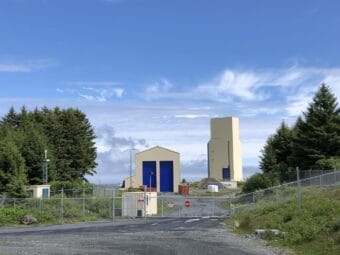
The state-owned Pacific Spaceport Complex is seen on July 13, 2021, in Kodiak. (Photo by James Brooks/Alaska Beacon)

Alaska’s state-owned Pacific Spaceport Complex on Kodiak Island launched a secret U.S. Department of Defense missile last week during what observers believe was a hypersonic weapon being tested by the U.S. military.

The launch, which was not disclosed beforehand, took place about 10 p.m. Thursday night and was observed by people across the Kodiak Archipelago and was visible as far away as Seward.

Hypersonic missiles are those that can travel at least five times the speed of sound.

While long-range ballistic missiles — produced since World War II — frequently exceed that threshold, they cannot typically maneuver to avoid defenses and are locked on a fixed trajectory.

Modern hypersonic missiles, under development by several countries, would be able to avoid anti-missile systems being deployed by the United States, Israel and other countries.

KMXT-FM public radio and the Kodiak Daily Mirror first reported the launch, which was preceded by warnings to navigators and road closures on Kodiak, home to Alaska’s state-owned spaceport.

The spaceport is owned and operated by the Alaska Aerospace Corporation, a state-owned public corporation created in the late 1990s as part of legislative efforts to diversify Alaska’s economy.

Officials issued a written statement the day after saying that “a successful government rocket launch” took place Thursday night and that it was the 35th launch from the Kodiak spaceport since its creation in 1998.

“The residents of Kodiak should be proud of yesterday’s achievement and the significant contribution their community provides to the space legacy of the United States,” the statement said in part.

The corporation did not state the purpose of the launch.

Warning messages issued ahead of the launch are similar to those that observers saw in 2021, when the Department of Defense twice attempted and failed to launch a hypersonic missile from the Kodiak spaceport.

The corporation declined to answer questions asking about the launch on Monday.

John Oberst, president and CEO of the corporation, said by email, “The Alaska Aerospace Corporation considers transparency with Alaskans a priority.  On occasion, there are some launches, like the one last week, that do not permit us this latitude. Thank you for your interest in our business.”

Research scientist Dr. Marco Langebroek, who tracks space launches from his home in the Netherlands, observed that the warnings to navigators match a planned three-stage missile test splashing down near the U.S. military’s rocket site at Kwajalein, Marshall Islands in the central Pacific Ocean.

Four years ago, the U.S. Army published documents indicating that it intended to test a hypersonic missile from Kodiak. The information in those documents matches the warning messages published ahead of last week’s flight.

In 2021, a prior test launch from Kodiak failed due to problems with the booster rocket intended to lift the hypersonic weapon to a high altitude.

Regional airline Ravn Alaska calls it quits

A man stands at a gate in Unalaska's airport looking out at a Ravn plane on the tarmac.
A Ravn Alaska plane at Unalaska’s Tom Madsen Airport. (Photo by Theo Greenly/KUCB)

Regional air carrier Ravn Alaska announced on its website Thursday that it was closing, effective immediately.

A brief note on the site said Ravn was “no longer operating flights in Alaska” and that the company appreciated its years of service.

The Alaska-based airline had struggled since launching in late 2020, laying off staff and eliminating routes.

It first cancelled its route to Dillingham in 2022, less than a year after starting service to Bristol Bay. Just last year, the company laid off 130 employees. Most recently, Ravn announced it would stop serving the Bering Sea island community of St. Paul this fall.

The company’s former CEO, Rob McKinney, left his role last year, and Tom Hsieh — the president of Ravn Alaska’s parent company, FLOAT Alaska LLC — stepped into the top leadership position. Around the same time, the company announced it would cease flights to the Aleutians, including to Unalaska and Sand Point.

Hsieh did not respond to requests for comment Thursday.

Ravn Alaska had previously taken over service to the Aleutians from RavnAir, purchasing its license but operating as a distinct company.

Several regional airlines have stepped in to fill the gaps in rural Alaska communities. Aleutian Airways began serving Dutch Harbor and Sand Point in 2023. Last month, Kenai Aviation was accepted as the Essential Air Service provider to St. Paul, though it recently announced that service would begin about six weeks behind schedule due to aircraft maintenance.

Correction: This story has been updated to correct the years in which Ravn’s layoffs occurred.

Trump’s EPA reaffirms Biden-era Pebble Mine veto

The proposed site of the Pebble Mine.
The proposed site of the Pebble Mine. (Jason Sear/KDLG)

The Environmental Protection Agency is sticking with its veto of the proposed Pebble Mine project in southwest Alaska.

Northern Dynasty, the parent company behind the Pebble project, is still suing to get the veto overturned. A document filed in that lawsuit early this month said the company and the EPA were in settlement talks, and that the Trump administration said it was open to reconsidering the Biden-era veto on the controversial mining project.

But on July 17, attorneys in the case filed another document to update the judge. It says that negotiations between the company and the EPA did not reach a resolution, and that the Trump administration will continue to back the veto.

The proposed site for the copper and gold mine is upriver from Bristol Bay, home to the world’s largest sockeye salmon fishery. The mining project is unpopular in the region, where many people believe the open-pit mine would put the salmon run at risk.

Karla Jensen is an environmental specialist from Pedro Bay. Her village is close to the proposed mining site. She says that after the veto of the project in 2023, many of the mine’s opponents felt relieved but remained wary.

“It reminded me of a cancer,” Jensen said. “Some people were like, ‘We don’t have to worry about that… I don’t have cancer anymore.’ But you always have that nagging in the back of your mind that it can always come back.”

The Pebble Limited Partnership is now asking the court to rule on whether the veto is lawful.

NTSB: Too much cargo and unapproved installation of moose antlers likely caused plane crash that killed Peltola’s husband

Video footage from one of the hunters being ferried by Eugene "Buzzy" Peltola on Sept. 12, 2023 shows Peltola's airplane rolling right immediately after takeoff, before it crashed.
Video footage from one of the hunters being ferried by Eugene “Buzzy” Peltola on Sept. 12, 2023 shows Peltola’s airplane rolling right immediately after takeoff, before it crashed. (National Transportation Safety Board)

Federal investigators say the plane that crashed in September 2023, killing former U.S. Rep. Mary Peltola’s husband, was overloaded with cargo.

That’s according to the National Transportation Safety Board’s final report released Tuesday on the crash near St. Mary’s that resulted in the death of pilot Eugene “Buzzy” Peltola Jr., 57. Peltola was a well-respected Bethel community member who’d previously served as Alaska regional director for the federal Bureau of Indian Affairs. He retired from the position to support his wife’s successful run for Congress.

According to the report, in the days before the accident, Peltola was transporting a group of hunters from Holy Cross to an airstrip near St. Mary’s, where the hunters set up camp. The hunters killed a moose, and Peltola made a series of two flights to transport the meat and other remains back to Holy Cross.

The report says the first flight on Sept. 12, 2023 was uneventful. During the second flight later that day, Peltola’s plane was ferrying about 117 more pounds of cargo than its maximum takeoff weight, or about 6% over. Additionally, Peltola had strapped the moose’s antlers to the plane’s right wing strut. While the report notes that transporting antlers in that manner isn’t unusual, it says the practice requires formal Federal Aviation Administration approval, which officials said had not been done.

The second flight took off at around 8:45 p.m. The report says that as the plane reached the end of the runway, “it pitched up and turned sharply to the right; however, rather than climbing as before, it flew behind the adjacent ridgeline and out of view.”

Hunters headed up and over the ridge, where they saw the plane had crashed. The hunters pulled Peltola from the crash site, according to the report, and one of them issued an SOS from a satellite phone. Though hunters were able to bundle Peltola in a blanket near a heater, he ultimately succumbed to wounds from the crash after about two hours. A National Guard helicopter sent from Joint Base Elmendorf-Richardson in Anchorage arrived about six hours after the crash occurred, at around 1:50 a.m. the following morning.

The report attributed the crash to Peltola operating the plane while it exceeded its maximum weight limit and installing an unapproved external load to the plane which resulted in “a loss of airplane control during takeoff into an area of mechanical turbulence and downdrafts.”

Investigators added that “there was no evidence that any of the meat had shifted in flight, and the antlers remained firmly attached to the wing strut and were not interfering with any of the flight control cables.”

Unrelated to the release of the NTSB report, Peltola’s widow, former Congresswoman Mary Peltola, filed a lawsuit Friday against the owners of the plane her husband was flying. The suit alleges negligence by hunting guide Bruce Werba and two companies under Werba’s control, which caused Gene Peltola’s death.

Tsunami advisory lifted after M7.3 earthquake near Sand Point

boats in harbor at Sand Point
Fishing boats in the harbor near Sand Point. (J. Stephen Conn/Creative Commons)

Update, 3:20 p.m.:

The National Weather Service has lifted a tsunami advisory for communities on the Alaska Peninsula and Kodiak Island after a magnitude 7.3 earthquake struck about 55 miles south of Sand Point. The advisory was lifted at 2:43 p.m. Wednesday.

The Weather Service at first issued a tsunami warning, which was later downgraded to an advisory for the Alaska Peninsula and Kodiak Island, including the cities of Sand Point, Cold Bay and Kodiak, where sirens went off intermittently Wednesday afternoon.

No major waves were reported in any community. In Sand Point, the Weather Service reported a wave just a few inches high.

The earthquake struck at about 12:37 p.m. local time Wednesday at a depth of about 9 miles, according to the Alaska Earthquake Center. The Alaska Earthquake Center reported about 30 aftershocks in the two hours after the quake. The largest aftershock so far had a magnitude of 5.2.

This is a developing story. 

Original story:

The National Weather Service has issued a tsunami warning for communities on the Alaska Peninsula and Kodiak Island after a magnitude 7.3 earthquake struck about 50 miles south of Sand Point. The warning includes the southern end of the Alaska Peninsula, along the coast, and up to both sides of Cook Inlet.

The earthquake struck at about 12:37 p.m. local time Wednesday at a depth of about 12 miles, according to the USGS.

It is not known yet if the earthquake generated significant tsunami waves, but anyone in a tsunami inundation zone should start looking for higher ground.


The June salmon harvest in the southern Alaska Peninsula was the worst in 4 decades

The fishing fleet delivering to Trident in Sand Point in June 2024.
The fishing fleet delivering to Trident in Sand Point in June 2024. (Theo Greenly/KSDP)

Last month’s commercial salmon harvest in the southern Alaska Peninsula was the lowest in four decades, according to the state’s preliminary data for the management region known as Area M.

According to the Alaska Department of Fish and Game, fishermen in the Shumagin Islands and South Unimak areas harvested about 720,000 salmon through the end of June — the second-lowest June on record since the 1980s.

Technically, the lowest harvest occurred in 2001, but Area Management Biologist Matthew Keyse said that year was an outlier due to a price dispute that kept many boats off the water.

“There was almost no fishing, so I would say, with fishing occurring, this is probably the lowest harvest in June,” he said.

Now, additional restrictions are further limiting the July harvest in an effort to conserve king salmon. A section of Area M where roughly 65% of the king harvest takes place was closed this week after the fleet harvested 1,000 fish, the limit for kings in the area.

Sockeye salmon, the primary target species, came in at under half a million fish last month. That’s less than a third of the 10-year average.

One possible factor is that the purse seine fleet has been voluntarily avoiding areas with high chum concentrations to support conservation goals. That’s because of record low chum returns in parts of western Alaska.

“They’ve been doing an excellent job of self-imposing these restrictions, and trying to avoid high, abundant chum areas, curtailing their own fisheries,” Keyse said.

Still, he said those efforts alone don’t fully explain the steep drop. The fleet has followed similar voluntary practices for the past three years, and the June harvest has never been this low.

On the other side of the peninsula, Bristol Bay is seeing a strong run that’s right on par with preseason forecasts. That contrast has Keyse scratching his head.

“Unfortunately, my fish crystal ball is pretty fuzzy,” Keyse said.

Fisheries on the southern peninsula include salmon stocks from multiple regions, so Keyse said it’s difficult to pinpoint a single cause. Factors like ocean conditions, migratory routes and stock origin could all play a role.

July numbers, so far, are looking much stronger, but Keyse said it’s still very early and didn’t make any predictions.

Site notifications
Update notification options
Subscribe to notifications