Alaska Native Arts & Culture

Lingít Word of the Week: Shaa — Mountain

Mount Jumbo, also known as Mount Bradley, from the trail. (Photo by Adelyn Baxter/KTOO)

This is Lingít Word of the Week. Each week, we feature a Lingít word voiced by master speakers. Lingít has been spoken throughout present-day Southeast Alaska and parts of Canada for over 10,000 years.

Gunalchéesh to X̱’unei Lance Twitchell, Goldbelt Heritage Foundation and the University of Alaska Southeast for sharing the recorded audio for this series.

This week’s word is shaa, or mountain. Listen to the audio below to learn how to say shaa.

The following transcript is meant to help illustrate the words and sentences. 

Keihéenák’w John Martin: Shaa. 

That means mountain.

Here are some sentences:

Keihéenák’w John Martin: Ḵúnáx̱ átx̱ sitee yá Lingít yá óoxjaa noowx̱ sitee yá shaa.

Itʼs really something, for the Lingít, the mountains are a wind fortress.

Keiyishí Bessie Cooley: Shaa kaadé na.átch dzískw, tlákw táakw.

The moose always walk up the mountains every winter.

Kooshdáakʼu Bill Fawcett: Shaayadaadé gax̱too.aat.

Letʼs go up around the upper part of the mountain.

Ḵaakal.áat Florence Marks Sheakley: Lingít aaní shayadihéin shaa.

There are many mountains on Lingít land.

Kaxwaan Éesh George Davis: Dleit a shakée daak wusitán wé shaa.

It snowed on top of the mountain.

You can hear each installment of Lingít Word of the Week on the radio throughout the week. 

Additional language resources:

Find biographies for the master speakers included in this lesson here.

Learn more about why we use Lingít instead of Tlingit here.

Watch a video introducing Lingít sounds here.

The Juneau School District will pay for more of local Lingít language immersion program

Ayuq Blanchett and Josaia Lehauli receive awards from the Tlingit Culture Language and Literacy program at Harborview Elementary School on Monday, Feb. 6, 2023. (Photo by Clarise Larson/KTOO)

After multiple meetings and extended debate, the school board has agreed to fund more of a Lingít language immersion program in the upcoming school year – even amid statewide school budgeting concerns. 

The program in question is Át Koowaháa: Expanding the Tlingit Culture, Language, and Literacy Program — or TCLL. The school district and the nonprofit arm of a regional Native corporation have historically roughly split the cost. 

The school board signed a memorandum of agreement Wednesday with Sealaska Heritage Institute to increase its investment in the TCLL.

But school board members brought up questions about whether the district should pay for more of the TCLL program amidst widespread concerns about funding. 

Board member Elizabeth Siddon said the school board supports TCLL, but it has to balance that with the needs of the entire district. 

“But we support it amongst how we support all of our 4,000 students,” she said. “So I’m trying to keep in mind that these 119 are not the only students we’re responsible for.”

The school board initially approved the change during its budget process. They were then under the impression that the grant SHI used for the program was ending, according to the school board president. But SHI was later approved for an extension of the grant. 

The program isn’t growing, but now JSD will fund eight of its 11 positions. The change requires an additional $233,802 from the school district’s budget. 

SHI Education Director Kristy Ford said the program is intended to increase the number of Lingít language speakers. 

“We have less than 10 fluent speakers left,” she said. “So the need and the urgency to put an intensive amount of support and instruction into the TCLL program was asked of us.”

Some school board members raised the concern that the program only serves a small percentage of Juneau students, but Ford said the scope is intentional. It is intense and immersive so that there is a group of dedicated speakers to make sure the Lingít language doesn’t go extinct.

Correction: This story has been updated to include a more accurate cost estimate for the two teaching positions. 

Lingít Word of the Week: Geesh — Bull Kelp

Photo courtesy of Matt Kern and Lia Heifetz
Matt Kern harvests wild bull kelp for salsa that he and his partner, Lisa Heifetz, sell. (Photo courtesy of Matt Kern and Lia Heifetz)

This is Lingít Word of the Week. Each week, we feature a Lingít word voiced by master speakers. Lingít has been spoken throughout present-day Southeast Alaska and parts of Canada for over 10,000 years.

Gunalchéesh to X̱’unei Lance Twitchell, Goldbelt Heritage Foundation and the University of Alaska Southeast for sharing the recorded audio for this series.

This week’s word is geesh, or bull kelp. Listen to the audio below to learn how to say geesh.

The following transcript is meant to help illustrate the words and sentences. 

Ḵaakal.áat Florence Marks Sheakley: Geesh. 

That means bull kelp.

Here are some sentences:

Ḵaakal.áat Florence Marks Sheakley: Yakʼéi áyá geesh wán daak adustʼéix̱i.

It is good to go out fishing at the edge of the bull kelp.

Keihéenák’w John Martin: Yá yéil sh kalneegí áyá geesh daax̱ woogoodí yéil.

There is a Raven story where Raven went around the bull kelp. 

Keiyishí Bessie Cooley: Éilʼ héen yíkx̱ yaa kana.éin wé geesh.

Kelp is growing in the ocean.

Kooshdáakʼu Bill Fawcett: Dliwkát latín wé geesh líl a káx̱ eeḵooxúḵ!

Watch that bull kelp; donʼt go over it! 

Kaxwaan Éesh George Davis: Héen x̱ʼakee yoo liháshk geesh.

The bull kelp floats on the water.

You can hear each installment of Lingít Word of the Week on the radio throughout the week. 

Additional language resources:

Find biographies for the master speakers included in this lesson here.

Learn more about why we use Lingít instead of Tlingit here.

Watch a video introducing Lingít sounds here.

Alaska flag designer Benny Benson granted honorary doctorate

Daren Herman, grandson of Alaska flag designer Benny Benson, was in the state for the first time to accept an honorary degree on his late grandfather’s behalf. (Photo by Adelyn Baxter/KTOO)

A special visitor touched down at Ted Stevens Anchorage International Airport on April 24. Daren Herman, grandson of Alaska flag designer Benny Benson, was in the state for the first time to accept an honorary degree on his late grandfather’s behalf. It had been almost a century since Benson’s unlikely win in a flag design contest for Alaska schoolchildren.

Herman descended the airport lobby escalator to a crowd cheering, singing the Alaska Flag Song, waving the iconic blue and gold starred banner, and performing traditional Unangax̂ dances. He knew there would be a reception, but not how big it would be.

Livingston showed Herman around Anchorage, bringing him to local landmarks, including those named after Benson. (Photo courtesy of Mike Livingston)

“I can’t even put words to it. I would have never dreamt anything like this,” he said. “This is just awesome, it’s crazy.”

Herman is from North Dakota, but has deep family roots in Alaska. His grandfather was the boy who overcame unlikely odds and prejudice to become the first and only known Native person to design an American state flag. Benson died in 1972 at age 59, and received an honorary doctorate in humane letters from Alaska Pacific University on April 26.

Mike Livingston, a regional historian whose work centers on overlooked Alaska Native stories in the Aleutians and beyond, served as Herman’s guide. He showed Herman around Anchorage, bringing him to local landmarks, including those named after Benson.

Livingston is a fixture of cultural justice efforts in the region he calls home. He played a part in recognizing the World War II service of Unangax̂ soldier Pfc. George Fox, and in bringing traditional Unangax̂ names back to Aleutian sites with offensive monikers like “Nip Hill” and “Nazi Creek.” He was also part of a team recognized by the Alaska press corps last month for shedding light on the state’s Missing and Murdered Indigenous People.

“It brings me a lot of satisfaction to recognize our heroes who have, in a real sense, been forgotten,” Livingston told KUCB.

Livingston said Benson receiving an honorary doctorate is “pretty dang cool.”
(Photo courtesy of Mike Livingston)

He spent years researching Benson’s life and heritage, and was the lead author of a 2022 paper that sought to correct a misconception that Benson was Alutiiq or Sugpiaq, not Unangax̂. Livingston pushed to have Benson posthumously enrolled as a member of the Qawalangin Tribe of Unalaska, which was approved the same day Benson’s grandson landed in Alaska.

Livingston said Benson receiving an honorary doctorate is “pretty dang cool.”

“He really should have received it when he was still with us, but it’s never too late to correct wrongs,” he said.

Benson grew up in the Jesse Lee Home for Children, a boarding school in Unalaska that later moved to Seward. He experienced firsthand discrimination during the flag design contest when a panel of judges, some of whom were members of the Seward press, wrote offensive things about him based on his ethnicity. This lit a spark in him, and in the 1960s, he successfully advocated for his inclusion in the Kodiak Elks Lodge, opening the door for other Alaska Natives to join the Elks.

Livingston called Benson “a positive role model.”

“He was a brave young man who stayed in the contest and won the contest,” he said. “If it hadn’t been for Benny, we probably would have another boring state flag with a blue background and the state seal in the middle of it.”

At the commencement, around 120 graduates were recognized, including Benson.

Alaska Pacific University President Janelle Vanasse credited his contributions to the state.

“Today, we Alaskans are proud of our flag. Our state song echoes the words that young Benny submitted with his very design,” she said. “We have our flag because of Benny’s resolve.”

The room was packed with family and friends of the graduates, many of whom are Alaska Native. Herman walked onstage and accepted his grandfather’s doctorate to applause.

After the ceremony, Herman said as busy as it was, his first visit to Alaska was “awesome” and a learning experience.

“A lot of this stuff’s new to me, and it’s great to hear the story and be a part of it,” he said.

KTOO’s Adelyn Baxter contributed reporting.

‘Our next step toward sovereignty’: Haines tribe launches tourism brand

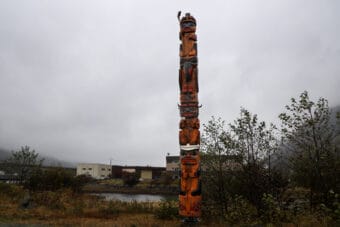
A crowd watches the unveiling of a Chilkoot totem pole during the “Discover Deishú” launch event. (Avery Ellfeldt/KHNS)

On a recent Friday night, people streamed into a wood-paneled building on a dock overlooking the Lynn Canal. A local performance group, the Chilkat Dancers, performed a Tlingit song and dance while the crowd looked on.

The space sat empty for years. But now the building is at the center of the Chilkoot Indian Association’s new effort to launch a tourism brand to bring in extra dollars – and to reduce their reliance on the federal government.

“It has taken us 10 years. But I would like to say thank you. Thank you everyone for being here to support us in our next step toward sovereignty,” Harriet Brouillette, the tribal administrator, said during the event marking the effort’s launch.

The tribe has dubbed the business venture, “Discover Deishú.”

Deishú, the traditional name of the Haines townsite, has a dual meaning: the beginning of the trail and the end of the trail. It’s a nod to the trade routes that Alaska Natives have used for millennia to transport goods – including hooligan oil – between the coast and the interior.

James G̱ooch Éesh Hart,  president of the Chilkoot Indian Association, pictured above on May 20, 2025. (Avery Ellfeldt/KHNS)

James G̱ooch Éesh Hart is the tribal council president. In an interview, he called Discover Deishú a “beacon of hope” that has been in the works for years.

“I feel like we have this opportunity to really grow and create something of our own,” Hart said.

The initiative is made up of several businesses. First there’s the dock itself. It’s been used as a port by a private ferry for the last several years, and more recently by small cruise ships. There’s also an outdoor tour business and gear and apparel store, which the tribe started operating this year.

But the restaurant, named “Taste of Deishú,” is the centerpiece. It’s a two-story building with big windows that look out over the fjord and Chilkoot mountains. Upstairs, there’s a seating area with tables decorated with Tlingit art.

The restaurant is downstairs. Its menu will feature locally sourced ingredients and traditional foods. During the opening night reception, guests queued up to order. Halibut and black cod chowder were on the menu. Drinks included locally made beverages such as spruce tip soda and chaga root beer.

The plan, Hart said, is to take a similar approach to the entire initiative.

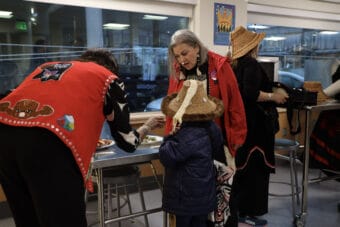
Haines residents line up to order at the Chilkoot Indian Association’s new restaurant, Taste of Deishú. (Avery Ellfeldt/KHNS)

“My hope and my goal is that we Indigenize it into a way that it seems relevant for us, and we’re able to share our way of thinking and way of doing things,” he said.

The restaurant is part of a larger effort that aligned with the Chilkoot Indian Association’s desire to rely less heavily on the federal government.

Hart said that’s especially the case given the Trump administration’s efforts to drastically downsize the government, including by making cuts to funding for tribes and Native organizations.

“Here we are in a place and a time where we can start steering our ship and work towards giving ourselves opportunities to live the way we would like to, on our traditional homelands, and not have to rely on grants,” he said.

The restaurant’s official opening date is still uncertain, but Hart said tourists and locals should be able to eat there soon. The dock, for its part, has already hosted multiple smaller cruise ships this season.

ANSEP cancels summer acceleration academy after loss of federal grant

ANSEP's building on the University of Alaska Anchorage campus.
ANSEP’s building on the University of Alaska Anchorage campus. (Wesley Early/Alaska Public Media)

The loss of a federal grant has forced the University of Alaska’s ANSEP program to cancel its long-running summer academy, less than two weeks before rural students were scheduled to arrive.

ANSEP, the Alaska Native Science and Engineering Program, operates the yearly Summer Acceleration Academy, allowing high school students in rural communities to come to Anchorage for a five-week program in various STEM courses.

Michele Yatchmeneff, chief operating officer for ANSEP, said many of these students don’t get a chance to take similar courses in their local schools.

“So what we do is offer the course here at the university, so that they can get dual credit,” Yatchmeneff said. “So they can get credit for graduation from high school and then also graduation towards a degree.”

Yatchmeneff said ANSEP officials were informed last week that the federal government had terminated their $2.5 million grant from the National Science Foundation, forcing the last-minute cancellation of the Summer Acceleration Academy. The program was set to begin May 24 and serve 47 students.

“The National Science Foundation right now has been told that they’re getting a 50% cut,” Yatchmeneff said. “They’re mainly supporting a lot of research; I also have had research projects with them. So nationally, this has become an issue, and ANSEP is part of that.”

Yatchmeneff said she’s hopeful the program will return next year, and she doesn’t anticipate any further cuts.

“Right now, we still have federal funding coming in from example, like the National Park Service and a few others, and we don’t foresee any more cuts,” Yatchmeneff said.

Other summer ANSEP programs, including the Summer Bridge internship program and middle school academies, were not impacted by the funding cut.

This is not the only recent impact to the ANSEP program from changes at the federal level. The program recently removed the term “Alaska Native” from many parts of its website, citing compliance with federal guidelines on DEI-related language related to race. The change sparked widespread pushback. In the United States, Native American and Alaska Native tribal members are legally considered a political class, as opposed to just a racial group.

Correction: This story has been corrected to reflect that ANSEP is still referred to as the Alaska Native Science and Engineering Program, despite the removal of “Alaska Native” from different parts of its website.

Site notifications
Update notification options
Subscribe to notifications