Inside the clan house in the Walter Soboleff building, Sukteeneidí clan members stood in front of a large poster depicting a totem pole that represents their clan story. They offered thanks to other clans, carvers, and SHI leadership.
In a ceremony held on Indigenous People’s Day, the latest pole in Sealaska Heritage Institute’s Kootéeyaa Deiyí — totem pole trail — was dedicated.
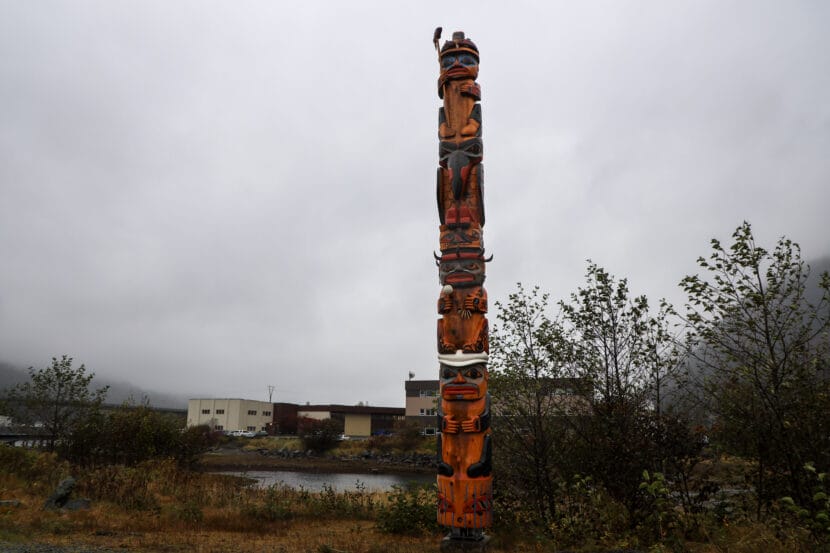
The pole is called a kooteeyaa in Lingít and was funded by the National Parks Service. It was raised near Juneau’s Overstreet Park, but organizers held the dedication inside due to weather.
Edward Thomas is Sukteeneidí and he said he’s excited to see his clan join the handful of others already represented by the Kootéeyaa Deiyí.
“As I look at the walk of the totem pole along the waterfront here, I’m proud to see that all of our clans are being represented,” he said.
Thomas went on to thank the carver, Lee Wallace, and his apprentices for the thought and work they put into the pole.
Wallace is a Haida master carver and lives in Saxman, but he said this kootéeyaa is a part of his family’s legacy, too.
“My great grandfather has a totem pole in the state building, Dwight Wallace. My grandfather, John Wallace, has a totem pole that was outside the city museum,” he said. “So now, with this particular kootéeyaa pole, there’s three generations of Wallace totem poles standing here in Juneau.”
Wallace was helped by apprentices, including his son Charles Peele.
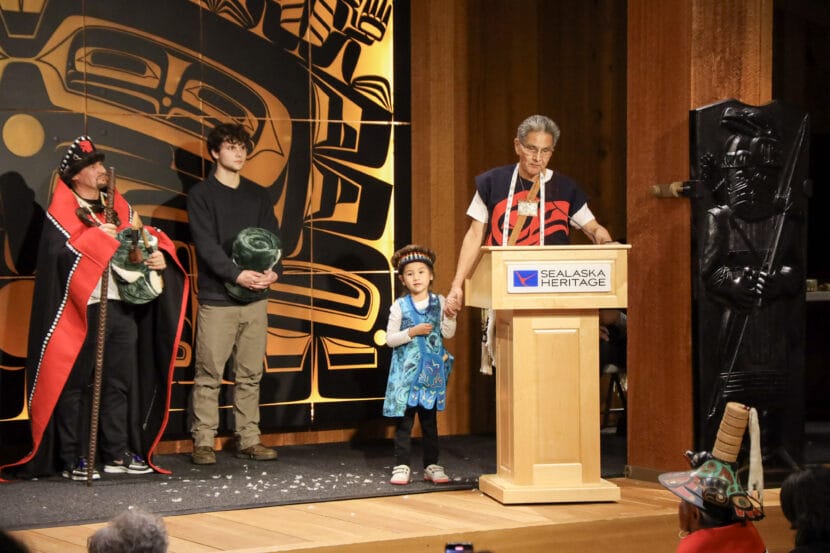
And Peele held the youngest member of the carving team — his five-year-old daughter Jáadsangaa Elizabeth — as he described the design of the pole.
“And at the top, we have the current clan leaders. We want to acknowledge that this is representation of a living people,” he said. “That this isn’t just something that’s from the past, this is something that’s tying history together. We often look at totem poles as things that are coming back from the past. And we wanted to add a piece that represents the present.”
Below the current clan leaders, the pole features a spirit man, Raven, and a box that represents the abundance of knowledge and history held in the Sukteeneidí clan, whose homelands are near Kake.
At the base is the clan crest — dog salmon swimming in tall grasses.
SHI plans to raise a total of 30 poles along Juneau’s waterfront. So far, 13 poles have been installed.