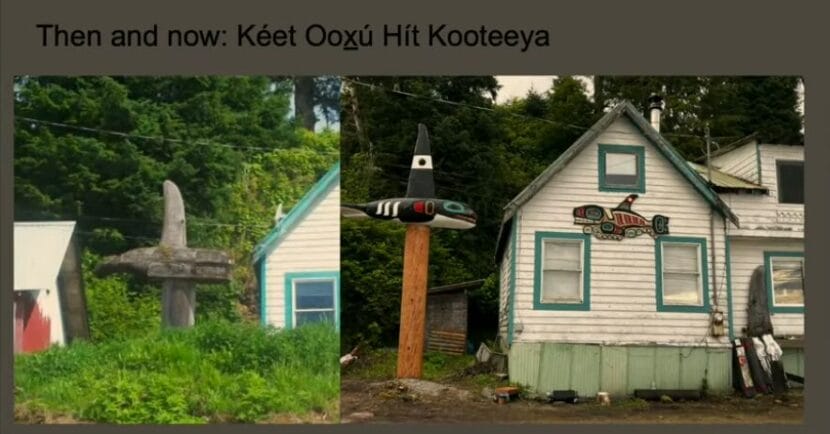
Addressing an audience in the clan house inside the Walter Soboleff building in Juneau, Shgendootaan George laid out the history of three killer whale totem poles that have stood next to her clan house in Angoon. The latest was raised in August.
The lecture was part of a Sealaska Heritage Institute series celebrating Native American Heritage Month.
For George, the history of the Killer Whale Tooth clan house and its kootéeyaa — or totem poles — are intertwined with her own personal history. She was nine years old when they raised a second pole commemorating the 100th anniversary of when the U.S. Navy attacked the village of Angoon.
“This picture is going to make me cry. This is my dad on top of the forklift helping place the killer whale as it goes on to the post,” George said, referencing a slideshow she presented during the lecture. “And this is me and my mom looking out the window.”
The 1882 bombardment destroyed the village, its clan houses, canoes and food supplies – just before winter set in. Six children died.
The memorial kootéeyaa depicted a black and white killer whale sitting on a tall stand. Master Carver Wayne Price carved it at Angoon High School. It replaced a similar pole that stood next to the house and was laid down before George was born.
“Then that’s where I spent the rest of my life after that,” she said. “Growing up with this totem pole next to our house.”
It aged too. She showed a photo of the same pole, with all of its paint worn away.
“And this is where, you know, it kind of ended up weathered and worn and moss growing on it,” George said.
When kootéeyaa begin to disintegrate, that is considered part of their life cycle, and they are taken down and laid to rest.
That also happened to the second pole in 2010. George led that process. The pole was laid to rest like a clan member: it was cremated.
Over the last decade, George also reconstructed the clan house that she grew up in and continues to live in each summer with her family.
And earlier this year, the newest killer whale kootéeyaa, carved by Joe Zuboff, was raised with the help of the people — and their descendants — who participated in the raising and lowering of its predecessor.
“One of the things that is really important to me in the raising of this most recent poll is to really be really thoughtful in thinking about continuity and really connecting with the past and bringing that forward into the future,” she said.
And now that the kootéeyaa is standing, and the house is restored, George has time to reflect on her experience.
“That was probably the biggest thing that I will ever be directly a part of in my life,” she said.
SHI President Rosita Worl attended the lecture, and applauded George and her community for the legacy they have carried forward.
“Look at the knowledge that you have, look at the practices that you can do,” Worl said. “It just warms my heart to see that Angoon has been the center and the stronghold of our culture.”
Last fall, the U.S. Navy issued a formal apology for the bombardment of Angoon, after clan leaders and Worl herself spent decades asking for one.