This is Tongass Voices, a series from KTOO sharing weekly perspectives from the homelands of the Áak’w Kwáan and beyond.
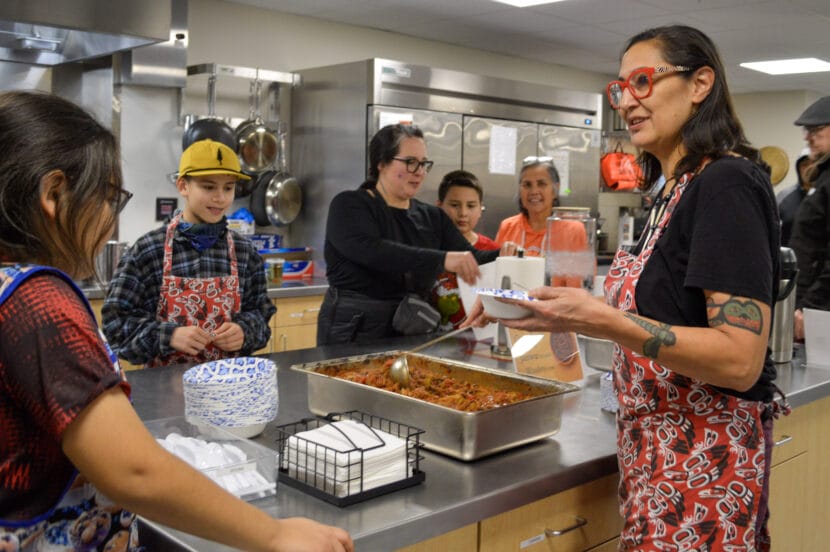
S’eitlin Jamiann Hasselquist has been hosting weekly community soup nights this month in the Traditional Foods and Medicine Kitchen inside Sealaska Heritage Institute’s new Indigenous Science Building in Downtown Juneau.
She and her team use traditional Lingít foods to make soup for anyone who wants to try some — and maybe bring home the recipe to make themselves.
Last week, the group prepared chili with beef, deer and mountain goat meat. The last soup night is Wednesday from 6 to 7 p.m.
Listen:
The following transcript has been lightly edited for clarity.
S’eiltin Jamiann Hasselquist: Can you hear it sizzling? We have so many good things in here. We have g̱uwakaan, deer; jánwu, mountain goat and wasóos, cow.
And then cow, you know, wasóos. Most of us know cow. But we don’t know that it’s called wasóos in Lingít, and so to share that part is kind of fun.
Lingít x̱’éináxS’eiltin yoo x̱at duwasáakw. Yéilx̱ x̱at sitee. Deisheetaan áyá x̱at. Yéil S’aag̱i Hít dáx̱. My people come from Angoon and the Raven’s bones house and my Lingít name is S’eitlin. Most people know me by Jamiann.
I think it’s a really beautiful way to bring community together, especially in a time of need, when SNAP benefits have been delayed or whatever it is, it’s putting our families and members of our community into very stressful positions where they’re having to make choices between food and whatever else is important.
And so being able to provide a night where we can gather together and share a meal and just enjoy each other’s company and show each other like we’re not alone, that we’re here to support each other. I think that’s really important.
There was a child who was in here, I think last week. They had never tried deer meat before, so it was their first time. They were probably 10 years old, and others. I never tried mountain goat before. You know, I’ve been cooking with it now. It cooks a lot like deer, and it tastes pretty similar to deer, but a little bit different.
And then cow, you know, wasóos. Most of us know cow. But we don’t know that it’s called wasóos in Lingít, and so to share that part is kind of fun.
I think it’s really nice to be able to share these out with people in the community, because it should be a part of our regular diet, and because of, you know, harms that have happened, distances between relations of the Earth and us as people, and what we ate in our diets, what we use for plant medicines, there’s been a huge disruption in that.
And so to be able to bring it into a dish like chili, to share it with everyone and have them try it, I hear things like, “Oh, I remember tasting this when I was a kid,” or “I’ve never had this in my entire life.” So there’s a wide range of emotions that go along with feeding this traditional food to our people.
That animal, they had a life going on, and they give that life to be here. And so um I will thank it for its life and its spirit still being with us through this process, and tell it the healing that it’s bringing to the people.
That some people have never tried you before. They don’t know the taste. Some people, it’s going to transport them back to when they were children, 30 years ago. Maybe, you know, some people think that they never were going to try this again.
It makes me emotional when I’m talking to them, but I also feel it’s very appropriate, and it’s something that has to be done to be able to respect the spirit of whatever that is that’s here, to help us learn, to help us return, to re-remember.